
Ezekiel as depicted by Michelangelo on the Sistene Chapel ceiling
Ezekiel 1: 1-3 Meeting Ezekiel the Prophet
1 In the thirtieth year, in the fourth month, on the fifth day of the month, as I was among the exiles by the river Chebar, the heavens were opened, and I saw visions of God. 2 On the fifth day of the month (it was the fifth year of the exile of King Jehoiachin), 3 the word of the LORD came to the priest Ezekiel son of Buzi, in the land of the Chaldeans by the river Chebar; and the hand of the LORD was on him there.
The book of Ezekiel begins with fixing the beginning of Ezekiel’s ministry as a prophet on the thirtieth year, the fourth month, and the fifth day of the month in modern day Iraq between the Tigris and the Euphrates. Yet, even for all this specificity one initial question is what is the designation of the thirtieth year marking from? There are two primary conjectures that scholars have made: the first is that it is thirty years after the high priest Hilkiah rediscovered the book of the law in the temple and presented it to King Josiah initiating Josiah’s attempt to reform the practice of the people of Jerusalem and Judah. (2 Kings 22-23) More likely is the explanation which goes back to Origen (185-253 CE) that the thirty years designates the thirtieth year of life for the prophet. (Block, 1997, p. 83) Although there is no way to be certain about the marker the thirty years counts forward from, the thirtieth year of life for a person from a priestly family would indicate the time they would begin to serve in the temple:
from thirty years old up to fifty years old, all who qualify to do work relating to the tent of meeting. (Numbers 4:3, this is for the Kohathites but the same provisions relate to the Gershonites and the Merarites (divisions within the Levite families with different tasks in the tent of meeting) see verses 23 and 30)
Ezekiel’s twenty-two-year ministry would roughly cover the ages from thirty to fifty years old of service for a person in the temple if the thirty years is counting Ezekiel’s age. In exile, Ezekiel who has lost the ability to serve in the temple is now granted an equivalent or perhaps higher (if more challenging) calling to be a prophet to the LORD.
The secondary time marker, the fifth year of the exile of King Jehoiachin, fixes the date. King Jehoiachin is exiled in 597 BCE along with princes, military leaders, skilled craftsmen, royal officials, and the elite members of Jerusalem. This first exile leaves much of the population behind and creates two centers for the Jewish people: the exiles in Babylon and the remnant in Judah. When Ezekiel sits beside the river Chebar it calls to mind the psalmist mourning the exile: By the rivers of Babylon—there we sat down and there we wept when we remembered Zion. (Psalm 137:1) Though Psalm 137 may reflect the second exile where the temple and city are destroyed, Ezekiel surely mourns like the psalmist as they attempt to navigate their exile away from their home and the temple. The river of Chebar is in the vicinity of Nippur, a city destroyed by Nebuchadrezzar’s father Nabopolassar and resettled with deportees from across the empire. (Block, 1997, p. 84) Into this place of displaced and mourning people the son of the priest Buzi experience the hand of the LORD upon him as he encounters God’s presence in this foreign land.
Ezekiel 1: 4-28 The Chariot of God
4 As I looked, a stormy wind came out of the north: a great cloud with brightness around it and fire flashing forth continually, and in the middle of the fire, something like gleaming amber. 5 In the middle of it was something like four living creatures. This was their appearance: they were of human form. 6 Each had four faces, and each of them had four wings. 7 Their legs were straight, and the soles of their feet were like the sole of a calf’s foot; and they sparkled like burnished bronze. 8 Under their wings on their four sides they had human hands. And the four had their faces and their wings thus: 9 their wings touched one another; each of them moved straight ahead, without turning as they moved. 10 As for the appearance of their faces: the four had the face of a human being, the face of a lion on the right side, the face of an ox on the left side, and the face of an eagle; 11 such were their faces. Their wings were spread out above; each creature had two wings, each of which touched the wing of another, while two covered their bodies. 12 Each moved straight ahead; wherever the spirit would go, they went, without turning as they went. 13 In the middle of the living creatures there was something that looked like burning coals of fire, like torches moving to and fro among the living creatures; the fire was bright, and lightning issued from the fire. 14 The living creatures darted to and fro, like a flash of lightning.
15 As I looked at the living creatures, I saw a wheel on the earth beside the living creatures, one for each of the four of them. 16 As for the appearance of the wheels and their construction: their appearance was like the gleaming of beryl; and the four had the same form, their construction being something like a wheel within a wheel. 17 When they moved, they moved in any of the four directions without veering as they moved. 18 Their rims were tall and awesome, for the rims of all four were full of eyes all around. 19 When the living creatures moved, the wheels moved beside them; and when the living creatures rose from the earth, the wheels rose. 20 Wherever the spirit would go, they went, and the wheels rose along with them; for the spirit of the living creatures was in the wheels. 21 When they moved, the others moved; when they stopped, the others stopped; and when they rose from the earth, the wheels rose along with them; for the spirit of the living creatures was in the wheels.
22 Over the heads of the living creatures there was something like a dome, shining like crystal, spread out above their heads. 23 Under the dome their wings were stretched out straight, one toward another; and each of the creatures had two wings covering its body. 24 When they moved, I heard the sound of their wings like the sound of mighty waters, like the thunder of the Almighty, a sound of tumult like the sound of an army; when they stopped, they let down their wings. 25 And there came a voice from above the dome over their heads; when they stopped, they let down their wings.
26 And above the dome over their heads there was something like a throne, in appearance like sapphire; and seated above the likeness of a throne was something that seemed like a human form. 27 Upward from what appeared like the loins I saw something like gleaming amber, something that looked like fire enclosed all around; and downward from what looked like the loins I saw something that looked like fire, and there was a splendor all around. 28 Like the bow in a cloud on a rainy day, such was the appearance of the splendor all around. This was the appearance of the likeness of the glory of the LORD.
When I saw it, I fell on my face, and I heard the voice of someone speaking.
To most modern readers the descriptions of Ezekiel that begin the book are some of the strangest and least understood imagery in scripture. The Puritan scholar Willian Greenhill described Ezekiel as, “full of majesty, obscurity, and difficulty.” (Block, 1997, p. 89) This obscurity and difficulty has led to numerous psychological and even extraterrestrial explanations, but the imagery as much as it stretches the ability of Ezekiel to put into words, would also be more familiar within the imagery of the temple and the world around Jerusalem at this time. Throughout these reflections I have attempted to approach each of these books from the perspective of trust and faith and with the assumption that each work has something to teach me. In that light I am crediting Ezekiel with attempting to report as honestly as he can about this experience with things beyond his ability to describe. Ezekiel’s descriptions will gain additional precision in chapter ten when he has language for the living creatures as cherubim, but for now we will encounter these creatures, wheels, and throne through the writing describing through analogy what this overwhelming experience was like.
Ezekiel has a far more detailed report of his encounter with the divine than Isaiah, or Jeremiah and part of that may be due to his situation. Previous prophets had all operated in the land of Israel and many may have had access to the temple in Jerusalem, but Ezekiel is the first prophet operating from the exile. As Ellen Davis can insightfully state, “As the first prophet to receive a vision outside of the land, he had to produce a fuller record in order to be believed.” (Davis, 1989, p. 30) Ezekiel has an intense interest in priestly matters and in particular the temple, so perhaps it is not surprising that the imagery that Ezekiel sees is connected with the imagery of the temple and is also comparable to images from the surrounding region. This visitation comes from the north in a great cloud of lightning or fire with a center like gleaming amber or molten metal. The closest analogy to what Ezekiel sees is the approach of the hailstorm as the seventh sign (plague) in Egypt (Exodus 9:23-24). Yet the quick description of this ‘stormy wind’[1]is often forgotten by most readers as they become confused by the description of the four living creatures, the wheels, the throne, and the one upon the throne.
Before delving into the individual descriptions, it is important to realize what the overall image is pointing to: a great chariot with God sitting on a throne or seat upon that chariot. Many artistic renderings of Ezekiel’s vision miss the forest for the trees and become focused on the components of the vision without any way to coherently put the images together as below.

Augsburger Wunderzeichenbuch — folio 15? „Vision des Hesekiel“
Throughout these descriptions Ezekiel provides us enough information for our imaginations to be stimulated but, as is demonstrated by the diversity of artistic interpretations, not enough to fully grasp what his eyes see. Ezekiel seems to be at the edge of his ability to describe. In Tova Ganzel’s words:
As the prophet’s description of the vision progresses, he gradually seems to lose his grasp of tangible expression. It grows increasingly difficult for him to describe what he is experiencing. See, for example, the pervasive use of the prepositional kaf (like), and the growing number of instances in which he refers to a demut (semblance or likeness): (Ganzel, 2020, p. 22)
Much like the descriptions of the tabernacle in Exodus 25-27, 35-39 or the temple in 1 Kings 5-7 can only give us a general idea of those structures, the description of Ezekiel can give us an idea of this chariot and its occupant. Although Ezekiel may be at the edge of what his language can describe, knowing some cultural references can help us to better understand the image from the world he inhabits.
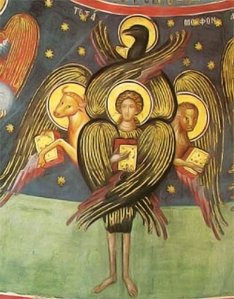
A tetramorph cherub, in Eastern Orthodox iconography 16th Century
Although the four faces of the four living creatures is a feature unique to Ezekiel’s description, much of the description of these creatures is similar to what scholars believe the cherubim on the ark of the covenant (Exodus 25: 10-22) and the temple (1 Kings 6:23-28). Most modern portrayals of the ark picture the cherubim as resembling humans with wings.
However, most representation of divine creatures in the surrounding world are sphinx like with both human and animal features.

Hittite sphinx. Basalt. 8th century BC. From Sam’al. Museum of the Ancient Orient, Istanbul.
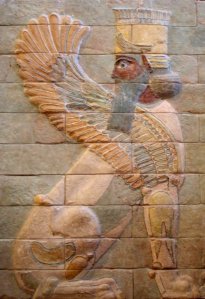
Winged sphinx from the palace of Darius the Great during Persian Empire at Susa (480 BC)
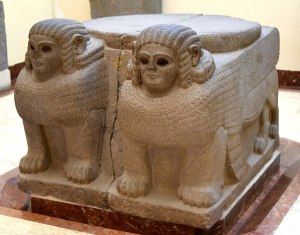
Column base in the shape of a double sphinx. From Sam’al. 8th century BC. Museum of the Ancient Orient, Istanbul.
These living creatures as described in Ezekiel have both humanoid and animal features. The creatures are able to move in any direction without turning (as the spirit/wind/breath moves them) and there are both animate and inanimate characteristics to these creatures which are a part of the divine throne. The creatures seem to be animated by the wind and the electricity/lighting/fire that is in the midst of these creatures.
The wheels also have had lively interpretation in the artistic imagination, but functionally this is a four wheeled chariot. The chariot seems to have a life that flows between the living creatures and the wheels as they are moved by the spirit/wind. The wheels gleam like beryl or glowing metal and the eyes may be eye shaped precious stones that are of a piece of the wheel. (Block, 1997, pp. 100-101) Although the pictures which are a part of this post are meant to help bring some visual structure to Ezekiel’s vision from an ancient context, the prophet’s descriptions are still challenging to envision and likely were overwhelming for the prophet to experience.

An ivory from Tel Megiddo showing a king sitting on a throne which is supplicated by a sphinx-esque winged hybrid.
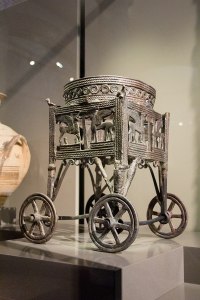
Wheeled stand for a cauldron, bronze, 12-11th century BCE. Probably from Kition, Larnaka district, Cyprus. Currently in the Neues Museum, in Berlin. IN : Misc. 8947.
Above this chariot is a dome to support the throne and the presence upon the throne. The scene describes an experience overwhelming to both the eyes and the ears. The crystal dome which supports the emerald or lapis lazuli throne on which seats something like a human form. Yet, the human form is enclosed with both a rainbow-like radiance and fire and brightness. Ezekiel is probably wise in limiting the description of the glory of the LORD, but the overwhelming scene prepares us for the end where the voice of the LORD speaks.
There are sound reasons for traditional limitation of the book of Ezekiel in Jewish circles to men over thirty as the strangeness of the book has inspired many strange and disparate interpretations. Ezekiel is strange to our ears, but it is easy to become lost in the initial descriptions and not pay attention to what the voice of the LORD has to say to Ezekiel. Four-faced, four-winged living creature and wheels within wheels with eyes are fascinating images but they are only to prepare us to hear the call of Ezekiel to his difficult ministry both to the exiles in Babylon and those remaining in Judah.
[1] Ruach se’ara in Hebrew. Ruach plays multiple roles in the Bible and in this passage: wind, breath and spirit are the most common meanings. Later in the chapter when it talks about the ‘wherever the spirit would go’ or ‘the spirit of the living creatures’ it is ruach behind each usage of spirit.
 Sign of the Rose