Tag Archives: false prophets

Ezekiel 13 Against the False Prophets

Window on a whitewashed wall, Djerba, Tunisia By LBM1948 – Own work, CC BY-SA 4.0, https://commons.wikimedia.org/w/index.php?curid=113677551

Ezekiel 13

Ezekiel 13: 1-16 Proclamation Against Male False Prophets

1 The word of the LORD came to me: 2 Mortal, prophesy against the prophets of Israel who are prophesying; say to those who prophesy out of their own imagination: “Hear the word of the LORD!” 3 Thus says the Lord GOD, Alas for the senseless prophets who follow their own spirit, and have seen nothing! 4 Your prophets have been like jackals among ruins, O Israel. 5 You have not gone up into the breaches, or repaired a wall for the house of Israel, so that it might stand in battle on the day of the LORD. 6 They have envisioned falsehood and lying divination; they say, “Says the LORD,” when the LORD has not sent them, and yet they wait for the fulfillment of their word! 7 Have you not seen a false vision or uttered a lying divination, when you have said, “Says the LORD,” even though I did not speak?

8 Therefore thus says the Lord GOD: Because you have uttered falsehood and envisioned lies, I am against you, says the Lord GOD. 9 My hand will be against the prophets who see false visions and utter lying divinations; they shall not be in the council of my people, nor be enrolled in the register of the house of Israel, nor shall they enter the land of Israel; and you shall know that I am the Lord GOD. 10 Because, in truth, because they have misled my people, saying, “Peace,” when there is no peace; and because, when the people build a wall, these prophets smear whitewash on it. 11 Say to those who smear whitewash on it that it shall fall. There will be a deluge of rain, great hailstones will fall, and a stormy wind will break out. 12 When the wall falls, will it not be said to you, “Where is the whitewash you smeared on it?” 13 Therefore thus says the Lord GOD: In my wrath I will make a stormy wind break out, and in my anger there shall be a deluge of rain, and hailstones in wrath to destroy it. 14 I will break down the wall that you have smeared with whitewash, and bring it to the ground, so that its foundation will be laid bare; when it falls, you shall perish within it; and you shall know that I am the LORD. 15 Thus I will spend my wrath upon the wall, and upon those who have smeared it with whitewash; and I will say to you, The wall is no more, nor those who smeared it — 16 the prophets of Israel who prophesied concerning Jerusalem and saw visions of peace for it, when there was no peace, says the Lord GOD.

The authentic prophets of God already have difficult roles when they are given an unpopular message of judgement to deliver to the people of God, and their role is made significantly more challenging when false prophets appear delivering a message of peace when there is no peace. Although there are significant differences between the society and worldview of Ezekiel’s time and our own, both times struggle to separate truth from opinion. In our own time different news sources present a completely different version of reality based on the political narrative the network holds. Likewise, a person can go to different congregations and receive drastically different interpretations of faith, some that would be unrecognizable as Christianity’s traditional beliefs.[1] As quote attributed the former senator Daniel Patrick Moynihan says, “Everyone is entitled to their own opinions, but not their own facts.” But when the facts in question are competing divine messages from God how are the people to discern the true prophet from the foolish and senseless prophets who have seen nothing and speak from their own spirit?

From our canonical standpoint we know that Ezekiel is the true prophet bearing the word of the LORD while his opponents are those who have envisioned falsehood and lying divination. Yet, in this time where Ezekiel and Jeremiah were declaring the judgment upon the temple, Jerusalem, the land, and the Davidic line of kings other prophets gave reasonable sounding reassurances of peace because of the covenant status of the people, the temple, the Davidic king, the land, and the favored position of Jerusalem with God. Jerusalem had been spared once before from the Assyrians, and these popular prophets proclaimed that deliverance would come once again. The guidance in Deuteronomy only allows a prophet’s truth to be evaluated in retrospect:

You may say to yourself, “How can we recognize a word that the LORD has not spoken?” If a prophet speaks in the name of the LORD but the thing does not take place or prove true, it is a word that the LORD has not spoken. The prophet has spoken presumptuously; do not be frightened. Deuteronomy 18: 21-22

Yet, Deuteronomy also indicates that the prophet who either speaks in the name of another god or the prophet who speaks a word that the LORD has not given them will die. (Deuteronomy 18: 20) Here the LORD declares, through Ezekiel, the judgment of these foolish prophets who have spoken what they have not heard and declared what they have not seen.

Although the NRSV declares the prophets as senseless, the Hebrew word (nabal) is normally translated foolish. As Daniel Block describes this word:

The adjective nābāl is used in wisdom literature of a special kind of fool: one who is arrogant (Prov. 30:32), crude of speech (Prov. 1:17), spiritually and morally obtuse (Job 2:10), a scoundrel (Job 30:8). In the Psalms the nābāl denies (14:1; 53:2 [End. 1]) and blasphemes God (74:22). (Block, 1997, p. 400)

Syrian Jackal (Canis aureus syriacus) in Tel Aviv By Jan Ebr – https://www.inaturalist.org/photos/114837596, CC BY 4.0, https://commons.wikimedia.org/w/index.php?curid=116759612

These foolish prophets have not received a divine vision, unlike Ezekiel, and are following their own human spirit rather than being directed by the spirit of God. These prophets are like jackals who inhabit the ruins of foreign cities in Isaiah[2] and in the ruins of Jerusalem in Micah 1:8. These foolish prophets rather than building up and defending the people have helped to bring about their downfall. The true prophet should have stood in the breach or helped to repair the wall literally or metaphorically. Instead, they stood in a position of privilege inside the city and away from the danger of conflict on the wall during the siege. Yet, instead of reinforcing the divine message or recalling people to the covenant they have resisted the true prophets like Ezekiel, and provided the illusion of peace where there was no peace.

The problem with these foolish prophets is not that they proclaim a message of peace, Ezekiel will later proclaim a message of peace and hope, but that they are not sent from God, and they do not understand the time. It is unclear whether these prophets are in Jerusalem or being encountered by Ezekiel in exile, although it is clear that Jeremiah encountered prophets who declared peace in contrast to his message of Babylon’s impending invasion and God’s judgment:

For from the least of them to the greatest of them, everyone is greedy for gain; and from prophet to priest, everyone deals falsely. They have treated the wound of my people carelessly, saying, “Peace, peace,” when there is no peace. Jeremiah 6:13-14[3]

These prophets have provided cosmetic treatments to cover up the flaws in the walls that will not endure the storm to come. These false prophets have contributed to a future where Jerusalem will have her foundations laid bare like Samaria[4] was by the Assyrians. These prophets have contributed to a cover up of the flaws in Jerusalem and have contributed to the fall of the city.

The judgment on these foolish prophets is to revoke their place among the people. Not only will they lose their place in the council of the people, but they will also be removed from the register of Israel and be exiles from the land. Like the jackals they were compared to earlier, they will be the castoffs living among the ruins and not fit to cohabitate with the rest of society. They may be popular at the moment, but history will remember Ezekiel and Jeremiah. The countless false prophets will lose their place in society and history.

One final note before proceeding to the next section which deals with women who are distracting from Ezekiel and other true prophets, is that although most interpreters assume these prophets are acting in the name of the LORD, and the ones mentioned above do seem to be referencing the God of Israel, a large part of the judgment upon Israel is due to their unfaithfulness both to the covenant but also their worship of other gods. It is clear that there were multiple gods worshipped in various ways throughout Judah at this time, and many probably considered this pluralistic worship alongside the worship of the LORD acceptable. There may have been prophets speaking and declaring on behalf of other (false) gods and with the unpopular nature of the harsh messages of Jeremiah and Ezekiel it made these alternative messages even more palatable.

Ezekiel 13: 17-23 Proclamation Against Female False Prophets

17 As for you, mortal, set your face against the daughters of your people, who prophesy out of their own imagination; prophesy against them 18 and say, Thus says the Lord GOD: Woe to the women who sew bands on all wrists, and make veils for the heads of persons of every height, in the hunt for human lives! Will you hunt down lives among my people, and maintain your own lives? 19 You have profaned me among my people for handfuls of barley and for pieces of bread, putting to death persons who should not die and keeping alive persons who should not live, by your lies to my people, who listen to lies.

20 Therefore thus says the Lord GOD: I am against your bands with which you hunt lives; I will tear them from your arms, and let the lives go free, the lives that you hunt down like birds. 21 I will tear off your veils, and save my people from your hands; they shall no longer be prey in your hands; and you shall know that I am the LORD. 22 Because you have disheartened the righteous falsely, although I have not disheartened them, and you have encouraged the wicked not to turn from their wicked way and save their lives; 23 therefore you shall no longer see false visions or practice divination; I will save my people from your hand. Then you will know that I am the LORD.

The target of Ezekiel in the second half of this condemnation of false prophets is against ‘the daughters of your people’ who like the male prophets speak from their own heart/imagination.[5] These women, who Ezekiel does not call prophets (although they are prophesying) are sewing something on peoples’ arms and making something for peoples’ heads. Any reconstruction of this scene involves speculation since the references are too obscure to give us an accurate picture of what Ezekiel is protesting against, although it would have been clear in his time. It is not even clear whether these women are in Jerusalem/Judea or in exile with Ezekiel (or perhaps both). Although the law has clear prohibitions against divination and augury as practiced in the surrounding culture[6] it is also likely that these practices did occur among the people at this time of crisis. When a crisis arises people often seek certainty and there will always be those who are vulnerable to those who promise protection or control.

One interpretation of the actions of these women is that they are creating bands and phylacteries, veils, or amulets that have the divine name upon them as a ward against evil times. Although this practice would bear the name of the LORD, it would be utilizing the name of God in a way that other nations invoke their deities. This context would make sense of the statement that these women ‘have profaned me’ and the barley and bread is their payment for these articles of clothing. It is also possible that these bands and veils/amulets may be utilizing other entities as a form of protection. From Ezekiel’s view these women are not prophets and are not only snake oil salespeople, but their practices have actively caused the innocent to die and the wicked to prosper. Their actions represent the opposite of Ezekiel’s call in Ezekiel 3: 16-21 where Ezekiel is responsible to confront the wicked to get them to turn from their ways. Now these daughters of Israel by the lies they tell, and the people who listen to their lies are enabling those who should not live to live, while those who should not die are dying.

There are women prophets in the story of Israel and there are women who resist the ways of the LORD. Although it is possible that as Katheryn Pfister Darr suspects, “that Ezekiel has, in effect, “demonized” these women unfairly.” (NIB VI: 1203)[7] I am less suspicious than she is in her interpretation here. Women have been demonized by men in positions of authority and the line between magic and authority was murkier in the past, but like the male prophets in the first half of the chapter the issue is not that they are prophesying-it is that they were not sent by God and their actions are furthering the injustice in the society.

[1] I would include Christian nationalism and the prosperity gospel among these common belief systems that are alien to traditional Christian theology, although they have emerged at various points throughout history.

[2] Isaiah 13:22, 34:13

[3] See also Jeremiah 8 :10-11, 14:13-24, 23: 16-22.

[4] Echoing the language of Micah 1:6.

[5] The word in Hebrew is “inner mind or heart” rather than the more modern concept of imagination. In verse three the male prophets are led by their own ruach (spirit, wind, breath).

[6] Leviticus 20:6, Deuteronomy 18: 10-14

[7] Referencing Nancy R. Bowen, “The Daughters of Your People: Female Prophets in Ezekiel 13: 17-23,” JBL 118 (199) 420.
Ezekiel 12 Judgment on the Leaders and People of Jerusalem

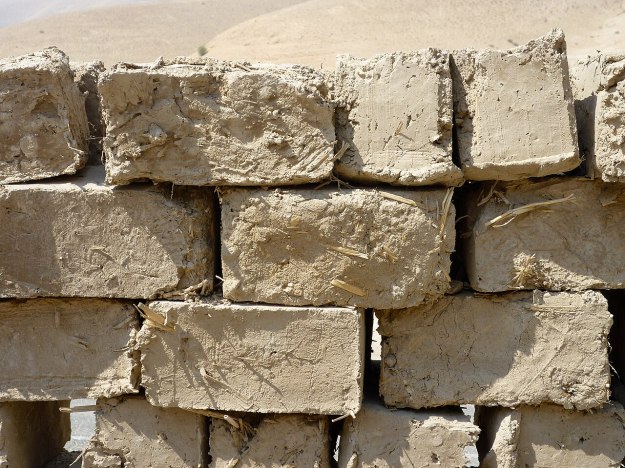
New, unlaid mudbricks in the Jordan ValleyWest Bank Palestine, (2011) By Whiteghost.ink – Own work, CC BY-SA 3.0, https://commons.wikimedia.org/w/index.php?curid=16303999

Ezekiel 12

Ezekiel 12: 1-16 Zedekiah’s End Enacted

1 The word of the LORD came to me: 2 Mortal, you are living in the midst of a rebellious house, who have eyes to see but do not see, who have ears to hear but do not hear; 3 for they are a rebellious house. Therefore, mortal, prepare for yourself an exile’s baggage, and go into exile by day in their sight; you shall go like an exile from your place to another place in their sight. Perhaps they will understand, though they are a rebellious house. 4 You shall bring out your baggage by day in their sight, as baggage for exile; and you shall go out yourself at evening in their sight, as those do who go into exile. 5 Dig through the wall in their sight, and carry the baggage through it. 6 In their sight you shall lift the baggage on your shoulder, and carry it out in the dark; you shall cover your face, so that you may not see the land; for I have made you a sign for the house of Israel.

7 I did just as I was commanded. I brought out my baggage by day, as baggage for exile, and in the evening I dug through the wall with my own hands; I brought it out in the dark, carrying it on my shoulder in their sight.

8 In the morning the word of the LORD came to me: 9 Mortal, has not the house of Israel, the rebellious house, said to you, “What are you doing?” 10 Say to them, “Thus says the Lord GOD: This oracle concerns the prince in Jerusalem and all the house of Israel in it.” 11 Say, “I am a sign for you: as I have done, so shall it be done to them; they shall go into exile, into captivity.” 12 And the prince who is among them shall lift his baggage on his shoulder in the dark, and shall go out; he shall dig through the wall and carry it through; he shall cover his face, so that he may not see the land with his eyes. 13 I will spread my net over him, and he shall be caught in my snare; and I will bring him to Babylon, the land of the Chaldeans, yet he shall not see it; and he shall die there. 14 I will scatter to every wind all who are around him, his helpers and all his troops; and I will unsheathe the sword behind them. 15 And they shall know that I am the LORD, when I disperse them among the nations and scatter them through the countries. 16 But I will let a few of them escape from the sword, from famine and pestilence, so that they may tell of all their abominations among the nations where they go; then they shall know that I am the LORD.

Ezekiel’s sign-acts are designed, by the nature of their strangeness, to garner attention. In a world before internet influencers who attempt to draw attention to themselves for fame and money, prophets like Ezekiel did outlandish and sometimes destructive acts to call attention to a message God wants the people to talk about and share. Especially for a message which will need to be transmitted (in a world without telephones, new reports, or even a newspaper or regular mail) from the exiles in Babylon to the people of Jerusalem requires it to be memorable and significant. Ezekiel’s action of preparing an exile’s baggage, digging a hole in the wall of his house, entering the house with the baggage through the hole he created and then exiting at night by the same whole leaves his curious neighbors seeking an explanation for these actions, an explanation that he communicates from the LORD.

Throughout the passage the contrast between sight and the lack of sight, light, and darkness, “presents a fascinating study in perception and blindness.” (Block, 1997, p. 365) Christian readers will be familiar with Jesus using identical language to Ezekiel’s description of Israel as those “who have eyes to see but do not see, who have ears to hear but do not hear.” This type of language occurs multiple times in the prophets and the psalms. Ezekiel’s older contemporary Jeremiah says in Jerusalem:

Hear this, O foolish and senseless people. Who have eyes, but do not see, who have ears, but do not hear. (Jeremiah 5:21)[1]

And in the psalmist’s protest against idols:

Their idols are silver and gold, the work of human hands. They have mouths, but do not speak; eyes, but do not see. They have ears, but do not hear; noses, but do not smell. Psalm 115: 4-6

Like Isaiah and Jeremiah, Ezekiel’s message attempts to reach people who are blind and deaf to the implications of these divine messages. Yet Ezekiel’s actions are audacious enough to attract the curiosity of his fellow exiles even if they do not lead to repentance. As stated when Ezekiel is called, when these audacious sign-acts and words come to fruition the people will know that a prophet has been among them whether they hear or refuse to hear. (Ezekiel 2:5)

Ezekiel prepares his exile’s baggage[2] and visibly places it on they outside of his house and then proceeds to dig a hole in the wall of his house.[3] The exiles may have interpreted his actions positively as an end to their exile and a return to their homes in Judah. Yet, Ezekiel’s actions of preparing his baggage, digging through the wall, placing his baggage on the inside, and then departing through the hole in the wall at night will be interpreted the next morning for those who are curious enough to see the prophet’s action and hear its interpretation.

The interpretation involves the people still in Jerusalem and in particular king Zedekiah. Zedekiah is never named in Ezekiel and is referred to here as prince (Hebrew navi) rather than king (Hebrew melek). Zedekiah is the target of prophecy for the first time in Ezekiel. Prior to this Ezekiel only referred to the exile of King Jehoichin and the elders acting unfaithfully in Jerusalem. The temple, the city of Jerusalem and the land have all received judgment, but now the appointed leader in Jerusalem is singled out. The prophet Jeremiah had extensive interactions with Zedekiah in Jerusalem (Jeremiah 32-34, 37-38) and narrates the ending of Zedekiah twice in the book of Jeremiah (Jeremiah 39, 52). 2 Kings shares an identical description of Zedekiah’s end:

Then a breach was made in the city wall; the king with all the soldiers fled by night by the way of the gate between the two walls, by the king’s garden, though the Chaldeans were all around the city. They went in the direction of the Arabah. But the army of the Chaldeans pursued the king, and overtook him in the plains of Jericho; all his army was scattered, deserting him. Then they captured the king and brought him up to the king of Babylon at Riblah, who passed sentence on him. They slaughtered the sons of Zedekiah before his eyes, then put out the eyes of Zedekiah; they bound him in fetters and took him to Babylon. 2 Kings 25: 4-7

The actions of Jeremiah foreshadow the actions of Zedekiah fleeing Jerusalem through a hole in the wall with the sword following him. Ezekiel’s prophecy indicates that the LORD is the one casting his net and setting a snare for Zedekiah and Babylon is merely the instrument.[4] The king does leave by a hole in the wall, is quickly captured, and then is taken to Babylon blinded. As the prophet indicates he is taken to Babylon, but he does not see it.

We live in an age where even many biblical scholars are skeptical of prophecy as prediction. Many scholars of the historical critical and source criticism school view prophesies which foretell later events as “prophecy after the fact” which are included in the compilation of the words of the prophets which may have occurred at a later date. This idea would have been foreign to the early readers of scripture who viewed the prophet as one who receives and transmits divine oracles in both word and action. The prophets’ predictions normally speak in generalities, but it is expected (as we will see in the resistance in the remainder of the chapter) that prophets would communicate coming events. Blinding captives was a widespread practice among the Babylonians, but believability based on common practices is not necessary for a prophet. A true prophet was a person who received a message or insight from God whose knowledge is not limited to the present and whose actions may include the actions through another nation as an instrument of God’s judgment or salvation.

Ezekiel 12: 17-20 Portraying a Traumatized People

17 The word of the LORD came to me: 18 Mortal, eat your bread with quaking, and drink your water with trembling and with fearfulness; 19 and say to the people of the land, Thus says the Lord GOD concerning the inhabitants of Jerusalem in the land of Israel: They shall eat their bread with fearfulness, and drink their water in dismay, because their land shall be stripped of all it contains, on account of the violence of all those who live in it. 20 The inhabited cities shall be laid waste, and the land shall become a desolation; and you shall know that I am the LORD.

In the next visual picture, the prophet demonstrates the traumatic nature of the events for those impacted by the LORD’s judgment of Jerusalem. One of the symptoms of prolonged stress and trauma is uncontrollable shaking, and in the public act of eating and drinking[5] and again the sign must be memorable enough to be communicated from Ezekiel’s position in exile to the remnant in Jerusalem. The judgment of the LORD echoes the covenant curses of Leviticus 26:43:

For the land shall be deserted by them, and enjoy its sabbath year by lying desolate without them while they make amends for their iniquity, because they dared to spurn my ordinances, and abhorred my statutes.[6]

Within Hebrew thought there is a connection between the people and the land, and the disobedience of the people has a negative impact on the land. In Leviticus the land is given a sabbath to recover from the damage incurred by the unfaithfulness of the people, but in Ezekiel the focus is on the impact on the people who will bear the fearful consequences of violence committed in the land.

Ezekiel 12: 21-28 The Time of Judgment is At Hand

21 The word of the LORD came to me: 22 Mortal, what is this proverb of yours about the land of Israel, which says, “The days are prolonged, and every vision comes to nothing”? 23 Tell them therefore, “Thus says the Lord GOD: I will put an end to this proverb, and they shall use it no more as a proverb in Israel.” But say to them, The days are near, and the fulfillment of every vision. 24 For there shall no longer be any false vision or flattering divination within the house of Israel. 25 But I the LORD will speak the word that I speak, and it will be fulfilled. It will no longer be delayed; but in your days, O rebellious house, I will speak the word and fulfill it, says the Lord GOD.

26 The word of the LORD came to me: 27 Mortal, the house of Israel is saying, “The vision that he sees is for many years ahead; he prophesies for distant times.” 28 Therefore say to them, Thus says the Lord GOD: None of my words will be delayed any longer, but the word that I speak will be fulfilled, says the Lord GOD.

Although the God presented throughout the book of Ezekiel is a God whose judgment will not be delayed much longer, the character of the God of Israel throughout scripture is a God who desires repentance. The patience of God in continuing to send prophets to warn the people of the consequences of their actions has continued to meet resistance from a people who no longer hear or see. The two proverbs that the LORD responds to in this final portion of the chapter speak to the belief among the speakers that the visions of the prophets come to nothing or they are for distant times. Unfortunately, what these proverb speakers fail to realize is that the time of judgment being delayed is closing and they will soon see these prophecies of doom fulfilled.

Throughout the bible, the patience of God has allowed an opportunity for the wicked to turn from their ways. This patience often has a cost for the righteous, the society, and as mentioned above even the land and God’s costly patience is not infinite. Prophets throughout the bible have encountered rejection[7] as well as dealing with false prophets[8] who often echoed royal or popular desires. The combination of divine patience and conflicting message made it difficult for the population to take the challenging message of Jeremiah and Ezekiel as seriously as they merited. This combination of factors has led to the illusion that God’s judgment will either not come or will be delayed for a future generation to deal with. Ezekiel attempts to communicate with a people who no longer listen with the urgency of the prophecy he has received.

[1] Similar language is used in Isaiah 6:9-10, 43: 8.

[2] Literally “container of exile.” Probably a sort of knapsack to carry the essentials for a long journey. This would be familiar to the exiles who prepared similar baggage for their journey from Jerusalem to Babylon.

[3] The Hebrew qir used here is the word for the wall of a house. Homa is the Hebrew word for a defensive wall. The act of digging through the wall is reasonable because most structures in Babylon used bricks made from dried mud. (Block, 1997, p. 370)

[4] The same claim will be advanced with nearly identical wording in Ezekiel 17: 20.

[5] Eating in the ancient world was normally a communal activity not a private one, and the LORD using this as a prophetic sign act implies an audience to observe the sign act.

[6] A similar stripping of the land will occur in 32:15 (referring to Egypt) and 33:28(referring to Judah). Zechariah 7:10 uses the image of a desolated land in a similar way, while Jeremiah uses the image of a desolate land as the place where God will in the future will know joy and prosperity (Jeremiah 33:10) as he narrates a hopeful future after the exile.

[7] For example, the man of God from Judah (1 Kings 13) the prophets killed by Jezebel (1 Kings 18:4) and later the threat to Elijah (1 Kings 19) Zechariah (2 Chronicles 24: 20-22)

[8] The prophets may have been aligned with other gods like the prophets of Baal in 1 Kings 18 or simply proclaim a message that did not come from the God of Israel like Hananiah in Jeremiah 28.