Tag Archives: Elijah

2 Kings 8 Transitioning from Prophetic Time to a Major Transition in Royal Time

Ivory carving found at Arslan Tash, Syria. A cache of ivories found at the Assyrian outpost of Arslan Tash was undoubtedly booty taken from Hazael’s palace in Damascus. The regal figure depicted on this piece is probably Hazael himself. (Louvre Museum, Paris)

2 Kings 8: 1-6 

1Now Elisha had said to the woman whose son he had restored to life, “Get up and go with your household and settle wherever you can, for the LORD has called for a famine, and it will come on the land for seven years.” 2So the woman got up and did according to the word of the man of God; she went with her household and settled in the land of the Philistines seven years. 3At the end of the seven years, when the woman returned from the land of the Philistines, she set out to appeal to the king for her house and her land. 4Now the king was talking with Gehazi the servant of the man of God, saying, “Tell me all the great things that Elisha has done.” 5While he was telling the king how Elisha had restored a dead person to life, the woman whose son he had restored to life appealed to the king for her house and her land. Gehazi said, “My lord king, here is the woman, and here is her son whom Elisha restored to life.” 6When the king questioned the woman, she told him. So the king appointed an official for her, saying, “Restore all that was hers, together with all the revenue of the fields from the day that she left the land until now.”

Elisha continues to provide for this woman who showed him hospitality and warns her and her child to flee the coming famine. The husband is not mentioned and is likely dead at this point in their story and this woman acts as a head of household. The seven years of famine matches the seven-year cycle of Genesis 41: 25-30 which causes the sons of Israel to seek food in Egypt, but here the famine is far more localized. Seven is a common biblical number of completion or a long time, and so the actual span of the drought may be longer or shorter than this commonly used number to designate a completed time. The woman makes her temporary home in Philistia, roughly 100 miles away, and avoids the impact of the famine. The famine is not explicitly stated as God’s judgment on the Omri dynasty in Samaria and is likely linked to the famine mentioned in the previous chapter during the siege of Samaria, but the famine as a part of God’s judgment against the Omri dynasty can be implied in the story. The stories of the last several chapters which chronicle the works of Elisha probably exist beyond the twelve years of King Jehoram of Judah (even though Jehoram’s reign brackets these stories). The king who is interested in the works of Elisha is the king of Israel, but likely not Jehoram or any other king of the Omri line.

Gehazi reemerges in the story, and this may either precede his affliction with leprosy/skin disease,[1] after some unmentioned healing of his disease, or he may remain afflicted. Whatever his condition he is able to converse with the king of Israel about the acts of Elisha. As he describes Elisha’s raising of the woman’s son, he points to this woman who has come to “cry out” (NRSVue appeal)[2] for the return of her property. The Torah imagines a world where the property of a family would be held by that family in perpetuity, but the narrative of scripture points to a different reality. It is possible that in her absence a relative or even squatters have come in and taken over her land, or that in her absence it became crown land, but this once well-connected woman now comes to appeal for her property. Her connection to Elisha allows her appeal to be heard by this king who is interested in the acts of Elisha, and her “crying out” is heard by the king who appoints an official[3] to restore not only her land but also the revenue from the land in the time of her absence.

2 Kings 8: 7-15

  7Elisha went to Damascus while King Ben-hadad of Aram was ill. When it was told him, “The man of God has come here,” 8the king said to Hazael, “Take a present with you and go to meet the man of God. Inquire of the LORD through him, whether I shall recover from this illness.” 9So Hazael went to meet him, taking a present with him, all kinds of goods of Damascus, forty camel loads. When he entered and stood before him, he said, “Your son King Ben-hadad of Aram has sent me to you, saying, ‘Shall I recover from this illness?’ ” 10Elisha said to him, “Go, say to him, ‘You shall certainly recover,’ but the LORD has shown me that he shall certainly die.” 11He fixed his gaze and stared at him to the point of embarrassment. Then the man of God wept. 12Hazael asked, “Why does my lord weep?” He answered, “Because I know the evil that you will do to the people of Israel; you will set their fortresses on fire; you will kill their young men with the sword, dash in pieces their little ones, and rip up their pregnant women.” 13Hazael said, “What is your servant, who is a mere dog, that he should do this great thing?” Elisha answered, “The LORD has shown me that you are to be king over Aram.” 14Then he left Elisha and went to his master Ben-hadad, who said to him, “What did Elisha say to you?” And he answered, “He told me that you would certainly recover.” 15But the next day he took the bedcover and dipped it in water and spread it over the king’s face, until he died. And Hazael succeeded him.

The prophet Elijah when he was instructed to anoint Elisha to be prophet in his place was also commanded to appoint Hazael as king over Aram and Jehu as king over Israel (1 Kings 19: 15-17). Elijah did call Elisha, but now it is Elisha who is engaged in Hazael’s ascension to power in Damascus. The story is an inversion of the story in 2 Kings 1 where King Ahaziah, king in Samaria, sends to inquire of Baal-zebub, the god of Ekron. While the king of Israel appeals to the god of Ekron, now a foreign king appeals to the prophet of Israel to inquire of the LORD his God. Yet, this inquiry of Ben-hadad sets in motion his demise despite the affirmative answer of the prophet. The prophetic messenger appoints Hazael to do the work that prophets do not do. The involvement of the prophet in both a lie and the politics of a foreign power has caused discomfort for some readers.

In the scriptures God often works through foreign powers, even if these powers are unaware of their participation in God’s action of judgment or deliverance. Hazael, the servant of Ben-hadad approaches the prophet with a large gift for this emissary of the God of Israel, but unlike Naaman’s large gift we never learn the disposition of the forty camel loads of gifts offered to the prophet. Hazael is informed of his role even though the prophet regrets the damage he will do to the people of Israel. Although Elisha gives Hazael the message that the king will recover from the illness, he also sets in motion a chain of events that lead to King Ben-hadad’s death at the hands of his servant. The prophet Amos views Hazael’s ascension as God’s act as well, but as a judgment on Ben-hadad (Amos 1: 3-4) but in Elisha’s view what is important is Hazael’s actions towards Israel. Following the original commissioning of Elijah to set Hazael over Aram and Jehu over Israel, both Aram and Jehu (and Elisha) are the swords that shall kill many. Many modern readers recoil at the violence of the actions attributed to Hazael in the prophet’s words, but war in the ancient world was violent. War of all times is violent, and innocent people often pay a heavy cost but armies in the ancient world did not act with the same restraint that modern militaries do in attempting to limit the destructiveness of the soldiers unleashed to practice violence on the enemy land and people. Hazael acknowledges that the violence the prophet describes would be a “great thing” and his only protest is that he is too insignificant to be able to accomplish this great thing. God has designated Hazael as a part of God’s plan for Israel, but Hazael is a blunt instrument that will incur a lot of damage in the removal of the Omri dynasty.

Elisha may weep for the future that he sees but he remains faithful to God’s vision. The ways of the Omri dynasty have led the people of Israel away to following other gods and unjust practices. Elisha may have wrestled with his role in being a part of the (ultimately) violent solution to the wicked (in the view of 2 Kings) kings of Israel who have now corrupted even the line of kings in Judah (see below). Many of the stories of Elisha have shown him working with individuals and groups in miraculous ways to help them navigate this world of famines and sieges. Yet, the narrative of 2 Kings attempts to understand how God is at work in the collapse of both Israel and Judah working through Aram, Assyria, and Babylon. Hazael, son of a nobody, as a large basalt statue of Shalmaneser refers to him derogatorily, (Cogan, 1988, p. 90) may not be anointed by Elisha in this story, but Elisha gives him the vision that leads to the suffocation of his ailing master and allows the son of a nobody to grasp power in Aram and to become God’s blunt instrument utilized in the judgment of Israel.

2 Kings 8: 16-29

  16In the fifth year of King Joram son of Ahab of Israel, Jehoram son of King Jehoshaphat of Judah began to reign. 17He was thirty-two years old when he became king, and he reigned eight years in Jerusalem. 18He walked in the way of the kings of Israel, as the house of Ahab had done, for the daughter of Ahab was his wife. He did what was evil in the sight of the LORD. 19Yet the LORD would not destroy Judah, for the sake of his servant David, since he had promised to give a lamp to him and to his descendants forever.
  20
In his days Edom revolted against the rule of Judah and set up a king of their own. 21Then Joram crossed over to Zair with all his chariots. He set out by night and attacked the Edomites and their chariot commanders who had surrounded him, but his army fled home. 22So Edom has been in revolt against the rule of Judah to this day. Libnah also revolted at the same time. 23Now the rest of the acts of Joram and all that he did, are they not written in the Book of the Annals of the Kings of Judah? 24So Joram slept with his ancestors and was buried with them in the city of David; his son Ahaziah succeeded him.

  25
In the twelfth year of King Joram son of Ahab of Israel, Ahaziah son of King Jehoram of Judah began to reign. 26Ahaziah was twenty-two years old when he began to reign; he reigned one year in Jerusalem. His mother’s name was Athaliah, a granddaughter of King Omri of Israel. 27He also walked in the way of the house of Ahab, doing what was evil in the sight of the LORD, as the house of Ahab had done, for he was son-in-law to the house of Ahab.
  28
He went with Joram son of Ahab to wage war against King Hazael of Aram at Ramoth-gilead, where the Arameans wounded Joram. 29King Joram returned to be healed in Jezreel of the wounds that the Arameans had inflicted on him at Ramah, when he fought against King Hazael of Aram. King Ahaziah son of Jehoram of Judah went down to see Joram son of Ahab in Jezreel because he was wounded.

The bulk of the first eight chapters of 2 Kings have broken from the typical construction of the story around the reigns of kings and has focused instead on the end of the prophet Elijah’s story and then multiple stories centered on the prophet Elisha. We will return to Elisha for a few final stories, but the narrator of 2 Kings returns us to the timeline of kings, particularly the kings in Judah. The narration of the book of kings has focused almost entirely on the northern kingdom of Samaria or Israel since the reign of Jehoshaphat in Judah in 1 Kings 22: 41-51. In contrast to his father and grandfather who followed the ways of the LORD, Jehoram[4] the new king of Judah follows the ways of the kings of Israel and is allied with these kings by marriage to Athaliah, a sister of king Joram of Israel. Like Jezebel, king Ahab’s wife, Athaliah is viewed as a corrupting influence upon both Jehoram and her son Ahaziah.

2 Chronicles reports a letter from Elijah to Jehoram:

12A letter came to him from the prophet Elijah, saying, “Thus says the LORD, the God of your father David: Because you have not walked in the ways of your father Jehoshaphat or in the ways of King Asa of Judah 13but have walked in the way of the kings of Israel and have led Judah and the inhabitants of Jerusalem into unfaithfulness, as the house of Ahab led Israel into unfaithfulness, and because you also have killed your brothers, members of your father’s house, who were better than you, 14see, the LORD will bring a great plague on your people, your children, your wives, and all your possessions, 15and you yourself will have a severe sickness with a disease of your bowels until your bowels come out, day after day, because of the disease.” 2 Chronicles 21:12-14

Both 2 Chronicles and 2 Kings view the time of Jehoram as a time which corrupted the house of David and jeopardized the enduring line promised to David. God restrains the judgement on these two unfaithful kings of Judah because of God’s loyalty to David, but Judah is in danger of becoming like the north.

Kings in the ancient world[5] are judged by their ability to maintain power and here we see the beginning of a deterioration of Judah’s control of Edom as well as one of its own cities. The narrative sets the infidelity toward the LORD of these two kings of Judah alongside their loss of power over their vassals. Readers can make a judgement about the connection between their inability to project power over their vassals and their unfaithfulness to the LORD (Brueggemann, 2000, p. 375) but the theological perspective of the narrator of 2 Kings would probably view them as connected. Alex Israel suggests that Libnah, as a Levite city, may have been demonstrating against the idolatrous religious orientation of Jehoram (Israel, 2019, p. 159) and while there were likely Levites and other people faithful to the LORD who were distressed about the direction of Judah under Jehoram and Ahaziah it is probably unlikely that one city would simply separate itself from Judah without the intervention of other powers. However, Alex Israel’s description of Judah under Jehoram is pointed and accurate:

we may certainly summarize his dismal eight-year reign as a period of national disintegration: religious deviation, internecine royal infighting, a collapse of regional influence, and failure to defend his country’s borders. Judah is in decline on all fronts. (Israel, 2019, p. 159)

The introduction of Ahaziah’s brief reign over Judah sets the stage for the violent transitions in Samaria and Jerusalem in the next three chapters. King Joram is wounded in battle like his father Ahab (1 Kings 22: 29-40) and Ahaziah goes to visit him at this critical moment where Elisha anoints Jehu which brings about the ending of the Omri dynasty and the violent transition in Jerusalem.


[1] See the discussion on skin disease/leprosy in chapter five.

[2] The Hebrew za’aq as Brueggemann notes is frequently used of those who are abused or oppressed “crying out” to God or someone who can intervene on their behalf. (Brueggemann, 2000, p. 366)

[3] Mordechai Cogan and Hayim Tadmor note that saris means ‘eunuch’ based on linguistic evidence. (Cogan, 1988, p. 112)

[4] Both Jehoram and Joram have the same name, they are differentiated in translations to make it easier to refer to these kings in Samaria and Judah which reign concurrently.

[5] The bible, particularly 1&2 Kings, evaluates kings on a completely different set of values, but in general kings in the ancient world were supposed to maintain or increase their territory and wealth. Wealth was primarily generated through land as a producer of agriculture, livestock, and mineral resources.

2 Kings 2 Elijah’s Departure and Elisha’s Ministry Begins

Elijah the Prophet By Nicholas Roerich – Estonian Roerich Society, Public Domain, https://commons.wikimedia.org/w/index.php?curid=5066171

2 Kings 2: 1-18 A Prophetic Transition

  1Now when the Lord was about to take Elijah up to heaven by a whirlwind, Elijah and Elisha were on their way from Gilgal. 2Elijah said to Elisha, “Stay here, for the Lord has sent me as far as Bethel.” But Elisha said, “As the Lord lives and as you yourself live, I will not leave you.” So they went down to Bethel. 3The company of prophets who were in Bethel came out to Elisha and said to him, “Do you know that today the Lord will take your master away from you?” And he said, “Yes, I know; keep silent.”
  4
Elijah said to him, “Elisha, stay here, for the Lord has sent me to Jericho.” But he said, “As the Lord lives and as you yourself live, I will not leave you.” So they came to Jericho. 5The company of prophets who were at Jericho drew near to Elisha and said to him, “Do you know that today the Lord will take your master away from you?” And he answered, “Yes, I know; keep silent.”
  6
Then Elijah said to him, “Stay here, for the Lord has sent me to the Jordan.” But he said, “As the Lord lives and as you yourself live, I will not leave you.” So the two of them went on. 7Fifty men of the company of prophets also went and stood at some distance from them, as they both were standing by the Jordan. 8Then Elijah took his mantle and rolled it up and struck the water; the water was parted to the one side and to the other, and the two of them crossed on dry ground.
  9
When they had crossed, Elijah said to Elisha, “Tell me what I may do for you before I am taken from you.” Elisha said, “Please let me inherit a double share of your spirit.” 10He responded, “You have asked a hard thing, yet if you see me as I am being taken from you, it will be granted you; if not, it will not.” 11As they continued walking and talking, a chariot of fire and horses of fire separated the two of them, and Elijah ascended in a whirlwind into heaven. 12Elisha kept watching and crying out, “Father, father! The chariots of Israel and its horsemen!” But when he could no longer see him, he grasped his own clothes and tore them in two pieces.
  13
He picked up the mantle of Elijah that had fallen from him and went back and stood on the bank of the Jordan. 14He took the mantle of Elijah that had fallen from him and struck the water. He said, “Where is the Lord, the God of Elijah? Where is he?” He struck the water again, and the water was parted to the one side and to the other, and Elisha crossed over.
  15
When the company of prophets who were at Jericho saw him at a distance, they declared, “The spirit of Elijah rests on Elisha.” They came to meet him and bowed to the ground before him. 16They said to him, “See now, we have fifty strong men among your servants; please let them go and seek your master; it may be that the spirit of the Lord has caught him up and thrown him down on some mountain or into some valley.” He responded, “No, do not send them.” 17But when they urged him to the point of embarrassment, he said, “Send them.” So they sent fifty men who searched for three days but did not find him. 18When they came back to him (he had remained at Jericho), he said to them, “Did I not say to you, ‘Do not go’?”

The well-known imagery of the chariot of fire and the ascension of Elijah into heaven in the whirlwind serves as a transition between the prophetic ministry of Elijah and Elisha. The story is told outside of the framing of time in the succession of kings, likely to enhance the special nature of this moment. As Walter Brueggemann states, “the remarkable moment of prophetic transition is so odd and so exceptional that it cannot be held in royal time or understood in royal rationality.” (Brueggemann, 2000, p. 293) In this moment Elisha beholds that God’s power and might are at work in the world in a way that both reflects the imagery of the kingly power of the day (chariots and horses as the primary military technology of the time) but also transcends it. In addition to the transition between the ministries of Elijah and Elisha it also reminds the readers that God’s work in the world, often unseen, continues and occasionally the faithful servants of God have their eyes opened to see God’s power and presence in surprising ways.

Throughout this journey from Gilgal to Bethel to Jericho and then to the Jordan, a journey of at least twenty-four miles, Elijah tells Elisha three times to “Stay here” and Elisha answers, “As the Lord lives and as you yourself live, I will not leave you.” The story has some resonance with the refusal of Ruth to abandon her mother-in-law Naomi in Ruth 1: 15-17, and there are familial overtones to the Elijah and Elisha narrative as well. Both Ruth and Elisha are not related to the person they are clinging to by blood, but both claim the bond and responsibility of primary relations. This is heightened when one realizes that the word “leave” has the connotation of “abandon” in Hebrew. (Brueggemann, 2000, p. 294) Elisha’s ask of a ‘double share’ of Elijah’s spirit also connects with the ‘double share’ that a first-born heir is to receive according to Deuteronomy 21: 15-17. Elisha is probably not asking to receive twice the spirit endowed charisma as Elijah but instead to be recognized by Elisha and ultimately God as the proper heir to the prophetic ministry of Elijah.

Elisha is aware throughout the narrative of Elijah’s impending departure, a knowledge reinforced by the message of the sons of prophets at each location of their journey. Finally, as Elijah approaches the Jordan River, he utilizes his mantle and causes the waters of the river to be divided. Elijah’s mantle functions in a similar manner to Moses’ staff and Elijah’s authority is the authority promised in Deuteronomy 18:18 of a prophet like Moses. After Elijah’s ascension the same mantle in the hands of Elisha demonstrates that this heir to the prophetic ministry of Elijah is also a prophet with the authority and power that God entrusted to both Elijah and Elisha.

Most religious art depicting the ascension of Elijah pictures the prophet riding in the chariot, but that is not explicit in the text. The chariot of fire and the horses[1] separate Elijah from Elisha. Elisha sees a multitude of chariots, a sight he will later share with his servant in 2 Kings 6:17. Elijah, and presumably the chariots as well, ascend in the whirlwind. The company of prophets who observed this from a distance presumably saw something like the whirlwind but not the chariots of Israel and its horsemen.[2] In their limited vision they press Elisha to allow fifty strong men from their company to seek Elijah’s body to give it a proper burial. Elisha says not to send them but eventually is pressed enough that in embarrassment he allows the fifty to seek Elijah.

Elijah’s influence will continue long beyond his death even though he will only be mentioned one additional time in the Hebrew Bible. Elijah is the forerunner of the day of LORD in Malachi 4: 5-6:

See, I will send you the prophet Elijah before the great and terrible day of the Lord comes.  He will turn the hearts of parents to their children and the hearts of children to their parents, so that I will not come and strike the land with a curse.

Elijah continues to have a role in the practice of both Judaism and Christianity. In Judaism the role of Elijah would be tied to the coming of the messiah and he continues to have a seat at the practice of circumcision, during the Sedar meal, and the prayer at the end of the Sabbath calls for Elijah to come in the coming week. Elijah’s role in Christianity would rest upon John the Baptist and the one who preceded the coming of Jesus and Elijah along with Moses would appear at the transfiguration. Only Elijah and Enoch would not experience death in their stories in the bible, and this allowed both figures to become popular in the stories and hope of later generations.


2 Kings 2: 19-25 A Prophet of Blessing and Curse

  19Now the people of the city said to Elisha, “The location of this city is good, as my lord sees, but the water is bad, and the land is unfruitful.” 20He said, “Bring me a new bowl, and put salt in it.” So they brought it to him. 21Then he went to the spring of water and threw the salt into it and said, “Thus says the Lord: I have made this water wholesome; from now on neither death nor miscarriage shall come from it.” 22So the water has been wholesome to this day, according to the word that Elisha spoke.
  23
He went up from there to Bethel, and while he was going up on the way, some small boys came out of the city and jeered at him, saying, “Go away, baldhead! Go away, baldhead!” 24When he turned around and saw them, he cursed them in the name of the Lord. Then two she-bears came out of the woods and mauled forty-two of the boys. 25From there he went on to Mount Carmel and then returned to Samaria.

The ministry of Elisha as the main prophetic figure of the time begins with two stories that intentionally bring together the potential for blessing and curse in a figure whose life and ministry are closely tied to God. The first story now links Elisha to Moses with a story with multiple parallels to Moses’ making the bitter waters of Marah sweet. Alex Israel identifies the similarities between the two stories:

  • Marah follows the splitting of the Reed Sea. Our Jericho story follows the miraculous parting of the Jordan River.
  • Three Days: Marah followed the crossing of the Reed Sea by three days. Similarly, the events at Jericho transpire three days after the splitting of the Jordan (II Kings 2: 17-18).
  • In both instances, the water is undrinkable. The people voice the problem to the prophet.
  • The water is made drinkable by casting into it (vayashleh) a substance that would seem unrelated to the treatment of water (tree/salt).
  • The proclamation made in God’s name identifies God as their “healer”: At Marah, “I am the Lord, your healer.” (Ex. 15:26) At Jericho, “Thus says the Lord: I have healed this water.” (II Kings 2:21) (Israel, 2019, p. 31)

One could argue, a Choon-Leong Seow does, that Elisha even surpasses the work of Moses by ‘healing’ the waters where Moses only ‘sweetens’ the bitter waters. (NIB III:178) This ministry of blessing in Jericho is now set alongside a curse on the prophet’s journey to Bethel towards the disrespectful small boys.

The second half of these stories cause a fair amount of discomfort for modern readers who view the prophet’s curse and the resulting mauling of the boys as an overreaction to their taunting of the prophet as ‘baldy’ or ‘baldhead.’ Forty-two may be a figure to explain a large number[3] but our modern embarrassment at the mauling of these boys in my view misses the point of the narrative. Elisha, as the prophet of God and speaker of the words of God, is closely tied both to this ministry of Moses and Elijah but more critically to the God of Israel. To disrespect Elisha, for the narrative, is to disrespect God. When the people of entreat Elijah with respect he brings them blessing, when these boys treat the emissary of God with disrespect it brings a curse. A true bearer of God’s message of blessing and curse is a fearful and wonderful thing.

Elisha’s ministry begins by retracing the steps of Elijah from the Jordan to Jericho, from Jericho to Bethel, and finally returning to Mount Carmel. Mount Carmel, as Alex Israel reminds us, is the site of “Elijah’s pièce de resistance” (Israel, 2019, p. 22) where the God of Israel demonstrated victory over the 500 prophets of Baal. (1 Kings 18: 20-40) Now Elisha begins his career by ascending both physically and metaphorically to the zenith of Elijah’s ministry.


[1] The Hebrew word rekeb may refer to a group of chariots (NIB III:176).

[2] This phrase will reappear at the end of Elisha’s ministry in 2 Kings 13: 14-19.

[3] This is also the number of victims slain by Jehu in 2 Kings 10:14

2 Kings 1: The Foolish King Ahaziah Confronted By God Through Elijah

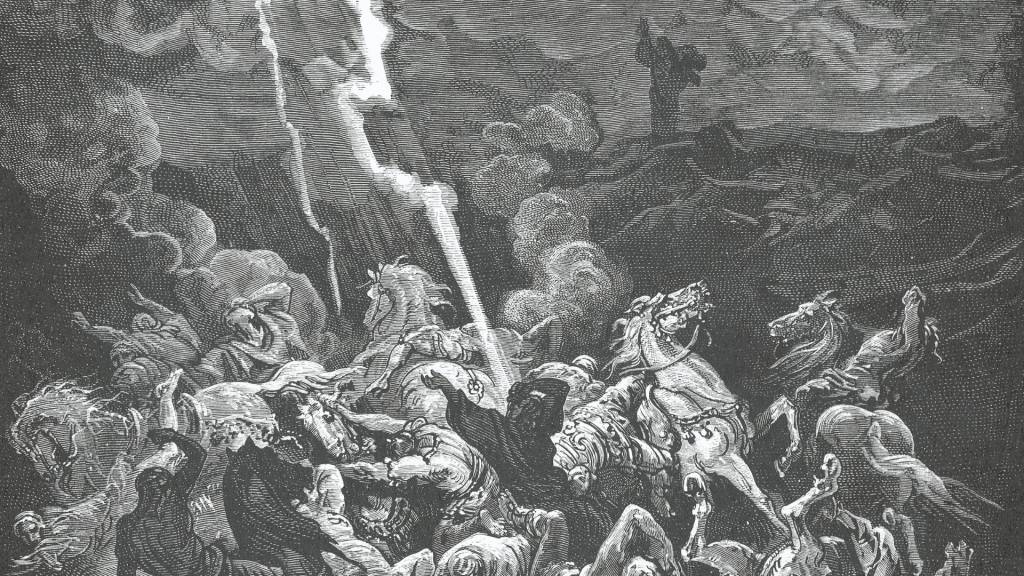
Gustave Dore, Fire Consumes the Soldiers of Ahaziah from the Illustrated Bible. 19th Century Engraving. Cropped Image

2 Kings 1

1 After the death of Ahab, Moab rebelled against Israel. 2 Ahaziah had fallen through the lattice in his upper chamber in Samaria, and lay injured; so he sent messengers, telling them, “Go, inquire of Baal-zebub, the god of Ekron, whether I shall recover from this injury.” 3 But the angel of the LORD said to Elijah the Tishbite, “Get up, go to meet the messengers of the king of Samaria, and say to them, ‘Is it because there is no God in Israel that you are going to inquire of Baal-zebub, the god of Ekron?’ 4 Now therefore thus says the LORD, ‘You shall not leave the bed to which you have gone, but you shall surely die.'” So Elijah went.

5 The messengers returned to the king, who said to them, “Why have you returned?” 6 They answered him, “There came a man to meet us, who said to us, ‘Go back to the king who sent you, and say to him: Thus says the LORD: Is it because there is no God in Israel that you are sending to inquire of Baal-zebub, the god of Ekron? Therefore you shall not leave the bed to which you have gone, but shall surely die.'” 7 He said to them, “What sort of man was he who came to meet you and told you these things?” 8 They answered him, “A hairy man, with a leather belt around his waist.” He said, “It is Elijah the Tishbite.”

9 Then the king sent to him a captain of fifty with his fifty men. He went up to Elijah, who was sitting on the top of a hill, and said to him, “O man of God, the king says, ‘Come down.'” 10 But Elijah answered the captain of fifty, “If I am a man of God, let fire come down from heaven and consume you and your fifty.” Then fire came down from heaven, and consumed him and his fifty.

11 Again the king sent to him another captain of fifty with his fifty. He went up and said to him, “O man of God, this is the king’s order: Come down quickly!” 12 But Elijah answered them, “If I am a man of God, let fire come down from heaven and consume you and your fifty.” Then the fire of God came down from heaven and consumed him and his fifty.

13 Again the king sent the captain of a third fifty with his fifty. So the third captain of fifty went up, and came and fell on his knees before Elijah, and entreated him, “O man of God, please let my life, and the life of these fifty servants of yours, be precious in your sight. 14 Look, fire came down from heaven and consumed the two former captains of fifty men with their fifties; but now let my life be precious in your sight.” 15 Then the angel of the LORD said to Elijah, “Go down with him; do not be afraid of him.” So he set out and went down with him to the king, 16 and said to him, “Thus says the LORD: Because you have sent messengers to inquire of Baal-zebub, the god of Ekron,– is it because there is no God in Israel to inquire of his word?– therefore you shall not leave the bed to which you have gone, but you shall surely die.”

17 So he died according to the word of the LORD that Elijah had spoken. His brother, Jehoram succeeded him as king in the second year of King Jehoram son of Jehoshaphat of Judah, because Ahaziah had no son. 18 Now the rest of the acts of Ahaziah that he did, are they not written in the Book of the Annals of the Kings of Israel?

This final prophetic episode in the Elijah cycle prior to the ascension of Elijah in the following chapter occurs during the year long reign of Ahaziah.[1] The division between 1 Kings and 2 Kings splits the comments on the brief reign of Ahaziah between the final three verses of 1 Kings and the initial chapter of 2 Kings. Ahaziah’s insignificant reign cut short by his injury and offense against God are contrasted with the significant prophet Elijah’s final action. The Book of Kings could easily have been the Book of Prophets, since for most of the book the kings are often secondary characters to the prophets.

Ahaziah fell from his upper chamber to the lower floor and is injured by the fall and confined to his bed. Yet, Ahaziah’s response to his injury is what dominates his portion of the story. Instead of appealing to the LORD, whether through a prophet or through the temple in Jerusalem he sends messengers to Ekron to appeal to the priests of prophets of Baal-zebub. There has been an ongoing animosity between the leaders in Samaria and Jerusalem, and the Omri dynasty has also been hostile to Elijah and other prophets of the LORD so on the one hand the action of Ahaziah to appeal to a foreign god, even a god of the once hostile Philistines, is not out of character for the Omri dynasty. Yet it is an audacious slight of the LORD the God of Israel, one that will have fatal consequences for this insignificant king.

Baal-zebub, the title for the god of Ekron would be the lord of the flies, and this is likely an intended insult of Baal-zebul the lord of the house. This is reflected title Beelzebul in the New Testament when Jesus is accused of being in lead with the lord of demons.[2] This minor spelling change turns the master of the house into the master of something considered a pest and nuisance in the ancient world. It is possible that ‘zebub’ is a local ‘baal’[3] and there is some debate over the rendering of ‘zebub’ as ‘fly’, but the Bible does frequently use insults for the other ‘gods’ that the people of Israel and the surrounding country follow.

Hebrew loves wordplay and it helps to know that the word for messenger (malakh) and angel (malakim) are closely related. Ahaziah sends messengers and the messenger of the LORD comes to Elijah to intercept these messengers of the king. Elijah’s message from the messenger (angel) of God speaks directly to the king’s messengers, “Is it because there is no God in Israel that you (plural) are going to inquire of Baal-zebub, the god of Ekron?” But when the king’s messengers return to the king they now point the blame on the king, “Is it because there is no God in Israel that you (singular) are sending to inquire of Baal-zebub, the god of Ekron?”  The sentence declared on the king is terminal by the LORD. As Brueggemann states:


The particular phrase, “surely die,” is repeated three times by the prophet (1:4, 6, 16). While the phrase looks commonplace in the English translation, it is in fact a quite severe, absolute, and formal pronouncement of a death penalty from which there is no escape or reprieve. (Brueggemann, 2000, p. 284)

From the description of the man who intercepted the prophets, a hairy man with a leather belt around his waist, the king realizes that it is the longtime foe of the Omri dynasty, the prophet Elijah. Elijah’s successor Elisha we will learn in 2:23 is bald and so there is a drastic difference in the appearance of the hairy man and the man ridiculed for being bald. The description of Elijah will also be paralleled, although in an inexact manner, by the appearance of John the Baptist at the beginning of the gospels.[4] Elijah and Elisha will be different in appearance and as we transition to the Elisha cycle it will be worthwhile to compare the ministries of these two prophets.

The king views Elijah as a threat and sends three separate leaders and soldiers to bring Elijah down from the mountain.[5] The king desires to bring Elijah down by force but only manages to cause Elijah to bring down the fire of God upon his forces.[6] The first commander of fifty goes up the mountain to approach Elijah and orders the man of God to come down, yet Elijah demonstrates that the forces of the king are no match for the power of God as the first group of fifty is consumed. The second leader goes up to Elijah, but he may not go up the mountain. There may be some hint in the story that this second commander keeps his distance, but his words indicate that now the king orders Elijah to come down. The second group of fifty meets the same fate as the first. The final commander comes and kneels before the prophet and asks the prophet to show grace[7] for his life and the lives of his men. This final commander also indicates that he is Elijah’s servant instead of the king’s. The messenger (angel) of the LORD lets Elijah know it is safe to go with this commander to deliver the message directly to the king.

For the narrative of 2 Kings, King Ahaziah dies because of the declaration of the LORD not the injuries the king receives falling through the lattice. Throughout the Elijah cycle the people under the Omri dynasty have had divided loyalties. Elijah is an uncompromising in his zeal for the LORD the God of Israel and although the Omri will continue beyond the time of Elijah, it is quickly coming to end. Ahaziah in the narrative of the Book of Kings will be one more king whose brief reign in Samaria will be defined by his disobedience to the LORD the God of Israel.


[1] 1 Kings 22:51 notes that Ahaziah ruled for two years. He came to power in the seventeenth year of Jehoshaphat of Judah and died in his eighteenth year, but his total reign was less than twelve months long. (Cogan, 1988, p. 21)

[2] Matthew 10:25; 12: 24,27; Mark 3:22; Luke: 11: 15, 18, 19.

[3] Baal is a general title for lord, and there were multiple ‘Baals’ worshipped regionally throughout Canaan.

[4] John is wearing camel’s hair as clothing rather than being described as hairy, although he does have the leather belt around his waist.

[5] Choon-Leong Seow notes that the same word har is used here as a Mount Carmel and the NIV and NRSV translation of this as ‘hill’ obscures the linkage to the previous story (1 Kings 18). (NIB III:173)   

[6] Once again there is a Hebrew wordplay between the word for ‘man’ (‘is) and the word for fire (‘es). NIB III: 173.

[7] NRSV entreat. The Hebrew hanan means “to show grace’. (Brueggemann, 2000, p. 286)

Introduction to 2 Kings

Cry Of Prophet Jeremiah on the Ruins of Jerusalem by Ilya Repin 1870

1&2 Kings together form a narrative that runs from the pinnacle of the nation of Israel under Solomon to its nadir at the beginning of the Babylonian exile. First and Second Kings were initially a common book, the book of Kings, which was later divided into two books in the biblical canon.[1] I worked through 1 Kings in 2022-2023, and now it is time to walk through the remainder of this story of the northern kingdom’s destruction by the Assyrian empire in 721 BCE and the Babylonian empire’s conquering of Judah in roughly 587 BCE. 1 Kings ends during of the ministry of Elijah and Elisha the prophets in northern Israel.

In the Jewish division of the Hebrew Scriptures the Deuteronomic History (Joshua, Judges, 1&2 Samuel, and 1&2 Kings) are all grouped with the prophets. They are history viewed through a theological lens and with the intention of looking backwards to understand the situation of the people in exile. There is a tradition of associating these books with Jeremiah, and they do share a common worldview. This association is heightened by the reality that 2 Kings and Jeremiah end with a narration that is almost identical.

2 Kings narrates the collapse of the land of Israel and the monarchy of both Israel (Samaria) and Judah. The kings throughout the book of Kings are evaluated by the theological perspective of Deuteronomy and with a few notable exceptions most of these kings can be summarized by the phrase, “He committed all the sins that his father did before him; his heart was not true to the LORD his God like the heart of his father David.” (1 Kings 15:3 referring to Abijam, son of Rehoboam, son of Solomon but similar language is used for all the ‘bad’ kings).

If you spend much time working in the Hebrew Scriptures/Old Testament, the impact of the Babylonian exile is unavoidable. It is a central defining crisis for the people of Judah. The books of Jeremiah, Lamentations, and Ezekiel are all centered around this time-period and 2 Kings’ historical narrative ends at the exile. 2 Kings has some stories that are utilized in the life of the church, but as a book the stories of 2 Kings are probably less familiar than the stories of 1 Kings. My journey through 1 Kings provided me a much fuller appreciation of this portion of the story of God’s people, and I look forward to discovering the conclusion of this portion of the story of Israel in a richer way.

Resources Used For This Journey

Brueggemann, Walter. 1 & 2 Kings. Macon, GA: Smith & Helwys Publishing Incorporated. 2000

Walter Brueggemann is one of the most prolific Christian writers on the Hebrew Scriptures and brings a wide breadth of knowledge on both the collection of scripture as whole. His writing is consistently readable and insightful and tends to explore challenging perspectives. The Smith & Helwys Bible Commentary series is a very attractive resource bringing together commentary and discussion with artwork, maps, and other visual resources. This resource is closer to the blogging format which I write in than many books. More of a thematic commentary which is useful for preaching and teaching. I also utilized this volume during my reflections on 1 Kings.

Cogan, Mordechai and Hayim Takmor, II Kings: A New Translation with Introduction and Commentary (The Anchor Bible). New York City: Doubleday & Company, Inc. 1988

The Anchor Bible, Now the Anchor Yale Bible, is a detailed textual commentary. I utilized Mordechai Cogan’s first volume in my work on 1 Kings. This is the longest and most detailed of the works I used for this journey through 2 Kings. This is a volume more directed to the specialist rather than the preacher or teacher and some knowledge of Hebrew is helpful in using this resource.

Israel, Alex. II Kings: In A Whirlwind. (Maggid Studies in the Tanakh). Jerusalem: Maggid Books, 2019.

I utilized Rabbi Alex Israel’s first volume in my reflections on 1 Kings. When looking at a Hebrew Scripture text I like to have a Jewish voice and the Maggid Studies are an approachable resource. Rabbi Israel’s skill as a teacher is on display in this volume as he writes an approachable text which brings 2 Kings into dialogue with the historical context and rabbinic interpretation. A clear and insightful perspective on the people and events of 2 Kings.

Seow, Choon-Leong. “The Books of 1 and 2 Kings.” In New Interpreter’s Bible III: 1-295.12 Vols. Nashville: Abingdon Press. 1999.

The NIB (New Interpreter’s Bible) is a solid resource as a resource for preaching and teaching that covers the entire bible and goes into some textual issues, but it primarily is focused on giving a fuller context to the story. Choon-Leon Seow’s contribution on the 1 and 2 Kings goes into a little more depth on translational issues than some other portions of this commentary set I’ve utilized, and this was a positive since it identified some interesting things to explore in the Hebrew text. This was another solid portion of the NIB and it is a resource worth having on the shelf for a pastor.


[1] The division initially occurred in the translation of the Hebrew Text into Greek (the Septuagint).

The Book of 1 Kings

By Hans Holbein the Younger – Christian Müller; Stephan Kemperdick; Maryan Ainsworth; et al, Hans Holbein the Younger: The Basel Years, 1515–1532, Munich: Prestel, 2006, ISBN 9783791335803., Public Domain, https://commons.wikimedia.org/w/index.php?curid=5977456

Transitioning into 1 Kings
1 Kings 1 An Uneasy Transition from David to Solomon
1 Kings 2 Bloody Beginnings
1 Kings 3 The Wisdom of Solomon
1 Kings 4 A Prosperous Beginning of Solomon’s Reign
1 Kings 5 The High Cost of Construction
1 Kings 6 The Construction of Solomon’s Temple
1 Kings 7 The Halls of Solomon and the Furnishing of the Temple
1 Kings 8 The Dedication of the Temple
1 Kings 9 Solomon’s Second Vision and Continued Reign
1 Kings 10 The Queen of Sheba and the Golden King
1 Kings 11 The Foolish End of Solomon
1 Kings 12 A Divided Kingdom
1 Kings 13 A Man of God, the King, and a Prophet: A Strange Story
1 Kings 14 The End of Kings Jeroboam and Rehoboam
1 Kings 15: 1-31 Kings Abijam and Asa of Judah, King Nadab of Israel and the Unending Conflict Between the Two Nations
1 Kings 15: 32-16:34 Unrest in Israel
1 Kings 17 Elijah the Prophet Emerges
1 Kings 18 Elijah’s Showdown with the Prophets of Baal
1 Kings 19 Elijah Encounters the LORD at Mount Horeb and the Appointment of Elijah
1 Kings 20 King Ahab and the Conflict with Aram
1 Kings 21 Naboth’s Vineyard
1 Kings 22 The End of King Ahab
Resources on the Book of 1 Kings
Reflections After a Journey Through 1 Kings

Reflections After a Journey Through 1 Kings

By Hans Holbein the Younger – Christian Müller; Stephan Kemperdick; Maryan Ainsworth; et al, Hans Holbein the Younger: The Basel Years, 1515–1532, Munich: Prestel, 2006, ISBN 9783791335803., Public Domain, https://commons.wikimedia.org/w/index.php?curid=5977456

I have been reading scripture for much of my life, but it wasn’t until I was in my second year of seminary that I had any background to understand the narrative of 1 Kings. Over twenty years later it was still a portion of scripture I rarely utilized. I was aware of Solomon, the split between Israel and Judah in the time of Rehoboam and Jeroboam, and the conflicts between Elijah and King Ahab but there are always insights gained from the sustained reflection of working through a book. The world of scripture is far more ancient and alien to our world than most people realize and working through both Judges and 1 Kings has helped me peel back some of the modern assumptions I have placed on these books.

The story of Solomon forms a large portion of the book of 1 Kings. The reign of Solomon is the pattern that many later leaders will attempt to follow but from the theological perspective of 1 Kings Solomon is a failed king. Solomon from an external perspective, and in the view of many Christians, is a paragon of wisdom, the builder of the great temple to the LORD, a person whose policies of trade make Israel a significant and wealthy player on the world scene. Yet, Solomon’s wisdom is directed towards acquisition and Solomon’s policies begin to model the policies of the nations that Solomon becomes partners with. Solomon from the theological perspective of 1 Kings is one who ‘gained the world at the cost of his life.’ Throughout Solomon’s story there is a tension between who he is and the model king of Deuteronomy 17: 14-20. Solomon ultimately walks into the path of idolatry as he is influenced by his numerous wives who are a part of his policy of alliance building. Solomon’s aggressive concentration of power, wealth, and the heavily utilization of forced labor begin to look like Pharoah and set the conditions for the rebellion under his son.

Once the Northern tribes break away under Jeroboam the focus of the narrative moves with the northern tribes (or Israel) instead of Judah. Even though Rehoboam and Abijam will be judged as evil kings who reigned over Judah their transgressions will be passed over for the sake of David and their mentions in the narrative are brief. When Asa and Jehoshaphat bring reforms to help bring Judah a long period of stability and faithful leadership they also receive only passing mentions in the narrative. Although 1 Kings is compiled by an author from Judah, the focus throughout the first book is on Israel. The reason for this focus is both the idolatry of the kings of Israel, but also the emergence of the prophets as a major voice in the story. Although the book is named the Book of Kings, it could just as easily be the book of prophets. The kings of Israel are the primary markers of time while the prophets are the primary markers of meaning. The prophets, both named prophets like Elijah and Micaiah and the unnamed prophets, continue to enact the LORD of Israel’s guidance and often are key manipulators of the rising and falling of the dynasties of Israel.

1 & 2 Kings together narrate the journey from Israel at the height of its power when it has fully come into possession of the promised land to its split and then the long journey towards the loss of the promised land in Israel under Assyria and in Judah under Babylon. As a historical reflection it attempts to answer the question why Israel and Judah failed. It evaluates the kings from the perspective of covenant loyalty/faithfulness which is a perspective that the kings probably would not have considered central. Yet, it enables the editor of 1 & 2 Kings to answer the question by showing that Israel and Judah are eventually defeated because they were unfaithful to the LORD the God of Israel who brought them out of Egypt and into the promised land. This God of Israel continually sent messengers to warn the people to return to their ways and these messengers, even with their acts of power, rarely were able to achieve lasting change. As Elijah would say to God, “I am no better than my ancestors.” (1 Kings 19: 4) The prophets for all their strangeness will encounter numerous others claiming to be prophets of God (or a god) while representing the interests of the king of the time. Throughout 1 Kings, Judah still has the Levitical priests and the temple which maintain the connection between the people and their God, but in Israel the kings from Jeroboam to Ahab have set up other images, altars and sometimes have explicitly brought in prophets of the gods of other nations like Baal or Asherah.

Although it is an ancient story, 1 Kings narrates the struggle of remaining faithful to the LORD the God of Israel in a world of numerous alternatives. Israel and Judah struggled to maintain their distinctiveness among the nations and kings often influenced their people to follow the practices of the nations they traded and made alliances with. Even when the prophets, like Elijah, may be ready to give up on Israel the God of Israel continues to act through the slow working of history to remove the unfaithful kings and to give new leaders a chance to be faithful. Even in the midst of the failures that are a part of the story it narrates a God who is slow to give up on this people and who eagerly looks for repentance.


1 Kings 19 Elijah Encounters the LORD at Mount Horeb and the Appointment of Elisha

Elijah in the Wilderness By Frederic Leighton (1877-78) – uQG9WGfbc10kDw at Google Cultural Institute maximum zoom level, Public Domain, https://commons.wikimedia.org/w/index.php?curid=21878932

1 Kings 19: 1-18

1 Ahab told Jezebel all that Elijah had done, and how he had killed all the prophets with the sword. 2 Then Jezebel sent a messenger to Elijah, saying, “So may the gods do to me, and more also, if I do not make your life like the life of one of them by this time tomorrow.” 3 Then he was afraid; he got up and fled for his life, and came to Beer-sheba, which belongs to Judah; he left his servant there.

4 But he himself went a day’s journey into the wilderness, and came and sat down under a solitary broom tree. He asked that he might die: “It is enough; now, O LORD, take away my life, for I am no better than my ancestors.” 5 Then he lay down under the broom tree and fell asleep. Suddenly an angel touched him and said to him, “Get up and eat.” 6 He looked, and there at his head was a cake baked on hot stones, and a jar of water. He ate and drank, and lay down again. 7 The angel of the LORD came a second time, touched him, and said, “Get up and eat, otherwise the journey will be too much for you.” 8 He got up, and ate and drank; then he went in the strength of that food forty days and forty nights to Horeb the mount of God. 9 At that place he came to a cave, and spent the night there.

Then the word of the LORD came to him, saying, “What are you doing here, Elijah?” 10 He answered, “I have been very zealous for the LORD, the God of hosts; for the Israelites have forsaken your covenant, thrown down your altars, and killed your prophets with the sword. I alone am left, and they are seeking my life, to take it away.”

11 He said, “Go out and stand on the mountain before the LORD, for the LORD is about to pass by.” Now there was a great wind, so strong that it was splitting mountains and breaking rocks in pieces before the LORD, but the LORD was not in the wind; and after the wind an earthquake, but the LORD was not in the earthquake; 12 and after the earthquake a fire, but the LORD was not in the fire; and after the fire a sound of sheer silence. 13 When Elijah heard it, he wrapped his face in his mantle and went out and stood at the entrance of the cave. Then there came a voice to him that said, “What are you doing here, Elijah?” 14 He answered, “I have been very zealous for the LORD, the God of hosts; for the Israelites have forsaken your covenant, thrown down your altars, and killed your prophets with the sword. I alone am left, and they are seeking my life, to take it away.” 15 Then the LORD said to him, “Go, return on your way to the wilderness of Damascus; when you arrive, you shall anoint Hazael as king over Aram. 16 Also you shall anoint Jehu son of Nimshi as king over Israel; and you shall anoint Elisha son of Shaphat of Abel-meholah as prophet in your place. 17 Whoever escapes from the sword of Hazael, Jehu shall kill; and whoever escapes from the sword of Jehu, Elisha shall kill. 18 Yet I will leave seven thousand in Israel, all the knees that have not bowed to Baal, and every mouth that has not kissed him.”

Elijah’s triumph over the prophets of Baal and triumphal run before King Ahab quickly dissolves before the vengeful fury of Jezebel. Jezebel becomes the primary opponent of Elijah, not King Ahab, and although she may be unable to act openly on the day of Elijah’s triumph when the rains have returned and the memory of the fire of the LORD consuming the altar and the sacrifice still is fresh on Ahab and the crowd’s memory, she acts through a messenger.[1] The messenger relays Jezebel’s promise of death. Her threat has already eliminated many prophets of the LORD and has sent many others into hiding.[2] Ultimately Jezebel’s warning enables Elijah’s escape, but as Alex Israel points out, “She need not actually kill him; she is happy to see him disappear for another three years!” (Israel, 2013, p. 260) Jezebel views Elijah as a singular threat to the values she represents.

Jezebel as she is represented in the narrative of 1 Kings is the antithesis of the values of the covenantal way of the Torah (the law of Israel). Some have speculated that the canonical portrayal of Jezebel is another example of a patriarchal silencing of a powerful woman, but the issue for the author of 1 Kings is not the power Jezebel wields but how her use of it leads people away from the ways of covenantal faithfulness. Jezebel’s name will become a symbol for all that leads away from faithful adherence to the way of God in both Jewish and Christian thought. For example, Jezebel’s name will later be used in the book of Revelation for a figure who is leading the faithful astray. [3] For the narrative of 1 Kings, Jezebel and Elijah represent the opposing poles which Israel continues to ‘limp’ between. Jezebel represents faithfulness to the Phoenician gods and values of her family while Elijah represents fidelity to the worship and covenantal values of the LORD the God of Israel. Israel often attempted to combine elements of both into their communal life but both Elijah and Jezebel are violently opposed to this accommodation.

There have been many who have speculated on Elijah’s mental state as he flees the threat of Jezebel and heads into the wilderness outside the territory of Israel. He passes over the border into Jerusalem and then leaves behind his servant and heads alone on his journey. In Brueggemann’s words,

He arrives in the wilderness completely spent. He has mustered enormous energy for the dispute at Carmel. And though he has won, he is permitted no chance of exultation. His wish-prayer of v.4 is for death. He is distressed and dismayed. And then he sleeps. He has no energy for anything else. (Brueggemann, 2000, p. 234)

It is possible that after the contest with the prophets of Baal and the run to Jezreel that Elijah is physically, emotionally, and spiritually exhausted but the scriptures rarely share these details in their narration of the story. Others have speculated that Elijah is in a deep bout of depression as he asks God to end his life, and that is possible although ancient people would not have thought of depression as a clinical issue but merely as a state of melancholia. I would suggest another alternative, one that does not rule out exhaustion or depression, Elijah’s heart is broken. Elijah presided over the defeat and destruction of the prophets of Baal, rallied the people, ran before the king, and still, no one in Israel seems to be able to protect him from Queen Jezebel. Israel’s turn back towards the LORD the God of Israel seems to Elijah to have been washed away by the returning rains and forgotten once they left Mount Carmel. Three years of drought and hiding, the people’s suffering, the prophets’ death all seems to count for nothing and Elijah, for all his zeal, has not managed to change the course of the people. In his words he is no better than those who came before him and failed to change things.

The journey[4] of Elijah has been difficult. The journey that takes him into the wilderness is merely one part of this exhausting journey, but now alone he is content to leave the people behind and appeal to his God for death. Finding a solitary tree in the wilderness, Elijah is ready to renounce his vocation and his life. A messenger set him on this flight, and now another messenger replies to his plea for his journey and his life to end. One messenger threatens death, the second brings nourishment and comfort that brings the prophet back from his wish for death. This angelic messenger from God meets him as he sleeps. Sleep is often a time where God or God’s messengers interact with the faithful. We often discount this space of sleep and dreams but in the scriptures it is often a place where the divine draws close. Yet, this angelic messenger does not bring just guidance but brings tangible food and drink to help restore the prophet’s strength. This passage uses a number of uncommon Hebrew words to talk about the cake, ‘hot stones,’ and jar of water that link us to other critical scenes in the scriptures. The words for ‘cake’ and ‘jar’[5] are the same words that are used when Elijah asks the widow for water and a cake of bread in 1 Kings 17: 8-16, and now Elijah is like the widow and her son nearing the point of death and needing divine provision in a place where no food grows. ‘Hot coals’ or ‘hot stones’[6] is only used here and in Isaiah 6:6 when the seraphs bring a hot stone to purify Isaiah’s lips. (NIB III: 140) Food, drink, and rest are the divine answers to the prophets who has been worn out on the way. The second time the angel awakens Elijah he encourages him to eat again “or the way will be too much for you.” The NRSV’s translation indicates that the food is for the journey ahead to Mount Horeb, but the Hebrew is more ambiguous.[7] It may refer to the forty day and forty-night journey to and sojourn on Mount Horeb[8] but it also may refer more broadly to the way that Elijah will be called to walk as the prophet of God.

Mount Horeb is a sacred space in the imagination of Israel. Mount Horeb and Mount Sinai refer to the same mountain, the mountain where God first spoke to Moses, where the people receive the commandments of the LORD, and critically where Moses goes to appeal to God after the people worshipped the golden calf. The cave that Elijah journeys to is likely the same cleft where Moses hid while God passed by (Exodus 33:22). Elijah is coming to a place where he can encounter God directly. God is bringing Elijah to a place where he can be reoriented to the way of Moses.

In the commandments, the explanation for making not making an idol is, “for I the LORD your God am a jealous God,” and the words[9] translated ‘zealous’ when referring to Elijah is the same word in the commandment for God’s ‘jealousy.’ A close reader might begin to question if Elijah is taking too much responsibility on his shoulders, attempting to be ‘jealous’ in God’s stead. As mentioned above I do believe that Elijah is heartbroken over the seeming inability of Israel to maintain faithfulness to God his own seeming ineffectiveness as a prophet. Elijah is jealous on behalf of God and perhaps angry at feeling left alone to complete this work. Although we know that there are at least one hundred prophets who were rescued by Obadiah, Elijah’s complaint that he is alone to bear the burden of Israel’s unfaithfulness and it is a burden he can no longer bear.

The LORD grants Elijah’s wish for an audience, but it does not transpire as Elijah probably hoped. Baal is a storm god in Canaanite mythology and so the approach of a great wind would be associated with a god of storms, but the LORD was not in this wind which breaks rocks apart. The earthquake and the fire are also forces of immense power and places where God’s presence may be expected but God appears in none of these destructive forces. These things are driven before the LORD as the LORD approaches[10] but when they have passed the LORD is present in the ‘sound of sheer silence.’ The ‘sound of sheer silence’ comes from three Hebrew words: kol -voice or sound, demama- silence, and daka-thin, withered, or granular. The voice can be emerging from the silence or present in the silence, but it is not the terrifying, destructive thing that preceded it. Elijah wraps his mantle around his face and walks into the sound and silence.

Twice Elijah is asked “What are you doing here?” and twice he responds, “I have been zealous for the LORD, the God of hosts; for the Israelites have forsaken your covenant, thrown down your altars, and killed your prophets with the sword. I alone am left, and they are seeking my life to take it away.” Unlike Moses who goes up the mountain to plead for the people, Elijah goes up the mountain to accuse the people. Elijah had earlier mocked the prophets of Baal for their god’s inactivity, now Elijah is frustrated with the LORD’s response to the unfaithfulness among the people.

He cannot stand that God will sit by and watch as the nation adopts Baal as its deity… God wishes to function in the world via the “still, small voice”; Elijah wants fire, thunder, and earthquake. He cannot accommodate a world in which Jezebel can rule with a free hand, and does not understand why god will not bring the world to order. (Israel, 2013, pp. 266-267)

Elijah is brokenhearted with both the LORD and with Israel and stands caught between both. The world no longer makes sense to this prophet who sees his work on behalf of God met with threats of violence. Elijah is seeking a world where either the LORD acts against Jezebel and those who oppose the prophets or he no longer bears this burden.

The LORD will act and will grant what Elijah wishes, but not in the way that Elijah expects. Elijah does receive a mandate to return to his way, but it is a journey where he will be setting in motion the forces that end the reign of Ahab and Jezebel. The LORD is not going to act through wind, earthquake and fire, nor will the LORD summon the heavenly host, instead the LORD is going to work through the movement of forces within and external to Israel. God will work behind the scenes of history in the transitions of power. Elijah has perhaps in his jealousy overestimated his own significance in feeling that he is the only faithful one left, while God discloses a remnant of seven thousand and has designated another to bear his mantle. Elijah’s wish for his service and life to be at an end will be granted by God, but he is given three final tasks to prepare the way for the future. Ironically, the prophet who has complained about the unfaithfulness of Israel will not fulfill his final directive in the way the LORD directs.

1 Kings 19: 19-21

19 So he set out from there, and found Elisha son of Shaphat, who was plowing. There were twelve yoke of oxen ahead of him, and he was with the twelfth. Elijah passed by him and threw his mantle over him. 20 He left the oxen, ran after Elijah, and said, “Let me kiss my father and my mother, and then I will follow you.” Then Elijah said to him, “Go back again; for what have I done to you?” 21 He returned from following him, took the yoke of oxen, and slaughtered them; using the equipment from the oxen, he boiled their flesh, and gave it to the people, and they ate. Then he set out and followed Elijah, and became his servant.

Elijah never makes it to Damascus. Instead he approaches his replacement first and casts his mantle upon him. Abel-meholah is closer to Mount Horeb than Damascus and it may reflect an exhausted and broken-hearted prophet ready to pass the mantle of prophecy to another. Elisha, whose name means ‘God is my salvation’, is presumably coming from a wealthy household since he has twelve yoke of oxen to plow with. Yet, when Elijah throws the mantle over him Elisha is willing to leave this life behind, he only asks Elijah’s permission to say farewell. Although Jesus will later say to a disciple who wishes to bury his father, “let the dead bury their own dead.” (Matthew 8:21), there is no judgment expressed by Elijah. There may be a note of regret as Elijah says to Elisha, “Go back again; for what have I done to you?” The brokenhearted prophet may not wish for another to leave behind a life of prosperity for a life of deprivation and hardship, a life hunted by those in power. Yet, Elisha in saying farewell not only to his parents, but also the community, sacrifices the oxen and sets out to join Elijah on the way.

[1] The Hebrew mal’ak is used for both the messenger of Jezebel and the angel of the LORD in this passage.

[2] Notably the 100 prophets hidden by Obadiah in the previous chapter.

[3] Revelation 2:20

[4] Journey and way throughout this passage are the Hebrew derek which generally means way, road, distance, or journey.

[5] Hebrew ‘uga and shappahat

[6] Hebrew reshapim

[7] Hebrew mimmeka haddarek (NIB III: 140)

[8] The forty-day journey can be literal, but forty days is also frequently a way that the scriptures refer to a long and complete time. The number forty in Jewish thought often designates completeness, hence forty years in the wilderness, forty days Moses spends on Mount Sinai receiving the law, forty days of temptation, and many other examples.

[9] Quanno qunneti

[10] This imagery is common in scriptures, for example Judges 5: 4-5, Psalm 18:7-10, and Isaiah 29:6

1 Kings 18 Elijah’s Showdown with the Prophets of Baal

1 Kings 18

Elijah Stained Glass Window By Cadetgray – Own work, CC BY-SA 3.0, https://commons.wikimedia.org/w/index.php?curid=13329347

1 After many days the word of the LORD came to Elijah, in the third year of the drought, saying, “Go, present yourself to Ahab; I will send rain on the earth.” 2 So Elijah went to present himself to Ahab. The famine was severe in Samaria. 3 Ahab summoned Obadiah, who was in charge of the palace. (Now Obadiah revered the LORD greatly; 4 when Jezebel was killing off the prophets of the LORD, Obadiah took a hundred prophets, hid them fifty to a cave, and provided them with bread and water.) 5 Then Ahab said to Obadiah, “Go through the land to all the springs of water and to all the wadis; perhaps we may find grass to keep the horses and mules alive, and not lose some of the animals.” 6 So they divided the land between them to pass through it; Ahab went in one direction by himself, and Obadiah went in another direction by himself.

7 As Obadiah was on the way, Elijah met him; Obadiah recognized him, fell on his face, and said, “Is it you, my lord Elijah?” 8 He answered him, “It is I. Go, tell your lord that Elijah is here.” 9 And he said, “How have I sinned, that you would hand your servant over to Ahab, to kill me? 10 As the LORD your God lives, there is no nation or kingdom to which my lord has not sent to seek you; and when they would say, ‘He is not here,’ he would require an oath of the kingdom or nation, that they had not found you. 11 But now you say, ‘Go, tell your lord that Elijah is here.’ 12 As soon as I have gone from you, the spirit of the LORD will carry you I know not where; so, when I come and tell Ahab and he cannot find you, he will kill me, although I your servant have revered the LORD from my youth. 13 Has it not been told my lord what I did when Jezebel killed the prophets of the LORD, how I hid a hundred of the LORD’s prophets fifty to a cave, and provided them with bread and water? 14 Yet now you say, ‘Go, tell your lord that Elijah is here’; he will surely kill me.” 15 Elijah said, “As the LORD of hosts lives, before whom I stand, I will surely show myself to him today.” 16 So Obadiah went to meet Ahab, and told him; and Ahab went to meet Elijah.

17 When Ahab saw Elijah, Ahab said to him, “Is it you, you troubler of Israel?” 18 He answered, “I have not troubled Israel; but you have, and your father’s house, because you have forsaken the commandments of the LORD and followed the Baals. 19 Now therefore have all Israel assemble for me at Mount Carmel, with the four hundred fifty prophets of Baal and the four hundred prophets of Asherah, who eat at Jezebel’s table.”

20 So Ahab sent to all the Israelites, and assembled the prophets at Mount Carmel. 21 Elijah then came near to all the people, and said, “How long will you go limping with two different opinions? If the LORD is God, follow him; but if Baal, then follow him.” The people did not answer him a word. 22 Then Elijah said to the people, “I, even I only, am left a prophet of the LORD; but Baal’s prophets number four hundred fifty. 23 Let two bulls be given to us; let them choose one bull for themselves, cut it in pieces, and lay it on the wood, but put no fire to it; I will prepare the other bull and lay it on the wood, but put no fire to it. 24 Then you call on the name of your god and I will call on the name of the LORD; the god who answers by fire is indeed God.” All the people answered, “Well spoken!” 25 Then Elijah said to the prophets of Baal, “Choose for yourselves one bull and prepare it first, for you are many; then call on the name of your god, but put no fire to it.” 26 So they took the bull that was given them, prepared it, and called on the name of Baal from morning until noon, crying, “O Baal, answer us!” But there was no voice, and no answer. They limped about the altar that they had made. 27 At noon Elijah mocked them, saying, “Cry aloud! Surely he is a god; either he is meditating, or he has wandered away, or he is on a journey, or perhaps he is asleep and must be awakened.” 28 Then they cried aloud and, as was their custom, they cut themselves with swords and lances until the blood gushed out over them. 29 As midday passed, they raved on until the time of the offering of the oblation, but there was no voice, no answer, and no response.

30 Then Elijah said to all the people, “Come closer to me”; and all the people came closer to him. First he repaired the altar of the LORD that had been thrown down; 31 Elijah took twelve stones, according to the number of the tribes of the sons of Jacob, to whom the word of the LORD came, saying, “Israel shall be your name”; 32 with the stones he built an altar in the name of the LORD. Then he made a trench around the altar, large enough to contain two measures of seed. 33 Next he put the wood in order, cut the bull in pieces, and laid it on the wood. He said, “Fill four jars with water and pour it on the burnt offering and on the wood.” 34 Then he said, “Do it a second time”; and they did it a second time. Again he said, “Do it a third time”; and they did it a third time, 35 so that the water ran all around the altar, and filled the trench also with water.

36 At the time of the offering of the oblation, the prophet Elijah came near and said, “O LORD, God of Abraham, Isaac, and Israel, let it be known this day that you are God in Israel, that I am your servant, and that I have done all these things at your bidding. 37 Answer me, O LORD, answer me, so that this people may know that you, O LORD, are God, and that you have turned their hearts back.” 38 Then the fire of the LORD fell and consumed the burnt offering, the wood, the stones, and the dust, and even licked up the water that was in the trench. 39 When all the people saw it, they fell on their faces and said, “The LORD indeed is God; the LORD indeed is God.” 40 Elijah said to them, “Seize the prophets of Baal; do not let one of them escape.” Then they seized them; and Elijah brought them down to the Wadi Kishon, and killed them there.

41 Elijah said to Ahab, “Go up, eat and drink; for there is a sound of rushing rain.” 42 So Ahab went up to eat and to drink. Elijah went up to the top of Carmel; there he bowed himself down upon the earth and put his face between his knees. 43 He said to his servant, “Go up now, look toward the sea.” He went up and looked, and said, “There is nothing.” Then he said, “Go again seven times.” 44 At the seventh time he said, “Look, a little cloud no bigger than a person’s hand is rising out of the sea.” Then he said, “Go say to Ahab, ‘Harness your chariot and go down before the rain stops you.'” 45 In a little while the heavens grew black with clouds and wind; there was a heavy rain. Ahab rode off and went to Jezreel. 46 But the hand of the LORD was on Elijah; he girded up his loins and ran in front of Ahab to the entrance of Jezreel.

Elijah’s well-known confrontation with the prophets of Baal on Mount Carmel portrays a public demonstration of the LORD the God of Israel’s power over Baal or any other deity. King Ahab’s policies prior to the drought seemed to be leading Israel to a new time of prosperity: they were oriented on trade with Tyre and Sidon, we know from extra-biblical sources that he built up a large stables and chariot force, and Israel seems to be a force among the local kingdoms. Yet, the three years of drought have reduced Ahab and his palace steward to searching for forage for the animals he has collected. There seems to be little concern for the suffering of the population, at least as 1 Kings narrates the story. The horses and donkeys of the royal stables would have been both symbolic of the wealth of the king and instrumental in the military of Israel. Yet, for all their former strength, now these two men are reduced to seeking the last remnants of water and grass to attempt to keep some of their animals alive.

Obadiah is caught between competing loyalties. Obadiah reveres the LORD and has saved one hundred of the prophets of the God of Israel from those loyal to Queen Jezebel. Yet, Obadiah serves in a position of great responsibility and privilege as the steward of the palace. Obadiah is caught between his overt loyalty to the king, and his covert actions to attempt to care for the servants of the LORD. The appearance of Elijah troubles the delicate balance of his life between the LORD and his lord Ahab.

After three years of drought, and the near death of the widow’s son in the previous chapter providing a human face for the suffering of the years, God declares to Elijah that it is now the time to act and to declare that rain is returning to the region. Elijah will no longer hide in the wadi or in foreign territory. Now he is to go directly to Ahab and to bring the challenge directly to the king of Israel. Elijah’s absence from the public scene has allowed Ahab and Jezebel to eliminate many other prophetic voices that would trouble their reign. Now the king who built an altar to Baal and the prophet of the LORD of Israel are finally going to meet for the first time since Elijah declared an end to the rain and the dew.

Obadiah’s encounter with Elijah foreshadows the challenge Israel faces as it ‘limps between two opinions.’ Obadiah reveres the LORD and bows down before Elijah upon seeing him, and yet he is fearful of reaction of Ahab who has set out to destroy Elijah. The initial response of Elijah to “Go tell your lord the Elijah is here” can also mean “Go tell your lord Lo, the LORD is God.”[1] (NIB III: 132) Obadiah, whose name means ‘worshipper of the LORD,’ now has to choose between his loyalty to God and his prophet and the king who seeks the prophet’s life. Obadiah has danced between the two, saving prophets and serving the king, for years and he fears the potential of the king’s wrath. Elijah has been absent for three years as the king sought him and Obadiah fears that the LORD will whisk him away on the wind once he goes to alert the king. Yet, Elijah assures Obadiah that he will be present when the king returns. Obadiah, once the servant to the king, now goes forth as the messenger of Elijah and by extension Elijah’s LORD.

Ahab, on arrival, declares that Elijah is the ‘troubler of Israel.’ From Ahab’s point of view, Elijah declared the drought which has caused great suffering among the people and animals of the kingdom and has unsettled the land. Yet Elijah declares that it is Ahab and his household that have brought this trouble upon Israel by turning their back on the LORD the God of Israel and worshipping Baal. Elijah proposes a prophetic showdown on Mount Carmel so that the people can stop wavering in their loyalties and choose either the LORD or Baal as the focus of their worship.

Elijah’s challenge to the people is met with silence. Without some demonstration the people seem content with their dual loyalties, but when presented with a demonstration they believe that Elijah’s proposal is well spoken. The numerous prophets of Baal are allowed to begin the show by preparing their altar and bull and calling repeatedly upon the name of Baal. Yet there is no voice and no answer. Like the nation of Israel ‘limping’ between different opinions, the prophets of Baal ‘limp’ around the altar.[2] Elijah mocks their ineffectual cries and actions, declaring they should try harder to summon their god’s attention. Finally, the action of drawing blood is added to their cries and ‘limping’ to attempt to draw the attention of Baal but again there is no voice, no answer, and no response.

Elijah calls the crowd to himself after they have observed the priests of Baal in their wailing and limping and bleeding. Elijah build an altar with twelve stones, summoning the people back to their origin as twelve tribes. It is possible that Elijah is rebuilding a previously existing altar that existed on the site, but the construction of the altar with twelve stones harkens back to the actions to their forefathers. The dimensions of the trench around the altar is disputed, but the action of soaking the altar and the offering with water by the people makes the demonstration of the LORD’s power more impressive. Elijah’s brief appeal to the LORD brings about an instant response as the fire of the LORD consumes the offering, the water, the stones, the wood, and even the dust. The people, upon seeing this demonstration, immediately fall on their faces and reaffirm their loyalty to the LORD.

Elijah demands that the prophets of Baal be seized, and he executes them at the Wadi Kishon. Some view Elijah’s actions as similar to Jezebel’s action of killing the prophets of the LORD.  Jezebel and Ahab probably viewed the killing of the prophets of the LORD as a way of eliminating opponents to their reign. Yet, Elijah probably views this execution of the prophets of Baal as essential to cleansing the land from its idolatry and removing a temptation from the people to return to their divided loyalties. The text does not indicate that the prophets of Asherah are present at this event, but the death of these prophets of Baal in the dry streambed Deborah and Barak battled the forces of King Jabin of Canaan (Judges 4) reasserts the dominion of the LORD over Israel.

In the aftermath of the prophetic challenge, Elijah speaks to Ahab in a very civil manner telling him to go eat and drink. Ahab obeys. Elijah returns to Carmel to await the rain, bowing down and presumably praying for the rain to come. Elijah’s servant is told to look for rain clouds and report back, and after seven trips to the pinnacle to look toward the sea the initial rain cloud is seen. Elijah then sends the message to Ahab to return home before the rain makes the journey impossible by chariot. The action of Elijah girding up his loins and running before the chariot of Ahab can be seen as both a demonstration of the hand of the LORD on Elijah in granting him speed and Elijah serving as one who runs before the king and may indicate a second chance for Ahab.

For the moment, Elijah is safe as he enters Jezreel before the king. The rain comes and washes away the blood that was spilled. The crops and animals languishing in the drought finally have a chance of renewal. And Israel has an opportunity to stop limping between its loyalty to the LORD the God of Israel and the gods of the surrounding nations. Yet, Elijah who here runs before the king will soon run away from a vengeful queen and the way of life represented by Baal has not been uprooted. Miracles rarely seem to produce a lasting change in behavior.

The struggles of Obadiah and Israel as they attempt to limp through life with divided loyalties is a struggle that is relevant to the faithful as they attempt to remain true to their faith in the midst of the demands and constraints of the world. There are times where the faithful will have to reassert that they will follow the LORD and reclaim the obedience to the covenant way of life that the LORD expects. Even through the three years of drought where the prophets have been silenced, God has not abandoned the people and will not let Elijah remain in isolation. God continues to call the king and the people back to the way of the commandments. Yet, even Elijah will struggle with the forces that oppose the prophetic call of faithfulness to the LORD the God of Israel.

[1] Because Elijah’s name means the LORD is God there is this double meaning.

[2] Both are using the Hebrew verb psh. All Hebrew verbs are based on three letters and then conjugated into their form.

1 Kings 17 Elijah the Prophet Emerges

1 Kings 17: 1-7 Elijah’s Declaration

1 Now Elijah the Tishbite, of Tishbe in Gilead, said to Ahab, “As the LORD the God of Israel lives, before whom I stand, there shall be neither dew nor rain these years, except by my word.” 2 The word of the LORD came to him, saying, 3 “Go from here and turn eastward, and hide yourself by the Wadi Cherith, which is east of the Jordan. 4 You shall drink from the wadi, and I have commanded the ravens to feed you there.” 5 So he went and did according to the word of the LORD; he went and lived by the Wadi Cherith, which is east of the Jordan. 6 The ravens brought him bread and meat in the morning, and bread and meat in the evening; and he drank from the wadi. 7 But after a while the wadi dried up, because there was no rain in the land.

Particularly in the Northern Kingdom of Israel we have seen prophets occupy a large role in the transition between royal dynasties. Yet, these prophets have not been listened to by the kings of Israel as they kings have drifted further away from loyalty to the LORD the God of Israel. Now under King Ahab are actively promoting the worship of Baal. With the sudden appearance of Elijah we see a dramatic interruption of the narrative of the kings of Israel where the prophetic voice emerges as to challenge the unfaithful (in the view of the narrator of First Kings) stewardship of these kings. As Walter Brueggemann states of the emergence of these prophets:

It is impossible to overstate the historical, literary, and theological significance of this intrusion that features in turn, Elijah (1 Kings 17-21 along with 2 Kings 1-2), Miciah (1 Kings 22), and Elisha (2 Kings 3-9). The three are completely unexpected, uncredentialed, and uninvited characters in the royal history of Israel. According to the tale told, they enact the raw unfiltered power of Yahweh that lies completely beyond the command of the royal houses. Indeed, their presence in the narrative service to expose the inadequacy and lameness of the kings as shapers of history, in order to assert that real authority and real energy for historical reality lie outside the legitimated claims of monarchy. (Brueggemann, 2000, p. 207)

Elijah the Tishbite in an important symbol in the practice of Judaism. Elijah is present at circumcision ceremonies, the seder table, and is to be the herald of the messiah. In Christianity Elijah is associated with John the Baptist and many of Elijah’s acts which demonstrate the LORD’s power will be mirrored by Jesus in his ministry. Elijah’s name is a combination of the generic word for god ‘El’ and the name of the LORD the God of Israel ‘Yahweh” and means ‘Yahweh is my God.’ In Alex Israel’s description on the biblical persona of Elijah:

Elijah is a zealot (19:10, 14)—agitated, demanding, and passionate; he is the brusque, itinerant prophet who causes fire to descend from heaven to earth, and who ends his life by ascending heavenward in a fiery chariot (II Kings 2:11). (Israel, 2013, p. 229)

There is some debate about Tishbe, the geolocation given to Elijah because there is no known site for this town. Some have speculated that Elijah is a foreign follower of the LORD the God of Israel who was in Gilead at the time of Ahab, but regardless of his origin he becomes the defender of the worship of the LORD of Israel and the challenger to Ahab’s promotion of Baal as the favored deity of the north.

Throughout the articulation of the law in Deuteronomy there are consequences for turning away from the worship and the commandments of the LORD the God of Israel. Drought and the failure of the land to produce the food needed for life is one of the frequently articulated consequences.

Take care, or you will be seduced into turning away, serving other gods and worshipping them, for then the anger of the LORD will be kindled against you and he will shut up the heavens, so that there will be no rain and the land will yield no fruit; then you will perish quickly off the good land that the LORD is giving you. Deuteronomy 11: 16-17 (see also Deuteronomy 28:22)

Elijah invokes the LORD in his declaration that there will be neither rain nor dew until he calls for rain as a fulfillment of these consequences.[1] Elijah’s declaration challenges both the prosperity that Ahab’s reign has brought to Israel and the claims of Baal worship. Baal in Canaanite religion is a storm god and when there are periods of drought it is presumed that death (personified as a deity in Canaanite religion) has slain Baal and conversely when the rains come Baal has conquered death. (NIB III: 126) Much like the signs and wonders in Egypt where the LORD demonstrated power over the Egyptian gods (Exodus 7-11) now the LORD demonstrates mastery over Baal by withholding the rains.

Elijah’s withdrawl to the Wadi Cherith east of the Jordan returns the prophet to Gilead. Ravens become the strange providers of the nourishment that the prophet needs to survive in this wilderness environment. Although ravens are considered unclean birds and do have some negative associations in scripture[2] this scene also share similarities with God’s provision for Israel in the wilderness with manna and quails.[3] Ravens are a large bird and are capable of bringing a larger quantity of food than many other birds would be capable of. The Talmud adds the entertaining element that the ravens are either stealing food from the table of King Ahab or King Jehoshaphat in Jerusalem and bringing it to the wadi for the prophet. (Israel, 2013, p. 233) Yet, as the drought continues, and the prophet continues to remain hidden in east of the Jordan river the waters of the wadi dry up and the prophet begins to encounter the dangers felt throughout the land as the rain and dew are withheld. God will need to provide a new place where the prophet can survive the presumed threat from King Ahab and the lack of food and water in the drought.

1 Kings 17: 8-16 Elijah and the Widow of Zarephath

8 Then the word of the LORD came to him, saying, 9 “Go now to Zarephath, which belongs to Sidon, and live there; for I have commanded a widow there to feed you.” 10 So he set out and went to Zarephath. When he came to the gate of the town, a widow was there gathering sticks; he called to her and said, “Bring me a little water in a vessel, so that I may drink.” 11 As she was going to bring it, he called to her and said, “Bring me a morsel of bread in your hand.” 12 But she said, “As the LORD your God lives, I have nothing baked, only a handful of meal in a jar, and a little oil in a jug; I am now gathering a couple of sticks, so that I may go home and prepare it for myself and my son, that we may eat it, and die.” 13 Elijah said to her, “Do not be afraid; go and do as you have said; but first make me a little cake of it and bring it to me, and afterwards make something for yourself and your son. 14 For thus says the LORD the God of Israel: The jar of meal will not be emptied and the jug of oil will not fail until the day that the LORD sends rain on the earth.” 15 She went and did as Elijah said, so that she as well as he and her household ate for many days. 16 The jar of meal was not emptied, neither did the jug of oil fail, according to the word of the LORD that he spoke by Elijah.

Apparently the effects of the drought are not only being felt in Israel, but also in the region of Tyre and Sidon. Geographically this is not a long distance (approximately 40-50 miles as the raven flies depending on where East of the Jordan Elijah is coming from), and it is not surprising that they would encounter the same weather patterns. From a theological perspective, which is central to the narration of First Kings, it also extends the judgment against Baal into the land where Baal is expected to reign. Now the LORD the God of Israel will provide food in this Phoenician commercial city for the widow where King Ethbaal and Baal cannot. Yet, Elijah’s demonstrations of the power of the LORD will not be a public spectacle but will take place in small ways that would be unnoticed by many in this city. Elijah’s demonstration of the LORD’s power will be seen only by those who pay attention to the widow and her plight.

On arriving in Zarephath and discovering the widow that the LORD indicated he immediately asks her for water and then food. The widow still has some water to share, but she is preparing to make a final meal for herself and her son before starvation takes its course. The widow must recognize Elijah as an Israelite, for the oath she swears is by the LORD, Elijah’s God. She does not claim the LORD as her own God, but she recognizes Elijah as an Israelite and still is willing to share water with him. Elijah still demands her hospitality and to be served first before she feeds herself and her son, and the widow apparently complies. The promised provision of oil and flour continues to provide for her and perhaps those in her network during the drought as the LORD provides for the widow and her son, two individuals who are among the most vulnerable in the event of an extended drought. Elijah who has been isolated at the Wadi Cherith is now presented with a human face to the impact of the drought that he declared on the land.

1 Kings 17: 17-24 Elijah Revives the Widow’s Son

17 After this the son of the woman, the mistress of the house, became ill; his illness was so severe that there was no breath left in him. 18 She then said to Elijah, “What have you against me, O man of God? You have come to me to bring my sin to remembrance, and to cause the death of my son!” 19 But he said to her, “Give me your son.” He took him from her bosom, carried him up into the upper chamber where he was lodging, and laid him on his own bed. 20 He cried out to the LORD, “O LORD my God, have you brought calamity even upon the widow with whom I am staying, by killing her son?” 21 Then he stretched himself upon the child three times, and cried out to the LORD, “O LORD my God, let this child’s life come into him again.” 22 The LORD listened to the voice of Elijah; the life of the child came into him again, and he revived. 23 Elijah took the child, brought him down from the upper chamber into the house, and gave him to his mother; then Elijah said, “See, your son is alive.” 24 So the woman said to Elijah, “Now I know that you are a man of God, and that the word of the LORD in your mouth is truth.”

Although there is no correlation in the text between the desperate situation of the widow and her son prior to the arrival of Elijah and the onset of his mysterious illness, prolonged lack of sustenance can have significant physical impacts on the body. In many ways the widow and her son become representative of the impact of the drought upon the land and likely many mothers were seeing their sons (and daughters) suffer as food becomes scarce. Even with the grain and the oil now providing sustenance the crisis of a child who stops breathing places the future in jeopardy for this family and the presence of the worshipper of the God of Israel in the land around Sidon may be viewed by the woman as a reason for Baal to curse her son, or as the text indicates she may view Elijah’s God as judging her. Elijah has called for judgment but has never appealed for mercy until this incident where the widow’s son lies lifeless. Now, on behalf of the widow, he intercedes with God calling on God for healing. Elijah speaks to God first in accusation and then imploring God three times for the ‘life’[4] of the child to return and the LORD responds to Elijah’s requests. Elijah’s revival of the widow’s son allows her to proclaim that Elijah is ‘a man of God, and that the word of the LORD in your mouth is truth.” Elijah’s LORD has demonstrated power over both famine and an illness that has led her son to death’s door. For the first time Elijah enters into the space between the people and God.

The struggle of the widow and her son put a human face on the drought. Other children are certainly dying as food and water become scarce. Elijah dropped from the public space and retreated first to the Wadi Cherith and then to Zarephath. In the aftermath of the revival of the widow’s son, he returns to confront both King Ahab and the prophets of Baal who have alienated the people of Israel from the LORD their God.

[1] Alex Israel has an enlightening discussion of the Jewish debate about whether Elijah initiates the drought expecting the support of the LORD or whether he is responding to God’s word. This is one of the benefits of seeking Jewish readings of the Hebrew Scriptures which often have insights often neglected in Christian biblical studies. Although I will not end up following either direction Israel highlights my thoughts were shaped by this discussion. (Israel, 2013, pp. 230-240)

[2] Leviticus 11: 15, Psalm 147:9, Job 38: 41

[3] Exodus 16

[4] This is the Hebrew nephesh which is often translated ‘soul’ is rightly rendered as ‘life’ here. The Hebrew idea of nephesh is not the Greek idea of an immortal soul which continues beyond the mortal body, nephesh is the essence of life itself.