Tag Archives: Egypt

Ezekiel 30: Oracles Against Egypt Continued

A stele dating to the 23rd regnal year of Amasis, on display at the Louvre

Ezekiel 30: 1-19 The Third Oracle Against Egypt: The Day of The LORD

1The word of the LORD came to me: 2Mortal, prophesy, and say, Thus says the Lord GOD:
Wail, “Alas for the day!”
3For a day is near,
the day of the LORD is near;
it will be a day of clouds,
a time of doom for the nations.
4A sword shall come upon Egypt,
and anguish shall be in Ethiopia,
when the slain fall in Egypt,
and its wealth is carried away,
and its foundations are torn down.
5Ethiopia, and Put, and Lud, and all Arabia, and Libya, and the people of the allied land shall fall with them by the sword.
6Thus says the LORD:
Those who support Egypt shall fall,
and its proud might shall come down;
from Migdol to Syene
they shall fall within it by the sword,
says the Lord GOD.
7They shall be desolated among other desolated countries,
and their cities shall lie among cities laid waste.
8Then they shall know that I am the LORD,
when I have set fire to Egypt,
and all who help it are broken.
9On that day, messengers shall go out from me in ships to terrify the unsuspecting Ethiopians; and anguish shall come upon them on the day of Egypt’s doom; for it is coming!
10Thus says the Lord GOD:
I will put an end to the hordes of Egypt,
by the hand of King Nebuchadrezzar of Babylon.
11He and his people with him, the most terrible of the nations,
shall be brought in to destroy the land;
and they shall draw their swords against Egypt,
and fill the land with the slain.
12I will dry up the channels,
and will sell the land into the hand of evildoers;
I will bring desolation upon the land and everything in it
by the hand of foreigners;
I the LORD have spoken.
13Thus says the Lord GOD:
I will destroy the idols
and put an end to the images in Memphis;
there shall no longer be a prince in the land of Egypt;
so I will put fear in the land of Egypt.
14I will make Pathros a desolation,
and will set fire to Zoan,
and will execute acts of judgment on Thebes.
15I will pour my wrath upon Pelusium,
the stronghold of Egypt,
and cut off the hordes of Thebes.
16I will set fire to Egypt;
Pelusium shall be in great agony;
Thebes shall be breached,
and Memphis face adversaries by day.
17The young men of On and of Pi-beseth shall fall by the sword;
and the cities themselves shall go into captivity.
18At Tehaphnehes the day shall be dark,
when I break there the dominion of Egypt,
and its proud might shall come to an end;
the city shall be covered by a cloud,
and its daughter-towns shall go into captivity.
19Thus I will execute acts of judgment on Egypt.
Then they shall know that I am the LORD.

This third oracle against Egypt is undated. It may come early (during the siege of Jerusalem) like the first oracle or late (after the failed siege of Tyre) like the second oracle. It is sandwiched between a late oracle and an early one and either situation can fit this declaration against the Egyptians. My best guess is that it follows the timeline of the immediately preceding oracle but ultimately it makes little difference to the interpretation of the prophet’s words of judgment.[1]

Ezekiel’s third oracle against Egypt taps into the thematic day of the LORD. As I mention in my longer discussion on the Evolution of the Day of the LORD, this has been used both as a phrase indicating both judgment for Judah and salvation. Here the terrifying direction of the day of the LORD is directed against Egypt, and by extension the nations. Much of the day of the LORD language is thematic and has resonances across the prophets regardless of the direction of the judgment it implies. Ezekiel echoes Zephaniah 1:15[2] storm imagery:

That day will be a day of wrath, a day of distress and anguish, a day of ruin and devastation, a day of darkness and gloom, a day of clouds and thick darkness.

Although the Hebrew Scriptures continually remind the reader that the LORD is the creator of the heavens and the earth, the LORD’s power is often depicted coming from the sky. But here the judgment from the sky is paired with the judgment by sword from approaching armies. The LORD is both the Lord of heaven and earth and the LORD of hosts[3]. The LORD is moving in judgment against Egypt and any who stand with them in this oracle.

One of the reasons that people have been fascinated with Egypt has been its wealth. The wealth of the nation unearthed from the tombs of the kings of Egypt draws both modern interest but also drew ancient interest as well. Egypt’s elite hoarded this wealth, and this was to be one of the distinctions between the ways of Egypt and the ways of the people of Israel. Now this wealth or horde, (Hebrew hamon) will be taken away by the sword. That which they stored in temples and tombs will now become the reward for the wielder of the sword which causes both death and destruction for this proud empire. This focus on the wealth of Egypt being carried away links this to the previous oracle when Egypt’s wealth is to be the payment to Nebuchadrezzar for the effort and resources he expended against Tyre.

Ethiopia, Libya (Put), Asia Minor (Lud), the Arabians (literally mixed hordes), and an unknown people (NRSV Libya)[4]  and “the sons of the land of the covenant” (NRSV people of allied lands) all find themselves in danger of this approaching sword and storm. The Egyptians, like most ancient armies, had fighters from many lands which formed their army. Some may have been mercenaries; others were allied or vassal kingdoms. A similar dynamic is at work in Ezekiel’s metaphor of Tyre where the men of Paras, Lud, and Put were in their army and men of Arvad, Helech, and Gamad were archers on their walls.[5] The interesting addition to this list is the ‘sons of the land of the covenant’ who were likely Judean soldiers serving Egypt. There are several ancient sources who list Judean mercenaries serving in Egyptian campaigns, and there are Judean settlements in Egypt at the time of Ezekiel’s ministry.[6] Now these Judeans both serving and residing in Egypt are warned of the coming sword (assuming Ezekiel’s missive traveled to these communities).

The terror of this coming sword penetrates the length of the Nile into Ethiopia. Egypt had endured conflict before, but the communities on the eastern and northern edge of Egypt absorbed the threat. Ethiopians at the southern end of the Nile could benefit from the economic advantages of the river while being relatively safe from an invader coming from the Middle East. But now even these places at the edge of the Egyptian empire were no longer safe in the oracle. The ‘hordes’ or ‘wealth’ of Egypt will end under King Nebuchadrezzar of Babylon. This force coming from the north is portrayed as the ‘most terrible of nations.’

The destruction of Egypt’s wealth and military are paralleled by the loss of both the cities and the ‘gods’ of Egypt. Just as the ‘signs and wonders’ that the LORD utilized to bring the people of Israel out of Egypt struck at both the reign of Pharoah and the Egyptian gods[7] now the ‘idols’[8] and ‘images’ are destroyed as well as the cities where the temples are located.

The actions of Nebuchadrezzar’ army are paired with the actions of the LORD against the land. Nebuchadrezzar may wield the sword, but the LORD is drying up the channels of the Nile. At Tehaphnehes the day becomes dark[9] as it is covered by a cloud, echoing the day of the LORD imagery at the beginning of the oracle. The LORD of the heavens and earth wields the natural powers of destruction while the LORD of hosts dispatches the Babylonians with the sword against the Egyptians.

Ezekiel 30: 20-26 The Fourth Oracle Against Egypt Disarming Pharoah

20In the eleventh year, in the first month, on the seventh day of the month, the word of the LORD came to me: 21Mortal, I have broken the arm of Pharaoh king of Egypt; it has not been bound up for healing or wrapped with a bandage, so that it may become strong to wield the sword. 22Therefore thus says the Lord GOD: I am against Pharaoh king of Egypt, and will break his arms, both the strong arm and the one that was broken; and I will make the sword fall from his hand. 23I will scatter the Egyptians among the nations, and disperse them throughout the lands. 24I will strengthen the arms of the king of Babylon, and put my sword in his hand; but I will break the arms of Pharaoh, and he will groan before him with the groans of one mortally wounded. 25I will strengthen the arms of the king of Babylon, but the arms of Pharaoh shall fall. And they shall know that I am the LORD, when I put my sword into the hand of the king of Babylon. He shall stretch it out against the land of Egypt, 26and I will scatter the Egyptians among the nations and disperse them throughout the countries. Then they shall know that I am the LORD.

For this fourth oracle we once again have a date, and the date helps provide a context for this message. April 29, 587 BCE would be almost four months after the initial oracle and roughly four months before the destruction of Jerusalem. Jeremiah 37: 5-10 indicates that Pharoah did come to Jerusalem’s aid causing a temporary removal of the siege while Nebuchadrezzar turned his forces to deal with the Egyptian incursion, and that likely set the background for Ezekiel’s first oracle against Egypt. We know that the Egyptian forces did not remain and either retreated or suffered a defeat before the Babylonians. The time period of this oracle makes sense in a time after Egypt has been forced to retreat without providing liberation to Jerusalem.

The broken arm of Pharaoh is likely his weakened state after his initial defeat by Babylon. Egypt has suffered defeats to Babylon in the region before, but now this metaphorical wound which weakens Pharoah will not be bound or bandaged and allowed to heal properly. Now a weakened Pharoah with one remaining arm is left to oppose a Babylon with two strong arms, but even before the battle the LORD breaks Pharoah’s other arm as the arm of the king of Babylon is made strong and the LORD’s swords placed in his hand for judgment. Pharoah, once mighty, has now been disarmed and Egypt is vulnerable to this warrior who comes to deliver the LORD’s judgment.

[1] Many historical critical interpreters viewed this portion of Ezekiel as a later introduction by a different author of the “Ezekiel school” due to the lack of date and the language. Although it is worth acknowledging the insight of these scholars, Ezekiel often does not include a date and Ezekiel’s language varies widely throughout the book.

[2] Joel 2: 2 also utilizes this imagery, but Joel is most likely at 4th Century BCE prophet and is echoing Ezekiel or Zephaniah.

[3] The host referred to here is a military host in this commonly used title.

[4] Put is modern day Libya. The Hebrew kub could be another North African nation, but we simply do not know.

[5] Ezekiel 27:10-11.

[6] Jeremiah 24:8, 44:1.

[7] See my comments on Exodus 711.

[8] Hebrew gillum, Ezekiel’s coarse image for foreign idols.

[9] Eclipsing the sun god ‘Ra.’

Egypt’s Role in the Geopolitics of Israel/Judah During the Time of the Assyrian and Babylonian Empires

The Roman Kiosk of Trajan (left) on Agilkia island in the Nile River, near Aswān, Egypt

Egypt’s Role in the Geopolitics of Israel/Judah During the Time of the Assyrian and Babylonian Empires

Egypt’s connection with the story of Israel goes back to its beginning and is complex. At times the Egyptians have been allies and trading partners and at other times they are antagonists. Egypt was one of the first regional powers to emerge in history, and they would remain independent until they are brought under the Persian Empire in the sixth century BCE (roughly forty years after the siege of Jerusalem and the Babylonian exile). Egypt had been a military and economic power for thousands of years at the emergence of the Assyrian and later Babylonian powers to the north and had exercised both political and commercial influence over the region throughout this time.

One of the ways Egypt continued to exercise influence was by encouraging the rulers throughout the region to resist both Assyrian and Babylonian rule. Egypt was often sought for support or protection once these ruling powers were provoked, aid that sometimes materialized and often did not. For example, 2 Kings records Samaria (Northern Israel) attempting to resist Assyria in 724 BCE:

King Shalmaneser of Assyria came up against him; Hoshea (king of Samaria) became his vassal. But the king of Assyria found treachery in Hoshea; for he had sent messengers to King So of Egypt, and offered no tribute to the king of Assyria as he had done year by year; therefore the king of Assyria confined him and imprisoned him. Then the king of Assyria invaded all the land and come to Samaria; for three years he besieged it. In the ninth year of Hoshea the king of Assyria captured Samaria; he carried the Israelites away into Assyria. 2 Kings 17: 3-6a

Here Egypt is either unable or unwilling to march into Samaria to defend them from the Assyrians. This results in the collapse of Northern Israel (Samaria). Later Assyria would march against the Philistine city of Ekron who also appeals to Egypt for aid. In 701 BCE Egypt does march to the aid of Ekron but its forces are defeated and captured. (NIB VI: 1402) Assyria then turns towards Judah and when Rabshakeh, the commander of the Assyrian forces comes before the walls of Jerusalem he taunts the people:

The Rabshakeh said to them, “Say to Hezekiah. Thus says the great king, the king of Assyria: on what do you base this confidence of yours? Do you think that mere words are strategy and power for war? On whom do you rely, that you have rebelled against me? See, you are relying now on Egypt, that broken reed of a staff, which will pierce the hand of anyone who leans on it. Such is Pharoah king of Egypt to all who rely on him. 1 Kings 18:19-21, Isaiah 36:4-6

Rabshakeh’s siege does not capture Jerusalem when he abruptly turns away to another fight, biblical tradition indicates it is an internal conflict among Assyrian forces, and the threat is resolved.

Eventually Assyria and Egypt would change from opponents into allies at the emergence of the Babylonian empire. This becomes important for Judah’s history for several interconnected reasons. Judah under Josiah was undergoing a time of renewal according to the bible and there was even a hope for Judah to now once again rule over the lands of both Judah and what had formerly been Samaria. A part of this optimism was the alliance with Babylon. In 609 BCE when Pharoah Necho marches his army north to aid Assyria, King Josiah marches the army of Judah out to resist him. Judah’s army is conquered, King Josiah is killed, and Judah comes under Egyptian power with Pharoah Necho appointing Eliakim to rule in Jerusalem as a vassal. In 605 BCE Egyptian forces were defeated by Babylon at the Battle of Carchemish and pursued back to the Egyptian border. Even after Babylon asserted control over Judah and the surrounding region, Egypt continued to attempt to provoke Judah and other regional vassal states to resist Babylon.

When Babylon does react to Jerusalem withholding tribute by besieging the city, Egypt does march to their aid which causes Babylonian forces to briefly lift the siege of Jerusalem to deal with the Egyptian incursion. (Jeremiah 37:5-10) Yet the Egyptian forces quickly return to Egypt and Babylon resumes its siege. Egypt has once again proven to be an unreliable support for Jerusalem in its problems. This history of provocative behavior and unreliability likely informs Ezekiel’s words against Egypt.

 Jeremiah 44 Plummeting to the End

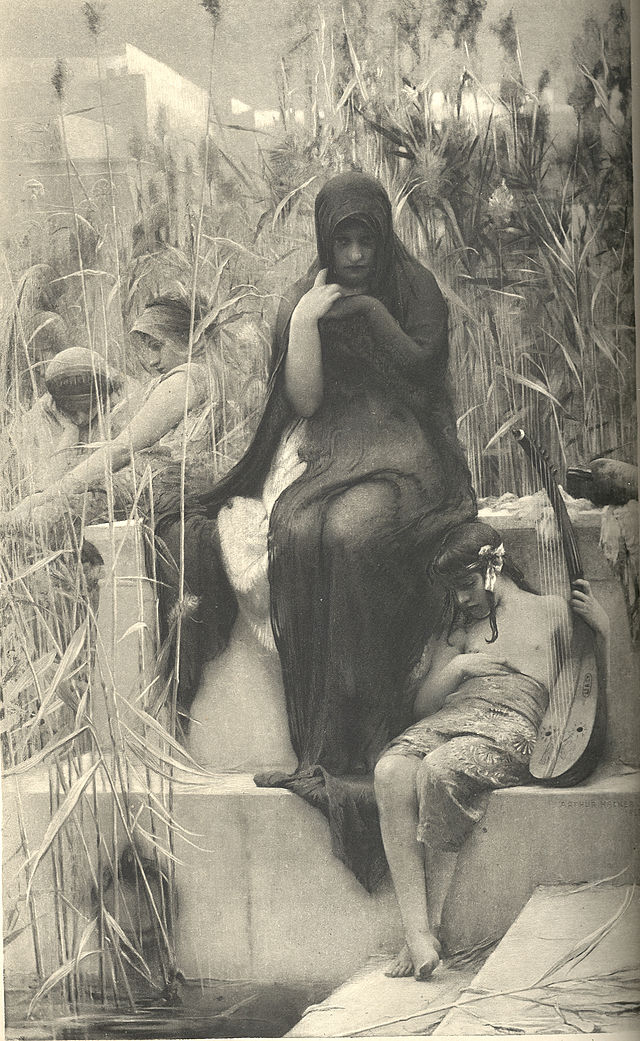
Athur Kacker, By the Waters of Babylon (1888)

Athur Kacker, By the Waters of Babylon (1888)

Jeremiah 44: 1-14 Forty Years and Nothing Changed

The word that came to Jeremiah for all the Judeans living in the land of Egypt, at Migdol, at Tahpanhes, at Memphis, and in the land of Pathros, 2 Thus says the LORD of hosts, the God of Israel: You yourselves have seen all the disaster that I have brought on Jerusalem and on all the towns of Judah. Look at them; today they are a desolation, without an inhabitant in them, 3 because of the wickedness that they committed, provoking me to anger, in that they went to make offerings and serve other gods that they had not known, neither they, nor you, nor your ancestors. 4 Yet I persistently sent to you all my servants the prophets, saying, “I beg you not to do this abominable thing that I hate!” 5 But they did not listen or incline their ear, to turn from their wickedness and make no offerings to other gods. 6 So my wrath and my anger were poured out and kindled in the towns of Judah and in the streets of Jerusalem; and they became a waste and a desolation, as they still are today.

 7 And now thus says the LORD God of hosts, the God of Israel: Why are you doing such great harm to yourselves, to cut off man and woman, child and infant, from the midst of Judah, leaving yourselves without a remnant? 8 Why do you provoke me to anger with the works of your hands, making offerings to other gods in the land of Egypt where you have come to settle? Will you be cut off and become an object of cursing and ridicule among all the nations of the earth? 9 Have you forgotten the crimes of your ancestors, of the kings of Judah, of their wives, your own crimes and those of your wives, which they committed in the land of Judah and in the streets of Jerusalem? 10 They have shown no contrition or fear to this day, nor have they walked in my law and my statutes that I set before you and before your ancestors.The word that came to Jeremiah for all the Judeans living in the land of Egypt, at Migdol, at Tahpanhes, at Memphis, and in the land of Pathros, 2 Thus says the LORD of hosts, the God of Israel: You yourselves have seen all the disaster that I have brought on Jerusalem and on all the towns of Judah. Look at them; today they are a desolation, without an inhabitant in them, 3 because of the wickedness that they committed, provoking me to anger, in that they went to make offerings and serve other gods that they had not known, neither they, nor you, nor your ancestors. 4 Yet I persistently sent to you all my servants the prophets, saying, “I beg you not to do this abominable thing that I hate!” 5 But they did not listen or incline their ear, to turn from their wickedness and make no offerings to other gods. 6 So my wrath and my anger were poured out and kindled in the towns of Judah and in the streets of Jerusalem; and they became a waste and a desolation, as they still are today.

 11 Therefore thus says the LORD of hosts, the God of Israel: I am determined to bring disaster on you, to bring all Judah to an end. 12 I will take the remnant of Judah who are determined to come to the land of Egypt to settle, and they shall perish, everyone; in the land of Egypt they shall fall; by the sword and by famine they shall perish; from the least to the greatest, they shall die by the sword and by famine; and they shall become an object of execration and horror, of cursing and ridicule. 13 I will punish those who live in the land of Egypt, as I have punished Jerusalem, with the sword, with famine, and with pestilence, 14 so that none of the remnant of Judah who have come to settle in the land of Egypt shall escape or survive or return to the land of Judah. Although they long to go back to live there, they shall not go back, except some fugitives.


The book of Jeremiah really doesn’t have just one ending but three, one coming in chapter 45, one at the end of 51 at the conclusion of the judgments on the nations and then chapter 52 gives a final ending narrating what happens back in Babylon. Maybe this reflect the unresolved nature of the people and their relationship with God in the light of the disaster of the destruction of Jerusalem, the kingdom of Judea, the Davidic line of kings, the temple and all these markers of identity that made them the people of the LORD. But as we plummet towards the end of the story of the last remaining group not in Babylon, a group that once sought Jeremiah’s word and now rather than a small remnant we find settlements in three cities and perhaps a larger emigration to Egypt after the confusion of the last several years. It is a group that has already heard and ignored Jeremiah’s words that their actions of turning to Egypt will mean famine, the sword and pestilence. In the midst of this refugee group in Egypt we see Jeremiah dealing with some of the same issues as the beginning of his ministry.

Forty years earlier, when Josiah was king and led a reformation of the temple and worship in Jerusalem and turned the people back to the LORD and away from the practices of adopting the customs and worship of the Assyrians now returns again as they encounter Egypt and its lifestyle, culture and religions. As Benyamin Lau describes it:


Jeremiah wanders around his people in shock. All the reformations of his beloved Josiah are instantly forgotten. The idolatry he had witnessed in his childhood, the legacy of Manasseh, has been resurrected in a different form. He finds himself back where he started forty years earlier, only now he is weary, broken, and drained of all hope. For the last time he summons the strength to warn the people against going astray in Egypt to learn from the sins of their forefathers. (Lau, 2013, p. 216)


At stake are different readings of history and the times. Jeremiah reads the events of the past in light of the LORD’s judgment on the people for turning away from the covenant, law, decrees and worship of the LORD. The group of people who are gathered together one last time to hear the prophet’s final recorded words to them read the events of the last several years in a different light.

Jeremiah 44: 15-23 Different Readings of Reality

 15 Then all the men who were aware that their wives had been making offerings to other gods, and all the women who stood by, a great assembly, all the people who lived in Pathros in the land of Egypt, answered Jeremiah: 16 “As for the word that you have spoken to us in the name of the LORD, we are not going to listen to you. 17 Instead, we will do everything that we have vowed, make offerings to the queen of heaven and pour out libations to her, just as we and our ancestors, our kings and our officials, used to do in the towns of Judah and in the streets of Jerusalem. We used to have plenty of food, and prospered, and saw no misfortune. 18 But from the time we stopped making offerings to the queen of heaven and pouring out libations to her, we have lacked everything and have perished by the sword and by famine.” 19 And the women said, “Indeed we will go on making offerings to the queen of heaven and pouring out libations to her; do you think that we made cakes for her, marked with her image, and poured out libations to her without our husbands’ being involved?”

 20 Then Jeremiah said to all the people, men and women, all the people who were giving him this answer: 21 “As for the offerings that you made in the towns of Judah and in the streets of Jerusalem, you and your ancestors, your kings and your officials, and the people of the land, did not the LORD remember them? Did it not come into his mind? 22 The LORD could no longer bear the sight of your evil doings, the abominations that you committed; therefore your land became a desolation and a waste and a curse, without inhabitant, as it is to this day. 23 It is because you burned offerings, and because you sinned against the LORD and did not obey the voice of the LORD or walk in his law and in his statutes and in his decrees, that this disaster has befallen you, as is still evident today.”


The people answer Jeremiah’s prophecy with a very different reading of reality. From their perspective, prior to Jeremiah’s prophecies, prior to the reformation of Josiah and under the reign of Manasseh forty years ago things were pretty good. The people had adopted a pro-Assyrian policy, adopted their customs and practices and along with that portions of their religious practice. Until that time, in the memory of the people, things went well for Judah. After Josiah’s death at the hands of Egypt and the rise of the Babylonian empire, while they had ceased worshipping the Assyrian gods/goddesses (although apparently the remembrance of the practice and probably the practices themselves lingered). The queen of heaven probably referred to Astarte, a fertility goddess but could also refer here in Egypt to Isis, but somehow there is an amalgamation between the worship of the LORD the God of Israel and this other deity.  The people defiantly resist Jeremiah, claiming ‘we will go on making offerings.’

It is easy to imagine the allure of the culture and worship in Egypt as well as the practices from the past when times seemed easier and more secure being very attractive to the people. It’s also not hard to imagine the allure of a fertility cult at any point in society. Yet, in the midst of these final words between the people and Jeremiah we see the people interpreting reality in light of their prosperity of the past while doing these practices and Jeremiah seeing the judgment of the recent past in light of these practices. Judaism probably was not as monotheistic throughout its history prior to the exile as it became when it emerged again from the exile in Babylon. Yet in the book of Jeremiah this is a new low point, the people feel no need to apologize for their actions or cover them up. They are claiming a new identity in the new land, they are choosing to no longer be the people of the LORD. Perhaps this is that moment where something so drastic has happened that the parent has disowned the child and this is the counter story to the story of the Prodigal Son in Luke 15.  Regardless for this portion of the exiles, who disobeyed Jeremiah’s prophetic words against going to Egypt and now are adopting new practices in this new land the dissolution in nearly complete.


Byzantine Fresca of Joshua from Hosias Loukas Monastery in Boetian, Greece

Byzantine Fresca of Joshua from Hosias Loukas Monastery in Boetian, Greece

Jeremiah 44: 24-30: Choose This Day Who You Will Serve

                24 Jeremiah said to all the people and all the women, “Hear the word of the LORD, all you Judeans who are in the land of Egypt, 25 Thus says the LORD of hosts, the God of Israel: You and your wives have accomplished in deeds what you declared in words, saying, ‘We are determined to perform the vows that we have made, to make offerings to the queen of heaven and to pour out libations to her.’ By all means, keep your vows and make your libations! 26 Therefore hear the word of the LORD, all you Judeans who live in the land of Egypt: Lo, I swear by my great name, says the LORD, that my name shall no longer be pronounced on the lips of any of the people of Judah in all the land of Egypt, saying, ‘As the Lord GOD lives.’ 27 I am going to watch over them for harm and not for good; all the people of Judah who are in the land of Egypt shall perish by the sword and by famine, until not one is left. 28 And those who escape the sword shall return from the land of Egypt to the land of Judah, few in number; and all the remnant of Judah, who have come to the land of Egypt to settle, shall know whose words will stand, mine or theirs! 29 This shall be the sign to you, says the LORD, that I am going to punish you in this place, in order that you may know that my words against you will surely be carried out: 30 Thus says the LORD, I am going to give Pharaoh Hophra, king of Egypt, into the hands of his enemies, those who seek his life, just as I gave King Zedekiah of Judah into the hand of King Nebuchadrezzar of Babylon, his enemy who sought his life.”


At the end of a very different story in the book of Joshua, Joshua presents the people with a choice:


Now therefore revere the LORD, and serve him in sincerity and in faithfulness; put away the gods that your ancestors served beyond the River and in Egypt, and serve the LORD. Now if you are unwilling to serve the LORD, choose this day whom you will serve, whether the gods your ancestors served in the region beyond the River or the gods of the Amorites in whose land you are living; but as for me and my household, we will serve the LORD. (Joshua 24: 14f)


At the end of Jeremiah the people have made a choice, and it is a different choice. Every action has consequences in the world of Jeremiah, but Jeremiah has played his part and done his job. Jeremiah is finished with this people. “By all means, keep your vows and make your libations!” but the consequence of this choice is that the people are no longer to use the name of the LORD. They are no longer Israel, or Judah without their relationship to the God of Israel. Once again the words come prophesying the war, famine, and disease that will reduce the people in Egypt greatly. These words are followed up by a series of events that unfold in the near future when Pharoah Hophra is killed in a rebellion in 569 BCE and then Nebuchadrezzar invades in 568/67 BCE shattering the illusion of the safety of the Egyptian empire. (Elizabeth Actemeir, et. al., 1994, p. VI: 874) From the brokenhearted prophet there is one more word of promise not for the people but for Baruch as the story closes and then inhales for a final scream of judgment against the nations. Light will re-emerge, there will be a hope for the future but it will not be seen by those in Egypt, nor quickly by those in Babylon. The Judean refugees in Babylon will go through a long process of reconstructing their identity as a people no longer identified by land, the temple and its worship or the Davidic king. Now they must begin the long process of gathering their stories, figuring out who they are and imagining a new future for themselves and their LORD.