Ezekiel 25: 1-7 Against Ammon
1The word of the LORD came to me: 2Mortal, set your face toward the Ammonites and prophesy against them. 3Say to the Ammonites, Hear the word of the Lord GOD: Thus says the Lord GOD, Because you said, “Aha!” over my sanctuary when it was profaned, and over the land of Israel when it was made desolate, and over the house of Judah when it went into exile; 4therefore I am handing you over to the people of the east for a possession. They shall set their encampments among you and pitch their tents in your midst; they shall eat your fruit, and they shall drink your milk. 5I will make Rabbah a pasture for camels and Ammon a fold for flocks. Then you shall know that I am the LORD. 6For thus says the Lord GOD: Because you have clapped your hands and stamped your feet and rejoiced with all the malice within you against the land of Israel, 7therefore I have stretched out my hand against you, and will hand you over as plunder to the nations. I will cut you off from the peoples and will make you perish out of the countries; I will destroy you. Then you shall know that I am the LORD.
Ezekiel is a book in the bible that has relatively few readers except for certain well-known passages, and within the book these chapters proclaiming judgment against other nations are probably the least likely to be read and dwelt upon. Yet, within many of the prophets there is a pattern of completing the judgment against Israel or Judah, turning to a judgment against the nations, and then the emergence of hope for a new beginning. Isaiah and Zephaniah follow this pattern and in its Septuagint arrangement Jeremiah does as well.[1] Ezekiel will highlight seven nations in these judgments: Ammon, Moab, Edom, Philistia, Tyre, Sidon, and Egypt. The section is structures with the first six nations receiving their judgments followed by a brief word of hope in Ezekiel 28: 24-26 followed by a judgment against Egypt which is equal in length to the first six nations’ judgments combined. (Block, 1998, p. 5) Although many readers may skim or pass these eight chapters of judgements against the nations, I am going to continue my pattern of working through the book sequentially and reflect upon these sections.
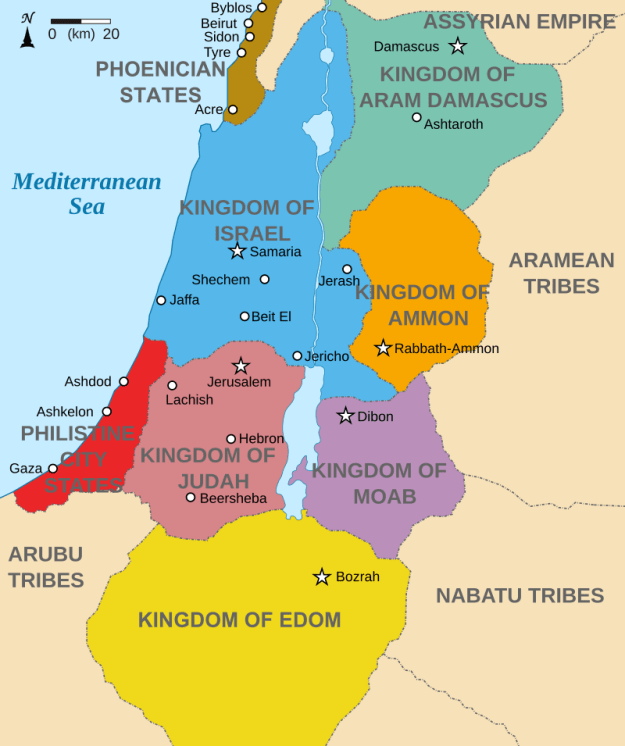
When peering back this far into history there are relatively few sources to help give a broader context to these words against Ammon, Moab, Edom and Philistia. All these nations are neighbors to Israel and have at various times been enemies and allies. Ammon and Moab, according to Genesis, have their origins with Lot, Abraham’s nephew.[2] It makes sense to begin with the judgment against Ammon since they were mentioned as the road not taken by the Babylonians in Ezekiel 21: 18-32 when they proceeded to Jerusalem. Jeremiah also mentions Ammon (along with Moab, Tyre, and Sidon) as the nations who convene with King Zedekiah to discuss forming an alliance against Babylon[3] (presumable with the support of Egypt). There is no way of knowing whether an alliance was formed or whether Ammon or the other nations worked in support of Jerusalem or against them in their conflict against Babylon. Both Jeremiah[4] and Ezekiel indicate that Ammon celebrates the destruction of the city. They shout “Aha” and clapped their hands and stamped their feet against them. Ezekiel had been commanded to clap his hands and stamp his feet against the abominations occurring in the temple (Ezekiel 6:11) and later God strikes God’s hands together against the people (Ezekiel 21: 14, 17; 22:13) but now in the aftermath of the destruction God has once again taken a protective stance towards the people.
Ammon’s judgment is here given to the ‘people of the east.’ These are probably nomadic raiders coming out of the Arabian desert. Josephus (writing shortly after the time of Jesus) states that five years after the destruction of Jerusalem Babylon would conquer both Ammon and Moab, but that is probably not what this prophecy refers to. Ultimately in the oracle Ammon disappears from the list of nations. The prophecy indicates destruction, but historically it seems that the Ammonites assimilated to and merged into the Babylonian, Persian, Greek, and finally Roman empires.
Ezekiel 25: 8-11 Against Moab
8Thus says the Lord GOD: Because Moab said, The house of Judah is like all the other nations, 9therefore I will lay open the flank of Moab from the towns on its frontier, the glory of the country, Beth-jeshimoth, Baal-meon, and Kiriathaim. 10I will give it along with Ammon to the people of the east as a possession. Thus Ammon shall be remembered no more among the nations, 11and I will execute judgments upon Moab. Then they shall know that I am the LORD.
Moab and Ammon share a common origin in Genesis and a common fate in this set of declarations against the surrounding nations. Like Ammon their judgment is left to the ‘people of the east’ and they are to be remembered ‘no more among the nations.’ It was also one of the nations who sent emissaries to King Zedekiah in Jeremiah 27 and who did not assist Jerusalem in the conflict with Babylon. The primary offense laid against Moab is their consideration of Judah like the other nations. Israel and Judah have frequently desired to be like the other nations, but they are not like other nations before God or in relation to the world. As mentioned above Josephus refers to the conquest of Moab by Babylon five years after the destruction of Jerusalem, but Moab, like Ammon seems to have assimilated into the Babylonian, Persian, Greek, and finally Roman empires. Moab receives an entire chapter in Jeremiah’s oracles against the nations. (Jeremiah 48)
Ezekiel 25: 12-14 Against Edom
12Thus says the Lord GOD: Because Edom acted revengefully against the house of Judah and has grievously offended in taking vengeance upon them, 13therefore thus says the Lord GOD, I will stretch out my hand against Edom, and cut off from it humans and animals, and I will make it desolate; from Teman even to Dedan they shall fall by the sword. 14I will lay my vengeance upon Edom by the hand of my people Israel; and they shall act in Edom according to my anger and according to my wrath; and they shall know my vengeance, says the Lord GOD.
Edom seems to have taken a more active role in the humiliation of Judah and Jerusalem. Edom biblically has its origins in Esau, Jacob’s older brother,[5] and the conflicted relationship of the brothers continued in the troubled relationship between the nations. Edom is not present at the discussions with King Zedekiah mentioned in Jeremiah 27. Their actions in this time evoke multiple reactions among scriptural writers. Psalm 137:7 records them crying out against Jerusalem:
Remember, O LORD, against the Edomites the day of Jerusalem’s fall, how they said, “Tear it down! Tear it down! Down to its foundations!”
While Obadiah’s vision is almost completely focused on the Edomites, and Jeremiah’s language for the Edomites is harsh, declaring that they will become an object of horror.[6] In a hopeful note for the people of Judah, they are once again declared ‘God’s people’ and are raised up to take an active role in the vengeance against Edom. Edom is later called Idumea, and this will be the area that Herod the Great and his ancestors hail from.
Ezekiel 25: 15-17 Against the Philistines
15Thus says the Lord GOD: Because with unending hostilities the Philistines acted in vengeance, and with malice of heart took revenge in destruction; 16therefore thus says the Lord GOD, I will stretch out my hand against the Philistines, cut off the Cherethites, and destroy the rest of the seacoast. 17I will execute great vengeance on them with wrathful punishments. Then they shall know that I am the LORD, when I lay my vengeance on them.
The Philistines were the long-time antagonists of Israel and are frequently mentioned in the stories of King Saul and King David. Yet, there is no knowledge of what role the Philistines took in the actions against Jerusalem. Ezekiel and Jeremiah 47 both indicate that the Philistines are to be destroyed and cut off. The Babylonians to conquer the area of the Philistines and take them into exile where they maintain an identity as men of Gaza or Ashkelon but between the Babylonian and Persian period they assimilate with the population between periods of exile and resettlement.
Ezekiel, unlike Jeremiah, is not in Jerusalem to witness any actions by Ammon, Moab, Edom, or the Philistines. His voice is one from a shattered people who have seen their nation humiliated and yet continue to believe that the God of Israel is also the God of the nations. If Judah’s actions have resulted in punishment, so will the actions of these nations who celebrated or participated in Judah’s humiliation. These chapters of judgment on other nations are always difficult to deal with since the other nations are not in a covenantal relationship with the God of Israel. Yet, the scripture spends far less time on these nations than they do on the condemnation of Judah or Israel’s unfaithfulness.
[1] The Septuagint is the Greek translation of the Bible. In English translations (following the Hebrew ordering) Jeremiah concludes his book with these judgments against the nations. (Jeremiah 47-51)
[2] Genesis 19: 30-38.
[3] Jeremiah 27: 1-7. Jeremiah’s focus is on God’s message to these envoys, not on the content or result of these conversations, which it is unlikely that Jeremiah had access to.
[4] Jeremiah 49: 1-6
[5] Genesis 36: 1-8.
[6] Jeremiah 49: 7-22.
 Sign of the Rose