Tag Archives: Davidic Kings

2 Kings 15 The Stability of Judah in Contrast to the Instability of Samaria

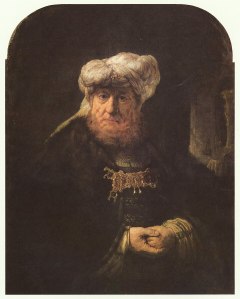
The King Uzziah Stricken with Leprosy, by Rembrandt, 1635.

2 Kings 15: 1-7 King Azariah (Uzziah) of Judah

 1In the twenty-seventh year of King Jeroboam of Israel, King Azariah son of Amaziah of Judah began to reign. 2He was sixteen years old when he began to reign, and he reigned fifty-two years in Jerusalem. His mother’s name was Jecoliah of Jerusalem. 3He did what was right in the sight of the Lord, just as his father Amaziah had done. 4Nevertheless, the high places were not taken away; the people still sacrificed and made offerings on the high places. 5The Lord struck the king so that he had a defiling skin disease to the day of his death and lived in a separate house. Jotham the king’s son was in charge of the palace, governing the people of the land. 6Now the rest of the acts of Azariah and all that he did, are they not written in the Book of the Annals of the Kings of Judah? 7Azariah slept with his ancestors; they buried him with his ancestors in the city of David; his son Jotham succeeded him.

King Azariah, also known as King Uzziah, has a long and successful reign over Judah. Uzziah and Azariah are used interchangeably in scriptures and even in this chapter and Uzziah was likely the name he assumed as king of Judah. His fifty-two-year reign begins in the middle of the forty-one year reign of Jeroboam II and both kings enjoy a period of military success and national resurgence. Azariah’s long and stable reign contrasts with his two predecessors (Joash and Amaziah) who saw the royal and temple treasuries diminished and in their political or military weakness were ultimately assassinated by those who served them. The stability during the time of Azariah in Judah also contrasts sharply with the instability in Samaria after the death of Jeroboam II.

Although 2 Kings does not spend a lot of time on the reign of Azariah/Uzziah his story is greatly expanded in 2 Chronicles 26. According to 2 Chronicles Azariah/Uzziah is a successful military leader who wins victories over Philistia, Ammon and extends Judah’s trade and military influence over the region. 2 Kings 14:22 gives a small window into the king’s success when it notes, “He rebuilt Elath and restored it to Judah after King Amaziah slept with his ancestors.” This small note indicates a large accomplishment only shared by Solomon, Jehoshaphat and Hezekiah. This gave Judah a port on the Mediterranean but also required them to control not only the port but the wilderness between. Alex Israel notes that he controls both major highways between Egypt and Mesopotamia, a lucrative trade route and source of income for the nation. (Israel, 2019, p. 227) 2 Chronicles also notes that King Uzziah strengthened the city walls of Jerusalem and increased the agricultural output of the land by his improvements and built up the army.

2 Kings’ brief account of this king who did what was right in the sight of the LORD ends with the jarring note that the LORD struck the king with ‘a defiling skin disease.’ This skin disease was traditionally rendered leprosy in most translations although we now believe that Hanson’s disease (which is what we call leprosy today) did not exist in the Middle East during this time. Yet, this affliction was normally associated with a judgment from God, and 2 Chronicles tells of the king entering the temple to offer incense, the job of the priests, and being struck with ‘leprosy’ as a punishment. Ultimately in 2 Chronicles the king is punished for overstepping his responsibility, attempting to fulfill both the kingly and the priestly role and ends his life separated from the palace and his responsibilities were assumed by his son Jotham until he died.

It is interesting that 2 Kings does not go into the success and fall of Azariah/Uzziah in the same manner as 2 Chronicles. Perhaps the narrator of 2 Kings doesn’t want to focus on the military success of Azariah in contrast to the lack of success by Joash and Amaziah who are both evaluated as kings who did what was right in the site of the LORD and at the same time does not want to focus on the act that leads to the king’s affliction. Despite the short narration of Azariah’s lengthy reign it is a consequential time as Judah remains stable as Northern Israel becomes chaotic and is one generation from collapse. This is also a time of prophetic voices and Isaiah (first Isaiah), Amos, Hosea, and Micah all give voice to this time in Israel and Judah.

2 Kings 15: 8-12 The Brief Reign of Zechariah King of Israel and the End of the Jehu Dynasty

  8 In the thirty-eighth year of King Azariah of Judah, Zechariah son of Jeroboam reigned over Israel in Samaria six months. 9 He did what was evil in the sight of the Lord, as his ancestors had done. He did not depart from the sins of Jeroboam son of Nebat that he caused Israel to sin. 10 Shallum son of Jabesh conspired against him and struck him down in Ibleam and killed him and reigned in place of him. 11 Now the rest of the deeds of Zechariah are written in the Book of the Annals of the Kings of Israel. 12 This was the promise of the Lord that he gave to Jehu, “Your sons shall sit on the throne of Israel to the fourth generation.” And so it happened.

The message of the LORD to Jehu after the destruction of the Omri dynasty indicated that his line would continue for four generations (2 Kings 10:30) and now after the death of Jeroboam II, the fourth generation, the Jehu dynasty collapses six months later. Jehu’s line ruled in Samaria for ninety-two years and it was enjoying a period of success under Jeroboam II, but the public murder of Zechariah ignites a power for struggle that will be violent and ultimately weaken Northern Israel as the Assyrian empire under Tiglath-Pileser III ascends. Zechariah is the first of a group of inconsequential kings in Samaria whose cumulative impact is very consequential in weakening Israel in a dangerous world.

2 Kings 15: 13-31 A Tumultuous Period in Israel

  13Shallum son of Jabesh began to reign in the thirty-ninth year of King Uzziah of Judah; he reigned one month in Samaria. 14Then Menahem son of Gadi came up from Tirzah and came to Samaria; he struck down Shallum son of Jabesh in Samaria and killed him; he reigned in place of him. 15Now the rest of the deeds of Shallum, including the conspiracy that he made, are written in the Book of the Annals of the Kings of Israel. 16At that time Menahem sacked Tiphsah, all who were in it and its territory from Tirzah on; because they did not open it to him, he sacked it. He ripped open all the pregnant women in it.

  17
In the thirty-ninth year of King Azariah of Judah, Menahem son of Gadi began to reign over Israel; he reigned ten years in Samaria. 18He did what was evil in the sight of the Lord; he did not depart all his days from any of the sins of Jeroboam son of Nebat that he caused Israel to sin. 19King Pul of Assyria came against the land; Menahem gave Pul a thousand talents of silver, so that he might help him confirm his hold on the royal power. 20Menahem exacted the silver from Israel, that is, from all the wealthy, fifty shekels of silver from each one, to give to the king of Assyria. So the king of Assyria turned back and did not stay there in the land. 21Now the rest of the deeds of Menahem and all that he did, are they not written in the Book of the Annals of the Kings of Israel? 22Menahem slept with his ancestors, and his son Pekahiah succeeded him.

  23
In the fiftieth year of King Azariah of Judah, Pekahiah son of Menahem began to reign over Israel in Samaria; he reigned two years. 24He did what was evil in the sight of the Lord; he did not turn away from the sins of Jeroboam son of Nebat that he caused Israel to sin. 25Pekah son of Remaliah, his captain, conspired against him with fifty of the Gileadites and attacked him in Samaria, in the citadel of the palace along with Argob and Arieh; he killed him and reigned in place of him. 26Now the rest of the deeds of Pekahiah and all that he did are written in the Book of the Annals of the Kings of Israel.

  27
In the fifty-second year of King Azariah of Judah, Pekah son of Remaliah began to reign over Israel in Samaria; he reigned twenty years. 28He did what was evil in the sight of the Lord; he did not depart from the sins of Jeroboam son of Nebat that he caused Israel to sin.
  29
In the days of King Pekah of Israel, King Tiglath-pileser of Assyria came and captured Ijon, Abel-beth-maacah, Janoah, Kedesh, Hazor, Gilead, and Galilee, all the land of Naphtali, and he carried the people captive to Assyria. 30Then Hoshea son of Elah made a conspiracy against Pekah son of Remaliah, attacked him, and killed him; he reigned in place of him, in the twentieth year of Jotham son of Uzziah. 31Now the rest of the acts of Pekah and all that he did are written in the Book of the Annals of the Kings of Israel.

Shallum son of Jabesh, Menahem son of Gadi, Pekahiah son of Menahem and Peka son of Remaliah all struggle for power during the stable reign of Azariah/Uzziah and (during Pekah’s reign in Samaria) the transition to Azariah’s son Jothan. Shallum reigns only for a month before he is overthrown by Menahem. Menahem assumes power in a violent manner and his description of sacking Tiphsah and tearing open the wombs of pregnant women describes him like the worst oppressors of Israel[1] and it is the violent ones who have ascended to power. Menahem may reign for ten years in Samaria but the large tribute payment[2] to Assyria under Tiglath-Pileser III[3] that he extracts from the gibbor hahayil (NRSVue ‘wealthy’)[4] likely means he is ruling with the political and even possibly military support of Assyria. When he dies his son is only to reign for two years. There are likely factions looking to align the nation with Assyria or Egypt as Hosea states:

Ephraim has become like a dove,
silly and without sense;
they call upon Egypt, they go to Assyria. (Hosea 7:11)

This is conjecture, but if Peka son of Remaliah ended the alliance with Assyria it would make sense of Tiglath-Pileser III seizing territory as well as dragging the captured people into exile. Records from Assyria indicate that there was a campaign against Israel in 733-732 BC and they took 13,520 people into exile. (Israel, 2019, p. 238) The Assyrian were known for taking exiles and displacing them to where they are totally dependent on Assyria and forced to blend into the larger Assyrian world. (Cogan, 1988, p. 177) The enemy has been within Samaria with this string of strongmen seizing power but now they face a much larger threat which is penetrating their borders and capturing the people and Israel appears powerless to resist.

2 Kings 15: 32-38 King Jothan of Judah


  32
In the second year of King Pekah son of Remaliah of Israel, King Jotham son of Uzziah of Judah began to reign. 33He was twenty-five years old when he began to reign, and he reigned sixteen years in Jerusalem. His mother’s name was Jerusha daughter of Zadok. 34He did what was right in the sight of the Lord, just as his father Uzziah had done. 35Nevertheless, the high places were not removed; the people still sacrificed and made offerings on the high places. He built the upper gate of the house of the Lord. 36Now the rest of the acts of Jotham and all that he did, are they not written in the Book of the Annals of the Kings of Judah? 37In those days the Lord began to send King Rezin of Aram and Pekah son of Remaliah against Judah. 38Jotham slept with his ancestors and was buried with his ancestors in the city of David, his ancestor; his son Ahaz succeeded him.

In contrast to the bloody and dangerous instability of Samaria, Judah continues to function under another king of the Davidic line who does what is right in the sight of the LORD. 2 Chronicles 27 indicates that Jothan continues to build up the walls and defenses of Judah, and the king is likely aware of the growing threat to the north in Assyria. Again, 2 Chronicles portrays Jothan as a militarily successful king and in 2 Kings we have indication of both Aram and Samaria/Northern Israel attacking Judah (possibly as agents of Assyria) yet we do not have any indication that Judah is losing territory. Resin and Pekah may be attempting to raid for resources in their own struggles against the rising might of Assyria, but for the moment the threat to stable Judah is significantly less than it appears to be for Northern Israel.


[1] See for example Elisha’s description of what Hazael will do in 2 Kings 8:12, the accusations against Edom in Amos 1:13, or the judgement oracle of Hosea 13:16.

[2] Roughly seventy five thousand pounds of silver.

[3] King Pul is a nickname in late sources for Tiglath-Pileser III, and the use of this title in 2 Kings indicated the familiarity of the narrator with this leader of Assyria. (Israel, 2019, p. 238)

[4] Gibbor hahayil is often rendered mighty ones and often this was assumed to have military connotations. This term is common in the book of Judges, but it also can refer to landowners like Boaz in the book of Ruth. Wealthy may be the proper translation, but with Menahem being a warrior leader, it may also indicate something like warlords who are maintaining power beneath him.

2 Kings 11 The Overthrow of Athaliah in Judah and the Beginning of the Reign of King Joash

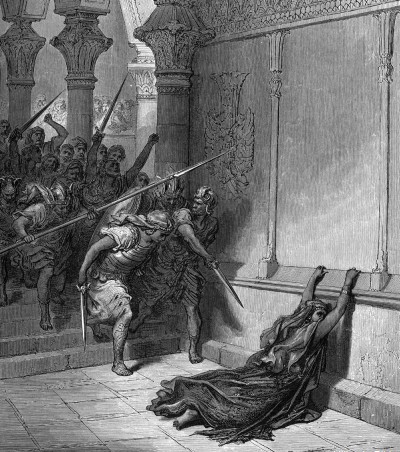
Gustave DoréThe Death of Athaliah

2 Kings 11

  1Now when Athaliah, Ahaziah’s mother, saw that her son was dead, she set about to destroy all the royal family. 2But Jehosheba, King Joram’s daughter, Ahaziah’s sister, took Joash son of Ahaziah and stole him away from among the king’s children who were about to be killed; she put him and his nurse in a bedroom. Thus she hid him from Athaliah, so that he was not killed; 3he remained with her six years, hidden in the house of the LORD, while Athaliah reigned over the land.

  4
But in the seventh year Jehoiada summoned the captains of the Carites and of the guards and had them come to him in the house of the LORD. He made a covenant with them and put them under oath in the house of the LORD; then he showed them the king’s son. 5He commanded them, “This is what you are to do: one-third of you, those who go off duty on the Sabbath and guard the king’s house 6(another third being at the gate Sur and a third at the gate behind the guards), shall guard the palace, 7and your two divisions that come on duty in force on the Sabbath and guard the house of the LORD 8shall surround the king, each with weapons in hand, and whoever approaches the ranks is to be killed. Be with the king in his comings and goings.”
  9
The captains did according to all that the priest Jehoiada commanded; each brought his men who were to go off duty on the Sabbath, with those who were to come on duty on the Sabbath, and came to the priest Jehoiada. 10The priest delivered to the captains the spears and shields that had been King David’s, which were in the house of the LORD; 11the guards stood, every man with his weapons in his hand, from the south side of the house to the north side of the house, around the altar and the house, to guard the king on every side. 12Then he brought out the king’s son, put the crown on him, and gave him the covenant; they proclaimed him king and anointed him; they clapped their hands and shouted, “Long live the king!”

  13
When Athaliah heard the noise of the guard and of the people, she went into the house of the Lord to the people; 14when she looked, there was the king standing by the pillar, according to custom, with the captains and the trumpeters beside the king, and all the people of the land rejoicing and blowing trumpets. Athaliah tore her clothes and cried, “Treason! Treason!” 15Then the priest Jehoiada commanded the captains who were set over the army, “Bring her out between the ranks and kill with the sword anyone who follows her.” For the priest said, “Let her not be killed in the house of the Lord.” 16So they laid hands on her; she went through the horses’ entrance to the king’s house, and there she was put to death.
  17
Jehoiada made a covenant between the LORD and the king and people, that they should be the LORD’s people; also between the king and the people. 18Then all the people of the land went to the house of Baal and tore it down; his altars and his images they broke in pieces, and they killed Mattan, the priest of Baal, in front of the altars. The priest posted guards over the house of the LORD. 19He took the captains, the Carites, the guards, and all the people of the land; then they brought the king down from the house of the LORD, marching through the gate of the guards to the king’s house. He took his seat on the throne of the kings. 20So all the people of the land rejoiced, and the city was quiet after Athaliah had been killed with the sword at the king’s house.
  21
Jehoash was seven years old when he began to reign.

The final remaining figure of the Omri dynasty is not in Israel but in Judah. Jehu’s bloody revolt in Israel has eliminated both the ruling line in Samaria as well as Ahaziah, the king of Judah, who was linked to the line of Ahab by his mother Athaliah. Jehoram, son of king Jehoshaphat, the father of the recently murdered King Ahaziah was married to Athaliah the daughter of Ahab. Athaliah who holds power in Judah for seven years is not listed in the line of Davidic kings because she is not of the Davidic line. Aside from her violent actions the problem with Ahaziah is not primarily that she is a woman but instead that she is of the line of King Ahab and Jezebel and apparently brings the religious and moral practices of Tyre into Jerusalem.

Athaliah seizes power in the aftermath of her sons death attempting to wipe out any other claimants to the throne. As a person with a tenuous grip on power the elimination of potential claimants to the throne is coldly logical in a world where political power is seized in often bloody manners. To use the logic of George R.R. Martin’s Game of Thrones “when you play the game of thrones (power) you either win or you die.” Although Athaliah is not viewed favorably in either 2 Kings or the parallel telling of this story in 2 Chronicles 22, her seizure of power is likely less bloody than Jehu’s in Samaria. Yet, unlike Jehu her seven years on the throne in Jerusalem pull the people further from the worship of the LORD the God of Israel and she ends up being the only woman in the bible, “to be awarded the moniker: “the Wicked”” in 2 Chronicles 24:7. (Israel, 2019, p. 178) And as Choon-Leong Seow states accurately, “Athaliah is to Judah what Jezebel was to Israel…Like the ruthless Jezebel, Athaliah is willing to commit murder in order to have her way.” (NIB III: 228) She is a mother who seizes power by killing the royal family which likely contains her own children and grandchildren.[1]

Yet, Athaliah’s plot to wipe out the line of David is thwarted by her sister Jehosheba who hides young Joash. 2 Chronicles 22: 10-12 states that Jehosheba is the wife of Jehoida the priest that will play a dominant role in the protection of Joash and the elimination of Athaliah. Yet, 2 Kings does not give us Jehosheba’s motive in saving this child, but she like many of the women in Exodus,[2] are responsible for thwarting the murderous intentions of a ruler. Joash will be hidden and raised in the house of the LORD.

The plot to place Joash on the throne begins in the seventh year of Athaliah’s occupying the throne in Jerusalem. The priest Jehoida summons summons the Carites, which may be the Cherethites mentioned elsewhere as body guards and soldiers of David or a different armed group, and the guards to both swear loyalty to the new king and to act as protection for the moment of the revelation of the king to the people. The exact details of the deployment of these troops may be a challenge for translators to render in an exact format but the overall intent is clear. The full complement of soldiers will be armed and ready in key positions on the day when young Joash is anointed publicly and acclaimed as king.

The king is crowned, anointed and either given an insignia or a covenant document. As Walter Brueggemann states of the term that can be rendered emblem/insignia or covenant,

The term here is not very clear. It may refer to insignia of office. Or it might more precisely refer to a scroll, a written charter delineating both the prerogatives and requirements of power, a document that situates royal power in something like a constitutional frame of reference that precludes royal arbitrariness. (Brueggemann, 2000, p. 409)

If it is a covenant, it probably reflects an understanding of the expectations of a king similar to Deuteronomy 17: 14-20.

 14When you have come into the land that the Lord your God is giving you and have taken possession of it and settled in it, and you say, ‘I will set a king over me, like all the nations that are around me,’ 15you may indeed set over you a king whom the Lord your God will choose. One of your own community you may set as king over you; you are not permitted to put a foreigner over you, who is not of your own community. 16Even so, he must not acquire many horses for himself or return the people to Egypt in order to acquire more horses, since the Lord has said to you, ‘You must never return that way again.’ 17And he must not acquire many wives for himself or else his heart will turn away; also silver and gold he must not acquire in great quantity for himself. 18When he has taken the throne of his kingdom, he shall write for himself a copy of this law on a scroll in the presence of the Levitical priests. 19It shall remain with him, and he shall read in it all the days of his life, so that he may learn to fear the Lord his God, diligently observing all the words of this law and these statutes, 20neither exalting himself above other members of the community nor turning aside from the commandment, either to the right or to the left, so that he and his descendants may reign long over his kingdom in Israel.

This anointed and crowned king now receives the vocal acclamation from the guards and priests, “Long live the king.”

Athaliah hears the commotion and discovers the plot underway. The young king is standing by the pillar, perhaps the pillars at the front of the temple or in the position where Ezekiel envisions the king supervising the offerings. (Ezekiel 48: 2-8)[3]    Athaliah echoes the words of Joram, “Treason! Treason!”[4] but like Joram her realization of the plot afoot is too late to save her life. She is brought out of the temple and killed with the sword. Then the covenant is renewed between the LORD, the king, and the people. The people then destroy the house of Baal, possibly built under Athaliah’s instructions, and Mattan the priest of Baal is also killed. The verbs in 2 Kings on the destruction of the temple of Baal echo the instructions of Deuteronomy 12: 2-3:

2You must demolish completely all the places where the nations whom you are about to dispossess served their gods, on the mountain heights, on the hills, and under every leafy tree. 3Break down their altars, smash their pillars, burn their sacred poles with fire, and cut down the idols of their gods, and thus blot out their name from their places.

In contrast to Jehu’s revolution, the coup enacted by the priest Jehoida is much less violent. Only Athaliah and Mattan are killed and then the city was quiet. As Brueggemann notes about the final phrase about the city being quiet,

The assertion that the “city was quiet” is more important than the simple phrasing might suggest (11:20). The term “quiet” (shaqath) is the same term used in the book of Judges in the recurring phrase “the land had rest” (Judg 3:11, 30; 5:31; 8:28) (Brueggemann, 2000, p. 413)

Joash, or Jehoash, begins his long reign at the age of seven. He is under the influence of Jehoida and yet his reign will be one of the times that 2 Kings views favorably. The covenant between God, the king, and the people is restored, the land has rest, and there is a chance for renewal in Judah after the decline of the house of David over the past two kings.


[1] There were probably other children of Jehoram by wives other than Athaliah as well as others in the line of David.

[2] Exodus 1: 15-2:10

[3] Ezekiel’s words come in the time immediately after the time of the kings and the temple, but his visions are likely informed by his familiarity with the temple practices before its destruction.

[4] 2 Kings 9:23.

Psalm 110 A Psalm of Enthronement

Stained Glass window at the Melkite Catholic Annunciation Cathedral in Roslindale, MA depicting Christ the King with the regalia of a Byzantine Emperor

Psalm 110

Of David. A Psalm.
1The LORD says to my lord, “Sit at my right hand until I make your enemies your footstool.”
2The LORD sends out from Zion your mighty scepter. Rule in the midst of your foes.
3Your people will offer themselves willingly on the day you lead your forces on the holy mountains. From the womb of the morning, like dew, your youth will come to you.
4The LORD has sworn and will not change his mind, “You are a priest forever according to the order of Melchizedek.”
5The LORD is at your right hand; he will shatter kings on the day of his wrath.
6He will execute judgment among the nations, filling them with corpses; he will shatter heads over the wide earth.
7He will drink from the stream by the path; therefore he will lift up his head.

Psalm 110 is repeatedly referenced in the New Testament[1] as a way of demonstrating that Jesus is the Messiah and that as the Messiah, he is more important even than David. Yet this psalm so important to early Christians is heard differently by Jewish readers. Within these reflections I’ve tried to hold both Christian and Jewish voices in conversation, and I think that both can help us gain a fuller picture of the scriptures that we share. This enthronement psalm shares similar themes to Psalm 2. Both psalms view this newly anointed lord as the chosen vessel of the LORD the God of Israel. The king may be seated at the right hand[2]

As an enthronement psalm for a Davidic king, these words would likely come from a court prophet or singer to be spoken as God’s words over the new king. The prophet or singer refers to the new king as ‘my lord’ because they serve that king. The capitalization of the letters in the other occurrences of LORD in this psalm indicate that it refers to the divine name, YHWH, and the vowels are pointed around the letters to indicate to the speaker to say ‘Lord’ (or Adonai in Hebrew) instead of the divine name. YHWH speaks through the prophet to the new king and invites the king into this position of honor and promises to fight on the new king’s behalf. Verse three is full of textual difficulties, as Nancy deClaissé- Walford states, the

words appear to be an elevated description of the newly enthroned monarch, obeyed willingly by the people and endowed with strength and stamina—the dew of your childhood—which emanate from the splendor of holiness.” (Nancy deClaisse-Walford, 2014, p. 836)

Although there were both royal and priestly roles in the world of the Davidic kings, the kings of Israel did have priestly functions. Now the king is linked to the ancient figure of Melchizedek who comes from Salem, and who is also a king, and blesses Abraham by God Most High. This King of Salem becomes the priestly model for the King of Jerusalem, likely built on the same spot generations later. This installation of the new king in both a royal and priestly role integrates this new leader into their privileged place in God’s ordering of the world. (Mays, 1994, p. 352)

The ancient world was a violent place, and the Davidic kings were expected to lead the nation to both safety and military victory. Yet, Israel was never to be a military power,[3] and their strength resided in the God who executes judgment among the nations. The language of ‘filling the nations with corpses’ and ‘shattering heads over the wide earth’ continues the elevated description of the power behind the new monarch and the power behind the throne that ultimately controls the fate of the nations. The LORD, the God of Israel, will provide the stream beyond the path of the new king allowing this king to lift up his head in honor and strength.

Christian readers will hear this psalm through the lens of Christ, and ‘sitting at the right hand of the Father’ becomes a way that the church will talk about the honored and powerful position of Jesus for the church and the world. Jesus takes on the role of king for Christians and this led to the persecution of many early followers of Jesus who refused to pay honor to the divinity of Caesar. The book of Hebrews also highlights the way Jesus fulfils the role of the priesthood for Christians.[4] In liturgical churches the final Sunday of the church year is Christ the King Sunday which celebrates the way Jesus is enthroned at the right hand of God, but instead of being a conquering king he was a crucified messiah. Revelation 19: 11-16 is the closest the New Testament gets to the militaristic language of verse five and six of this psalm. The quotation of this psalm by Jesus in his conflicts with the Pharisees in Matthew 22:44 and parallels probably was not viewed as a convincing argument by his opponents and most Jewish leaders, if they utilize this psalm today, would be waiting for a return of a Davidic ruler who can rule from the power of the LORD the God of Israel and bring the nation back to a place of security. As large of a role as this psalm plays in the New Testament, I don’t believe that it plays a similar role in the thought of contemporary Judaism.


[1] Matthew 22:44; Mark 14:62; 16:19; Luke 22:69; Acts 2:34-35; 7:55; Romans 8:34; Ephesians1:20; Colossians 3:1; Hebrews 1:3,13; 8:1; 10:12; 1 Peter 3:22

[2] Being seated at the right hand is a position of honor and power. It is interesting that in Psalm 109 the psalmists asks for an accuser to take this position for the wicked person. The name Benjamin comes from a conjunction of the Hebrew word for son (bin) and right hand (yamin).  

[3] Deuteronomy 17: 14-20 which sets the limits on a king for Israel indicates that the focus is not to be on building a stronger military but instead on a ruler being faithful to the LORD and the covenant.

[4] Particularly Hebrews chapters 5 and 7.

Psalm 89 Shattered Worlds and Broken Symbols

The Siege and Destruction of Jerusalem by Romans Under the Command of Titus, A.D. 70 by David Roberts 1850

Psalm 89

<A Maskil of Ethan the Ezrahite.>
1 I will sing of your steadfast love, O LORD, forever; with my mouth I will proclaim your faithfulness to all generations.
2 I declare that your steadfast love is established forever; your faithfulness is as firm as the heavens.
3 You said, “I have made a covenant with my chosen one, I have sworn to my servant David:
4 ‘I will establish your descendants forever, and build your throne for all generations.'” Selah
5 Let the heavens praise your wonders, O LORD, your faithfulness in the assembly of the holy ones.
6 For who in the skies can be compared to the LORD? Who among the heavenly beings is like the LORD,
7 a God feared in the council of the holy ones, great and awesome above all that are around him?
8 O LORD God of hosts, who is as mighty as you, O LORD? Your faithfulness surrounds you.
9 You rule the raging of the sea; when its waves rise, you still them.
10 You crushed Rahab like a carcass; you scattered your enemies with your mighty arm.
11 The heavens are yours, the earth also is yours; the world and all that is in it — you have founded them.
12 The north and the south — you created them; Tabor and Hermon joyously praise your name.
13 You have a mighty arm; strong is your hand, high your right hand.
14 Righteousness and justice are the foundation of your throne; steadfast love and faithfulness go before you.
15 Happy are the people who know the festal shout, who walk, O LORD, in the light of your countenance;
16 they exult in your name all day long, and extol your righteousness.
17 For you are the glory of their strength; by your favor our horn is exalted.
18 For our shield belongs to the LORD, our king to the Holy One of Israel.
19 Then you spoke in a vision to your faithful one, and said: “I have set the crown on one who is mighty, I have exalted one chosen from the people.
20 I have found my servant David; with my holy oil I have anointed him;
21 my hand shall always remain with him; my arm also shall strengthen him.
22 The enemy shall not outwit him, the wicked shall not humble him.
23 I will crush his foes before him and strike down those who hate him.
24 My faithfulness and steadfast love shall be with him; and in my name his horn shall be exalted.
25 I will set his hand on the sea and his right hand on the rivers.
26 He shall cry to me, ‘You are my Father, my God, and the Rock of my salvation!’
27 I will make him the firstborn, the highest of the kings of the earth.
28 Forever I will keep my steadfast love for him, and my covenant with him will stand firm.
29 I will establish his line forever, and his throne as long as the heavens endure.
30 If his children forsake my law and do not walk according to my ordinances,
31 if they violate my statutes and do not keep my commandments,
32 then I will punish their transgression with the rod and their iniquity with scourges;
33 but I will not remove from him my steadfast love, or be false to my faithfulness.
34 I will not violate my covenant, or alter the word that went forth from my lips.
35 Once and for all I have sworn by my holiness; I will not lie to David.
36 His line shall continue forever, and his throne endure before me like the sun.
37 It shall be established forever like the moon, an enduring witness in the skies.” Selah
38 But now you have spurned and rejected him; you are full of wrath against your anointed.
39 You have renounced the covenant with your servant; you have defiled his crown in the dust.
40 You have broken through all his walls; you have laid his strongholds in ruins.
41 All who pass by plunder him; he has become the scorn of his neighbors.
42 You have exalted the right hand of his foes; you have made all his enemies rejoice.
43 Moreover, you have turned back the edge of his sword, and you have not supported him in battle.
44 You have removed the scepter from his hand, and hurled his throne to the ground.
45 You have cut short the days of his youth; you have covered him with shame. Selah
46 How long, O LORD? Will you hide yourself forever? How long will your wrath burn like fire?
47 Remember how short my time is —  for what vanity you have created all mortals!
48 Who can live and never see death? Who can escape the power of Sheol? Selah
49 Lord, where is your steadfast love of old, which by your faithfulness you swore to David?
50 Remember, O Lord, how your servant is taunted; how I bear in my bosom the insults of the peoples,
51 with which your enemies taunt, O LORD, with which they taunted the footsteps of your anointed.
52 Blessed be the LORD forever. Amen and Amen.

The approach to Psalm 89 will be different than my approach to most of the other psalms because it evokes for me an important question that continues to be wrestled with in communities of faith. This psalm likely originates in the collapse of the Davidic line of kings in the aftermath of Babylon’s destruction of Jerusalem in 587 BCE and wrestles with the contrast between the psalmist’s understanding of God’s promises and their present experience. It is plausible that Psalm 89 may be a combination of one (or more) psalms which expressed the royal theology of the Davidic kings with the tough questions of verse thirty-eight onward. Like Psalm 88 it takes us into the darkness of the psalmist’s experience where no light appears on the horizon, but unlike the previous psalm this is the experience of the community of the faithful questioning how the God’s faithfulness proved unfaithful. The psalm is still processing the anger, grief, and the disillusionment over the loss of institutions they thought would continue perpetually.

The language of Psalm 89 weaves together the kingdom of God and the monarchy of David into a common tapestry. Psalm 89 is built upon the words through the prophet Nathan to David in 2 Samuel 7: 8-17, but the rough edges of this prophecy where the ‘seeds of arrogance’ (Nancy de Claisse-Walford, 2014, p. 681) seen in David are smoothed out. Like Psalm 2 the strength of the Davidic kings is directly linked to the strength of the LORD. Their victories are the LORD’s victories, their enemies are the LORD’s enemies, their unfaithfulness is punished but they are never separated from God’s steadfast love and faithfulness (unlike King Saul or the Kings of Northern Israel). The first seventy percent of the psalm weaves God’s reign which is founded on steadfast love and faithfulness into experience of life under David’s descendants. The royal theology is expressed through the temple, and the temple, Jerusalem, and the Davidic kings all become important symbols of God’s reign on earth. The covenant language of Psalm 89 leaves no space for God to change God’s mind despite the unfaithfulness of many of the kings in Jerusalem. Yet, when the seam holding God’s reign and the Davidic king’s reign unravels in verse thirty-eight, the psalmist now takes God to task for renouncing the covenant. The situation of humiliation that the people experience now moves the psalmist to the dangerous and perhaps blasphemous conclusion that God whose reign is built on steadfast love and faithfulness has now proven unfaithful. God who was once Father and Rock who exalted David’s horn and strengthened his arm now strengthens the arms of the foes of the people, has rejected God’s children, and has renounced the covenant.

Moving beyond the psalm for the moment, the close alliance of God’s kingdom with any individual or government always presents the danger of idolatry. King David occupies an almost mythical role in the story of Israel as the ‘once and future king’ who was a man after God’s own heart. The narrative of David in First and Second Samuel, and the experience of the Davidic kings in First and Second Kings is often disconnected from the interwoven theology which connects the stability of the kings in Jerusalem with a larger vision of God’s cosmic reign over the forces of creation and the nations of the world. When the destruction of Jerusalem by Babylon occurs and the Davidic line of kings seems to be a stump which is cutdown and never to rise again the Jewish people would have to reckon with their relationship with God in a new way and to discover their new identity as a people of God in exile without king, temple, or land. They would have to reimagine the role of David within their life of faith and to reexamine how the hopes of 2 Samuel 7 and Psalm 89: 1-36 ended in the desolation of 2 Kings 25 and Psalm 89: 37-51.

Although the United States there is the concept of the ‘separation of the church and the state’ there is also a semi-religious understanding of manifest destiny and exceptionalism which exists within the political language of the country. Recently there has been a strong movement among both individuals and churches towards a Christian nationalism which weaves these ideas of manifest destiny and exceptionalism into a religious retelling of the story of the United States which ignores many aspects of the country’s past and present. This Christian nationalism has coalesced around the Republican Party in the United States and is still wielded by former President Trump to link his presidency with the faith of many of his followers. The almost messianic fervor that some have placed upon him and the sharp polarization between adherents and opponents highlights the danger of this interweaving of God’s reign and any individual or political group.

As an heir of the Lutheran reformation, I am a part of what is sometimes referred to as the magisterial reformation. The magisterial reformation includes the Lutheran, Reformed, and Anglican reform movements that still believed that secular authority should be followed (in contrast to the radical reformers who rejected any secular authority). Yet, the Lutheran (as well as Reformed and Catholic churches) in Germany had to struggle with the demands for loyalty from the National Socialist party as they assumed power in the 1930s. Many prominent Lutheran scholars, like Paul Althaus,[1] welcomed the rise of the National Socialist and Althaus viewed the government of the state as an order of God’s creation which was given by God. If the government of the state was an order of creation it was not subject to critique by the church, but there were others in the church who would criticize the National Socialist. Dietrich Bonhoeffer is the most well known of these resisters to the demands of loyalty. For Bonhoeffer he viewed the government as a vessel God uses to preserve life and when the government fails in its responsibility the church has a responsibility to speak. Many in Germany in the 1930s were able to combine their practice of Christianity with the demands of the state. Looking back upon this time it is easy to wonder how many people of faith were able to participate in or tolerate actions which seem antithetical to the scriptures, yet it is amazing how malleable peoples’ interpretation of scripture can be to fit their political dispositions.

Within Psalm 89 the kingdom of God and the reign of the Davidic kings is woven together until the tapestry is ripped apart by the experience of the present. There were Christians during the Third Reich who viewed Adolf Hitler as God’s gift to Christianity[2] and I fear there are many Christians in the United States making a similar mistake today. Unfortunately for many in Germany and in the United States participation in these movements has drowned out critical voices that questioned this interweaving of God and nationalism. For Judaism the crisis of exile in Babylon led to a reexamination of their faith in light of their new situation. I fear that for many Christians the eventual collapse of Christian nationalism will lead to an abandonment of their faith.

For me the conclusion of this psalm in verse fifty-two is also a moment of hope. It closes the third book of the psalter and brings this open question into the continued act of praise. Even when there are no easy answers for shattered symbols, broken communities, and even a broken nation there is a community that sits in the discomfort and still brings these questions into the blessing of their God. It closes with a double ‘amen’ which acknowledges the still unanswered questions of the prayers while allowing them to be lifted up to the God who may be Father, may be opponent but still remains connected to the community of the faithful. Elie Wiesel in his memoirs All Rivers Run to the Sea captures the relationship of these faithful crying out to God when he says of his own experience of the Holocaust:

I have never renounced my faith in God. I have risen against His justice, protested His silence and sometimes His absence, but my anger rises up within faith, not outside of it. (Wiesel, 1994, p. 84)

[1] Paul Althaus was not an isolated example, but he was in the 1930s viewed as the leading scholar on Luther’s theology. When I was studying in seminary in the early 2000s his works The Theology of Martin Luther and The Ethics of Martin Luther were still used.

[2] Paul Althaus in 1933 stated, “Our Protestant churches have greeted the turning point of 1933 as a gift and miracle of God” (Ericksen, 2012, p. 37)