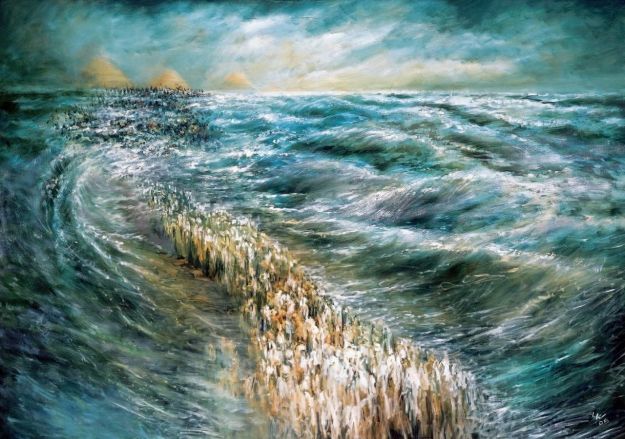
1When Israel went out from Egypt, the house of Jacob from a people of strange language, 2Judah became God’s sanctuary, Israel his dominion. 3The sea looked and fled; Jordan turned back. 4The mountains skipped like rams, the hills like lambs. 5Why is it, O sea, that you flee? O Jordan, that you turn back? 6O mountains, that you skip like rams? O hills, like lambs? 7Tremble, O earth, at the presence of the Lord, at the presence of the God of Jacob, 8who turns the rock into a pool of water, the flint into a spring of water.
This second “Egyptian Hallel” psalm[1] praises the power of the LORD the God of Israel’s being. Throughout this short poem the nations, the waters, and the land all respond and tremble at the LORD’s presence. Nowhere in the poem does God act, except indirectly in the final verse. The background of the poem is the exodus narrative and the creation narrative. The LORD is the God of creation with power over the waters and the mountains, but also the God of the exodus who brought the people out of Egypt and into the promised land.
The poem is built on parallel expressions: Israel/house of Jacob; Judah/Israel; sea/Jordan; mountains/hills; and rock/flint. Each line doubles the reaction using these parallel expressions and intensifies the effect of the poem’s praise. The people’s experience of the power of the LORD goes back to the experience of God taking the people out of Egypt and making them into a sanctuary (Hebrew qados– devoted, set apart) (Nancy deClaisse-Walford, 2014, p. 851) and dominion. The exodus narrative is the obvious reference alluded to throughout the poem and yet in poetic function the event becomes transformed to the creation’s reaction to the presence of the LORD among God’s people.
The opening verse informed the reader of the poem that the reference was the exodus and now in verse three the poet uses a set of parallels to bracket the biblical narrative of the exodus event. The sea which looks and flees from God references the crossing of the Red Sea in Exodus 14 while the crossing of the Jordan once it has turned back references the end of the journey in Joshua 3. The sea and river become things that flee[2] from the LORD’s presence among the people of Israel. The God who exercised control over the deep in creation is now feared by these waters which bracket the story of the exodus.
The mountains and hills, unmoving and permanent, now become like rams and lambs in their rapid motion. Psalm 29 used a similar image of Lebanon and Sirion fleeing before the LORD, even using the same term ‘skip’ although in that psalm the metaphor is a calf and a wild ox. Habakuk also utilizes a similar image of the hills and mountains being shattered and sinking at the appearance of the LORD.[3] This reaction of both the waters and the immovable rock of mountains and hills is caused by the presence of the LORD. The earth models the proper response by trembling.[4] Creation itself models that “The fear of the LORD is the beginning of wisdom” (Psalm 111:10).
Although it should be clear throughout the poem that the people, the waters and the mountains are all responding to the God of Jacob, God is mentioned explicitly for the first time in verse seven.[5] The poem concludes by bringing the imagery of rock and water together with an allusion to God’s provision of water via Moses striking the rock at Rephidim in Exodus 17:1-7. The God who moved over the depths in creation and formed the seas, the rivers, the rocks, hills and mountains becomes known to God’s people who come to know God’s impact on the world as God brings them out of Egypt, providing water in the wilderness, and passing them through the waters of the Jordan into the promised land. The people and the earth tremble before the fearful presence of the LORD in their midst.
[1]Psalm 113-118 are often called the Egyptian Hallel psalms because they are recited on the Passover meal on the eighth day of Passover. They are the psalms used to celebrate God’s actions to take their ancestors out of Egypt.
[4]Psalm 97:4 also has the earth trembling in reaction to the LORD’s lightning.
[5] In the NRSV in verse 2 God is mentioned in verse 2 when Judah became God’s sanctuary, but the Hebrew is simply Judah became his sanctuary (the third person singular pronoun is attached to qados the word for sanctuary.
1Bless the LORD, O my soul. O LORD my God, you are very great. You are clothed with honor and majesty, 2wrapped in light as with a garment. You stretch out the heavens like a tent, 3you set the beams of your chambers on the waters, you make the clouds your chariot, you ride on the wings of the wind, 4you make the winds your messengers, fire and flame your ministers. 5You set the earth on its foundations, so that it shall never be shaken. 6You cover it with the deep as with a garment; the waters stood above the mountains. 7At your rebuke they flee; at the sound of your thunder they take to flight. 8They rose up to the mountains, ran down to the valleys to the place that you appointed for them. 9You set a boundary that they may not pass, so that they might not again cover the earth. 10You make springs gush forth in the valleys; they flow between the hills, 11giving drink to every wild animal; the wild asses quench their thirst. 12By the streams the birds of the air have their habitation; they sing among the branches. 13From your lofty abode you water the mountains; the earth is satisfied with the fruit of your work. 14You cause the grass to grow for the cattle, and plants for people to use, to bring forth food from the earth, 15and wine to gladden the human heart, oil to make the face shine, and bread to strengthen the human heart. 16The trees of the LORD are watered abundantly, the cedars of Lebanon that he planted. 17In them the birds build their nests; the stork has its home in the fir trees. 18The high mountains are for the wild goats; the rocks are a refuge for the coneys. 19You have made the moon to mark the seasons; the sun knows its time for setting. 20You make darkness, and it is night, when all the animals of the forest come creeping out. 21The young lions roar for their prey, seeking their food from God. 22When the sun rises, they withdraw and lie down in their dens. 23People go out to their work and to their labor until the evening. 24O LORD, how manifold are your works! In wisdom you have made them all; the earth is full of your creatures. 25Yonder is the sea, great and wide, creeping things innumerable are there, living things both small and great. 26There go the ships, and Leviathan that you formed to sport in it. 27These all look to you to give them their food in due season; 28when you give to them, they gather it up; when you open your hand, they are filled with good things. 29When you hide your face, they are dismayed; when you take away their breath, they die and return to their dust. 30When you send forth your spirit, they are created; and you renew the face of the ground. 31May the glory of the LORD endure forever; may the LORD rejoice in his works — 32who looks on the earth and it trembles, who touches the mountains and they smoke. 33I will sing to the LORD as long as I live; I will sing praise to my God while I have being. 34May my meditation be pleasing to him, for I rejoice in the LORD. 35Let sinners be consumed from the earth, and let the wicked be no more. Bless the LORD, O my soul. Praise the LORD!
This psalm and its predecessor are linked by their common opening and closing, “Bless the LORD, O my soul (nephesh).” The pairing of these psalms reminds me of a table prayer that I taught my children as they were growing up, “God is great, God is good, and we thank God for our food.” As Rolf A. Jacobson can state,
Whereas the central theological witness of Psalm 103 is that God is good (that is, the Lord is a God of hesed), the driving witness of Psalm 104 is that God is great. (Nancy deClaisse-Walford, 2014, p. 774)
This psalm looks in doxological wonder at the beauty, majesty, and order of God’s creation and exuberantly pours out praise at the greatness of the God who created the heavens and the earth. Like earlier psalms that marveled in the intricate connections and scale of creation, the psalmist joins their voice as a humble offering amidst the chorus of creation.
When modern people talk of creation our typical mode of thought is scientific and explanatory. The debate between creationists who try to limit God’s creation to the seven days of Genesis 1 and evolutionists arguing for a natural evolution of the universe are both framed by the language of modernity, a language which would be foreign to the scriptures. The biblical way of approaching the creation is the language of poetry and praise, wonder and curiosity. The entire direction of both the biblical narratives of creation in Genesis 1-2 and the places where the bible poetically wonders at the creation is oriented on giving praise, honor, glory, and majesty to the God of creation. This poem shares the characteristic joyfulness of the faithful ones throughout the scriptures reflecting on God’s own joy at the good creation.
Both Psalm 104 and the Genesis narratives utilize and subvert the mythological language found in the creation myths throughout the Middle East. While the Lord’s chambers are established upon the waters, an image of chaos throughout the Middle Eastern mythologies, both Genesis and the Psalms have the LORD bringing order out of chaos in a non-violent manner. Light and heavens, waters and wind, fires and flames, clouds and earth all become ordered to form the dominion of God and all the elements are brought together to build and serve the order of God. The waters rise up like a garment and though they can cover the mountains they flee at God’s rebuke and are bound and contained. The chaotic waters that threatened to flood the earth become the lifegiving seas and waters which provide for the plants of the earth and the animals of the field.
The psalmist delight’s in “God’s superabundant liberality”[1] and imagines God looking with delight upon the majestic creation. The lens of the psalmist begins his reflection on the works[2] of God’s hands with agricultural images that would likely be closest to their daily experience. God causes grass to grow for cattle, and plants that people harvest that bring forth the food that people eat. God is great and God is good, and they thank God for the food that God provides. God provide for the necessities of life but also for the joyous things: wine to gladden the human heart, oil for the human face, and bread to strengthen the heart.[3] Yet, the reflection on the works of God do not end with the immediate benefits for human society. God provides for the trees and the birds that live in them, wild goats and rabbits. There is a time for everything, daytime and nighttime for humanity and the creatures of the forest, days marked by the sun and seasons marked by the moon. The lion, the representative great beast of the forest, humanity works in the city and fields, and Leviathan the great beast of the sea all joins in the noise of creation calling out to God. Leviathan, the great chaos monster that was a threat to the gods in other societies, is now merely a plaything of the LORD. The great lion of the forest and the dragon of the sea have been tamed by the creating LORD upon whom both depend. Lion, humanity, and Leviathan all know that God is great, and God is good, and it is the LORD who they thank for the food that God provides in due season.
Yet, the creation is dependent upon God’s continual attention and sustainment. Hebrew thought has no conception of the modern image of a god who created the universe as a clockmaker creates a clock, winds it up and then departs. The creation remains dependent upon God’s face being turned towards it and God’s breath[4] residing within and animating the creature. Humanity and all creation are completely dependent upon the continued provision of the LORD which animates the creatures and renews the face of the ground. The face of the ground looks up in adoration at the face of the LORD which provides for it. The earth trembles at the attention of the LORD and the touch of God’s finger upon the mountain causes them to smoke.
The psalmist sings his song amid the majesty of creation as an offering to the LORD. The penultimate line where the psalmist asks for “sinners to be consumed from the earth, and let the wicked be not more” may seem like a discordant note to end the psalm with, but within the ordered world of creation and God’s justice and righteousness there is no space for those who undermine the order of creation. Hebrew wisdom does separate good from evil, righteous from sinners, wise from foolish, and the faithful from the wicked. Yet, the LORD is both good and great, providing life, food, and joy for all of creation, and the psalmists humble meditation tries to with their humble offering of praise to bring a little joy to the creator. Their whole life[5] is involved with blessing and praising the good and great God of creation.
Cecil Alexander’s joyous song “All Things Bright and Beautiful” echoes the emotion and orientation of this psalm:
All things bright and beautiful, all creatures great and small, all things wise and wonderful, the Lord God made them all.
And in the final verse of this song, after reflecting on creation from the smallness of flowers to the majesty of the mountains, Cecil Alexander’s words come back to the human standing amid the wonders of God’s works:
God gave us eyes to see them, and lips that we might tell how great is God Almighty, who has made all things well.
Or in the words of the psalmist, Bless the LORD, O my soul (nephesh). Praise the LORD. May our eyes, lips, and entire being continually live in wonder at the greatness of the creation that God’s hands formed, at the faithfulness of God continuing to look upon the face of the earth and sending forth the ruach (wind, spirit, breath) which continues to animate and sustain the creation and to respond in praise.
[2] Works, Hebrew ‘asa, is an important concept in the poem which is sometimes translated make (s)/made (v. 4, 19, 24b) and other times as works (v. 13, 31). (NIB VI: 1096)
[3] Worth noting that the heart in Hebrew is not the instrument of emotion but of will and decision.
[4] This is the Hebrew ruach which can also mean spirit or wind. All creation in both Genesis 1 and Psalm 104 is dependent upon the ruach which originates in God. English translates ruach as breath and spirit in successive verses obscuring this connection.
[5] Hebrew nephesh is not simple the Greek concept of soul but encompasses all of life.
And Elohim Created Adam by William Blake – The Yorck Project (2002) 10.000 Meisterwerke der Malerei (DVD-ROM), distributed by DIRECTMEDIA Publishing GmbH. ISBN: 3936122202., Public Domain, https://commons.wikimedia.org/w/index.php?curid=147900
The fields are devastated, the ground mourns; Joel 1:10a
One of the concepts that I’ve felt drawn to in Hebrew thought is the way the earth is personified and often bears the consequences of human activity. Humanity is connected with the earth in a way that is often missed in English and this connection starts at the very beginning of the Bible. The man (adam)[1] is formed from dust the soil (adamah) and when the man eats the fruit of the tree of the knowledge of good and evil God’s declaration has the earth bear the curse but also reiterates the linkage between the man and the ground:
And to the man (adam) he said, “Because you have listened to the voice of your wife, and have eaten of the tree about which I commanded you, ‘You shall not eat of it,’ cursed is the ground (adamah) because of you; in toil you shall eat of it all the days of your life; thorns and thistles it shall bring forth for you; and you shall eat the plants of the field. By the sweat of your face you shall eat bread until you return to the ground (adamah), for out of it you were taken; you are dust, and to dust you shall return.” Genesis 3: 17-19
This theme continues in Cain and Abel as the personified ground cries out in protest against Cain’s murder of his brother:
And the LORD said, “What have you done? Listen; your brother’s blood is crying out to me from the ground (adamah)! And now you are cursed from the ground(adamah), which has opened its mouth to receive your brother’s blood from your hand. When you till the ground, it will no longer yield to you its strength; you will be a fugitive and a wanderer on the earth.” Genesis 4: 10-12
The consequence of the wickedness of humanity leads a grieving God to blot out human beings from creation along with all the other animals (Genesis 6:6-7) and in the aftermath of the flood God tells Noah:
The fear and dread of you shall rest on every animal of the earth, and on every bird of the air, on everything that creeps on the ground, and on all the fish of the sea; into your hand they are delivered. Genesis 9:2
This recapitulates the call of humanity to rule over creation in Genesis 1: 28-30. How humanity exercises this rule will be important for both humanity and the entire creation.
This imagery in Genesis is picked up by the prophets and highlights the connection between the disobedience of the people of God and the earth’s plight. For example, Isaiah states:
The earth dries up and withers, the world languishes and withers; the heavens languish together with the earth. The earth lies polluted under its inhabitants; for they have transgressed laws, violated the statutes, broken the everlasting covenant. Therefore a curse devours the earth and its inhabitants suffer for their guilt; therefore the inhabitants of the earth dwindled, and few people are left. Isaiah 24: 4-6
Or in Jeremiah:
How long will the land mourn, and the grass of every field wither? For the wickedness of those who live in it the animals and the birds are swept away, and because people said, “He is blind to our ways.” Jeremiah 12: 4
For the prophet Joel the disobedience of the people is the cause of the environmental disaster that they are encountering where the crops, vines, trees, cattle, sheep, and wild animals are all suffering because of humanity. The land becomes the first victim of the curse on behalf of humanity and although humanity will eventually suffer the earth is the first bearer of these curses so that humanity has a chance to understand and repent. As in the signs and wonders (plagues) in Egypt (Exodus 7-11) the environmental disasters all refrain from the loss of human life until the final sign. The blessings and curses in Deuteronomy 27-30 also share this pattern where the land’s prosperity is linked to the obedience of the people and there is always an opportunity for the people to repent and receive the blessing of the LORD. As we will see in the prophet Joel, the expected repentance will lead to not only a reversal of the current curse on the land but to a time of the LORD’s prosperity.
In the New Testament this way of thinking emerges in Paul’s Letter to the Romans as Paul leans into his vision of hope. Paul articulates a bold hope for all of creation when he proclaims:
For the creation waits with eager longing for the revealing of the children of God; for the creation was subjected to futility, not of its own will but by the will of the one who subjected it, in hope that the creation itself will be set free from its bondage to decay and will obtain the freedom of the glory of the children of God. We know that the whole creation has been groaning in labor pains until now; and not only the creation, but we ourselves, who have the first fruits of the Spirit, groan inwardly while we wait for adoption, the redemption of our bodies. Romans 8: 19-23
Humanity’s disobedience to God’s will impacts the creation. Although Joel never articulates what actions lead to God’s judgment on the earth through locusts and drought, as we look at natural disasters perhaps this is an opportunity to consider our impact on the world. I write this from North Texas which has had the second hottest and second driest August ever recorded, with temperatures frequently above 105 degrees (and heat index frequently above 115) I wonder what are the things that this community needs to repent of. I do believe that the way we utilize our environment impacts the climate from the fossil fuels we burn to power our lifestyles to the concrete, asphalt, and steel that lay as a hot blanket on the soil. The worldview of Genesis, Deuteronomy, the prophets (and the bible in general) would be critical of the societal drive for acquisition and the lack of care for the world we inhabit. I also have been questioning the disconnect that most urban and suburban people have from the soil. We may be insulated from the consequences of our actions but the impacts for the earth may only grow more dire.
[1] Adam can be a proper name, but it is also the generic term for ‘the man’.
What is the palette in which the master artist dipped the brush that painted in colors?
Or what thunderous notes did the creator sing to tune the sun and stars and quasars?
Which no eye would see, nor any ear hear, nor thought comprehend for millions of years
Where the colors spoken into being or where did they burst onto the scene with the elements
Did spirits or angels go to gather them together at their master’s directing like treasure hunters
Or was it the act of a solitary composer working in silence waiting to create an audience
Crafting the depths of the universe and sprinkling brilliant light into the blackness of the abyss
Singing into the silence of space a symphonic composition whose melodies gave form and shape
Whose beat marked the passage of days and millennia as the spheres turned and the cosmos shone.
What runes were hidden deep within the caverns of the earth which are the hidden signature
Of the master artist waiting to be discovered by those who peer deeply into the painting?
What fingerprints might remain from the act of raising the mountains and carving canyons?
Do the notes of the songbird echo some piece of the melody of the maker, a reflected praise?
Or the whale song of the deep form a baseline with the rumble of the continental drift?
Might the human drive of curiosity be the imprint of the master’s image on the creature?
The drive to delight in the possibilities of the palette of the painting they reside within
The desire to listen to the melody of the cosmos in all its wide range of sounds
To develop eyes to see and ears to hear and minds to comprehend their place in the picture
To join the song and dance in delight at the magic of the universe’s echo of the song it learned
At the knee of its creator and which it continues to sing as it wonders at its majesty
The stream burbled patiently singing its tune
As the sun shone in a ray through the break in the trees
While dragonflies danced and frogs played
In the early summer’s warmth of this peaceful place
My secret place where others rarely enter
A space to commune with the undisturbed world
To delight in the slow and steady rhythm of the creator
Where every mote of dust reflects magic and light
And heaven and earth are not so far apart
This thin space where sometimes epiphanies occurs
Into this peaceful space emerges a hawk, proud and strong
Soaring in to rest upon the branch an ancient oak tree
And it watches me watching it with knowing eyes
A herald of the mystery that awaits unveiling in that space
Rustling through the underbrush another unexpected guest
Emerging with his royal blue head from the undergrowth
Strutting into this magical place with his myriad eyes
As he quickly expands his tailfeathers in proud display
Looking imperially at the human who happens to be
In this space where creation came to play in delight
To dance in the joy of the creator’s masterwork
As nature continued to roll back her curtain of majesty
Rolling out her green carpet to await the celebration
Out of the mystery steps lady wisdom cloaked in green
With her escorts, a stag on her left and a wolf on her right
The frogs cease their croaking chorus
Dragonflies circle to land on the cat lilies
The peacock bows his proud blues head
the hawk swoops down to land upon her shoulder
While I stand transfixed by this moment of mystery
All watch as she brings forth an egg from her cloak
Which she cradles in her hands like the greatest treasure
As the creation watches this miracle of new birth
Somehow, I know to look away not to look unmediated
At the divine drama unfolding in this beautiful place
But from the reflection of the stream I see her lay
The dormant egg into a thick blanket of green grass
And from the bed of green emerges red, yellow, blue and orange
As nature’s nest burns and yet remains unconsumed
And I wonder if I, like Moses, stand on sacred ground
As the new chick emerges with a cry of victory
From fire and light and ash the new phoenix emerges
Spreading its wings towards the waiting sky
Looking to its dominion among the heavens
Before it flies away from this place it scooped
By the woman’s gentle hands and they share a second
As all the earth bows in this moment of mystery
Wolf and stag bend low, peacock and hawk
Even the trees themselves seem to stoop
As creation lifts its joyous song and the resurrection
The revelation that magic has not left the creation
And I, on behalf of humanity lie upon the verdant ground
In wonder and awe as a witness of this sight
As quickly as it was revealed it is concealed
Nature closes her curtain and the world returns
To the chorus of frogs and the dance of dragonflies
The woman and her escorts are gone
Back behind the shroud of the ancient trees of the forest
The phoenix disappears into the heavens
Shining as radiant and dazzling as the beaming sun
Yet, I remain stunned at this dream, this vision
Wondering at what I have seen as the memories fade
And so, I grab my pen and write furiously
Trying to capture the essence of the epiphany
Of the magic and mystery at work in the world
Masked but to those who sit in the thin spaces
Where heaven and earth are not so far apart
1 Rejoice in the LORD, O you righteous. Praise befits the upright. 2 Praise the LORD with the lyre; make melody to him with the harp of ten strings. 3 Sing to him a new song; play skillfully on the strings, with loud shouts. 4 For the word of the LORD is upright, and all his work is done in faithfulness. 5 He loves righteousness and justice; the earth is full of the steadfast love of the LORD. 6 By the word of the LORD the heavens were made, and all their host by the breath of his mouth. 7 He gathered the waters of the sea as in a bottle; he put the deeps in storehouses. 8 Let all the earth fear the LORD; let all the inhabitants of the world stand in awe of him. 9 For he spoke, and it came to be; he commanded, and it stood firm. 10 The LORD brings the counsel of the nations to nothing; he frustrates the plans of the peoples. 11 The counsel of the LORD stands forever, the thoughts of his heart to all generations. 12 Happy is the nation whose God is the LORD, the people whom he has chosen as his heritage. 13 The LORD looks down from heaven; he sees all humankind. 14 From where he sits enthroned he watches all the inhabitants of the earth — 15 he who fashions the hearts of them all, and observes all their deeds. 16 A king is not saved by his great army; a warrior is not delivered by his great strength. 17 The war horse is a vain hope for victory, and by its great might it cannot save. 18 Truly the eye of the LORD is on those who fear him, on those who hope in his steadfast love, 19 to deliver their soul from death, and to keep them alive in famine. 20 Our soul waits for the LORD; he is our help and shield. 21 Our heart is glad in him, because we trust in his holy name. 22 Let your steadfast love, O LORD, be upon us, even as we hope in you.
This psalm is a majestic psalm of praise that takes the fundamental trust throughout the psalms that God will take care of the author and the faithful ones and extends that care to all of creation. If you read Psalm 32 and 33 together then this psalm becomes the shout for joy by the righteous ones (shout for joy in 32 and rejoice in 33 translate the same Hebrew verb). Martin Luther’s well-known explanation of the first commandment that we are to “fear, love and trust God above all things.” could explain the dynamic of many psalms, but we hear in this psalm why God is trustworthy and many of the things that seem to be powerful are not. The faithful one understands that the earth is full of the steadfast love of God and that the poet’s role is to praise this creative love of God which permeates everything.
Structurally the poem is designed to give a sense of completeness. The poem’s 22 lines, mirroring the 22 letters of the Hebrew alphabet even though the poem is not acrostic, speak a complete message of God’s power and trustworthiness in all of creation. (Actemeir, 1997, p. IV:809) The act of praise is an act of hope and faith, of speaking trust amid a world that trusts in other sources of power. It protests trusting in military might, physical strength, financial resources or political power. The Psalmist can rejoice because at its heart the world is full of the steadfast love of God that nothing can separate the poet from.
The LORD is described as committed to a stance of uprightness, faithfulness, righteousness and justice. The God of the psalmist is not an unmoving or unengaged deity, but one that chooses and defends those who attempt to live in accordance with God’s will for the world. Even though the word shalom (peace, harmony) is not mentioned in this new song the poet lifts before the LORD, it underlies the trust that the one who created and ordered the world protects and guards the one who lives in righteousness and faithfulness. The words of the LORD given through the law and the prophets echo the order that the LORD has spoken into creation itself.
Psalm 33 shares a common vocabulary with Genesis 1, where the creation comes into being and is given form by the word of the LORD. In the beginning when the LORD created the heavens and the earth reverberates as the heavens are created by the word of the LORD and the host are created by the breath of God. The limits for the oceans and sea become playfully like a bottle and the LORD has storehouses that can contain the immeasurable (at least at the time of the psalm’s composition) depths of the oceans. If the world itself is an act of imagination and speaking for the LORD and the seas and the stars find their place due to the word of the LORD, then the promises uttered passed on to the psalmist are a faithful foundation to build the poet’s trust and hope upon. If earth is full of the steadfast love of God, then the psalmist can rest in the comforting embrace of that love.
Philip Melanchthon, one of Martin Luther’s close associates in the reformation, once said, “to know Christ is to know his benefits rather than his natures…” and similarly Rolf Jacobson can parallel:
the Psalter bears witness that to know the Lord is to know the benefits of being in relationship with the Lord, rather than to know the Lord’s natures. In Psalm 33, the emphasis first of all upon the relationship with that the Lord forges with humanity through the act of creation (vv. 6-7, 9, 15) and also upon the special relationship that God forged through Israel through the election of the chosen people. (v.12) (Nancy deClaisse-Walford, 2014, p. 319)
Blessed is the nation whose God is the LORD, who trusts in God rather than the military might, financial prosperity or political influence. Faith enables the individual and the faithful ones to see that the benefit of the LORD’s trustworthiness. I’ve said in other forums that I believe that the greatest idol in the United States is security and we are willing to sacrifice almost anything to that idol. We may inhabit a place where great armies and military technology can create incredible damage and vast amounts of death, but ultimately it is the LORD who looks down from heaven who can control the course of humanity. God sees all of humanity, fashions the hearts, observes the deeds, and the eyes of God watches those who trust in the LORD. Nothing can separate them from the seeing eyes and the pervading love of the LORD, not death and not famine nor anything else under the heavens.
The grace of God that can forgive sin and bring about peace and reconciliation is the same steadfast love of God that creates and fills the earth. The word of the LORD, whose utterance brought creation into being continues to shape the hearts of humanity and the course of the nations. Even though might and power may appear to reside in the strength of the military or the wealth contained within the vaults of banks or the political power of various groups these are ultimately illusions. The steadfast love of God fills the earth and faithful ones have learned to rest within this gracious presence of God’s creative might. This praise of the upright and new song of the faithful ones proclaim the trustworthiness of the LORD and stands among the blessed ones chosen for the joyous task of praising the LORD and knowing what the steadfast love of God is creating in their midst.
James Tissot, The Creation (between 1896 and 1902)
Psalm 19
<To the leader. A Psalm of David.> 1 The heavens are telling the glory of God; and the firmament proclaims his handiwork. 2 Day to day pours forth speech, and night to night declares knowledge. 3 There is no speech, nor are there words; their voice is not heard; 4 yet their voice goes out through all the earth, and their words to the end of the world. In the heavens he has set a tent for the sun, 5 which comes out like a bridegroom from his wedding canopy, and like a strong man runs its course with joy. 6 Its rising is from the end of the heavens, and its circuit to the end of them; and nothing is hid from its heat. 7 The law of the LORD is perfect, reviving the soul; the decrees of the LORD are sure, making wise the simple; 8 the precepts of the LORD are right, rejoicing the heart; the commandment of the LORD is clear, enlightening the eyes; 9 the fear of the LORD is pure, enduring forever; the ordinances of the LORD are true and righteous altogether. 10 More to be desired are they than gold, even much fine gold; sweeter also than honey, and drippings of the honeycomb. 11 Moreover by them is your servant warned; in keeping them there is great reward. 12 But who can detect their errors? Clear me from hidden faults. 13 Keep back your servant also from the insolent; do not let them have dominion over me. Then I shall be blameless, and innocent of great transgression. 14 Let the words of my mouth and the meditation of my heart be acceptable to you, O LORD, my rock and my redeemer.
Psalm 19 as a psalm of praise brings together the wonder and mysterious natural knowledge of God uttered in the unheard speech of creation and the revealed wisdom of the LORD in the gift of the Torah (the law). Like Psalm 8, the other psalm of praise we have encountered at this point in the book of Psalms, it reflects upon the majesty of creation from a sense of wonder and awe. It can look at the heavens above, the earth below and the seas in their vastness and be amazed at the creator God who has done all of these things. Here in the first verse the word for God is the generic El which can be either God, a god, or in plural gods, but it is not a name like will be used beginning in verse seven. Yet, the heavens and day and night and sun are all poetically personified in the psalm, speaking in words that are unheard and voices that human ears cannot perceive. Perhaps the psalmist, just straining, can barely hear the silent resonance of the Creator echoing through the creation. Perhaps they can perceive the God that stands behind the creation where others have taken the created parts of creation and deified them. In verses four and five, it is possible that the Psalmist makes use of an existing Akkadian/Summerian bilingual hymn that refers to the sun as a hero, warrior and bridegroom (Nancy deClaisse-Walford, 2014, p. 208) yet instead of leaving the sun as a deity in its right (like the surrounding cultures) now the sun becomes a rejoicing servant reveling in the course that the creator God has set for it. The first half of the Psalm revels with the song of creation in the artistry and majesty of the creator and the Psalmist lifts up in their own way an audible voice for the unheard creation’s song.
It may seem unusual to bring together creation and the law in a poem, and perhaps these originated in two different places, but bringing these two together makes sense of the broader understanding of how God works with the Hebrew people. Creation is a gift of God for all the world, but the law (the Torah) is the special revealed gift for God’s chosen people. The God referred to initially only with the generic El now receives the revealed name YHWH (frequently pronounced Yahweh, anytime you see LORD in the Hebrew Scriptures (Old Testament) the proper name of God revealed to Moses is behind that, it is typically pronounced Adonai when read (translates to Lord) to not take the LORD’s name in vain). Together with Psalm 1 and the much longer Psalm 119, Psalm 19 praises the law of the LORD. The revealed will of God in the law becomes the nourishment, which revives the faithful, brings wisdom and purity and clarity and are a rich gift fit for a king. The ideal leader was to have the law always before them and to diligently observe and follow it all the days of their life. (see Deuteronomy 17: 18-20) If the king is the one lifting up this prayer the wonder of the cosmos is combined with the revealed wisdom of the Torah to keep them in obedience to God’s will for their life and God’s people.
The Psalm ends with a petition to be kept in this way revealed by the LORD in the midst of all the temptations that life brings forward. There is a humility in realizing that even though the law may reveal the human may conceal from themselves the faults of their hands and hearts. Even with the wisdom of Solomon one may fail to see the divergence in one’s life from the way of the covenant which coheres with God’s law. The Psalmist petitions their LORD to clear them of hidden faults, to keep them away from the insolent and foolish and to allow them to be blameless. God is their rock and their redeemer, the word for redeemer is go’el the kinsman redeemer who is able to, and is expected to, purchase their enslaved kin from slavery. Here the LORD is the one who is able to set the Psalmist free to live the life they are called to live: a life that can revel in God’s creation and delight in God’s law.
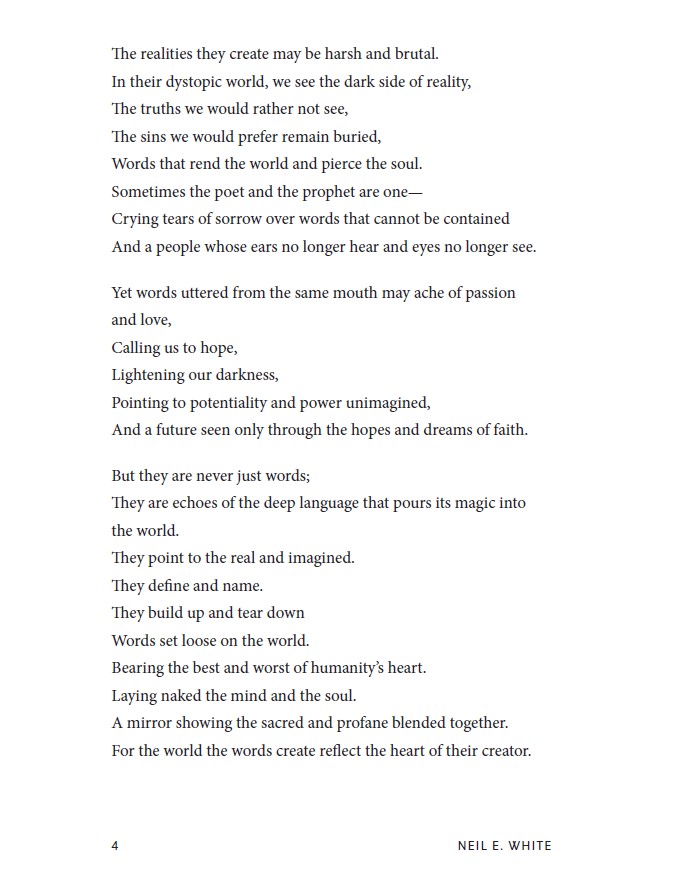
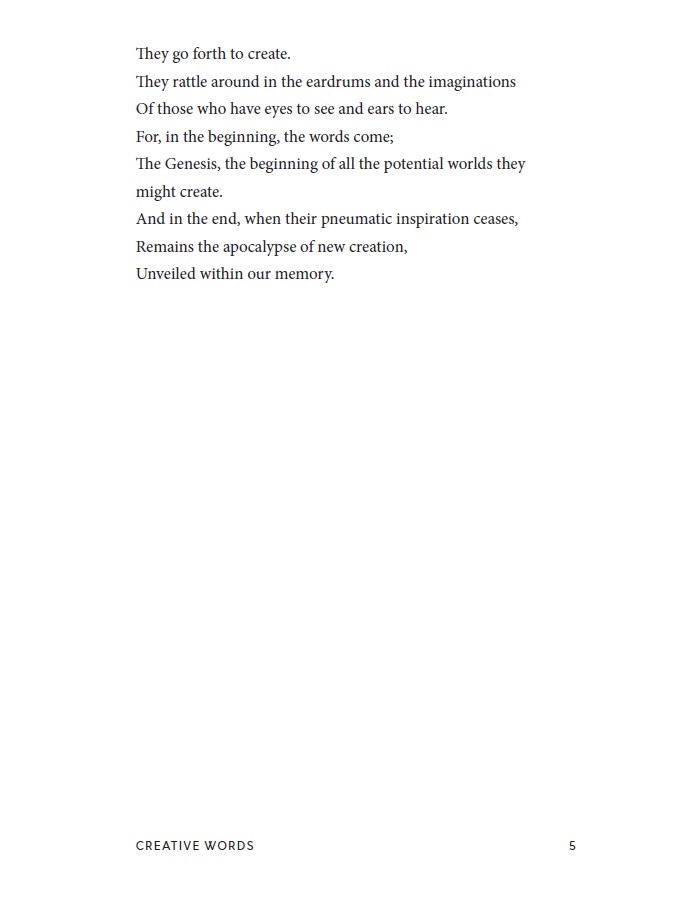
What power lies within the syllables and sounds? Do they merely describe a reality fully formed? A mimetic act of the glorification of creation Reflecting upon a completed picture imperfectly A flawed simulacrum of what sense can comprehend Or is there something more in the words? Do they reflect or recreate? In these syllables and sounds is there the power of creation? Do the songs and poetry open up new worlds of possibilities? Can a statement or the stroke of a pen start a reality? Can the sounds dance along the chaotic creative waters Or commands give shape to the formless clay Or is it something less contained in the words? Do they reinvent or refract? And perhaps the answer isn’t in the words at all For maybe it is the potential of the creation already latent And words may describe the reality that is already present Or serve as a key that opens up some preexisting door Echoing the preordained syllables that resonate among the stars Copying the creative wisdom that predates the cosmos And perhaps they are only words and yet, they are words Resurrecting, retelling, recasting and realizing




 Sign of the Rose