Tag Archives: Covenant

Deuteronomy 29: A Final Address

Deuteronomy 29: 1-9 Restating the Covenant

James Tissot, Moses (1896-1902)

James Tissot, Moses (1896-1902)

1 These are the words of the covenant that the LORD commanded Moses to make with the Israelites in the land of Moab, in addition to the covenant that he had made with them at Horeb.

                2 Moses summoned all Israel and said to them: You have seen all that the LORD did before your eyes in the land of Egypt, to Pharaoh and to all his servants and to all his land, 3 the great trials that your eyes saw, the signs, and those great wonders. 4 But to this day the LORD has not given you a mind to understand, or eyes to see, or ears to hear. 5 I have led you forty years in the wilderness. The clothes on your back have not worn out, and the sandals on your feet have not worn out; 6 you have not eaten bread, and you have not drunk wine or strong drink– so that you may know that I am the LORD your God. 7 When you came to this place, King Sihon of Heshbon and King Og of Bashan came out against us for battle, but we defeated them. 8 We took their land and gave it as an inheritance to the Reubenites, the Gadites, and the half-tribe of Manasseh. 9 Therefore diligently observe the words of this covenant, in order that you may succeed in everything that you do.


In a world of legal contracts where a signature is binding until such time as a legal contract that supersedes the previous contract is agreed upon it seems strange for us to see the need to go back within the same document multiple times to the same story and to restate the covenant. Yet, the way that Deuteronomy is shaped owes to its oral structure and possible origination. Just as in Deuteronomy 6 with its continual recitation of the central statement of faith when a person enters the house or leaves, when they rise up or when they lay down, so the re-iteration of the covenant multiple times serves to reinforce its binding nature upon the people. Chapter 29 begins what is often referred to as the third address of Moses and it begins by restating in a concise way the narrative laid out in Deuteronomy 1-3 as well as reminding them, as in Deuteronomy 8 of how the LORD provided for them on their journey to this point.

The covenant is always connected with the narrative. The people are the people of God because of the LORD’s action to bring them out of Egypt, through the wilderness and to the promised land. The Exodus becomes the central story of who they are as a people and their life flows out of the LORD’s provision for them. The great fear of Deuteronomy is that in the midst of abundance the people will become complacent. Yet, the people always lives in response to God’s action to free them from their captivity. Their life flows from the ways in which they embrace or turn away from the therefore of God’s action to give them freedom. As we have seen in the previous chapters the people have the ability to choose blessing or curse, and the fear is that they will choose by their actions the curse.

Within the prophetic imagination of Israel, the people will have to wrestle with their inability to remain faithful in the covenant. Is free will only a partial option, do they lack eyes that see, ears that hear and minds that understand? Will they become the embodiment of the people Isaiah is sent to in Isaiah 6:

Keep listening, but do not comprehend; keep looking, but do not understand.’ Make the mind of this people dull, and stop their ears, and shut their eyes, so that they may not look with their eyes, and listen with their ears, and comprehend with their minds, and turn and be healed.” Isaiah 6: 9-10

Yet as we will see in Deuteronomy 30, even with the inability of the people to remain faithful the LORD will, even though it is painful, remain in a relationship with them. There will be a place for those with eyes to see and ears to hear and a trust that eventually that the LORD will write the law on their hearts and they will all know the LORD (Jeremiah 31: 33)

Deuteronomy 29: 10-29 The Danger of Complacency

 10 You stand assembled today, all of you, before the LORD your God– the leaders of your tribes, your elders, and your officials, all the men of Israel, 11 your children, your women, and the aliens who are in your camp, both those who cut your wood and those who draw your water– 12 to enter into the covenant of the LORD your God, sworn by an oath, which the LORD your God is making with you today; 13 in order that he may establish you today as his people, and that he may be your God, as he promised you and as he swore to your ancestors, to Abraham, to Isaac, and to Jacob. 14 I am making this covenant, sworn by an oath, not only with you who stand here with us today before the LORD our God,

 15 but also with those who are not here with us today. 16 You know how we lived in the land of Egypt, and how we came through the midst of the nations through which you passed. 17 You have seen their detestable things, the filthy idols of wood and stone, of silver and gold, that were among them. 18 It may be that there is among you a man or woman, or a family or tribe, whose heart is already turning away from the LORD our God to serve the gods of those nations. It may be that there is among you a root sprouting poisonous and bitter growth. 19 All who hear the words of this oath and bless themselves, thinking in their hearts, “We are safe even though we go our own stubborn ways” (thus bringing disaster on moist and dry alike)– 20 the LORD will be unwilling to pardon them, for the LORD’s anger and passion will smoke against them. All the curses written in this book will descend on them, and the LORD will blot out their names from under heaven. 21 The LORD will single them out from all the tribes of Israel for calamity, in accordance with all the curses of the covenant written in this book of the law. 22 The next generation, your children who rise up after you, as well as the foreigner who comes from a distant country, will see the devastation of that land and the afflictions with which the LORD has afflicted it– 23 all its soil burned out by sulfur and salt, nothing planted, nothing sprouting, unable to support any vegetation, like the destruction of Sodom and Gomorrah, Admah and Zeboiim, which the LORD destroyed in his fierce anger– 24 they and indeed all the nations will wonder, “Why has the LORD done thus to this land? What caused this great display of anger?” 25 They will conclude, “It is because they abandoned the covenant of the LORD, the God of their ancestors, which he made with them when he brought them out of the land of Egypt. 26 They turned and served other gods, worshiping them, gods whom they had not known and whom he had not allotted to them; 27 so the anger of the LORD was kindled against that land, bringing on it every curse written in this book. 28 The LORD uprooted them from their land in anger, fury, and great wrath, and cast them into another land, as is now the case.” 29 The secret things belong to the LORD our God, but the revealed things belong to us and to our children forever, to observe all the words of this law.


After the previous chapter it may seem like overkill to return again to the possibility of disobedience, yet this is a pressing concern of Deuteronomy and this is also set up as a later address. As the people reaffirm the covenant there is both consequence, but there is also hope beyond consequence that is to come. In our world where we are hesitant to talk about God’s activity within our lives and within the movements of the world this may seem odd. In Deuteronomy’s world faithfully living out of their covenant identity is the meaning of life and peace and there is the trust that if they are faithful the LORD will provide. Yet, the danger is that they will become complacent or begin to place their trust in other things or gods. The LORD has invested in the people of Israel and for them to turn away rejecting God’s blessings grieves God. If you have read any of my writing on Jeremiah, you would see I approach the wrath in that book from the perspective of a wounded God crying out in pain at the loss of a relationship. Addressing this passage Deanna Thompson makes a similar point:

Amid the anger and fury, however, we also catch glimpses of an expression of rejected and wounded divine love similar to what we see in Hosea when it talks about Israel’s rejection of God. Israel’s disobedience leads to a portrait of God who is not just angry and wrathful but wounded as well. (Thompson, 2014, p. 207f.)

Time and time again Deuteronomy and the prophets of later times will try to speak to a people who do not hear on behalf of a wounded and grieved God.  The people cannot rest upon any special status, on kings or temples or walled cities or land. They are a people whose lives are bound into this covenantal relationship with a God who takes these bonds seriously. They have been given the law and the covenant, they are witnesses of the way the LORD has provided for them and now they live in the therefore. They may not know all the secrets of the universe, but their God has revealed enough for their life of faith as a people.

The other theme that re-emerges here is the way that the people and the land are linked. Much as in Genesis 3: 17-19 where the ground is cursed for the disobedience of Adam, here the land becomes a witness to the people’s unfaithfulness for generations to come. The soil becomes unable to support life and mirroring the lifelessness around Sodom and Gomorrah. Yet, the wrath articulated here in its fierceness seems to not be the first response of their God. The LORD will deal with the anger, woundedness, and rage but will continue to hope for a turn in the midst of the people. Moses is preparing to relinquish his position between the people and their LORD. It may seem like judgment takes a lot of the text of Deuteronomy or that wrath is the primary emotion, but as we will see in the coming chapter love always outlasts any wrath, and that even in desolation there is a way forward. As in Jeremiah there is a hard won hope that emerges out of the broken and exiled people, and here as well there is always the opportunity to return to the LORD their God who is gracious and merciful.


Deuteronomy 19: Justice, Refuge and Grace

"Bouguereau-The First Mourning-1888" by William-Adolphe Bouguereau - Art Renewal Center – description. Licensed under Public Domain via Commons - https://commons.wikimedia.org/wiki/File:Bouguereau-The_First_Mourning-1888.jpg#/media/File:Bouguereau-The_First_Mourning-1888.jpg

“Bouguereau-The First Mourning-1888” by William-Adolphe Bouguereau – Art Renewal Center – description. Licensed under Public Domain via Commons – https://commons.wikimedia.org/wiki/File:Bouguereau-The_First_Mourning-1888.jpg#/media/File:Bouguereau-The_First_Mourning-1888.jpg

Deuteronomy 19: 1-13: Cities of Refuge

1 When the LORD your God has cut off the nations whose land the LORD your God is giving you, and you have dispossessed them and settled in their towns and in their houses, 2 you shall set apart three cities in the land that the LORD your God is giving you to possess. 3 You shall calculate the distances and divide into three regions the land that the LORD your God gives you as a possession, so that any homicide can flee to one of them.

 4 Now this is the case of a homicide who might flee there and live, that is, someone who has killed another person unintentionally when the two had not been at enmity before: 5 Suppose someone goes into the forest with another to cut wood, and when one of them swings the ax to cut down a tree, the head slips from the handle and strikes the other person who then dies; the killer may flee to one of these cities and live. 6 But if the distance is too great, the avenger of blood in hot anger might pursue and overtake and put the killer to death, although a death sentence was not deserved, since the two had not been at enmity before. 7 Therefore I command you: You shall set apart three cities.

                8 If the LORD your God enlarges your territory, as he swore to your ancestors– and he will give you all the land that he promised your ancestors to give you, 9 provided you diligently observe this entire commandment that I command you today, by loving the LORD your God and walking always in his ways– then you shall add three more cities to these three, 10 so that the blood of an innocent person may not be shed in the land that the LORD your God is giving you as an inheritance, thereby bringing bloodguilt upon you. 11 But if someone at enmity with another lies in wait and attacks and takes the life of that person, and flees into one of these cities, 12 then the elders of the killer’s city shall send to have the culprit taken from there and handed over to the avenger of blood to be put to death. 13 Show no pity; you shall purge the guilt of innocent blood from Israel, so that it may go well with you.

                 With the roles that people will play within the community to ensure justice established in chapters 17 and 18 (judges, priests, king and prophets) now this section of Deuteronomy turns to expounding upon laws that continue to flesh out the ten commandments, particularly how the people of Israel are to relate to one another. There is less of a narrative and more of a didactic tone as the exposition of the law is intended to illustrate what the covenant life of the people is to look like and the manner in which they are interconnected with their God, the land and with one another. The author of Deuteronomy may not move systematically through the various commandments in articulating this exposition of the law, but is continually concerned to relate the adherence to the commandments to the people’s continuing life under the covenant with their LORD.

The setting up of cities of refuge assumes a situation very different from our modern legal system. In ancient honor bound agrarian societies if a member of the family was killed it was the family’s responsibility to enact justice. Deuteronomy assumes this type of system but also limits it with the provision of cities of refuge where a person who has killed another may flee to. Mentioned in Exodus 21: 13 and later designated in Joshua 20 they provide a place where the cycle of violence may be stopped providing the killing is accidental. If the killing is murder, the elders fill a judicial function in having the murderer turned over from the city of refuge to the family. The family remains the executor of judgment in this system.

Within this law setting aside both the cities of refuge and the method of justice to prevent a murder from remaining in sanctuary within these cities is an understanding of innocent blood which would contaminate the land and bring bloodguilt upon the people. Perhaps the understanding of this bloodguilt is similar to God’s response to Cain in Genesis 4:

And the LORD said, “What have you done? Listen; your brother’s blood is crying out to me from the ground! And now cursed you are cursed from the ground, which has opened its mouth to receive your brother’s blood from your hand. Genesis 4: 10-11

Innocent blood calls out to God who is ultimately the one who will have vengeance. There is an understanding that only blood can atone for blood and that the injury is not only against the individual but also the community and their holiness before God.

Issues of revenge and vengeance are huge threats to order within any society. There needs to be some manner that wrongs can be addressed. Yet, there also is a role for the legal system of a society to place a limit on the practice of revenge or vigilante justice. As much as Americans may love characters like Batman who are symbols of vigilante justice in a society where justice is perceived to be lacking. The reality of people creating their own systems of justice in a system where justice is not being carried out effectively (or rigorously enough) has led to many terrible acts throughout history. As will be outlined later in the chapter what is being sought is not vengeance but instead proportional justice. The lex talionis, (an eye for an eye, a tooth for a tooth, etc.) which probably was not enforced literally, provided a formula for justice that did not exceed the damage caused.


Deuteronomy 19:14 Honoring Boundaries

14 You must not move your neighbor’s boundary marker, set up by former generations, on the property that will be allotted to you in the land that the LORD your God is giving you to possess.


The gift of the land to the people of Israel was a part of their living out of the providence of their LORD. Within this society, where land is the primary means of producing food and ultimately wealth, the book of Deuteronomy has a very different understanding of land than our modern understanding derived from philosophers like John Locke or Adam Smith. For the people of Israel land was to remain with a family and was not viewed as private property that could be bartered or sold, it was to remain with the family for as long as the people remained faithful to God’s commandments. It was contingent on their relation to God, not to their ability to acquire more wealth.  Moving the boundary markers on a neighbor’s property is stealing from their neighbor in addition to failing to trust in the provision of God for their needs.


Deuteronomy 19: 15-21 Bearing False Witness

15 A single witness shall not suffice to convict a person of any crime or wrongdoing in connection with any offense that may be committed. Only on the evidence of two or three witnesses shall a charge be sustained. 16 If a malicious witness comes forward to accuse someone of wrongdoing, 17 then both parties to the dispute shall appear before the LORD, before the priests and the judges who are in office in those days, 18 and the judges shall make a thorough inquiry. If the witness is a false witness, having testified falsely against another, 19 then you shall do to the false witness just as the false witness had meant to do to the other. So you shall purge the evil from your midst. 20 The rest shall hear and be afraid, and a crime such as this shall never again be committed among you. 21 Show no pity: life for life, eye for eye, tooth for tooth, hand for hand, foot for foot.

Central to the pursuit of justice is truthfulness. Truth is not only about not telling falsehoods, but also about the damage it does to the neighbor and by extension the community. Fear of punishment is a part of the understanding for obedience in Deuteronomy. People are to fear the consequences of their actions both from God and from the community. Deuteronomy’s justice is a harsh justice but it is a proportional one, and here the lex talionis is applied to the concept of bearing false witness or perjury against another. The punishment is in relation to the damage the false witness intended to do to the neighbor.

Within any community people will act out of self-interest and look for advantages over their neighbor. Yet, Israel was intended to embody something different. They were to look out for and to care for their neighbor. Within the laws of Deuteronomy safe guards are put in place, like the provision of needing multiple witnesses to convict a person of any crime or wrongdoing and the important role of the judges and the priests in ensuring an impartial hearing. For Deuteronomy’s author the consequences are too high for justice to be corrupted. The bloodguilt would cry out against the community before God and the people would find themselves needing to atone for the wrongs done to the innocent.

Some Christians embrace this harsh judgment within Deuteronomy and would love to see a legal system that is as unforgiving and which embraces capital punishment for a number of crimes. They may also want to ensure that they can have the right to bear arms and have the ability to be enforcers of this system like the families in the ancient world would do in relation to a murder. Yet, Christians also have to wrestle with the way Jesus engages this text Matthew’s gospel for example:

“You have heard that it was said, ‘An eye for and eye and a tooth for a tooth.’ But I say to you, Do not resist and evildoer. But if anyone strikes you on the right cheek, turn the other also; and if anyone wants to sue you and take your coat, give your cloak as well; and if anyone forces you to go one mile, go also the second mile. Give to everyone who begs from you, and do not refuse anyone who wants to borrow from you.  Matthew 5: 38-42

Jesus was certainly concerned about a community that could live in justice but his manner of speaking about the way this community was centered more upon forgiveness than on justice. Perhaps Archbishop Desmond Tutu’s famous quote that, “there is no future without forgiveness.” Which came out of his experiences in South Africa, represent the challenge of constructing a society where forgiveness can lead to justice. But whether we talk about Jesus (see immediately before the above quote in Matthew 5: 33-37), or Archbishop Tutu, or Deuteronomy one of the prerequisites for a society that has justice is truthfulness.

Deuteronomy 10- The Covenant Renewed

Patrice Leon, (940)

Patrice Leon, (940)

Deuteronomy 10: 1-5 – A Renewed Covenant

1 At that time the LORD said to me, “Carve out two tablets of stone like the former ones, and come up to me on the mountain, and make an ark of wood. 2 I will write on the tablets the words that were on the former tablets, which you smashed, and you shall put them in the ark.” 3 So I made an ark of acacia wood, cut two tablets of stone like the former ones, and went up the mountain with the two tablets in my hand. 4 Then he wrote on the tablets the same words as before, the ten commandments that the LORD had spoken to you on the mountain out of the fire on the day of the assembly; and the LORD gave them to me. 5 So I turned and came down from the mountain, and put the tablets in the ark that I had made; and there they are, as the LORD commanded me.


This retelling of the second giving of the ten commandments, combines portions of Exodus 34 and Exodus 37 putting the focus on Moses. Throughout Deuteronomy, Moses is the paradigm for what the people of Israel are to be. Moses again goes up Mount Sinai/ Horeb to be in the presence of God after the people have transgressed the covenant and the original tablets have been shattered by Moses in his frustration. The second giving of the Ten Commandments after the incident with the golden calf is an opportunity at a new beginning. God has moved past the previous transgressions and grants the people a new chance to live into their identity. In a key difference in tellings, now it is Moses who creates the original ark to house the Ten Commandments rather than Bezalel and Oholiab, but this is consistent with Deuteronomy’s focus on the character and person of Moses as the paradigmatic person who embodies what the Hebrew people are called to be. The place of the Ark of the Covenant in the story of the Jewish people comes not from its skillful work or the gold or the images of the cherubim but rather from its association with the story of Moses and its place as a holder of the words of God that Moses brings to the people.


Deuteronomy 10: 6-9 – Side Note on the Journey and Setting Aside the Levites


 6 (The Israelites journeyed from Beeroth-bene-jaakan to Moserah. There Aaron died, and there he was buried; his son Eleazar succeeded him as priest. 7 From there they journeyed to Gudgodah, and from Gudgodah to Jotbathah, a land with flowing streams. 8 At that time the LORD set apart the tribe of Levi to carry the ark of the covenant of the LORD, to stand before the LORD to minister to him, and to bless in his name, to this day. 9 Therefore Levi has no allotment or inheritance with his kindred; the LORD is his inheritance, as the LORD your God promised him.)


This is an interesting insertion into the story of the second time Moses is on the mountain with God, for it seems out of place. On the one hand the travel narrative jumps us well ahead in the story as told in Exodus and Numbers to the death of Aaron immediately prior to the second approach to the promised land and uses different names for the places in the movement, for example Moserah in Numbers is Mount Hor. Perhaps more importantly for the narrative is the removal of Aaron from the line of authority between Moses and the people. Moses becomes the link between the people and God as their leader and prophet and the Levites, and Aaron’s son Eleazar inherit the role of priests for the people. It sets the Levites up for their role once they enter the promised land but also explains their lack of an inherited land. The Levites going forward will be the ones to pass on the law that Moses receives in the narratives of Deuteronomy and Exodus, but their authority is as receivers of the law and their authority is derivative from the setting aside of God and dependent on the faithfulness of the other tribes in providing for them. The Levites become, in a sense, a permanent reminder of the people’s Exodus journey, becoming a representative people without a land dependent only upon the Lord as their inheritance.


Deuteronomy 10: 10-11- Back on the Mountain with God


            10 I stayed on the mountain forty days and forty nights, as I had done the first time. And once again the LORD listened to me. The LORD was unwilling to destroy you. 11 The LORD said to me, “Get up, go on your journey at the head of the people, that they may go in and occupy the land that I swore to their ancestors to give them.”

Continuing the theme from the beginning of this chapter we see a chance at a new beginning. The LORD’s anger has passed, the LORD’s promise of the land has not changed, the people’s disobedience has been consigned to the past with a new future opened up by forgiveness. Moses has intervened for the people and the LORD has listened but also the emphasis is on the LORD’s choce, “The LORD was unwilling to destroy you. Moses is reaffirmed as being the leader and is to go at the head of the people

Deuteronomy 10: 12-22 – The Choice of God

12 So now, O Israel, what does the LORD your God require of you? Only to fear the LORD your God, to walk in all his ways, to love him, to serve the LORD your God with all your heart and with all your soul, 13 and to keep the commandments of the LORD your God and his decrees that I am commanding you today, for your own well-being. 14 Although heaven and the heaven of heavens belong to the LORD your God, the earth with all that is in it, 15 yet the LORD set his heart in love on your ancestors alone and chose you, their descendants after them, out of all the peoples, as it is today. 16 Circumcise, then, the foreskin of your heart, and do not be stubborn any longer. 17 For the LORD your God is God of gods and Lord of lords, the great God, mighty and awesome, who is not partial and takes no bribe, 18 who executes justice for the orphan and the widow, and who loves the strangers, providing them food and clothing. 19 You shall also love the stranger, for you were strangers in the land of Egypt. 20 You shall fear the LORD your God; him alone you shall worship; to him you shall hold fast, and by his name you shall swear. 21 He is your praise; he is your God, who has done for you these great and awesome things that your own eyes have seen. 22 Your ancestors went down to Egypt seventy persons; and now the LORD your God has made you as numerous as the stars in heaven.


The people are in their position because of the choice of their God. Their response is one of obedience, respect, awe and love. They are called to commit themselves to God wholeheartedly. Working from the contrast between the smallness of the people and the vastness of God’s creation and domain they are reminded that God chose to love their ancestors and by extension them. As the previous chapters of Deuteronomy have made clear it is not their military might, their wealth, their self-righteousness or any other factor that have placed them into this covenantal relationship with their God. Rather, it is the divine choice to love this people. So the people are called to live out of this calling.

This God of Israel, the LORD, is also not primarily interested in the sacrifices or the wealth offered during the worship of God. God cannot be bribed by the produce of the land or the riches of the wealthiest kings. This is a God who may have dominion over the heavens and the heaven of heavens and the earth and all that is in it, but this is also a God who chooses to pay attention to the lost and the least of that same earth. The people are not to model themselves after an image of God who seeks the mighty and the powerful of the earth, but rather they are to model themselves on the imageless God who seeks out justice for the weakest of the community: the widow, the orphan and the stranger. The LORD who rescued them from their slavery expects them not to, in their entry into the land, to now become the oppressor and the slaveholder. As the LORD cared for them in their captivity and slavery in Egypt, the promise is that the LORD will also value the stranger, the captive, the slave and the weak in their midst.

Deuteronomy 4: A Story Formed People and an Imageless God

James Tissot, Moses Sees the Promised Land from Afar

James Tissot, Moses Sees the Promised Land from Afar

Deuteronomy 4: 1-14 Living in Light of the Narrative

So now, Israel, give heed to the statutes and ordinances that I am teaching you to observe, so that you may live to enter and occupy the land that the LORD, the God of your ancestors, is giving you. 2 You must neither add anything to what I command you nor take away anything from it, but keep the commandments of the LORD your God with which I am charging you. 3 You have seen for yourselves what the LORD did with regard to the Baal of Peor– how the LORD your God destroyed from among you everyone who followed the Baal of Peor, 4 while those of you who held fast to the LORD your God are all alive today.

 5 See, just as the LORD my God has charged me, I now teach you statutes and ordinances for you to observe in the land that you are about to enter and occupy. 6 You must observe them diligently, for this will show your wisdom and discernment to the peoples, who, when they hear all these statutes, will say, “Surely this great nation is a wise and discerning people!” 7 For what other great nation has a god so near to it as the LORD our God is whenever we call to him? 8 And what other great nation has statutes and ordinances as just as this entire law that I am setting before you today?

 9 But take care and watch yourselves closely, so as neither to forget the things that your eyes have seen nor to let them slip from your mind all the days of your life; make them known to your children and your children’s children– 10 how you once stood before the LORD your God at Horeb, when the LORD said to me, “Assemble the people for me, and I will let them hear my words, so that they may learn to fear me as long as they live on the earth, and may teach their children so”; 11 you approached and stood at the foot of the mountain while the mountain was blazing up to the very heavens, shrouded in dark clouds. 12 Then the LORD spoke to you out of the fire. You heard the sound of words but saw no form; there was only a voice. 13 He declared to you his covenant, which he charged you to observe, that is, the ten commandments; and he wrote them on two stone tablets. 14 And the LORD charged me at that time to teach you statutes and ordinances for you to observe in the land that you are about to cross into and occupy.

Any speech only has a life as long as it is remembered in the memory of the people who continue to remember and tell it. For the collection of books sometimes referred to as the Deuteronomic History (Deuteronomy, Joshua, Judges, 1 & 2 Samuel, 1 & 2 Kings) one of the recurring issues is that people turn aside from these words, or a later generation does evil in the eyes of the LORD. Without memory and re-telling the narrative and the commands of the law there will always be other narratives provided in the world. This was true in Israel’s time and it is true in our postmodern digitally pluralistic world. One of the interesting movements of this section of Deuteronomy is the movement from the narrative of the previous generation to that narrative being a part of the narrative of the new generation. Just as the people are reminded of what happened when some of their people began to worship the gods of Moab, this story appears in Numbers 25, and the people are charged to remember how fierce the LORD’s jealousy was in this instance, they are charged to remember that their LORD expects fidelity throughout the generations.

In the narrative Moses takes upon himself the role as the teacher of the commandments of God one last time. In this long extended series of speeches Moses is trying to prepare this generation for a life of faithfulness. In their obedience they will be a place that the nations look to and they will stand apart from others. For the Deuteronomist the people of Israel are expected to be an example to the world around them. This is the covenant they have with the LORD, the blessing and the curse of their identity. They are to live with more access to the LORD but they also live under higher scrutiny than the nations that surround them. In the midst of the ignorance of the nations they are to know the LORD.

By hearing this story the people also now participate in it. They no longer are just those who are hearing about the event of the Ten Commandments (or ten words) being given at Horeb (or Sinai) but now they are there. Physically they were not there, that generation has passed away, that was the generation that wandered in the wilderness and never reached the promised land, but in this speech this new generation becomes an extension of the old. They cannot resort to saying they didn’t see or didn’t hear. The telling of the story from generation to generation will be a way of living that story. Even though they may not have been there to see, later generations will be gathered among those who did see and will be judged like those who did hear. One of the critical focuses of Deuteronomy is the telling of the tradition and the stories from generation to generation so that they, as a people, may live in the land. On a critical edge the Deuteronomist also sees the loss of the land through the lens of the failure of Israel to hold fast to the words and ordinances.

Deuteronomy 4: 15-31 The Imageless God

                15 Since you saw no form when the LORD spoke to you at Horeb out of the fire, take care and watch yourselves closely, 16 so that you do not act corruptly by making an idol for yourselves, in the form of any figure– the likeness of male or female, 17 the likeness of any animal that is on the earth, the likeness of any winged bird that flies in the air, 18 the likeness of anything that creeps on the ground, the likeness of any fish that is in the water under the earth. 19 And when you look up to the heavens and see the sun, the moon, and the stars, all the host of heaven, do not be led astray and bow down to them and serve them, things that the LORD your God has allotted to all the peoples everywhere under heaven. 20 But the LORD has taken you and brought you out of the iron-smelter, out of Egypt, to become a people of his very own possession, as you are now.

21 The LORD was angry with me because of you, and he vowed that I should not cross the Jordan and that I should not enter the good land that the LORD your God is giving for your possession. 22 For I am going to die in this land without crossing over the Jordan, but you are going to cross over to take possession of that good land. 23 So be careful not to forget the covenant that the LORD your God made with you, and not to make for yourselves an idol in the form of anything that the LORD your God has forbidden you. 24 For the LORD your God is a devouring fire, a jealous God.

                25 When you have had children and children’s children, and become complacent in the land, if you act corruptly by making an idol in the form of anything, thus doing what is evil in the sight of the LORD your God, and provoking him to anger, 26 I call heaven and earth to witness against you today that you will soon utterly perish from the land that you are crossing the Jordan to occupy; you will not live long on it, but will be utterly destroyed. 27 The LORD will scatter you among the peoples; only a few of you will be left among the nations where the LORD will lead you. 28 There you will serve other gods made by human hands, objects of wood and stone that neither see, nor hear, nor eat, nor smell. 29 From there you will seek the LORD your God, and you will find him if you search after him with all your heart and soul. 30 In your distress, when all these things have happened to you in time to come, you will return to the LORD your God and heed him. 31 Because the LORD your God is a merciful God, he will neither abandon you nor destroy you; he will not forget the covenant with your ancestors that he swore to them.


In a world full of images the Hebrew people had a narrative, a covenant and a law. There is a level of unknown with the God of Israel. The divine form is not to be locked down, the divine name is not to be used, there may be visual aspects to the way in which God has met the people but those representations do not represent the form of God. They were a story formed people, they had words from God and words about God but somehow to lock God into any sort of likeness was to fall into idolatry. Perhaps it is the natural inclination to see in the objects of the world the aspects of the divine and to assign the creation as the image of the creator. In our own age which has become much more visual and where digital images continually are placed before us and can tell us who we are to be and how we are to live the people of God are called again to rely more on our ears telling us specifically this narrative and this story rather than our eyes which are easily led astray to any number of images.

The God of Israel has a special relationship with God’s people, what God allows of others is not allowed to them. The nations around them will have their images and their relationships with these gods in their own ways, but Israel is to be different. They are a people who lives out of their covenant with the imageless God. They are to be separate and obedient and that obedience does not come easily. There will be many images in the world around them, other narratives they will hear, and other people whose ways they admire. Just as the creation narrative in Genesis 1 can talk about God speaking and the world coming into being, they are a speech formed people. Their lives are to be ordered by the words about God, words that can never adequately describe or tame their LORD. It is a risky strangeness to the God portrayed in Deuteronomy, a God who is never too familiar. A God who is good but also jealous for God’s people, a God who desires to bless but is willing to curse, a merciful God who is willing to destroy. It is the God of Exodus and exile who sees the people through their faithfulness and unfaithfulness, and while human beings may be formed in the image of God they cannot claim to capture the image of God.

We live in an age where image is everything. If we are truly in a post-literate society where people no longer pay attention to written and spoken text but instead are swept up in the unending stream of digital images that portray reality then perhaps this is one of the central challenges for Judaism, Christianity and Islam. Christianity has wrestled with the prohibition of images since its beginnings and the iconoclastic controversy seems to present itself each time Christianity has to re-imagine itself in a new age and time. The wisdom of the ancient church was that if God could present Godself in the person of Jesus, as Christians believe, then these images could be used to help tell the story of the God who met us in this way. Yet the images were to be connected with the narrative. With time and distance there is always the danger of the image becoming isolated from the story, for example the loss of the Jewish nature of Jesus’ identity for hundreds of years, but there the danger that the story becomes lost as well.

Deuteronomy 4: 32-40 The Uniqueness of the Relationship

                32 For ask now about former ages, long before your own, ever since the day that God created human beings on the earth; ask from one end of heaven to the other: has anything so great as this ever happened or has its like ever been heard of? 33 Has any people ever heard the voice of a god speaking out of a fire, as you have heard, and lived? 34 Or has any god ever attempted to go and take a nation for himself from the midst of another nation, by trials, by signs and wonders, by war, by a mighty hand and an outstretched arm, and by terrifying displays of power, as the LORD your God did for you in Egypt before your very eyes? 35 To you it was shown so that you would acknowledge that the LORD is God; there is no other besides him. 36 From heaven he made you hear his voice to discipline you. On earth he showed you his great fire, while you heard his words coming out of the fire. 37 And because he loved your ancestors, he chose their descendants after them. He brought you out of Egypt with his own presence, by his great power, 38 driving out before you nations greater and mightier than yourselves, to bring you in, giving you their land for a possession, as it is still today. 39 So acknowledge today and take to heart that the LORD is God in heaven above and on the earth beneath; there is no other. 40 Keep his statutes and his commandments, which I am commanding you today for your own well-being and that of your descendants after you, so that you may long remain in the land that the LORD your God is giving you for all time.

In the speech Moses is portrayed calling the people back to the uniqueness of their relationship with the LORD and more directly to the uniqueness of the LORD. Unlike most of the peoples of the ancient world who saw their gods as tied to their tribes, nations or lands the Hebrew faith is in a God who creates the whole earth and has a unique relationship with Israel. There is a diversity of views of what to think of gods of the other nations, whether they are real or not, but as Deanna Thompson insightfully states, “Deuteronomy is the first biblical book to state explicitly that “there is no other” besides the God of Israel (4:35, 39).” (Thompson, 2014, p. 47) The people are linked back to the generations that experienced God’s taking them out of Egypt, going with them through the exile, presenting them the Ten Commandments at Horeb and setting them aside as a people. In this closing of this speech Moses again calls them back to remember that their relationship with the LORD, the God of Israel is both unique and decisive. They are not to acknowledge any other God and just as their ancestors heard the words of God they are to continually go back to these statutes and commandments which make them who they are.

Deuteronomy 4: 41-49 Closing Business

                41 Then Moses set apart on the east side of the Jordan three cities 42 to which a homicide could flee, someone who unintentionally kills another person, the two not having been at enmity before; the homicide could flee to one of these cities and live: 43 Bezer in the wilderness on the tableland belonging to the Reubenites, Ramoth in Gilead belonging to the Gadites, and Golan in Bashan belonging to the Manassites.

                44 This is the law that Moses set before the Israelites. 45 These are the decrees and the statutes and ordinances that Moses spoke to the Israelites when they had come out of Egypt, 46 beyond the Jordan in the valley opposite Beth-peor, in the land of King Sihon of the Amorites, who reigned at Heshbon, whom Moses and the Israelites defeated when they came out of Egypt. 47 They occupied his land and the land of King Og of Bashan, the two kings of the Amorites on the eastern side of the Jordan: 48 from Aroer, which is on the edge of the Wadi Arnon, as far as Mount Sirion (that is, Hermon), 49 together with all the Arabah on the east side of the Jordan as far as the Sea of the Arabah, under the slopes of Pisgah.

The speech ends and we transition to the closing business before moving on to the larger speech to follow. Deuteronomy narrates the setting aside of Bezer, Ramoth and Golan as cities for refuge, also narrated in Numbers 35: 9-14 which goes back to the appeal for the sort of justice the people are to live under. They are to be a people where vengeance is not supreme and the people and the judges are to act in accordance with justice even for those at the margin. In the event of a homicide there are places of refuge where the accused can go to and seek refuge until the evidence can be heard. The simplicity of an eye for an eye and a tooth for a tooth was never to be the way of the Jewish people. They were to be a people of justice and of God’s law.

Finally we hear the preparation for what is to come and a brief narration of what was before. The decrees and statutes find their authority in the God who has rescued them from Egypt, journeyed with them through the exile and in the eyes of the people who were before Moses had led them into the land they currently occupied past giants and walled cities. In what is to come the people are to listen, to hear and to obey these final words that Moses will speak to them prior to their journey across the Jordan under Joshua and their residence in the Promised Land.


Jeremiah 34: A Broken Covenant

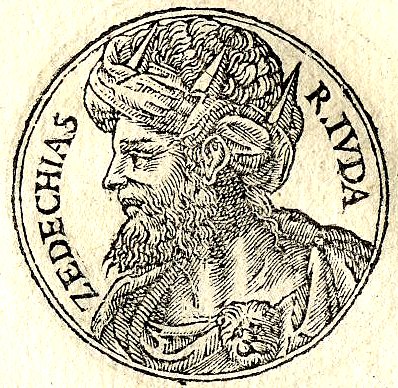
Zedekiah, last King of Judah before the destruction of the kingdom by Babylon, "Promptuarii Iconum Insigniorum" published by Guillaume Rouille (1518-1589)

Zedekiah, last King of Judah before the destruction of the kingdom by Babylon, “Promptuarii Iconum Insigniorum” published by Guillaume Rouille (1518-1589)

Jeremiah 34: 1-7: A Final Chance for Zedekiah?

The word that came to Jeremiah from the LORD, when King Nebuchadrezzar of Babylon and all his army and all the kingdoms of the earth and all the peoples under his dominion were fighting against Jerusalem and all its cities: 2 “Thus says the LORD, the God of Israel: Go and speak to King Zedekiah of Judah and say to him: Thus says the LORD: I am going to give this city into the hand of the king of Babylon, and he shall burn it with fire. 3 And you yourself shall not escape from his hand, but shall surely be captured and handed over to him; you shall see the king of Babylon eye to eye and speak with him face to face; and you shall go to Babylon. 4 Yet hear the word of the LORD, O King Zedekiah of Judah! Thus says the LORD concerning you: You shall not die by the sword; 5 you shall die in peace. And as spices were burned for your ancestors, the earlier kings who preceded you, so they shall burn spices for you and lament for you, saying, “Alas, lord!” For I have spoken the word, says the LORD.

6 Then the prophet Jeremiah spoke all these words to Zedekiah king of Judah, in Jerusalem, 7 when the army of the king of Babylon was fighting against Jerusalem and against all the cities of Judah that were left, Lachish and Azekah; for these were the only fortified cities of Judah that remained.


Like the previous chapters we are in the context of the invasion of Judah by Nebuchadrezzar of Babylon but unlike chapters 30-33 this is not a chapter of hope, this is focused on the immediate reality of the collapse of Judah, Jerusalem, and the Davidic dynasty. On the one hand this is a much kinder word than his predecessor Jehoiakim receives from Jeremiah, in many ways it is the exact opposite word (see Jeremiah 22: 18-19). As Rabbi Lau narrates this part of the story he sees Jeremiah looking at Zedekiah in a web far beyond his own control and that ultimately this crisis is not his fault. (Lau, 2013, p. 162) The defenses and all the alliances have failed as the fortified cities of Judah quickly fall. Zedekiah actually endures a much harsher punishment than what Jeremiah states here, and perhaps this is one final plea for Zedekiah and the forces of Jerusalem to surrender. The city will fall either way, there is no escape for Zedekiah but perhaps Jeremiah offers him one final chance for some mercy for the king and by extension the people in the face of the destruction.


Jeremiah 34: 8-22: A Broken Covenant

Roman collared slaves-Marble relief from Smyrna (Izmir, Turkey), 200 CE

Roman collared slaves-Marble relief from Smyrna (Izmir, Turkey), 200 CE

8 The word that came to Jeremiah from the LORD, after King Zedekiah had made a covenant with all the people in Jerusalem to make a proclamation of liberty to them, 9 that all should set free their Hebrew slaves, male and female, so that no one should hold another Judean in slavery. 10 And they obeyed, all the officials and all the people who had entered into the covenant that all would set free their slaves, male or female, so that they would not be enslaved again; they obeyed and set them free. 11 But afterward they turned around and took back the male and female slaves they had set free, and brought them again into subjection as slaves. 12 The word of the LORD came to Jeremiah from the LORD: 13 Thus says the LORD, the God of Israel: I myself made a covenant with your ancestors when I brought them out of the land of Egypt, out of the house of slavery, saying, 14 “Every seventh year each of you must set free any Hebrews who have been sold to you and have served you six years; you must set them free from your service.” But your ancestors did not listen to me or incline their ears to me. 15 You yourselves recently repented and did what was right in my sight by proclaiming liberty to one another, and you made a covenant before me in the house that is called by my name; 16 but then you turned around and profaned my name when each of you took back your male and female slaves, whom you had set free according to their desire, and you brought them again into subjection to be your slaves. 17 Therefore, thus says the LORD: You have not obeyed me by granting a release to your neighbors and friends; I am going to grant a release to you, says the LORD– a release to the sword, to pestilence, and to famine. I will make you a horror to all the kingdoms of the earth. 18 And those who transgressed my covenant and did not keep the terms of the covenant that they made before me, I will make like the calf when they cut it in two and passed between its parts: 19 the officials of Judah, the officials of Jerusalem, the eunuchs, the priests, and all the people of the land who passed between the parts of the calf 20 shall be handed over to their enemies and to those who seek their lives. Their corpses shall become food for the birds of the air and the wild animals of the earth. 21 And as for King Zedekiah of Judah and his officials, I will hand them over to their enemies and to those who seek their lives, to the army of the king of Babylon, which has withdrawn from you. 22 I am going to command, says the LORD, and will bring them back to this city; and they will fight against it, and take it, and burn it with fire. The towns of Judah I will make a desolation without inhabitant.


This event gives a window into some of the competing ideals that are at work in the time of Jeremiah. Slavery in this time was an economic arrangement where a person no longer able to pay their debts would become a slave to the debt holder. Leviticus 25: 10 (also Isaiah 61:1 and Ezekiel 46: 17 refer to this idea) places a limit on this time of servitude requires the release of lands and bonded servants and Deuteronomy 15 also talks about this regular practice of the remission of debts and the freeing of those under those debts and indentured slavery. In a time of military and political crisis the people fall back on to this practice under the leadership of Zedekiah. The cut a covenant with God, set those in slavery free. In the context of the invasion this is also the point where the approaching Babylonian armies have to turn aside to deal with an approaching Egyptian army. Quickly, once the threat of the approaching Babylonian army turns aside economic concerns begin to dominate again and the people recently freed are returned to their positions of servitude. Perhaps the people are beginning to mock Jeremiah’s words and believe that they have averted yet another crisis: the city and the temple and the Davidic king are all the guarantee they need rather than living out the covenant they have made with their God. The Lord is furious with this turnaround, this is one additional illustration of the unfaithfulness of the people to the covenant that they made with the Lord. The Lord’s words refer to the action of cutting a covenant, similar to the action narrated in Genesis 15 between God and Abraham, where the action of cutting apart an animal and passing through the center is used to mark the cutting of the covenant and also to symbolize the consequences of breaking that covenant. Now the people who have broken this covenant will become a corpse like the calf and be left for the wild animals. They were a people who could have been a blessing but they in their turning away have become a curse. The army of Babylon will not stay away, they will come and burn, kill and destroy.

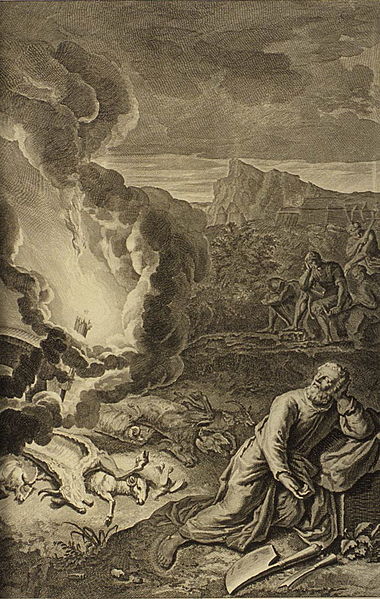
A Deep Sleep Came Upon Abraham and a Horror Siezed Him, as in Genesis 15: 12 from 1728 Figures de la Bible illustrated by Gerard Hoet (1648-1733)

A Deep Sleep Came Upon Abraham and a Horror Siezed Him, as in Genesis 15: 12 from 1728 Figures de la Bible illustrated by Gerard Hoet (1648-1733)

The Poetry of Death and Destruction: Jeremiah 4: 11-18

The Prophet Jeremiah by Michelangelo

The Prophet Jeremiah by Michelangelo

Jeremiah 4: 11-18

 11 At that time it will be said to this people and to Jerusalem: A hot wind comes from me out of the bare heights in the desert toward my poor people, not to winnow or cleanse- 12 a wind too strong for that. Now it is I who speak in judgment against them.
 13 Look! He comes up like clouds, his chariots like the whirlwind;
his horses are swifter than eagles– woe to us, for we are ruined!
 14 O Jerusalem, wash your heart clean of wickedness so that you may be saved.
 How long shall your evil schemes lodge within you?
 15 For a voice declares from Dan and proclaims disaster from Mount Ephraim.
 16 Tell the nations, “Here they are!”
Proclaim against Jerusalem, “Besiegers come from a distant land;
they shout against the cities of Judah.
 17 They have closed in around her like watchers of a field,
 because she has rebelled against me, says the LORD.
 18 Your ways and your doings have brought this upon you.
This is your doom; how bitter it is! It has reached your very heart.”
 
The prophet lapses into his deathly poetry again, trying desperately with his words to shake his people out of what Brueggeman calls their “religious indifference and covenantal recalcitrance”  (Brueggemann 1998, 56) Yet the words seem to be falling on deaf ears, the party continues and nobody wants to sober up and go home. Yet the Northern tribe of Dan is proclaiming the disaster that is coming.

Though it will be the Babylonian army that will come and lay siege to Jerusalem and take the people into exile, they are not named. The people and the prophet live in different theological realities.  The prophet sees the way in which God is sovereign over not just Israel or Judah, but over the besiegers and conquerors as well, and that God is indeed moving in judgment towards the people of Judah for the ways they have not kept their covenantal faith.

The people are presented with two conflicting realities. The rulers and the priests pass on the platitudes that things are ok, as well as apparently many of those looked upon as prophets. They continue to prop up the Davidic regime and the temple hierarchy, and the people really have no reason to question the way things are. It is a much different world, where most people are illiterate and do not have anything beyond their oral memory to challenge the king and the priests who not only bear the recorded word of God, they are the only ones who are educated enough to be able to approach the words we take for granted. Also worship has become focused on the temple, and so most people may make it to the temple for the festivals (much as people who come at Christmas and Easter) and may have their own practices which may or may not line up with the temple ideology, but they are reliant upon the priests and the king to point them to what covenantal faithfulness looks like. Jeremiah, the prophet and poet, is one of the few voices of dissent pointing to the way in which the leaders have failed to be the exemplars of covenantal faithfulness that may lead the people back into God’s way of justice and shalom.

purple rose 01 by picsofflowers.blogspot.com