Tag Archives: Cedar of Lebanon

Ezekiel 31 Egypt as a Mighty Tree Cut Down

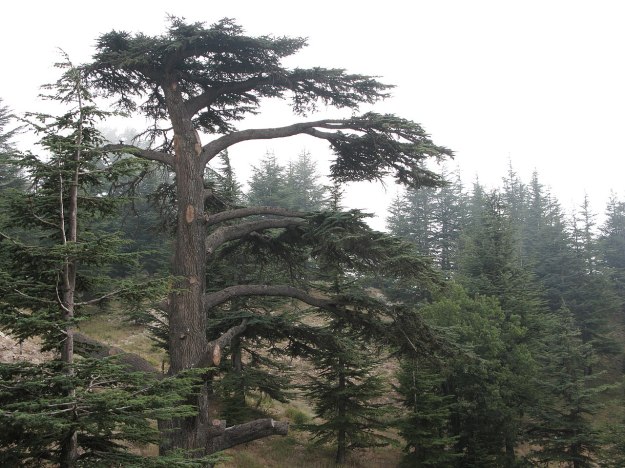
Cedar of Lebanon (Cedar of God), Lebanon By © Vyacheslav Argenberg / http://www.vascoplanet.com/, CC BY 4.0, https://commons.wikimedia.org/w/index.php?curid=92872076

Ezekiel 31

1In the eleventh year, in the third month, on the first day of the month, the word of the LORD came to me: 2Mortal, say to Pharaoh king of Egypt and to his hordes:
Whom are you like in your greatness?
3Consider Assyria, a cedar of Lebanon,
with fair branches and forest shade,
and of great height,
its top among the clouds.
4The waters nourished it,
the deep made it grow tall,
making its rivers flow
around the place it was planted,
sending forth its streams
to all the trees of the field.
5So it towered high
above all the trees of the field;
its boughs grew large
and its branches long,
from abundant water in its shoots.
6All the birds of the air
made their nests in its boughs;
under its branches all the animals of the field
gave birth to their young;
and in its shade
all great nations lived.
7It was beautiful in its greatness,
in the length of its branches;
for its roots went down
to abundant water.
8The cedars in the garden of God could not rival it,
nor the fir trees equal its boughs;
the plane trees were as nothing
compared with its branches;
no tree in the garden of God
was like it in beauty.
9I made it beautiful
with its mass of branches,
the envy of all the trees of Eden
that were in the garden of God.
10Therefore thus says the Lord GOD: Because it towered high and set its top among the clouds, and its heart was proud of its height, 11I gave it into the hand of the prince of the nations; he has dealt with it as its wickedness deserves. I have cast it out. 12Foreigners from the most terrible of the nations have cut it down and left it. On the mountains and in all the valleys its branches have fallen, and its boughs lie broken in all the watercourses of the land; and all the peoples of the earth went away from its shade and left it.
13On its fallen trunk settle
all the birds of the air,
and among its boughs lodge
all the wild animals.
14All this is in order that no trees by the waters may grow to lofty height or set their tops among the clouds, and that no trees that drink water may reach up to them in height.
For all of them are handed over to death,
to the world below;
along with all mortals,
with those who go down to the Pit.
15Thus says the Lord GOD: On the day it went down to Sheol I closed the deep over it and covered it; I restrained its rivers, and its mighty waters were checked. I clothed Lebanon in gloom for it, and all the trees of the field fainted because of it. 16I made the nations quake at the sound of its fall, when I cast it down to Sheol with those who go down to the Pit; and all the trees of Eden, the choice and best of Lebanon, all that were well watered, were consoled in the world below. 17They also went down to Sheol with it, to those killed by the sword, along with its allies, those who lived in its shade among the nations.
18Which among the trees of Eden was like you in glory and in greatness? Now you shall be brought down with the trees of Eden to the world below; you shall lie among the uncircumcised, with those who are killed by the sword. This is Pharaoh and all his horde, says the Lord GOD.

This fifth oracle against Egypt is like Ezekiel’s earlier oracle against the King of Tyre where the king is highlighted for their beauty and preeminent state among the garden of Eden.[1] Like that previous oracle the one who excels all others is brought low as they exceed their station as a creation of God. Although this oracle is directed against Pharoah and his hordes, it only mentions Pharoah or Egypt in the first and last verse, the rest of the oracle uses Assyria as an example for Egypt to heed. Assyria who was once the great empire in the north has collapsed and dragged all who allied themselves with her down to Sheol, and the same fate awaits proud Egypt in this oracle.

It is likely that Ezekiel is building upon Isaiah’s imagery in Isaiah 2:11-13 linking pride and great trees.

The haughty eyes of people shall be brought low, and the pride of everyone shall be humbled; and the LORD alone will be exalted in that day. For the LORD of hosts has a day against all that is proud and lofty, against all that is lifted up and high; against all the cedars of Lebanon, lofty and lifted up; and against all the oaks of Bashan;

Just as Daniel will probably utilize Ezekiel’s imagery in his own image in Daniel 4: 10-17 and Jesus alludes to this imagery in his parable of the mustard seed.[2] Yet, Ezekiel’s usage is the longest sustained use of this metaphor.

This oracle is dated almost two months after the previous one, June 21, 587 BCE. The city of Jerusalem is still besieged by Babylon, and it is possible that Babylon has already repulsed the Egyptian attempts to lift the siege. Egypt has been one of the significant powers in the ancient world throughout Israel’s history, and Egypt has continually exerted influence in the region around Israel. Now Egypt in this parable is told to look at a metaphor of Assyria. Assyrian was the great empire in the north prior to the emergence of the Babylonian empire. There are some translators who view Assyria’s presence here as a mistake, but thematically it makes sense to use a metaphor about Assyrian to demonstrate to Egypt that it too can fall from its great heights. Even though verses three through nine repeatedly refer to the beauty of this metaphorical tree and portray its majesty in an admirable light, like the earlier references to the King of Tyre, this is a case of prophetic satire. Although the kings of Assyria normally have the date palm as their image, the use of the cedar of Lebanon would be a well-known image of both size and strength, and a tree frequently used in royal and holy construction.

There are mythical elements in the background of this image, but they should not distract from the basic point that Pharoah and Egypt, according to the oracle, will share the same fate as Assyria. Although the waters nourished it and the deep made it grow tall, it will still fall when the prince of nations (King Nebuchadrezzar of Babylon) cuts it down. The waters and deep are the same Hebrew words used in Genesis 1:2 and this tree surpasses the trees of the garden of God (Eden) but ultimately, like the King of Tyre, its beauty, strength, and height cannot prevent its falling into the realm of the dead. The remnants of the tree fall on the mountains and valleys, just as the defeated ‘dragon’ in the next chapter will have its remains fall on the mountains, valleys, and waterways.[3] Now this great tree and all the lesser trees that inhabited the space under its branches find themselves in the Pit.

The very forces which once gave this great tree life now bury it in the depths. The rivers that flowed around it are now restrained and this once beautiful and living tree is now debris scattered upon the ground, or in other places brought down into the pit. The great tree and the empire it represents are now dead, and Egypt who is similarly a great tree is in danger from the same axe wielding prince of the nations. In the oracle Pharoah and all his armies cannot oppose God and God’s chosen instrument of vengeance King Nebuchadrezzar.

As mentioned before there are limited historical records from this period. We do know that Nebuchadrezzar does eventually turn his army to march on Egypt. Although the Babylonians have enjoyed multiple victories over Egypt, Egypt never becomes a part of the Babylonian empire. The great cedar tree which represents Egypt will stand at least for a time longer. Ezekiel interprets the actions of the king of Babylon and his forces as an extension of the will of the God of Israel. Even though Jerusalem is under siege, the LORD’s actions, in Ezekiel’s mind, are just. The LORD is not merely the God of Israel but is at work in the movement of empires to bring about the will of God.

[1] Ezekiel 28.

[2] Matthew 13: 31-32, Mark 4: 30-32, Luke 13: 18-19

[3] Ezekiel 32: 5-6.

1 Kings 5 The High Cost of Construction

Cedar of Lebanon (Cedar of God), Lebanon By © Vyacheslav Argenberg / http://www.vascoplanet.com/, CC BY 4.0, https://commons.wikimedia.org/w/index.php?curid=92872076

1 Kings 5

1 Now King Hiram of Tyre sent his servants to Solomon, when he heard that they had anointed him king in place of his father; for Hiram had always been a friend to David. 2 Solomon sent word to Hiram, saying, 3 “You know that my father David could not build a house for the name of the LORD his God because of the warfare with which his enemies surrounded him, until the LORD put them under the soles of his feet. 4 But now the LORD my God has given me rest on every side; there is neither adversary nor misfortune. 5 So I intend to build a house for the name of the LORD my God, as the LORD said to my father David, ‘Your son, whom I will set on your throne in your place, shall build the house for my name.’ 6 Therefore command that cedars from the Lebanon be cut for me. My servants will join your servants, and I will give you whatever wages you set for your servants; for you know that there is no one among us who knows how to cut timber like the Sidonians.”

7 When Hiram heard the words of Solomon, he rejoiced greatly, and said, “Blessed be the LORD today, who has given to David a wise son to be over this great people.” 8 Hiram sent word to Solomon, “I have heard the message that you have sent to me; I will fulfill all your needs in the matter of cedar and cypress timber. 9 My servants shall bring it down to the sea from the Lebanon; I will make it into rafts to go by sea to the place you indicate. I will have them broken up there for you to take away. And you shall meet my needs by providing food for my household.” 10 So Hiram supplied Solomon’s every need for timber of cedar and cypress. 11 Solomon in turn gave Hiram twenty thousand cors of wheat as food for his household, and twenty cors of fine oil. Solomon gave this to Hiram year by year. 12 So the LORD gave Solomon wisdom, as he promised him. There was peace between Hiram and Solomon; and the two of them made a treaty.

13 King Solomon conscripted forced labor out of all Israel; the levy numbered thirty thousand men. 14 He sent them to the Lebanon, ten thousand a month in shifts; they would be a month in the Lebanon and two months at home; Adoniram was in charge of the forced labor. 15 Solomon also had seventy thousand laborers and eighty thousand stonecutters in the hill country, 16 besides Solomon’s three thousand three hundred supervisors who were over the work, having charge of the people who did the work. 17 At the king’s command, they quarried out great, costly stones in order to lay the foundation of the house with dressed stones. 18 So Solomon’s builders and Hiram’s builders and the Gebalites did the stonecutting and prepared the timber and the stone to build the house.

The reign of Solomon sets in motion dramatic changes for Israel. The mobilization to build the temple is a massive undertaking requiring international cooperation for materials. Traditionally most interpreters of these early portions of Solomon’s reign have viewed the preparation and the construction of the temple as examples of the wisdom and faithfulness of Solomon to the LORD. However, there are multiple perspectives related to the temple and the building projects of Solomon and that are woven together in the report of 1 Kings on this massive undertaking which dramatically changes the religious landscape of the people.

The tabernacle constructed during the journey from Egypt to the promised land was to be a place where God could dwell among the people, but it was a tent designed to travel with the people. Once the people entered the land of Canaan there were several worship sites throughout the land, but the worship of the LORD often was modeled after the worship of the deities of the surrounding peoples. From a perspective of unifying the worship of the LORD in a common place and with a common practice the temple has the potential to be a unifying place where the name of the LORD can dwell, and the priest can hand on the law and its interpretation to the people. Israel had never before had a permanent place to worship the LORD or a place to become a central symbol of God’s presence among the people.

Yet, even when King David wants to build the temple of God during his reign he is met with the response of a God who is flattered but who refuses to be confined to a permanent place. While God indicates that David’s son will eventually build a house of cedar for the LORD, there is a thread of discomfort within the passage about God’s presence not being able to move among the people (2 Samuel 7: 1-17). The compromise in the construction is that temple will be a house ‘for the name of the LORD my God’ and not a place where God’s presence is limited to. God’s freedom will continue to expand beyond the temple. God will deign to show God’s presence in this place, but God will not be limited to only being present in this place among the people.

In the construction of a place of worship the expectation is that people will contribute their best to the endeavor. This was the practice in the construction of the tabernacle and Moses was reported to have more than enough for the project by a freewill offering (Exodus 35). Now the temple is the first public project of the Solomon regime, and it is done by the mechanism of taxation and forced labor. The temple may be a great public good, but the question of cost is subtly raised here in the text along with the broader question of what type of nation Israel is becoming. The negotiations between King Hiram and King Solomon may be necessary to secure the materials and good relations to ensure peace during the construction of the temple. Yet, the project comes with an extremely high price tag.

King Hiram of Tyre provided lumber and people skilled in construction when David established his household in Jerusalem after he conquered it. There is no indication of the cost David paid the King of Tyre for these resources and craftsmen, but this trade agreement marks the entry of Israel onto a much broader stage. Now in negotiations with the new king, Hiram continues to provide lumber and craftsmen in exchange for the agricultural produce of the land. In addition to supplying the needs of the household of Solomon, now the land must support the burden of the household of King Hiram of Tyre. Choon-Leong Seow names this section “Shady Deals and Oppressive Policies” (NIB III: 56) and it is likely that the deal cut between Solomon and this Phoenician king well versed in international trade is more favorable to the King of Tyre than the people of Israel. Looking closely at the amount of wheat and oil given it quickly becomes apparent that the numbers here are large. Roughly twice the amount of grain collected for Solomon’s household is given annually to the King of Tyre, and if you follow the Hebrew (unlike the NRSV which follows the Greek Septuagint in its translation) the 2,000 cors (almost 7,000 gallons) of oil is a wealth of agricultural resources traded for the cedar. The cedars of Lebanon are often associated with affluence and their use by the people of Israel comes at a high annual price tag. It is possible that Israel enjoyed many years of great harvests that may have made the construction projects bearable but knowing the stresses on the population by the end of Solomon’s reign we can see the beginning of the internal strain within the nation.

In addition to the cost in agricultural production is the cost in conscripted forced labor. As mentioned earlier, the people of Israel were the forced labor for construction in Egypt and this new project which in the text mobilizes over one hundred eighty thousand men for log cutting and transport, stone cutting and transport, and construction is another strain on the population. It is possible that Judah is excluded from this conscription (NIB III: 58) like it is possible they were excluded from the provision for Solomon’s household in the previous chapter, but this is assuming a differentiation between Israel and Judah. It also is a return to the ways of Egypt where the king enslaves the people and wealth of the nation is owned by the ruler.

The construction of the temple will be a focal point for the reign of Solomon and for the worship of the southern kingdom of Judah after his death. The temple of Solomon will stand as a central fixture of Jerusalem for centuries and will be a symbol of the faith of the people. Yet, the process of construction sounds some ominous notes as it becomes a public work that is done by the taxation and forced labor of the people. The suspicious part of my mind wonders if this is like the public work projects throughout the former Warsaw Pact countries where beautiful train stations, government buildings, and public spaces were constructed while the majority of the population lived in deprivation. Solomon’s early reign is rapidly changing the city of Jerusalem and the manner in which the population of the nation is governed. This place created for the name of God will be a source of public focus for many generations, but we are primed to wonder about the cost that this great building will exact not only on the wealth of the people but also on their identity.