Tag Archives: Book of Joel

Joel 3 God’s Judgment of the Nations

Let us Beat Swords Into Plowshares, a sculpture by Evgeniy Vuchetich, given by the Soviet Union to the United Nations in 1959

Joel 3

1 For then, in those days and at that time, when I restore the fortunes of Judah and Jerusalem, 2 I will gather all the nations and bring them down to the valley of Jehoshaphat, and I will enter into judgment with them there, on account of my people and my heritage Israel, because they have scattered them among the nations. They have divided my land, 3 and cast lots for my people, and traded boys for prostitutes, and sold girls for wine, and drunk it down.

4 What are you to me, O Tyre and Sidon, and all the regions of Philistia? Are you paying me back for something? If you are paying me back, I will turn your deeds back upon your own heads swiftly and speedily. 5 For you have taken my silver and my gold, and have carried my rich treasures into your temples. 6 You have sold the people of Judah and Jerusalem to the Greeks, removing them far from their own border. 7 But now I will rouse them to leave the places to which you have sold them, and I will turn your deeds back upon your own heads. 8 I will sell your sons and your daughters into the hand of the people of Judah, and they will sell them to the Sabeans, to a nation far away; for the LORD has spoken.

9 Proclaim this among the nations:
Prepare war, stir up the warriors. Let all the soldiers draw near, let them come up.
10 Beat your plowshares into swords, and your pruning hooks into spears;
let the weakling say, “I am a warrior.”
11 Come quickly, all you nations all around, gather yourselves there.
Bring down your warriors, O LORD.
12 Let the nations rouse themselves, and come up to the valley of Jehoshaphat;
for there I will sit to judge all the neighboring nations.
13 Put in the sickle, for the harvest is ripe.
Go in, tread, for the wine press is full.
The vats overflow, for their wickedness is great.
14 Multitudes, multitudes, in the valley of decision!
For the day of the LORD is near in the valley of decision.
15 The sun and the moon are darkened, and the stars withdraw their shining.
16 The LORD roars from Zion, and utters his voice from Jerusalem, and the heavens and the earth shake. But the LORD is a refuge for his people, a stronghold for the people of Israel.
17 So you shall know that I, the LORD your God, dwell in Zion, my holy mountain.
And Jerusalem shall be holy, and strangers shall never again pass through it.
18 In that day the mountains shall drip sweet wine,
the hills shall flow with milk, and all the stream beds of Judah shall flow with water;
a fountain shall come forth from the house of the LORD and water the Wadi Shittim.
19 Egypt shall become a desolation and Edom a desolate wilderness,
because of the violence done to the people of Judah,
in whose land they have shed innocent blood.
20 But Judah shall be inhabited forever, and Jerusalem to all generations.
21 I will avenge their blood, and I will not clear the guilty, for the LORD dwells in Zion.

This final chapter of Joel may seem bloodthirsty and distasteful to many modern Christians who have grown up without the experience of war and famine devastating their land. The image of God as the divine warrior who humiliates the enemies of the people of God may seem like a remnant of a more violent time, but it also reflects our ability to trust in our own military might to secure our future rather than God being the defender of Israel (or any other nation). In the aftermath of the Babylonian exile the military power Israel or Judah could exert was shattered. Although we do not know much about the geopolitics of the fourth and fifth century BCE it is clear that Joel’s complaints against the other nations parallel the events listed in other prophets. The army of locusts which devastated the land in Joel 1-2 for a community which suffered a series of crises as it tried to regain its footing in the land must have seemed like the straw that broke the camel’s back. (Birch, 1997, p. 162) As Judah and Jerusalem imagine a hopeful future beyond the locusts and the evil inflicted on them by their neighbors in their troubled past it involves both the renewal of the agricultural prosperity of the land and the removal of the threat of their neighbors.

Although the United States has been involved in conflicts during the fifty years of my life, these conflicts have always taken place in some other land and have been conducted by a volunteer military whose experiences are not shared by the majority of the population. In contrast in Israel:

Every forty-four years out of the last four thousand, on average, an army has marched through it, whether to conquer it, to rescue it from someone else, to use it as a neutral battleground on which to fight a different enemy, or to take advantage of is as the natural route for getting somewhere else to fight there instead. (Wright, 1992, p. 3)

Especially at this juncture of history where Jerusalem and Judah are a weak client state of Persia surrounded by hostile neighbors, the people were scattered among the nations, the land was divided up after the conquest of Babylon and is only partially restored after Persia allows some of the people to resettle, and where slavery for men and women and even children is a recent memory their desire for justice on their oppressors is understandable. More critical in Joel’s vision is that the LORD has taken offense at the misuse of “my people and my heritage Israel.” The nations have taken advantage of Israel’s inability to protect itself through multiple crises and have profited off this weakness to obtain land, and to either be those who captured people to sell into slavery or served as markets where slaves were sold to other nations.

Human trafficking or slavery was an assumed part of conflicts in the ancient world. One of the bounties that armies marching through a land would take is from selling both the defeated enemy, but also captured civilians into slavery. Both the economic and the human capital of Judah and Jerusalem have been plundered and moved through the seaports of Tyre and Sidon and Philistia. Families cry out for their lost generations and God promises to return them home to Judea and to do to Phoenicia (Tyre and Sidon) and Philistia what they did to God’s people and inheritance. The silver and gold will be returned from their temples (or palaces)[1] and while the children of Israel were sold into slavery among the Greeks, the Sabeans in the south are the promised destination of the children of these nations.

In verse nine the text becomes more poetic as the LORD issues a challenge to the nations. It is important to note that the LORD is not telling Israel to prepare for war but throws down the gauntlet to challenge the nations to face God at the valley of judgment.[2] Although the famous image of Isaiah 2: 1-4 and Micah 4: 1-3 where the nations turn their swords into plowshares[3] and spears into pruning hooks (or knives) is reversed here so that the nations are invited to take up what weapons they can fashion if they choose to oppose the LORD who awaits their arrival as a divine warrior. The image of God treading the winepress echoes Isaiah 63: 1-6:

“Who is this that comes from Edom, from Bozrah in garments stained crimson? Who is this so splendidly robed marching in his great might?”“ It is I, announcing vindication, mighty to save.: “Why are your robes red, and your garments like theirs who tread the wine press?” “I have trodden the wine press alone, and from the peoples no one was with me; I trod them in anger and trampled them in wrath; their juice spattered on my garments, and stained all my robes. For the day of vengeance was in my heart, and the year for my redeeming work had come. I looked and there was no helper; I stared, but there was no one to sustain me; so my own arm brought me victory, and my wrath sustained me. I trampled down peoples in my anger, I crushed them in my wrath,and I poured out their lifeblood on the earth.

The God of Israel will not allow the oppression of God’s people and God’s inheritance to go on indefinitely and the wickedness of the world must be eliminated. The scene is violent and there is no way around the violence of the imagery, but the nations are invited to gather before the LORD and only their continued opposition to the LORD has brought about this bloody moment. The advent of God’s presence brings about a cosmic reaction as the sun and moon are darkened and the earth shakes. The imagery is similar to Amos 1: 1-2 but also reflects the common Jewish thought that the creation itself reacts to the divine presence drawing near.

The presence of God as the divine warrior and protector of the people ensures the safety of Zion. God’s presence sanctifies the land, but that sanctification for Joel also means the exclusion of the nations (Gentiles). (Collins, 2013, p. 28) Perhaps this is only the exclusion of political occupation, but as mentioned in the previous post Joel does not see this vision of God’s Spirit being poured upon all the people as including the nations. This restoration of safety by the exclusion of the nations and the punishment of those who had oppressed Israel probably stretches to the limit of the imagination of Joel. The later expansion of this vision in the early Christians would be a struggle documented in the book of Acts. It also echoes the renewal of agricultural prosperity from Joel 2: 18-27. The wine that had dried up in chapter one now drips from the mountains, the sheep and cattle who were dying of starvation now produce milk in the hills, and the creeks dried up in the drought now flow with water. In an image that echoes Ezekiel 47: 1-12, water now flows from the temple of God and flows out to provide water for the Wadi Shittim.

From the position of many Western Christians who have not experienced the oppression of an external enemy or the life-threatening environmental crisis of Joel these images of God may seem difficult to square with the God of love proclaimed in many churches. Yet, for Joel and most other Jewish and early Christians God judges because God cares about God’s people, God’s land, and God’s inheritance. For those who have lived in the shadow of terror where children have become the victims of human trafficking, where men and women of all ages are sold into slavery and where violence has ruled the land their hope is for a God who can and will defend them.

Prior to becoming a pastor, I served as an officer in the Army during the time the peacekeeping missions in Bosnia. The experience of Bosnia or Rwanda is probably closer to the experience of Judah and Jerusalem than the peaceful existence of the United States throughout my lifetime. Years ago, I encountered Miroslav Volf’s profound reflections on forgiveness in light of his experiences as a Croatian in the aftermath of the desolation of his country and people by the Serbians, and Exclusion and Embrace is one of the books I use frequently to inform how I encounter the God of the scriptures who comes to provide judgment on earth. As Volf states:

Most people who insist on God’s “nonviolence” cannot resist using violence themselves (or tacitly sanctioning its use by others). They deem the talk of God’s judgment irreverent, but think nothing of entrusting judgment into human hands, persuaded presumably that this is less dangerous and more humane than to believe in a God who judges! That we should bring “down the powerful from their thrones” (Luke 1: 51-52) seems responsible; that God should do the same, as the song of that revolutionary Virgin explicitly states, seems crude. And so, violence thrives, secretly nourished by belief in a God who refuses to wield the sword.

My thesis that the practice of nonviolence requires a belief in divine vengeance will be unpopular with many Christians, especially theologians in the West. To the person who is inclined to dismiss it, I suggest imagining that you are delivering a lecture in a war zone (which is where a paper that underlies this chapter was originally delivered). Among your listeners are people whose cities and villages have been first plundered, then burned and leveled to the ground, whose daughters and sisters have been raped, whose fathers and brothers have had their throats slit. The topic of the lecture: a Christian attitude toward violence. The thesis: we should not retaliate since God is perfect noncoercive love. Soon you would discover it takes the quiet suburban home for the birth of the thesis that human nonviolence corresponds to God’s refusal to judge. In a scorched land, soaked in the blood of the innocent, it will invariably die. And as one watches it die, one will do well to reflect about many other pleasant captivities of the liberal mind. (Volf, 1996, pp. 303-304)

These images may never be easy for many Christians to read, but they are an essential part of the hope of a people who are unable to defend themselves. God is their divine warrior who provides not only protection but prosperity and turns away the warring of the nations. In the language of Psalm 46:

Come, behold the works of the LORD; see what desolations he has brought on the earth. He makes wars to cease to the end of the earth; he breaks the bow, and shatters the spear; he burns the shields with fire. “Be still, and know that I am God! I am exalted among the nations, I am exalted in the earth.”    (Psalm 46: 8-10)

Only when we step away from our privileged and hear these words from the troubled world that Joel inhabits can we properly hear these words of hope that Joel speaks to this grieving community. There is no hope of a future that can be separated from physical safety for themselves and their children. I do think God calls on us for our imaginations to continue to expand as we envision a future for ourselves and our enemies, but it is also critical to understand that the prophets speak to a specific people with specific traumas that need to be healed. Perhaps for Joel it is only the nations mobilizing with their swords and spears that can finally bring them to the point that Isaiah and Micah can hope for where nations no longer train for war and the instruments of war are returned to implements of agriculture. For Joel forgiveness is not possible for the nations before justice (or retribution) for the wrong his people have suffered has been exacted by their God. Joel’s voice is not unique in scripture, but it is also not the only voice.

[1] The word in Hebrew can mean either temple or palaces. Likely this refers to the items taken from the temple of the LORD or from the household of the king since most people would not have access to large amounts of silver or gold.

[2] Jehoshaphat means the LORD judges.

[3] Or mattocks. As James D. Nogalski notes this probably refers to a mattock which is smaller than an animal pulled plowshare and would be turned into a short sword rather than what is often seen in sculptures. (Nogalski, 2023, p. 166)

Joel 2: 1-27 The Day of the Lord Averted

Millions of swarming Australian plague locusts on the move By CSIRO, CC BY 3.0, https://commons.wikimedia.org/w/index.php?curid=35486123

Joel 2: 1-17 The Day of the LORD Draws Near

1 Blow the trumpet in Zion; sound the alarm on my holy mountain! Let all the inhabitants of the land tremble, for the day of the LORD is coming, it is near —
2 a day of darkness and gloom, a day of clouds and thick darkness! Like blackness spread upon the mountains a great and powerful army comes; their like has never been from of old, nor will be again after them in ages to come.
3 Fire devours in front of them, and behind them a flame burns. Before them the land is like the garden of Eden, but after them a desolate wilderness, and nothing escapes them.
4 They have the appearance of horses, and like war-horses they charge.
5 As with the rumbling of chariots, they leap on the tops of the mountains, like the crackling of a flame of fire devouring the stubble, like a powerful army drawn up for battle.
6 Before them peoples are in anguish, all faces grow pale.
7 Like warriors they charge, like soldiers they scale the wall. Each keeps to its own course, they do not swerve from their paths.
8 They do not jostle one another, each keeps to its own track; they burst through the weapons and are not halted.
9 They leap upon the city, they run upon the walls; they climb up into the houses, they enter through the windows like a thief.
10 The earth quakes before them, the heavens tremble. The sun and the moon are darkened, and the stars withdraw their shining.
11 The LORD utters his voice at the head of his army; how vast is his host! Numberless are those who obey his command. Truly the day of the LORD is great; terrible indeed — who can endure it?
12 Yet even now, says the LORD, return to me with all your heart, with fasting, with weeping, and with mourning;
13 rend your hearts and not your clothing. Return to the LORD, your God, for he is gracious and merciful, slow to anger, and abounding in steadfast love, and relents from punishing.
14 Who knows whether he will not turn and relent, and leave a blessing behind him, a grain offering and a drink offering for the LORD, your God?
15 Blow the trumpet in Zion; sanctify a fast; call a solemn assembly;
16 gather the people. Sanctify the congregation; assemble the aged; gather the children, even infants at the breast. Let the bridegroom leave his room, and the bride her canopy.
17 Between the vestibule and the altar let the priests, the ministers of the LORD, weep. Let them say, “Spare your people, O LORD, and do not make your heritage a mockery, a byword among the nations. Why should it be said among the peoples, ‘Where is their God?'”

One of the choices that any reader of Joel has to make is whether the imagery in chapter two continues to be a metaphor for the invasion of locusts or whether this is now an invasion from a conquering army. Those who believe this is describing an invasion of an actual army will point to the language in verse twenty of ‘the northern army’ as evidence of a literal army since a human army (at this time) would invade from the north rather than across the desert to the east and Egypt was no longer the primary threat from the south. Locust plagues in this part of the world tend to originate in Africa and spread from the south and southeast through the Middle East and the Indian Subcontinent. My perspective throughout this chapter is that this is using the metaphor of a military invasion to describe the swarm of locusts which has brought the region to the brink. It may be a restatement of the same condition of chapter one of the approach of a new swarm, but repetition in Hebrew poetry and in the prophets is a common rhetorical device used to, “intensify the impression on the reader.” (Collins, 2013, p. 18)

The prophet Joel is the sentinel raising the alarm in Zion to awaken the people that this invasion of locusts is the day of the LORD’s judgment. Like Jeremiah or Ezekiel,[1] Joel is now charged to raise the alarm for the people to give them a chance to return to the LORD and plead for mercy. For Joel this crisis is not a prelude to God’s action of judgment, the insectile invasion which has threatened the life of the people, the animals, and the land itself the dark day of the LORD that nothing can stand before.  Life hangs in the balance and the only hope is that the LORD will relent and turn the plague of locusts away.

Joel’s language echoes the language of other prophets as he narrates the situation. The day of the LORD as a time of judgment goes back to the 8th century BCE prophet Amos who indicates that the day of the LORD is a day of darkness. The day of the LORD being near and being a day of clouds and thick darkness echoes the language of Zephaniah 1: 7, 15. Later in verse eleven the language is similar to Malachi 4: 5 and 3:2. Finally verse fourteen echoes the King of Nineveh in Jonah 3:9 when he declares, “Who knows? God may relent and change his mind; he may turn from his fierce anger, so that we do not perish.” Joel is likely familiar with these passages, and they may provide him the language to articulate his understanding of God’s action upon Israel. Joel has demonstrated that he is immersed in the language and imagery of the scriptures, and they form the lexicon he uses to describe the experience of this crisis.

As mentioned above, I view this language as metaphorically describing the locust swarm. Although the language of an invading army could be literal, and armies do destroy both the land and the people, the particular choices that Joel makes poetically describe the swarm as well. The day of thick darkness and the blackness on the mountains may indicate a swarm so thick it obscures the sun and covers the ground. The sound of a locust swarm has been described as a roar with constant popping like a brush or forest fire. (Birch, 1997, p. 143) Revelation will use the metaphor of approaching horses to describe the locusts in that vision (Revelation 9:7). No walls or weapons are able to repel this locust horde which enters the city unopposed and emerges in the houses of the city. There is no sanctuary from this immense horde which decimates fields and households. These insignificant insects come together to be a gathered horde of ‘mighty warriors’[2]

Joel’s responsibility to sound the shofar (trumpet) and alert the people is because the LORD wants the people to return to the LORD. The alarm is so that the people do not have to endure the unendurable day of the LORD. Even now, with the locust swarm on the horizon there is a chance that God will lead this devouring army away, but the time for action is now. The actions of public repentance: fasting, weeping and morning are the appropriate start, but they are not sufficient. Joel’s well-known call to “rend your hearts and not your clothing” indicates that something more than ceremony is needed. The heart in Hebrew is the seat of volition and will and Joel is calling for people not merely to be ‘broken-hearted’ but to make a change. This is a call to action. The crisis is at hand and the communal actions of blowing the shofar, sanctifying a fast, calling a solemn assembly, and gathering the people where there are no exemptions: the infant to the elderly. This solemn communal activity takes precedence over celebrating the joy of a new marriage. The life of the people is at stake and both public and private change is necessary in this moment. There is still a hope that God may relent, that God may remember that Israel is God’s inheritance and has a responsibility to ensure the continuation of the people. The call goes up to remind God that God’s honor will suffer if the people cease to exist because the death of the people will cause the nations to question. “Where is their God?

Joel expects the priests to both set an example for the people but also to intercede with God for the people. Like Moses standing between God and the people after the golden calf, the priests stand between the vestibule and the altar on behalf of the people. In a world where the priests and those in the temple would be the only ones with access to the scriptures they are called to interpret to the people what this repentant life will look like. They will be responsible for both interceding before God and teaching the covenant way of life that the LORD is expecting from the people. The existence of the people hangs in the balance as the priests begin to intercede and lead the solemn assembly. They act in hope that the LORD will prove to be a God who is gracious and abounding in steadfast love who will turn away the impending disaster and leave a blessing in its place.

Threshing Place in Santorini, Greece. Photo by Stan Zurek – CC BY-SA 3.0, https://commons.wikimedia.org/w/index.php?curid=917402

Joel 2: 18-27 Judgment Turns to Blessing

18 Then the LORD became jealous for his land, and had pity on his people.
19 In response to his people the LORD said: I am sending you grain, wine, and oil, and you will be satisfied; and I will no more make you a mockery among the nations.
20 I will remove the northern army far from you, and drive it into a parched and desolate land, its front into the eastern sea, and its rear into the western sea; its stench and foul smell will rise up. Surely he has done great things!
21 Do not fear, O soil; be glad and rejoice, for the LORD has done great things!
22 Do not fear, you animals of the field, for the pastures of the wilderness are green; the tree bears its fruit, the fig tree and vine give their full yield.
23 O children of Zion, be glad and rejoice in the LORD your God; for he has given the early rain for your vindication, he has poured down for you abundant rain, the early and the later rain, as before.
24 The threshing floors shall be full of grain, the vats shall overflow with wine and oil.
25 I will repay you for the years that the swarming locust has eaten, the hopper, the destroyer, and the cutter, my great army, which I sent against you.
26 You shall eat in plenty and be satisfied, and praise the name of the LORD your God, who has dealt wondrously with you. And my people shall never again be put to shame.
27 You shall know that I am in the midst of Israel, and that I, the LORD, am your God and there is no other. And my people shall never again be put to shame.

The crisis is averted, the relationship is restored, the curse is turned away and blessings for the people are returned. This oracle of reassurance given to Joel promises renewal for the people, the animals, and the land. Grain, wine, and oil return to nourish the people. The ‘northern army’ is driven to the east and west where it dies in the sea and in the wilderness. As mentioned above I believe that Joel’s imagery is describing the locust swarm and not an army, and the death of the locusts in the wilderness would create a stench. The language is reminiscent of the end of the ‘wonder’ of locusts in Exodus 10:19 where the locusts are driven into the Red Sea. With the locusts gone the soil can recover, the wilderness can provide the grass the cattle desire, the trees and the vines are once again fruitful. The signs of abundance have returned in the aftermath of the curse. The return of the people has led to the return of God’s blessings on the land. The drought ends with the return of the early and late rains and the harvest fills the threshing floor and the vats. The years of scarcity will be replaced by years of abundance and the people will be satisfied and live in prosperity.

This joyous vision of renewed prosperity for the people, the animals, and the soil ends with the promise of the LORD’s dwelling in the midst of Israel. One of the recurring themes in scriptures is the desire of God to dwell among God’s people. The disobedience of the people causes God to withdraw, but the entire purpose of the tabernacle or temple is to give a place for God’s presence among the people. In a similar way Jeremiah can echo this vision:

But this is the covenant that I will make with the house of Israel after those days, says the LORD: I will put my law within them, and I will write it on their hearts; and I will be their God, and they shall be my people. No longer shall they teach one another, or say to each other, “Know the LORD,” for they shall all know me, from the least of them to the greatest, says the LORD; for I will forgive their iniquity, and remember their sin no more. Jeremiah 31: 33-34

The people will no longer know shame. Instead, the people will know the LORD. The renewed relationship with the people and the land opens up a hopeful vision of the future where the people know the will of God.

[1] Jeremiah 4:5, Ezekiel 3: 17-21, 33:1-9

[2] The warriors mentioned in verse seven is the Hebrew gibborim which are the elite warriors or men of status (officers, leaders). The labeling of these grasshoppers as gibborim poetically shows how these pests have become more threatening than the greatest warriors of an enemy army.

Joel 1 The Locust as God’s Judgment on the People

Millions of swarming Australian plague locusts on the move By CSIRO, CC BY 3.0, https://commons.wikimedia.org/w/index.php?curid=35486123

Joel 1

1 The word of the LORD that came to Joel son of Pethuel:
2 Hear this, O elders, give ear, all inhabitants of the land! Has such a thing happened in your days, or in the days of your ancestors?
3 Tell your children of it, and let your children tell their children, and their children another generation.
4 What the cutting locust left, the swarming locust has eaten. What the swarming locust left, the hopping locust has eaten, and what the hopping locust left, the destroying locust has eaten.
5 Wake up, you drunkards, and weep; and wail, all you wine-drinkers, over the sweet wine, for it is cut off from your mouth.
6 For a nation has invaded my land, powerful and innumerable; its teeth are lions’ teeth, and it has the fangs of a lioness.
7 It has laid waste my vines, and splintered my fig trees; it has stripped off their bark and thrown it down; their branches have turned white.
8 Lament like a virgin dressed in sackcloth for the husband of her youth.
9 The grain offering and the drink offering are cut off from the house of the LORD. The priests mourn, the ministers of the LORD.
10 The fields are devastated, the ground mourns; for the grain is destroyed, the wine dries up, the oil fails.
11 Be dismayed, you farmers, wail, you vinedressers, over the wheat and the barley; for the crops of the field are ruined.
12 The vine withers, the fig tree droops. Pomegranate, palm, and apple — all the trees of the field are dried up; surely, joy withers away among the people.
13 Put on sackcloth and lament, you priests; wail, you ministers of the altar. Come, pass the night in sackcloth, you ministers of my God! Grain offering and drink offering are withheld from the house of your God.
14 Sanctify a fast, call a solemn assembly. Gather the elders and all the inhabitants of the land to the house of the LORD your God, and cry out to the LORD.
15 Alas for the day! For the day of the LORD is near, and as destruction from the Almighty it comes.
16 Is not the food cut off before our eyes, joy and gladness from the house of our God?
17 The seed shrivels under the clods, the storehouses are desolate; the granaries are ruined because the grain has failed.
18 How the animals groan! The herds of cattle wander about because there is no pasture for them; even the flocks of sheep are dazed.
19 To you, O LORD, I cry. For fire has devoured the pastures of the wilderness, and flames have burned all the trees of the field.
20 Even the wild animals cry to you because the watercourses are dried up, and fire has devoured the pastures of the wilderness.

The prophet Joel looks at the environmental disaster that threatens the people, the animals, and the land itself through the word that he receives from the LORD the God of Israel. The destruction of the locusts and the drought have brought life in Israel to a critical point and Joel calls upon the priests to lead the people in the actions that demonstrate to the LORD the people’s desire to repent and restore the relationship with God. Even though Joel never indicates what actions the people need to repent from he sounds a clarion call to awake from their slumber and realize that the only hope that the people has is to remember their covenant with God, to show that they intend to be obedient, and pray for God to restore their fortunes. Joel’s shrill cry to the people points the way to a future beyond the judgment of God.

The book of Joel begins with the declaration that the word of the LORD came to Joel. This is a formula that is common in the prophets, but unlike many of the major and minor prophets there are no details in this introduction to locate the prophet in the time of a king or a major event. The only information we have on Joel is the name of his father (a name not used elsewhere in scriptures). The name Joel is common in genealogies, and it means ‘YHWH is God.’ It is the same components of Elijah’s name in reverse order. Scholars best guess to the context for Joel is the mid to late Persian empire before 343 BCE, but as mentioned in Transitioning to the Prophet Joel this educated guess is based upon clues throughout the short book.

The first recorded word of the prophet Joel is “hear” (Hebrew shemah) which immediately calls the attentive ear to Deuteronomy where the people of Israel are called to “hear.” The central commandment for the Jewish way of life comes from Deuteronomy 6: 4-5:

Hear, O Israel: The LORD is our God, the LORD alone. You shall love the LORD your God with all your heart, with all your soul, and with all your might.

Deuteronomy articulates a way of life centered around obedience to the commandments of God. It concludes with blessings if the people live wisely in accordance with the commandments of God and curses if they foolishly abandon the way of their God. As James D. Nogalski points out, many of the same elements in these curses articulated in Deuteronomy 28:15-68 are being experienced in this initial chapter of Joel: heat and drought (22-24), attack by locusts (28, 38, 42), devastated vineyards and olive groves (39-40) and the loss of both the harvest of trees and the fields (42). (Nogalski, 2023, p. 86) Joel is a writer who has access to the scriptures, which becomes apparent by his use of imagery found throughout scripture, and it is not surprising that his insight is framed in the language of Deuteronomy. Yet, Joel’s hope is also framed in the language of Deuteronomy:

When all these things have happened to you, the blessings and the curses that I have set before you, if you call them to mind among all the nations where the LORD your God has driven you, and return to the LORD your God, and you and your children obey him with all your heart and with all your soul, just as I am commanding you today, then the LORD your God will restore your fortunes and have compassion on you…and the LORD your God will make you abundantly prosperous in all your undertakings, in the fruit of your body, in the fruit of your livestock, and in the fruit of your soil. For the LORD your God will again take delight in prospering you, just as he delighted in prospering your ancestors. (Deuteronomy 30: 1-3, 9)

In calling the inhabitants of the land to hear, Joel wants them to understand that the environmental catastrophe they are enduring is a work of God to call them back to obedience. Joel is reminding the people how to interpret their lives theologically and calling them to repentance so that this judgment of God may be reversed, and they may experience prosperity again.

Viewing an infestation of locusts, drought, and wildfire through the lens of a punishment of God may seem like an alien concept to most who live in the modern world of weather forecasts, insecticides, and scientific explanations. People who proclaim natural disasters like hurricanes, tornados, droughts, or wildfires as a judgment of God are often viewed in our world as people disconnected from modern society. They are crazy or delusional or they are pushing a judgmental view of God to maintain power over their followers. Joel may have been looked on as a voice out of tune with the rest of society even two millennia in the past. Prophets have rarely been welcomed in their time, and it would be easy to dismiss Joel’s correlation between these disasters and God, but the reality of this short book being included in our scriptures encourages us to slow down and reconsider our world in a different framework than we are used to employing.

Joel asks the elders among his hearers to look to their experience and the experience of their ancestors and see if they can find something comparable in their memory or the stories of their parents and grandparents. The word elders may refer to the leaders of the people, but it may be simply asking the elderly among the people to look back upon the longer span of their lives and look back into the past as far as their memories and stories will allow. Joel wants them to examine and discover that what is happening to their land in the present is not normal, it is like the onslaught of locusts Egypt experienced in the Exodus (Exodus 10: 1-20). This event is to be remembered by them and the future generations so they may return to the ways of God, and their descendants may not encounter these life-threatening conditions.

Most of the people reading this reflection are probably not connected to the land and the annual cycle of preparing, planting, growing, and harvesting that life depends upon. In a drought the prices may increase at the grocery store and municipalities may limit the amount of water to be utilized on landscaping, but life continues without interruption. Some have looked at Joel and thought the situation of the people of Joel’s time was not worth comparing to the military invasions that other prophets dealt with, but that would misunderstand the threat to life. Four different words[1] are used for locusts, and Joel 2:25 indicates that this invasion of locusts may have continued for years. If it was a single lost harvest people may rely on reserves of seed and food from previous years. There is no hardware store or nursery where the people can go to purchase new seeds, they rely on the previous year’s harvest for what will be planted. Not only is one harvest ruined. This crisis places the cycle of production itself at risk. Often the invasion of armies has used the metaphor of locust who eat everything to denote their destructiveness, now in Joel the metaphor is reversed: the invading army is the locusts.

Joel calls the people to wake from their stupor and realize the perilous situation they are in and the hope that their rituals can offer. Not only the wheat and barley have suffered from this invasion of locusts, but the vines and trees are also dying. The wine of the vineyard has been cut off and the vines are laid waste. Even more catastrophic than the devastation of the vineyards is the locusts eating the bark off the trees.  Trees without bark will die, it may be a slow death, but even if the bark of a tree is removed in a ring (a process called girdling) the tree cannot endure. The white branches on the trees are probably mildew or signs of disease.

For Joel the proper response is lament and grief. Public grief for a broken relationship like a virgin mourning the loss of a husband that was promised. Not only the people involved in the activity of planting and harvesting are to mourn but the priests are to mourn as well. No food among the people means no sacrifices to bring to the altar and the priests are suffering along with the people. Without the offerings the priests have no way to feed themselves and their families. Unlike Amos or Isaiah[2] who are critical of the actions of sacrificing and piety, Joel is calling the priests to lead the people in these actions which demonstrate their repentance. Wearing sackcloth both during the day and at night, fasting, lamenting, wailing, calling a solemn assembly, and crying out to God are all appropriate actions in the face of this disaster.

Their broken relationship with God is a problem for the people, but also for the creation. The animals also cry out to God, both the wild animals and the domestic, in the absence of food and water. The pastures of the wilderness, the grazing land for cattle, have been destroyed by wildfire caused by the drought. Even the sheep, which are able to subsist in rockier terrain and are able to eat a more varied diet, are struggling in the decimated land. The animals know who to cry out to, but the people of the land need to prophet to awaken them and help them realize how to respond.

[1] Four is a common pattern in judgments, possible referencing the four corners of the earth or the four winds. See for example Jeremiah 15:3, Ezekiel 14: 21, Daniel 7 and 8, Zechariah 1: 18 and 6:1 and of course the four horsemen of Revelation 6: 1-8.

[2] Amos 5:21, Isaiah 1:13

Transitioning to the Prophet Joel


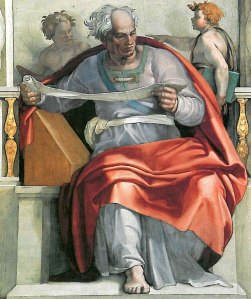
The Prophet Joel painted by Michelangelo and his assistants for the Sistine Chapel in the Vatican between 1508 to 1512

The prophet Joel is one of several books in the bible that often are overlooked by Christians. We may hear the shrill words of Joel 2: 1-2, 12-17 as one of the options to call congregations to repentance on Ash Wednesday to begin the Lenten journey or hear Peter’s reference to Joel 2: 28-29 on the day of Pentecost, but this short text is otherwise a mystery to most people of faith. A very attentive reader may remember the plague of locusts which begins the book, but it is far more likely that this book that resides between Hosea and Amos will be forgotten. One of my goals in these reflections is to dive into the parts of scripture that I am less familiar with, and the prophet Joel certainly matches that description.

The prophet Joel is one of the ‘twelve prophets’ or ‘minor prophets’ in the Hebrew Scriptures. The term the ‘twelve prophets’ comes from when the books were written on scrolls. Isaiah, Jeremiah, and Ezekiel are each long enough that they require their own scroll while Hosea, Joel, Amos, Obadiah, Jonah, Micah, Nahum, Habakkuk, Zephaniah, Haggai, Zechariah, and Malachi[1] were written together on a single scroll. Knowing the context that the prophet is speaking to can be very beneficial for the reader but in the case of Joel this is difficult to pinpoint since Joel doesn’t mention any specific historical events. Scholars use the following clues to make a best guess of Joel’s rough time period:

    1. Joel is well versed in the scriptures referencing Exodus, Deuteronomy, Obadiah, Isaiah (or Micah), and Amos. (Nogalski, 2023) So, these references would presume a date after these books. Many argue that with the exception of Daniel, Joel is one of the last books added to the Hebrew Scriptures/Old Testament.
    2. Joel frequently mentions Jerusalem, Zion, and the temple and the priesthood as a functioning organization but never mentions a king. This probably indicates that Joel is a post-exilic prophet within the time period of the middle to late Persian empire.
    3. The “political constellation presumed in Joel 3: 4-8 (4: 4-8),[2] with its assumptions of cooperative efforts between Tyre, Sidon, and the Philistines, best fits the late Persian period prior to Sidon’s destruction by Artxerxes III in 343 BCE.”(Nogalski, 2023, p. 31)

Most scholars now view Joel as a 4th Century prophet before 343 BCE which means that Jerusalem has been resettled after the Babylonian exile, the temple has been rebuilt, and Israel (now referring to the remnant of Judah centered around Jerusalem, is a province of the Persian Empire (based out of modern-day Iran). There would be no king of the Hebrew people, instead this time period reflects the reality after Ezra and Nehemiah where Judah is a vassal state of Persia yet is still troubled by marauding nations and is unable to adequately defend itself.

As with my previous reflections I utilize the work of several authors who have spent a long time studying this portion of scripture. Below are the people whose reflections I am studying alongside my own writing and reflections.:

Elizabeth Achtemeier, “The Book of Joel” in The New Interpreter’s Bible. Volume VII. Nashville: Abingdon Press, 1996.

Bruce C. Birch, Hosea, Joel, and Amos. Louisville, KY: Westminster John Knox Press, 1997.

John J. Collins. Joel, Obadiah, Haggai, Zechariah, Malachi. Collegeville, MC: Liturgical Press,2007.

James D. Nogalski. The Books of Joel, Obadiah, and Jonah. Grand Rapids, MI: William B. Eerdman’s Publishing Company, 2023

The book of Joel is a short book, but I am excited to begin walking intentionally through these three chapters.

[1] In the Christian organization of the Bible Daniel is included among the prophets but in the Jewish organization of scripture Daniel is included among the writings. The Jewish organization also includes Joshua, Judges, 1&2 Samuel, and 1&2 Kings in the prophets.

[2] The numbering of the book of Joel in English and Hebrew is different. Hebrew treats Joel 2: 28-32 as a separate chapter (Joel 3: 1-5) and the third chapter of Joel in English translations is the fourth chapter in Hebrew.