Tag Archives: Book of Ezekiel

The Book of Ezekiel

A tetramorph cherub, in Eastern Orthodox iconography 16th Century

This is a link to my reflections journeying through the Book of Ezekiel in 2024-2025.

Introduction to the Prophet Ezekiel

Ezekiel 1 Ezekiel’s Experience of the Divine Chariot in Exile

Ezekiel 2 A Prophet’s Call and a Message to Be Consumed

Ezekiel 3 A Consumed Word, a Commissioned Sentinel, and a Prophet Silenced

Ezekiel 4 The Siege of Jerusalem Portrayed

Ezekiel 5 An Image of Jerusalem’s Destruction

Ezekiel 6 Judgment Against the Land of Israel

Ezekiel 7 A Three Alarm Crisis

Ezekiel 8 The Corruption of the Temple and the People

Ezekiel 9 The Sealing of the Righteous and the Judgment of the City

Ezekiel 10 God Prepares to Leave the Temple

Ezekiel 11 Judgment on Jerusalem and Hope for the Exiles

Ezekiel 12 Judgment on the Leaders and People of Jerusalem

Ezekiel 13 Against False Prophets

Reflection: A Split in the Identity of God

Ezekiel 14 Unfaithful Elders, Deceived Prophets, and Representative Righteous Ones

Ezekiel 15 The Unfruitful Vine

Ezekiel 16 Jerusalem as an Unfaithful Bride

Ezekiel 17 A Parable of Two Great Eagles, Two Trees, and a Fickle Vine

Ezekiel 18 Life for the Righteous Ones

Ezekiel 19 A Lamentation for the Princes of Israel: Violent Lions and a Lofty Branch

Ezekiel 20 Retelling Israel’s Story in a Negative Light

Ezekiel 21 God’s Sword Against Judah

The Babylonian Empire

Ezekiel 22 A Bloody City, Impure Ore, and No One to Stand in the Breach

Ezekiel 23 Oholah and Oholibah: The Metaphor of Unfaithfulness Revisited

Ezekiel 24 The Painful Judgment of God

Ezekiel 25 Against Ammon, Moab, Edom, and the Philistines

Ezekiel 26 Against Tyre

Ezekiel 27 A Satirical Lament for Tyre

Ezekiel 28 Against the Rulers of Tyre, Sidon, and a Renewed Hope for Israel

Egypt’s Role in the Geopolitics of Israel/Judah During the Assyrian and Babylonian Empires

Military Actions as Economic Decisions in the Ancient World

Ezekiel 29 Against the Pharoah of Egypt

Ezekiel 30 Oracles Against Egypt Continued

Ezekiel 31Egypt as a Mighty Tree Cut Down

Ezekiel 32 Concluding the Oracles Against Egypt

Ezekiel 33 The Beginning of Ezekiel’s Role after Jerusalem’s Fall

Ezekiel 34 Unfaithful and Faithful Shepherd

Ezekiel 35 Judgment on Edom and Hope for Israel

Ezekiel 36 A Healed Land for a People Renewed Heart and Spirit

Ezekiel 37 The Valley of the Dry Bones and a Sign of Reunification

Ezekiel 38 The Forces of Gog and the Divine Warrior

Ezekiel 39 The Disposal of Gog and the Glorification of the LORD

Ezekiel 40 A New Temple for a New Beginning

Ezekiel 41 The Center of the New Temple

Ezekiel 42 Concluding the Survey of the New Temple

Ezekiel 43 The Presence of the LORD Returns and the New Altar

Ezekiel 44 The Sealed Gate, the Levites, and the Priests

Ezekiel 45 Land, Justice, Sacrifices, and the Passover

Ezekiel 46 Daily, Weekly, and Monthly Sacrifices, Land, and Sanctified Food

Ezekiel 47 The Waters of Life and the Boundaries of a Renewed Israel

Ezekiel 48 A Reconstituted Land, Tribes, and a New City

Resources on the Book of Ezekiel

Reflections on the Journey Through Ezekiel

Reflections on the Journey through Ezekiel

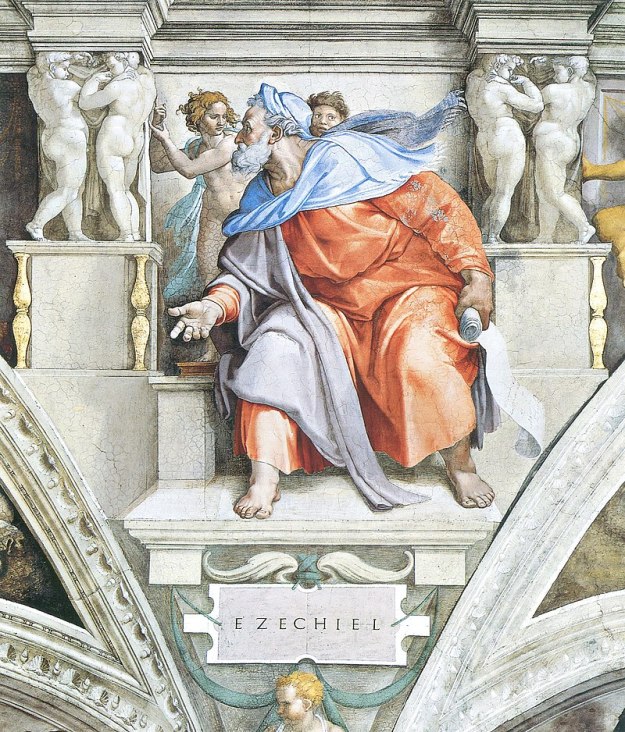
Ezekiel as depicted by Michelangelo on the Sistene Chapel ceiling

I am glad to be coming to the end of this long journey with the prophet Ezekiel and I appreciate the work of scholars who make this book in particular their life work. Working through both Jeremiah and Ezekiel has given me a much richer view of the time leading up to and after the Babylonian exile. I have a much richer view of the history, technology, and culture of the time but also of the way this people of Israel and these prophets had to deconstruct and reconstruct their view of the world. Prior to the exile, for Judah, the Davidic king, the temple of Solomon, the city of Jerusalem (or Zion), and the land were all central images for the faith of the people and Babylon shattered all of these. Ezekiel as a prophet of primarily written word due to communicating to Jerusalem from the exile in Babylon, although many of his visions, sign acts, and proclamations were likely done for a local audience first, is a part of the transition of the people of Judah from being the people of the land, temple and king to being a people of the book. Ezekiel’s perspectives are very different, even from his elder contemporary Jeremiah and there was a lot I gained from this protracted study.

Jeremiah has often been called the ‘wailing prophet’ and his dialogues with God are often honest and pathos filled while Ezekiel only protests when God asks him to do something that offends his priestly sensibilities. In this book obedience to God is a central idea and Ezekiel is a contrast to a disobedient and rebellious people. I do think both Jeremiah and Ezekiel illustrate different aspects of a faithful relationship to the God of Israel and especially for an independently minded person like myself in an independent and individualistic culture Ezekiel’s obedience was both uncomfortable but also provided a necessary correction for me.

 Ezekiel’s priestly perspective on holiness was also an uncomfortable but necessary corrective for me. Within many Protestant traditions the focus on the intimacy of the relationship with God or the closeness of God has obscured the dangerous and holy God that Ezekiel knows. This holiness in Ezekiel impacts everything from the design of the new temple to God’s reaction to the disobedience of the people. God’s holiness and the careless actions of idolatry and abomination committed by the people which defile this holiness form Ezekiel’s justification (or God’s justification in Ezekiel) for the death and suffering caused by the Babylonian destruction of Jerusalem and the exile of the people. This way of thinking and believing enabled Ezekiel and those who heard and passed on his words to make sense of the disorienting reality of their homes and beliefs being shattered by the armies of Chaldeans and their allies.

Ezekiel’s imagery can be offensive. The culture that I live in can occasionally silence offensive voices, especially in academic circles, and promote offensive voices in other contexts. Sometimes the offensive message, as in Ezekiel, can point to an uncomfortable truth. Would there be different images or words we would utilize in our context, almost certainly, but there is a reason these words have been transmitted for more than two millennia (often by hand copying the words). I think in general much of the church’s response to Ezekiel has been either embarrassment or neglect. Ezekiel may never be our favorite messenger, but I am thankful that I have taken this time to reflect on his strange and uncomfortable messages.

There were several times as I was working through Ezekiel that I noted his influence on Revelation. Even when I worked through Revelation in 2018, I wished that I could have worked through Ezekiel and Daniel first, but now the echoes of Ezekiel in Revelation are much clearer. Ezekiel may not be at the center of the cannon within the cannon for the Lutheran tradition I am a part of, but I am beginning to have a fuller grasp of the breadth, depth and width of the scriptures which have been handed on to us and the ways in which the law, the prophets, the poetry and narratives of the Hebrew Scriptures enrich and inform the New Testament and ultimately my faith.

This is the thirteenth book I have walked through, and it was one of the hardest. My faith and life were enriched by this journey, and I can appreciate this book in ways I didn’t before. Next, I will be returning to Psalms, now for Psalm 101-110, before selecting another book to begin. Back in 2022 I mapped out the journey through 1 Kings, Joel, and Ezekiel with ten psalms surrounding each reading and I am finally approaching the final leg of this group of texts from the Hebrew Scriptures.

Resources on the Book of Ezekiel

This is a list of the major sources I used on this fourteen-month journey through the book of Ezekiel. I selected each resource for a reason and below is a brief evaluation of each source. It is not a comprehensive evaluation of the literature on Ezekiel, but it may be a useful place to start for those interested in learning more about this book of scripture. Ezekiel is a very difficult book to approach from a scholarly perspective and yet I can now see the way some of the imagery of Ezekiel has influenced both later prophets and New Testament authors.

Version 1.0.0

Block, Daniel I. The Book of Ezekiel: Chapters 1-24. (New International Commentary on the Old Testament series) Grand Rapids, MI: William B. Eerdmans Publishing Company, 1997.

_______. The Book of Ezekiel: Chapters 25-48. (New International Commentary on the Old Testament series) Grand Rapids, MI: William B. Eerdmans Publishing Company, 1998.

Daniel Block’s massive two volume commentary on the prophet Ezekiel is probably more information than the casual reader will probably ever want, but it ended up being the source I referenced the most throughout this study. Daniel Block is both a phenomenal interpreter of the Hebrew text and very familiar with both the literature of the surrounding world and the archeological/historical context of the period around the Babylonian exile. I typically try to consult at least one textual commentary that pays attention to translational issues and especially with a text like Ezekiel that is both hard to translate due to unusual words and gaps. This work was highly valuable. Block and a lot of readers of Ezekiel tend to lean a little farther into source criticism that I would prefer, but Ezekiel’s history of interpretation is heavily influenced by that period of Old Testament scholarship.

Darr, Katheryn Pfisterer. “The Book of Ezekiel.” In The New Interpreter’s Bible. (New International Commentary on the Old Testament series) Grand Rapids, MI: William B. Eerdmans Publishing Company, 1997.Volume VI. Nashville, Abingdon Press, 1994.

The NIB is a solid all-around commentary on the entire bible and apocrypha. It is designed for pastors and those leading in congregations, so it does not normally engage the textual issues as deeply as the NICOT or Anchor Bible commentaries. Katheryn Pfisterer Darr does a good job of providing textual notes when they are important but remains focused on making Ezekiel intelligible to a reader with some education in the text, but who may not want to wade too deeply into the waters of this rarely utilized book in Christian circles. There are times where you can tell that the author is uncomfortable with Ezekiel’s language as a feminist scholar, but she does a good job of remaining attentive to the text even when the language or content becomes challenging.

Davis, Ellen F. Swallowing the Scroll: Textuality and the Dynamics of Discourse in Ezekiel’s Prophecy. Sheffield, England: Almond Press, 1989.

Ellen Davis is one of the scholars who I attempt to read anything that they write. This is her doctoral dissertation, and it really focuses on the initial call of Ezekiel and his position as a composer of a written text. I found this text particularly helpful in the early chapters of Ezekiel as I was trying to understand this strange prophet. Most readers are not going to pick up a doctoral dissertation, no matter how well written, but Ellen Davis is a gifted author, and you can see in this early work how she will develop as a patient and generous reader of scripture.

Version 1.0.0

Klein, Ralph W. Ezekiel: The Prophet and His Message. Clemson, SC: University of South Carolina Press, 1988. Reprinted by Minneapolis: Fortress Press, 2024.

Ralph Klien is a Lutheran Old Testament scholar and when I picked this up, I thought it was a new work. I quickly realized that it was a reprint of a work published in 1988 that dealt with Ezekiel in a more introductory manner. This may have been more useful if I was not reading it in conjunction with several other authors discussing Ezekiel, but it was the source I referenced the least once I read through it.


Ganzel, Tova. Ezekiel: From Destruction to Restoration. Maggid Studies in Tanakh. Jerusalem: Maggid Books, 2020.

When I can I attempt to utilize a Jewish scholar when reading the scriptures that we share. The Maggid Studies I have utilized in the past have been approachable but also provide a window into perspectives that most Christian scholars may not explore. This volume was also readable and had some insightful comments.

Ezekiel 40 A New Temple for a New Beginning

Schematic of Ezekiel’s Temple drawn by Dutch architect Bartelmeüs Reinders, Sr. (1893–1979) released into public domain by artist.

Ezekiel 40:1-4 Beginning the Final Vision

1 In the twenty-fifth year of our exile, at the beginning of the year, on the tenth day of the month, in the fourteenth year after the city was struck down, on that very day, the hand of the LORD was upon me, and he brought me there. 2 He brought me, in visions of God, to the land of Israel, and set me down upon a very high mountain, on which was a structure like a city to the south. 3 When he brought me there, a man was there, whose appearance shone like bronze, with a linen cord and a measuring reed in his hand; and he was standing in the gateway. 4 The man said to me, “Mortal, look closely and listen attentively, and set your mind upon all that I shall show you, for you were brought here in order that I might show it to you; declare all that you see to the house of Israel.”

When looking at ancient manuscripts you can often tell what was important to the author and the community that continued to transmit the author’s work by the amount of space dedicated to the subject. In a world before printers and copiers where words were copied by hand it is clear that the description of sacred spaces is extremely important in the life of the community. Although it is not the last vision of Ezekiel by date[1] its position at the end of Ezekiel’s collected words is significant. It is also much longer than any of Ezekiel’s other visions. In a time of great disorder this vision of hope points to a perfectly ordered future.

This vision is given two reference points, the beginning of Ezekiel’s exile and the Destruction.[2] This is the only vision dated from the destruction of Jerusalem, and it is fourteen years after the remnant of Jerusalem and Judah arrived in exile in Babylon. Now as the nation is becoming accustomed to life in exile there emerges a vision of a new possibility beyond exile. In the disorienting reality of life as strangers in a strange land the prophet, in Katheryn Pfisterer Darr’s words,

describes a perfectly ordered homeland under the leadership of a perfectly ordered homeland under the leadership of a perfectly ordered priesthood serving in a perfectly ordered Temple complex. (NIB VI:1532)

The date of the vision, the tenth day of the first month, would coincide with the Passover celebration:

This month shall mark for you the beginning of months; it shall be the first month of the year for you. Tell the whole congregation of Israel that on the tenth of this month they are to take a lamb for each family, a lamb for each household. Exodus 12: 2-3

But as the people resided in Babylon it would also occur during the Babylonian akitu festival which celebrated the enthronement of Marduk. The religion of the conquerors may have been a powerful draw to many of the Judeans who felt their God had abandoned them. The danger of settling in the land of Babylon was adopting the practices and worship of their neighbors. Here the dual setting of the worship of Marduk and the promise of liberation by the God of Israel form a dramatic tension.

This final vision of Ezekiel has numerous parallels to the Torah attributed to Moses to order the society in their journey from slavery to becoming the people of God. Both the tabernacle and the temple were expected to be places where God’s presence could dwell among the people. Previously in chapter eight, the desecration of the previous temple was revealed, and now that temple lies in ruins and God’s presence abandoned that structure.[3] This new and perfectly ordered temple guarded from the abominable practices which cause the LORD’s fury once again provides a hope for God’s presence in the midst of the people.

The man, whose appearance shines like bronze or copper, is obviously an individual from the divine rather than the human realm. This unusual man functions both like the guide in chapter eight, but also is outfitted as a surveyor. Ezekiel now takes on the role of a recorder of measurements for this orderly structure at the center of a reordered world. Briefly mentioned is ‘a city to the south’  but this note is echoed at the end of the vision where the city is named  Yahweh Shammah (Yahweh is there). This vision is to be recorded and communicated to the people of Israel, a vision of hope in a hopeless time, a vision of order in disorder, a new future from shattered past. The new beginning begins with a new sacred space.

Ezekiel 40: 5-16 The Wall and Outer Gate

5 Now there was a wall all around the outside of the temple area. The length of the measuring reed in the man’s hand was six long cubits, each being a cubit and a handbreadth in length; so he measured the thickness of the wall, one reed; and the height, one reed. 6 Then he went into the gateway facing east, going up its steps, and measured the threshold of the gate, one reed deep. There were 7 recesses, and each recess was one reed wide and one reed deep; and the space between the recesses, five cubits; and the threshold of the gate by the vestibule of the gate at the inner end was one reed deep. 8 Then he measured the inner vestibule of the gateway, one cubit. 9 Then he measured the vestibule of the gateway, eight cubits; and its pilasters, two cubits; and the vestibule of the gate was at the inner end. 10 There were three recesses on either side of the east gate; the three were of the same size; and the pilasters on either side were of the same size. 11 Then he measured the width of the opening of the gateway, ten cubits; and the width of the gateway, thirteen cubits. 12 There was a barrier before the recesses, one cubit on either side; and the recesses were six cubits on either side. 13 Then he measured the gate from the back of the one recess to the back of the other, a width of twenty-five cubits, from wall to wall. 14 He measured also the vestibule, twenty cubits; and the gate next to the pilaster on every side of the court. 15 From the front of the gate at the entrance to the end of the inner vestibule of the gate was fifty cubits. 16 The recesses and their pilasters had windows, with shutters on the inside of the gateway all around, and the vestibules also had windows on the inside all around; and on the pilasters were palm trees.

Most modern readers will look at the description of the structure and either be overwhelmed by the description or those with engineering or construction backgrounds will be perplexed by the missing details that would be required to construct the temple. In a world where literacy was relatively rare and copying a document was a labor, resource, and time intensive process.[4] Yet, like the previous descriptions of the tabernacle and temple, there is nowhere near enough information to actually construct the temple Ezekiel is shown. Tova Ganzel speculates that the “opacity of the verses and the futility of trying to base the construction on them is deliberate” to prevent anyone from attempting to carry out the temple construction at any point in the future. (Ganzel, 2020, p. 361) At the same time it is important for the prophet to convey a vision of the temple that the people can envision to give specificity to this image of hope.
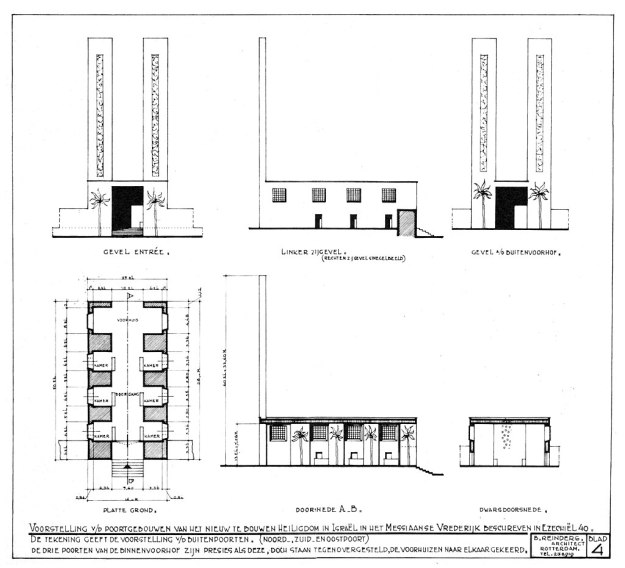
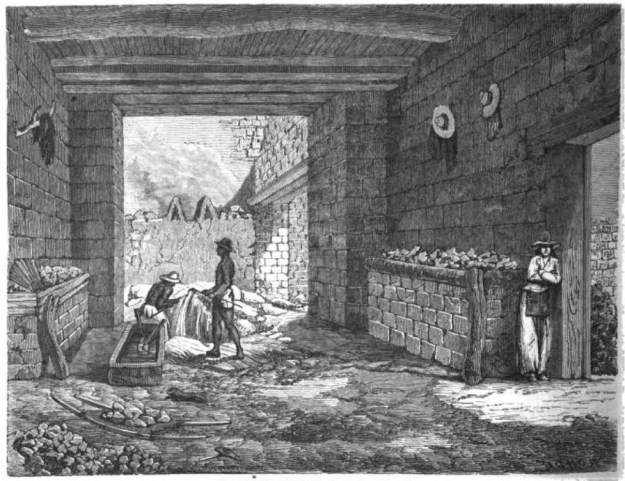
Gateways of Ezekiel’s Temple, as described in the Book of Ezekiel, drawn by the Dutch architect Bartelmeüs Reinders (1893–1979) released into public domain by artist.

The temple is oriented to the east, and this is a common practice across religions in temple construction (the temple faces towards the direction of the rising sun). It is surrounded by a ten-foot tall and ten-foot thick wall. The temple is walled off from the surrounding world and even the city to the south and much of the external structure is similar to what is expected in walled cities rather than temples. This eastern gate is a large structure, the gate opens to be roughly seventeen feet in width, but the gateway itself is about twenty-two feet wide. The width of the gate is later stated to be twenty-five feet. When you add the length of the gateways vestibules, pilasters which lead from the outside of the temple into the inner courtyard it is fifty cubits, or roughly eighty-six feet. Like ancient, fortified cities, the vestibules and ‘windows’[5] may be for defensive purposes.

This temple is created to be a place where God can dwell among the people in a reestablished relationship, and the creation of the temple is the setting aside of a holy space. In creating this holy space there is a need to separate it from the mundane space surrounding the temple, and this exterior wall forms an initial and likely guarded barrier between the people and God’s space at the center of the temple. Most Christian worship spaces have significantly reduced the space between the people and God, but for our Jewish ancestors this separation was essential. God was holy, the people were not. To defile God’s holy place was to invite God to abandon the people or to lash out at the defilement, as we have seen throughout Ezekiel. Now a new beginning begins with a new structure walled off and protected from the outside world’s interference.

Ezekiel 40: 17-27 The Outer Court

17 Then he brought me into the outer court; there were chambers there, and a pavement, all around the court; thirty chambers fronted on the pavement. 18 The pavement ran along the side of the gates, corresponding to the length of the gates; this was the lower pavement. 19 Then he measured the distance from the inner front of the lower gate to the outer front of the inner court, one hundred cubits.

 20 Then he measured the gate of the outer court that faced north — its depth and width. 21 Its recesses, three on either side, and its pilasters and its vestibule were of the same size as those of the first gate; its depth was fifty cubits, and its width twenty-five cubits. 22 Its windows, its vestibule, and its palm trees were of the same size as those of the gate that faced toward the east. Seven steps led up to it; and its vestibule was on the inside. 23 Opposite the gate on the north, as on the east, was a gate to the inner court; he measured from gate to gate, one hundred cubits.

24 Then he led me toward the south, and there was a gate on the south; and he measured its pilasters and its vestibule; they had the same dimensions as the others. 25 There were windows all around in it and in its vestibule, like the windows of the others; its depth was fifty cubits, and its width twenty-five cubits. 26 There were seven steps leading up to it; its vestibule was on the inside. It had palm trees on its pilasters, one on either side. 27 There was a gate on the south of the inner court; and he measured from gate to gate toward the south, one hundred cubits.

There are two additional outer gates that lead into the courtyard, one facing north and one facing south, of identical description to the eastern gate. There is no western gate, since the inner court of the structure is at the western edge of the complex and separated by the court and the wall from the surrounding people. As the temple sections become closer to the space where God’s presence is expected the elevation increases. The architecture ascending reflects the increasing holiness of this space and the closer proximity to the divine.  The thirty chambers which surround the outer court are not given any specific function here, but Jeremiah 35: 2-4 suggests that they were places for meeting, eating and drinking, and Nehemiah 13: 4-14 indicates they were to be used for storage of grain offerings, frankincense, and tithes of grain, wine, and oil.[6] Once a person passed the outer gates there was a separation of one hundred cubits (roughly one hundred seventy feet) from the outer gates to the inner gates.

Ezekiel 40: 28-47 The Inner Court

28 Then he brought me to the inner court by the south gate, and he measured the south gate; it was of the same dimensions as the others. 29 Its recesses, its pilasters, and its vestibule were of the same size as the others; and there were windows all around in it and in its vestibule; its depth was fifty cubits, and its width twenty-five cubits. 30 There were vestibules all around, twenty-five cubits deep and five cubits wide. 31 Its vestibule faced the outer court, and palm trees were on its pilasters, and its stairway had eight steps.

32 Then he brought me to the inner court on the east side, and he measured the gate; it was of the same size as the others. 33 Its recesses, its pilasters, and its vestibule were of the same dimensions as the others; and there were windows all around in it and in its vestibule; its depth was fifty cubits, and its width twenty-five cubits. 34 Its vestibule faced the outer court, and it had palm trees on its pilasters, on either side; and its stairway had eight steps.

35 Then he brought me to the north gate, and he measured it; it had the same dimensions as the others. 36 Its recesses, its pilasters, and its vestibule were of the same size as the others; and it had windows all around. Its depth was fifty cubits, and its width twenty-five cubits. 37 Its vestibule faced the outer court, and it had palm trees on its pilasters, on either side; and its stairway had eight steps.

38 There was a chamber with its door in the vestibule of the gate, where the burnt offering was to be washed. 39 And in the vestibule of the gate were two tables on either side, on which the burnt offering and the sin offering and the guilt offering were to be slaughtered. 40 On the outside of the vestibule at the entrance of the north gate were two tables; and on the other side of the vestibule of the gate were two tables. 41 Four tables were on the inside, and four tables on the outside of the side of the gate, eight tables, on which the sacrifices were to be slaughtered. 42 There were also four tables of hewn stone for the burnt offering, a cubit and a half long, and one cubit and a half wide, and one cubit high, on which the instruments were to be laid with which the burnt offerings and the sacrifices were slaughtered. 43 There were pegs, one handbreadth long, fastened all around the inside. And on the tables the flesh of the offering was to be laid.

44 On the outside of the inner gateway there were chambers for the singers in the inner court, one at the side of the north gate facing south, the other at the side of the east gate facing north. 45 He said to me, “This chamber that faces south is for the priests who have charge of the temple, 46 and the chamber that faces north is for the priests who have charge of the altar; these are the descendants of Zadok, who alone among the descendants of Levi may come near to the LORD to minister to him.” 47 He measured the court, one hundred cubits deep, and one hundred cubits wide, a square; and the altar was in front of the temple.

As Ezekiel is led further into the heart of the temple he continues to pass through large gates and ascends an additional eight stairs increasing the elevation of the inner court. The gateways into the inner court are also twenty-five by fifty cubits, the same dimensions as the outer gateways. These gateways separate the outer courtyard from the inner courtyard and presumably restrict access to only those set apart for the ministry in the temple. The temple’s function is to bring offerings to God, rather than a place of gathering like most modern worship spaces. In this gateway to the inner courtyard is a room for the preparation and offering of sacrifices. The description of the tables and pegs is functional and a person of priestly heritage, like Ezekiel, probably would be familiar with the proper layout of the temple, the proper preparation of offerings, and the utilization of this space.

The priests who have ‘charge’ of the temple and the altar are likely charged with guarding these spaces for their proper use by the proper people. The Hebrew word samar behind the English ‘charge’ is normally used in relation to guard duty or keeping watch over something in order to protect it. In chapter eight we saw the defilement of the temple by the elders of Judah, and now these priests are charged to ensure that the temple, particularly the inner court, remains a holy space undefiled by improper worship or idolatrous figures.

Ezekiel 40: 48-49 Entering the Temple

48 Then he brought me to the vestibule of the temple and measured the pilasters of the vestibule, five cubits on either side; and the width of the gate was fourteen cubits; and the sidewalls of the gate were three cubits on either side. 49 The depth of the vestibule was twenty cubits, and the width twelve cubits; ten steps led up to it; and there were pillars beside the pilasters on either side.

Although these final two verses of the chapter would fit better with the following chapter which focuses on the temple itself, I will keep with the chapter divisions and comment briefly on the entrance into the temple. Now the gate structure is twenty cubits total, fourteen cubit entry and three cubits on either side. The vestibule (room) is twenty cubits by twelve cubits[7] with an additional ten steps moving us up into a higher space (reflecting architecturally a holier space).  In addition to the pilasters (pillars built on the wall) there are two free standing pillars in the entry, probably copying the two bronze pillars, Jachin and Boaz, of Solomon’s temple mentioned in 1 Kings 7: 15-22. Any priest familiar with the design of Solomon’s temple would have noticed these large brass pillars in the past and they were likely a visible reminder of the opulence of the now destroyed temple. This vision of a new temple has not focused on the gold and other resources expended on the construction like 1 Kings, but this original temple likely shaped the imaginations of Ezekiel and his later readers.

[1] Ezekiel’s last by date prophecy begins in Ezekiel 29:17 (April 26, 571 BCE) two years after this date.

[2] The destruction of both Jerusalem and the temple.

[3] Ezekiel 10.

[4] One of my personal practices is hand copying the texts that I am working through (in English) just to accommodate myself to the reality of the transmission of these texts over thousands of years. Scrolls and later codices (ancient books) also would have used vellum, parchment, or papyrus rather than paper. These resources were much more expensive than modern paper. The preservation of a book like Ezekiel, which takes most of a modern 100 sheet composition book to write out, is a significant investment of time and resources in the ancient world.

[5] The ‘windows’ (Hebrew hallonot atumot) are the source of a lot of exegetical speculation. They may be ‘false windows’ with stones set in the relief, (Ganzel, 2020, p. 361) or slotted windows for archers, cupboards for utensils or tools for temple guards. (Block, 1998, p. 522)

[6] The controversy in Nehemiah is when one of these rooms is prepared as a room for Tobiah, which Nehemiah vehemently disapproves of.

[7] Roughly thirty-five feet by twenty-one feet.

Ezekiel 32 Concluding the Oracles Against Egypt

Nile Crocodile Eating a Wildabeast in the Masai Mara By Arturo de Frias Marques – Own work, CC BY-SA 4.0, https://commons.wikimedia.org/w/index.php?curid=34596035

Ezekiel 32: 1-16 Egypt as the Dragon of the Seas

1In the twelfth year, in the twelfth month, on the first day of the month, the word of the LORD came to me: 2Mortal, raise a lamentation over Pharaoh king of Egypt, and say to him:
You consider yourself a lion among the nations,
but you are like a dragon in the seas;
you thrash about in your streams,
trouble the water with your feet,
and foul your streams.
3Thus says the Lord GOD:
In an assembly of many peoples
I will throw my net over you;
and I will haul you up in my dragnet.
4I will throw you on the ground,
on the open field I will fling you,
and will cause all the birds of the air to settle on you,
and I will let the wild animals of the whole earth gorge themselves with you.
5I will strew your flesh on the mountains,
and fill the valleys with your carcass.
6I will drench the land with your flowing blood
up to the mountains,
and the watercourses will be filled with you.
7When I blot you out, I will cover the heavens,
and make their stars dark;
I will cover the sun with a cloud,
and the moon shall not give its light.
8All the shining lights of the heavens
I will darken above you,
and put darkness on your land,
says the Lord GOD.
9I will trouble the hearts of many peoples,
as I carry you captive among the nations,
into countries you have not known.
10I will make many peoples appalled at you;
their kings shall shudder because of you.
When I brandish my sword before them,
they shall tremble every moment
for their lives, each one of them,
on the day of your downfall.
11For thus says the Lord GOD:
The sword of the king of Babylon shall come against you.
12I will cause your hordes to fall
by the swords of mighty ones,
all of them most terrible among the nations.
They shall bring to ruin the pride of Egypt,
and all its hordes shall perish.
13I will destroy all its livestock
from beside abundant waters;
and no human foot shall trouble them any more,
nor shall the hoofs of cattle trouble them.
14Then I will make their waters clear,
and cause their streams to run like oil, says the Lord GOD.
15When I make the land of Egypt desolate
and when the land is stripped of all that fills it,
when I strike down all who live in it,
then they shall know that I am the LORD.
16This is a lamentation; it shall be chanted.
The women of the nations shall chant it.
Over Egypt and all its hordes they shall chant it,
says the Lord GOD.

The sixth oracle against Egypt is labeled as a lamentation and is framed by the Hebrew word for lamentation once in the second verse and four times[1] in verse sixteen. Yet, the intervening poem does not share the normal pattern of lifting in praise the object of the lament followed by a fall in most biblical laments. Within the larger structure of Ezekiel, the previous chapter may fulfill this purpose, but this ‘dragon of the seas’ while a mighty beast is not a sympathetic character at the beginning of the lament. Yet, unlike the previous usage of a metaphor for Assyria, as a great tree felled, the imagery is directly related to Egypt’s Pharoah and its military might.

In contrast to the self-perception of Pharoah as a lion among the nations,[2] but the LORD indicates through Ezekiel that he is a ‘dragon of the seas.’ We are again exposed to the Hebrew word tannin, here dragon, which often refers to a mythical sea creature and in chapter 29 referred to Pharoah as a crocodile. Here there are crocodile-like elements, the creature has feet instead of fins or flippers, but instead of being a creature of the rivers it is a creature of the seas. Part of this contrasting set of metaphors may be related to Egypt’s perception of themselves as a land-based power with a strong army (a lion among the nations) but their real power may be in their naval and merchant fleets which would prove less valuable in a defense of the homeland. Yet, this ‘dragon of the seas’ now seems to be confined to thrashing about in its streams, troubling the water with its feet, and fouling the streams. The presence of this ‘dragon of the seas’ presents in the image an ecological crisis for the waters it inhabits.

This massive beast is summarily dealt with when a net is thrown over it and it is brought out of the waters and cast on the land. Previously the LORD had cast his net over Zedekiah,[3] now the Egyptian Pharoah who Zedekiah appealed to for aid against Babylon is also ensnared. The timing of this oracle, indicated by Ezekiel’s date as March 3, 585 BCE would be two months after the exiles learn of the destruction of Jerusalem, may indicate the reason for this oracle.  Although the city is gone there may still be some lingering hope that the great sea dragon of Egypt would rouse itself fully and attack Babylon in retaliation for Jerusalem. For Ezekiel the army of Babylon under Nebuchadrezzar has been functioning on behalf of the God of Israel and now only Egypt opposes the reign of Babylon. Yet, in Ezekiel’s image the sea dragon is out of its element and serves only as food for the birds of the air and the wild animals who gorge on it. The dragon is now the food for vultures and jackals.

The metaphorical destruction of Egypt’s hordes and Pharoah has both grotesque elements and cosmic elements. Egypt is not a land of mountains and valleys, yet the carcass of the beast falls on both mountains and valleys and the blood of the beast fills the land. At the same time the defeat of this beast causes the sun, moon, and the stars to be blocked out.[4] Such a drastic change on the seas and the earth is reflected by the shrouding of the heavens. The impact of Egypt’s departure from the nations causes other kings to shudder when the LORD responsible for this upheaval brandishes his sword at them as well.

The sword of the LORD is quickly indicated to be the sword of the king of Babylon and the swords of his mighty ones. They are both the most terrible among the nations and yet they are still the chosen instrument of God. Both the humans and the animals of Egypt are destroyed, and the land is desolate. Although there is a positive ecological impact on the waters as humans and animals are removed. The once fouled and troubled waters now flow like oil.

The great sea monster, just like the crocodile-like figure in chapter 29, is removed from their element and the predator becomes prey. Isaiah will later utilize a similar praise for God’s strength over Egypt by saying:

Awake, awake, put on strength, O arm of the LORD! Awake, as in days of old, the generations of long ago! Was it not you who cut Rahab in pieces, who pierced the dragon? Isaiah 53:9[5]

Ezekiel has condemned Jerusalem’s leadership for trusting in Egypt instead of the LORD. Ezekiel’s voice was probably not popular during this time when the nation of Judah collapsed, but Ezekiel’s continual emphasis on God’s strength being enacted through Babylon likely helped the people make sense of their shattered lives in the aftermath of the destruction of Jerusalem, the temple, and their political system. Ezekiel’s imagery may have also influenced the beast from the sea in Revelation13:1-10.[6]

Ezekiel 31: 17-32 Egypt Goes Down to the Pit


17In the twelfth year, in the first month, on the fifteenth day of the month, the word of the LORD came to me:
18Mortal, wail over the hordes of Egypt,
and send them down,
with Egypt and the daughters of majestic nations,
to the world below,
with those who go down to the Pit.
19“Whom do you surpass in beauty?
Go down! Be laid to rest with the uncircumcised!”
20They shall fall among those who are killed by the sword. Egypt has been handed over to the sword; carry away both it and its hordes. 21The mighty chiefs shall speak of them, with their helpers, out of the midst of Sheol: “They have come down, they lie still, the uncircumcised, killed by the sword.”
22Assyria is there, and all its company, their graves all around it, all of them killed, fallen by the sword. 23Their graves are set in the uttermost parts of the Pit. Its company is all around its grave, all of them killed, fallen by the sword, who spread terror in the land of the living.
24Elam is there, and all its hordes around its grave; all of them killed, fallen by the sword, who went down uncircumcised into the world below, who spread terror in the land of the living. They bear their shame with those who go down to the Pit. 25They have made Elam a bed among the slain with all its hordes, their graves all around it, all of them uncircumcised, killed by the sword; for terror of them was spread in the land of the living, and they bear their shame with those who go down to the Pit; they are placed among the slain.
26Meshech and Tubal are there, and all their multitude, their graves all around them, all of them uncircumcised, killed by the sword; for they spread terror in the land of the living. 27And they do not lie with the fallen warriors of long ago who went down to Sheol with their weapons of war, whose swords were laid under their heads, and whose shields are upon their bones; for the terror of the warriors was in the land of the living. 28So you shall be broken and lie among the uncircumcised, with those who are killed by the sword.
29Edom is there, its kings and all its princes, who for all their might are laid with those who are killed by the sword; they lie with the uncircumcised, with those who go down to the Pit.
30The princes of the north are there, all of them, and all the Sidonians, who have gone down in shame with the slain, for all the terror that they caused by their might; they lie uncircumcised with those who are killed by the sword, and bear their shame with those who go down to the Pit.
31When Pharaoh sees them, he will be consoled for all his hordes — Pharaoh and all his army, killed by the sword, says the Lord GOD. 32For he spread terror in the land of the living; therefore he shall be laid to rest among the uncircumcised, with those who are slain by the sword — Pharaoh and all his multitude, says the Lord GOD.

This final oracle against both Egypt and the nations consigns Pharoah and his multitude to the Pit along with the nations who went before. There is no month in the Hebrew text for the date and the NRSV assumes that it should be the first month of the twelfth year, although I agree with both Block, and other scholars, who follow the cue of the previous oracle and have it in the first month roughly two weeks after the sixth oracle. (Block, 1998, p. 216) Egyptian royalty invested heavily in creating royal tombs to ensure that in their afterlife they would have both wealth and power, but here they join all the other nations in the Pit or Sheol. Both the Egyptians and Phoenicians mentioned here practiced circumcision, so their coming down to lie with the uncircumcised means a dishonorable death. Instead of the wealth and power they exercised, all that waits for them in Sheol is the presence of the other nations who went before.

This final oracle is highly repetitive using words like horde, go down, uncircumcised, and sword frequently in its descriptions. All these empires or nations had armies, all failed and suffered shame, all were overthrown by a greater empire with a larger army (sword). Assyria’s domain had once been great, and their rule was violent. Empires in the ancient world were violent and the accusation of spreading terror fits with Assyria’s self-description of their rule under Shalmaneser III:

I slew their warriors with the sword, descending upon them like (the god) Adad when he makes the rainstorm pour down. In the moat (of the town) I piled them up, I covered the wide plain with the corpses of their fighting me, I dyed the mountains with their blood like red wool. I took away from him many chariots (and) horses broken to the yoke. I erected pillars of skulls in front of his town, destroyed his (other) towns, tore down (their walls) and burnt (them) down. (ANET 277 quoted in NIB VI: 1442)

Now these once fierce Assyrians with their graves surrounding their leaders who once spread terror in the land of the living occupy the uttermost parts of the Pit. They were violent in life but now in death they are a part of the company of the dishonored who await Egypt. Elam, from modern day Iran, appear in the biblical writing rarely, although Jeremiah has an oracle against the Elamites,[7] and Isaiah portrays Elam as a nation skilled in archery and chariotry (or cavalry) which participated in Assyria’s attack of Judah.[8] Meshech-Tubal appeared in Ezekiel 27: 13 as nations who trafficked in the slave trade and bronze vessels and they will appear in Ezekiel 38:2 as allies of Gog. Unlike some mysterious other warriors who went down to an honorable burial (with their weapon and shield) they have arrived in Sheol bereft of the weapons they once terrified the nations with. Edom received its own oracle in Ezekiel 25: 12-14 and was one of Judah’s close neighbors, while the princes of the north and Sidonians likely refer to the Phoenicians who control Tyre and Sidon.[9]

Sheol or the Pit are not places of torment like the later conceptions of Hell but are places of darkness.[10] It is not the hoped afterlife of the Egyptian rulers, but the consolation that is offered to Egypt is that they are not alone in being consigned to the dustbin of history. They take up their place among these other nations who once terrified the people in the place of the dead, disarmed and dishonored. Katheryn Pfisterer Darr notes insightfully that for all Ezekiel’s threats to Israel, God never consigns them to the Sheol. (NIB VI: 1445)

[1] The Hebrew qina, qonem is behind both lamentation and chant in verse sixteen.

[2] The nations (goyim) and many peoples are repetitive and unifying structures for this oracle.

[3] Ezekiel 12:13, 17:20.

[4] The prophet Joel uses similar darkening of the heavenly lights for the coming day of the LORD in Joel 2:10.

[5] Rahab is a cypher for Egypt as seen in Isaiah 30:7 and Psalm 87:4.

[6] Revelation’s description of the beast from the sea is significantly different from Ezekiel’s description of this ‘sea dragon’ but Ezekiel is one of the dominant influences on the imagery of Revelation.

[7] Jeremiah 49: 35-39.

[8] Isaiah 22:6.

[9] Ezekiel 2628.

[10] See my reflection on Gehenna, Tartaros, Sheol, Hades, and Hell.

Ezekiel 27 A Satirical Lament for Tyre

Tyre, Lebanon – columns of what is believed to be palaestra (athletes’ training area) at the Al Mina excavation area By Heretiq – Own work, CC BY-SA 2.5, https://commons.wikimedia.org/w/index.php?curid=555876

Ezekiel 27

1The word of the LORD came to me: 2Now you, mortal, raise a lamentation over Tyre, 3and say to Tyre, which sits at the entrance to the sea, merchant of the peoples on many coastlands, Thus says the Lord GOD:
O Tyre, you have said,
“I am perfect in beauty.”
4Your borders are in the heart of the seas;
your builders made perfect your beauty.
5They made all your planks
of fir trees from Senir;
they took a cedar from Lebanon
to make a mast for you.
6From oaks of Bashan
they made your oars;
they made your deck of pines
from the coasts of Cyprus,
inlaid with ivory.
7Of fine embroidered linen from Egypt
was your sail,
serving as your ensign;
blue and purple from the coasts of Elishah
was your awning.
8The inhabitants of Sidon and Arvad
were your rowers;
skilled men of Zemer were within you,
they were your pilots.
9The elders of Gebal and its artisans were within you,
caulking your seams;
all the ships of the sea with their mariners were within you,
to barter for your wares.
10Paras and Lud and Put
were in your army,
your mighty warriors;
they hung shield and helmet in you;
they gave you splendor.
11Men of Arvad and Helech
were on your walls all around;
men of Gamad were at your towers.
They hung their quivers all around your walls;
they made perfect your beauty.
12Tarshish did business with you out of the abundance of your great wealth; silver, iron, tin, and lead they exchanged for your wares. 13Javan, Tubal, and Meshech traded with you; they exchanged human beings and vessels of bronze for your merchandise. 14Beth-togarmah exchanged for your wares horses, war horses, and mules. 15The Rhodians traded with you; many coastlands were your own special markets; they brought you in payment ivory tusks and ebony. 16Edom did business with you because of your abundant goods; they exchanged for your wares turquoise, purple, embroidered work, fine linen, coral, and rubies. 17Judah and the land of Israel traded with you; they exchanged for your merchandise wheat from Minnith, millet, honey, oil, and balm. 18Damascus traded with you for your abundant goods — because of your great wealth of every kind — wine of Helbon, and white wool. 19Vedan and Javan from Uzal entered into trade for your wares; wrought iron, cassia, and sweet cane were bartered for your merchandise. 20Dedan traded with you in saddlecloths for riding. 21Arabia and all the princes of Kedar were your favored dealers in lambs, rams, and goats; in these they did business with you. 22The merchants of Sheba and Raamah traded with you; they exchanged for your wares the best of all kinds of spices, and all precious stones, and gold. 23Haran, Canneh, Eden, the merchants of Sheba, Asshur, and Chilmad traded with you. 24These traded with you in choice garments, in clothes of blue and embroidered work, and in carpets of colored material, bound with cords and made secure; in these they traded with you. 25The ships of Tarshish traveled for you in your trade.
So you were filled and heavily laden
in the heart of the seas.
26Your rowers have brought you
into the high seas.
The east wind has wrecked you
in the heart of the seas.
27Your riches, your wares, your merchandise,
your mariners and your pilots,
your caulkers, your dealers in merchandise,
and all your warriors within you,
with all the company
that is with you,
sink into the heart of the seas
on the day of your ruin.
28At the sound of the cry of your pilots
the countryside shakes,
29and down from their ships
come all that handle the oar.
The mariners and all the pilots of the sea
stand on the shore
30and wail aloud over you,
and cry bitterly.
They throw dust on their heads
and wallow in ashes;
31they make themselves bald for you,
and put on sackcloth,
and they weep over you in bitterness of soul,
with bitter mourning.
32In their wailing they raise a lamentation for you,
and lament over you:
“Who was ever destroyed like Tyre
in the midst of the sea?
33When your wares came from the seas,
you satisfied many peoples;
with your abundant wealth and merchandise
you enriched the kings of the earth.
34Now you are wrecked by the seas,
in the depths of the waters;
your merchandise and all your crew
have sunk with you.
35All the inhabitants of the coastlands
are appalled at you;
and their kings are horribly afraid,
their faces are convulsed.
36The merchants among the peoples hiss at you;
you have come to a dreadful end
and shall be no more forever.”

This lament or dirge that Ezekiel is commanded to compose has been viewed in several manners. Historians have looked upon the list of goods and locations as a witness to the trade networks of the Tyrians of this time. Like many lists of goods and locations it contains many words rarely used in the Hebrew Bible and scholars have attempted to designate which type of wood or which city or nation is being referenced. Yet, for all the detail in portraying Tyre metaphorically as a trading ship filled with agricultural and luxury goods from across the known world its accumulated wealth and beauty are wrecked in a simple line, the east wind has wrecked you in the heart of the sea. Tyre, wealthy city of traders, is lamented by those who participated in trade with her.

Extracted from its placement in Ezekiel it would be easy to read this passage as a genuine lament from the author’s point of view because Tyre was a city of great resources and was a trading hub for the Mediterranean. Yet, within its placement in Ezekiel it is in the middle of a set of oracles against Tyre it is clear the author’s intent is satirical. Even so, with the detailed list of trade and trading partners, there may be a sense of envy for the wealth of the city. If this is written close to the oracles of the previous chapter, it also would share the bitterness of Tyre still standing after the fall of Jerusalem.

The initial imagery of Tyre as a ship is bracketed by the statements, “I am perfect in beauty” and “they have made perfect your beauty.” Between these two statements is a list of the materials used to construct this metaphorical ship, the crew of the ship and the soldiers who protect this vessel. Without getting into the weeds of types of wood, these are high quality timbers used for purposes appropriate to their strengths. For example, the mast made of a tall cedar tree from Lebanon, oars made of hard wood. The practical use of these fine materials is also combined with luxury when the deck is also inlaid with ivory, the sail which also serves to identify the ship comes from finely embroidered material and the coverings for the deck are made with royal colors. The crew come from Phoenicia: Sidon, Arvad, Gebul (Byblos) all cities along the coast and allies with Tyre. The defense of the ship comes from across the world: soldiers from Paras (Persia?), Lud and Put (Asia Minor and Libya) as well as archers from Arvad, Helech and Gamad.[1]

The poetic metaphor of the beautiful ship is temporarily interrupted by a list of nations and their resources which are filling the ship. Perhaps Ezekiel viewed the ship as in port taking on goods and it is surprising that Ezekiel would have the knowledge of trade that a list like this would require. Yet, Ezekiel has in other places shown an eclectic array of knowledge. Tarshish, Jonah’s hoped destination in Jonah 1:3, is probably a Phoenician port in southern Spain at the edge of the Mediterranean Sea.[2]Juvan, Tubal and Meshech are listed as traders in both vessels of bronze but also slave trafficking. Slave trafficking was an accepted part of the commerce of the ancient world and there is no indication that Ezekiel is highlighting these three trading partners or Tyre for their participation in this trade. However, Joel 3:6 accuses the people of Tyre and Sidon of selling the people of Judah and Jerusalem as slaves to the people of Juvan.[3] Judah and Israel are in the middle of the list as vendors of agricultural goods, and the rest of the list comprises a mixture of luxury and agricultural goods from across the region.  As the list concludes the metaphor resumes with the ship weighed down from goods brought in by land and sea and stored in the ship holds.

The east wind in the Mediterranean Sea has a reputation for destruction in the bible. Psalm 48:7 has the east winds shattering the ships of Tarshish, and we have seen Ezekiel use the east wind twice previously in metaphors to dry up the vine of Israel.[4] Now this wind proves disastrous for the ship of Tyre heavily laden with both crew and the wealth of the nations. All Tyre has accumulated in the metaphor are gone in an instant and the people who traded with her mourn. Tyre had been a central hub in the trading of the region, and many had made their profits in her harbors, and in the metaphor those who were once her patrons are now appalled by the fate of this city. The metaphorical destruction of Tyre upsets not only the merchants and people of the coastlands, but even kings are horribly afraid. The fear of kings may relate to the perceived impregnability of Tyre, and if this island fortress can fall to Babylon what hope do they have before this unstoppable force.

Tyre functioned like New York or Los Angeles, bringing goods into port for distribution throughout the region and as a location where the goods of the region were sent to the Mediterranean. The trading network of this time is smaller than modern cross ocean trade, but Tyre’s trade network spread across North Africa, the Middle East, and Southern Europe as far a Spain. The city would be a rich treasure if captured by any army, but being an island nation, it also proved a difficult city to conquer. Historically we know that Babylon was easily able to capture the sister cities on land who provided the food that normally fed the city, but without a blockade Tyre was able to sustain itself during the siege. As mentioned in the previous chapter, Babylon never captures Tyre. They are reported to have the city under siege for thirteen years and at the end they take the king of Tyre into captivity, but the city remains, in terms of the metaphor, seaworthy. Ironically the lament for Tyre here, and the briefer lament in the previous chapter, provide a pattern for Revelation’s lament over Babylon in Revelation 18.[5]

[1] Arvad is mentioned above. Helech may be Cilicia and the location of Gamad is uncertain.

[2] Jeremiah 10:9 refers to beaten silver brought from Tarshish. (NIB VI:1378)

[3] NRSV translates this are Greeks in Joel 3:6. The Juvans were the Ionians, the Greeks of western Asia Minor.

[4] Ezekiel 17:10; 19:12.

[5] Babylon in Revelation is a cypher for Rome, but the irony of using a lament for a city besieged by Babylon as a model for the lament of Babylon remains.

Ezekiel 26 Against Tyre

Prophesied Destruction of Tyre By John Martin – -gF2vHlFlZ8p2A at Google Cultural Institute maximum zoom level, Public Domain, https://commons.wikimedia.org/w/index.php?curid=21880083

Ezekiel 26

1In the eleventh year, on the first day of the month, the word of the LORD came to me: 2Mortal, because Tyre said concerning Jerusalem,
“Aha, broken is the gateway of the peoples;
it has swung open to me;
I shall be replenished,
now that it is wasted,”
3therefore, thus says the Lord GOD:
See, I am against you, O Tyre!
I will hurl many nations against you,
as the sea hurls its waves.
4They shall destroy the walls of Tyre
and break down its towers.
I will scrape its soil from it
and make it a bare rock.
5It shall become, in the midst of the sea,
a place for spreading nets.
I have spoken, says the Lord GOD.
It shall become plunder for the nations,
6and its daughter-towns in the country
shall be killed by the sword.
Then they shall know that I am the LORD.
7For thus says the Lord GOD: I will bring against Tyre from the north King Nebuchadrezzar of Babylon, king of kings, together with horses, chariots, cavalry, and a great and powerful army.
8Your daughter-towns in the country
he shall put to the sword.
He shall set up a siege wall against you,
cast up a ramp against you,
and raise a roof of shields against you.
9He shall direct the shock of his battering rams against your walls
and break down your towers with his axes.
10His horses shall be so many
that their dust shall cover you.
At the noise of cavalry, wheels, and chariots
your very walls shall shake,
when he enters your gates
like those entering a breached city.
11With the hoofs of his horses
he shall trample all your streets.
He shall put your people to the sword,
and your strong pillars shall fall to the ground.
12They will plunder your riches
and loot your merchandise;
they shall break down your walls
and destroy your fine houses.
Your stones and timber and soil
they shall cast into the water.
13I will silence the music of your songs;
the sound of your lyres shall be heard no more.
14I will make you a bare rock;
you shall be a place for spreading nets.
You shall never again be rebuilt,
for I the LORD have spoken,
says the Lord GOD.
15Thus says the Lord GOD to Tyre: Shall not the coastlands shake at the sound of your fall, when the wounded groan, when slaughter goes on within you? 16Then all the princes of the sea shall step down from their thrones; they shall remove their robes and strip off their embroidered garments. They shall clothe themselves with trembling, and shall sit on the ground; they shall tremble every moment, and be appalled at you. 17And they shall raise a lamentation over you, and say to you:
How you have vanished from the seas,
O city renowned,
once mighty on the sea,
you and your inhabitants,
who imposed your terror
on all the mainland!
18Now the coastlands tremble
on the day of your fall;
the coastlands by the sea
are dismayed at your passing.
19For thus says the Lord GOD: When I make you a city laid waste, like cities that are not inhabited, when I bring up the deep over you, and the great waters cover you, 20then I will thrust you down with those who descend into the Pit, to the people of long ago, and I will make you live in the world below, among primeval ruins, with those who go down to the Pit, so that you will not be inhabited or have a place in the land of the living. 21I will bring you to a dreadful end, and you shall be no more; though sought for, you will never be found again, says the Lord GOD.

In contrast to the relatively brief oracles against Ammon, Moab, Edom, and Philistia, Tyre receives a sprawling collection of oracles only eclipsed by Ezekiel’s words against Egypt. Tyre and their partner Sidon had been present in the discussion of envoys in Jeremiah 27: 1-7 and continued to resist Babylon even after the fall of Jerusalem. Egypt and Tyre become the only two powers left to resist the Babylonians, and Tyre’s position as a major trading site made it an attractive but difficult target for the Babylonians.

If you visit Tyre in modern day Lebanon it is a peninsula, but at this point Tyre was an island roughly six hundred yards from the coastline. It has two ports, one facing north towards Sidon (twenty-five miles away) and one facing south towards Egypt and Africa. Tyre as a city has ancient origins but began its “golden age” under Hiram I (969-936 BCE). This coincided with the golden age of the Davidic monarchy under David and Solomon, and both partnered with Hiram I. Hiram provided material and masons to build David’s house (2 Samuel 5:11) and would later provide material and masons for Solomon’s ambitious building projects. (1 Kings 5) Solomon gained great wealth copying the practices of Tyre, but this also brought about Solomon’s demise as his adoption of the economic practices brought him into alliances by marriage and the adoption of the worship of his wives. Tyre would later form alliances with Samaria, most famously with King Ahab who marries the daughter of King Ethbaal of the Sidonians (whose throne was in Tyre).[1] Tyre often receives condemnation in the Bible for its commercial wealth, but they were often allied with Judah and Israel for trade.

The dating of this oracle against Tyre is incomplete and there is no straightforward way to resolve its intended date. In the date there is no month, and the fall of Jerusalem comes in the eleventh year of King Zedekiah in the fourth month on the ninth day.[2] Presumably this is a time close to the fall of Jerusalem, which fits with what we know about the beginning of Nebuchadrezzar’s siege of Tyre. If Daniel Block’s hypothesis that it is the first day eleventh month of the eleventh year (February 3, 585 BCE), then you can fix an exact date. (Block, 1998, p. 35) Yet, a date within a year of the fall of Jerusalem makes sense and is close enough for any reasonable attempt at dating, especially since the siege of Tyre lasts for thirteen years according to ancient sources.

Tyre’s offense is seeing an opportunity for profit in the aftermath of Jerusalem’s demise. Jerusalem is a central location for overland trade between Egypt and Africa in the south and Babylon, Cyprus, and Greece to the north and east. Although Jerusalem and Tyre had a mutually beneficial trading relationship in the past, Tyre may see the unrest on the overland routes in the countries along the Eastern Mediterranean as a boon to their maritime trading. Yet, for Ezekiel this schadenfreude exhibited by the residents of Tyre is the reason for the LORD’s condemnation of them.

Initially the opponent against Tyre is the LORD the God of Israel directly. God hurls the nations at Tyre like the sea breaking against the rock of the island. God personally scrapes the soil from the island making it a bare rock while the nations break down the walls and towers that protect the city. Tyre will become the plunder for the nations, and the ‘daughter-towns’ which are the land cities which provide the water and food the city requires are killed by the sword. The first oracle ends with the declaration that amid this destruction the people of Tyre will know that the one who has brought about their destruction in the LORD. The sovereignty of God is an important point for Ezekiel but throughout the book the nations are never streaming to the LORD in adoration, only in subjugation.

The second oracle begins with announcing the tool that the LORD will use in this judgment: Nebuchadrezzar. This is the first time the King of Babylon is mentioned by name. He brings his military might against the city. The description of siege warfare is detailed and reflective of practices of the day for assaulting a city on land. Yet, the issue is that Tyre is an island, and it is nearly impossible to set up a ramp against an island fortress or bring the battering ram to bear. In contrast to the expectations of Ezekiel, the siege of Tyre lasted for thirteen years but the city is never captured or destroyed. Nebuchadrezzar at the end of the siege deported the king of Tyre and exacted tribute, but the city would not be destroyed until Alexander the Great created a land bridge and captured the city in 332 BCE. The land bridge continued to gather deposits from the sea and now forms the peninsula that connects Tyre to the coast of Lebanon. Ezekiel acknowledges the failed siege of Tyre and promises Egypt as a payment to Nebuchadrezzar in Ezekiel 29: 17-20.

A lament for the city of Tyre begins in verse fifteen. The princes of the sea may be kings and rulers who traded with Tyre, or they may be merchants who made their living off the trade through their ports. The imagined removal of Tyre as a trading partner and a military power in the region causes the surrounding region to tremble and mourn. A similar tone is struck in Revelation 18 at the lament over Babylon (which is significantly longer than this short lament).

The final declaration of God in this chapter brings mythological language into the destruction of Tyre. God brings up the deep (Hebrew tehom) over them. Tehom is often used in scripture as the cosmic waters or chaos that can resist God or can be that which creation is pulled from, but here it becomes a tool like Nebuchadrezzar utilized for God’s judgment. After the deep comes over the city the residents go down to the Pit, the place of the dead. As a place of the dead, it is not necessarily a place of torment, like the much later notion of hell, but it is a place that separates the living from the dead. Here it is a ruin separated from the dwelling places of the living. The chapter closes with the first instance of “I will bring you to a dreadful end, and you shall be no more; though sought for, you will never be found again” which structurally helps provide a marker for these three chapters of words against Tyre. Tyre, like Ammon and Moab, is to be no more in this prophecy.

Like the previous chapter with its oracles against the nations surrounding Judah, this is the cry of a conquered people attempting to make sense of their place with God and the nations. Jerusalem and the temple are destroyed and yet the nations who taunt them seem to prosper. The only person they can turn to for vengeance in their humiliation is their God. These chapters are difficult as a modern reader. Troubling for some readers is the reality that the events described by Ezekiel do not occur as the prophet foresaw.  Other readers may be troubled by the portrayal of a vengeful God. Yet, our struggles with this text are miniscule compared to the struggle to reinterpret the faith of the people of Judah in the aftermath of the destruction of their society.


[1] Tyre and Sidon are often mentioned together and often the term Sidonians refers to both.

[2] 2 Kings 25:3, Jeremiah 39:3.

Ezekiel 25 Against Ammon, Moab, Edom and the Philistines

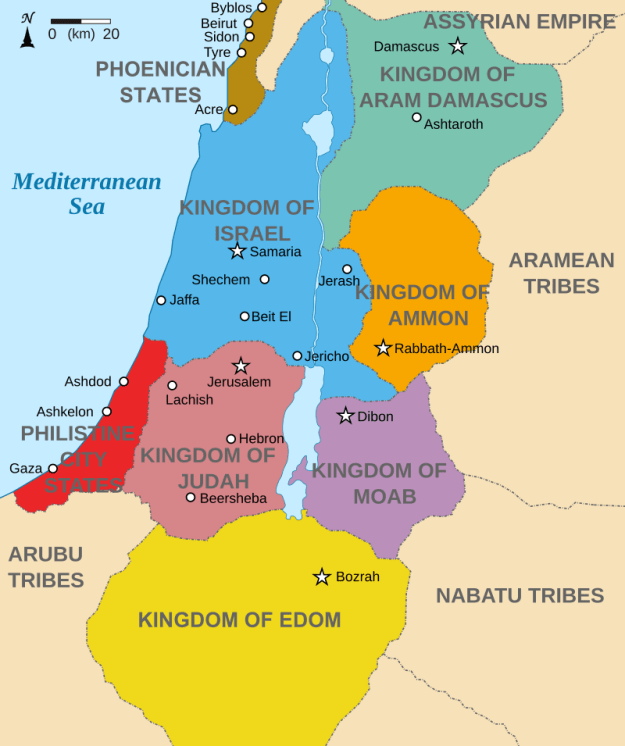
Kingdoms around Israel 830 BCE. *Oldtidens_Israel_&_Judea.svg: FinnWikiNoderivative work: Richardprins (talk)derivative work: Richardprins (talk) – Kingdoms_of_Israel_and_Judah_map_830.svg, CC BY-SA 3.0, https://commons.wikimedia.org/w/index.php?curid=10876701

Ezekiel 25: 1-7 Against Ammon

1The word of the LORD came to me: 2Mortal, set your face toward the Ammonites and prophesy against them. 3Say to the Ammonites, Hear the word of the Lord GOD: Thus says the Lord GOD, Because you said, “Aha!” over my sanctuary when it was profaned, and over the land of Israel when it was made desolate, and over the house of Judah when it went into exile; 4therefore I am handing you over to the people of the east for a possession. They shall set their encampments among you and pitch their tents in your midst; they shall eat your fruit, and they shall drink your milk. 5I will make Rabbah a pasture for camels and Ammon a fold for flocks. Then you shall know that I am the LORD. 6For thus says the Lord GOD: Because you have clapped your hands and stamped your feet and rejoiced with all the malice within you against the land of Israel, 7therefore I have stretched out my hand against you, and will hand you over as plunder to the nations. I will cut you off from the peoples and will make you perish out of the countries; I will destroy you. Then you shall know that I am the LORD.

Ezekiel is a book in the bible that has relatively few readers except for certain well-known passages, and within the book these chapters proclaiming judgment against other nations are probably the least likely to be read and dwelt upon. Yet, within many of the prophets there is a pattern of completing the judgment against Israel or Judah, turning to a judgment against the nations, and then the emergence of hope for a new beginning. Isaiah and Zephaniah follow this pattern and in its Septuagint arrangement Jeremiah does as well.[1] Ezekiel will highlight seven nations in these judgments: Ammon, Moab, Edom, Philistia, Tyre, Sidon, and Egypt. The section is structures with the first six nations receiving their judgments followed by a brief word of hope in Ezekiel 28: 24-26 followed by a judgment against Egypt which is equal in length to the first six nations’ judgments combined. (Block, 1998, p. 5) Although many readers may skim or pass these eight chapters of judgements against the nations, I am going to continue my pattern of working through the book sequentially and reflect upon these sections.

When peering back this far into history there are relatively few sources to help give a broader context to these words against Ammon, Moab, Edom and Philistia. All these nations are neighbors to Israel and have at various times been enemies and allies. Ammon and Moab, according to Genesis, have their origins with Lot, Abraham’s nephew.[2] It makes sense to begin with the judgment against Ammon since they were mentioned as the road not taken by the Babylonians in Ezekiel 21: 18-32 when they proceeded to Jerusalem. Jeremiah also mentions Ammon (along with Moab, Tyre, and Sidon) as the nations who convene with King Zedekiah to discuss forming an alliance against Babylon[3] (presumable with the support of Egypt). There is no way of knowing whether an alliance was formed or whether Ammon or the other nations worked in support of Jerusalem or against them in their conflict against Babylon. Both Jeremiah[4] and Ezekiel indicate that Ammon celebrates the destruction of the city. They shout “Aha” and clapped their hands and stamped their feet against them. Ezekiel had been commanded to clap his hands and stamp his feet against the abominations occurring in the temple (Ezekiel 6:11) and later God strikes God’s hands together against the people (Ezekiel 21: 14, 17; 22:13) but now in the aftermath of the destruction God has once again taken a protective stance towards the people.

Ammon’s judgment is here given to the ‘people of the east.’ These are probably nomadic raiders coming out of the Arabian desert. Josephus (writing shortly after the time of Jesus) states that five years after the destruction of Jerusalem Babylon would conquer both Ammon and Moab, but that is probably not what this prophecy refers to. Ultimately in the oracle Ammon disappears from the list of nations. The prophecy indicates destruction, but historically it seems that the Ammonites assimilated to and merged into the Babylonian, Persian, Greek, and finally Roman empires.

Ezekiel 25: 8-11 Against Moab

8Thus says the Lord GOD: Because Moab said, The house of Judah is like all the other nations, 9therefore I will lay open the flank of Moab from the towns on its frontier, the glory of the country, Beth-jeshimoth, Baal-meon, and Kiriathaim. 10I will give it along with Ammon to the people of the east as a possession. Thus Ammon shall be remembered no more among the nations, 11and I will execute judgments upon Moab. Then they shall know that I am the LORD.

Moab and Ammon share a common origin in Genesis and a common fate in this set of declarations against the surrounding nations. Like Ammon their judgment is left to the ‘people of the east’ and they are to be remembered ‘no more among the nations.’ It was also one of the nations who sent emissaries to King Zedekiah in Jeremiah 27 and who did not assist Jerusalem in the conflict with Babylon. The primary offense laid against Moab is their consideration of Judah like the other nations. Israel and Judah have frequently desired to be like the other nations, but they are not like other nations before God or in relation to the world. As mentioned above Josephus refers to the conquest of Moab by Babylon five years after the destruction of Jerusalem, but Moab, like Ammon seems to have assimilated into the Babylonian, Persian, Greek, and finally Roman empires. Moab receives an entire chapter in Jeremiah’s oracles against the nations. (Jeremiah 48)

Ezekiel 25: 12-14 Against Edom

12Thus says the Lord GOD: Because Edom acted revengefully against the house of Judah and has grievously offended in taking vengeance upon them, 13therefore thus says the Lord GOD, I will stretch out my hand against Edom, and cut off from it humans and animals, and I will make it desolate; from Teman even to Dedan they shall fall by the sword. 14I will lay my vengeance upon Edom by the hand of my people Israel; and they shall act in Edom according to my anger and according to my wrath; and they shall know my vengeance, says the Lord GOD.

Edom seems to have taken a more active role in the humiliation of Judah and Jerusalem. Edom biblically has its origins in Esau, Jacob’s older brother,[5] and the conflicted relationship of the brothers continued in the troubled relationship between the nations. Edom is not present at the discussions with King Zedekiah mentioned in Jeremiah 27. Their actions in this time evoke multiple reactions among scriptural writers. Psalm 137:7 records them crying out against Jerusalem:

Remember, O LORD, against the Edomites the day of Jerusalem’s fall, how they said, “Tear it down! Tear it down! Down to its foundations!”

While Obadiah’s vision is almost completely focused on the Edomites, and Jeremiah’s language for the Edomites is harsh, declaring that they will become an object of horror.[6] In a hopeful note for the people of Judah, they are once again declared ‘God’s people’ and are raised up to take an active role in the vengeance against Edom. Edom is later called Idumea, and this will be the area that Herod the Great and his ancestors hail from.

Ezekiel 25: 15-17 Against the Philistines

15Thus says the Lord GOD: Because with unending hostilities the Philistines acted in vengeance, and with malice of heart took revenge in destruction; 16therefore thus says the Lord GOD, I will stretch out my hand against the Philistines, cut off the Cherethites, and destroy the rest of the seacoast. 17I will execute great vengeance on them with wrathful punishments. Then they shall know that I am the LORD, when I lay my vengeance on them.

The Philistines were the long-time antagonists of Israel and are frequently mentioned in the stories of King Saul and King David. Yet, there is no knowledge of what role the Philistines took in the actions against Jerusalem. Ezekiel and Jeremiah 47 both indicate that the Philistines are to be destroyed and cut off. The Babylonians to conquer the area of the Philistines and take them into exile where they maintain an identity as men of Gaza or Ashkelon but between the Babylonian and Persian period they assimilate with the population between periods of exile and resettlement.

Ezekiel, unlike Jeremiah, is not in Jerusalem to witness any actions by Ammon, Moab, Edom, or the Philistines. His voice is one from a shattered people who have seen their nation humiliated and yet continue to believe that the God of Israel is also the God of the nations. If Judah’s actions have resulted in punishment, so will the actions of these nations who celebrated or participated in Judah’s humiliation. These chapters of judgment on other nations are always difficult to deal with since the other nations are not in a covenantal relationship with the God of Israel. Yet, the scripture spends far less time on these nations than they do on the condemnation of Judah or Israel’s unfaithfulness.

[1] The Septuagint is the Greek translation of the Bible. In English translations (following the Hebrew ordering) Jeremiah concludes his book with these judgments against the nations. (Jeremiah 47-51)

[2] Genesis 19: 30-38.

[3] Jeremiah 27: 1-7. Jeremiah’s focus is on God’s message to these envoys, not on the content or result of these conversations, which it is unlikely that Jeremiah had access to.

[4] Jeremiah 49: 1-6

[5] Genesis 36: 1-8.

[6] Jeremiah 49: 7-22.

Ezekiel 24 The Painful Judgment of God

By John Singer Sargent – This file was donated to Wikimedia Commons as part of a project by the National Gallery of Art. Please see the Gallery’s Open Access Policy., CC0, https://commons.wikimedia.org/w/index.php?curid=81473181

Ezekiel 24:1-14 The Boiling Pot

1 In the ninth year, in the tenth month, on the tenth day of the month, the word of the LORD came to me: 2 Mortal, write down the name of this day, this very day. The king of Babylon has laid siege to Jerusalem this very day. 3 And utter an allegory to the rebellious house and say to them, Thus says the Lord GOD: Set on the pot, set it on, pour in water also;
4 put in it the pieces, all the good pieces, the thigh and the shoulder; fill it with choice bones.
5 Take the choicest one of the flock, pile the logs under it; boil its pieces, seethe also its bones in it.
6 Therefore thus says the Lord GOD: Woe to the bloody city, the pot whose rust is in it, whose rust has not gone out of it! Empty it piece by piece, making no choice at all.
7 For the blood she shed is inside it; she placed it on a bare rock; she did not pour it out on the ground, to cover it with earth.
8 To rouse my wrath, to take vengeance, I have placed the blood she shed on a bare rock, so that it may not be covered.
9 Therefore thus says the Lord GOD: Woe to the bloody city! I will even make the pile great.
10 Heap up the logs, kindle the fire; boil the meat well, mix in the spices, let the bones be burned.
11 Stand it empty upon the coals, so that it may become hot, its copper glow, its filth melt in it, its rust be consumed.
12 In vain I have wearied myself; its thick rust does not depart. To the fire with its rust!
13 Yet, when I cleansed you in your filthy lewdness, you did not become clean from your filth; you shall not again be cleansed until I have satisfied my fury upon you.
14 I the LORD have spoken; the time is coming, I will act. I will not refrain, I will not spare, I will not relent. According to your ways and your doings I will judge you, says the Lord GOD.

Before addressing the content of this allegory or metaphor[1]it is necessary to address the dating of this portion of Ezekiel. If the dating is done according to the pattern of the rest of the dates of Ezekiel then the time from the beginning of the siege until Ezekiel is notified that the siege has ended is almost three years. We know that the siege of Jerusalem lasted roughly eighteen months and it is unlikely that it would have taken another eighteen months for the information about the fall of Jerusalem to reach Ezekiel. Yet, it is not surprising that the dating changes since the same date is referenced in both 2 Kings and Jeremiah.

And in the ninth year of his reign, in the tenth month, on the tenth day of the month, King Nebuchadnezzar of Babylon came with all his army against Jerusalem, and laid siege to it; they built siegeworks against it all around. So the city was besieged until the eleventh year of King Zedekiah. On the ninth day of the fourth month the famine became so severe in the city that there was no food for the people of the land. 2 Kings 25:1-3, see also Jeremiah 39: 1-3.

Whether Ezekiel changes his dating scheme based on the command to write down the name of the day by the LORD, or whether a later scribe corrects Ezekiel’s dating scheme to reflect the standard dating practice, the siege of Jerusalem begins in the ninth year of King Zedekiah’s reign in the tenth day of the tenth month of the year. The prophesied siege has finally begun. The words of Ezekiel are finally occurring in a way that the people can now see that there has been a prophet among them.

Ezekiel has frequently built upon previously used images and throughout this metaphor he pulls together the image of the pot previously used in chapter eleven and the bloody city from chapter twenty-two. There is a poetic quality to the image, and it is possible that Ezekiel is utilizing a cooking ditty that gets repurposed into this image, taking something familiar and using it in an uncomfortable manner to warp the preconceived notions of the hearer. But even if this is utilizing a song about a cooking pot, this is no ordinary meal being prepared. The copper pot indicates either a cultic use or court use because most people at this time would use clay pots.

The translation of the corruption of the pot as rust is problematic because copper does not rust. Copper when it oxidizes turns green and so if the corruption is with the pot then a better translation would be corruption that would need to be smelted away if the pot is to be clean. Yet, the more likely indication is that the meat is corrupted rather than the pot and that rather than the content of the pot being choice cuts of the choicest animal of the flock what they ended up with is putrid flesh. (Block, 1997, p. 777) This resonates with the imagery of chapter eleven where the leaders view themselves as the choice meat safe within the pot, while the LORD indicates that they are rotten.

Ezekiel, along with Jeremiah and others, has been challenging the Zion theology that viewed the temple and Jerusalem as guarantees of the LORD’s protection for the people. In this theology the exiles were the ones discarded while those remaining in the city were the choice cuts who are safe. Now with the beginning of the siege the pot which once offered safety is now heated until it glows. If this was being used for either consumption or cultic use the law would expect the blood of the sacrificed animal to be poured out on the ground, but the blood is in the pot and everything in the pot is heated to the point where the corruption is consumed. The blood still testifies to the violence committed in the city and there is no beginning without the contents of the pot being consumed. There can only be a new beginning once there is an ending. God has spoken and now those words are realized. It is only in retrospect that the people can understand that a prophet has been among them. It is only after the destruction of the city and in the time of exile that a new beginning can occur. For Ezekiel, the judgment of this time is just and yet this journey will take a difficult toll on him personally as well as any loss he may feel at the destruction of the city he grew up in and the temple he had been trained to serve in.

Ezekiel 24: 15-27 A Tragic Final Sign

15 The word of the LORD came to me: 16 Mortal, with one blow I am about to take away from you the delight of your eyes; yet you shall not mourn or weep, nor shall your tears run down. 17 Sigh, but not aloud; make no mourning for the dead. Bind on your turban, and put your sandals on your feet; do not cover your upper lip or eat the bread of mourners. 18 So I spoke to the people in the morning, and at evening my wife died. And on the next morning I did as I was commanded.

19 Then the people said to me, “Will you not tell us what these things mean for us, that you are acting this way?” 20 Then I said to them: The word of the LORD came to me: 21 Say to the house of Israel, Thus says the Lord GOD: I will profane my sanctuary, the pride of your power, the delight of your eyes, and your heart’s desire; and your sons and your daughters whom you left behind shall fall by the sword. 22 And you shall do as I have done; you shall not cover your upper lip or eat the bread of mourners. 23 Your turbans shall be on your heads and your sandals on your feet; you shall not mourn or weep, but you shall pine away in your iniquities and groan to one another. 24 Thus Ezekiel shall be a sign to you; you shall do just as he has done. When this comes, then you shall know that I am the Lord GOD.

25 And you, mortal, on the day when I take from them their stronghold, their joy and glory, the delight of their eyes and their heart’s affection, and also their sons and their daughters, 26 on that day, one who has escaped will come to you to report to you the news. 27 On that day your mouth shall be opened to the one who has escaped, and you shall speak and no longer be silent. So you shall be a sign to them; and they shall know that I am the LORD.

Even though the book of Ezekiel is one of the longer books in the bible we know very little biographical information about the prophet: we know that he was thirty years old at the time of his call[2], that he was a part of the initial group of exiles in Babylon, that he is a priest and the son of Buzi, and now we learn that he is married. Being a thirty year old male we may have assumed he was married but in this time of upheaval it is likely that many traditional markers in the personal life of individuals may be delayed. Now that we have learned that he has a wife described here as the delight of his eyes it helps provide some answers to how the prophet was able to become the living sign that God required him to be. Presumably when Ezekiel portrays the siege of Jerusalem with his body for over four hundred days it would be his wife who ministered to him and cared for him. Throughout the book of Ezekiel, the prophet has been obedient in contrast to the disobedience of the people and only protests when he is asked to do something that makes him unclean or when he feels that all of Israel is being destroyed. Now Ezekiel who has occupied the space between a heartbroken God and the disobedient people endures his own personal heartbreak with no set of listening ears to hear his grief. Ezekiel has often been a living sign for the people of Israel and his actions have cost him physically, but now his family becomes one final sign before the destruction of Israel, and he is unable to collapse in mourning because of the imperative of his mission from God.

Ezekiel is addressed as Mortal[3] and then told that with ‘one blow’ God is taking away his wife and he is not to mourn of weep. The term translated ‘one blow’ elsewhere has referred to death from a plague, but here it conveys the suddenness of the death. There was no indication that Ezekiel’s wife is sick before this announcement but in the span of a day his wife is dead. The lack of the standard actions associated with mourning is a noticeable departure from the expected activity and it makes people demand an explanation from the prophet. Throughout the book the prophet has been both the medium and the messenger, but one last time he is both the physical sign to the people and the one to explain the sign. Instead of mourning and covering the upper lip,[4] he is to dress and carry on in a normal manner. In Leviticus Aaron and his sons Eleazar and Ithamar were not allowed to mourn Aaron’s two sons who offered an ‘unholy fire’ before the LORD and were killed (Leviticus 10: 6-7) and later this becomes the expected practice for the high priest (Leviticus 21: 10-12). In the absence of the temple, now perhaps we are to see the prophet as the new high priest for the people. The ‘stronghold, joy, and delight of the people’ (the city and temple) in addition to their sons and daughters of the people are being taken away and the prophets will become the new center of faith at the beginning of a new era in Babylon.

Ezekiel embodies obedience throughout his ministry, and this has come at a high cost. This portion of Ezekiel’s life resonates with Abraham’s call to sacrifice his beloved son Isaac. Yet, unlike Abraham’s offering in Genesis 22 there is no lamb to take the place of the beloved one.  Ezekiel pays a steep price for the privilege of serving as God’s agent charged with carrying the difficult message of the judgment on Jerusalem, the leaders of Israel, the temple, and the land. Daniel Block argues that he pays a price higher than any other recorded prophet. (Block, 1997, p. 793)

Why does God ask such a high price from God’s most faithful people? This is a difficult question without one simple answer, but this is a question that any reading of the scriptures does prompt. Prophets like Ezekiel and Jeremiah often find themselves caught between the people who God loves and the God who the people have rejected, and they become living witnesses to the tension in this broken relationship. I’ve often told my community that “God sends God’s very best in the hope that the people God loves will return.” This thought is captured in Jesus’ parable of the wicked tenants (Matthew 21: 33-46, Mark 12: 1-12, Luke 20: 9-19) where the house master (NRSV landowner) continually sends servants to tenants who resist them, eventually sending the Son. This is an opportunity for the tenants, but it means that the servants (or slaves) of God suffer abuse. Some prophets have protested the treatment they have received, but Ezekiel throughout these twenty-four chapters that lead to the exile has demonstrated a quiet obedience to God’s will. The book of Ezekiel does not consider sharing the emotional struggle of the prophet worthy of space (and any speculations we make are merely speculations) in contrast to the essential task of communicating the word of God to a resistant people.

The first half of Ezekiel has been leading to this point where the consequences of the disobedience of the people of Israel occur in the siege of Jerusalem by Babylon. This is a difficult portion of scripture to read but the people valued these difficult words enough to preserve them as a continual witness to warn against the loss of the covenantal dimension of the relationship between the people of God and the God of Israel. Ezekiel will be an influence on several later prophets as well as the New Testament, particularly Revelation. As we continue in this book the focus shifts from Judah to the nations. The LORD the God of Israel is not merely the God of Israel. Ezekiel like many prophets will have messages for many other nations and as the next eight chapters of Ezekiel will concern Ammon, Moab, Edom, Philistia, Tyre, and Egypt. Now that the forces of Babylon are on the march these nations which conspired with Judah will not be exempt from the judgment of King Nebuchadrezzar (and by extension the LORD).

[1] This is the Hebrew masal which can be translated parable, proverb, allegory or metaphor.

[2] Presuming the initial dating of the thirtieth year is Ezekiel’s thirtieth year, see chapter one.

[3] Literally son of man, as throughout the book. This is God’s characteristic address to the prophet Ezekiel.

[4] Elsewhere in the bible this is a sign of shame (Micah 3:7) and perhaps communal mourning, but this passage assumes that this is also a common practice symbolizing bereavement.

Ezekiel 22 A Bloody City, Impure Ore, and No One to Stand in the Breach

Interior of the Silver Smelter of Corralitos By Philippe Rondé – Le Tour du Monde, volume 4 [1], Public Domain, https://commons.wikimedia.org/w/index.php?curid=82418139

Ezekiel 22: 1-21 The Bloody City

The word of the LORD came to me: 2 You, mortal, will you judge, will you judge the bloody city? Then declare to it all its abominable deeds. 3 You shall say, Thus says the Lord GOD: A city! Shedding blood within itself; its time has come; making its idols, defiling itself. 4 You have become guilty by the blood that you have shed, and defiled by the idols that you have made; you have brought your day near, the appointed time of your years has come. Therefore I have made you a disgrace before the nations, and a mockery to all the countries. 5 Those who are near and those who are far from you will mock you, you infamous one, full of tumult.

6 The princes of Israel in you, everyone according to his power, have been bent on shedding blood. 7 Father and mother are treated with contempt in you; the alien residing within you suffers extortion; the orphan and the widow are wronged in you. 8 You have despised my holy things, and profaned my sabbaths. 9 In you are those who slander to shed blood, those in you who eat upon the mountains, who commit lewdness in your midst. 10 In you they uncover their fathers’ nakedness; in you they violate women in their menstrual periods. 11 One commits abomination with his neighbor’s wife; another lewdly defiles his daughter-in-law; another in you defiles his sister, his father’s daughter. 12 In you, they take bribes to shed blood; you take both advance interest and accrued interest, and make gain of your neighbors by extortion; and you have forgotten me, says the Lord GOD.

13 See, I strike my hands together at the dishonest gain you have made, and at the blood that has been shed within you. 14 Can your courage endure, or can your hands remain strong in the days when I shall deal with you? I the LORD have spoken, and I will do it. 15 I will scatter you among the nations and disperse you through the countries, and I will purge your filthiness out of you. 16 And I shall be profaned through you in the sight of the nations; and you shall know that I am the LORD.

The prophet Nahum in the 7th Century BCE issues oracles against the Assyrian capital Ninevah he declares that it is a city of bloodshed. Ninevah had been responsible for the conquering of Samaria and Nahum viewed their violent actions as meriting God’s judgement. “Ah, City of bloodshed, utterly deceitful, full of booty—no end to plunder” (Nahum 3:1) Although it is not certain that Ezekiel would have known these words from a prophet a couple of decades prior to his ministry, the content of this oracle reflects similar language, although now the bloody city is Jerusalem instead of Ninevah. Ezekiel is now called to judge the city which has transformed itself by its actions from the city of God to the bloody city.

The actions of bloodshed and idolatry have led the city to this space where they stand under God’s judgment. The punishment long withheld is finally arriving and Jerusalem instead of occupying a privileged space of honor as Zion now occupies a space of mockery and dishonor before the nations. The society of Judah has unraveled. They have lost their grounding in the covenant and in this dangerous city the fundamental building block of society (the family) has broken down and the vulnerable are exploited.

Throughout the law it is clear that leaders in Judah have a responsibility to maintain justice among the citizens. Their position is one of responsibility and not primarily one of privilege. Ezekiel accuses the princes of Israel of practicing exploitation instead of justice. Family is treated with contempt, the vulnerable (aliens, orphans, and widows) are exploited, the holy things of God are profaned, dishonest words are used to spill blood, unholy actions and things are lifted up, the boundaries of decency in family and among neighbors is broken, profit is made upon the misfortune of others (by charging interest) and all of this points to the reality that the people has forgotten the LORD. The list of unrighteous actions is the opposite of the righteous man who can save his own life in Ezekiel 18:5-9 and both build upon the understanding of holiness expressed in Leviticus 18-19.

Ezekiel paints a bleak picture of the communal life of Jerusalem. When they can be referred to in a similar way to Ninevah (or Samaria and Sodom as in 16: 44-58) then they are a society that has lost its moorings. When the city of shalom (Jeru-shalom) has become the bloody city the world has turned upside down. Ezekiel’s language is evocative. He paints this blood red image of violence to demonstrate the brokenness of Jerusalem and the righteousness of God in calling for judgment. These words, which are preserved beyond the judgment may have enabled the children to look upon the actions of their parents, consider and not do likewise. (Ezekiel 18:14)

Ezekiel 22: 17-22 Israel is Dross

17 The word of the LORD came to me: 18 Mortal, the house of Israel has become dross to me; all of them, silver, bronze, tin, iron, and lead. In the smelter they have become dross. 19 Therefore thus says the Lord GOD: Because you have all become dross, I will gather you into the midst of Jerusalem. 20 As one gathers silver, bronze, iron, lead, and tin into a smelter, to blow the fire upon them in order to melt them; so I will gather you in my anger and in my wrath, and I will put you in and melt you. 21 I will gather you and blow upon you with the fire of my wrath, and you shall be melted within it. 22 As silver is melted in a smelter, so you shall be melted in it; and you shall know that I the LORD have poured out my wrath upon you.

Israel was to be a treasured possession, a priestly kingdom, and a holy nation (Exodus 19: 5-6). Just as the city of peace became the blood city, now the treasured possession has become dross. The imagery of the refinement of silver from the silver ore which contains multiple elements (copper, iron, lead and tin) becomes the metaphor for God’s action of pouring out anger to melt the elements to separate the dross from the precious metal. There is a resonance with the metaphor here and Egypt as the iron smelter which God delivered his people from (Deuteronomy 4:20) but a stronger resonance exists in Isaiah’s earlier description of Judah:

How the faithful city has become a whore! She that was full of justice, righteousness lodged in her—but now murderers! Your silver has become dross, your wine is mixed with water. Your princes are rebels and companions of thieves. Everyone loves a bribe and runs after gifts. They do not defend the orphan, and the widow’s cause does not come before them. Isaiah 1: 21-23 (emphasis mine).

Yet, Ezekiel’s image may indicate that there is nothing precious left in Israel. They are completely dross. It is only God’s action that dross which has nothing precious can emerge from the smelter as silver. Any hope for Israel’s future lies in the same God whose blast of wrath is melting the people in their current state.

Ezekiel 22: 23-31 No One to Stand in the Breach

23 The word of the LORD came to me: 24 Mortal, say to it: You are a land that is not cleansed, not rained upon in the day of indignation. 25 Its princes within it are like a roaring lion tearing the prey; they have devoured human lives; they have taken treasure and precious things; they have made many widows within it. 26 Its priests have done violence to my teaching and have profaned my holy things; they have made no distinction between the holy and the common, neither have they taught the difference between the unclean and the clean, and they have disregarded my sabbaths, so that I am profaned among them. 27 Its officials within it are like wolves tearing the prey, shedding blood, destroying lives to get dishonest gain. 28 Its prophets have smeared whitewash on their behalf, seeing false visions and divining lies for them, saying, “Thus says the Lord GOD,” when the LORD has not spoken. 29 The people of the land have practiced extortion and committed robbery; they have oppressed the poor and needy, and have extorted from the alien without redress. 30 And I sought for anyone among them who would repair the wall and stand in the breach before me on behalf of the land, so that I would not destroy it; but I found no one. 31 Therefore I have poured out my indignation upon them; I have consumed them with the fire of my wrath; I have returned their conduct upon their heads, says the Lord GOD.

This third section within the chapter continues to build upon previously used imagery and has echoes of the words of Jeremiah, Micah,[1] and especially Zephaniah. The image of princes as roaring lions was seen in chapter 19 and prophets are covering up the flaws in the society with whitewash as in chapter 13. Like many speakers these images are brought again to hearers to reinforce the injustice done by the rulers of the society.  For the first time in Ezekiel the priests are brought into the condemnation. The overall passage, as mentioned above, echoes the language of Zephaniah 3:

Ah, soiled, defiled, oppressing city! It has listened to no voice; it has accepted no correction. It has not trusted the LORD; it has not drawn near to its God. The officials within it are roaring lions; its judges are evening wolves that leave nothing until the morning. Its prophets are reckless, faithless persons; its priests have profaned what is sacred they have done violence to the law. Zephaniah 3: 1-4 (emphasis mine).

The echoes between prophets may originate in a tradition of preserving the words of the prophets and studying these words, but if we take seriously the claims that the prophets are proclaiming the word of the LORD, then they share a common source. Through multiple voices similar images and messages have attempted to break through the resistance of the people of Israel, but now the people stand at the precipice of judgment with no one to stand in the gap for them.

The narrative of the flood in the book of Genesis (Genesis 6-9) deals with God’s attempt to cleanse the land from the wickedness, corruption, and violence of humanity. Now this violence, wickedness and corruption are focused in Judah and the action of the LORD is to purify the land once again. The princes, officials, priest, and prophets have all practiced violence, corrupted the teaching of the law and profaned the holy things, shed blood for dishonest gain, and covered up the corruption in the society. The result is a society that was intended to provide justice to the poor, needy, and the alien are now exploiting those vulnerable members of society.

The LORD seeks someone who will stand in the breach before God on behalf of the land. Gary Anderson points to the way Moses filled this role for the people in both Exodus 32: 7-14 and Numbers 14: 11-20. (Anderson, 2008, p. 223) Moses after both the Golden Calf and the rebellion against Moses and Aaron stands between the people and God and calls upon God not to destroy the people, initially for the sake of the name of God and then later picking up on God’s declared identity in the aftermath of the first betrayal. There is no Moses to stand in the breach for the people, to both defend the people from the wrath of the LORD, but also to reorient the people on the way of the law.

In a time where there is no Moses to stand in the breach and the princes, prophets, officials, and priests have all betrayed the ways of God the society is disordered. There is no reform that will reorient this broken society, only the wrath of God which washes over and consumes can purify the dross into silver. When Jerusalem is bloodier than Ninevah then perhaps only the destruction of the city can bring about the healing of the land. There is no hope in Ezekiel which does not pass through the destruction of Jerusalem, the temple, the Davidic line of kings, and the loss of the land.  There are only two more chapters of Ezekiel prior to the exile of the majority of the people, and throughout the book there has been no expectation that the people would hear and respond to the words of the prophet. Ezekiel does provide a lens for the people to look backward through in the aftermath of exile once they realize that there has been a prophet among them.

[1] Jeremiah 5: 1-5, 31; Micah 3:11.