
Tag Archives: Babylonian Empire

Jeremiah 34: A Broken Covenant

Zedekiah, last King of Judah before the destruction of the kingdom by Babylon, "Promptuarii Iconum Insigniorum" published by Guillaume Rouille (1518-1589)

Zedekiah, last King of Judah before the destruction of the kingdom by Babylon, “Promptuarii Iconum Insigniorum” published by Guillaume Rouille (1518-1589)

Jeremiah 34: 1-7: A Final Chance for Zedekiah?

The word that came to Jeremiah from the LORD, when King Nebuchadrezzar of Babylon and all his army and all the kingdoms of the earth and all the peoples under his dominion were fighting against Jerusalem and all its cities: 2 “Thus says the LORD, the God of Israel: Go and speak to King Zedekiah of Judah and say to him: Thus says the LORD: I am going to give this city into the hand of the king of Babylon, and he shall burn it with fire. 3 And you yourself shall not escape from his hand, but shall surely be captured and handed over to him; you shall see the king of Babylon eye to eye and speak with him face to face; and you shall go to Babylon. 4 Yet hear the word of the LORD, O King Zedekiah of Judah! Thus says the LORD concerning you: You shall not die by the sword; 5 you shall die in peace. And as spices were burned for your ancestors, the earlier kings who preceded you, so they shall burn spices for you and lament for you, saying, “Alas, lord!” For I have spoken the word, says the LORD.

6 Then the prophet Jeremiah spoke all these words to Zedekiah king of Judah, in Jerusalem, 7 when the army of the king of Babylon was fighting against Jerusalem and against all the cities of Judah that were left, Lachish and Azekah; for these were the only fortified cities of Judah that remained.


Like the previous chapters we are in the context of the invasion of Judah by Nebuchadrezzar of Babylon but unlike chapters 30-33 this is not a chapter of hope, this is focused on the immediate reality of the collapse of Judah, Jerusalem, and the Davidic dynasty. On the one hand this is a much kinder word than his predecessor Jehoiakim receives from Jeremiah, in many ways it is the exact opposite word (see Jeremiah 22: 18-19). As Rabbi Lau narrates this part of the story he sees Jeremiah looking at Zedekiah in a web far beyond his own control and that ultimately this crisis is not his fault. (Lau, 2013, p. 162) The defenses and all the alliances have failed as the fortified cities of Judah quickly fall. Zedekiah actually endures a much harsher punishment than what Jeremiah states here, and perhaps this is one final plea for Zedekiah and the forces of Jerusalem to surrender. The city will fall either way, there is no escape for Zedekiah but perhaps Jeremiah offers him one final chance for some mercy for the king and by extension the people in the face of the destruction.


Jeremiah 34: 8-22: A Broken Covenant

Roman collared slaves-Marble relief from Smyrna (Izmir, Turkey), 200 CE

Roman collared slaves-Marble relief from Smyrna (Izmir, Turkey), 200 CE

8 The word that came to Jeremiah from the LORD, after King Zedekiah had made a covenant with all the people in Jerusalem to make a proclamation of liberty to them, 9 that all should set free their Hebrew slaves, male and female, so that no one should hold another Judean in slavery. 10 And they obeyed, all the officials and all the people who had entered into the covenant that all would set free their slaves, male or female, so that they would not be enslaved again; they obeyed and set them free. 11 But afterward they turned around and took back the male and female slaves they had set free, and brought them again into subjection as slaves. 12 The word of the LORD came to Jeremiah from the LORD: 13 Thus says the LORD, the God of Israel: I myself made a covenant with your ancestors when I brought them out of the land of Egypt, out of the house of slavery, saying, 14 “Every seventh year each of you must set free any Hebrews who have been sold to you and have served you six years; you must set them free from your service.” But your ancestors did not listen to me or incline their ears to me. 15 You yourselves recently repented and did what was right in my sight by proclaiming liberty to one another, and you made a covenant before me in the house that is called by my name; 16 but then you turned around and profaned my name when each of you took back your male and female slaves, whom you had set free according to their desire, and you brought them again into subjection to be your slaves. 17 Therefore, thus says the LORD: You have not obeyed me by granting a release to your neighbors and friends; I am going to grant a release to you, says the LORD– a release to the sword, to pestilence, and to famine. I will make you a horror to all the kingdoms of the earth. 18 And those who transgressed my covenant and did not keep the terms of the covenant that they made before me, I will make like the calf when they cut it in two and passed between its parts: 19 the officials of Judah, the officials of Jerusalem, the eunuchs, the priests, and all the people of the land who passed between the parts of the calf 20 shall be handed over to their enemies and to those who seek their lives. Their corpses shall become food for the birds of the air and the wild animals of the earth. 21 And as for King Zedekiah of Judah and his officials, I will hand them over to their enemies and to those who seek their lives, to the army of the king of Babylon, which has withdrawn from you. 22 I am going to command, says the LORD, and will bring them back to this city; and they will fight against it, and take it, and burn it with fire. The towns of Judah I will make a desolation without inhabitant.


This event gives a window into some of the competing ideals that are at work in the time of Jeremiah. Slavery in this time was an economic arrangement where a person no longer able to pay their debts would become a slave to the debt holder. Leviticus 25: 10 (also Isaiah 61:1 and Ezekiel 46: 17 refer to this idea) places a limit on this time of servitude requires the release of lands and bonded servants and Deuteronomy 15 also talks about this regular practice of the remission of debts and the freeing of those under those debts and indentured slavery. In a time of military and political crisis the people fall back on to this practice under the leadership of Zedekiah. The cut a covenant with God, set those in slavery free. In the context of the invasion this is also the point where the approaching Babylonian armies have to turn aside to deal with an approaching Egyptian army. Quickly, once the threat of the approaching Babylonian army turns aside economic concerns begin to dominate again and the people recently freed are returned to their positions of servitude. Perhaps the people are beginning to mock Jeremiah’s words and believe that they have averted yet another crisis: the city and the temple and the Davidic king are all the guarantee they need rather than living out the covenant they have made with their God. The Lord is furious with this turnaround, this is one additional illustration of the unfaithfulness of the people to the covenant that they made with the Lord. The Lord’s words refer to the action of cutting a covenant, similar to the action narrated in Genesis 15 between God and Abraham, where the action of cutting apart an animal and passing through the center is used to mark the cutting of the covenant and also to symbolize the consequences of breaking that covenant. Now the people who have broken this covenant will become a corpse like the calf and be left for the wild animals. They were a people who could have been a blessing but they in their turning away have become a curse. The army of Babylon will not stay away, they will come and burn, kill and destroy.
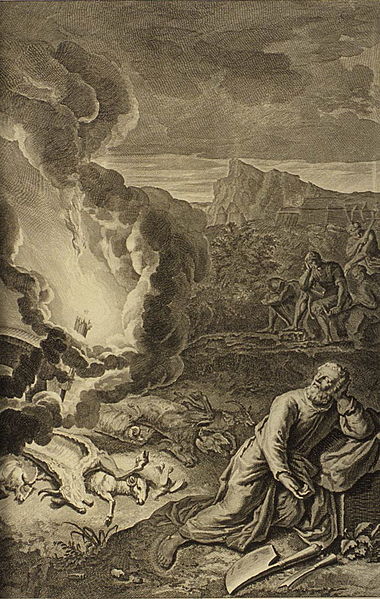
A Deep Sleep Came Upon Abraham and a Horror Siezed Him, as in Genesis 15: 12 from 1728 Figures de la Bible illustrated by Gerard Hoet (1648-1733)

A Deep Sleep Came Upon Abraham and a Horror Siezed Him, as in Genesis 15: 12 from 1728 Figures de la Bible illustrated by Gerard Hoet (1648-1733)
Jeremiah 25- Drinking the Cup of Wrath

Jeremiah 25: 1-14- The Voice of Frustration

The Prophet Jeremiah by Michelangelo

The Prophet Jeremiah by Michelangelo

1 The word that came to Jeremiah concerning all the people of Judah, in the fourth year of King Jehoiakim son of Josiah of Judah (that was the first year of King Nebuchadrezzar of Babylon), 2 which the prophet Jeremiah spoke to all the people of Judah and all the inhabitants of Jerusalem: 3 For twenty-three years, from the thirteenth year of King Josiah son of Amon of Judah, to this day, the word of the LORD has come to me, and I have spoken persistently to you, but you have not listened. 4 And though the LORD persistently sent you all his servants the prophets, you have neither listened nor inclined your ears to hear 5 when they said, “Turn now, everyone of you, from your evil way and wicked doings, and you will remain upon the land that the LORD has given to you and your ancestors from of old and forever; 6 do not go after other gods to serve and worship them, and do not provoke me to anger with the work of your hands. Then I will do you no harm.” 7 Yet you did not listen to me, says the LORD, and so you have provoked me to anger with the work of your hands to your own harm.

                8 Therefore thus says the LORD of hosts: Because you have not obeyed my words, 9 I am going to send for all the tribes of the north, says the LORD, even for King Nebuchadrezzar of Babylon, my servant, and I will bring them against this land and its inhabitants, and against all these nations around; I will utterly destroy them, and make them an object of horror and of hissing, and an everlasting disgrace. 10 And I will banish from them the sound of mirth and the sound of gladness, the voice of the bridegroom and the voice of the bride, the sound of the millstones and the light of the lamp. 11 This whole land shall become a ruin and a waste, and these nations shall serve the king of Babylon seventy years. 12 Then after seventy years are completed, I will punish the king of Babylon and that nation, the land of the Chaldeans, for their iniquity, says the LORD, making the land an everlasting waste. 13 I will bring upon that land all the words that I have uttered against it, everything written in this book, which Jeremiah prophesied against all the nations. 14 For many nations and great kings shall make slaves of them also; and I will repay them according to their deeds and the work of their hands.


After going through Jeremiah for the past several months, for whatever reason writing this chapter I wanted to stop. Twenty five chapters of darkness with little hope is difficult to go through intentionally and I can only imagine the pain that Jeremiah went through in not only bearing the difficult message he is given to bear but also the constant rejection and persecution by his people. Yet, after letting sit for a couple days I was ready to return again to hearing Jeremiah’s words and trying to understand them. This is a chapter that is filled with frustration, broken dreams and lost hope. For twenty three years Jeremiah has spoken the message given to him and for twenty three years it has not been heard and so the time of change is coming. In the frustration there is the promise of an everlasting disgrace, of a falling never to rise again, of a complete loss of joy and gladness. It is a picture of the exile to come, and yet even in the language of everlasting in English comes from the Hebrew ‘olam which doesn’t refer to a timeless future but rather the forseeable future. Regardless the judgment is harsh and at the beginning of the time of exile the prospect of being alienated from one’s homeland and all one knows for seventy years must have seemed like an eternity.

                Jeremiah probably seemed like a traitor to his people and his faith in saying that Nebuchadrezzar was a servant of the Lord, and yet he gives theological significance to the rise of the Babylonian empire and its king. Jeremiah gives voice to what others will not, that God is at work in the movement of nations and that even this pagan empire can be a tool that the Lord is using, and that the chosen people can be the recipients of both the Lord’s blessing and curse. The land and people that were meant to be a light will become darkness, the land of milk and honey will become a waste and ruin, and hope of a new light will have to come at some other time. In this time of the prophet’s heartbreak it is not here.

Jeremiah 25: 15-38- The Cup of Wrath

cup-of-wrath

15 For thus the LORD, the God of Israel, said to me: Take from my hand this cup of the wine of wrath, and make all the nations to whom I send you drink it. 16 They shall drink and stagger and go out of their minds because of the sword that I am sending among them.

                17 So I took the cup from the LORD’s hand, and made all the nations to whom the LORD sent me drink it: 18 Jerusalem and the towns of Judah, its kings and officials, to make them a desolation and a waste, an object of hissing and of cursing, as they are today; 19 Pharaoh king of Egypt, his servants, his officials, and all his people; 20 all the mixed people; all the kings of the land of Uz; all the kings of the land of the Philistines– Ashkelon, Gaza, Ekron, and the remnant of Ashdod; 21 Edom, Moab, and the Ammonites; 22 all the kings of Tyre, all the kings of Sidon, and the kings of the coastland across the sea;23 Dedan, Tema, Buz, and all who have shaven temples; 24 all the kings of Arabia and all the kings of the mixed peoples that live in the desert; 25 all the kings of Zimri, all the kings of Elam, and all the kings of Media; 26 all the kings of the north, far and near, one after another, and all the kingdoms of the world that are on the face of the earth. And after them the king of Sheshach shall drink.

27 Then you shall say to them, Thus says the LORD of hosts, the God of Israel: Drink, get drunk and vomit, fall and rise no more, because of the sword that I am sending among you.

28 And if they refuse to accept the cup from your hand to drink, then you shall say to them: Thus says the LORD of hosts: You must drink! 29 See, I am beginning to bring disaster on the city that is called by my name, and how can you possibly avoid punishment? You shall not go unpunished, for I am summoning a sword against all the inhabitants of the earth, says the LORD of hosts.

30 You, therefore, shall prophesy against them all these words, and say to them:

The LORD will roar from on high, and from his holy habitation utter his voice;

he will roar mightily against his fold, and shout, like those who tread grapes,

against all the inhabitants of the earth.

                31 The clamor will resound to the ends of the earth,

for the LORD has an indictment against the nations;

he is entering into judgment with all flesh,

and the guilty he will put to the sword, says the LORD.

                32 Thus says the LORD of hosts:

See, disaster is spreading from nation to nation,

and a great tempest is stirring from the farthest parts of the earth!

                33 Those slain by the LORD on that day shall extend from one end of the earth to the other. They shall not be lamented, or gathered, or buried; they shall become dung on the surface of the ground.

                34 Wail, you shepherds, and cry out; roll in ashes, you lords of the flock,

for the days of your slaughter have come—

and your dispersions, and you shall fall like a choice vessel.

                35 Flight shall fail the shepherds, and there shall be no escape for the lords of the flock.

                36 Hark! the cry of the shepherds, and the wail of the lords of the flock!

For the LORD is despoiling their pasture,

                37 and the peaceful folds are devastated, because of the fierce anger of the LORD.

38 Like a lion he has left his covert; for their land has become a waste because of the cruel sword, and because of his fierce anger.

In this vision of the cup of wrath, where Jeremiah takes it to all the nations beginning in Jerusalem and eventually ending with Babylon which seems as unforgiving a passage as one will find in scripture. The language is so angry it almost spits when it is said and yet perhaps it is precisely this language of cursing that is needed to move beyond the woundedness. As the cup and its wrath and curse pass among all the nations of the region no one is exempted. The sovereignty of God is completely and utterly unquestionable to the prophet. What is the pot to say to its creator when it is used in a way that the pot might find objectionable? To be honest I find this a very distasteful passage, it reveals a dark side of God in Jeremiah’s view that I have difficulty coming to terms with at times. It is a picture of God who is so wrapped up in God’s anger that the wrath must be spread over every nation, that each people is now being held to the same curse as the chosen people. Perhaps it only the language of brokenheartedness, the rage that needs to be given vent. Perhaps it is Jeremiah and others trying to assign theological meaning to the crisis and destruction going on around them. Regardless of where it comes from I know that as a 21st Century American I stand in a very different place than Jeremiah and there are times where I cannot faithfully place myself in his shoes nor give voice to the pain and anger in his words about the brokenness of his people and of all the nations.

The Place of Authority: A Brief History Part 3a: The Exile, the Crisis of Collapse

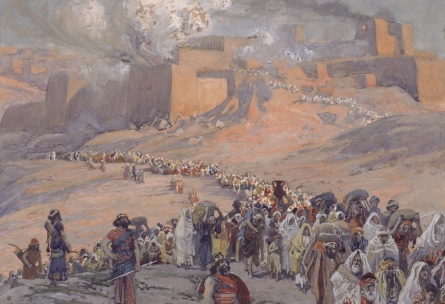
James Tissot, The Flight of the Prisoners

By the rivers of Babylon—there we sat down and there we wept when we remembered Zion. In the willows there we hung up our harps.For there our captors asked us for songs, and our tormentors asked for mirth, saying,

“Sing us one of the songs of Zion!”

How could we sing the Lord’s song in a foreign land? If I forget you, O Jerusalem, let my right hand wither! Let my tongue cling to the roof of my mouth, if I do not remember you,if I do not set Jerusalem above my highest joy. 

Remember, O Lord, against the Edomites the day of Jerusalem’s fall, how they said,

 “Tear it down! Tear it down! Down to its foundations!”

O daughter of Babylon, you devastator! Happy shall they be who pay you back what you have done to us! Happy shall they be who take your little ones and dash them against the rock!   Psalm 137 NRSV

In 721 BCE, after roughly 200 years of separation from the Southern Kingdom of Judah, the Northern Kingdom Israel falls to the Assyrian Empire (which has its origins in the Northwestern Part of modern day Iraq) and the Northern Kingdom is effectively absorbed into the Assyrian nation.  Somehow Judah holds on, even though it becomes completely surrounded by the Assyrian Empire.  Empires come and go, and power shifts to the Babylonian Empire (which has its origins in modern day Southern Iraq) without going into the bloody details: Jerusalem falls, the temple is destroyed, the Davidic monarchy effectively ends and the people of Judah are taken into exile or captivity in Babylon.  The loss of king and temple, as well as the land cause a crisis of authority which leads to one of the most constructive and important periods in Judaism.

The loss of home is catastrophic, it leads to a ton of questions about the future and there may not be any good answers at that point.  The closest cinematic example I could come up with was the loss of Anatevka in Fiddler on the Roof where families try to make the best of their coming exile, belittling what they are leaving behind-and yet families are broken apart, scattered across the world, many will never see each other again.

Something as catastrophic to not only the physical well-being but also to the communal consciousness can lead to several outcomes, many of which do emerge in this time. One response of the conquered is to assimilate with the conqueror, to align oneself with the victor, to adopt their values and practices and to set aside at least a portion of one’s previous identity to become a part of something different.  This is the perceived response of the Northern Kingdom by the Southern Kingdom-they stay on their land, intermarry with the Assyrians, and what emerges will be a hybrid people-no longer really Jewish, already separated from the Davidic monarchy and the temple hundreds of years before they become the other…the Samaritan (yes this is where those Samaritans that Jesus runs into in the New Testament come from).  But to be fair, a large number of the Judeans also assimilate into Babylon, only a small portion of the Judean people will return to their homeland at the end of the exile, most will remain dispersed throughout the nations.

In the lead up to the exile, the prophetic voice becomes very harsh in its critique of the monarchy, temple, the lack of economic justice within the nation, and the perceived idolatry of the shepherds of the nation.  This is the time where the first parts of Isaiah, much of Jeremiah and Ezekiel and many of the Minor Prophets become active in the memory of the people. The prophetic voice leads the way pointing to the ways in which kings and priests, throne and temple have not only failed as sources of authority but are at the very heart of the crisis viewed as a judgment from the LORD.  The prophets announce condemnation for the shepherds (the leaders, the authority in throne and temple) as one example among many:

The word of the Lord came to me: Mortal, prophesy against the shepherds of Israel: prophesy, and say to them—to the shepherds: Thus says the Lord God: Ah, you shepherds of Israel who have been feeding yourselves! Should not the shepherds feed the sheep? You eat the fat, you clothe yourselves with the wool, you slaughter the fatlings: but you do not feed the sheep. You have not strengthened the weak, you have not healed the sick, you have not brought back the strayed, you have not sought the lost, but with force and harshness you ruled them.  So they were scattered, because there was no shepherd: and scattered wandered over all the mountains and on every high hill; my sheep were scattered over the face of the earth, with no one to search or seek for them. Ezekiel 34.1-6 NRSV

 Instead of coming to believe that somehow their God is weaker than the gods of the Assyrians or the Babylonians, something amazing happens in the prophetic imagination (to use Walter Brueggemann’s keen words) and they begin to understand the transitions and the conflict around them as a part of God’s work—that behind Assyrian and Babylonian is the Lord of hosts (literally the Lord of armies-typically we think of this as heavenly armies, but I am beginning to think that in there is something more earthly to this term than often given credit). The coming destruction is a judgment particularly on the leaders, but also within all this death is the chance for something new: a fresh start, a redefinition, a chance to redefine and re-imagine what it means to be the chosen people.

The hand of the Lord came upon me, and he brought me out by the spirit of the Lord and set me down in the middle of the valley; it was full of bones.  He led me around them; there were very many lying in the valley, and they were very dry.  He said to me, “Mortal, can these bones live?” I answered, “O Lord God, you know.” Then he said to me, “Prophecy to these bones, and say to them: O dry bones, hear the word of the Lord. Thus says the Lord God to these bones: I will cause breath to enter you, and you shall live. I will lay sinews on you, and will cause flesh to come upon you, and cover you with skin, and put breath in you, and you shall live; and you shall know that I am the Lord. Ezekiel 37.1-6 NRSV

The prophetic voice will help the people re-imagine a new way forward, a way that is so critical to the way we understand things that we need to take some time with it.  Hope will not die, in fact it will be reborn in a new and powerful way and the people will understand themselves as a chosen people, but what that means takes a dramatic turn in the exile.  To that we shall turn next.

purple rose 01 by picsofflowers.blogspot.com