Tag Archives: Aram

2 Kings 16 King Ahaz and the Syro-Ephraimite War

Charles-Antoine Bridan, Relief on the Wall of Notre Dame Cathedral in Chartres (1786-1789) Isaiah speaking to King Ahaz

2 Kings 16

 1In the seventeenth year of Pekah son of Remaliah, King Ahaz son of Jotham of Judah began to reign. 2Ahaz was twenty years old when he began to reign; he reigned sixteen years in Jerusalem. He did not do what was right in the sight of the LORD his God, as his ancestor David had done, 3but he walked in the way of the kings of Israel. He even made his son pass through fire, according to the abominable practices of the nations whom the LORD had driven out before the people of Israel. 4He sacrificed and made offerings on the high places, on the hills, and under every green tree.
  5
Then King Rezin of Aram and King Pekah son of Remaliah of Israel came up to wage war on Jerusalem; they besieged Ahaz but could not conquer him. 6At that time King Rezin of Aram recovered Elath for Edom and drove the Judeans from Elath, and the Edomites came to Elath, where they live to this day. 7Ahaz sent messengers to King Tiglath-pileser of Assyria, saying, “I am your servant and your son. Come up and rescue me from the hand of the king of Aram and from the hand of the king of Israel, who are attacking me.” 8Ahaz also took the silver and gold found in the house of the Lord and in the treasures of the king’s house and sent a present to the king of Assyria. 9The king of Assyria listened to him; the king of Assyria marched up against Damascus and took it, carrying its people captive to Kir; then he killed Rezin.
  10
When King Ahaz went to Damascus to meet King Tiglath-pileser of Assyria, he saw the altar that was at Damascus. King Ahaz sent to the priest Uriah a model of the altar and its pattern exact in all its details. 11The priest Uriah built the altar; in accordance with all that King Ahaz had sent from Damascus, so did the priest Uriah build it, before King Ahaz arrived from Damascus. 12When the king came from Damascus, the king viewed the altar. Then the king drew near to the altar, went up on it, 13and offered his burnt offering and his grain offering, poured his drink offering, and dashed the blood of his offerings of well-being against the altar. 14The bronze altar that was before the LORD he removed from the front of the house, from the place between his altar and the house of the LORD, and put it on the north side of his altar. 15King Ahaz commanded the priest Uriah, saying, “Upon the great altar offer the morning burnt offering and the evening grain offering and the king’s burnt offering and his grain offering, with the burnt offering of all the people of the land, their grain offering, and their drink offering; then dash against it all the blood of the burnt offering and all the blood of the sacrifice, but the bronze altar shall be for me to inquire by.” 16The priest Uriah did everything that King Ahaz commanded.
  17
Then King Ahaz cut off the frames of the stands and removed the laver from them; he removed the sea from the bronze oxen that were under it and put it on a pediment of stone. 18The covered portal for use on the Sabbath that had been built inside the palace and the outer entrance for the king he removed from the house of the Lord. He did this because of the king of Assyria. 19Now the rest of the acts of Ahaz that he did, are they not written in the Book of the Annals of the Kings of Judah? 20Ahaz slept with his ancestors and was buried with his ancestors in the city of David; his son Hezekiah succeeded him.

King Ahaz son of Jotham bears the same name as Jehoahaz son of Josiah (Ahaz is the shortened form of the name) but unlike the recent kings of Judah he receives a judgment by the narrator which is harsher than any other king in Judah or Israel. King Ahaz reigns at a critical juncture in the story of Judah and Israel and the surrounding region and the prophet Isaiah provides an additional witness to this time of conflict known as the Syro-Ephraimite War by historians. 2 Kings 16 and its parallel in 2 Chronicles 28, which is even harsher in its evaluation of Ahaz, point to an unfaithful king who is spared only by God’s continuing faithfulness to the line of David.

The theological judgment of King Ahaz in both 2 Kings and 2 Chronicles contrasts with the qualified faithfulness of his ancestors with the idolatrous practices of his reign. The reference to walking in the ways of the kings of Israel may refer to the crafting of new images to worship like the frequently mentioned sins of Jeroboam (1 Kings 12: 25-33) and 2 Chronicles 28:2 indicates that Ahaz cast images of the Baals. Also indicated in both 2 Kings and 2 Chronicles is passing his sons through fire, imagery associated with the worship of Molech the god of the Ammonites in the bible. Passing a child through fire (presumably sacrificing the child to a god) is prohibited in Deuteronomy 18:10. Many scholars have hypothesized that “Ahaz sacrificed his first-born during the pressing hours of the siege of Jerusalem by the Syro-Ephraimite armies, as Mesha, king of Moab, had once done under similar circumstances” (Cogan, 1988, p. 186) (see 2 Kings 3:27 for Mesha, king of Moab) but this can only be hypothesized and 2 Chronicles indicates that one of the king’s sons is captured in the conflict. 2 Chronicles also heightens the depravity of Ahaz by indicating that “he sacrificed and made offerings on the high places, on the hills, and under every green tree.” (2 Chronicles 28:4) From the theological perspective of both 2 Kings and 2 Chronicles King Ahaz has a disastrous impact upon Judah, and Judah’s defeats are directly attributed to his apostacy in 2 Chronicles.

The prophet Isaiah points to the intent of the Syro-Ephraimite war at the beginning of Isaiah 7:

1In the days of Ahaz son of Jotham son of Uzziah, king of Judah, King Rezin of Aram and King Pekah son of Remaliah of Israel went up to attack Jerusalem but could not conquer it. 2When the house of David heard that Aram had allied itself with Ephraim, the heart of Ahaz and the heart of his people shook as the trees of the forest shake before the wind.
3
Then the LORD said to Isaiah, “Go out to meet Ahaz, you and your son Shear-jashub, at the end of the conduit of the upper pool on the highway to the fuller’s field, 4and say to him: Take heed, be quiet, do not fear, and do not let your heart be faint because of these two smoldering stumps of firebrands, because of the fierce anger of Rezin and Aram and the son of Remaliah. 5Because Aram—with Ephraim and the son of Remaliah—has plotted evil against you, saying, 6Let us go up against Judah and terrify it and conquer it for ourselves and make the son of Tabeel king in it’ (Isaiah 7:1-6)

Isaiah is sent to King Ahaz to provide him reassurance that God is not going to allow the forces of Aram and Israel to remove him and put another more compliant ruler in his place. This is the background of Isaiah’s famous Immanuel prophecy: “Therefore the Lord himself will give you a sign. Look, the young woman is with child and shall bear a son and shall name him Immanuel.” (Isaiah 7:14) Within the original context of this time of King Ahaz the message of hope from Isaiah was that within two years the threat of Israel and Aram would be eliminated, but this section of Isaiah also had an important voice in later Jewish messianic hope and Christianity. Isaiah encourages Ahaz not to fear and to stand firm in faith, ultimately Ahaz chooses a different path that both 2 Kings and 2 Chronicles point to.

The Syro-Ephraimite War (736-732 BCE) was the result of a shifting power dynamic in the region. The Assyrian forces under Tiglath-Pileser III have become a dominant force in the region and Aram and Israel are attempting to build a coalition to resist this rising threat. In this regional struggle for power Judah stands unaligned as Aram, Israel, Philistia, and Edom attempt to both seize power in Judah and promote a regime change that will bring Judah into this alliance against Assyria. 2 Chronicles narrates a catastrophic defeat of Judah. As Alex Israel summarizes:

The battle statistic reinforce the magnitude and severity of the attack: 120,000 casualties in a single day of fighting, 200,000 Judahite women and children captured as prisoners of war, and the king’s son as well as other key governmental officials among the dead. (Israel, 2019, p. 244)

Ahaz is caught between forces coming from multiple directions. Israel and Aram have frequently been against Judah in recent history. Judah loses control of Elath, under Judah’s control since the time of Uzziah/Azariah and is clearly unable to manage conflict on multiple military fronts.  Ahaz may have already failed the theological evaluation of 2 Kings, but he makes a fateful choice in his military vulnerability. King Ahaz sends tribute to King Tiglath-Pileser III of Assyria.

Although 2 Chronicles states that Assyria refuses to help Judah, 2 Kings gives the impression that Assyria was eager to take advantage of the situation. Alex Israel summarizes again:

One imagines that Assyria is only too happy to accept the offer. They are securing an ally, a foothold, in the sought-after region, and undermining the enemy coalition. (Israel, 2019, p. 245)

While Aram and Israel attack Judah, Assyria attacks and conquers Damascus, the capital of Aram taking Aram out of the fight.

King Ahaz remains in power as a vassal of Assyria and the chapter concludes with Ahaz traveling to Damascus to pay tribute to Tiglath-Pileser III. Abraham Heschel in his work The Prophets indicates that for Assyria, “Political subservience involved acceptance of her religious institutions.” (Heschel, 1962, p. 72) and this may form a part of Ahaz’s adoption of this design for a new altar. Yet, the priest Uriah is assumed to be a supporter of the prophet Isaiah (Isaiah 8:2) and one would assume faithful to the LORD the God of Israel so his immediate compliance with the king on this altar has led some interpreters to wonder if the new altar was not idolatrous, but merely offensive because it displaced Solomon’s original altar described in 1 Kings 8:64. The stands, lavers, the bronze oxen, and the covered portal may have been removed and melted down as payment to Assyria, but bronze was not a highly valuable metal at the time so that is not certain. 2 Kings indicates these changes were made because of the king of Assyria, but why the king of Assyria desired these changes is uncertain. Interpreters are divided about Ahaz’s intent and the role of Uriah the priest in these changes in the temple, but for the narrator of 2 Kings the time of Ahaz has been a disaster for the faithfulness of the people of Judah and for the welfare of the nation.

2 Kings 14 King Amaziah of Judah and King Jehoash and Jeroboam II of Israel

Stele of Adad-nirari III from Tell al-Rimah, now in the Iraq Museum, mentions the name of Jehoash the Samarian

2 Kings 14: 1-22

1In the second year of King Joash son of Joahaz of Israel, King Amaziah son of Joash of Judah began to reign. 2He was twenty-five years old when he began to reign, and he reigned twenty-nine years in Jerusalem. His mother’s name was Jehoaddin of Jerusalem. 3He did what was right in the sight of the LORD, yet not like his ancestor David; in all things he did as his father Joash had done. 4But the high places were not removed; the people still sacrificed and made offerings on the high places. 5As soon as the royal power was firmly in his hand, he killed his servants who had murdered his father the king. 6But he did not put to death the children of the murderers, according to what is written in the book of the law of Moses, where the Lord commanded, “The parents shall not be put to death for the children or the children be put to death for the parents, but all shall be put to death for their own sins.”
  7
He killed ten thousand Edomites in the Valley of Salt and took Sela by storm; he called it Jokthe-el, which is its name to this day.
  8
Then Amaziah sent messengers to King Jehoash son of Jehoahaz son of Jehu of Israel, saying, “Come, let us look one another in the face.” 9King Jehoash of Israel sent word to King Amaziah of Judah, “A thornbush on Lebanon sent to a cedar on Lebanon, saying, ‘Give your daughter to my son for a wife,’ but a wild animal of Lebanon passed by and trampled down the thornbush. 10You have indeed defeated Edom, and your heart has lifted you up. Be content with your glory and stay at home, for why should you provoke trouble so that you fall, you and Judah with you?”
  11
But Amaziah would not listen. So King Jehoash of Israel went up; he and King Amaziah of Judah faced one another in battle at Beth-shemesh, which belongs to Judah. 12Judah was defeated by Israel; everyone fled home. 13King Jehoash of Israel captured King Amaziah of Judah son of Jehoash son of Ahaziah at Beth-shemesh; he came to Jerusalem and broke down the wall of Jerusalem from the Ephraim Gate to the Corner Gate, a distance of four hundred cubits. 14He seized all the gold and silver and all the vessels that were found in the house of the LORD and in the treasuries of the king’s house, as well as hostages; then he returned to Samaria.
  15
Now the rest of the acts that Jehoash did, his might, and how he fought with King Amaziah of Judah, are they not written in the Book of the Annals of the Kings of Israel? 16Jehoash slept with his ancestors and was buried in Samaria with the kings of Israel; then his son Jeroboam succeeded him.
  17
King Amaziah son of Joash of Judah lived fifteen years after the death of King Jehoash son of Jehoahaz of Israel. 18Now the rest of the deeds of Amaziah, are they not written in the Book of the Annals of the Kings of Judah? 19They made a conspiracy against him in Jerusalem, and he fled to Lachish. But they sent after him to Lachish and killed him there. 20They brought him on horses; he was buried in Jerusalem with his ancestors in the city of David. 21All the people of Judah took Azariah, who was sixteen years old, and made him king to succeed his father Amaziah. 22He rebuilt Elath and restored it to Judah, after King Amaziah slept with his ancestors.

This is a fascinating passage that looks at the paradox of King Amaziah’s twenty-nine-year reign and highlights some of the ways that most biblical scholars struggle with the competing desires of the theological perspective of the text and the expectation of kings in the ancient world. Walter Brueggemann, a well-respected and highly published biblical scholar, highlights this for me when he states, “What strikes one most is that the reign of Amaziah is dominated by acts of violence.” (Brueggemann, 2000, p. 439) The text does highlight three instances of conflict in Amaziah’s almost three decade long reign, and there is an internal conflict within the theological perspective of the narrator of 2 Kings. On the one hand, from the very beginning of Israel having kings, these kings were warriors who led the people in conflict. The Old Testament may want a king to trust primarily in God, and military victories are primarily a sign of the LORD the God of Israel’s deliverance and not the military prowess of the king and their military leaders, and yet it shares a view with the majority of the ancient world that the primary role of a king was to expand their territory and wealth through the exercise of their power. Susan Kay Penman, a historical fiction author, shares some of this idea in writing about her perspective on Richard the Lionheart in the comments at the end of her historical fiction retelling Lionheart:

War was the vocation of kings in the Middle Ages, and, at that, Richard excelled; he was almost invincible in hand-to-hand combat, and military historians consider him one of the best medieval generals. It was in the Holy Land that the Lionheart legend took root, and his bravura exploits won him a permanent place in the pantheon of semimythic heroes, those men whose fame transcended their own time. Even people with little knowledge of history have heard of Caesar, Alexander, Napolean—and Richard Lionheart. This would have pleased Richard greatly, for he was a shrewd manipulator of his public image. (Penman, 2013, p. 582)

Even though there are many differences between the Middle Ages and the late Iron Age where Amaziah reigns, the ancient world expected kings to accumulate wealth primarily through gaining land and resources. There is an important caveat in the narration of the stories of the kings of Israel and Judah in 1&2 Kings which evaluates these kings by their faithfulness to the worship of the LORD the God of Israel.

The evaluation of King Amaziah in the beginning of the text is a positive one with the caveat that the high places were not removed. King Amaziah, like his father Joash in 2 Kings, is faithful to the LORD and we even see him conducting justice in the framework of Deuteronomy. 2 Kings explicitly references Deuteronomy 24:16 to justify the king’s decision not to put to death the family of the men who assassinated his father. From the Deuteronomic theology which forms the perspective of the narrator of 2 Kings Amaziah is a faithful king who worships God and practices judgment according to the law.

From a military perspective King Amaziah starts out well by winning a significant victory over Edom and expanding the territory of Judah by adding the city Sela, which is renamed Jokthe-el. Yet, Amaziah makes a critical error in engaging King Jehoash of Israel in battle. The NIV translates verse eight in a way that indicates the antagonistic intent of Amaziah, “with the challenge: “Come, meet me face to face.” Northern Israel is larger and more populous and has been continually engaged with Aram throughout this time. Amaziah may see his role as recapturing Israel and reuniting the entire kingdom under Davidic rule, but he also misreads the situation. The threat to northern Israel from Aram has diminished with the rise of the Assyrian empire which provides a moment of relative peace for Samaria. Jehoash may understand the broader implications of the struggle for power to his north and his parable indicates that war between the two parties is not wise because there is a third party (perhaps Aram of Assyria) who can trample down Judah the insignificant thornbush next to the cedar of Israel. There is an obvious warning but also condescending tone to Jehoash’s answer to Amaziah and Amaziah marches out but is defeated before he even leaves the boundary of Judah. Even though 2 Kings does not include Amaziah’s defeat in its overall evaluation of his reign the inclusion of this narrative paints the king in a negative light. Amaziah’s ambition not only results in his defeat and capture but also in the destruction of a six-hundred-foot section of Jerusalem’s northern wall, a humiliation for the city and the king. In addition, Samaria seizes the wealth of Judah stored in the king’s household and the temple. The royal and temple treasuries have been emptied in a humiliating manner under consecutive Davidic kings.

It is unclear how long Amaziah remains captive, but he continues to reign fifteen years after the death of Jehoash who captured him. Yet, his reign ends with a coup that causes him to flee to Lachish where he is captured, killed, and returned to Jerusalem to be buried with his ancestors. He may receive the honor of being buried in Jerusalem but his time as the king of Judah ends in disaster. His reign is the sole example of a time when Israel will penetrate the walls of Jerusalem and take a Davidic king captive. Even with the early mention of Amaziah’s faithfulness there is no mention of the LORD throughout the narration of his conflicts and as Brueggemann can correctly indicate, “Amaziah, heir of David, may be a prize example of Nathan’s verdict on the dynasty in 2 Samuel 12:10, “The sword will never depart from your house.” (Brueggemann, 2000, p. 446) Amaziah may have passed the theological perspective of 2 Kings but 2 Kings also narrates the events of an reign that is unsuccessful in conflict and ends with the king running for his life and ultimately killed by his own people.

2 Kings 14: 23-29

  23In the fifteenth year of King Amaziah son of Joash of Judah, King Jeroboam son of Joash of Israel began to reign in Samaria; he reigned forty-one years. 24He did what was evil in the sight of the LORD; he did not depart from all the sins of Jeroboam son of Nebat that he caused Israel to sin. 25He restored the border of Israel from Lebo-hamath as far as the Sea of the Arabah, according to the word of the LORD, the God of Israel, which he spoke by his servant Jonah son of Amittai, the prophet who was from Gath-hepher. 26For the LORD saw that the distress of Israel was very bitter; there was no one left, bond or free, and no one to help Israel. 27But the LORD had not said that he would blot out the name of Israel from under heaven, so he saved them by the hand of Jeroboam son of Joash.
  28
Now the rest of the acts of Jeroboam and all that he did, and his might, how he fought, and how he recovered for Israel Damascus and Hamath, which had belonged to Judah, are they not written in the Book of the Annals of the Kings of Israel? 29Jeroboam slept with his ancestors, the kings of Israel; his son Zechariah succeeded him.

In contrast to Amaziah of Judah, Jeroboam II of Samaria is a king who fails in the theological evaluation of the narrator of 2 Kings but succeeds militarily. Jeroboam II, like his unrelated namesake Jeroboam I (1 Kings 12) maintains the northern shrines in Dan and Bethel (the sin of Jeroboam) but the LORD the God of Israel sends word by the prophet Jonah son of Amittai which allows Jeroboam II to recapture the boundaries of Israel under David and Solomon.

Jeroboam’s military success which allows his recovery of territories lost to Aram takes place within the geopolitical events of the region. As Alex Israel states,

Jeroboam son of Joash of the northern kingdom takes full advantage of a regional power vacuum. Aram, Israel’s prime enemy of the past decades, has waned, while the Assyrian empire has yet to extend its reach westward. Jeroboam restores and expands the norther border beyond Damascus, to Hamath, establishing Israel’s hegemony to the border in place during King Solomon’s heyday. (Israel, 2019, p. 222)

From the theological perspective of 2 Kings, it is the LORD the God of Israel who is behind these movements as testified by the positive words of the prophet Jonah and the tangible success of Jeroboam. The LORD saw the distress of Israel and utilizes Jeroboam II as the means of deliverance in the view of 2 Kings.

It is also worth noting that there is another prophetic voice other than Jonah son of Amittai that speaks of the time of Jeroboam II. As the book of Amos records,

The words of Amos, who was among the shepherds of Tekoa, which he saw concerning Israel in the days of King Uzziah of Judah and in the days of King Jeroboam son of Joash of Israel, two years before the earthquake. Amos 1:1

Alex Israel correctly categorizes the witness of Amos when he states it, “depicts a society of wealth, complacency, and security, and yet it bears startling inequalities of income and outrageous exploitation of the poor by the rich.” (Israel, 2019, p. 222) Jeroboam II success may be due to the action of the LORD the God of Israel but that success does not mean that Jeroboam II will govern according to the intent of the law. We are entering the time where we have the words of the prophets written into the scriptures and this gives us a second witness about the time of these kings as the story of the Northern Kingdom nears its conclusion.

2 Kings 13 The Death of Elisha, The Reigns of Jehoahaz and Jehoash of Israel, and the Conflict with Aram

The miracle at the grave of Elisha. (Jan Nagel, 1596)

2 Kings 13:1-13 The Reign of Jehoahaz and Jehoash (Joash) of Israel

 1In the twenty-third year of King Joash son of Ahaziah of Judah, Jehoahaz son of Jehu began to reign over Israel in Samaria; he reigned seventeen years. 2He did what was evil in the sight of the LORD and followed the sins of Jeroboam son of Nebat that he caused Israel to sin; he did not depart from them. 3The anger of the LORD was kindled against Israel, so he gave them repeatedly into the hand of King Hazael of Aram, then into the hand of Ben-hadad son of Hazael. 4But Jehoahaz entreated the LORD, and the LORD heeded him, for he saw the oppression of Israel, how the king of Aram oppressed them. 5Therefore the LORD gave Israel a savior, so they escaped from the hand of the Arameans, and the people of Israel lived in their homes as formerly. 6Nevertheless, they did not depart from the sins of the house of Jeroboam that he caused Israel to sin but walked in them; the sacred pole also remained in Samaria. 7So Jehoahaz was left with an army of not more than fifty horsemen, ten chariots, and ten thousand footmen, for the king of Aram had destroyed them and made them like the dust at threshing. 8Now the rest of the acts of Jehoahaz and all that he did, including his might, are they not written in the Book of the Annals of the Kings of Israel? 9So Jehoahaz slept with his ancestors, and they buried him in Samaria; then his son Joash succeeded him.
  10In the thirty-seventh year of King Joash of Judah, Jehoash son of Jehoahaz began to reign over Israel in Samaria; he reigned sixteen years. 11He also did what was evil in the sight of the LORD; he did not depart from all the sins of Jeroboam son of Nebat that he caused Israel to sin, but he walked in them. 12Now the rest of the acts of Joash and all that he did, as well as the might with which he fought against King Amaziah of Judah, are they not written in the Book of the Annals of the Kings of Israel? 13So Joash slept with his ancestors, and Jeroboam sat upon his throne; Joash was buried in Samaria with the kings of Israel.

One of the struggles many readers of 2 Kings have in this, and the surrounding chapters is that the names are often reused by different leaders. In this chapter alone we have a King Jehoash/Joash of both Judah and Israel as well as King Hazael naming his son Ben-hadad, the name of the king he murdered in Aram. It is also worth noting briefly that the math for the time period of the reigns of these two kings in Samaria do not add up: If Jehoahaz begins his reign in the twenty-third year of King Joash of Judah and his son King Jehoash begins his reign in the thirty-seventh year of King Joash of Judah he would reign fourteen years, not seventeen as indicated by 2 Kings. There can be reasons, like a co-regency for three years, that can cause the math to work out. I’m not going to dwell on this because it is ultimately not the focus of the narrative, but it is worth noting.

Jehoahaz and Jehoash of Samaria are descendants of Jehu who in his bloody revolution wiped out the worship of Baal in Samaria but, in the view of 2 Kings, Jehu and his descendants did not go far enough to return Northern Israel to the right worship of God. The sins of Jeroboam son of Nebat are the golden calves which the first king of Northern Israel placed in shrines at Bethel and Dan (1 Kings 12: 25-33) to represent the God of Israel and to prevent the people of Northern Israel from returning to Jerusalem to worship in Solomon’s temple. There is also an Asherah (NRSVue sacred pole) in Samaria. The term refers both to the goddess Asherah and the sacred pole utilized in her worship. These worship sites and practices anger the God of Israel and are a cause for the continued victories of Aram over the kings of Israel in the view of the narrator.

Hazael and later his son Ben-hadad of Aram continue to gain territory from Israel and to humiliate the kings of Israel militarily. King Jehoahaz being left with an army of fifty horsemen, ten chariots, and ten thousand footman points to an army whose maneuver units (horsemen and chariots) have been decimated. Ten thousand footmen is a significant force, but they are vulnerable to the much faster moving horse mounted or pulled forces. Likely this transformed the army of Jehoahaz into a defensive force rather than one that has the speed and maneuverability to be an effective raiding and attacking force. Yet, Israel was never to be a military power and Jehoahaz finally appeals to the LORD from the oppression of the people and the LORD hears.

The narration of this flow where the kings did what was evil in the sight of the LORD causing the LORD to be angry with the people but then crying out to the LORD and the LORD providing deliverance is the basic pattern of the book of Judges. Here King Jehoahaz entreats the LORD, the LORD sees the oppression of the people and sends a deliverer/savior. Yet, this narration is unusual because it never identifies the deliverer. As Choon-Leong Seow can state:

Whereas the “savior” is typically named in the analogous depictions from Israel’s early history (it was typically the next ruler), however, he is not explicitly identified here (v.5). Scholars have variously suggested that the allusion is to a third-party aggressor whose pressure on the Arameans brought a reprieve for Israel (such as the Assyrian king Adad-nirari III or even Zakkur of Hamath), another Israelite king like Joash or Jeroboam (II), or Elisha. (NIB III: 236)

Although there are geopolitical events, like the rise of Assyria, which weaken the Arameans I do think that the likely candidates for the text are King Jehoash or the Prophet Elisha (see below) since Jehoash will recapture the land lost to the Arameans after his meeting with the dying Elisha.

2 Kings 13: 14-20 The Death of Elisha

  14Now when Elisha had fallen sick with the illness of which he was to die, King Joash of Israel went down to him and wept before him, crying, “My father, my father! The chariots of Israel and its horsemen!” 15Elisha said to him, “Take a bow and arrows,” so he took a bow and arrows. 16Then he said to the king of Israel, “Draw the bow,” and he drew it. Elisha laid his hands on the king’s hands. 17Then he said, “Open the window eastward,” and he opened it. Elisha said, “Shoot,” and he shot. Then he said, “The LORD’s arrow of victory, the arrow of victory over Aram! For you shall fight the Arameans in Aphek until you have made an end of them.” 18He continued, “Take the arrows,” and he took them. He said to the king of Israel, “Strike the ground with them”; he struck three times and stopped. 19Then the man of God was angry with him and said, “You should have struck five or six times; then you would have struck down Aram until you had made an end of it, but now you will strike down Aram only three times.”
  20
So Elisha died, and they buried him. Now bands of Moabites used to invade the land in the spring of the year. 21As a man was being buried, a marauding band was seen and the man was thrown into the grave of Elisha; as soon as the man touched the bones of Elisha, he came to life and stood on his feet.

Elisha’s approximately fifty-year ministry comes to an end as he nears his death, yet the text records two final miraculous actions to the prophet. The first involves the deliverance of Israel from its oppression under the Arameans. King Joash/Jehoash of Israel comes to the prophet’s deathbed mourning. It is conceivable that the king has come to seek the prophet’s guidance as he marches to war with Aram. As Mordechai Cogan and Hayim Tadmor note,

Prophets were regularly consulted prior to the departure of the army to battle (cf. e.g. 1 Kgs 22); Elisha even accompanied Jehoram on the Moabite campaign (see above 3:11) Might not Joash have sought the advice of the dying Elisha, just as Israel was setting off to attack Aram? (Cogan, 1988, p. 150)

It is also worth noting that Elisha has been a thorn in the Aramean side before by informing the king of Israel where the Aramean forces would be. (2 Kings 6: 8-23) For the narrator of 2 Kings prophets often have more power than kings to deliver the people.

The phrase, “The chariots of Israel and its horsemen!” first appeared at the ascension of Elijah into heaven and its presence here may link Elisha with his famous predecessor. It appears visually in 2 Kings 6: 8-23 when the eyes of the servant of Elisha is opened to see the horses and chariots of fire which surrounded and protected Elisha and the sons of the prophets. Yet here it may also allude to the reality that Israel no longer has horsemen and chariots after their humiliation by the Arameans. Elisha’s presence may be the necessary replacement for the military inadequacy of King Joash/Jehoash of Israel’s forces and now the prophet is on his deathbed.

Elisha does two sign acts with a bow and arrow.[1] First an arrow is drawn and shot out the east facing window which becomes the LORD’s arrow of victory over Aram. Then the king is instructed to take the arrows and strike the ground with them. The prophet is angered that the king only strikes the ground three times which portends three victories over Aram rather than five or six which would have eliminated Aram as a threat, yet in the text the instructions of the prophet do not indicate the expectation of striking the ground multiple times. Yet, the ways of prophets are often inscrutable to those who seek their counsel and the words of the prophet give immediate hope to a beleaguered people and their king.

After Elisha dies and is buried we hear of another conflict involving the Moabites. This may be a story from a later time, but it also may occur in the continued conflict between Aram and Israel where Moabites take advantage of the instability to raid. Ultimately the conflict is not the primary point of the narrative. Rather, the continuing power of the prophet Elisha is whose bones are enough to bring a dead man back to life are the focal point of the story. Elisha had once brought the son of the Shunammite woman back to life and now even in death his bones continue to bring life in a time of death.

2 Kings 13: 22-25 The Conflict Between Israel and Aram

  22 Now King Hazael of Aram oppressed Israel all the days of Jehoahaz. 23 But the LORD was gracious to them and had compassion on them; he turned toward them because of his covenant with Abraham, Isaac, and Jacob and would not destroy them, nor has he banished them from his presence until now.
  24 When King Hazael of Aram died, his son Ben-hadad succeeded him. 25 Then Jehoash son of Jehoahaz took again from Ben-hadad son of Hazael the towns that he had taken from his father Jehoahaz in war. Three times Joash defeated him and recovered the towns of Israel.

The narrator of 2 Kings views the occurrences in the story of Israel and Judah through a theological lens where the LORD the God of Israel is responsible for both the good and the bad that occurs to the people. Even with the actions of Israel that cause the LORD to be angry the LORD still responds to their entreaties in a gracious manner because of the promises made to Abraham, Isaac, and Jacob. The combination of the story of Elisha’s action with the defeat of Aram by Jehoash son of Jehoahaz illustrate the faithfulness and patience of God with the people. Yet, the narrator of 2 Kings knows that this patience of God will not last forever, and the story is told from the perspective of the exile of Northern Israel by Assyria and Judah by Babylon, hence the ominous “until now” in verse 23.

From a historical perspective this is a time where the Aramean threat is tempered by the rise of Assyria. Northern Israel is still a militarily vulnerable kingdom whose practices continue to, from the perspective of 2 Kings, anger the LORD their God. The prophet Elisha who had been a deliverer of the people in many times is now dead and the promised four generations of Jehu on the throne in Samaria has now halfway to its completion. There are storms brewing to the north of Israel and within the kingdom of Samaria that will break forth in the coming years and chapters.


[1] In Ezekiel 21:21 shaking arrows is used by the Babylonians as a means of divination, but with the prophets of Israel and Judah these are sign acts which enhance the prophet’s words.

2 Kings 8 Transitioning from Prophetic Time to a Major Transition in Royal Time

Ivory carving found at Arslan Tash, Syria. A cache of ivories found at the Assyrian outpost of Arslan Tash was undoubtedly booty taken from Hazael’s palace in Damascus. The regal figure depicted on this piece is probably Hazael himself. (Louvre Museum, Paris)

2 Kings 8: 1-6 

1Now Elisha had said to the woman whose son he had restored to life, “Get up and go with your household and settle wherever you can, for the LORD has called for a famine, and it will come on the land for seven years.” 2So the woman got up and did according to the word of the man of God; she went with her household and settled in the land of the Philistines seven years. 3At the end of the seven years, when the woman returned from the land of the Philistines, she set out to appeal to the king for her house and her land. 4Now the king was talking with Gehazi the servant of the man of God, saying, “Tell me all the great things that Elisha has done.” 5While he was telling the king how Elisha had restored a dead person to life, the woman whose son he had restored to life appealed to the king for her house and her land. Gehazi said, “My lord king, here is the woman, and here is her son whom Elisha restored to life.” 6When the king questioned the woman, she told him. So the king appointed an official for her, saying, “Restore all that was hers, together with all the revenue of the fields from the day that she left the land until now.”

Elisha continues to provide for this woman who showed him hospitality and warns her and her child to flee the coming famine. The husband is not mentioned and is likely dead at this point in their story and this woman acts as a head of household. The seven years of famine matches the seven-year cycle of Genesis 41: 25-30 which causes the sons of Israel to seek food in Egypt, but here the famine is far more localized. Seven is a common biblical number of completion or a long time, and so the actual span of the drought may be longer or shorter than this commonly used number to designate a completed time. The woman makes her temporary home in Philistia, roughly 100 miles away, and avoids the impact of the famine. The famine is not explicitly stated as God’s judgment on the Omri dynasty in Samaria and is likely linked to the famine mentioned in the previous chapter during the siege of Samaria, but the famine as a part of God’s judgment against the Omri dynasty can be implied in the story. The stories of the last several chapters which chronicle the works of Elisha probably exist beyond the twelve years of King Jehoram of Judah (even though Jehoram’s reign brackets these stories). The king who is interested in the works of Elisha is the king of Israel, but likely not Jehoram or any other king of the Omri line.

Gehazi reemerges in the story, and this may either precede his affliction with leprosy/skin disease,[1] after some unmentioned healing of his disease, or he may remain afflicted. Whatever his condition he is able to converse with the king of Israel about the acts of Elisha. As he describes Elisha’s raising of the woman’s son, he points to this woman who has come to “cry out” (NRSVue appeal)[2] for the return of her property. The Torah imagines a world where the property of a family would be held by that family in perpetuity, but the narrative of scripture points to a different reality. It is possible that in her absence a relative or even squatters have come in and taken over her land, or that in her absence it became crown land, but this once well-connected woman now comes to appeal for her property. Her connection to Elisha allows her appeal to be heard by this king who is interested in the acts of Elisha, and her “crying out” is heard by the king who appoints an official[3] to restore not only her land but also the revenue from the land in the time of her absence.

2 Kings 8: 7-15

  7Elisha went to Damascus while King Ben-hadad of Aram was ill. When it was told him, “The man of God has come here,” 8the king said to Hazael, “Take a present with you and go to meet the man of God. Inquire of the LORD through him, whether I shall recover from this illness.” 9So Hazael went to meet him, taking a present with him, all kinds of goods of Damascus, forty camel loads. When he entered and stood before him, he said, “Your son King Ben-hadad of Aram has sent me to you, saying, ‘Shall I recover from this illness?’ ” 10Elisha said to him, “Go, say to him, ‘You shall certainly recover,’ but the LORD has shown me that he shall certainly die.” 11He fixed his gaze and stared at him to the point of embarrassment. Then the man of God wept. 12Hazael asked, “Why does my lord weep?” He answered, “Because I know the evil that you will do to the people of Israel; you will set their fortresses on fire; you will kill their young men with the sword, dash in pieces their little ones, and rip up their pregnant women.” 13Hazael said, “What is your servant, who is a mere dog, that he should do this great thing?” Elisha answered, “The LORD has shown me that you are to be king over Aram.” 14Then he left Elisha and went to his master Ben-hadad, who said to him, “What did Elisha say to you?” And he answered, “He told me that you would certainly recover.” 15But the next day he took the bedcover and dipped it in water and spread it over the king’s face, until he died. And Hazael succeeded him.

The prophet Elijah when he was instructed to anoint Elisha to be prophet in his place was also commanded to appoint Hazael as king over Aram and Jehu as king over Israel (1 Kings 19: 15-17). Elijah did call Elisha, but now it is Elisha who is engaged in Hazael’s ascension to power in Damascus. The story is an inversion of the story in 2 Kings 1 where King Ahaziah, king in Samaria, sends to inquire of Baal-zebub, the god of Ekron. While the king of Israel appeals to the god of Ekron, now a foreign king appeals to the prophet of Israel to inquire of the LORD his God. Yet, this inquiry of Ben-hadad sets in motion his demise despite the affirmative answer of the prophet. The prophetic messenger appoints Hazael to do the work that prophets do not do. The involvement of the prophet in both a lie and the politics of a foreign power has caused discomfort for some readers.

In the scriptures God often works through foreign powers, even if these powers are unaware of their participation in God’s action of judgment or deliverance. Hazael, the servant of Ben-hadad approaches the prophet with a large gift for this emissary of the God of Israel, but unlike Naaman’s large gift we never learn the disposition of the forty camel loads of gifts offered to the prophet. Hazael is informed of his role even though the prophet regrets the damage he will do to the people of Israel. Although Elisha gives Hazael the message that the king will recover from the illness, he also sets in motion a chain of events that lead to King Ben-hadad’s death at the hands of his servant. The prophet Amos views Hazael’s ascension as God’s act as well, but as a judgment on Ben-hadad (Amos 1: 3-4) but in Elisha’s view what is important is Hazael’s actions towards Israel. Following the original commissioning of Elijah to set Hazael over Aram and Jehu over Israel, both Aram and Jehu (and Elisha) are the swords that shall kill many. Many modern readers recoil at the violence of the actions attributed to Hazael in the prophet’s words, but war in the ancient world was violent. War of all times is violent, and innocent people often pay a heavy cost but armies in the ancient world did not act with the same restraint that modern militaries do in attempting to limit the destructiveness of the soldiers unleashed to practice violence on the enemy land and people. Hazael acknowledges that the violence the prophet describes would be a “great thing” and his only protest is that he is too insignificant to be able to accomplish this great thing. God has designated Hazael as a part of God’s plan for Israel, but Hazael is a blunt instrument that will incur a lot of damage in the removal of the Omri dynasty.

Elisha may weep for the future that he sees but he remains faithful to God’s vision. The ways of the Omri dynasty have led the people of Israel away to following other gods and unjust practices. Elisha may have wrestled with his role in being a part of the (ultimately) violent solution to the wicked (in the view of 2 Kings) kings of Israel who have now corrupted even the line of kings in Judah (see below). Many of the stories of Elisha have shown him working with individuals and groups in miraculous ways to help them navigate this world of famines and sieges. Yet, the narrative of 2 Kings attempts to understand how God is at work in the collapse of both Israel and Judah working through Aram, Assyria, and Babylon. Hazael, son of a nobody, as a large basalt statue of Shalmaneser refers to him derogatorily, (Cogan, 1988, p. 90) may not be anointed by Elisha in this story, but Elisha gives him the vision that leads to the suffocation of his ailing master and allows the son of a nobody to grasp power in Aram and to become God’s blunt instrument utilized in the judgment of Israel.

2 Kings 8: 16-29

  16In the fifth year of King Joram son of Ahab of Israel, Jehoram son of King Jehoshaphat of Judah began to reign. 17He was thirty-two years old when he became king, and he reigned eight years in Jerusalem. 18He walked in the way of the kings of Israel, as the house of Ahab had done, for the daughter of Ahab was his wife. He did what was evil in the sight of the LORD. 19Yet the LORD would not destroy Judah, for the sake of his servant David, since he had promised to give a lamp to him and to his descendants forever.
  20
In his days Edom revolted against the rule of Judah and set up a king of their own. 21Then Joram crossed over to Zair with all his chariots. He set out by night and attacked the Edomites and their chariot commanders who had surrounded him, but his army fled home. 22So Edom has been in revolt against the rule of Judah to this day. Libnah also revolted at the same time. 23Now the rest of the acts of Joram and all that he did, are they not written in the Book of the Annals of the Kings of Judah? 24So Joram slept with his ancestors and was buried with them in the city of David; his son Ahaziah succeeded him.

  25
In the twelfth year of King Joram son of Ahab of Israel, Ahaziah son of King Jehoram of Judah began to reign. 26Ahaziah was twenty-two years old when he began to reign; he reigned one year in Jerusalem. His mother’s name was Athaliah, a granddaughter of King Omri of Israel. 27He also walked in the way of the house of Ahab, doing what was evil in the sight of the LORD, as the house of Ahab had done, for he was son-in-law to the house of Ahab.
  28
He went with Joram son of Ahab to wage war against King Hazael of Aram at Ramoth-gilead, where the Arameans wounded Joram. 29King Joram returned to be healed in Jezreel of the wounds that the Arameans had inflicted on him at Ramah, when he fought against King Hazael of Aram. King Ahaziah son of Jehoram of Judah went down to see Joram son of Ahab in Jezreel because he was wounded.

The bulk of the first eight chapters of 2 Kings have broken from the typical construction of the story around the reigns of kings and has focused instead on the end of the prophet Elijah’s story and then multiple stories centered on the prophet Elisha. We will return to Elisha for a few final stories, but the narrator of 2 Kings returns us to the timeline of kings, particularly the kings in Judah. The narration of the book of kings has focused almost entirely on the northern kingdom of Samaria or Israel since the reign of Jehoshaphat in Judah in 1 Kings 22: 41-51. In contrast to his father and grandfather who followed the ways of the LORD, Jehoram[4] the new king of Judah follows the ways of the kings of Israel and is allied with these kings by marriage to Athaliah, a sister of king Joram of Israel. Like Jezebel, king Ahab’s wife, Athaliah is viewed as a corrupting influence upon both Jehoram and her son Ahaziah.

2 Chronicles reports a letter from Elijah to Jehoram:

12A letter came to him from the prophet Elijah, saying, “Thus says the LORD, the God of your father David: Because you have not walked in the ways of your father Jehoshaphat or in the ways of King Asa of Judah 13but have walked in the way of the kings of Israel and have led Judah and the inhabitants of Jerusalem into unfaithfulness, as the house of Ahab led Israel into unfaithfulness, and because you also have killed your brothers, members of your father’s house, who were better than you, 14see, the LORD will bring a great plague on your people, your children, your wives, and all your possessions, 15and you yourself will have a severe sickness with a disease of your bowels until your bowels come out, day after day, because of the disease.” 2 Chronicles 21:12-14

Both 2 Chronicles and 2 Kings view the time of Jehoram as a time which corrupted the house of David and jeopardized the enduring line promised to David. God restrains the judgement on these two unfaithful kings of Judah because of God’s loyalty to David, but Judah is in danger of becoming like the north.

Kings in the ancient world[5] are judged by their ability to maintain power and here we see the beginning of a deterioration of Judah’s control of Edom as well as one of its own cities. The narrative sets the infidelity toward the LORD of these two kings of Judah alongside their loss of power over their vassals. Readers can make a judgement about the connection between their inability to project power over their vassals and their unfaithfulness to the LORD (Brueggemann, 2000, p. 375) but the theological perspective of the narrator of 2 Kings would probably view them as connected. Alex Israel suggests that Libnah, as a Levite city, may have been demonstrating against the idolatrous religious orientation of Jehoram (Israel, 2019, p. 159) and while there were likely Levites and other people faithful to the LORD who were distressed about the direction of Judah under Jehoram and Ahaziah it is probably unlikely that one city would simply separate itself from Judah without the intervention of other powers. However, Alex Israel’s description of Judah under Jehoram is pointed and accurate:

we may certainly summarize his dismal eight-year reign as a period of national disintegration: religious deviation, internecine royal infighting, a collapse of regional influence, and failure to defend his country’s borders. Judah is in decline on all fronts. (Israel, 2019, p. 159)

The introduction of Ahaziah’s brief reign over Judah sets the stage for the violent transitions in Samaria and Jerusalem in the next three chapters. King Joram is wounded in battle like his father Ahab (1 Kings 22: 29-40) and Ahaziah goes to visit him at this critical moment where Elisha anoints Jehu which brings about the ending of the Omri dynasty and the violent transition in Jerusalem.


[1] See the discussion on skin disease/leprosy in chapter five.

[2] The Hebrew za’aq as Brueggemann notes is frequently used of those who are abused or oppressed “crying out” to God or someone who can intervene on their behalf. (Brueggemann, 2000, p. 366)

[3] Mordechai Cogan and Hayim Tadmor note that saris means ‘eunuch’ based on linguistic evidence. (Cogan, 1988, p. 112)

[4] Both Jehoram and Joram have the same name, they are differentiated in translations to make it easier to refer to these kings in Samaria and Judah which reign concurrently.

[5] The bible, particularly 1&2 Kings, evaluates kings on a completely different set of values, but in general kings in the ancient world were supposed to maintain or increase their territory and wealth. Wealth was primarily generated through land as a producer of agriculture, livestock, and mineral resources.

2 Kings 6:24-7:20 The Siege and Deliverance of Samaria

Hills Near the Ruins of Samaria By Daniel Ventura – Own work, CC BY-SA 3.0, https://commons.wikimedia.org/w/index.php?curid=32449397

2 Kings 6:24-7:2

24Some time later King Ben-hadad of Aram mustered his entire army; he marched against Samaria and laid siege to it. 25As the siege continued, famine in Samaria became so great that a donkey’s head was sold for eighty shekels of silver and one-fourth of a kab of dove’s dung for five shekels of silver. 26Now as the king of Israel was walking on the city wall, a woman cried out to him, “Help, my lord king!” 27He said, “If the LORD does not help you, where would my help come from? From the threshing floor or from the winepress?” 28But then the king asked her, “What is your complaint?” She answered, “This woman said to me, ‘Give up your son; we will eat him today, and we will eat my son tomorrow.’ 29So we cooked my son and ate him. The next day I said to her, ‘Give up your son, and we will eat him.’ But she has hidden her son.” 30When the king heard the words of the woman he tore his clothes—now since he was walking on the city wall, the people could see that he had sackcloth on his body underneath 31and he said, “So may God do to me and more, if the head of Elisha son of Shaphat stays on his shoulders today.” 32So he dispatched a man from his presence.
  Now Elisha was sitting in his house, and the elders were sitting with him. Before the messenger arrived, Elisha said to the elders, “Are you aware that this murderer has sent someone to take off my head? When the messenger comes, see that you shut the door and hold it closed against him. Is not the sound of his master’s feet behind him?” 33
While he was still speaking with them, the king came down to him and said, “This trouble is from the LORD! Why should I hope in the LORD any longer?”

71But Elisha said, “Hear the word of the LORD: Thus says the Lord: Tomorrow about this time a measure of choice meal shall be sold for a shekel and two measures of barley for a shekel, at the gate of Samaria.” 2Then the captain on whose hand the king leaned said to the man of God, “Even if the LORD were to make windows in the sky, could such a thing happen?” But he said, “You shall see it with your own eyes, but you shall not eat from it.”

The final seven verses of chapter six are connected to the story that continues through the seventh chapter of 2 Kings. The verses and chapters were added at a later point, and the chapter division highlights the prophecy of Elisha by bookending the seventh chapter, but the narrative which evokes the word of the LORD begins at verse twenty-four. One of the Aramean kings named Ben-hadad[1] lays siege to Samaria creating the severe crisis of the story.

Siege warfare works by denying the encircled city the resources it needs to survive while the surrounding army has access to food from the land and if necessary, brought in from the besieging country. The first to feel the impact of the food shortages are the poor and the vulnerable as the cost of the food necessary to survive climbs as the supply dwindles. In our story the cost of once unpalatable foods has reached a point unreachable to all but the wealthiest households. The ‘dove’s dung’ has a couple possible interpretations. It may be the droppings from birds who are able to eat from the grain fields that the population no longer has access to, and this may form a disgusting but necessary source of nutrition for the captured population. Some translations like the NEB and NJPS follow a linguistic trail to translate this as the “seeds of the (false) carob” which is a plant of limited nutritional value. However one translates the ‘dove’s dung,’ the situation in the city has become desperate to the point where hunger is creating an inhumane situation.

The woman at the wall who calls upon the king of Israel for help is met with a pious sounding answer, “If the LORD does not help you, where would my help come from.” To me this resonates like the empty ‘thoughts and prayers’ of a politician who has no interest in resolving the crisis of the individual who comes to them for help. Yet, in Israel there is a tradition of people coming to their kings to judge difficult and life changing matters and the kings of Israel are supposed to be guardians of the vulnerable. This story resonates with Solomon’s judging between the two women fighting over a child in 1 Kings 3: 16-28, but in this story of famine now the women are fighting over children to be eaten in their starvation. The situation echoes the darkest warnings against disobedience in Deuteronomy 28: 52-57:

52 It shall besiege you in all your towns until your high and fortified walls, in which you trusted, come down throughout your land; it shall besiege you in all your towns throughout the land that the LORD your God has given you. 53 In the desperate straits to which the enemy siege reduces you, you will eat the fruit of your womb, the flesh of your own sons and daughters whom the LORD your God has given you. 54 Even the most refined and gentle of men among you will begrudge food to his own brother, to the wife whom he embraces, and to the last of his remaining children, 55 giving to none of them any of the flesh of his children whom he is eating, because nothing else remains to him, in the desperate straits to which the enemy siege will reduce you in all your towns. 56 She who is the most refined and gentle among you, so gentle and refined that she does not venture to set the sole of her foot on the ground, will begrudge food to the husband whom she embraces, to her own son, and to her own daughter, 57 begrudging even the afterbirth that comes out from between her thighs, and the children that she bears, because she is eating them in secret for lack of anything else, in the desperate straits to which the enemy siege will reduce you in your towns.

The woman’s situation in this siege echoes the narration of the later siege of Jerusalem by Babylon in Ezekiel 5:10 and Lamentations 2:20 and 4:10. It is a world where the bond between mother and child has been broken by hunger and people lose their humanity in the horror of the siege. The king who has been sheltered from the worst aspects of the deprivation of the siege is horrified by the woman’s situation and yet still claims no power to alleviate her condition. The stores of grain and wine even for the king are likely depleted and we learn that he is wearing sackcloth, a sign of mourning and repentance, under his clothes which he tears on hearing the woman’s story. In response he rashly declares that he will kill Elisha.

Elisha may be the target of the king’s rage as the representative of the LORD who the king of Israel blames for this unbroken siege, or he may simply be a scapegoat in the king’s powerlessness. Elisha did in the previous chapter deliver into Samaria an Aramean army who he instructed the king to feed and allow them to depart in peace. The peace which Elisha brokered did not endure and the king of Israel may blame the prophet for the situation. It is also possible that the king feels that the prophet, who has provided food miraculously, has not performed a miracle to provide food for the suffering city. If this unnamed king of Israel is Jehoram, as the order of the stories implies, there is a long animosity between the Omri dynasty that Jehoram is a member of and Elijah as well as Elisha. It is possible that the king has never approached the prophet until this point in the siege although it is worth noting that the elders are with the prophet during this scene.

The story becomes a bit confused in verses 32-33 where a messenger arrives and later the king. Mordechai Cogan and Hayim Tadmor point to Josephus’ reconstruction of the events as being as sensible as any:

“But you,” (Elisha) said, “when the man arrives who has been given this order be on guard as he is about to enter, and press him back against the door and hold him there, for the king will follow him and come to me, having changed his mind.” So, when the man came who had been sent by the king to make away with Elisha, they did as he had ordered. But Joram, repenting of his wrath against the prophet and fearing that the man who had been ordered to kill him might already be doing so, hastened to prevent the murder and even save the prophet. Antiquities ix, 69-70. (Cogan, 1988, pp. 80-81)

Despite the king’s earlier murderous words, the king, the prophet, and the elders all share in hearing the word of the LORD that Elisha receives declaring that the crisis will end suddenly in roughly twenty-four hours. The immediate availability of cheap food prophesied is unbelievable to the captain of the king, and Elisha adds a final note that this captain will see the prophecy fulfilled but be unable to partake in it.

2 Kings 7:3-20

  3Now there were four men with a defiling skin disease outside the city gate who said to one another, “Why should we sit here until we die? 4If we say, ‘Let us enter the city,’ the famine is in the city, and we shall die there, but if we sit here, we shall also die. Therefore, let us desert to the Aramean camp; if they spare our lives, we shall live, and if they kill us, we shall but die.” 5So they arose at twilight to go to the Aramean camp, but when they came to the edge of the Aramean camp there was no one there at all. 6For the Lord had caused the Aramean army to hear the sound of chariots and of horses, the sound of a great army, so that they said to one another, “The king of Israel has hired the kings of the Hittites and the kings of Egypt to fight against us.” 7So they fled away in the twilight and abandoned their tents, their horses, and their donkeys, leaving the camp just as it was, and fled for their lives. 8When these diseased men had come to the edge of the camp, they went into a tent, ate and drank, carried off silver, gold, and clothing, and went and hid them. Then they came back, entered another tent, carried off things from it and went and hid them.
  9
Then they said to one another, “What we are doing is wrong. This is a day of good news; if we are silent and wait until the morning light, we will be found guilty; therefore let us go and tell the king’s household.” 10So they came and called to the gatekeepers of the city and told them, “We went to the Aramean camp, but there was no one to be seen or heard there, nothing but the horses tied, the donkeys tied, and the tents as they were.” 11Then the gatekeepers called out and proclaimed it to the king’s household. 12The king got up in the night and said to his servants, “I will tell you what the Arameans have prepared against us. They know that we are starving, so they left the camp to hide themselves in the open country, thinking, ‘When they come out of the city, we shall take them alive and get into the city.’ ” 13One of his servants said, “Let some men take five of the remaining horses, since those left here will suffer the fate of the whole multitude of Israel that have perished already; let us send and find out.” 14So they took two mounted men, and the king sent them after the Aramean army, saying, “Go and find out.” 15So they went after them as far as the Jordan; the whole way was littered with garments and equipment that the Arameans had thrown away in their haste. So the messengers returned and told the king.
  16
Then the people went out and plundered the camp of the Arameans. So a measure of choice meal was sold for a shekel and two measures of barley for a shekel, according to the word of the LORD. 17Now the king had appointed the captain on whose hand he leaned to have charge of the gate; the people trampled him to death in the gate, just as the man of God had said when the king came down to him. 18For when the man of God had said to the king, “Two measures of barley shall be sold for a shekel and a measure of choice meal for a shekel, about this time tomorrow in the gate of Samaria,” 19the captain had answered the man of God, “Even if the LORD were to make windows in the sky, could such a thing happen?” And he had answered, “You shall see it with your own eyes, but you shall not eat from it.” 20It did indeed happen to him; the people trampled him to death in the gate.

The resolution to the crisis begins in the desperation of four men who are unclean and left outside the city. As mentioned above it is the vulnerable, and these four men with an affliction traditionally translated as leprosy would be vulnerable as they are excluded outside the city’s protective walls. In a situation where staying where they are would lead to death and entering the city would lead to death, they make the choice to surrender to the Arameans because the worst they can do is kill them. This decision to give up to the besieging forces sets in motion the deliverance of Samaria.

I have mixed feelings about the NRSVue decision throughout these texts to translate what is traditionally rendered ‘leprosy’ as a ‘defiling skin disease’ or ‘skin disease.’ On the one hand, what we now categorize as leprosy or Hansen’s disease is probably not what is referred to throughout the bible. But I wonder if the more generic skin disease disconnects the average reader from the severity of this diagnosis in the ancient world of Judaism. It is telling that Leviticus thirteen and fourteen are dedicated to the identification, the exclusion of the infected individuals from the community, and the necessary examination to allow their re-inclusion if the skin disorder clears up. These lepers are ‘unclean’ and unable to participate in the life of the community. Yet these outsiders will provide deliverance for the people trapped inside the city.

Before the four men approach the camp, the Arameans flee in panic because they hear the sound of horses and chariots approaching and fear that the king of Israel has paid Egypt and the Hittites to come and break the siege for them. The horses and chariots echo the appearance of the ‘horses and chariots of Israel’ in the previous story (2 Kings 6:15) and now instead of opening the eyes of the servant the LORD in a different manner opens the ears of the Arameans. The panic of the Arameans in the story is enough that they abandon not only their encampment but also their horses and donkey and leave a trail of discarded items in the path of their retreat. There are resources and wealth to feed and equip an army surrounding the city, much of the food likely taken from Israel’s fields, and there waiting to be discovered by the starving city.

The Jewish sages identified the four men with Gehazi and his sons (Israel, 2019, p. 129) which makes sense with this story being between Gehazi having Naaman’s leprosy cling to him and his family (2 Kings 5:27) and Gehazi’s reemergence talking with the king in the upcoming chapter (2 Kings 8: 4-5). This identification while interesting is not necessary for the story as these four men proceed to the camp, find it empty, ate and drank, pillaged some of the wealth they found, and eventually notify the gatekeepers of the situation. These men excluded as outsiders because of their skin condition still consider themselves a part of the people and have an obligation to those suffering inside the city. They appeal through the gatekeeper to the king’s household.

The king initially views this report from the four men as a trap set by the Aramean army to draw him out, but eventually one of his servants convinces the king to send out scouts with horses to examine the situation, lest the remaining horses perish with the people inside the city. Once the messengers return to the king it sets in motion the availability of food promised by the prophecy of Elisha as well as the death of the captain of the king. As mentioned in the previous section, the current chapter divisions highlight the words of Elisha at the beginning and ending of the chapter to demonstrate their fulfillment. A siege which reduced men and women to inhuman actions is now ended by four men whose humanity is compromised by the unclean disease carried on their skin. The God of Israel’s unseen host is now heard by the Aramean causing them to abandon their siege and to provide the food the city needs. The prophet once blamed by the king for the situation inside the city has now accurately predicted the cities deliverance by the LORD the God of Israel.


[1] Mordechai Cogan and Hayim Tadmor note there are at least two and possibly three kings name Ben-Hadad,  whose name means the son of (the God) Hadad, “At least two, if not three persons by this name are known: Ben-hadad, contemporary of Baasha (1 Kgs 15:18); Ben-hadad, foe of Abab (1 Kgs 20: 1; he is identical with mAdad-idri of Assyrian inscriptions…and Ben-hadad, son of Hazael (2 Kgs 13:3).” (Cogan, 1988, p. 78)

2 Kings 6: 1-23 Floating Iron and Opened Eyes

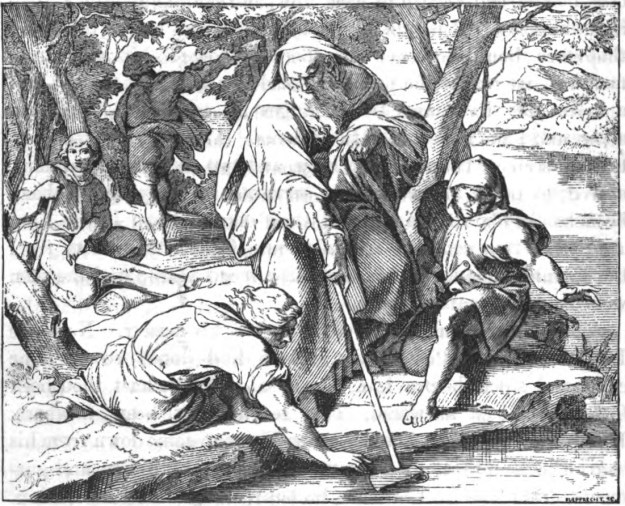
‘Elisha makes the Axe Head Swim’ illustration from The story of the Bible from Genesis to Revelation (1873)

2 Kings 6: 1-7 

1Now the company of prophets said to Elisha, “As you see, the place where we live under your charge is too small for us. 2Let us go to the Jordan, and let us collect logs there, one for each of us, and build a place there for us to live.” He answered, “Do so.” 3Then one of them said, “Please come with your servants.” And he answered, “I will.” 4So he went with them. When they came to the Jordan, they cut down trees. 5But as one was felling a log, his ax head fell into the water; he cried out, “Alas, master! It was borrowed.” 6Then the man of God said, “Where did it fall?” When he showed him the place, he cut off a stick and threw it in there and made the iron float. 7He said, “Pick it up.” So he reached out his hand and took it.

To the modern reader this may seem like a strange story to include among the miracles that are handed on about Elisha. In a world where an ax is a relatively inexpensive tool the loss of an ax head seems like a trivial matter to trouble the prophet Elisha with. But the world of Elisha’s time was very different from our world. At this time iron is a precious resource and smiths in ancient Israel would be rare. This was also a time when Israel is at war with Aram so most iron would be going to create weapons for the military of Israel. Much as the story of Elisha and the widow’s oil (2 Kings 4:1-7), the prophet’s action likely saved this member of the company of prophets from a debt they could not hope to repay. (NIB III: 199) Many of the stories in the previous two chapters have the company of prophets relying on the prophet Elisha to provide food in their want and Gehazi’s foolish (in the eyes of 2 Kings) request for recompense from Naaman (2 Kings 5: 19b-27) is also informed by the group’s poverty. Even if the neighbor who loaned the unfortunate man the ax would not attempt to collect the value of the lost tool, there is a strong concern for neighborly rights among the world envisioned in the Torah.

The story takes place at the Jordan geographically linking it to the previous healing of Naaman. At the Jordan Elisha provided healing for Naaman from his skin disease and relief for this fellow member of the company of prophets with the sunken ax head. Some scholars, both Jewish and Christians, have taken this story and attempted to create a non-miraculous version: the stick was cut to be able to fit into the aperture of the ax head or to have a flat surface for the ax head to rest on as the prophet lifts it out are two examples. Yet, to tell these stories the commenters in their desire to make the story more reasonable have missed the point that the man of God is able to do what others cannot. Elisha who can heal disease or provide adequate food can also through his connection with God make metal float and make an army captive.

2 Kings 6: 8-23

  8Once when the king of Aram was at war with Israel, he took counsel with his officers. He said, “At such and such a place shall be my camp.” 9But the man of God sent word to the king of Israel, “Take care not to pass this place, for the Arameans are going down there.” 10The king of Israel sent word to the place of which the man of God spoke. More than once or twice he warned a place so that it was on the alert.
  11
The mind of the king of Aram was greatly perturbed because of this; he called his officers and said to them, “Now tell me: Who among us is betraying us to the king of Israel?” 12Then one of his officers said, “No one, my lord king. It is Elisha, the prophet in Israel, who tells the king of Israel the words that you speak in your bedchamber.” 13He said, “Go and find where he is; I will send and seize him.” He was told, “He is in Dothan.” 14So he sent horses and chariots there and a great army; they came by night and surrounded the city.
  15
When an attendant of the man of God rose early in the morning and went out, an army with horses and chariots was all around the city. His servant said, “Alas, master! What shall we do?” 16He replied, “Do not be afraid, for there are more with us than there are with them.” 17Then Elisha prayed, “O LORD, please open his eyes that he may see.” So the LORD opened the eyes of the servant, and he saw; the mountain was full of horses and chariots of fire all around Elisha. 18When the Arameans came down against him, Elisha prayed to the Lord and said, “Strike this people, please, with blindness.” So he struck them with blindness as Elisha had asked. 19Elisha said to them, “This is not the way, and this is not the city; follow me, and I will bring you to the man whom you seek.” And he led them to Samaria.
  20
As soon as they entered Samaria, Elisha said, “O LORD, open the eyes of these men so that they may see.” The Lord opened their eyes, and they saw that they were inside Samaria. 21When the king of Israel saw them he said to Elisha, “Father, shall I strike them? Shall I strike them?” 22He answered, “No! Would you strike those whom you have taken captive with your sword and with your bow? Set food and water before them so that they may eat and drink, and let them go to their master.” 23So he prepared for them a great feast; after they ate and drank, he sent them on their way, and they went to their master. And the Arameans no longer came raiding into the land of Israel.

The Arameans are a continual danger to the people of Israel throughout the end of 1 Kings and the beginning of 2 Kings. Yet, Elisha through the previous and following chapter will play a pivotal role in the conflict between the king of Aram and the king of Samaria. Through Naaman, these soldiers who are brought captive by the prophet to Samaria, and the eventual defeat of the siege of Samaria the Arameans will come to know that there is a prophet in Samaria who king Ben-hadad of Aram will eventually consult (2 Kings 8: 7-15). Also reappearing in this story are the ‘horsemen and chariots of Israel’ which are the host of Israel’s God which Elisha first saw at Elijah’s ascension.

The conflict between the king of Aram and the prophet is precipitated by the prophet’s repeated warning of the king of Israel of the movements of Aram’s armies. Convinced that one of his leaders is betraying him, he summons them and asks how this is occurring. One of his officers knows that it is Elisha that is handing on this information, and the king of Aram orders a force sent to seize the prophet from his current location at Dothan. What the king’s men and the prophet’s men are blind to is the ‘horsemen and chariots of Israel’ which are surrounding the prophet and are more numerous than the forces sent by the king of Aram. Apparently, one’s eyes must be opened to be able to see the host of the LORD and that is exactly what Elisha prays for his servant to receive.

Throughout the narrative the movement between blindness and sight plays a critical role. Elisha’s servant may be able to see the forces of Aram, but he is blind to the forces of the LORD who Elisha serves until his eyes are opened. The prophet was able to provide vision for the king of Israel to elude the maneuvers of the king of Aram’s army and so the king of Aram attempts to remove the eyes of Israel by eliminating the prophet. The armies of Aram are struck with blindness by the LORD and led by the prophet to Samaria where the prophet asks for their sight to be restored.

The story ends with the king of Israel asking whether he should strike down this army that has been delivered by the prophet into his city and the prophet opening his eyes to another way. The king of Israel did not capture the Arameans, and their lives are in the prophet’s hands, and the prophet shows a way of peace. The book of Proverbs states, “If your enemies are hungry, give them bread to eat; and if they are thirsty, give them water to drink.” Proverbs 25:21 The prophet models this way of wisdom for the king who prepares a great feast for his enemies, and this brings at least a pause to the conflicts between Israel and Aram. The story moved from blindness to sight and from conflict to peace. Just like Naaman would discover that there is a prophet in Samaria, now these soldiers of Aram would also know both the power of the prophet’s God and the rescue provided in their desperate situation.

2 Kings 5 Elisha Heals Naaman and Gehazi’s Poor Choice

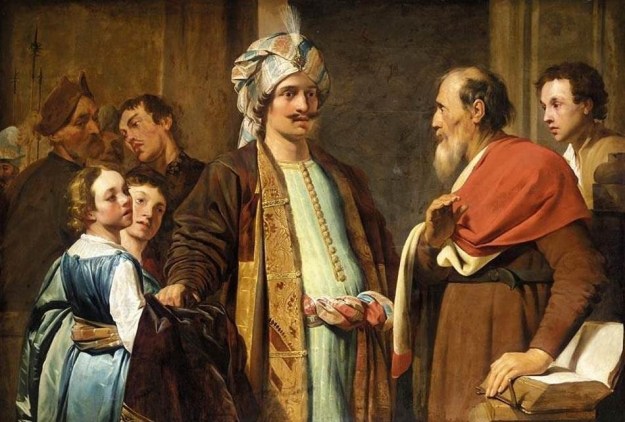
Pieter de Grebber, Elisha Refusing Gifts From Naaman (1630) https://www.theleidencollection.com/artwork/elisha-refusing-naamans-gifts/

2 Kings 5: 1-19a 

1Naaman, commander of the army of the king of Aram, was a great man and in high favor with his master because by him the Lord had given victory to Aram. The man, though a mighty warrior, suffered from a skin disease. 2Now the Arameans on one of their raids had taken a young girl captive from the land of Israel, and she served Naaman’s wife. 3She said to her mistress, “If only my lord were with the prophet who is in Samaria! He would cure him of his skin disease.” 4So Naaman went in and told his lord just what the girl from the land of Israel had said. 5And the king of Aram said, “Go, then, and I will send along a letter to the king of Israel.”
  He went, taking with him ten talents of silver, six thousand shekels of gold, and ten sets of garments. 6
He brought the letter to the king of Israel, which read, “When this letter reaches you, know that I have sent to you my servant Naaman, that you may cure him of his skin disease.” 7When the king of Israel read the letter, he tore his clothes and said, “Am I God, to give death or life, that this man sends word to me to cure a man of his skin disease? Just look and see how he is trying to pick a quarrel with me.”
  8
But when Elisha the man of God heard that the king of Israel had torn his clothes, he sent a message to the king, “Why have you torn your clothes? Let him come to me, that he may learn that there is a prophet in Israel.” 9So Naaman came with his horses and chariots and halted at the entrance of Elisha’s house. 10Elisha sent a messenger to him, saying, “Go, wash in the Jordan seven times, and your flesh shall be restored, and you shall be clean.” 11But Naaman became angry and went away, saying, “I thought that for me he would surely come out and stand and call on the name of the LORD his God and would wave his hand over the spot and cure the skin disease! 12Are not Abana and Pharpar, the rivers of Damascus, better than all the waters of Israel? Could I not wash in them and be clean?” He turned and went away in a rage. 13But his servants approached and said to him, “Father, if the prophet had commanded you to do something difficult, would you not have done it? How much more, when all he said to you was, ‘Wash, and be clean’?” 14So he went down and immersed himself seven times in the Jordan, according to the word of the man of God; his flesh was restored like the flesh of a young boy, and he was clean.
  15
Then he returned to the man of God, he and all his company; he came and stood before him and said, “Now I know that there is no God in all the earth except in Israel; please accept a present from your servant.” 16But he said, “As the LORD lives, whom I serve, I will accept nothing!” He urged him to accept, but he refused. 17Then Naaman said, “If not, please let two mule loads of earth be given to your servant, for your servant will no longer offer burnt offering or sacrifice to any god except the Lord. 18But may the LORD pardon your servant on one count: when my master goes into the house of Rimmon to worship there, leaning on my arm, and I bow down in the house of Rimmon, when I do bow down in the house of Rimmon, may the LORD pardon your servant on this one count.” 19He said to him, “Go in peace.”

The healing of Naaman, along with Elijah’s ascent in the whirlwind, are probably the two best-known and most frequently used stories from 2 Kings in the life of the church. This story, along with Elijah’s provision of meal and oil for the widow of Zarephath, is utilized in Luke 4:27 as an explanation for the expansiveness of Jesus’ ministry, but it is also paired with Jesus’ healing of lepers in the gospels. Naaman is both the victorious mighty warrior who occupies a privileged position with the king of Aram and has servants and slaves along with the access to considerable wealth and power, but in Israel he is also a Gentile, an unclean one, and an oppressor. The story illustrates the fundamental differences between the world envisioned by the king of Aram and Naaman at the beginning of the story and the prophet Elisha when he enters in the middle of the story.

The position of Naaman, in the view of 2 Kings, is a result of the LORD the God of Israel granting him victory leading the Arameans. On the one hand this provides an explanation for the defeat of Israel by a foreign power, the defeat is a judgment on the unfaithfulness of Samaria. On the other hand, it makes the mighty warrior subject, unknowingly at the beginning of the story, to the LORD the God of Israel. Even a captive young woman from Israel knows what this mighty warrior cannot, that the hope for healing resides in Samaria. This young woman who is a captive and the mighty man who is a leader of armies may be on opposite sides of the power differential but in the story they are linked. Captured slaves often have an unfavorable view of their masters, yet in Naaman throughout the story we see that this mighty man is both respected enough by his servants for them to speak truthfully and compassionately to him and Naaman as their master listens. The commander of warriors who can deliver victories depends upon the knowledge willingly shared by a captured young woman residing in his household.

The skin disease which has been traditionally translated as leprosy is probably not what we today categorize as leprosy (or Hansen’s disease) but it was something that ancient cultures took very seriously. Leviticus 13-14 deals with the priestly role in the diagnosis, the social implications for a person diagnosed with this skin disorder and the method that they can also be reintegrated into the community once they are healed. The seriousness of the disease can be demonstrated by the incredible amount of wealth (ten talents of silver, six thousand shekels of gold, and ten sets of garments)[1] which the king of Aram sends to the king of Israel to bring about the healing of his favored commander.

In the ancient world there was no concept of separation of religious and state powers. For most ancient kings, even in Israel, there are religious figures including prophets in the royal court. The prophet Nathan was involved in the court of king David, and earlier in the Omri dynasty we saw the conflict between the prophets who spoke favorably to king Ahab and Micaiah who was a faithful prophet of the LORD but not in royal favor. As Alex Israel notes about the contrasting views of prophets between the kings of Aram and Israel:

The king of Aram was incapable of imagining a scenario in which the prophet would not be fundamentally subordinate to the king, and so he sought the prophet by means of the latter. By contrast, the king of Israel couldn’t conceive a situation in which the prophet would be responsive to his control, and so he failed to entertain the prospect of appealing to Elisha! (Israel, 2019, p. 98)

The king of Aram views the king of Israel as his subordinate who he can command, but Elisha does not answer to the king of Israel. Yet, Elisha does hear of the king’s distress and instructs him to send Naaman to him.

Naaman has probably encountered other healers and prophets in Damascus who attempted to heal his skin disease, and he has ideas of how that process should look for a person of his station. As a person of high status, he anticipated personal attention from the prophet. His status as a mighty warrior and commander of the armies of Aram have allowed him to be a person who is able to fulfill their request, but now he finds that this status means nothing before the prophet, and he is reduced to a “supplicant who comes to the healer as a leper.” (Brueggemann, 2000, p. 334) Yet, as previously we saw with the young woman from Israel, Naaman is a master who his servants are willing to speak to in an honest and compassionate way. Once Naaman has completed his complaint about the command delivered by an emissary to wash in the Jordan, his servants are able to convince him that the prophet has not asked a hard thing, and it is in Naaman’s interest to attempt this novel cure.

The washing in the Jordan results in Naaman’s skin becoming like a young boy. The description of Naaman’s skin utilizing the masculine form of the words used to describe the young girl at the beginning of the story now link the two together. In some way Naaman is now like this enslaved young woman even though they occupy vastly different places in the social hierarchy. Both stand in a place of dependency before God and Naaman has not only learned that there is a prophet in Samaria, but that there is no God in all the earth except in Israel.

After the healing Naaman stands, with all his company before the prophet Elisha. Naaman attempts to offer payment, but Elisha swears that he will take no payment.[2] Naaman then makes two requests when payment continues to be refused. First Naaman requests to take two mule loads of earth. Naaman likely believes that the God of Israel is tied to the land of Israel and bringing the earth will allow him to build an altar or worship space where he can access this God whom he has discovered. Secondly, he requests that in his state functions that God would not hold it against him when he escorts his master into the worship space of Rimmon, the god of Damascus. Elisha does not judge Naaman for these requests and instructs him to depart in shalom.

2 Kings 5: 19b-27

  But when Naaman had gone from him a short distance, 20Gehazi, the servant of Elisha the man of God, thought, “My master has let that Aramean Naaman off too lightly by not accepting from him what he offered. As the LORD lives, I will run after him and get something from him.” 21So Gehazi went after Naaman. When Naaman saw someone running after him, he jumped down from the chariot to meet him and said, “Is everything all right?” 22He replied, “Yes, but my master has sent me to say, ‘Two members of a company of prophets have just come to me from the hill country of Ephraim; please give them a talent of silver and two changes of clothing.’ ” 23Naaman said, “Please accept two talents.” He urged him and tied up two talents of silver in two bags, with two changes of clothing, and gave them to two of his servants, who carried them in front of Gehazi. 24When he came to the citadel, he took the bags from them and stored them inside; he dismissed the men, and they left.
  25
He went in and stood before his master, and Elisha said to him, “Where have you been, Gehazi?” He answered, “Your servant has not gone anywhere at all.” 26But he said to him, “Did I not go with you in spirit when someone left his chariot to meet you? Is this a time to accept silver and to accept clothing, olive orchards and vineyards, sheep and oxen, and male and female slaves? 27Therefore the skin disease of Naaman shall cling to you and to your descendants forever.” So he left his presence diseased, as white as snow.

The stories of the previous chapter seem to indicate that the company of prophets (or sons of the prophets) continually struggle with poverty and this may inform Gehazi’s action contrary to his master Elisha. As Choon-Leong Seow remarks, “the faithfulness of Naaman’s slave girl at the beginning of the story stands in stark contrast to the treachery of Elisha’s servant at the end of the chapter.” (NIB III:192) While Elisha swore an oath (“as the LORD lives”) that he would accept no gift (literally blessing) from Naaman his servant Gehazi swears an oath that he will take something from this Gentile. Gehazi runs after Naaman’s party and Naaman, after dismounting his chariot asks, “Is all shalom?” Gehazi gives a reason for wanting a blessing/payment from Naaman, which Naaman is eager to grant giving double the initial request. For Naaman this is far less than the ten talents of silver he was willing to pay as payment for healing, but the roughly one hundred fifty pounds of silver with two sets of garments[3] which two of Naaman’s servants carry back to the citadel would be an incredible amount of wealth among the company of prophets. Yet, Gehazi’s secret is known by Elisha and the Hebrew indicates that Elisha’s heart went with Gehazi (NRSV ‘spirit’). Silver and clothing, land and livestock, servants and slaves for the company of the prophets is not where their security comes from. Gehazi has trusted in the same things that the king of Aram and Naaman trusted, and Elisha indicates that now Naaman’s skin disease will cling to Gehazi and his descendants.

The healing of Naaman does not end the conflict between Aram and Samaria which will continue in the narrative of the next two chapters. It is also not the end of Gehazi’s role in the story who will reappear in chapter eight. It is possible that the healing of Naaman is brought forward in the story to be a part of an Elisha cycle of miracles which reaches its peak with the thwarting of the king of Aram’s invasion of Israel. The king of Israel’s inability to heal his servant did not provide the provocation for a continued war, but ultimately the healing of Naaman did not end the conflict between Samaria and Damascus.


[1] The NIV notes that 10 shekels of silver is about 750 lbs (340 kg) of silver and 6,000 shekels of gold is about 150 lbs (70 kg).

[2] Numbers 22:18 and Daniel 5:17 are both times where two very different prophets (Balaam and Daniel) indicate that gold will not be acceptable to earn favor or as payment for a servant of the LORD.

[3] Garments in the ancient world are also expensive and an indicator of wealth.

1 Kings 20 King Ahab and the Conflict with Aram

1 Kings 20: 1-21 The Conflict with King-Hadad of Aram Begins

1 King Ben-hadad of Aram gathered all his army together; thirty-two kings were with him, along with

Assyrian stela of Shalmaneser that reports battle of Qarqar By Yuber – from en wiki, Public Domain, https://commons.wikimedia.org/w/index.php?curid=869262

horses and chariots. He marched against Samaria, laid siege to it, and attacked it. 2 Then he sent messengers into the city to King Ahab of Israel, and said to him: “Thus says Ben-hadad: 3 Your silver and gold are mine; your fairest wives and children also are mine.” 4 The king of Israel answered, “As you say, my lord, O king, I am yours, and all that I have.” 5 The messengers came again and said: “Thus says Ben-hadad: I sent to you, saying, ‘Deliver to me your silver and gold, your wives and children’; 6 nevertheless I will send my servants to you tomorrow about this time, and they shall search your house and the houses of your servants, and lay hands on whatever pleases them, and take it away.”

7 Then the king of Israel called all the elders of the land, and said, “Look now! See how this man is seeking trouble; for he sent to me for my wives, my children, my silver, and my gold; and I did not refuse him.” 8 Then all the elders and all the people said to him, “Do not listen or consent.” 9 So he said to the messengers of Ben-hadad, “Tell my lord the king: All that you first demanded of your servant I will do; but this thing I cannot do.” The messengers left and brought him word again. 10 Ben-hadad sent to him and said, “The gods do so to me, and more also, if the dust of Samaria will provide a handful for each of the people who follow me.” 11 The king of Israel answered, “Tell him: One who puts on armor should not brag like one who takes it off.” 12 When Ben-hadad heard this message — now he had been drinking with the kings in the booths — he said to his men, “Take your positions!” And they took their positions against the city.

13 Then a certain prophet came up to King Ahab of Israel and said, “Thus says the LORD, Have you seen all this great multitude? Look, I will give it into your hand today; and you shall know that I am the LORD.” 14 Ahab said, “By whom?” He said, “Thus says the LORD, By the young men who serve the district governors.” Then he said, “Who shall begin the battle?” He answered, “You.” 15 Then he mustered the young men who serve the district governors, two hundred thirty-two; after them he mustered all the people of Israel, seven thousand.

16 They went out at noon, while Ben-hadad was drinking himself drunk in the booths, he and the thirty-two kings allied with him. 17 The young men who serve the district governors went out first. Ben-hadad had sent out scouts, and they reported to him, “Men have come out from Samaria.” 18 He said, “If they have come out for peace, take them alive; if they have come out for war, take them alive.”

19 But these had already come out of the city: the young men who serve the district governors, and the army that followed them. 20 Each killed his man; the Arameans fled and Israel pursued them, but King Ben-hadad of Aram escaped on a horse with the cavalry. 21 The king of Israel went out, attacked the horses and chariots, and defeated the Arameans with a great slaughter.

This story of conflict between King Ben-hadad of Aram and King Ahab of Israel has puzzled many readers of 1 Kings.  Several historical scholars have argued that this conflict between Aram and Israel may actually have occurred during the reign of King Jehohaz (2 Kings 13: 1-9) at least thirty-five years later when Ben-hadad continues his father King Hazael’s work of oppressing Israel. It is possible that a later story was brought forward to make a point about King Ahab, but it is also plausible that a Ben-hadad attempted to oppress Israel at different times (names were often repeated in families).[1] Perhaps even more perplexing than the historical question is the vastly different allegiances of King Ahab from the previous chapters where he was in conflict with Elijah. Baal and the prophets of Baal are absent, a lone prophet of God becomes a central advisor, and the king is well acquainted enough with the prophets of the LORD to recognize a member of the ‘sons of the prophets’ when they speak to him later. (Israel, 2013, p. 273) Also missing in action are Elijah and Elisha. The ‘sons of the prophets’ will feature heavily in the Elisha stories, and it is possible that Elijah is preparing Elisha to assume the mantle of his work. Yet, as a foreign oppressor comes and the LORD promises to demonstrate God’s power by handing over a vastly superior force into the hands of Ahab these key prophets are absent.

Despite all the perplexing elements for the narrative the central theological point is clear: the fate and security of Israel rests in the LORD’s hands and not in the hands of the king or his limited military. King Ahab is not going to deliver Samaria by his military might, his political acumen, or his leadership through the conflict. The victory is a demonstration of the sovereignty of the LORD the God of Israel and the proper response is obedience. Ahab will ultimately fail, like many previous leaders, in this final test of obedience and will trust in his own ability to negotiate a favorable peace rather than trusting in the LORD who provided the victory. In the eyes of 1 Kings this is a critical theological error.

King Ben-hadad of the Arameans gathers a large coalition of leaders and sends a large force of chariots and horsemen which besiege Samaria. His initial demand is received as a demand that King Ahab become a vassal king of this large well-equipped coalition,[2] paying tribute and surrendering captives to ensure his loyalty. King Ahab initially consents to this proposal seeing it as a way to avoid a larger conflict and his initial response declares his willingness to subjugate himself to King Ben-hadad, yet the second demand is a more arduous invasion of King Ahab’s sovereignty and the kingdom. Ben-hadad’s promise to send his servants to take whatever pleases them is viewed as a provocation because it strips Ahab of his power to protect the people and his household. Ahab and the elders refuse to consent and in the initial war of words Ben-hadad taunts that he will reduce Samaria to destruction so completely that his followers will not be able to gather a handful of dust from their remains. Ahab replies with a taunt that one who is just preparing to fight should not boast like a victor taking off his armor. The negotiations are over, King Ahab has failed to avoid conflict with a superior coalition and the siege begins in earnest as the Aramean forces take positions around Samaria.

An unnamed prophet enters the narrative. Unlike previous times when the prophets of the LORD were hunted by Jezebel and those loyal to her, now a prophet has access to the king. The prophet declares that the upcoming victory is another demonstration to Ahab of the power of the LORD. This improbably victory is not due to the skill of the vastly outnumbered forces that Ahab can command, but instead is a way for Ahab and the people to know ‘that I am the LORD.’  Knowing that the God of Israel is the LORD is to acknowledge the sovereignty of the LORD the God of Israel also means obedience to the LORD’s expectations. The prophet does not invoke that this falls under the rules of a ‘holy war’[3] but instead answers the king’s questions about how to initiate the battle and how the king is to lead. The identity of the two hundred thirty-two men who serve the district governors[4] is not clear from the context and has been a source of debate. It is unlikely that they are ‘professional soldiers’ as we think of people who are a part of a standing military, and they may be the personal protectors or enforcers for the regional leaders. Regardless of their identity they will be the first ones sent out, followed by the seven thousand Israelites that will engage the Arameans. The number seven thousand intentionally links the reader to the seven thousand who have not bent their knee to Baal who are the faithful remnant that the LORD identifies to Elijah. (1 Kings 19:18)

When the initial representatives of Israel emerge from the city an already drunk King Ben-hadad gives the order to capture them alive whether they are seeking peace or conflict. In the early stage of a siege the expectation is that there is not much that the leaders need to supervise so the drunken kings may not be as surprising as it would be for a modern leader to be drunk on the battlefield. From a military perspective the Israelites have the element of surprise, and the momentum of the battle quickly springs in their favor as they encounter an opponent who focused on a later clash rather than the emergence of an immediate threat. The leaders of the Aramean coalition are inhibited from leading their forces by their heavy drinking and Ahab’s forces take advantage of this surprised force. Yet, 1 Kings writes from a theological perspective and from that perspective the entire strategy, execution and victory is the work of the LORD and a demonstration of the LORD’s power over a superior military force.

1 Kings 20: 22-30a The Defeat of King-Hadad

22 Then the prophet approached the king of Israel and said to him, “Come, strengthen yourself, and consider well what you have to do; for in the spring the king of Aram will come up against you.”

23 The servants of the king of Aram said to him, “Their gods are gods of the hills, and so they were stronger than we; but let us fight against them in the plain, and surely we shall be stronger than they. 24 Also do this: remove the kings, each from his post, and put commanders in place of them; 25 and muster an army like the army that you have lost, horse for horse, and chariot for chariot; then we will fight against them in the plain, and surely we shall be stronger than they.” He heeded their voice, and did so.

26 In the spring Ben-hadad mustered the Arameans and went up to Aphek to fight against Israel. 27 After the Israelites had been mustered and provisioned, they went out to engage them; the people of Israel encamped opposite them like two little flocks of goats, while the Arameans filled the country. 28 A man of God approached and said to the king of Israel, “Thus says the LORD: Because the Arameans have said, ‘The LORD is a god of the hills but he is not a god of the valleys,’ therefore I will give all this great multitude into your hand, and you shall know that I am the LORD.” 29 They encamped opposite one another seven days. Then on the seventh day the battle began; the Israelites killed one hundred thousand Aramean foot soldiers in one day. 30 The rest fled into the city of Aphek; and the wall fell on twenty-seven thousand men that were left.

The surprising victory at Samaria buys some time for King Ahab, but the survival of King Ben-hadad means that in the spring the Arameans will return to continue the fight. Again, the unnamed prophet is the central advisor in the story giving King Ahab advice which follows. Yet, on the opposite side of the conflict Ben-hadad’s advisor also gave him advice to prepare for the next battle. Both sets of advisors are coming from different theological perspectives as they provide military guidance for their respective leaders.

The advisors of Ben-hadad follow pretty conventional military advice for the technology of the day couched in a theological proposition about the God of Israel. There is a distinct advantage for a military force which depended on chariots as a key maneuver element to fight on level ground. Military planners often look for ground that will enhance their technological advantage or reduce their disadvantages. The Arameans will be the ones who choose the next battlefield, and they choose Aphek. There are multiple places in the region named Aphek, but this is most likely the Transjordan site near the modern day Golan Heights.[5] (Cogan, 2001, p. 466) Yet, the theological rationale for encouraging King Ben-hadad to make these decisions is that they believe the gods of Israel is are ‘gods of the hills’ whose ability to influence the fight will be negated by moving the location of the conflict.[6]

A second man of God comes to the king of Israel with a promise that the LORD will deliver this force into the hands of Israel both to demonstrate to the Arameans the error in their thinking and to demonstrate once again to Ahab that ‘I am the LORD.’ Even though the Arameans fill the country, and the Israelites look like two little flocks of goats, Israel is not reliant upon its military might but the LORD’s deliverance. The seven days wait before the conflict echoes the six days of marching and the fall of Jericho on the seventh day.[7] Like Jericho the defeat for the Arameans is massive. The number of one hundred twenty-seven thousand dead seems impossibly large, but the theological effect is that this massive army is removed by God’s action on the battlefield and at the wall of Aphek. Although the battle is never declared a ‘holy war’ the parallels with Jericho begin to give the battle that feel which will prove crucial in Ahab’s decision in the aftermath of the LORD’s triumph.

1 Kings 20: 30b-43 King Ahab’s Political Choice and Theological Blunder

Ben-hadad also fled, and entered the city to hide. 31 His servants said to him, “Look, we have heard that the kings of the house of Israel are merciful kings; let us put sackcloth around our waists and ropes on our heads, and go out to the king of Israel; perhaps he will spare your life.” 32 So they tied sackcloth around their waists, put ropes on their heads, went to the king of Israel, and said, “Your servant Ben-hadad says, ‘Please let me live.'” And he said, “Is he still alive? He is my brother.” 33 Now the men were watching for an omen; they quickly took it up from him and said, “Yes, Ben-hadad is your brother.” Then he said, “Go and bring him.” So Ben-hadad came out to him; and he had him come up into the chariot. 34 Ben-hadad said to him, “I will restore the towns that my father took from your father; and you may establish bazaars for yourself in Damascus, as my father did in Samaria.” The king of Israel responded, “I will let you go on those terms.” So he made a treaty with him and let him go.

35 At the command of the LORD a certain member of a company of prophets said to another, “Strike me!” But the man refused to strike him. 36 Then he said to him, “Because you have not obeyed the voice of the LORD, as soon as you have left me, a lion will kill you.” And when he had left him, a lion met him and killed him. 37 Then he found another man and said, “Strike me!” So the man hit him, striking and wounding him. 38 Then the prophet departed, and waited for the king along the road, disguising himself with a bandage over his eyes. 39 As the king passed by, he cried to the king and said, “Your servant went out into the thick of the battle; then a soldier turned and brought a man to me, and said, ‘Guard this man; if he is missing, your life shall be given for his life, or else you shall pay a talent of silver.’ 40 While your servant was busy here and there, he was gone.” The king of Israel said to him, “So shall your judgment be; you yourself have decided it.” 41 Then he quickly took the bandage away from his eyes. The king of Israel recognized him as one of the prophets. 42 Then he said to him, “Thus says the LORD, ‘Because you have let the man go whom I had devoted to destruction, therefore your life shall be for his life, and your people for his people.'” 43 The king of Israel set out toward home, resentful and sullen, and came to Samaria.

Throughout the conflict agents of the LORD the God of Israel have informed King Ahab that by these victories that Ahab will know that “I am the LORD.” These surprising military events should demonstrate to Ahab that God is the only refuge and support that the king needs. Yet, when presented with an opportunity to negotiate the reclamation of territory and trading rights for Israel, Ahab chooses to rely upon his skills in making a treaty. Ahab makes a political choice and a theological blunder. In the end Ahab trusts in crafting a commonsense deal rather than a zealous adherence to trusting in God and the results are disastrous for his household and Israel.

Ben-hadad’s servants convince their king to allow them to attempt to negotiate for his life. When they declare that the kings of Israel are ‘merciful’ kings they reference a central theological word often related to God: The Hebrew word hesed. Hesed is a rich word which can be rendered covenant faithfulness, grace, or mercy. It is God’s hesed that Israel relies upon. Now Ahab is to be manipulated by this property of hesed. The servants come out in sackcloth and with ropes on their heads to indicate their subservience to the Israelites. This has echoes of the way the Gibeonites trick the Israelites into sparing them in Joshua 9. These servants who may have been the same ones that would have been sent to plunder the house of Ahab, now come to make a humble appeal for the life of their king. Even though Ahab was previously treated with disdain by Ben-hadad, he extends the courtesy of calling him ‘brother’ and this allows Ben-hadad and Aram to negotiate terms of peace. With territory restored and trading rights promised King Ahab makes the political choice to allow his enemy to live. Peace between Aram and Israel will only last for three years.

King Ahab may have several political reasons to negotiate with the king of Aram. The return of land and the ability to expand trade with a neighbor are powerful incentives on their own. Ahab is also aware of the emergence of the Assyrians which will pose a threat to both Israel and Aram and may be looking for a military alliance with Aram to bolster the nations security. (Israel, 2013, p. 282) There is also the possibility that ‘class solidarity’ may play a part in Ahab’s considerations. (Brueggemann, 2000, p. 250) It may be fine for thousands of soldiers to be slaughtered but kings may be seen as ‘brothers.’ Ahab and Ben-hadad make a covenant[8] and the battle has ended.

Yet, the messengers of the LORD have to relay God’s displeasure at Ahab’s covenant which spares the life of Ben-hadad. We see the ‘sons of the prophets’ (NRSV company of prophets) appear for the first time. The sons of the prophets will feature heavily in the Elisha cycle, but now we encounter an unnamed prophet who declares to another to strike him. The failure of the first man to strike this prophet results in his death in a similar manner to the prophet who disobeyed in 1 Kings 13:24. Once the second man strikes the prophet and wounds him he departs to wait for the king. He is disguised with a bandage over his eyes because he is apparently known by sight to the king and portrays himself as a wounded soldier from the battle.

The prophet tells the king a ‘juridical parable’ where the offender is caught in the trap thinking the narrative is about someone else and then finding it refers to them. The most famous example of this type of parable is when the prophet Nathan confronts King David after sleeping with Bathsheba and ordering Uriah’s death.[9] Here the disguised prophet portrays himself as responsible for a man’s life and allows him to disappear in the chaos of the battlefield. Aram allows the words of the narrative to condemn the prophet only to find himself the one who has release one he was responsible for. King Ben-hadad was to be ‘devoted to destruction’ which translates the Hebrew herem. Herem is the practice of war referred to for the people that the Israelites were to eliminate in Deuteronomy 20: 16-18 (see also Deuteronomy 7: 1-5, 25-26). The story bears striking similarities to King Saul sparing King Agag of the Amalekites (1 Samuel 15) which results in the LORD’s rejection of Saul-although in the battle with the Amalekites the prophet Samuel invokes this concept of herem where they are to be completely committed to destruction. Only at the end of the narrative do we hear that the King of Aram was ‘devoted to destruction’ but like Saul, Ahab’s life and lineage are now marked.

This is a difficult passage to wrestle with. The theological blunder of Ahab is clear: he trusted in his own ability to bring about a better settlement for Israel even in the demonstration of the LORD’s might. The LORD wanted Ahab to acknowledge his power, authority, and protection and to respond with obedience and trust.  Even if the number of deaths here are significantly inflated, one of the difficult challenges for any reader of scripture is reconciling the God of hesed with the God who calls for herem. How does one balance mercy with obedience, political realism with faithfulness. These are not easy questions. I’ve wrestled with Violence and the Bible in other places in these reflections. But the overarching message that I believe the narrator of 1 Kings wants us to understand is that we are to orient our trust to be in the LORD and the LORD’s provision and protection and not in our own ability to negotiate.

[1] The prefix ‘Ben’ in names means ‘Son of’. Ben-hadad is literally the son of Hadad, likewise the common name Benjamin means ‘son of my right hand.’

[2] Chariots and horses were still viewed as the central military advantage in warfare of this time period.

[3] Hebrew herem, see the discussion of below on 20: 30b-43.

[4] Hebrew naari sarei hamedinot. This term not used at other times to help provide contextual clues for these ‘young men.’

[5] The Golan Heights is still a contentious piece of land that both Israel and Syria claim. Israel captured most of this territory in 1967 and annexed it in 1981. Syria still claims that the land is theirs.

[6] Judges also makes note of the Israelites being unable to clear the Canaanites and Philistines from the planes because of their iron chariots. (Judges 1:19) See also Joshua 17:16-18.

[7] Joshua 6

[8] Hebrew b’rith another key theological concept in the Hebrew Scriptures often linked with hesed.

[9] 2 Samuel 12, see also 2 Samuel 14 for another example when the woman of Tekoa confronts King David.