Category Archives: Masculinity

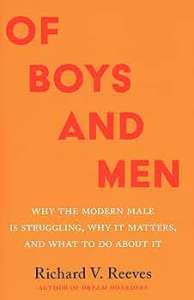
Reflection of Of Boys and Men by Richard V. Reeves

Reflections on Of Boys and Men: Why the Modern Male is Struggling. Why it Matters, and What to do about It. By Richard V. Reeves.

This is a part of a selection of readings I gathered to reflect on what a healthy approach to masculine identity would look like. I navigated my own journey into a version of manhood in my late teens and early twenties successfully, but now in middle age I see a lot of young men struggling to navigate this journey and for a variety of reasons failing to launch into life. I come to this with humility and curiosity seeking those who may be able to articulate more clearly the journeys that may lead young men to discover a fulfilling life of work and relationships and to help those moving into the space of elders to support and guide them in this journey.

Richard Reeves book Of Boys and Men was the first book that helped make sense of several intuitions I had about the way life had changed for men in relationships, in work, and in school. I initially listened to an audio version of the book in 2024 and then read and marked up a physical copy in 2025. One of the things I appreciate about Richard Reeves approach is that he continually reminds the reader that empathy is not a zero-sum game. We can be concerned about advancing equality for women and still acknowledge and address the ways men are struggling in education, relationships and the workforce and the fundamental changes in their roles in a relatively short period of time. Richard Reeves is also a person who thinks about policy and so the book not only identifies the struggles that many men face but also provides ideas for consideration in addressing the struggles.

In education at all levels men have fallen significantly behind women. Women are more likely to perform well in middle and high school, attend and graduate college, and go onto graduate level education. Part of the struggle that boys and men struggle with in education is biological. As Richard Reeves states:

Boys’ brains develop more slowly, especially during the most critical years of secondary education. When almost one in four boys (23%) is categorized as having a “developmental disability,” it is fair to wonder if it is educational institutions, rather than boys, that are not functioning properly. (8)

The lack of male educators in the school system impacts the ability of boys to learn, but it also leads to the pathologizing of normal adolescent behavior. Richard Reeves also suggests starting boys a year later in the educational progression to assist with the two to three year gap in development of key executive functions in brain activity between girls and boys, but also advocates for more male teachers, coaches, and other leadership roles within the educational system.

The workforce has fundamentally changed in recent generations and many of the jobs lost were traditionally masculine jobs that required physical strength, which has now been replaced by automation. Reeves notes that the significant effort to encourage women to be educated and work in STEM (Science, Technology, Engineering, and Mathematics) fields but the fastest growing job needs are in what Reeves labels as HEAL jobs: Healthcare, Education, Administration, and Literacy. As mentioned above he advocates for programs to encourage and fund men being trained in these HEAL jobs and notes the benefits that having men in these jobs would have for both men and women.

One of the other things I appreciated about Reeve’s attempt at balance was his willingness to criticize both the political left and right in their approach to the issue. The political right at least acknowledges that there is a problem, but their solution is to try to steer the world back to an earlier time when women were less involved in the workforce, college, and life outside the home. The political left has pathologized the problem as ‘toxic masculinity,’ viewed male problems as individual failings, been unwilling to acknowledge any biological basis for sex differences, and has been convinced that inequality can only run one way. An example of viewing the problem as individual failings would look like:

If men are depressed, it is because they won’t express their feelings. If they get sick, it is because they won’t go to the doctor. If they fail at school, it is because they lack commitment. If they die early, it is because they drink and smoke too much and eat the wrong things. For those on the political Left, then, victim-blaming is permitted when it comes to men. (109)

He also begins to reframe some of the traits that have been labelled ‘toxic’ in a more positive light. For example, the male psychology is more wired for risk, but it is also far more likely to take risks to save or protect others. He also highlights the erosion of the core institutions of work, family, and religion which guided common patterns of behavior for men and women.

I appreciate that Richard Reeves has not only provided a thoughtful approach to the problems that boys and men face but also continues to research and advocate for solutions. His work is one that several other authors are beginning to build upon and Of Boys and Men was one of the first books that attempted a balanced approach to the issues facing men. Of Boys and Men helped give me both a language to describe some of what I was seeing as well as prompting me to dig deeper and to want to know more. I found it helpful as we try to imagine a hopeful future for both men and women.

Reflections on The End of Men and the Rise of Women by Hannah Rosin

This is a part of a selection of readings I gathered to reflect on what a healthy approach to masculine identity would look like. I navigated my own journey into a version of manhood in my late teens and early twenties successfully, but now in middle age I see a lot of young men struggling to navigate this journey and for a variety of reasons failing to launch into life. I come to this with humility and curiosity seeking those who may be able to articulate more clearly the journeys that may lead young men to discover a fulfilling life of work and relationships and to help those moving into the space of elders to support and guide them in this journey.

There are some startling quotes in this book, but the one that stopped me in my tracks as we look at the future was this:

This script has played out once before in American culture. Starting in the 1970s, black men began leaving factory jobs; by 1987 only 20 percent of black men worked in manufacturing. The men who lived in the inner cities had a hard time making the switch to service jobs or getting the education needed to move into other sectors. (88)

There has been a lot of attention paid to the incarceration, unemployment, and the lack of young black men in raising children and the factors behind these men not being successful in society but when you expand the script to the plight of black men being predictive of the future of men as a whole that is bleak. I do believe that especially for men so much of their identity is tied to work and the loss of job opportunities for men without a college degree is a major factor in the failure of men in both the economy and life. Hannah Rosin’s book in 2012 was one the first one that I am aware of to notice the drastic changes occurring in the education and work space of America and she covers a wide range of impacts from the changes. From the changing dynamic of ‘hook-up culture’ in colleges, to the way the upper class still holds onto marriage as an economic advantage, the economic mobility of women and the economic stagnation of men, the drastic change in the makeup of college campuses, the increase in female violence, and the way women are breaking into the top of the job market.

I valued the combination of personal stories gained from interviews placed in the context of the seismic shift in the job and education market. As Hannah Rosin notes about the 2008-2009 Recession:

In the Great Recession, three-quarters of the 7.5 million jobs lost were lost by men. The worst-hit industries were overwhelmingly male, and deeply identified with macho: construction, manufacturing, high finance. (4)

I appreciated her candor in talking about the ‘hook-up culture’ on college campuses where women are also using it to avoid relationships which could derail their progression through college and into the workforce. Women are more educated and doing better economically in their late twenties than their male counterparts. Although college educated men and women were more likely to remain married and to ‘see-saw’ in their primary breadwinning roles, among men with only a high-school diploma the change was drastic. “In 1967, 97 percent of American men with only a high school diploma were working; in 2010, just 76 percent were.” (86) It has been common to note that this generation is not doing as well as the previous generation, but particularly for men:

In 2009, men brought home $48,000 on average, roughly the same as they did in 1969 after adjusting for inflation. In fact, as a recent report written by former White House economist Michael Greenstone discovered, the truth is even more dismal. Calling it stagnation fails to take into account the fact that fewer men are working full-time now or making any salary at all, and many more are incarcerated. If you add in those factors, the median income for men ages twenty-five to sixty-four has not only stagnated, but fallen sharply by almost $13,000 since 1969—a reduction of 28 percent. (125)

There is beginning to be an awareness of the change in the makeup of college classes, now dominated by women, but Hannah Rosin was one of the early voices who noted the vastly larger number of female applicants to college and the beginning of colleges attempting to balance the classes by giving preferential treatment to attract enough men.

What Hannah Rosin does a good job of doing is narrating the change that has occurred in society and how women have adapted while many men have failed to adapt. This is a story that need to be told, but it is also an uncomfortable story that undercuts one of the narratives I hear frequently where men are still assumed to be the ones with political and economic power. I have heard voices that refuse to believe that men are struggling, particularly from women who blazed the trail for the current generation. As Rosin states,

The closer women get to real power, the more they cling to the idea that they are powerless. To rejoice about feminist victories these days counts as betrayal. (272)

Women have made a lot of progress in my lifetime and that should be celebrated and there are still places where progress continues to be needed. Yet, we can want our young women to be successful and reach out to young men who are struggling to find a foothold in the rapidly changing geography of the job and education marketplace.

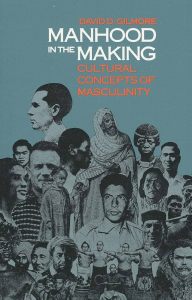
Reflections on Manhood in the Making: Cultural Concepts of Masculinity by David D. Gilmore. (1990)

This is a part of a selection of readings I gathered to reflect on what a healthy approach to masculine identity would look like. I navigated my own journey into a version of manhood in my late teens and early twenties successfully, but now in middle age I see a lot of young men struggling to navigate this journey and for a variety of reasons failing to launch into life. I come to this with humility and curiosity seeking those who may be able to articulate more clearly the journeys that may lead young men to discover a fulfilling life of work and relationships and to help those moving into the space of elders to support and guide them in this journey.

David Gilmore is an anthropologist who taught at the State University of New York whose book Manhood in the Making examines manhood as it is expressed through a number of representative cultures which have been studied by anthropologists. The groups included in the collection of studies are primarily from tribal and traditional societies which are geographically separate from larger cultural influences. With a couple of exceptions, there are expectations of a passage into manhood in these cultures and the possibility of a male child failing to navigate the expectations of manhood and being “unmanly” and unreliable in their society.  As Gilmore states,

there is a constantly recurring notion that real manhood is different from simple anatomical maleness, that it is not a natural condition that comes about spontaneously through biological maturation but rather it is a precarious or artificial state that boys must win against powerful odds. This recurrent notion that manhood is a problematic, a critical threshold that boys must pass through testing, is found at all levels of sociocultural development regardless of what other alternative roles are recognized. (11)

Or more simply, boys through culturally appropriate preparation and testing must be made into men. Simply being physically mature is not enough for the mantle of manhood. Men are made, not born. And although “being a good man” may have less focus than “being good at being a man” (30) there is in most cultures an expectation that “being good at being a man” involves providing for both kin and the larger society. “If a man rejects this provider’s role, he is said to be useless and to be dependent like a woman or like a child (Caughey 1970:69).” (73)

There are two exceptions listed in this study where the men are passive, the Tahiti and Semai. These societies with men who are conditioned to be more passive and peaceful are highlighted by some readers as an ideal for a modern society, but I don’t think these men would function well in modern society. As David Gilmore surmises as he wraps up the study, “When men are conditioned to fight, manhood is important; where men are conditioned to flight, the opposite is true.” (221) He concludes with two long statements which I will quote in their entirety because I find them very helpful:

When I started researching this book, I was prepared to rediscover the old saw that masculinity is self-serving, egotistical, and uncaring. But I did not find this. One of my findings here is that manhood ideologies always include a criterion of selfless generosity, even to the point of sacrifice. Again and again we find that “real” men are those who give more than they take; they serve others. Real men are generous, even to a fault, like the Mehinaku fisherman, the Samburu cattle-herder, or the Sambia or Dodoth Big Man. Non-men are often those stigmatized as stingy and unproductive. (229)

Men adopting the provider role provide more for their society than they take, and they will often do without so that others may have enough. One final quote from Manhood in the Making on the sacrifices men are expected to make for kin and society:

Men nurture their society by shedding their blood, their sweat, and their semen, by bringing home food for both child and mother, by producing children, and by dying if necessary in faraway places to provide safe haven for their people. This too, is nurturing in the sense of endowing or increasing. However, the necessary personal qualities for this male contribution are paradoxically the exact opposite of what we Westerners normally consider the nurturing personality. To support his family, the man has to be distant, away hunting or fighting wars; to be tender, he must be tough enough to fend off enemies. To be generous, he must be selfish enough to amass goods, often by defeating other men; to be gentle, he must first be strong, even ruthless in confronting enemies; to love he must be aggressive enough to court, seduce, and “win” a wife. (230)

I found Gilmore’s work to be helpful. At times he and his fellow anthropologists were a little overdependent on a Freudian framework, but the highlighting of the processes in these cultures to transform boys into men, something missing in any formal way in our society, and the expectation of a competent but generous masculinity in culture was helpful.

Gilmore, D. D. (1990). Masculinity in the Making: Cultural and Concepts of Masculinity. New Haven: Yale University Press.