Category Archives: Revelation

Revelation 14 The Harvest of God

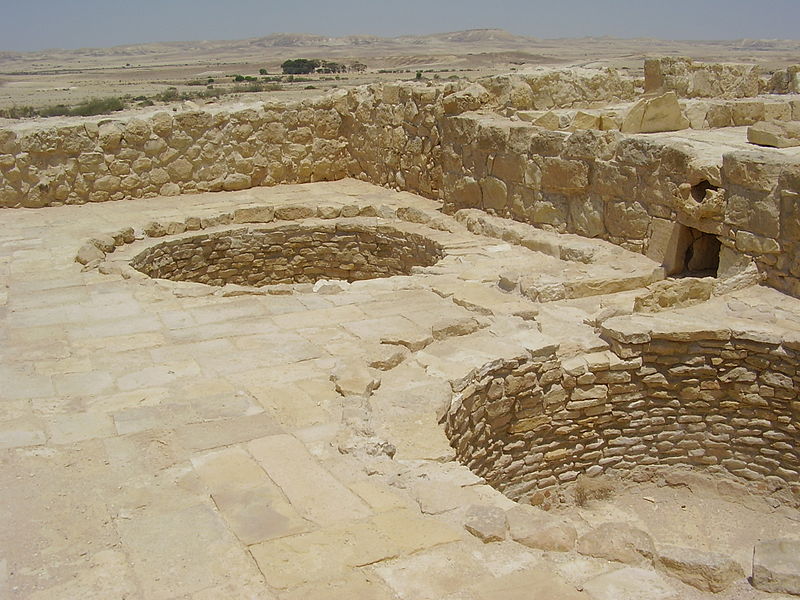
Wine Press in Shivta, photo by Avishai Teicher file licensed under Creative Commons Attribution 2.5

 Revelation 14

1 Then I looked, and there was the Lamb, standing on Mount Zion! And with him were one hundred forty-four thousand who had his name and his Father’s name written on their foreheads. 2 And I heard a voice from heaven like the sound of many waters and like the sound of loud thunder; the voice I heard was like the sound of harpists playing on their harps, 3 and they sing a new song before the throne and before the four living creatures and before the elders. No one could learn that song except the one hundred forty-four thousand who have been redeemed from the earth. 4 It is these who have not defiled themselves with women, for they are virgins; these follow the Lamb wherever he goes. They have been redeemed from humankind as first fruits for God and the Lamb, 5 and in their mouth no lie was found; they are blameless.

6 Then I saw another angel flying in midheaven, with an eternal gospel to proclaim to those who live on the earth — to every nation and tribe and language and people. 7 He said in a loud voice, “Fear God and give him glory, for the hour of his judgment has come; and worship him who made heaven and earth, the sea and the springs of water.”

8 Then another angel, a second, followed, saying, “Fallen, fallen is Babylon the great! She has made all nations drink of the wine of the wrath of her fornication.”

9 Then another angel, a third, followed them, crying with a loud voice, “Those who worship the beast and its image, and receive a mark on their foreheads or on their hands, 10 they will also drink the wine of God’s wrath, poured unmixed into the cup of his anger, and they will be tormented with fire and sulfur in the presence of the holy angels and in the presence of the Lamb. 11 And the smoke of their torment goes up forever and ever. There is no rest day or night for those who worship the beast and its image and for anyone who receives the mark of its name.”

12 Here is a call for the endurance of the saints, those who keep the commandments of God and hold fast to the faith of Jesus.

13 And I heard a voice from heaven saying, “Write this: Blessed are the dead who from now on die in the Lord.” “Yes,” says the Spirit, “they will rest from their labors, for their deeds follow them.”

14 Then I looked, and there was a white cloud, and seated on the cloud was one like the Son of Man, with a golden crown on his head, and a sharp sickle in his hand! 15 Another angel came out of the temple, calling with a loud voice to the one who sat on the cloud, “Use your sickle and reap, for the hour to reap has come, because the harvest of the earth is fully ripe.” 16 So the one who sat on the cloud swung his sickle over the earth, and the earth was reaped.

17 Then another angel came out of the temple in heaven, and he too had a sharp sickle. 18 Then another angel came out from the altar, the angel who has authority over fire, and he called with a loud voice to him who had the sharp sickle, “Use your sharp sickle and gather the clusters of the vine of the earth, for its grapes are ripe.” 19 So the angel swung his sickle over the earth and gathered the vintage of the earth, and he threw it into the great wine press of the wrath of God. 20 And the wine press was trodden outside the city, and blood flowed from the wine press, as high as a horse’s bridle, for a distance of about two hundred miles.

The triumphant tone of this chapter can be both jubilant and unsettling. For those who have undergone suffering and who are awaiting God’s decisive action they perhaps hear the distant refrain of the new song of the 144,000 proclaiming the victory of the lamb and an end to their tribulations. Yet, the image of a bloody harvest and the trampling of the great wine press of the wrath of God highlights the destructive power of God. The chapter has a militant tone which echoes in the lyrics of Julia Ward Howe’s “Battle Hymn of the Republic”

Mine eyes have seen the glory of the coming of the Lord
He is trampling out the vintage where the grapes of wrath are stored
He hath loosed the faithful lightning of his terrible swift sword
His truth is marching on

There are a number of contrasts between this vision and the vision that immediately precedes it in Revelation 13: while the dragon may stand upon the seashore the lamb stands upon the high ground of Mount Zion; while those who worshipped the beast were marked with its number the followers of the lamb bear the name of God upon their foreheads; the previous chapter showed the social cost of not conforming to the demands of the beast (or the empire) while here conformity’s cost is revealed as drinking the undiluted wine of God’s wrath. The chapter also looks forward to remaining chapters of Revelation and tells through one set of images the judgment of Babylon (Rome) what will be developed in two additional sets of images in chapters 15-16 and chapters 17-18 respectively. Much like the dragon’s defeat in heaven foreshadows the final defeat in Revelation 20, here Rome’s derivative rule will be announced here but told through the story of the harlot and the beast in Revelation 17-18. For those who have waited for God’s action the time of their waiting has ended and the time open to the possibility of repentance is quickly closing as well.

The one hundred and forty-four thousand, introduced in chapter seven, are reintroduced here. The number is a number of completeness, twelve times twelve thousand, where every tribe of Israel is sealed. They are purchased or redeemed out of humanity as a first fruit of the larger harvest that is expected and which will happen metaphorically below. As chapter seven remined us they will eventually be a part of the multitude beyond counting of every language, tribe, nation and people. These one hundred forty-four thousand are described as male virgins who have no family commitments and are free to follow the lamb wherever he goes. The old nursery song is now reversed where instead of Mary having a little lamb who follows wherever she goes the Lamb of God has these men who follow it regardless of where it goes. The virginity of these first fruits of humankind may be literal representing people unencumbered by familial ties but it also may be metaphorical referring to those who have not compromised their relationship with God or indulged in practices which Revelation views as immoral. There is a parallel with how Jeremiah uses bridal imagery for Israel in Jeremiah 2: 2-3

Go and proclaim in the hearing of Jerusalem, “Thus says the LORD: I remember the devotion of your youth, your love as a bride, how you followed me in the wilderness, in a land not sown. Israel was holy to the LORD, the first fruit of his harvest. All who ate of it were held guilty; disaster came upon them.

The figures of the one hundred forty-four thousand as chaste males also contrasts them strongly with not only those who have compromised in their faith but also sets them diametrically against the way Revelation views Rome (Babylon). Now in a striking use of language reminiscent of Jeremiah 2, the one hundred forty-four thousand represent an Israel that has remained faithful and now instead of Israel ‘playing the whore’ it is Rome (Babylon) who has made the nations drink the ‘wine of her fornication.’ This also contrasts with the public image that post-Augustan Rome tried to craft for itself being a nation of piety and law. Revelation continues to unmask the true character of Rome from the perspective of the early followers of Christ.

Three angels come announcing an eternal gospel. While many people are used to the word gospel being used to describe books out of the bible or its typical English translation of ‘good news’ the Greek word euangellion which we translate as gospel typically in Roman culture a ‘gospel’ is a proclamation on behalf of the emperor. There were gospels proclaiming the celebration of a victory (proclaiming to a people conquered their liberation by the forces of Imperial Rome) or to celebrate a birth or birthday or assumption of power related to the emperor. The language of the early Christians is full of political implications but they are people whose allegiance is to Christ, which means Messiah or King, and not to Caesar. The gospel proclaimed here is truly good news for those whose allegiance has been to Christ and who have resisted accommodating to the ways of the empire, but for those whose allegiance rests with the beasts, wittingly or unwittingly, it is the announcement of judgment. The purpose of Revelation is to encourage those who are among the faithful to continue in their perseverance even in the midst of persecution and to trust that the time of God’s action is approaching. Here the faithful have their reward and rest announced while those who have allowed the beast to have their allegiance and worship must drink the cup that has been prepared for them.

Talking about the judgment of God or the wrath of God has become unpopular in many churches and yet it is an essential, if uncomfortable, thing for Christians and the church to wrestle with unless we also want to, often unwittingly and unthinkingly, proclaim a God who either is unable to help people in the midst of their struggles or who always stands on the side of the oppressor. Christianity and Judaism before it has always believed that God takes sides, that God acts, and that God expects certain things from those who become covenant partners with God. For me one of the passages that reoriented how I think about Revelation comes from Miroslav Volf’s Exclusion and Embrace

Most people who insist on God’s “nonviolence” cannot resist using violence themselves (or tacitly sanctioning its use by others). They deem the talk of God’s judgment irreverent, but think nothing of entrusting judgment into human hands, persuaded presumably that this is less dangerous and more humane than to believe in a God who judges! That we should bring “down the powerful from their thrones” (Luke 1: 51-52) seems responsible; the God should do the same, as the song of that revolutionary Virgin explicitly states, seems crude. And so, violence thrives, secretly nourished by belief in a God who refuses to wield the sword.

My thesis that the practice of nonviolence requires a belief in divine vengeance will be unpopular with many Christians, especially theologians in the West. To the person who is inclined to dismiss it, I suggest imagining that you are delivering a lecture in a war zone (which is where a paper that underlies this chapter was originally delivered). Among your listeners are people whose cities and villages have been first plundered, then burned and leveled to the ground, whose daughters and sisters have been raped, whose fathers and brothers have had their throats slit. The topic of the lecture: a Christian attitude toward violence. The thesis: we should not retaliate since God is perfect noncoercive love. Soon you would discover it takes the quiet suburban home for the birth of the thesis that human nonviolence corresponds to God’s refusal to judge. In a scorched land, soaked in the blood of the innocent, it will invariably die. And as one watches it die, one will do well to reflect about many other pleasant captivities of the liberal mind. (Volf, 1996, pp. 303-304)

The harvest image that concludes this chapter and foreshadows the narrative of the coming chapters. The first harvest can be read as either a positive or negative image. On the positive side the harvest of wheat, barley and other grains, which were typically harvested by the sickle, indicate the end of the growing season and the gathering of the long-awaited harvest into the barns. There is no indication of the sifting of the wheat away from the tares, only the ingathering of the grain. However, the two harvests can be read together as a common bloody harvest. The images do pair the Son of Man image from Daniel 7:13 with the language of the harvest of grain and the winepress in Joel 3: 13:

Put in the sickle, for the harvest is ripe. Go in, tread, for the wine press is full.
 The vats overflow, for their wickedness is great.

Yet, I do read the first harvest as a positive image. The first reaping brings together the harvest from across the earth. The second reaping comes from the temple, which in the next chapters will be a place where judgment will come from. Although grapes are not typically harvested with a sickle, Revelation continues the metaphor to describe the harvest of the vintage of the earth. The image ends with the winepress of the wrath of God and blood flowing for two hundred miles to the depth of a horse’s bridle. On first reading it is easy to think of the God who treads this winepress as a blood thirsty God and more like the beasts than the Lamb, and while those who have undergone oppression may want to see the blood of those who shed their blood I don’t believe that vengeance is the primary function of this image, instead it is unveiling the way things are. The image of God treading the winepress echoes the beginning of Isaiah 63: 1-6

“Who is this that comes from Edom, from Bozrah in garments stained crimson?
Who is this so splendidly robed marching in his great might?”
“It is I, announcing vindication, mighty to save.:
“Why are your robes red, and your garments like theirs who tread the wine press?”
“I have trodden the wine press alone, and from the peoples no one was with me;
I trod them in anger and trampled them in wrath; their juice spattered on my garments,and stained all my robes.
For the day of vengeance was in my heart, and the year for my redeeming work had come.
I looked and there was no helper; I stared, but there was no one to sustain me;
so my own arm brought me victory, and my wrath sustained me.
I trampled down peoples in my anger, I crushed them in my wrath,
and I poured out their lifeblood on the earth

As violent as this passage is, I always imagine tears in the eyes of the personified figure of the LORD treading the wine press alone, abandoned by the world. Anger and grief are frequently close cousins and the prophets often portray an image of a grieving and wounded God seeing the state of the world or the people of God and desiring a solution. I also think it is important to pay attention to the construction of the metaphor. Ultimately, I believe this passage, like several other places in Revelation are not about prophesying some horrific scene of judgement but rather about revealing the reality of the bloodshed already present in the world. God does not transform the juice of the grapes into something it was not but rather in the press shows what the harvest of the world is in contrast to the harvest of Christ that has been brought into the barns.   As Craig Koester can insightfully state:

This scene, as in 19: 11-21, envisions an end to the injustice that has plagued the world (cf. sec. 39 COMMENT). The river of blood, which flows as high as horse’s bridle, show the magnitude of the violence that has been done on earth (14:20). It reveals why divine justice cannot be delayed indefinitely. As Christ tramples the grapes, the amount of blood that is squeezed out shows how full of brutality the world has become. From this perspective the question is not, “Why is God’s judgment so severe?” Rather, if one sees the earth as a vineyard already filled with blood, the question is like that of the martyrs: “Why has God not judged the wicked sooner?” (6:10) (Koester, 2014, pp. 630-631)

God may have desired a different harvest from the vineyard than the bloody one which was reaped, God may have desired not to tread the winepress alone and yet, the bloodshed of the earth was present even when it was not unveiled. The cry of the martyrs, “How long, O Lord” has remained unanswered until this point in Revelation. From this chapter onward the answer of the Lord is, “I will wait no longer, the time of harvest has come.” And the eyes of those watching will see the glory and the terror of the coming of the Lord, for the glory of God reveals and confronts the terror of the way things are on the earth and will soon put an end to those who have used their power to oppress and destroy the earth.

Revelation 13 Rome Portrayed as a Beast

Emperor Claudius Portraying the Conquest of Brittanica in AD 43 as the Rape of a Woman from Aphrodisias Excavations Sebasteion South Building http://aphrodisias.classics.ox.ac.uk/sebasteionreliefs.html#prettyPhoto

 Revelation 13: 1-10 The Beast from the Sea

1 And I saw a beast rising out of the sea, having ten horns and seven heads; and on its horns were ten diadems, and on its heads were blasphemous names. 2 And the beast that I saw was like a leopard, its feet were like a bear’s, and its mouth was like a lion’s mouth. And the dragon gave it his power and his throne and great authority. 3 One of its heads seemed to have received a death-blow, but its mortal wound had been healed. In amazement the whole earth followed the beast. 4 They worshiped the dragon, for he had given his authority to the beast, and they worshiped the beast, saying, “Who is like the beast, and who can fight against it?”

5 The beast was given a mouth uttering haughty and blasphemous words, and it was allowed to exercise authority for forty-two months. 6 It opened its mouth to utter blasphemies against God, blaspheming his name and his dwelling, that is, those who dwell in heaven. 7 Also it was allowed to make war on the saints and to conquer them. It was given authority over every tribe and people and language and nation, 8 and all the inhabitants of the earth will worship it, everyone whose name has not been written from the foundation of the world in the book of life of the Lamb that was slaughtered.

9 Let anyone who has an ear listen:
10 If you are to be taken captive, into captivity you go;
if you kill with the sword, with the sword you must be killed.
Here is a call for the endurance and faith of the saints.

The scene begins at the conclusion of Revelation 12 where the dragon stands upon the shore of the sea and then we enter our chapter with the first beast arising out of the sea, the second member of an unholy trinity opposed to the will of the Creator and an agent of the destruction of creation. These scenes are meant to be an unmasking of the powers, to use the title of Walter Wink’s book, but for many people unfamiliar with the rich tapestry of interweaving echoes and allusions present the beasts become an obfuscation of a simple message in John’s time: Rome’s power is not benevolent or divinely bestowed but rather is demonic and derives from the power of the devil. This is where there is a prophetic bite to the words of Revelation and where it becomes undeniably a reference to the Roman empire that seven churches in Asia found themselves living within. In contrast to the imperial claims of piety and security John uses metaphor to parody the seemingly unstoppable power of Roman might by proclaiming it is a savage beast subservient to the dragon who is the Devil and Satan.

From the Roman side the beast in particular embodies many traits that allude to Rome generally and to Emperor Nero (who will appear frequently in the explanations of this and coming chapters) in particular. John writes in the time after Nero’s death, but for the message John writes in Revelation Nero is the embodiment of the true character of the empire. In addition to the seven heads (which alludes to the seven hills around Rome and seven emperors) and the ten crowns (although emperors did not wear crowns the kings that ruled provinces on behalf of the Roman empire often did) as a representation of the empire (see also Revelation 17: 9-13) it is also helpful to know that the Jewish word for the Romans, the Kittim, also refers to people who come from the sea. The Kittim as they are mentioned in the book of Jeremiah (Jeremiah 2:10) and Ezekiel 27:6 are the people of Cypress, an island people who came across the sea but by the time of the New Testament the Kittim is a way of referring to the Romans. The head who received the death wound is almost certainly a reference to Nero who either committed suicide or was killed by a knife to the throat but rumors would persist of his remaining alive because few had seen his body.

Even some Greco-Roman authors could refer to Nero’s reign as that of a beast as Craig R. Koester can illustrate by quoting Philostratus saying,

“as for this beast, generally called tyrant, I have no idea how many heads it has,” but “its nature is wilder than the beasts of the mountains or forests” because “this beast is incited by those who stroke it” so that flattery makes it even more savage. (Vit. Apoll. 4.38.3; cf. Sib. Or. 8:157) (Koester, 2014, pp. 568-569)

Nero’s reign is also famous for the great fire that consumed much of Rome. Many believe that Nero was responsible for the blaze desiring to rebuild Rome in his own vision and even in Revelation it will be this Nero-like beast that will destroy its own city with fire (Rome as the harlot is burned by the beast in Revelation 17: 16). After the fire in 64 CE, Nero deflected criticism away from him by burning the Christian community in Rome. Tacitus records the persecution of the Christians by saying:

“Accordingly, and arrest was first made of all who pleaded guilty; then, upon their information, an immense multitude was convicted, not so much of the crime of firing the city, as of hatred against mankind. Mockery of every sot was added to their deaths. Covered with the skins of beasts, they were torn by dogs and perished, or were nailed to crosses, or were doomed to the flames and burnt, to serve as a nightly illumination, when daylight expired…it was not, as it seemed, for the public good, but to glut one man’s cruelty, that they were being destroyed. (Tacitus, Ann. 15.44) (Koester, 2014, p. 586)

Even though the churches in Asia were not on the receiving end of the persecution that occurred in Rome in 64 CE it probably remained a continual reminder of their vulnerability in the midst of the empire. Revelation wants its readers to understand that the Empire is not a benevolent and benign force but rather a beast whose trues character is revealed in its persecution of the people of God. In contrast to Christ who conquers through the cross the beast conquers through violence. Although the beast may inspire awe and fear by its military strength so that people may say, “Who is like the beast, and who can fight against it?” the early church know that they serve the Lord who has cast the great dragon out of heaven and Rome’s power is derivative from this already beaten Devil.

Those familiar with the book of Daniel will also hear a number of echoes from this book as well. Daniel and Ezekiel seem to provide the background for many of the images of Revelation and here we have a modification of the four beasts of Daniel 7, a chapter that has already appeared multiple times in our reading of Revelation. The relevant portion for our current discussion is Daniel 7: 1-8:

1In the first year of King Belshazzar of Babylon, Daniel had a dream and visions of his head as he lay in bed. Then he wrote down the dream: 2 I, Daniel, saw in my vision by night the four winds of heaven stirring up the great sea, 3 and four great beasts came up out of the sea, different from one another. 4 The first was like a lion and had eagles’ wings. Then, as I watched, its wings were plucked off, and it was lifted up from the ground and made to stand on two feet like a human being; and a human mind was given to it. 5 Another beast appeared, a second one, that looked like a bear. It was raised up on one side, had three tusks in its mouth among its teeth and was told, “Arise, devour many bodies!” 6 After this, as I watched, another appeared, like a leopard. The beast had four wings of a bird on its back and four heads; and dominion was given to it. 7 After this I saw in the visions by night a fourth beast, terrifying and dreadful and exceedingly strong. It had great iron teeth and was devouring, breaking in pieces, and stamping what was left with its feet. It was different from all the beasts that preceded it, and it had ten horns. 8 I was considering the horns, when another horn appeared, a little one coming up among them; to make room for it, three of the earlier horns were plucked up by the roots. There were eyes like human eyes in this horn, and a mouth speaking arrogantly.

In Revelation the aspects of the four beasts (which represent four empires in Daniel) are combined into the image of the beast of the sea integrating the lion, leopard, bear, ten horns all into one chimera-like combination of animals into one monster. Now instead of a single horn uttering blasphemous names all seven heads have blasphemous names in addition to the mouth uttering blasphemous things. The blasphemous names refer to the claims of divinity that were made for the emperors and the worship they received through the emperor cult. The Roman Emperors, from a Jewish or Christian perspective, were claiming titles that were reserved for God alone and in their persecution of the early Christians placed them in opposition to the coming kingdom of God and the Lamb. Just like the beasts of Daniel’s dream, the time when this beast would be destroyed was coming quickly in the vision.

Emperor Claudius portrayed astride allegories of the land and sea from
the Aphrodisias Excavations Sebasteion, south building. Image from http://aphrodisias.classics.ox.ac.uk/sebasteionreliefs.html

Revelation 13: 11-18 The Beast from the Land

11 Then I saw another beast that rose out of the earth; it had two horns like a lamb and it spoke like a dragon. 12 It exercises all the authority of the first beast on its behalf, and it makes the earth and its inhabitants worship the first beast, whose mortal wound had been healed. 13 It performs great signs, even making fire come down from heaven to earth in the sight of all; 14 and by the signs that it is allowed to perform on behalf of the beast, it deceives the inhabitants of earth, telling them to make an image for the beast that had been wounded by the sword and yet lived; 15 and it was allowed to give breath to the image of the beast so that the image of the beast could even speak and cause those who would not worship the image of the beast to be killed. 16 Also it causes all, both small and great, both rich and poor, both free and slave, to be marked on the right hand or the forehead, 17 so that no one can buy or sell who does not have the mark, that is, the name of the beast or the number of its name. 18 This calls for wisdom: let anyone with understanding calculate the number of the beast, for it is the number of a person. Its number is six hundred sixty-six.

I mentioned in the section above how the two beasts and the dragon form an unholy trinity opposed to the will of the Creator and bent upon the destruction of the creation. The beast from the land becomes the third member of this alliance deriving its power both from the beast from the sea and, by extension, from the dragon who stands behind the first beast. Where the first beast represents Rome, the second beast represents the cult of the emperor and the forces that proclaimed the message of Rome. The image of a beast that in many ways resembles a lamb but speaks like a dragon points to the reality that it is a wolf in sheep’s clothing-it may appear to be harmless but it is not. This metaphor of a beast like a lamb with a dragon’s voice causes those who resist its proclamation of the first beast to be put to death. The ruler cult here is placed in opposition to the people of God. Using several resonant images combined it unmasks the destructive character of the forces at work in economic, religious and social pressures designed to make people conform to the desires of the empire.

On the one hand the two beasts may allude to Leviathan and Behemoth, great chaos creatures from the land and sea that appear as threatening beasts to the ancient people and who appear as figures in the poetic imagery in the Psalms and Isaiah. A stronger correlation in Jewish tradition would be the traditions about false prophets who lead people astray and here the beast is a false prophet who leads people to deify the beast and turn away from the King of kings. Yet, even stronger for me, is the resonance with two familiar stories from the book of Daniel (as mentioned above Daniel and Ezekiel seem to provide background images that many of the images of Revelation resonate with). The first story in Daniel is from Daniel 3 when King Nebuchadnezzar has a golden statue erected and declares, “Whoever does not fall down and worship shall immediately be thrown into a furnace of blazing fire.” (Daniel 3:6) and the heroes of our story, three Jewish exiles renamed in Babylon Shadrach, Meshach and Abednego, refuse to worship the golden statue. A central to Jewish (and later Christian) faith was the statement that there are no gods that are to be worshipped before the LORD the God of Israel and in keeping with this central portion of their faith they refuse and are cast into the flaming furnace. Shadrach, Meshach and Abednego are rescued by God in the midst of the fiery furnace and the people are reminded to remain steadfast in their faith in the midst of the oppression of Babylon. Later in the book of Daniel (Daniel 6) the current king, Darius, is tricked into making a proclamation that all must pray to him for thirty days. Daniel knows the document has been signed and is the law and yet he continues to pray to God. Daniel is cast into the lions’ den, but God closes the mouth of the lions and Daniel is safe while those who accused Daniel, along with their families, are thrown into the lions’ den and are consumed by the lions. Both of these stories helped people of faith remain faithful during times of persecution and to trust that God would ultimately deliver them from the empire of the day and the claims made on behalf of rulers.

The action of the second beast to make others worship the first beast is accompanied by violence, false signs, and social and economic pressures. Violence is used against those who do not comply, who will not worship the emperor and by extension Rome. For these false prophets there is to be no alternative gospel. There was no freedom of the press nor separation of church and state in the ancient world and the imperial cult, as well as most other religions in the empire, were viewed as being in service of the state. The gospel of Rome may have fashioned itself as the Pax Romana, the peace of Rome, but it was a bloody peace spoken with a dragon’s voice and enforced through the violence of both the legions and the local authorities. While we are not aware of any miracles claimed by the imperial cult there is the continual demonstration of the power and might of Rome and as mentioned in the previous section, ‘Who can fight against it.’ Finally, is the social and economic pressure particularly highlighted by the mark of the beast.  Being a part of the imperial cult could bring a feeling of belonging, but it also allowed people the ability to participate in commercial opportunities. The mark may have been an allusion to the requirement to be a part of a trade organization, many of whom may have required people to demonstrate their allegiance to the emperor, or it may refer to Roman coinage, who many Jewish and early Christians viewed as containing blasphemous messages even though it was the medium of trade for the empire, or it may have referred to other types of pressures that Christians felt to demonstrate they were loyal.

The number of the beast which is a number for a person. In the ancient world gematria, adding up the numerical values of a word, was commonly used. Most historical readers assumed the name would have been known to John’s audience and the most common reading is Nero. Nrwn Qsr, as it is written in Greek (the language of the New Testament) is 666. When transliterated into Hebrew it comes to be 616 which is a common alternative to 666 in some ancient manuscripts. The number has been used to represent many individuals by different interpreters across time, but Nero was probably the individual that the first readers of John’s letter were to hear in this number.

Finally, a brief word about a word that does not appear in Revelation but is commonly linked with this chapter: Antichrist. The Antichrist appears as an opponent in 1 & 2 John which replace the true faith with a faith that is, from the author of the Johannine Epistles perspective, false. Matthew, Mark and Luke can mention false messiahs and 2 Thessalonians develops a theme from the book of Daniel about ‘the man of lawlessness’ who receives power from Satan but it is only in 1 & 2 John where the word Antichrist is used. The term is helpful in thinking about Revelation in the understanding that the second beast is in many ways the opposite of Christ and against Christ (what the anti- prefix means). But historically there is a desire to locate in one figure the role of an Antichrist: so, for Luther the pope could be the Antichrist, others would point to figures like Hitler or Stalin as the Antichrist or look for some futuristic figure. While I am uncomfortable when people use the term as an absolute title, searching for the Antichrist, as an adjective I find it is helpful. Is a concrete person acting in a way that is the opposite or opposed to Christ? Then the adjective can be illustrative. Yet, I still wouldn’t throw it around casually. Nor would I commonly refer to someone as a beast, as Revelation does, yet metaphor has its power. Revelation uses images both for illustration and parody, it wants its readers to see the world in the way that John is being enabled to see but it also wants to demonstrate the difference between the claims of, in this case, the Roman empire and its servants and its reality. Revelation continues to be powerful because its metaphors and parodies continue to resonate for people in multiple times, places and experiences to make sense of the reality of their world and to be reminded that whatever savage beasts that they are facing, no matter the bellow of the dragon and its servants that their God is ultimately able to allow them to persevere no matter the oppression they may experience.

Revelation 12 The Woman and the Dragon

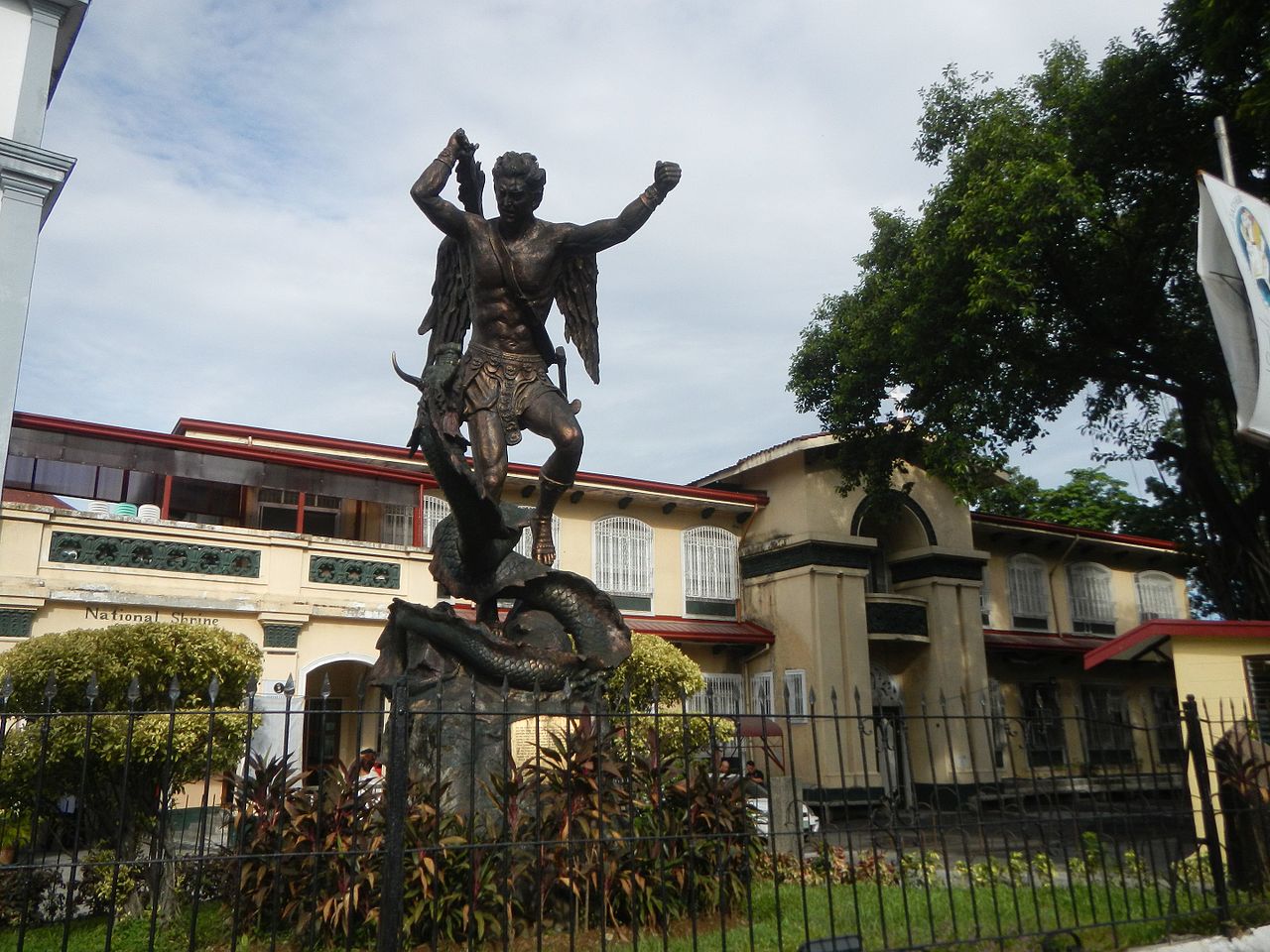
Saint Michael bronze statue at San Miguel Church (Manila) The Regal Parish and National Shrine of Saint Michael and the Archangels

Revelation 12

1 A great portent appeared in heaven: a woman clothed with the sun, with the moon under her feet, and on her head a crown of twelve stars. 2 She was pregnant and was crying out in birth pangs, in the agony of giving birth. 3 Then another portent appeared in heaven: a great red dragon, with seven heads and ten horns, and seven diadems on his heads. 4 His tail swept down a third of the stars of heaven and threw them to the earth. Then the dragon stood before the woman who was about to bear a child, so that he might devour her child as soon as it was born. 5 And she gave birth to a son, a male child, who is to rule all the nations with a rod of iron. But her child was snatched away and taken to God and to his throne; 6 and the woman fled into the wilderness, where she has a place prepared by God, so that there she can be nourished for one thousand two hundred sixty days.

7 And war broke out in heaven; Michael and his angels fought against the dragon. The dragon and his angels fought back, 8 but they were defeated, and there was no longer any place for them in heaven. 9 The great dragon was thrown down, that ancient serpent, who is called the Devil and Satan, the deceiver of the whole world — he was thrown down to the earth, and his angels were thrown down with him. 10 Then I heard a loud voice in heaven, proclaiming,

“Now have come the salvation and the power and the kingdom of our God and the authority of his Messiah, for the accuser of our comrades has been thrown down, who accuses them day and night before our God. 11 But they have conquered him by the blood of the Lamb and by the word of their testimony, for they did not cling to life even in the face of death. 12 Rejoice then, you heavens and those who dwell in them! But woe to the earth and the sea, for the devil has come down to you with great wrath, because he knows that his time is short!”

13 So when the dragon saw that he had been thrown down to the earth, he pursued the woman who had given birth to the male child. 14 But the woman was given the two wings of the great eagle, so that she could fly from the serpent into the wilderness, to her place where she is nourished for a time, and times, and half a time. 15 Then from his mouth the serpent poured water like a river after the woman, to sweep her away with the flood. 16 But the earth came to the help of the woman; it opened its mouth and swallowed the river that the dragon had poured from his mouth. 17 Then the dragon was angry with the woman, and went off to make war on the rest of her children, those who keep the commandments of God and hold the testimony of Jesus. 18 Then the dragon took his stand on the sand of the seashore.

The previous chapter gives us a key to understanding the unfolding images of the second half of Revelation when the twenty-four elders proclaim:

The nations raged but your wrath has come, and the time for judging the dead, for rewarding your servants, the prophets and saints and all who fear your name, both small and great, and for destroying those who destroy the earth. (Revelation 11: 18 emphasis added)

Up through the first eleven chapters of Revelation the cycle of the seals and trumpets may have caused destruction, but the desire was for those who were opposed to God and who were a part of the forces destroying the earth to see the Lord’s wrath, to hear the witness of the faithful and to repent. Now the narrative shifts decisively against those forces that are destroying the creation. The battle begins in chapter 12 with Satan being cast out of heaven and culminates with the casting of Satan into the lake of fire in Revelation 20.  Revelation in these chapters is revealing how the struggles the faithful are enduring are a part of the epic struggle between good and evil and how their faithful witness to the crucified and risen Jesus and their perseverance until the end is a part of the larger ways in which God’s kingdom overcomes the destructive forces aligned with the devil.

Revelation 12 is organized around three scenes with the critical scene in the middle. Scene A (1) runs from verse 1-6 and deals with the woman who gives birth and the dragon who wants to destroy her child. Scene B deals with the dragon being expelled from heaven by the angel Michael. Scene A (2) returns to the dragon pursuing the woman and making war on her and all her children. So visually the organization would look like:

Scene A (1) The woman in labor pursued by the dragon
Scene B The dragon is cast out of heaven
Scene A (2) The dragon makes war against the woman

There are a couple ways to interpret the figure of the woman: she could be viewed as Israel, as the church or as Mary. Ultimately these approaches are not mutually exclusive and interpreters throughout the history of the church have seen her in multiple ways. If she is Israel, then allegorically she is giving birth to Jesus, the child who the dragon wants to destroy, and the twelve stars could be the twelve tribes of Israel. The woman also could represent the church as the people of God. As we have seen earlier in Revelation, John has no trouble speaking of the church in terms of Israel’s vocation and promises and even Victorinus, who wrote the earliest known commentary on Revelation in the third century, the woman encompassed both Israel and the early church. (Koester, 2014, p. 525) If it is interpreted as the early church exclusively then the twelve stars become the twelve apostles allegorically. Finally, the story of the birth could be a cosmic explanation of the birth of Christ from Mary, his mother. This approach was favored especially as the Catholic church developed a high Mariology. As I mentioned above these approaches are not mutually exclusive: the church is viewed by John as having a vocation that is described in the same terms as the people of Israel had their vocation described and Mary has often been represented as the mother and representative of the church as a whole. In my reading I do see this being the case: the woman is Mary, but she is also by representation the whole people of God who the dragon is attempting to persecute. The dragon works through Herod the Great to bring a threat to Mary’s child and she is snatched away to flee through the wilderness into Egypt, but it also represents the displacement of the people of God who are also scattered by the oppression they feel. Mary’s story viewed in this light becomes their story and their story is linked to hers. They become, with her, a part of the cosmic drama unfolding as God begins to deal with the forces that are destroying the earth.

The dragon is named as the Devil and Satan. There are countless narratives in the ancient world of the conflict between and hero and a dragon, where the dragon represents the terrifying forces of uncontrollable destruction but here there is a difference. For example, in the Greek story of Leto and Apollo being pursued by the serpent Python or the goddess Isis being pursued by Typhon may have a similar pattern of a serpent creature attempting to destroy a goddess or god, but the specifics of the stories vary greatly. Ultimately the seven headed dragon is the source of all the forces that oppose the will of God and the coming of the child and that the beasts in the next chapter will derive their power from. Yet, the dragon here is cast out of heaven which both initiates the process that will ultimately lead to the dragon’s destruction but also increases its wrath and influence upon the earth.

The middle scene where Michael and his angels fight against the dragon and defeat them provide the interpretive key for both this chapter and the rest of Revelation.  As Craig Koester can succinctly state:

Then a heavenly voice announces the victory of God, the Lamb and the faithful and warns that the devil is furious because he has only a short time left in which to work (12:10-12). The point is that the evil one does not rage so fiercely on earth because he is so powerful, but because he is losing and desperate. Satan lashes out like a caged and wounded animal before his final defeat. (Koester, 2014, p. 555)

The banishment of Satan from heaven is a demonstration of the limits of the power of his malice but it is still a woe to those who must deal with his attempts to persecute them on earth. I’ve used a historical example when talking about this with members in my congregation: during the Civil War the decisive battle was ultimately Gettysburg, the war would rage on for years after this battle, but the Confederate army’s strategy would be dictated from that point onward by the superior manpower and logistics of the Union. The only way there could have been a different outcome after Gettysburg was if the Northern states decided the war was too costly or no longer worth fighting. Here in Revelation we are to see that the dragon has already been defeated, and it only took an emissary of God to cast down the great dragon. The conflict may continue for those who are aligned with God’s will and who are faithful to the Lamb, but the final victory is certain.

The woman returns in the final scene and becomes, along with her children the object of pursuit by the dragon. Yet now both heaven and earth work against the dragon. The woman in the vision is given the ability to fly away into the wilderness where she is protected for a time, and times and a half time. Even the earth itself works to protect the woman by opening its mouth to swallow the flood that the dragon pours out to attempt to overwhelm her. This is truly a cosmic struggle where the earth itself resists the forces that have set out to destroy the woman and the rest of creation.

This chapter, like the previous chapter have several parallel images with Daniel 12, and these images will figure heavily in the coming chapters of Revelation. Here two images reflect directly on this chapter: at the beginning of Daniel 12 we have the emergence of Michael.

“At that time Michael, the great prince, the protector of your people, shall arise. There shall be a time of anguish, such has never occurred since nations first came into existence. But at that time your people shall be delivered, everyone who is found written in the book. Daniel 12: 1

Michael is the guardian of the Jewish people in Daniel who rises to protect them during their persecution. Here Michael’s action on behalf of the woman/Israel/church/people of God sets in motion the beginning of the end for the Devil, but also in doing so initiates a time of great suffering for those on earth. The time of the woman’s residence in the wilderness also echoes the time, two times and a half time of Daniel 12: 7. In addition to the two images from Daniel 12, the casting of the stars from the heavens by the dragon also echoes Daniel 8: 10 when a blasphemous horn grows as high of the host of heaven and throws down some of the stars to the earth. Revelation takes several of these images from the book of Daniel and they become language used to describe this cosmic battle between the forces that are opposed to God and the creation and the forces that may seem small and insignificant, the woman and her children, but ultimately are aligned with the forces of God and heaven and whose victory will eventually come.

Revelation 11 Pausing for Hope, Witness and Worship

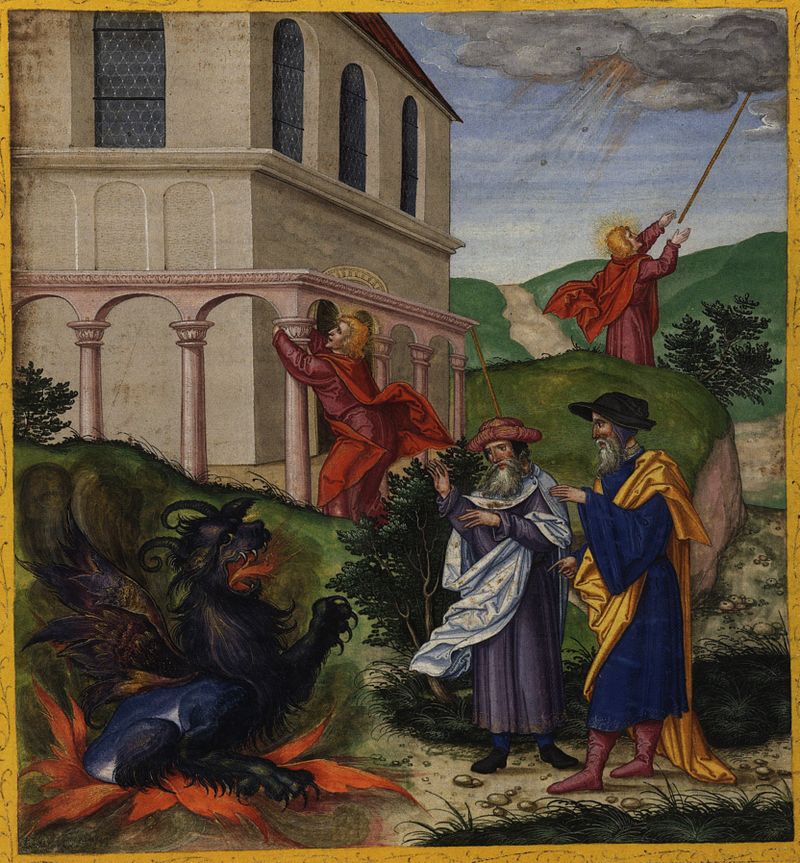
Matthias Gerung from the Ottheinrich Bible (1530-1532)

Revelation 11:1-2 Measuring the Temple

1 Then I was given a measuring rod like a staff, and I was told, “Come and measure the temple of God and the altar and those who worship there, 2 but do not measure the court outside the temple; leave that out, for it is given over to the nations, and they will trample over the holy city for forty-two months.

John is not merely an observer in the receiving of Revelation, but actively is called to participate in symbolic actions that help provide meaning. This measurement of the temple has a close correlation to Ezekiel 40 where the LORD has Ezekiel observe the measurement of the temple to demonstrate that the exile that Ezekiel and his fellow Judeans were a part of would last only for a time. In addition, the period articulated matches the period at the end of Daniel for the duration until the end of the wonders (and persecution) of the people who receive Daniel’s message (which most scholars date late in the time of the persecution under Antiochus Epiphanies IV in the time of the revolt of the Maccabees, roughly 166 BCE). Here is where Daniel asks how long this will last:

Then I, Daniel, looked, and two others appeared, one standing on this bank of the stream and one on the other. One of them said to the man clothed in linen, who was upstream, “How long shall it be until the end of these wonders?” The man clothed in linen, who was upstream, raised his right hand and his left hand toward heaven. And I heard him swear by the one who lives forever that it would be for a time, two times, and half a time, and that when the shattering of the power of the holy people comes to an end, all these things would be accomplished. (Daniel 12: 5-7)

A time, two times, and a half a time is three and a half and when the unit of time is years the forty-two months is three and a half years. This is also the one thousand two hundred and sixty days below (based on a thirty-day month). This extended quotation from Daniel also resonates with the figure of the angel in Revelation 10 who stands on the land and the sea and lifts his hand to the heavens. By combining resonant images of Daniel and Ezekiel, both images of hope during persecution, the act of measuring the temple and the time set aside point to the limited duration of the suffering of the churches hearing this message. Ultimately the God who unveils to John these images will bring an end to the trampling of the holy people of God.

Philip Medhurst, Revelation 11: 7-12 The Beast Shall Fight Against Them

Revelation 11: 3-14 The Witnesses

3 And I will grant my two witnesses authority to prophesy for one thousand two hundred sixty days, wearing sackcloth.”4 These are the two olive trees and the two lampstands that stand before the Lord of the earth. 5 And if anyone wants to harm them, fire pours from their mouth and consumes their foes; anyone who wants to harm them must be killed in this manner. 6 They have authority to shut the sky, so that no rain may fall during the days of their prophesying, and they have authority over the waters to turn them into blood, and to strike the earth with every kind of plague, as often as they desire.

7 When they have finished their testimony, the beast that comes up from the bottomless pit will make war on them and conquer them and kill them, 8 and their dead bodies will lie in the street of the great city that is prophetically called Sodom and Egypt, where also their Lord was crucified. 9 For three and a half days members of the peoples and tribes and languages and nations will gaze at their dead bodies and refuse to let them be placed in a tomb; 10 and the inhabitants of the earth will gloat over them and celebrate and exchange presents, because these two prophets had been a torment to the inhabitants of the earth.

11 But after the three and a half days, the breath of life from God entered them, and they stood on their feet, and those who saw them were terrified. 12 Then they heard a loud voice from heaven saying to them, “Come up here!” And they went up to heaven in a cloud while their enemies watched them. 13 At that moment there was a great earthquake, and a tenth of the city fell; seven thousand people were killed in the earthquake, and the rest were terrified and gave glory to the God of heaven.

14 The second woe has passed. The third woe is coming very soon.

Revelation continues to portray a God who desires for the people to place their trust in God instead of the forces that are opposed to God. Revelation continues its long pause to make a space for witness to the world so that the nations may give glory to God. During this one thousand two hundred sixty-day period we are introduced to the two witnesses that are two olive trees and two lampstands whose mission is to prophesy and proclaim God’s power, might and desires against the forces of the beast and Satan who is behind the beast. These verses foreshadow the larger narrative that will unfold in Revelation 12-13 which symbolically portray the devil and Rome as a dragon and beast respectively.

The identity of the witnesses has been debated and different interpreters have come to different answers about these witnesses. Some interpreters believe that the two witnesses are two concrete individuals who are given this task and specific powers which enable them to carry out this task. These two individuals would have the powers demonstrated by Elijah and Moses previously in scripture. Some have taken the two witnesses to be Elijah and Moses returned, other Elijah and Enoch (since both were bodily brought up into heaven) and others take these two witnesses to stand for the church or a portion of the church. Regardless of who one takes as the witnesses in one’s interpretation the message of the witnesses is clear and like prophets of all times and places they are viewed as a hindrance to the powers that claim to be in control. Eventually the beast (who we will see shortly is a way of representing Rome) acts to eliminate the pesky witnesses and many people rejoice that they have been silenced. Yet, God stands on the side of the witnesses and death is not the final word. The beast and those with the beast can persecute the witnesses of God but the God of Revelation is a God of resurrection. They may know humiliation and even death for a time, two times and a half a time but God will invite them to take their places at God’s kingdom.

The city, unnamed but indicated by what it is prophetically called as well as its location as where the Lord is crucified points to Jerusalem. Like all things in this vision there is a plasticity that has allowed interpreters to point to multiple interpretations but as I lay out my reading I start with the plain sense reading of the place where the witnesses begin their work being in Jerusalem. For me this scene deals with the mission of the whole church, since it is the work of the whole church to witness and to call for all the peoples, language, nations and tribes to turn to God. Are there unique witnesses within the whole? Certainly, but all are called to the vocation of witnesses. There are times where the church’s ability to speak and respond seems dead or powerless but ultimately this is a narrative of God’s power and control, God can resurrect a dead witness or a dead church. For me an interesting part of this narrative is the earthquake and its response: in the earthquake the damage is reduced from previous calamities (from one fourth in the seals, one third in the trumpets but here one tenth) and response is to give glory to God. Again, taking the city as Jerusalem I take this as a suggestive nod towards an acknowledgement by the people of Jerusalem (and by extension Israel) of the sovereignty of God. Even though the church symbolically assumes many of the roles of Israel throughout Revelation I view this portion in line with Paul’s argument in Romans 9-11 about the irrevocable call of God to Israel.

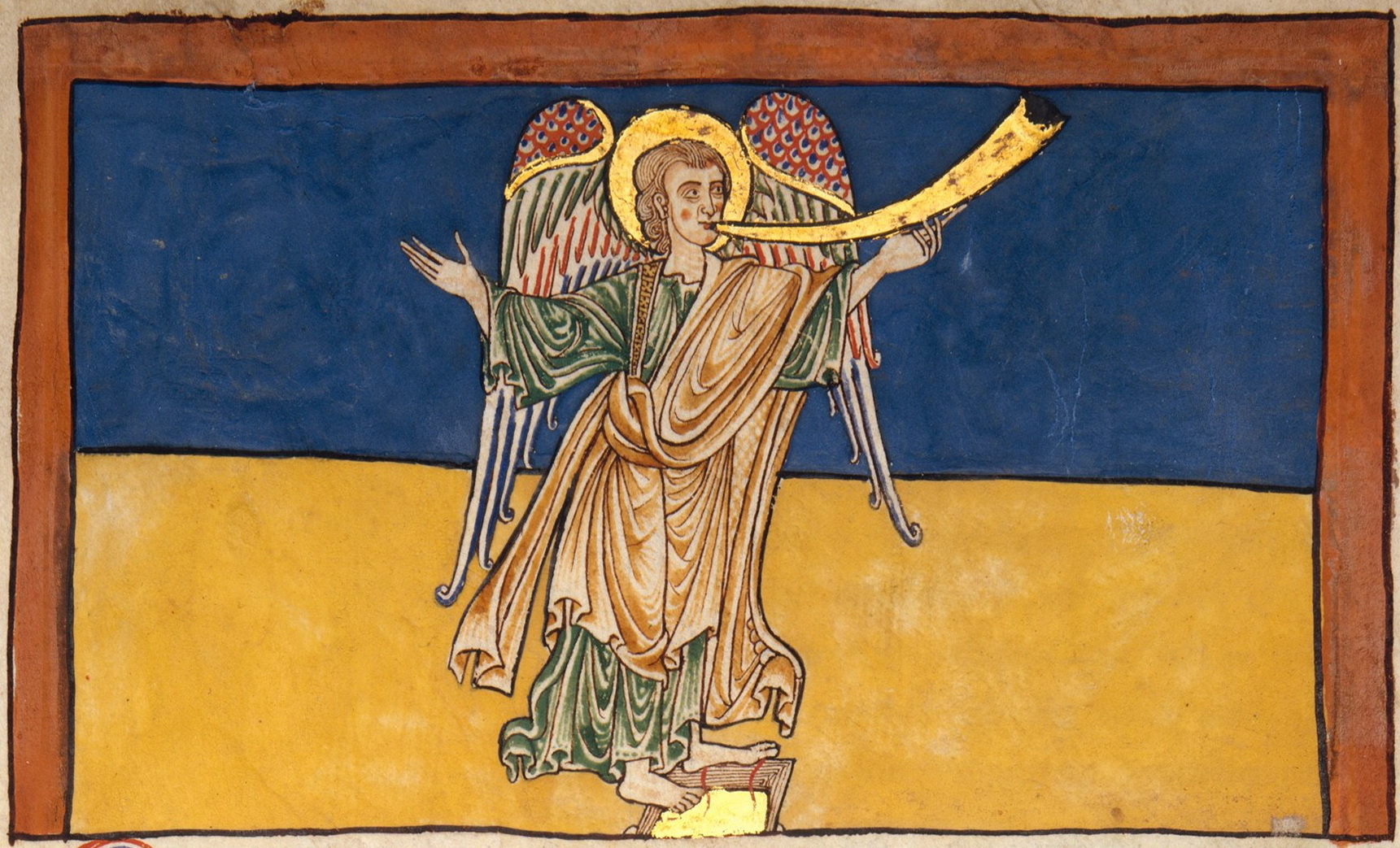
The Seventh Angel of the Apocalypse Proclaiming the Reign of the Lord, Unknown Spanish Miniaturist around 1180

Revelation 11: 15-19 The Final Trumpet

15 Then the seventh angel blew his trumpet, and there were loud voices in heaven, saying,

“The kingdom of the world has become the kingdom of our Lord and of his Messiah, and he will reign forever and ever.”

16 Then the twenty-four elders who sit on their thrones before God fell on their faces and worshiped God, 17 singing,

“We give you thanks, Lord God Almighty, who are and who were, for you have taken your great power and begun to reign. 18 The nations raged, but your wrath has come, and the time for judging the dead, for rewarding your servants, the prophets and saints and all who fear your name, both small and great, and for destroying those who destroy the earth.”

19 Then God’s temple in heaven was opened, and the ark of his covenant was seen within his temple; and there were flashes of lightning, rumblings, peals of thunder, an earthquake, and heavy hail.

The preceding section warns us that the third woe is coming soon and upon the final trumpet blast we are prepared for that final woe to come, and yet we instead see a different perspective on reality. We expect to focus on the earth and the chaos and struggle on the earth but instead we find ourselves focused on heaven and the order and worship and praise going on as the world is declared the kingdom of God. This is a pivotal scene in Revelation because the coming chapters we will see how in multiple symbolic ways the agents who have been at work destroying God’s order and creation are first unmasked and then overthrown. Satan will be banished from heaven; Rome and its heralds will be shown as beasts serving Satan and then later as a prostitute but both Rome and Satan’s power will come to an end. Here we have the announcement that God is now moving towards the earth. The desire of God to be a part of the creation and to dwell among God’s people will no longer wait. God’s time of patient waiting to give space and time for repentance are coming to an end. God’s power is being revealed, God’s covenant with God’s people is being renewed and in heaven there is worship.

Revelation continues to remind its reader that even though chaos may appear to reign on earth that God’s will indeed be done on earth as it is in heaven. The nations may rage but God’s judgment will decide the final victory, those servants who have been oppressed, misused and who have felt powerless will be rewarded. It is a time where the powerful will be brought low and the meek will be lifted up. For the faithful this is a time of celebration and joy while for those who have aligned themselves against God it is an announcement of God’s coming in strength and power.

Revelation 10 The Angel, The Scroll and the Prophet

The Angel with the Little Book, Bamberger Apocalypse Folio 25

Revelation 10

1 And I saw another mighty angel coming down from heaven, wrapped in a cloud, with a rainbow over his head; his face was like the sun, and his legs like pillars of fire. 2 He held a little scroll open in his hand. Setting his right foot on the sea and his left foot on the land, 3 he gave a great shout, like a lion roaring. And when he shouted, the seven thunders sounded. 4 And when the seven thunders had sounded, I was about to write, but I heard a voice from heaven saying, “Seal up what the seven thunders have said, and do not write it down.” 5 Then the angel whom I saw standing on the sea and the land raised his right hand to heaven 6 and swore by him who lives forever and ever, who created heaven and what is in it, the earth and what is in it, and the sea and what is in it: “There will be no more delay, 7 but in the days when the seventh angel is to blow his trumpet, the mystery of God will be fulfilled, as he announced to his servants the prophets.”

8 Then the voice that I had heard from heaven spoke to me again, saying, “Go, take the scroll that is open in the hand of the angel who is standing on the sea and on the land.” 9 So I went to the angel and told him to give me the little scroll; and he said to me, “Take it, and eat; it will be bitter to your stomach, but sweet as honey in your mouth.” 10 So I took the little scroll from the hand of the angel and ate it; it was sweet as honey in my mouth, but when I had eaten it, my stomach was made bitter.

11 Then they said to me, “You must prophesy again about many peoples and nations and languages and kings.”

Revelation does not press on inexorably towards judgment, instead it holds back since judgment by itself doesn’t seem to bring about repentance. We are continually reminded amid the chaos that is unleashed upon the earth that the forces that are at work for destruction are not comparable to the forces that God commands. Even as the first two woes have been unleashed the textual progression of Revelation takes a long pause to take our vision away from the death and destruction to prepare John, and by extension the churches that John is writing to, for their critical mission of witness. Here the mighty angel and the little scroll prepare the prophet and those who hear for the immediacy of their mission for there is no longer any time to delay.

Revelation operates in a world of paradoxes: on the one hand God is the primary actor who can unleash or restrain the forces of death and destruction but, on the other hand God chooses to work through individuals who may seem powerless compared to the mighty and powerful of the earth. God seems to choose the lowly to bring down the mighty from their thrones, the foolish to teach the wise and the exiled prophet speaks his words of prophecy to the peoples and nations and languages and kings. The churches of Asia may be a tiny minority amid the Roman empire and yet they serve a God whose power makes the might of Rome or any empire seem inconsequential.

The initial image of the angel standing astride the sea and land reflects God’s claim as the true Lord of all the creation but as we will see later in Revelation God’s dominion will be contested. Rome will be represented in Revelation 13 as a beast from the sea and a beast from the earth speaking against the dominion of God. The visual imagery discovered in the excavation of the imperial temple at Aphrodisias is strikingly similar to the description of the angel in this chapter. As the Aphrodisias excavation project describes the image:

Claudius with allegories of land and sea. Sebasteion, south building. Image from http://aphrodisias.classics.ox.ac.uk/sebasteionreliefs.html

The emperor strides across the panel in vigorous motion, framed behind by a billow of drapery, which in ancient iconography indicated floating, flying, and as here, divine epiphany. He receives in his right hand a cornucopia with the fruits of the earth from a small figure emerging from the ground. On the right he receives a steering oar from a sea figure or marine tritoness. She has fish legs and a fish-scale skirt. The cornucopia and the steering oar symbolize the prosperity of land and sea under the emperor’s rule. The composition is an arresting visualization of the Roman emperor as an all powerful hellenistic-style divinity as seen from the eastern provinces. The awkward, rather gauche handling of the proportions of the emperor’s body indicates that the composition was designed locally. There were no public monuments in Rome that portrayed such an elevated, panegyrical conception of the emperor’s role. (http://aphrodisias.classics.ox.ac.uk/sebasteionreliefs.html, accessed July 3, 2018)

In contrast to the claims made about Caesar in images like this and in the imperial cult it is now an emissary from God who places one foot on the land and one on the sea, who is wrapped in a rainbow and who demonstrates the power of God. The angel carries a little scroll which is probably a copy of the scroll that was unsealed earlier in Revelation. The angel is powerful, and his shout is like a lion’s roar and the thunders speak in response. The thunders, which could be the seven angels around the throne or could be God’s voice. In this case since it is seven thunders it probably refers to the angels around the throne answering the angel on the sea and land. Yet, the words are not to be written down and what was said was not for ears beyond John’s It is sealed up and unlike in Daniel the words are not sealed up to an appointed time, here they are not to be shared.

With the angel’s announcement we hear the conflicting time schedule of Revelation. On the one hand we are in a pause so that John and the church can witness, the seventh trumpet has not sounded and there will be a period of forty-two months where the witnesses will testify, on the other hand there is no more time (or as the NRSV translates this passage there will be no more delay). God’s mystery is about to be revealed, God’s kingdom is coming, and God’s dominion will spread over the land and sea, to peoples, nations, languages and kings.

John in the role of a prophet is having the mystery of God revealed to him to share with others. The language echoes Amos 3:7:

Surely the LORD God does nothing, without revealing his secret to his servants the prophets.

John now also receives an additional commissioning in the pattern of Ezekiel. He is commanded, like the prophet Ezekiel to eat an offered scroll (Ezekiel 3:3) and while it is sweet to the taste, like in Ezekiel, it is bitter in the stomach. A prophet is called to bear unpleasant truths to those who they are sent to and the prophet’s words are often unheard or ignored. The experience of the prophet is often one of disappointment and rejection. They are called to go out to the world and call for repentance. Yet, they are often broken hearted as their words go unheeded and as the consequences of people’s actions bear their unfortunate fruit. Yet, God’s love for the world and the people of it seems to require God to send God’s very best to witness, be rejected and suffer so that some might repent. Perhaps the bitterness of the scroll is the price that the prophet bears for entering the space between God and the world.

Revelation 9: The First Two Woes

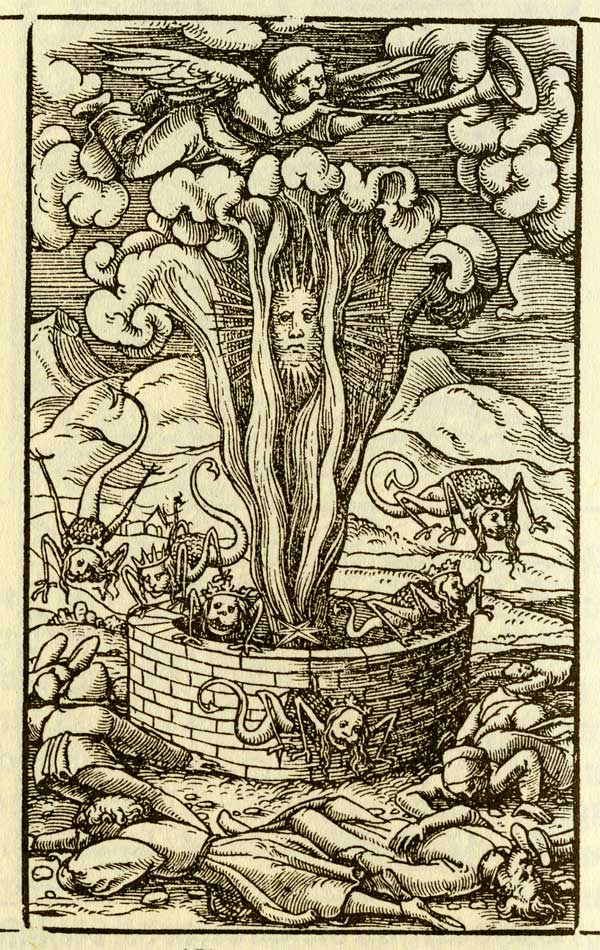
Hans Holbein from the 1531 Zwingli bible

Revelation 9: 1-12: The First Woe-The Locusts of the Abyss

1 And the fifth angel blew his trumpet, and I saw a star that had fallen from heaven to earth, and he was given the key to the shaft of the bottomless pit; 2 he opened the shaft of the bottomless pit, and from the shaft rose smoke like the smoke of a great furnace, and the sun and the air were darkened with the smoke from the shaft. 3 Then from the smoke came locusts on the earth, and they were given authority like the authority of scorpions of the earth. 4 They were told not to damage the grass of the earth or any green growth or any tree, but only those people who do not have the seal of God on their foreheads. 5 They were allowed to torture them for five months, but not to kill them, and their torture was like the torture of a scorpion when it stings someone. 6 And in those days people will seek death but will not find it; they will long to die, but death will flee from them.

7 In appearance the locusts were like horses equipped for battle. On their heads were what looked like crowns of gold; their faces were like human faces, 8 their hair like women’s hair, and their teeth like lions’ teeth; 9 they had scales like iron breastplates, and the noise of their wings was like the noise of many chariots with horses rushing into battle. 10 They have tails like scorpions, with stingers, and in their tails is their power to harm people for five months. 11 They have as king over them the angel of the bottomless pit; his name in Hebrew is Abaddon, and in Greek he is called Apollyon.

12 The first woe has passed. There are still two woes to come.

The first four trumpets saw the earth and sea and sky become the bearers of God’s judgment to provide an opportunity for the recalcitrant portions humanity to repent. Now in the fifth trumpet the recipients of the suffering begins to shift to humanity and specifically the portions of humanity not sealed with the seal of God. Like in the book of Exodus where the chosen people of Israel are not inflicted with the signs and wonders that God does against Egypt; so here the Israel sealed and protected will not be stung by the demonic locust swarm that is released from the abyss.

While the star that fell in Revelation 8:10 was referring to a meteor which falls from the heavens into the waters of the earth contaminating them the star here most likely refers to an angel of God. In Revelation 1: 20 we see the seven stars referred to as the seven angels of the churches. Some have taken this figure to be Satan falling from heaven coming to unleash the forces of the abyss and while this is possible (and there is language later in Revelation about Satan being cast out of heaven as well Jesus’ statement in Luke 10:18 about seeing Satan fall from heaven like a flash of lightning) it seems odd that God or an agent of God would hand Satan the key to the abyss. Initiating the first woe an angel opens the demonic realm of the abyss.

The abyss in Revelation is a demonic realm. It is not the same as under the earth, where the creatures that live there will give God praise. Instead this is the realm of the Destroyer and those forces that are opposed to the Creator. In Revelation 11 the beast will come up from the abyss, and in Revelation 20 Satan will be confined there. John observes the abyss being opened and the smoke arising from it along with the emergence of the locusts, but John does not dwell on the abyss itself and instead focuses on the impact of the abyss being opened upon the people of the earth.

These first two woes demonstrate a removal of restraints by God. The creatures of the abyss have been imprisoned there and only upon being released is their destruction seen and felt. The locusts of the abyss are demonic in every way and counter to the natural order. In some respects their description mirrors the Greek mythological creature of the manticore with its human, lion and scorpion traits and yet these demonic locusts are distinct even from this mythical creature which blurred the boundaries of species and reality. The locusts do not act like regular locusts: they fly through the smoke where normal locusts will become inactive in smoke, they do not consume the grass and plants of the field like normal locusts do and instead of their mouths it is their stingers that are the troubling aspect. The comparison of the locusts to horses emphasizes their military aspect and they, like the demonic cavalry that come with the sixth trumpet. Their description being like ‘horses equipped for battle’ echoes Joel 2: 4-5:

They have the appearance of horses, and like war-horses they charge. As with the rumbling of chariots. They leap on the tops of the mountains, like the crackling of a flame of fire devouring stubble, like a powerful army drawn up for battle.

The description of the demonic locusts indicates their menace and these locust act like a military unit attacking the people and yet they are not given the power to kill only to torture with their sting. The people wish for death due to the pain of the sting, but they are ultimately allowed to live, they are given the opportunity to repent after being incapacitated by the sting for an extended time.

For me the key to understanding this section comes in verses 20-21 where they people don’t repent and return to the worship of demons. As I’ve mentioned throughout this section the locusts and their master, Abaddon or Apollyon, are demonic forces of destruction that are in opposition to God the creator. The action of the angel in opening the abyss turns the people who worship, in John’s view, demons over to the demonic forces they worship, and they are tormented by them. Revelation is a vision of disclosure that attempts to illuminate the world through its strange images. God no longer restrains the demonic in order to unmask the idols that people are giving their allegiance to in order that they might turn to the Lord. But even here at the first woe there is restraint that prevents the demonic horde of locusts the ability to bring death even to the unrepentant.

It is also worth noting the similarities between the locusts of the first woe and the first rider from the first seal. The first rider on the white horse also wears a crown and is given the power to conquer. There is also a progression from this image to the image of war in both the second seal and the second woe. (See Revelation 6: 1-4)

Revelation 9: 13-21 The Second Woe-the Angels and the Cavalry Horde

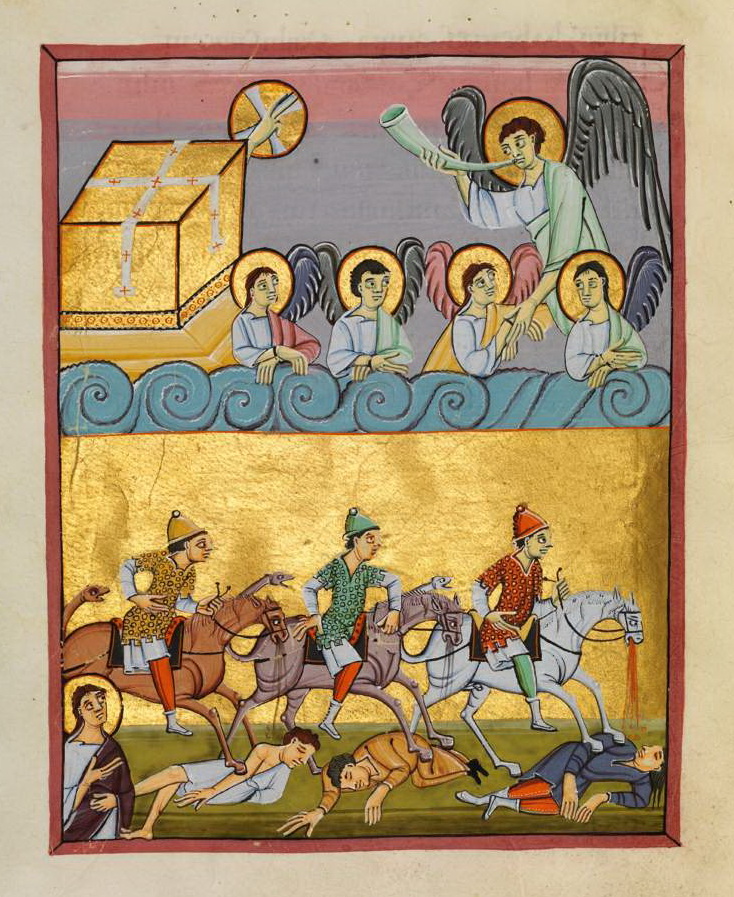
The Sixth Trumpet from the Bamberg Apocalypse

13 Then the sixth angel blew his trumpet, and I heard a voice from the four horns of the golden altar before God, 14 saying to the sixth angel who had the trumpet, “Release the four angels who are bound at the great river Euphrates.” 15 So the four angels were released, who had been held ready for the hour, the day, the month, and the year, to kill a third of humankind. 16 The number of the troops of cavalry was two hundred million; I heard their number. 17 And this was how I saw the horses in my vision: the riders wore breastplates the color of fire and of sapphire and of sulfur; the heads of the horses were like lions’ heads, and fire and smoke and sulfur came out of their mouths. 18 By these three plagues a third of humankind was killed, by the fire and smoke and sulfur coming out of their mouths. 19 For the power of the horses is in their mouths and in their tails; their tails are like serpents, having heads; and with them they inflict harm.

20 The rest of humankind, who were not killed by these plagues, did not repent of the works of their hands or give up worshiping demons and idols of gold and silver and bronze and stone and wood, which cannot see or hear or walk. 21 And they did not repent of their murders or their sorceries or their fornication or their thefts.

With the sixth trumpet a second group of creatures, this time angels, are released to bring about judgment. Much like the opening of the abyss, here creatures that are bent on destroying humanity are unleashed and with them a seemingly impossible number of demonic cavalry. Like in the second seal, war is unleashed upon the earth and death follows shortly afterwards. Structurally there seems to be a connection between the angels unleashed here and the four angels retraining the four winds of heaven in Revelation 7:1. These angels bound at the river Euphrates are not the same angels, but while the first angels hold back judgment these angels of death become the summoners of destruction and desolation. Yet, even in the midst of the destruction and devastation, Revelation wants us to hear that by releasing these angels of death that even here God remains firmly in control.

The angels at the beginning of this woe are bound, like Satan will be in Revelation 20:2 (see also the evocative language of binding the strongman in Mark 3:27). Perhaps they are bound as they emerge from the abyss and they are fallen angels like Satan, perhaps they are fallen angels that have been chained here at the Euphrates for countless years, or perhaps they were simply created to be vessels that God will use to bring about the judgment of the people. For me the angels themselves seem to be fallen creatures and the cavalry they will summon also is full of demonic aspects in its description and mission. Ultimately these creatures which are unleashed upon the creation are also forces of death and destruction and bring about the death of large portions of humanity. Yet the command to release the angels comes from the altar of God and, as mentioned above, God remains firmly in control despite the chaos the people of the earth would experience from the unleashing of the forces of war and destruction.

The description of the cavalry has its closest resonance in the mythical Chimera (which has a lion’s head, snake for a tail and a goat’s head arising from it’s back). They are not like a normal troop of cavalry and John reminds us that we are seeing this in a vision. The horses kill with fire, smoke and sulfur and in addition inflict harm with their snake-like tails. The vision shows us a distortion of the created order. The image is one of war and the destruction that comes with it and cavalry was the most powerful military unit of the time of Revelation. Looking back on the last century of warfare it may be tempting to assign to these creatures correlations with the technology of warfare in our time, but the images are a visionary representation of God’s judgment and attempting to lock down the image to a concrete time or technology robs it of its flexibility.

Ultimately the goal of Revelation’s visions and judgments is to bring about change. God’s desire is for people to turn away from the created things that they worship and the works of human hands so that they can join creation in worshipping the Creator. A frequent theme in the bible is the way that humanity “exchanges the glory of the immortal God for images resembling a mortal human being or birds or four- footed animals or reptiles.” (Romans 1: 23) God desires humanity to turn both from its worship of demons and the work of human hands but also to turn from their practices which are listed in opposition to God. Yet judgment alone does not bring about repentance. Ultimately, God will provide witnesses to the people who now become the prophets to all the nations calling people to, ‘return to the LORD their God.’ Judgment and witness ultimately are employed in the service of God to bring about repentance. God desires for people to turn from the forces that are working to destroy the creation and to give their allegiance to the Creator of the heavens and the earth.

Revelation 8 God’s Action Unsealed

Image from https://pixabay.com/en/angel-wing-blowers-golden-trumpet-4928/ image free for public use through Creative Commons CC0

Revelation 8: 1-5 The Final Seal

1 When the Lamb opened the seventh seal, there was silence in heaven for about half an hour. 2 And I saw the seven angels who stand before God, and seven trumpets were given to them.

3 Another angel with a golden censer came and stood at the altar; he was given a great quantity of incense to offer with the prayers of all the saints on the golden altar that is before the throne. 4 And the smoke of the incense, with the prayers of the saints, rose before God from the hand of the angel. 5 Then the angel took the censer and filled it with fire from the altar and threw it on the earth; and there were peals of thunder, rumblings, flashes of lightning, and an earthquake.

The seventh seal is open, and the content of the scroll can now be revealed. We enter a period of silence. With the sixth seal the inhabitants of the earth realize that God is about to act and now even in heaven the praise of the countless multitude is interrupted. The silence may reflect a type of silent reverence toward God or the message that has just been unsealed, or it may provide a space where the prayers of the saints can come before God so that God may hear the oppression of God’s people as God did in Exodus. Speech and song may stop but action continues as the seven angels before the throne are handed trumpets and a different angel offers up incense and prayers.

The seven angels may be the seven archangels listed in 1 Enoch 20: 1, a part of the Jewish Pseudepigrapha (a collection of works that were not included in the canon of scripture). Yet, while many are fascinated by attempting to catalogue the ranks of the angels of heaven only Michael will be named in Revelation and while these angels have a role to play within Revelation as those called to blow the trumpets which enact judgment we have no further information on their identity or role beyond this action.

While the seven angels and the trumpets given to them will form the progression of the next cycle of Revelation, the angel with the censer occupies the central role in this pivotal scene. When the fifth seal was opened in Revelation 6: 9-11 the ones slaughtered for their testimony called out to their God for judgment and for their blood to be avenged. Now as this angel occupying a priestly role by offering incense offered up with the prayers of the saints. This action echoes the poetic language of Psalm 141:

Let my prayers be counted as incense before you, and the lifting up of my hands as an evening sacrifice. (Psalm 141:2)

Incense in the tabernacle or temple was burned to honor God and to protect the priest from being harmed by the divine presence of God. John sees the angel’s offering of incense and prayer rise up before God. The scene ends with the prayers going up and fire coming down. The fire which is taken from the altar is thrown to earth and it is received as thunder, lightning and an earthquake, all signs of divine judgment in the ancient world.

Revelation 8: 6-13 The First Four Trumpets

6 Now the seven angels who had the seven trumpets made ready to blow them.

7 The first angel blew his trumpet, and there came hail and fire, mixed with blood, and they were hurled to the earth; and a third of the earth was burned up, and a third of the trees were burned up, and all green grass was burned up.

8 The second angel blew his trumpet, and something like a great mountain, burning with fire, was thrown into the sea. 9 A third of the sea became blood, a third of the living creatures in the sea died, and a third of the ships were destroyed.

10 The third angel blew his trumpet, and a great star fell from heaven, blazing like a torch, and it fell on a third of the rivers and on the springs of water. 11 The name of the star is Wormwood. A third of the waters became wormwood, and many died from the water, because it was made bitter.

12 The fourth angel blew his trumpet, and a third of the sun was struck, and a third of the moon, and a third of the stars, so that a third of their light was darkened; a third of the day was kept from shining, and likewise the night.

13 Then I looked, and I heard an eagle crying with a loud voice as it flew in midheaven, “Woe, woe, woe to the inhabitants of the earth, at the blasts of the other trumpets that the three angels are about to blow!”

The trumpets begin a new cycle of visions of destruction and judgment. While I view the seals as a prelude illuminating the world that the content of the scroll, which is revealed symbolically through the rest of the book, will address. With the trumpets we see God’s action in response to the prayers that have been lifted up and the cries of those whose blood has been shed. Like in Exodus 3: 7, the LORD has observed the misery of God’s people and God’s response is a combination of action and sending Moses as a witness.

In the cycle of the trumpets and cycle of the bowls in Revelation 16 there are similarities with the plagues in Exodus 7-12. While the similarities are closer with Revelation 16 they are worth noting here in addition to Psalm 78 and 105 which also echo the plagues on Egypt:

Exodus 7-12 Psalm 78 Psalm 105 Revelation 8-9 (Trumpets) Revelation 16 (bowls)
River Changes to blood (7: 14-25)  78:44 105: 29 Rivers become bitter, seas turn to blood (8: 8-11) Sea changes to blood (16:3)
Frogs (8: 1-15) 78:45 105:30   Froglike Spirits (16: 12-16)
Gnats (8:16-19)   105:31    
Flies (8: 23-32) 78:45 105:31    
Cattle, disease (9: 1-7) Cattle are given to hail (combining 5 &7) 78:48      
Sores (9: 8-12)       Painful sores (16:2)
Hail, fire, thunder (9: 13-35) 78:48 105:32 Hail and Fire mixed with blood (8:7) Huge hailstones (16: 21)
Locusts (10: 1-20) 78:46 105: 34-35 ‘Demonic Locusts’ (9:1-11)  
Darkness (10:21-29)   105:28 1/3 of lights in sky darkened (8: 12) Darkness over kingdom of beast (16: 10-11)
Death, Destroying angel (12: 29-32) 78:51 105:36 1/3 of humankind killed (9: 13-19)  

See similar chart in Craig Koester’s Revelation. (Koester, 2014, p. 446)

These cycles of judgment have been both fascinating and terrifying to Christians. Some early Christians, like Marcion, a second century church leader who was later declared to be a heretic, couldn’t reconcile the God of love that Jesus testified to with this God who judges.  Yet, Christians throughout history have been troubled by the violent language of Revelation. Many traditions, including my own, rarely use this book and I know in discussions with people who have been a part of my walking through the book with them that many had been afraid to read Revelation. Even well-meaning scholars may shy away or attempt to reframe the language of Revelation in a less harsh way. For example: Richard B. Hays, a scholar I respect greatly, attempting to interpret Revelation in light of the rest of the New Testament can state:

One of the major hermeneutical implications of reading Revelation within the canonical framework of the New Testament is to serve as a check and corrective on interpretations that seek to read the violent militaristic imagery of the Apocalypse literalistically. If Jesus wins his victory over the world through his faithful death on a cross (as all the rest of the New Testament documents insist), and if Revelation’s figurative depictions are to be read in intertextual concert with these other texts, then the triumphant rider who is “clothed in a robe dipped in blood” (Rev 19: 13) must be wearing a garment drenched with his own blood, and the “sharp sword” that comes “from his mouth…to strike down the nations” (Rev 19: 15) must be the proclaimed word of the gospel (as in Eph 6:17), not a literal sword of iron that kills enemies. (Richard B. Hays and Stefan Alikier, 2015) (Richard B. Hays and Stefan Alikier, 2015, p. 81)

While I would agree that the violent militaristic imagery of Revelation is not to be read literalistically, it is far too easy to attempt to create an image of God that fits nicely with a life of privilege and therefore does not respond to the saints calls for justice or for their blood to be avenged. In 2004, during my final semester of seminary, I had the opportunity to read for the first of many times Miroslav Volf’s Exclusion and Embrace which helped me understand the need for God’s judgment or wrath in a way I hadn’t before. Perhaps it was some of the connections between Dr. Volf’s stories and influences in my own story that made his poignant reflection so powerful since the unit I served with in the military had just returned from a peacekeeping mission in Bosnia and I heard many reflections on the way that Croatians had been targeted for ethnic cleansing, perhaps it was the vulnerable blending of personal experience and academics but the book resonated with me. This book became one of the works I have returned to again and again as I reflect on what an embodied Christian faith looks like. The final chapter of Exclusion and Embrace, ‘Violence and Peace’, may not be exclusively about Revelation but it dances with the imagery of Revelation multiple times as he argues for the necessity of divine judgment for Christians to practice reconciliation and non-violence. It is worth quoting here at length:

Most people who insist on God’s “nonviolence” cannot resist using violence themselves (or tacitly sanctioning its use by others). They deem the talk of God’s judgment irreverent, but think nothing of entrusting judgment into human hands, persuaded presumably that this is less dangerous and more humane than to believe in a God who judges! That we should bring “down the powerful from their thrones” (Luke 1: 51-52) seems responsible; the God should do the same, as the song of that revolutionary Virgin explicitly states, seems crude. And so violence thrives, secretly nourished by belief in a God who refuses to wield the sword.

My thesis that the practice of nonviolence requires a belief in divine vengeance will be unpopular with many Christians, especially theologians in the West. To the person who is inclined to dismiss it, I suggest imagining that you are delivering a lecture in a war zone (which is where a paper that underlies this chapter was originally delivered). Among your listeners are people whose cities and villages have been first plundered, then burned and leveled to the ground, whose daughters and sisters have been raped, whose fathers and brothers have had their throats slit. The topic of the lecture: a Christian attitude toward violence. The thesis: we should not retaliate since God is perfect noncoercive love. Soon you would discover it takes the quiet suburban home for the birth of the thesis that human nonviolence corresponds to God’s refusal to judge. In a scorched land, soaked in the blood of the innocent, it will invariably die. And as one watches it die, one will do well to reflect about many other pleasant captivities of the liberal mind. (Volf, 1996, pp. 303-304)

To Christians who live in easy accommodation with the ways of power, like those in the churches in Sardis and Laodicea we met in chapter three, the language of judgment may be uncomfortable or unwanted. As a person who serves in a privileged and predominantly affluent suburb in the United States it may be easier to deal with a God who allows things to remain as they are or to rely upon my own power for action and to take judgment into my own hands. But if vengeance is mine, then perhaps I too have fallen prey to the temptation the serpent put before Eve in the garden of Eden: to be like God. On the other hand, those who dwell on the violent portions of Revelation often miss the restraint that is a part of this and other places where divine judgment is involved. From the story of Noah onward we see that wrath or violence does not change the inclination of the human heart and punishment alone does not bring about repentance.

Another reflection from my time in the military that may also be a part of the costly patience of God has to do with the impact of these actions upon the people and the earth. Conflict that involves military force is always destructive and while modern military action often is restrained in its use of force there are always innocent casualties and damage to environment where the action occurs. While there is restraint in God’s actions as the trumpets sound here in Revelation the damage to the earth is dramatic. Like in Exodus 7-12, where God’s actions until the very last sign and wonder attempt to limit the death of the people of Egypt, the predominant ‘victim’ of the divine action is the earth. In Genesis 3:17, when God is judging Adam and Eve after they eat the fruit of the tree of the knowledge of good and evil, the earth bears the curse for humanity and likewise here in Revelation it will be the plants, the waters and even the sun and stars that will suffer prior to the sixth seal where death is unleashed and 1/3 of humankind is killed.

The first trumpet is hail mixed with fire and blood. Fire mixed with hail was one of the signs and wonders used against the Egyptians while the Israelites were slaves (Exodus 9: 13-35) and later in the book of Ezekiel it was prophesied against Gog and its allies (Ezekiel 38:22). Blood falling with rain is also a portent of war in Greco-Roman writings. (Koester, 2014, p. 448) As mentioned above it is the earth that feels the impact of this hail, fire and blood. That doesn’t mean people would be unaffected. The grass was used for feeding the flocks and the wood was used for everything from shelter to furniture to fuel for heat and cooking. One third of the earth being consumed by fires would be both an ecological and a financial disaster for the people and yet it allows for survival so that there remains an opportunity for continued witness and the hope of repentance.

The second trumpet impacts the seas and the creatures that live within it. While there are ships that are destroyed, the earth again bears the primary impact of this trumpet of judgment.  The loss of sea life would impact the diet of the people throughout the Roman empire who ate seafood and the loss of shipping would be an economic disaster for those who lost ships, cargo and crews. Yet, life continues to remain possible.

Artemisia Absinthium, also called ‘wormwood’

The third trumpet impacts the fresh waters by making them undrinkable. The naming of the star ‘wormwood’ references artemisia abisinthium which is bitter and whose oil would make food and water unpalatable. Even though this plant is now used for medicinal purposes, the reference here is to water that is no longer potable. While many died from undrinkable water there much of the waters that are not impacted so that life can continue and there remains the opportunity for change.

Finally, the fourth trumpet eliminates a third of the light of the sun, moon and stars. Even the heavens are altered by the narrative of Revelation. Combined the first four trumpets bring about an ecological disaster impacting the skies, the seas and the land. When I was growing up in the 1980s at the height of the Cold War the popular interpretations of passages like this were based on a nuclear war. While I don’t think John was witnessing a nuclear war being unveiled to him I do think it is important to realize that many of these images are portents of a devastating war and the ecological disaster it can bring. When I was growing up there were individuals who hoped for this war because they believed it would signal the beginning of the ‘apocalypse’ and would bring about God’s return. I wonder now how anyone could hope for the type of ecological and humanitarian disaster that a nuclear war would bring. There will always be a temptation to link concrete events with the language of Revelation, and at times of crisis like World War II, Revelation was viewed by some as a promise that the terror would have a limited span and that the horror would end. Revelation may prove a beacon of hope for those dealing with disasters and terrors across history but I prefer to allow the images to retain their plasticity and their ability to speak to multiple times and experiences.

The chapter ends with an eagle crying out “Woe, woe, woe” for the remaining trumpet blasts. This dire statement brings us into the expectation that the final trumpet blasts will be more severe than the four that came before. Yet, even these woes that are coming have limits placed upon them to allow for continued witnessing and calling for repentance.

Revelation 7 Restraint and Praise

Albrecht Durer (1471-1528), Angels Restraining the Four Winds (woodcut)

Revelation 7

1 After this I saw four angels standing at the four corners of the earth, holding back the four winds of the earth so that no wind could blow on earth or sea or against any tree. 2 I saw another angel ascending from the rising of the sun, having the seal of the living God, and he called with a loud voice to the four angels who had been given power to damage earth and sea, 3 saying, “Do not damage the earth or the sea or the trees, until we have marked the servants of our God with a seal on their foreheads.”

4 And I heard the number of those who were sealed, one hundred forty-four thousand, sealed out of every tribe of the people of Israel: 5 From the tribe of Judah twelve thousand sealed, from the tribe of Reuben twelve thousand, from the tribe of Gad twelve thousand, 6 from the tribe of Asher twelve thousand, from the tribe of Naphtali twelve thousand, from the tribe of Manasseh twelve thousand, 7 from the tribe of Simeon twelve thousand, from the tribe of Levi twelve thousand, from the tribe of Issachar twelve thousand, 8 from the tribe of Zebulun twelve thousand, from the tribe of Joseph twelve thousand, from the tribe of Benjamin twelve thousand sealed.

9 After this I looked, and there was a great multitude that no one could count, from every nation, from all tribes and peoples and languages, standing before the throne and before the Lamb, robed in white, with palm branches in their hands. 10 They cried out in a loud voice, saying,

“Salvation belongs to our God who is seated on the throne, and to the Lamb!”

11 And all the angels stood around the throne and around the elders and the four living creatures, and they fell on their faces before the throne and worshiped God, 12 singing,

“Amen! Blessing and glory and wisdom and thanksgiving and honor and power and might be to our God forever and ever! Amen.”

13 Then one of the elders addressed me, saying, “Who are these, robed in white, and where have they come from?” 14 I said to him, “Sir, you are the one that knows.” Then he said to me, “These are they who have come out of the great ordeal; they have washed their robes and made them white in the blood of the Lamb. 15 For this reason they are before the throne of God, and worship him day and night within his temple, and the one who is seated on the throne will shelter them. 16 They will hunger no more, and thirst no more; the sun will not strike them, nor any scorching heat; 17 for the Lamb at the center of the throne will be their shepherd, and he will guide them to springs of the water of life, and God will wipe away every tear from their eyes.”

The previous chapter ends with the mighty of the earth brought low in their fear of the face of the one seated on the throne and the wrath of the lamb and we are left expecting the vengeance of God to be unveiled. What follows in this chapter is another great reversal of expectations: where wrath is expected we find restraint, where the mighty wonder who is able to stand we see a countless multitude standing before the throne, where seals have been broken and the mighty brought low now a lost people is sealed and lifted up. In a pattern that Revelation will repeat, we pause before the last unveiling and we are reoriented to the worship that is ongoing in heaven. We will see the contrast between earth and heaven, but Revelation’s trajectory is that what happens on earth will be the same as what happens in heaven.

Our scene opens with four angels restraining the four winds at the four corners of the earth. After the great earthquake and the signs in the heavens which even the nations can see and respond to we pause. The earth is not to be damaged at this point, although the upcoming series of trumpets will direct much of the damage towards the earth. But here, while the 144,000 are sealed the earth gets a reprieve. As St. Paul can say in Romans, “For the creation waits with eager longing for the revealing of the children of God;” (Romans 8:19) Creation and humanity’s destiny are tied together throughout the Bible beginning with the creation narrative when, after eating the fruit from the tree of the knowledge of good and evil, it is creation that bears the curse that is originally to fall on Adam and Eve. (Genesis 3: 17) Now there is restraint as the servants (literally slaves) of God are to be sealed. The vocation which they have had before was unseen in the world but now they are being marked as servants of the living God. This sealing marks them as honored in this narrative and the slaves of God are higher than the generals and kings of the earth. The mighty are brought down and the humble and humiliated are here lifted up.

The one hundred forty-four thousand from the nation of Israel brings the people of God back into Revelation. As I’ve mentioned multiple times John, the author of Revelation, uses the language of Israel’s vocation in relation to the church but here the tribes of Israel are reassembled and marked for their own vocation. Numbers are symbolically important to Revelation and this twelve groups of twelve thousand symbolically points to a census where the total number of God’s people are sealed. John’s visionary approach may not lead to the type of declaration that Paul would make in his wrestling about the place of Israel in Romans 9-11 where he declares that all Israel will be saved (Romans 11:26) but the azimuth of this vision points in the same direction. God has not forgotten Israel and has sealed them as God’s own.

The close reader will notice that the listing of the tribes has two peculiarities: Ephraim and Dan are not named. The two sons of Joseph, Ephraim and Manasseh, are typically listed as half tribes. While Manasseh is named in the list Ephraim is not. Yet, there is a tribe of Joseph which would include Ephraim, but it is peculiar that Manasseh receives note and Ephraim (which becomes a way of talking about the northern tribes in general in some of the prophets) is not. Dan is missing from the list. We do not know the reason for Dan’s omission. Medieval interpreters favored an explanation that the Antichrist was to come from Dan, but these traditions all post-date Revelation by centuries. Yet, symbolically there are twelve tribes even if the names do not line up perfectly with the designation of the tribes elsewhere in scripture.

There has always been a temptation for Christian groups, from the Franciscans of the thirteenth century to the Jehovah’s Witnesses in the nineteenth and twentieth century to see the 144,000 as a special group that needed to be gathered to bring about the end age. Other Christians have seen this group as representing the church which may include Jewish Christians, but they read this in line with other parts of Revelation where the church assumes the vocation of Israel. As pointed out above, I view this as talking about the Jewish people and including them in a place of honor among the multitude among the nations which are gathered around the throne.

The seal of the living God has its opposite in the mark of the beast in Revelation 13. In the vision of Revelation there is no middle group, one either is marked by God or by the forces opposed to God. To be sealed by the 144,000 will provide them with protection, for example the demonic locusts in Revelation 9 will be able to torment those who do not have the seal of God on their forehead. Like in the plagues on Egypt in Exodus the people of God will not be targeted by all the destructive forces that are unleashed in later cycles. However, they will also be a target for those opposed to God and aligned with the forces of the devil. I am reminded of Luther’s advice to parents and churches baptizing young children:

Therefore, you have to realize that it is no joke at all to take action against the devil and not only to drive him away from the little child but also to hang around the child’s neck such a mighty, lifelong enemy. (Luther, 1978, p. 68)

Those who have been sealed by God are now in opposition to those whose power is opposed to God in the world. Like in Exodus, those whom God has chosen may seem like the lowest of slaves before the kings and generals of the world, but they are those who are able to stand before the face of the one on the throne and the wrath of the lamb.

Douce Apocalypse Bodlein MS180 (1265-70)

Yet, this salvation is not only for Israel. It is inclusive and broad and encompasses a multitude beyond counting of all nations, languages, tribes and peoples. This multitude joins the elders in wearing white. They have come out of the great ordeal and they hold palm branches celebrating the victory of the Lamb and the salvation that God and the Lamb have brought. Revelation operates in the space between Satan’s expulsion from heaven and the time of the Messiah’s return to earth to bring the peace that occupies heaven to earth. The time of the great ordeal is most likely not a reference to a time of future woe and tragedies but rather, like most of Revelation, an understanding that the current brokenness and suffering of the world is due to the influence of Satan and other forces opposed to God’s reign in the world.

The countless multitude cry out that salvation belongs to God and the Lamb. The language of salvation was frequently used in Roman declarations as the role of Caesar, but here the singing multitude attribute it to its proper place, to the Lord and to Jesus. The angels and elders join in with a seven-fold praise of God as symbolically the voices of heaven and earth join in praising God. God and Christ in this vision remain at the center of not only the praise of the people and angels and creatures, but also in the center of reality. Revelation enables John to show us a world that is struggling with the forces opposed to the creating God who desires to dwell among God’s world and people and yet God still reigns and is in control of the things that seem beyond control.

This vision also foreshadows the hope of Revelation which will come to fruition in Revelation 21 and 22 while it also pulls from a rich storehouse of prophetic images of hope. The great multitude are sheltered and then in language resonant of Isaiah 49:10:

They shall not hunger or thirst, neither shall scorching wind strike them down, for he who has pity on them will lead them, and by the springs of water will guide them.

In another image reversal it is the Lamb at the center of the throne who shepherds the multitude. Instead of a shepherd watching a flock of sheep now the Lamb is the shepherd of the people. As many Christians may recognize the familiar imagery of Psalm 23 in this image, ‘The Lord is my shepherd’ but may miss the image of Ezekiel 34 where in protest to the unfaithfulness of the existing shepherd/rulers the LORD sets up a new shepherd:

I will set up over them one shepherd, my servant David, and he shall feed them: he shall feed them and be their shepherd. And I, the LORD, will be their God, and my servant David shall be prince among them; I, the LORD, have spoken. Ezekiel 34: 23-24

And in an allusion to the great banquet that the LORD promises in Isaiah 25 we hear what is for me one of the most powerful images that appears here and in Revelation 21:4. As Isaiah 25: 8 states:

he will swallow up death forever.
Then the LORD God will wipe away the tears from all faces,
and the disgrace of his people he will take away from the earth,
for the LORD has spoken.

In combining language from several places in the prophets we have a beautiful and peaceful image of God’s consolation and care for those who have undergone suffering in the world. Many people focus only on the images of destruction in Revelation but miss these significant pauses and moments of restraint which point to the reality that amid the suffering God remains the one who has glory and power and honor and might. The Lamb is the place where salvation will come from instead of the kings, generals and the mighty of the world. And that, even with the death and terror in the world, heaven is centered on praising God. Revelation is leading us on a journey to a world where God’s will is done on earth as it is in heaven.

Revelation 6 Opening the Seals

Albrecht Durer, Four Horsemen of the Apocalypse (1498)

Revelation 6: 1-8 The Four Horsemen

1 Then I saw the Lamb open one of the seven seals, and I heard one of the four living creatures call out, as with a voice of thunder, “Come!” 2 I looked, and there was a white horse! Its rider had a bow; a crown was given to him, and he came out conquering and to conquer.

3 When he opened the second seal, I heard the second living creature call out, “Come!” 4 And out came another horse, bright red; its rider was permitted to take peace from the earth, so that people would slaughter one another; and he was given a great sword.

5 When he opened the third seal, I heard the third living creature call out, “Come!” I looked, and there was a black horse! Its rider held a pair of scales in his hand, 6 and I heard what seemed to be a voice in the midst of the four living creatures saying, “A quart of wheat for a day’s pay, and three quarts of barley for a day’s pay, but do not damage the olive oil and the wine!”

7 When he opened the fourth seal, I heard the voice of the fourth living creature call out, “Come!” 8 I looked and there was a pale green horse! Its rider’s name was Death, and Hades followed with him; they were given authority over a fourth of the earth, to kill with sword, famine, and pestilence, and by the wild animals of the earth.

The series of seals, trumpets and bowl which begin in this chapter and run through chapter nineteen are the portions of Revelation that many people are captivated and sometimes repulsed by.  This is also the portion of Revelation where interpretations will vary greatly. Sometimes familiarity with the language of scripture and the images of the culture of the time of Revelation can make certain interpretive options more likely for John’s initial audience but ultimately any attempt to restrict the highly symbolic image laden language of Revelation to one meaning betrays the lingering power of these images which continue to resonate two millennia later. As I proceed through these cycles of images I will present a reading that I find compelling and interesting, but I also am aware that my own reading will not agree with many other intelligent, informed and engaged interpreters.

Among these images the most famous is also the first. The four horses with their riders, commonly referred to as the four horsemen of the apocalypse, correspond to the initial four seals and are announced by the four living creatures around the throne. To begin looking at the four horses and their riders and the three seals that follows begins with a choice of how to approach the seals themselves. The seals are on a scroll written on the front and back, but ultimately unreadable until the scrolls are broken, and it is only the appearance of the Lion of Judah which is the sacrificed Lamb who is worthy (see the pivotal reversal of the previous chapter) which enables the seals to be opened. Do the seals themselves reveal the content of the scroll and are therefore a part of the judgment of God or are they merely preparations that enable us to be prepared to receive this judgment. One can argue for either perspective but following the image of a sealed scroll I read these as preparations to be able to understand what comes afterwards. Especially the first five seals represent in my reading a way of understanding the world to which the later judgements will be addressed. Even though there is a lot of interplay between what I am labeling three cycles as shown in the table below and there is a sense of progression in the narration from seal to trumpet to bowls there is also a cyclical nature where each series can illuminate a common idea in a different manner.

The Seven Seals (Revelation 6:1- 8:5) The Seven Trumpets (Revelation 8:6-11:13 The Seven Bowls (Revelation 16:2-21
S1 The First Horseman (Conquest/Empire) T1 hail and fire mixed with blood; 1/3 of the earth burned B1 Painful sores on those marked by beast
S2 The Second Horseman (War, removal of peace) T2 Burning mountain thrown into sea destroys 1/3 of life of the sea B2 Sea becomes like blood
S3 The Third Horseman (famine, inflation of food prices) T3 Wormwood falls making 1/3 of fresh water undrinkable B3 Rivers and springs become like blood
S4 The Fourth Horseman (Death, ¼ of population killed by sword, famine, death and wild animals) T4 1/3 of sun doesn’t shine, 1/3 of moonlight and starlight removed B4 People scorched by the sun’s fire
S5 Martyred Saints call for God’s action T5 First Woe: The Demonic Locusts B5 Darkness over the kingdom of the beast
S6 Earthquake, sun eclipsed, moon turns to blood, stars fall, sky rolls up like a scroll T6 Second Woe: Four Angels of the Abyss and demonic cavalry destroy 1/3 of population B6 Euphrates river dried up, demonic spirits rally kings to oppose the reign of God
S7 Silence in heaven followed by prayers of saints offered like incense T7 heavenly worship B7 Great city split by earthquake, islands and mountains disappear

NIB, XII:610

Another parallel to these initial seals is to the description can be seen in what is sometimes called the ‘little apocalypse’ in Mark 13 (and parallels in Matthew 24 and Luke 21).

Mark 13: 7-9, 24-25 Revelation 6:1-8:1-5
Wars S1 Conquest
Violent conflict between nations S2 War, removal of peace
Earthquakes S3 Famine
Famine S4 Death
Persecutions S5 Martyred saints
Heavenly Signs S6 Heavenly signs
Son of Man comes in the clouds S7 Heavenly silence and prayers

(Koester, 2014, p. 358)

The four horsemen of the apocalypse have proven to be a powerful visual image for artists, storytellers and has slipped into our language in surprising ways. John Gottman can adopt the four horsemen as a metaphor for four practices which, in his research, are the four primary predictors of divorce (criticism, defensiveness, contempt and stone walling). Gottman as a practicing Orthodox Jew was able to pull this metaphor from the cultural references to the horsemen. They have occupied the worlds of fiction and film, for example the Clint Eastwood movie Pale Rider is built around a resonance for the final rider on a ‘pale’ horse whose name is death and hell follows after him. Even within the world of video games in the Darksiders series you can play as War or Death (riders of the apocalypse) in a destroyed world that may not be theologically related to the world of the bible (other than involving angels and demons) but uses these brief descriptions as an imaginative starting point to construct a character and the world in which they unleash their destructive power in a search for redemption (in the first two games War and Death respectively are the protagonists). The artist and writers will continue to utilize the four horsemen as a source for their imaginative constructions both literarily and visually yet the challenge for the reader of scripture is to ponder how these briefly described figures emerging from the seals might help us to make sense of the world we encounter.

Interpretation of the horses and their riders ultimately rests with the first horse and rider and how they are viewed. While the riders and horses may draw inspiration from the horses that patrol the earth in Zechariah 1: 8-10 (red, sorrel and white) and the four chariots in Zechariah 6: 1-8 (red, black, white and dappled grey) which represent the four winds of heaven, ultimately the four horses and their riders form a new and powerful image of conquest, war, famine and death. Hearing the description of each seal I imagine John on the ground because he sees the horse emerge first and then only after looking at the horse is the rider observed and described. Yet, it will be the horse and the rider taken together with their complementary descriptions that will make the images as powerful as they remain.

The first rider on the white horse is described having a bow, a crown is given to him and he came out conquering and to conquer. On the one hand there is not a lot of description but what is present is symbolically rich and has led to several interpretations. Some interpreters have focused on the white horse and the repetitive use of nikao (Greek word translated to conquer see discussion in Revelation 2: 1-7) in two different verbal forms and have assumed that the first rider is Christ as he is depicted in Revelation 19. If Christ is the first rider then the other riders will be in opposition to the first rider and though this, by itself is not decisive, this description emphasizes that the weapon given to the rider is a bow, while Christ conquers with the sword of his mouth. A mounted bowman is also not a unit that was used within the Roman legions but was used by the Assyrians and Babylonians when they conquered Israel and Judah as well as other non-Roman peoples like the Parthians. While it could represent conquest by non-Roman forces or play upon Roman fears it may represent conquest more broadly. The parallel between the white horse here and in Revelation 19 may also reflect the way that conquest often masquerades as something that is righteous or holy. This first rider may reflect an anti-Christ figure that pretends to be holy when it is a manifestation of the unholy.  It is also worth noting that the bow is also used by the armies of Gog in Ezekiel 38-39 and as Ezekiel 39:3 can state:

I will strike your bow from your hand, and will make your arrows drop out of your right hand.

My best reading of this is that the white rider does represent conquest and that which parades as righteous but which Revelation will argue is demonic and within the progression of Revelation it will become clear that Rome is reflected by many of these images to the first hearers. As I mentioned the Roman legions did not use mounted bowmen at this point and yet the bow stands to distinguish the white horse here from Christ. Rome was the primary empire which built and sustained itself on wars of conquest. For me the seals reveal the world as it is for the hearers. Yet, the power of this and the other images of Revelation is the way they can typologically represent the experiences of multiple times. In many ways this rider which represents empire and conquest which often appears in the guise of righteousness but may truly be demonic should be an uncomfortable if poetic image to measure the powers and the actions of one’s time against. In my own context, in what ways does America masquerade as being righteous and benevolent and yet act in a way that models this rider rather than the crucified Lamb? Although he is referring to the image of the rider in Revelation 19, Miroslav Volf’s words resonate here as well. “We will believe in the Crucified, but we want to march with the Rider.” (Volf, 1996, p. 276) We may confess the crucified one who conquered through his suffering and death, but we may want to follow the strongman who conquers through military might.

The second fiery red horse and its rider with the sword who takes peace from the earth. The Pax Romana, the peace of Rome, was one of the claims of the benefits of the empire. Rome’s military might and administration was supposed to guarantee peace, but the Roman peace was built upon the enforcement of the legions and the fear of crucifixion or other means of punishment. Readers with a Jewish background would be familiar with what we can call today the first Jewish-Roman war from 66-73 CE in which Roman legions under the command of Vespasian and his son Titus would destroy the temple, much of Jerusalem and wreak havoc on the towns and countryside of Judea. The second rider on a red horse, much like the rider on a red horse in Zechariah 1: 7-12, can see that the peace that has been brought to the earth by forces of empire have done so at a high cost to Jerusalem and the cities of Judah (see Zechariah 1: 12). Or in the words of the prophet Jeremiah:

They have treated the wound of my people carelessly, saying, “Peace, peace,” when there is no peace. (Jeremiah 6:14; see also Jeremiah 8:11 and Ezekiel 13:10)

While the second rider could be a force which destroys the Pax Romana and sends the nations into turmoil I read it as a revelation of what the Pax Romana really is, war under the guise of peace. In the Roman pantheon Mars is second only to Jupiter in his importance and is viewed in the mythic genealogy of Rome as the father of Romulus and Remus. War was a central part of the Roman identity, theirs was a peace through continual conquest both on the borders of the empire and against any forces of insurrection internally. Rome was a strongman who conquered by the spear and the sword. As Tacitus, a Roman senator and historian, could sarcastically remark, “pacem sine dubio…verum cruentam. Peace there was, without question, but a bloody one.” (Zanker, 1988, p. 187) Again, the question becomes for my own context to ask about the ways in which in America military might becomes worshipped instead of the crucified. Could some of our own struggles with issues around guns in America reflect a god more like Mars or more like the expected Lion than the Crucified Lamb.

Ara Pacis, The “Tellus” Panel were Pax (Peace) is portrayed providing fertility and prosperity

The black horse with the rider with its scales for commerce comes while a voice calls out from the direction of the throne exorbitant prices for grain. As Craig Koester can note (citing the Jewish historian Josephus), “The prices in Revelation were eight to sixteen times higher than usual, rates associated with severe shortages (Josephus, Ant. 14.28). A worker would have to spend his entire day’s pay to provide wheat bread for himself or enough barley for a small family.” (Koester, 2014, p. 396) The trade enabled by the infrastructure of the empire and the security provided by the Roman legions. In Roman artwork Pax, the goddess of peace, is portrayed in ways that relate her to Venus and Tellus who are gods of fertility and agriculture. Yet, reality among the people did not always reflect the images portrayed in the language and artwork of the empire. As Craig Koester can note:

In the imperial world the principal cause of food shortages “was the earmarking of vast quantities of grain to feed the city of Rome and the armies, while through the Empire large areas continued to be diverted from the cultivation of cereals to the more profitable production of wine and olive oil.” (Rom. Civ. 2:247) Some people made handsome profits in oil and wine, but reduced grain cultivation meant that when the harvest was meager or grain shipments were disrupted, many cities faced a food crisis. (Koester, 2014, p. 397)

A modern dystopic world built on a similar crisis is The Hunger Games novels written by Suzanne Collins. In the books the conquered districts send most of their resources into a capital district to finance their lavish lifestyles and appetites while the people in the districts deal with oppression, hunger and deprivation. In a world of trade which is based upon consumer demand and property and the resources of the world concentrate in economically stronger countries and regions this image of the black horse, its rider and the calling voice continues to provide a challenging image for the world in which we live. When the consumption of luxury goods (represented by oil and wine in Revelation) begins to crowd out the ability of subsistence farmers to grow the necessities for making the bread to feed the mouths of the world then we live in a world reflective of this horseman where securing the minimums for survival becomes a challenge for all but the wealthy. The society that the bible advocates for is one where every mouth is fed and the neighbor’s well being is provided for. Yet, throughout the history of Israel and the church this vision continually conflicts with the human instinct to hoard resources and to accumulate property, wealth and power. In Revelation 18 when Babylon (Rome) falls and the economic system that sustained it collapses it will be the merchants who brought the wealth of the earth to the capital who will shed tears and cry at the devastation of the city and their livelihood that was tied to this system.

The final horse emerges as a sickly green and its rider is Death personified. Just as the Romans could personify things like Victory or Peace into goddesses like Nike or Pax the Hebrew people personified Death and Hades as superhuman forces which have the power to grasp or consume people. The forces of conquest, war and an economy of trade and taxation have led finally to death. The promises of empire of prosperity and peace have been finally revealed as their opposite. Sword, famine, and disease is a common traditional list of ways in which death comes as a judgment (see for example 2 Chronicles 20:9; Jeremiah 14: 12; 21:7; Ezekiel 5:17; 6:11) and added to this is the threat of wild animals which enter the space of devastation and destruction in the aftermath of war and the loss of the protection of cities and communities.

For me the four horses and their riders provide a resonant image that continues to function today as a prophetic image to evaluate society by. When the forces of empire, military might and commercial commerce instead of promoting life for the entire society, and by extension the world, but instead become forces that are based upon war or economic exploitation then we mirror the horsemen and bring death instead of life. I believe that the horses and their riders point to the reality of the world as it is and that while they are not caused by God they are shown for what they are. Yet, even Death and Hades are ultimately subject to God and in Revelation 20 will be forced to surrender their captives before being sentenced to the lake of fire.

Revelation 6: 9-11 The Faithful Saints

9 When he opened the fifth seal, I saw under the altar the souls of those who had been slaughtered for the word of God and for the testimony they had given; 10 they cried out with a loud voice, “Sovereign Lord, holy and true, how long will it be before you judge and avenge our blood on the inhabitants of the earth?” 11 They were each given a white robe and told to rest a little longer, until the number would be complete both of their fellow servants and of their brothers and sisters, who were soon to be killed as they themselves had been killed.

With the opening of the fifth seal we see yet another revelation of the way the world is in the death of those who are faithful witnesses. The death of these followers of Jesus may have seemed a meaningless loss to those on earth but here in Revelation their deaths are given meaning as a sacrifice lifted up to God. Yet, as this sacrifice is lifted up there is an expectation that God will act upon their sacrifice and the act as judge and avenger. Their cry is a familiar cry to the people of Israel, “how long?” They believe and trust that God will not let injustice continue indefinitely. God is a God who will act on behalf of the faithful.

This fifth seal reveals the position of the church at the beginning of Revelation, they continue to wait on God’s action. They do not take judgment into their own hands and act as revolutionaries. Their prayers go up, their lives may be offered up as faithful witnesses and yet action rests in God’s hands. God’s kingdom comes to earth in God’s time and not the time of the saints. Yet, they do receive a white robe to clothe their bodies in the resurrection. The image here is not of a disembodied soul, even though the word soul is used at the beginning of this description but the movement of the hope of Revelation and the early church is an embodied hope of resurrected bodies on earth rather than souls remaining in heaven.

Most translations introduce the word ‘number’ into verse eleven and this translation points to a number of witnesses that must die prior to God’s action, and while this tradition is based on other ancient sources it is not present in Revelation. Ultimately verse eleven points to the completion of the work of the witnesses. Their work is not yet complete. God exercises a costly divine patience so that the witnesses to the gospel might carry their message to the ends of the earth and that the nations may have an opportunity to repent. Even with the death and destruction of Revelation, God continues to exercise restraint providing the opportunity for all those who can be redeemed to be saved. Yet, God will not ultimately allow the forces of conquest, war, exploitation and death to reign. God will not remain indifferent as forces threaten the creation, but God will exercise a patience that is costly to the witnesses of the gospel. Much like in Jesus’ parable of wicked tenants (Mark 12: 1-12 and parallels) God continues to send the servants even as they are ridiculed, tortured and even killed in the hope that these tenants might change.

Revelation 6:12-17 The Sixth Seal

12 When he opened the sixth seal, I looked, and there came a great earthquake; the sun became black as sackcloth, the full moon became like blood, 13 and the stars of the sky fell to the earth as the fig tree drops its winter fruit when shaken by a gale. 14 The sky vanished like a scroll rolling itself up, and every mountain and island was removed from its place. 15 Then the kings of the earth and the magnates and the generals and the rich and the powerful, and everyone, slave and free, hid in the caves and among the rocks of the mountains, 16 calling to the mountains and rocks, “Fall on us and hide us from the face of the one seated on the throne and from the wrath of the Lamb; 17 for the great day of their wrath has come, and who is able to stand?”

With the sixth seam the creation itself reacts to the violence on the earth. Like Matthew’s crucifixion narrative in particular, (although both Mark and Luke share some of these elements) where the sun’s light is blocked, and an earthquake shatters the ground as the elements of the creation bear witness to what most of humanity remains unable to see. Here in Revelation several traditional elements like the sun becoming darkness and the moon turning to blood (Joel 2: 31, also quoted in Acts 2:20). The stars falling from the sky were viewed as a sign of impending disaster while the sky being rolled up like a scroll echoes the language of Isaiah 34:4. Yet, in these cosmic signs the mighty and powerful of the earth and those without power can read the signs in the heavens and the earth and know that judgment is coming, and they attempt to hide themselves. They would rather have the mountains fall upon them than endure the judgment that is to come. Their terror is such that death is preferable to enduring the coming judgment. This transition at the end of Revelation 6 to the beginning of Revelation 7 is one of those great reversals that the New Testament loves. In the language of Mary’s song:

He has shown strength with his arm; he has scattered the proud in the thoughts of their hearts.
He has brought down the powerful from their thrones, and lifted up the lowly;
he has filled the hungry with good things and sent the rich away empty.
He has helped his servant Israel in remembrance of his mercy,
according to the promise he made to our ancestors. Luke 1: 51-56

Now the mighty flee their thrones and their positions of power into the hills and mountains while the remnant of Israel are to be sealed and protected. For those among the faithful these signs are signs of hope and joy for they believe that God is finally ready to set the world right and to bring about the kingdom of God. In the language of Rory Cooney’s adaptation of the Mary’s song title ‘The Canticle of the Turning’

My heart shall sing of the day you bring. Let the fires of your justice burn.
Wipe away all tears, for the dawn draws near and the world is about to turn.

In the following chapter we will see the sealed remnant of Israel and the countless multitude of the nations who are able to stand while the political and military leaders and the wealthy and powerful quiver and hide among the rocks. God’s wrath may be an uncomfortable image for those who live a comfortable and sheltered life. God’s justice may mean the upending of the systems of conquest, military power, economic exploitation and ultimately death that the wealthy and powerful have benefited from. As a military veteran who lives in suburban America and who benefits from many systems where I have privilege these are difficult words to listen to. These can be words of judgment and hope, or to use Lutheran language law and gospel. The prophetic challenge should force us to reexamine the lives that we live and the policies we advocate for, but the prophetic hope calls us to dream of what would happen when the world turns, when God’s kingdom comes and God’s will is done on earth as it is in heaven. The change may be uncomfortable and there will be those who would rather die than change. Yet, in Revelation God’s justice will not ultimately be thwarted and God’s desire to dwell among humanity will finally be realized.

Revelation 5 The Lion is a Lamb

Francisco de Zurbaran, Agnus Dei, between 1635 and 1640


Revelation 5

1 Then I saw in the right hand of the one seated on the throne a scroll written on the inside and on the back, sealed with seven seals; 2 and I saw a mighty angel proclaiming with a loud voice, “Who is worthy to open the scroll and break its seals?” 3 And no one in heaven or on earth or under the earth was able to open the scroll or to look into it.4 And I began to weep bitterly because no one was found worthy to open the scroll or to look into it. 5 Then one of the elders said to me, “Do not weep. See, the Lion of the tribe of Judah, the Root of David, has conquered, so that he can open the scroll and its seven seals.”

 6 Then I saw between the throne and the four living creatures and among the elders a Lamb standing as if it had been slaughtered, having seven horns and seven eyes, which are the seven spirits of God sent out into all the earth.

7 He went and took the scroll from the right hand of the one who was seated on the throne. 8 When he had taken the scroll, the four living creatures and the twenty-four elders fell before the Lamb, each holding a harp and golden bowls full of incense, which are the prayers of the saints. 9 They sing a new song:

“You are worthy to take the scroll and to open its seals,
for you were slaughtered and by your blood you ransomed for God saints
from every tribe and language and people and nation;
10 you have made them to be a kingdom and priests serving our God,
and they will reign on earth.”

11 Then I looked, and I heard the voice of many angels surrounding the throne and the living creatures and the elders; they numbered myriads of myriads and thousands of thousands, 12 singing with full voice,

“Worthy is the Lamb that was slaughtered
to receive power and wealth and wisdom
and might and honor and glory and blessing!”

13 Then I heard every creature in heaven and on earth and under the earth and in the sea, and all that is in them, singing,

“To the one seated on the throne and to the Lamb
be blessing and honor and glory and might forever and ever!”

14 And the four living creatures said, “Amen!” And the elders fell down and worshiped.

Revelation envisions a world centered upon the worship of God and the Lamb. In contrast to the way in which people will worship idols of stone, wood, and metal or those who will worship at the altars of commerce, military might, fame, popularity or political power the people of God were always to ‘fear, love and trust God above all things’ in Martin Luther’s memorable explanation of the first commandment. The Lord’s prayer asks for God’s kingdom to come and God’s will to be done on earth as it is in heaven. Heaven becomes the template for what life on earth is to become. There is a consistent theme throughout the Bible of the desire of God to dwell among the earth and the people of God represented narratively through stories like God walking with Adam and Eve in Genesis 2, God’s creation of the tabernacle to dwell among the people of Israel in Exodus and decisively for Christians in the narratives of the incarnation in the gospels. Revelation will move us to a world where God comes down to dwell among humanity but here in heaven we see a glimpse of what the properly ordered world will look like. Heaven shows us a world centered on God the Father and on Jesus. To use Dietrich Bonhoeffer’s description from his lectures on the creation narratives, “The life that comes from God is at the center; that is to say, God, who gives life, is at the center.” (DBWE 3: 83)

The previous chapter brought us into the throne room of God where we saw the creatures and the elders worshipping the Lord who is seated on the throne. We begin chapter five with the introduction of a scroll with seven seals which is written inside and one the back. There is a message that is coming from God that is unable to be read because it is sealed and the revelation of its contents can only occur once all the seals are removed. The disclosure of the contents of the scroll and receiving this message from the Lord is a weighty matter and no one or nothing in heaven or on earth or under the earth meets the call for worthiness put forward by the mighty angel. God’s proclamation, judgment and justice seems to have been delayed because of the unworthiness of those throughout creation to receive the message. This situation causes John to weep at the delay of God’s action. In contrast to the merchants and the wealthy in Revelation 18 who will weep at the unfolding of judgment within the scroll, John weeps that justice appears to have been sealed away until another time. But John is among those blessed mourners mentioned in the Beatitudes of Matthew 5:4 for in Christ his mourning will be comforted.

One of the elders informs John that ‘the Lion of the tribe of Judah, the Root of David, has conquered.’ This conquest enables this one to be worthy to open the seals on the scroll, but this is a scene of many reversals and redefinitions. The one mentioned is Jesus and his conquest is in his crucifixion. Instead of a military leader who conquers through military might, as one might expect of one whose title is the Lion of Judah, by his suffering he redeems for God a multitude from every tribe and every nation. Revelation frequently evokes images and figures from Israel’s scriptures much like the gospel of John does. To use Richard B. Hays’ language about John the apostle applies here to John the author of Revelation as well, “John is the master of the carefully framed, luminous image that shines brilliantly against a dark canvas and lingers in the imagination.” (Hays, 2016, p. 284) The Lion of Judah goes back to Jacob’s final blessing of his sons Genesis 49: 9-10:

Judah is a lion’s whelp;
From the prey, my son, you have gone up.
He crouches down, he stretches out like a lion,
like a lioness—who dares rouse him up?
The scepter shall not depart from Judah,
nor the ruler’s staff from between his feet,
until tribute comes to him;
and the obedience of the peoples is his.

1 Kings relates how lion imagery adorned the throne room of Solomon:

The throne had six steps. The top of the throne was rounded in the back, and on each side of the seat were arm rests and two lions standing beside the arm rests, while twelve lions were standing, one on each end of a step on the six steps. Nothing like it was ever made in any kingdom. (1 Kings 10: 19-20)

The root of David recalls the imagery used in the prophets to talk about a coming one who will once again reign in the place of the lost Davidic monarchy. Isaiah 11: 1 specifically links the imagery of branch and root:

A shoot shall come out of the stump of Jesse,
and a branch shall grow out of its roots.

Other prophets like Jeremiah (23: 5; 33:15) and Zechariah (3:8; 6:12) will refer to the hope of the coming Davidic king referring to the branch imagery. Both of these terms had strong messianic resonance in the hope of the Jewish people around the time of Jesus and many New Testament books would link Jesus’ identity to his association with the line of David.

Jan van Eyxk, Mystic Lamb detail from the Gent altarpiece (1432)

The Lion of the tribe of Judas is worthy to open the scroll but in a reversal of expectations what John sees is not a man or a king or even a lion but a lamb. The lion is the lamb, the one who has conquered is the one who stands as if it has been slaughtered. This reversal is a key image for the remainder of Revelation. John’s gospel places a similar image in the mouth of John the Baptist when he proclaims, “Here is the Lamb of God who takes away the sin of the world!” (John 1: 29) The distinctive description of the lamb having seven horns and seven eyes continue to develop the paradox of the scene. The lamb appears like one that has been slaughtered but horns are considered representations of power. The seven eyes are linked to the seven spirits of God which are mentioned in chapter four linking the torches and spirits around God’s throne with the eyes on the Lamb. The description of the Lamb having seven horns sets up a comparison with the dragon and the beast that will arise from the sea (Revelation 12: 3; 13: 1) in addition to the death blow on the beast that arose out of the sea. Both the dragon and the beasts will demand honors that are only appropriate for God and the Lamb.

The Lamb approaches the throne and takes the scroll and the worship of the Lamb begins to radiate outward from the throne of God. The twenty-four elders bring the golden bowls of incense which we learn are the prayers of the saints. As Psalm 141 can state:

Let my prayer be counted as incense before you,
and the lifting up of my hands as an evening sacrifice. (Psalm 141:2)

And in light of the action of the Lamb they lift up a new song. As I read these words I am reminded of Psalm 96 which begins:

O sing to the LORD a new song, for he has done marvelous things.
His right hand and his holy arm have gotten him victory.
The LORD has made known his victory;
he has revealed his vindication in the sight of the nations. (Psalm 96: 1-2)

The new song the elders lift up to the Lamb is full of images from the scriptures. The connecting the slaughter of the Lamb and ransoming a people for God probably has its origination in the Passover lamb Exodus 12). Paul can use the image of Christ’s blood becoming a sacrifice of atonement (Romans 3: 25) and Mark’s gospel can briefly point in this direction when it mentions the Son of Man coming to serve and give his life as a ransom for many (Mark 10: 45). The ransomed include saints of every tribe, language and people and confers on this group the vocation of Israel as a kingdom of priests (see Exodus 19:6 and the discussion in chapter 1).

The praise of the elders ends and the focus of the vision expands to include an uncountable host of angels lifting up their voices in praise as well. The angelic host lifts up a seven fold praise as they sing together in a full voice. God the creator was given a three fold praise, “Glory, honor and power” but now the Lamb receives this seven fold praise in language similar to David’s praise of God in 1 Chronicles:

Your, O LORD, are the greatness, the power, the glory, the victory and the majesty; for all that is in the heavens and on the earth is yours; yours is the kingdom, O LORD, and you are exalted as head above all. Riches and honor come from you, and you rule over all. In your hand are power and might; and it is in your hand to make great and to give strength to all. And now, our God, we five thanks to you and praise your glorious name. (1 Chronicles 29: 11-13)

This scene of worship and praise ends with all of creation lifting up its voice in praise of both the one on the throne and the Lamb. The worship of the Creator and the Lamb are joined together in a final three-fold blessing of “honor and glory and might.” On behalf of the creation the four living creatures utter, “Amen!” and the elders continued their worship.

We will be returned to these scenes of heavenly worship throughout the book of Revelation. In the midst of the turmoil the saints will be reminded that God and the Lamb are firmly in control and worthy of worship and praise. Even though their praise may seem weak in the midst of the cacophony of the triumphant shouts directed to idols and the emperor, the faithful can know that their voices are joined to the elders, the myriads of angels and all of creation acknowledging the sovereignty of God. Though the individual communities may feel insignificant they are a part of the multitude from every tribe, language and people. They are reminded that all creation centers upon the Creator and the Lamb as they join in the universal worship.