Category Archives: Gospel of Matthew

Matthew 4: 1-11 The Temptation in the Wilderness

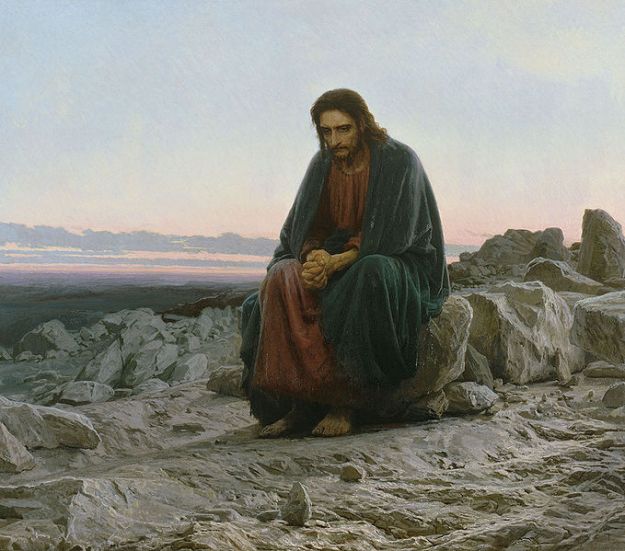
Ivan Kramskoy, Christ in the Desert (1872)

Matthew 4: 1-11

Parallel Mark 1: 12-13, Luke 4: 1-13

1 Then Jesus was led up by the Spirit into the wilderness to be tempted by the devil. 2 He fasted forty days and forty nights, and afterwards he was famished. 3 The tempter came and said to him, “If you are the Son of God, command these stones to become loaves of bread.” 4 But he answered,

“It is written, ‘One does not live by bread alone, but by every word that comes from the mouth of God.'”

5 Then the devil took him to the holy city and placed him on the pinnacle of the temple, 6 saying to him, “If you are the Son of God, throw yourself down; for it is written,

‘He will command his angels concerning you,’ and

‘On their hands they will bear you up, so that you will not dash your foot against a stone.'”

7 Jesus said to him, “Again it is written, ‘Do not put the Lord your God to the test.'”

8 Again, the devil took him to a very high mountain and showed him all the kingdoms of the world and their splendor; 9 and he said to him, “All these I will give you, if you will fall down and worship me.” 10 Jesus said to him, “Away with you, Satan! for it is written,

‘Worship the Lord your God, and serve only him.'”

11 Then the devil left him, and suddenly angels came and waited on him.

Even though a chapter division is introduced between the baptism scene at the end of chapter three and the temptation at the beginning of chapter four these scenes are connected. Within liturgical churches the perceived separation between these scenes is heightened by the traditional reading of the baptism scene after the end of the Christmas season and the temptation scene several weeks later during the first Sunday in Lent. Matthew and Luke share a common telling of this scene (although Luke modifies the order we find in Matthew probably due to Luke’s focus on the temple as being central to the narration of Jesus’ story) both keeping the placement in the narrative with Mark but adding the content of the temptation Jesus undergoes.

Jesus is led by the Spirit into the wilderness, a softening of the language we find in Mark where Jesus is literally ‘thrown’ into the wilderness (using the same term that Mark uses for casting out of demons). Throughout this temptation we are linked to the baptism by the location, the wilderness, the action of the Spirit of God and the continuity of the title used throughout the two scenes, Son of God. Previously the wilderness provided a place of revelation where the Spirit of God and the voice from heaven pronounce Jesus’ identity now it provides a place where Jesus’ identity is challenged. The wilderness will be a place of divine guidance, care and revelation but it is also a place of deprivation, isolation and challenge. Yet, this temptation seems to be if not divinely orchestrated at least an intentionality of movement by the Spirit of God and Jesus. It is a place where danger and revelation will hold hands, to use O. Wesley Allen’s phrase. (Allen, 2013, p. 39) Yet, there is also an element of, for a time, being isolated by God and entering into the suffering of that isolation as the wilderness of temptation becomes a place where the kingdom of heaven’s advent is both prepared for and resisted.

The forty days and forty nights in the wilderness that Jesus fasts prior to the temptation is frequently noted in paralleling the forty years that the people of Israel spend in the wilderness, a time where the people transition from being the slaves of Egypt to the people of the LORD the God of Israel. While the sojourn of the people of Israel is a time of divine guidance, care (providing food and water throughout their journey) and revelation (both the giving of the law and the creation of the tabernacle) and Jesus being identified with Israel is one of the accents within the identity that Jesus will bear there is also a close tying to the story of Moses in this scene. While Moses is not tested by the devil in the manner, we hear in Jesus story he has two forty-day periods on Mount Sinai where he receives the law (see Exodus 24: 18) and intercedes for the people after the incident of the Golden Calf. The intercession for the people after the Golden Calf is like the language of this scene:

He was there with the LORD forty days and forty nights; he neither ate bread nor drank water. And he wrote on the tablets the words of the covenant, the ten commandments. (Exodus 34:28)

Not only is he receiving the law to bring to the people, a parallel we will soon see in the sermon on the mount, but it is also during this forty days on Mount Sinai where Moses goes to make atonement for the people. Jesus, we learned in Matthew 1: 21 is one who will save the people from their sins. I believe this scene want us to hear an echo of Moses going up Mount Sinai to intercede for the people, Moses will say,

“Alas, the people has sinned a great sin; they have made for themselves gods of gold. But now only forgive their sin—but if not, blot me out of the book that you have written.”  Exodus 32: 31-32)

This scene in Exodus (Exodus 32-34) is a scene where God reveals God’s glory to Moses, where the covenant between God and Israel is renewed and God chooses to dwell among the people again. One of the links we may be encouraged to see here is a time where Jesus also initiates a time of fasting to restore the relationship between God and the people of God.

With all these connections and links to various images from the scriptures it can become a little overwhelming as we wonder: Who is Jesus? Is he God with us? David? Moses? Israel? Son of God? The Son of Man? The Christ? And ultimately Matthew feels we need all these titles and linkages to attempt to convey the fullness of who Jesus is and what his story means for those who hear it. Matthew is willing to use the rich language of the scriptures he inherits to attempt to paint his portrait of Jesus for the church to learn from and to follow. In the previous chapter I mentioned two great scriptural rivers that flow into the deep sea that is Matthews gospel (Isaiah specifically and the prophets in general along with the Psalms specifically and wisdom literature in general) but now I want to highlight a third river that flows through the landscape, one that has provided nourishment and hope and now as it reaches its goal in the gospel will be also be a part of the advent of the kingdom of heaven, the law (or Torah). As mentioned above, Jesus is one who becomes linked with Moses and the law in the Sermon on the Mount, but it is also worth noting here because the three quotations that Jesus makes during the temptation all come from the law, specifically the book of Deuteronomy.

Perhaps before we can begin the actual scene of temptation, we need to discuss the antagonist in the scene who is called tempter, devil and Satan. We view the world differently than our ancestors in the time of Matthew and we often don’t see our world as inhabited by devils and demons the way we find in the gospels. Philosopher Charles Taylor uses the language of the porous self in the earlier enchanted world to talk about this reality, where the porous self is vulnerable to spirits, demons and cosmic forces and these forces (both good and evil) actively inhabit the world and possess people within it. With evil forces active in the enchanted world affiliation with a power that could triumph over these forces was an important part of life, and for those within the sphere of Christianity and Judaism that force was God. In Taylor’s language:

Perhaps the clearest sign of the transformation in our world is that today many people look back to the world of the porous self with nostalgia. As though the creation of a thick emotional boundary between us and the cosmos were now lived as a loss. The aim is to try to recover some measure of this lost feeling. So people go to the movies about the uncanny in order to experience a frisson[1]. Our peasant ancestors would have thought us insane. You can’t get a frisson from what is really in fact terrifying you. (Taylor, 2007, p. 38)

That people believed in evil forces being personified in the devil and demons during the time of Matthew is not controversial, the controversy is how we as ones living in the disenchanted world we have inherited from modernity can talk about the devil and the demonic. One approach is taken creatively by C.S. Lewis in The Screwtape Letters where he ascribes the disenchanted world to the action of the devilish forces themselves. As the fictional devil Screwtape writes to a devil who is still learning how to manipulate humans:

Our policy, for the moment, is to conceal ourselves. Of course this has not always been so. We are really faced with a cruel dilemma. When the humans disbelieve our existence we lose all the pleasing results of direct terrorism and we make no magicians. On the other hand, when they believe is us, we cannot make them materialists and sceptics. (Lewis, 2017, p. 203)

Others may attribute social, psychological, or cultural reasons to explain the belief of the devilish and demonic forces in the gospel. The rational bias of the enlightenment encourages us to live within a world separated from the spiritual world or devils and angels, but I refuse to excise from the gospels the critical forces on opposing sides of the kingdom of heaven. Personally, I am all to aware of the persistence of evil in the world in ways that go beyond rational explanations of systemic evil or other modern explanations. Even though I may have never encountered evil personified in either the devil or a demon I am inclined to walk between the two options that C.S. Lewis states at the beginning of the Screwtape Letters: I neither disbelieve their existence nor do I exercise an unhealthy interest in them. (Lewis, 2017, p. 183)

The Spirit has led Jesus to a place where he is to be tempted, and there is an intentionality to this scene as the kingdom of heaven is brought into conflict with one who claims to be able to give all the kingdoms of the world. This conflict sets the stage for everything afterwards, this is the moment when we realize that the tempter is unable to tempt the one who has come to confront him and that the devil is powerless in the presence of the Son of God. The devil’s power here may appear incredible, but ultimately it derives its strength from those he is able to tempt into allegiance to him. Jesus shows us how to read scripture in a way that resists temptation and delivers us from the evil one, Jesus perhaps is led into temptation to show us how the law (Torah) helps us resist the promises of the devil. Yet, perhaps this scene also binds the strongman (see Matthew 12: 29) for immediately after this scene Jesus will announce the kingdom of heaven is at hand, demons will recognize him for who he is (Matthew 8: 28-31) and the forces that have bound people whether demonic or illness will be overcome.

The first temptation, turning stones to bread, begins with the situation of the forty days of fasting and the hunger that Jesus experiences. Jesus’ answer pulls on Deuteronomy 8: 2-3:

Remember the long way that the LORD your God has led you these forty years in the wilderness, in order to humble you, testing you to know what was in your heart, whether or not you would keep his commandments. He humbled you by letting you hunger, then by feeding you with manna, which neither you nor your ancestors were acquainted, in order to make you understand that one does not live by bread alone, but by every word that comes from the mouth of the LORD.

The fundamental issues throughout the temptation: Who is the God who Jesus will serve? Who provides what is needed? And what will Jesus’ title Son of God mean for the way he conducts himself? Jesus again takes on the role of Israel being tested not only by the devil but also demonstrating his obedience to God, being humble and keeping the commandments. The harkening back to this scene in Deuteronomy reminds the hearer with scripture tuned ears that God is the one able to provide bread in the wilderness, and while Jesus will later multiply loaves and fishes, ultimately God is the one who provides what is needed. Jesus enters this space of divine silence and devilish temptation awaiting the word that comes from the mouth of the LORD, and perhaps, to use imagery from the gospel of John, he is that word spoken to the devilish temptation.

Consistent throughout all the temptation is also the challenge of the way Jesus inhabits the title Son of God. Like the serpent in the garden of Eden he attempts to lure the one into believing that God would not deny that which is desirable to one who could be like God. Yet, unlike Eve and Adam, Jesus is not swayed by these words and will not be the Son of God by anyone else’s terms.  Much like the mocking tone of “You are the Christ” sung by King Herod in Jesus Christ Superstar there is a mocking of the way Jesus chooses to embody being the Son of God in Satan’s challenge.

The second temptation introduces a movement away from the wilderness to Jerusalem at the pinnacle of the temple. The proximity to holy space or the ability to quote scripture does not guarantee that one will read scripture correctly, as later conflicts within the temple will demonstrate. Here even the devil in this space uses scripture but uses it incorrectly. The quoted verses are from Psalm 91: 11-12, and as we heard previously the Psalms is one of the major texts that Matthew will use to talk about who Jesus is, but here even the devil can use the Psalms to talk about who he believes Jesus should be. The implied challenge for Jesus is to demonstrate his trust in God and demonstrate that trust through expecting God to rescue Jesus amid trouble. The angels will wait on Jesus after the temptation, but here they are absent, here in this place of temptation (even though they are at the pinnacle of the temple) the divine voice is silenced by the tempter’s words and even scripture is used as the devil’s tool. Yet, Jesus continues to demonstrate a way of reading scripture that models for Israel and the church how to resist temptation. Again, Jesus responds from the law (Torah) and again Deuteronomy speaks:

Do not put the LORD your God to the test, as you tested him at Massah. Deuteronomy 6:17

The testing at Massah refers to Exodus 17 where the people quarreled with Moses and demanded water, Massah is means test so there is a play on words within this verse in Deuteronomy. Jesus continues to embody what Israel was meant to be by refusing to test God even amid temptation. This temptation also echoes at the cross when Jesus is taunted, “If you are the Son of God, come down from the cross.” (Matthew 27: 40)

The final temptation takes place on a high mountain, typically a location of revelation for Matthew, but now the revealer is the tempter claiming dominion over all the kingdoms of the world and offering them to Jesus if he will worship him. Jesus is invited to claim power but at the cost of his identity, no longer is the title, “If you are the Son of God” used because to worship the devil would be abandon that identity. Perhaps within this temptation is the close association of earthly power with those anointed to be kings, which also is the context of Psalm 2 which echoes in the baptismal scene in the previous chapter.

I will tell of the decree of the LORD: He said to me, “You are my son; today I have begotten you. Ask of me, and I will make the nations your heritage, and the ends of the earth your possession. You shall break them with a rod of iron, and dash them in pieces like a potter’s vessel. Psalm 2: 7-9

Jesus is offered here the ends of the earth as a possession and the nations as a heritage, but the one offering is not the LORD, but instead the tempter. Many people will expect Jesus to model his life on those who claim worldly power, but the kingdom of heaven will be different, just like the nation of Israel was to be different than Egypt of Babylon or Rome. Even Peter will later rebuke Jesus when he talks about undergoing suffering and being killed and receive similar words, “Get behind me Satan! You are a stumbling block to me; for you are setting your mind not on divine things but on human things” Matthew 16: 23.

Jesus answers the devils by referencing Deuteronomy 10: 20,

You shall fear the LORD you God; him alone you shall worship; to him you shall hold fast, and by his name you shall swear.

This also refers to the first commandment (Exodus 20: 1-6, Deuteronomy 6: 6-10) where the people are to have no other gods and to worship on the LORD their God. In combination with this quotation Jesus also dismisses the devil. Jesus says, “Away with you, Satan” and the devil leaves. Jesus casts him out like he will later do with the demons. When the devil departs the angels arrive and wait on him. Somehow the devil’s presence made the angelic presence unavailable. Jesus had to enter this space to cast Satan out of it. The tempter has been thwarted, the strong man who claims power over the nations has been bound and the angels minister to Jesus as we approach the announcement of the kingdom of heaven’s arrival.

[1] A frisson is a sudden feeling of excitement or thrill
 

Matthew 3: 13-17 The Baptism and Revelation of Jesus

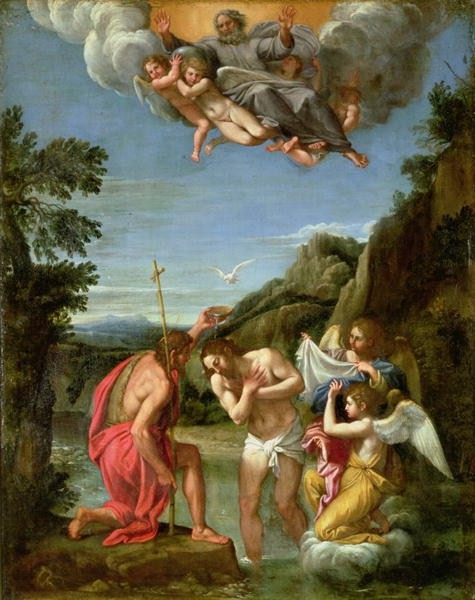
Francesco Albani, Baptism of Christ (1600s)

Matthew 3: 13-17

Parallel Mark 1: 9-11, Luke 3: 21-22

13 Then Jesus came from Galilee to John at the Jordan, to be baptized by him. 14 John would have prevented him, saying, “I need to be baptized by you, and do you come to me?” 15 But Jesus answered him, “Let it be so now; for it is proper for us in this way to fulfill all righteousness.” Then he consented. 16 And when Jesus had been baptized, just as he came up from the water, suddenly the heavens were opened to him and he saw the Spirit of God descending like a dove and alighting on him. 17 And a voice from heaven said, “This is my Son, the Beloved, with whom I am well pleased.”

Matthew’s careful narration of the ministry of John the Baptist reaches its climax with the baptism of Jesus, and just as the identity of John the Baptist and the content of his ministry pulls on the prophetic imagination, particularly from Isaiah in this short narrative of the baptism the hope of Isaiah mingles in with the poetic waters of the Psalms as we continue to wonder who this Jesus who meets us in the midst of the waters is. In the previous section I highlighted Isaiah 43: 1-7 where the people are reminded by the prophet Isaiah:

When you pass through the waters, I will be with you; and through the rivers, they shall not overwhelm you; when you walk through fire you shall not be burned, and the flames shall not consume you. Isaiah 43:2

We heard John proclaim that one who was more powerful was coming after him, one who would baptize with the Holy Spirit and fire, and as we are introduced to Jesus, Matthew invites us into the water to wonder about this one who is coming after John. The day that comes after the announcement of Elijah in Malachi 4: 5-6 is the day of the LORD, could the coming kingdom of heaven and the day of the LORD truly be at hand in this moment Matthew narrates to us? In Matthew 1 we were introduced to a title for Jesus, Emmanuel: God with us, could this Jesus who stands amid the waters with the reconstituted people of Israel in some way be the God of Israel? Mark’s gospel may have made continual allusions and hints that in Jesus we were encountering more than just a Messiah but Matthew continues to link suggestively in ways that would be shocking to those attuned to hear the imagery of scripture referenced in this way that in Jesus we are somehow meeting ‘God with us.’

Jesus reenters the gospel by approaching John at the Jordan and journeying away from his home in Galilee and approaches John to be baptized with the people. Matthew’s short narrative spends longer on this scene than either Mark or Luke wanting us to hear John’s protest and identify Jesus as one who is greater than him, as one who should be baptizing him.  Jesus’ response places him with the people of Israel, those who have come to the waters, those who have turned their hearts to God, those who are repenting and he enters into this space where they have come seeking God’s promised kingdom and is joined to their story. Jesus is not only linked to the story of Israel in the birth narratives, his narrative begins to take on the shape of their story and his identity is typologically joined to the identity and vocation of Israel. As Richard B. Hays proposes:

I would propose that Jesus’ acceptance of a baptism of repentance, performed at the Jordan River, is meant to signify his symbolic identification with sinful Israel (the people whom he will “save from their sins”), and the figurative beginning of that new Israel’s entry into the land of promise. (Hays, 2016, p. 116)

I think it is also important to realize that a continual theme throughout the scriptures is God’s desire to dwell among the people. The kingdom of heaven is being brought to earth rather than the citizens of earth being transported to heaven. God’s desire in the Exodus was to dwell among God’s people in the tabernacle at the center of the community and the sin of the Golden Calf threatened this because God’s anger at their betrayal posed a threat to the people, and yet God forgave and did dwell and go forward with he people. The entire birth narrative of Matthew suggests that this incarnation, to use the language Christians would assign to the birth of Jesus, is God in a new and unexpected ways coming to dwell among God’s people for the sake of the world.

Jesus’ answer to John the Baptist reintroduces us to the concept of righteousness. We first encountered Joseph as a righteous man and righteousness is far more important word to Matthew than to either Mark or Luke who rarely use this term. One the one hand, righteousness in the gospel is held as a contrast to sinners, sometimes in surprising ways, as Jesus will later say, “I have come to call not the righteous but sinners” (Matthew 9: 13) and yet the followers of Jesus are to, “strive first for the kingdom of God and his righteousness.” (Matthew 6: 33) Jesus becomes the fulfiller of what righteousness will look like and the one who can interpret how one is to live a righteous life. Here Jesus models righteousness in standing with the people who are striving for the kingdom of God and God’s righteousness, later in the Sermon on the Mount he will interpret how to approach the Torah (Law) and what the righteousness of the kingdom of heaven will look like. While Jesus has come to ‘save the people from their sins’ he is not leaving them alone in this, but instead he will walk with these new disciples and model and teach them what it means to hunger and thirst for righteousness, how they can embody a righteousness greater than the scribes and the Pharisees, and how they can seek first the kingdom of God and his righteousness.

Matthew in his unique way wants to highlight this story in a way that accents it differently than Mark and Luke. One of the differences between Matthew and Mark is what happens to the heavens. In Mark’s gospel the heavens are ripped open (the word in Greek is schizomenos, the schizo root is where we get schizophrenia-a ripped open mind) but for Matthew they were opened a far less violent act. This may relate to Matthew’s belief that the creation itself cooperates in bearing witness to who Jesus is and what Jesus means, like the star at the birth and the convulsions in the heaven and earth at the crucifixion. This is a significant change because the schizomenos word forms a bookend for the beginning and end of Mark’s gospel and Matthew chooses to narrate the story without using this rare and noticeable word. There is an intentionality in Matthew’s narration of this scene and the way he carefully chooses vocabulary to fit his vision of what is occurring.

Additionally, in Matthew’s narration of this scene, we see the only gospel where the declaration of the voice from heaven being for everyone present and not only for Jesus. In both Mark and Luke, the voice declares, “You are my son”, but in Matthew the declaration is, “This is my son, the Beloved, with whom I am well pleased.” Jesus may be the only one who sees the heavens open and the Spirit descend but the voice declares for those who have ears to hear that Jesus is given the titles of Son, Beloved and one with whom God is pleased. The proclamation in this form will be echoed at the Transfiguration in Matthew 17 and we are meant to hear the connection between these event that allow reveal who Jesus is. It also links us to the centurion’s declaration at the crucifixion that “This man was God’s Son.”

In this declaration of the voice we also hear the echo of another major scriptural current that will flow throughout Matthew’s Gospel, the poetic flow of the Psalms. Here the words go back to the words of Psalm 2 and its words lifting up God’s chosen leader and the close identification between God and that leader:

I will tell of the decree of the LORD: He said to me, “You are my son; today I have begotten you. Ask of me, and I will make the nations your heritage, and the ends of the earth your possession.  You shall break them with a rod of iron, and dash them in pieces like a potter’s vessel.”  Now therefore, O kings, be wise; be warned, O rulers of the earth. Psalm 2: 7-10

Just as Isaiah was one of the major rivers flowing into the deep sea of Matthew’s Gospel, so the Psalms will be one of the other major bodies of water contributing its language and rhythms to the gospel and helping the evangelist to find language to describe who Jesus is and what he means. For the identity of Jesus is critical to those who will pass through the waters with him.

I continued the quotation of Psalm 2 longer than most writers, though most catch the allusion to this Psalm, because there is in this public declaration a challenge to the existing powers. The gospel is a political statement and the kingdom of heaven does challenge the underlying assumptions of any empire: whether Egypt, Babylon, Rome or even a modern world power like the United States. In Jesus’ day it was well known that Caesar Augustus, who reigned during Jesus’ birth, and Emperor Tiberius, who reigned during Jesus ministry, both made claims to be the son of a god. Later in the gospel when Jesus asks for a denarius (Matthew 22:19) it likely bore an inscription stating Caesar Augustus Tiberius son of the divine Augustus. Yet, Jesus being declared Son of God by God’s voice occupies this role in a way that Caesar cannot, Caesar’s divine right may be defended by the might of the empire but for Matthew’s gospel the voice of the God of Israel’s declaration is the only one that matters.  A challenge to this vision of what God’s reign through the Beloved will look like will be encountered next in the temptation narratives of the following chapter.

Matthew also slightly modifies the language around the Spirit of God from Mark in a subtle but important way. In Mark’s gospel the Spirit of God comes down ‘into’ Jesus and the will ‘throw or cast out’ Jesus into the wilderness, but in Matthew the Spirit of God comes down and appears to Jesus and will later ‘lead’ Jesus into the wilderness. For Matthew it is important that Jesus remains in control and that the Spirit of God partners with Jesus rather than controlling or possessing Jesus (which you could argue for in Mark’s gospel).

This critical piece of the story once again points to who this Jesus is. It has been a topic introduced throughout the opening chapters and there have been multiple answers that continue to give richness to the answer Matthew wants us to hear. Yet, Matthew wants us to hear this close identification between Jesus and the God of Israel in an emphatic way that is reinforced throughout these chapters. As O. Wesley Allen can state:

What the angel declared to Joseph, what the magi understood the star to mean, what the prophetic texts confirm, and what John himself proclaimed is now summed up in God’s own voice. (Allen, 2013, p. 38)

Jesus’ identity will present a challenge to both the ruling authorities who desire to claim divine authorization for their own rule and it also reframes the Jewish expectation of the ruler who God reigns on God’s behalf. Matthew’s use of the Hebrew Scriptures stretches their imagination of how God comes to dwell with the people farther than the Psalms or the prophets would have dared, and yet it is the language of the prophets and psalms that underlies the proclamation of the evangelist. Matthew is making bold claims about who Jesus is and how he is related to God. Matthew’s carefully chosen words, along with the words of the other gospel writers, Paul and the other authors of the New Testament would give birth to the Trinitarian way in which Christians would talk about God. Yet, Matthew nor any other writer of the New Testament, would have developed the vast Trinitarian language that forms the creeds of the early Catholic and Orthodox church, that language evolved around the explanation of who Jesus is to a Greek philosophical mindset rather than the mindset immersed in the Hebrew Scriptures. Matthew is far more interested in letting the disciples of Jesus know that in Jesus they are somehow meeting God with them than attempting to describe how Jesus can be fully divine and fully human, or how Jesus, God and Spirit can be one being. Matthew would probably be ambivalent to these philosophical questions but instead would want us to know how the scriptures bear witness to the hope, promise and identity of Jesus and what it means for Israel and the rest of the world.


Matthew 3: 1-12 The Herald of the Kingdom of Heaven

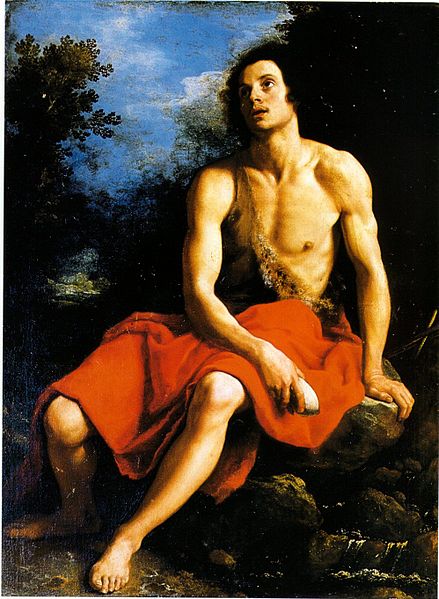
Cristofano Allori, John the Baptist in the Desert, 17th Century

Matthew 3: 1-12

Parallel Mark 1: 2-8, Luke 3: 1-17

1 In those days John the Baptist appeared in the wilderness of Judea, proclaiming, 2 “Repent, for the kingdom of heaven has come near.” 3 This is the one of whom the prophet Isaiah spoke when he said,

“The voice of one crying out in the wilderness: ‘Prepare the way of the Lord, make his paths straight.'”

4 Now John wore clothing of camel’s hair with a leather belt around his waist, and his food was locusts and wild honey. 5 Then the people of Jerusalem and all Judea were going out to him, and all the region along the Jordan, 6 and they were baptized by him in the river Jordan, confessing their sins.

7 But when he saw many Pharisees and Sadducees coming for baptism, he said to them, “You brood of vipers! Who warned you to flee from the wrath to come? 8 Bear fruit worthy of repentance. 9 Do not presume to say to yourselves, ‘We have Abraham as our ancestor’; for I tell you, God is able from these stones to raise up children to Abraham. 10 Even now the ax is lying at the root of the trees; every tree therefore that does not bear good fruit is cut down and thrown into the fire.

11 “I baptize you with water for repentance, but one who is more powerful than I is coming after me; I am not worthy to carry his sandals. He will baptize you with the Holy Spirit and fire. 12 His winnowing fork is in his hand, and he will clear his threshing floor and will gather his wheat into the granary; but the chaff he will burn with unquenchable fire.”

Some time later we arrive at the beginning of story of Jesus as an adult and to set the stage for that story we are introduced to John the Baptist who will share a common message with Jesus but a different role within that message. John will be the Elijah character who proceeds the promised messiah, but there is much more to the story than just preparing the way for the messiah’s coming. Here the story builds on what was revealed to us in the first two chapters to prepare us for the advent of the kingdom of heaven.

Place matters in the gospels and the wilderness of Judea along the Jordan river is a place that is rich in meaning. Wilderness indicates a place away from Jerusalem, Judea and all the inhabited region along the Jordan. It is unsettled and because of that it has the connotation of being a place where one may encounter danger or the divine. The wilderness is the place of baptism, of being joined to the community of the faithful and it is the place of devilish temptation where one’s identity is continually questioned. It can be a place where the voice of God may speak to the one who is listening, and it can also be a place where the demonic voices drive a person to madness. Israel had to pass through the wilderness to become the people of God, they would pass through the Red Sea on leaving Egypt and the Jordan on entering the promised land. The wilderness can also be the place where God’s creative power does new things, particularly the rich language of Isaiah is relevant here:

I am about to do a new thing; now it springs forth, do you not perceive it? I will make a way in the wilderness and rivers in the desert. (Isaiah 43: 19, see also Isaiah 35 and Jeremiah 31: 2)

The beautiful and hopeful language of Isaiah 43 along with Isaiah 35 and Jeremiah 31 add resonance to this theme, these hopeful passages spoken to an exiled people about God making a way in the wilderness and creating a new people enrich our hearing of the hope embodied in this strange prophet in a wilderness space.

The message that John the Baptist is summarized with the exact words that Jesus will use later in the gospel (Matthew 4: 17; 10:7). Both Mark and Luke include the ministry of John the Baptist to introduce the ministry of Jesus, but Matthew links the proclamation of John the Baptist explicitly to the later proclamation the good news that Jesus will proclaim. Both will run into challenges with the Pharisees, Sadducees and Herod and the other political powers, yet according to Matthew they are both sharing a common proclamation. As O. Wesley Allen Jr. state, “the difference between John and Jesus is not their message but the role they play in relation to that message.” (Allen, 2013, p. 35)

Scripture now speaks to give its direct voice to the role that John the Baptist will play in this story. Matthew instead of adopting the mashup of multiple verses used in Mark uses Isaiah 40:3 to identify John as “the voice crying out in the wilderness: ‘Prepare the way of the LORD, make his paths straight.’” Isaiah 40 is a message of comfort and hope to a people who have been exiled and may have felt forgotten by their God, but now Isaiah announces that God is indeed coming and that the people shall see the glory of the LORD together.

John is linked visually with Elijah by wearing clothing of camel’s hair with a leather belt around his waist. Elijah is described in 2 Kings 1:8 as “a hairy man with a leather belt around his waist.” As mentioned above there was an expectation that Elijah would proceed the coming of the messiah, this hope comes both from the manner that Elijah’s death is recorded in 2 Kings 2 and in Malachi (the book that immediately proceeds Matthew in the way many bibles are organized) in the final chapter we hear of a time when God will judge the unrighteous and will lift up the righteous and in this judgment and exaltation:

Lo, I will send you the prophet Elijah before the great and terrible day of the LORD comes.  He will turn the hearts of parents to their children and the hearts of children to their parents, so that I will not come and strike the land with a curse. (Malachi 4: 5-6)

The God of Israel is a God who desires repentance. As the prophet Joel can remind the people, “Return to the LORD your God, for he is gracious and merciful, slow to anger and abounding in steadfast love’ (Joel 2: 13, see also Deuteronomy 30:2, this portion of Joel picks up the language of the thirteen attributes of God from Exodus 34: 6-7) and we hear in Malachi that the expected Elijah was to go before the advent of the Lord to turn families back to the way they were intended to embody so that they would be among the righteous and not the unrighteous ones. They would be those who were greeting the advent of the kingdom of heaven with joy instead of with lamentation.

This first herald of the advancing kingdom of heaven is not the lavishly dressed and well fed ambassador we might see attempting to negotiate a peace treaty between two nations but is instead a strangely dressed (but typologically familiar) prophet who eats the diet of the poorest in the desert (but which was ritually clean). In a kingdom where the poor in spirit are blessed and those who hunger and thirst for righteousness will be filled, where the merciful and peacemakers are those who embody what this kingdom is about, the kingdoms of this world will look more like the kingdom of Egypt that the Israelites escaped from than their hoped for reign where God was their king in the promised land. This heavenly kingdom will be different than the kingdom of Judea or the empire of Rome, but that doesn’t mean that Rome and Herod Antipas wouldn’t hear this proclamation as a challenge to their own kingdoms and wouldn’t oppose it with every tool at their possession.

When the Pharisees and Sadducees arrive in the wilderness to investigate what is occurring with the movement around John the Baptist, we may be surprised by the confrontational language that John uses towards them. For most people who have been trained in reading scripture recently there has been a reappraisal of the Pharisees and Sadducees viewing both movements in a more positive light than the previous generations of scholarship. Often the Pharisees and the Sadducees became embodiments of a legalistic and rigid worldview in Christian writing and like Judaism in general most writing about these two movements was polemical in nature. Hopefully I can provide a more nuanced approach to the topic as we move through the gospel, but it is worth noting that in general both the Pharisees and the Sadducees will find themselves aligned on with the forces opposed initially to John and later to Jesus. Neither group is completely aligned with the goals of the political powers of Herod Antipas in Galilee or Pontus Pilate in Judea, but they have negotiated a way of working with these powers and maintaining their position. There is no separation of church and state in the ancient world, and any close look at the political world of the time of Jesus will quickly illuminate a connection between the religious authorities and the political.

The Pharisees and Sadducees are both movements within second temple Judaism that are connected with both local and national power, and they have struggled with each other for influence for generations, but they are still tied to the existing networks of power. I believe this alliance with the existing networks of power is behind the criticism of John the Baptist when he calls them a brood of vipers fleeing wrath and challenges them to bear fruits worthy of repentance. In John’s view their reforms are not enough, God is doing something new. This symbolically rich baptism of repentance is reconstituting Israel to begin again in a new and forgiven state. The Pharisees were a reform movement attempting to be faithful to the law by reclaiming practices of holiness and the Sadducees were focused on maintaining proper worship at the temple by the priesthood, but John stands within a long line of prophets who continually call the people of Israel to see that repentance is more than ritual or religious practice. As Anna Case-Winters can state, “If they “change their minds” it will change their lives. Where is the evidence of this? Ritual purity without righteousness counts for nothing. This message is strong in the ethical tradition of Judaism.” (Case-Winters, 2015, p. 46) [1]

Matthew wants us to hear John the Baptist in concert with Jesus and just like John using the language of the kingdom of heaven to introduce what his proclamation is about we will also hear almost identical words come from Jesus’ mouth towards the Pharisees about being a brood of vipers and bearing fruit worthy of repentance.

Either make the tree good, and its fruit good; or make the tree bad, and its fruit bad; for the tree is known by its fruit. You brood of vipers! How can you speak good things, when you are evil? For out of the abundance of the heart the mouth speaks. The good person brings good things out of a good treasure, and the evil person brings evil things out of an evil treasure. I tell you, on the day of judgment, you will have to give an account for every careless word you utter; for by your words you will be justified, and by your words you will be condemned. (Matthew 12: 33-37)

Jesus, in Matthew, can be both gracious and direct. He will embody both the prophetic hope and the prophetic critique. John foreshadows this by letting us know that Christ’s coming and the advent of the kingdom of heaven will not be a painless process for everyone. Forgiveness often means that something must die, repentance means that one must turn one’s back on something to turn towards that which you are returning to and grace while it is given freely may indeed cost the recipient much in terms of their relationship with family and the existing power structures of the world. The coming of Jesus means that some trees will be cut down and thrown into the fire so that those with good fruit have the space to flourish providing their fruit in each season for the healing of the nations.

Even though Matthew begins his telling of Jesus’ story with a genealogy he lets us know early that genealogy is not enough. Here in John’s accusation taps again into language from the prophet Isaiah:

Listen to me, you that pursue righteousness, you that seek the LORD. Look to the rock from which you were hewn, and the quarry from which you were dug. Look to Abraham your father and to Sarah who bore you; for he was but one when I called him, but I blessed him and made him many. (Isaiah 53: 1-2)

In Isaiah’s time he is speaking to an Israel that has already drained the cup of the Lord’s wrath (Is. 53:17) but now John is speaking to a people who are being offered a cup at the banquet of the Lord, but like those who will later refuse their place at the wedding banquet (see Matthew 22: 1-14) they will find themselves receiving the king’s judgment because they refused the invitation to turn away from the things that concerned them, their own negotiated settlements with the powers of the day and instead would mistreat and abuse the messengers of the banquet.

J.Ross Wagner in 2000 published a work called Heralds of the Good News: Paul and Isaiah in Concert in the Letter of Romans and if you haven’t guessed by the string of quotations from Isaiah referenced in these initial chapters I believe that Matthew as a herald of the kingdom is placing John the Baptist and later Jesus’ ministry in a key that would be in harmony with the prophetic hope and challenge of Isaiah in particular and other prophets as well. For years Christians have mined the prophet Isaiah for prooftexts that, cut off from their context, could be used as predictors for Jesus’ life and ministry but what if, instead, we actually allowed Isaiah’s words and hope to provide language and richness to the experience of Jesus narrated by Matthew. As I have argued from the beginning of these reflections, Matthew’s narration of Jesus’ story is a uniquely Hebrew way of reading the story of Jesus and as we immerse ourselves in Matthew’s gospel we should expect to be swimming in waters deeply infused with the words of the law, the prophets, the narrative and the poetry of the Hebrew people. Yet one of the major rivers flowing into the deep sea of Matthew’s gospel is the prophet Isaiah with his vision of hope and reinterpretation of what Israel’s identity is to be.

We are introduced here with the actions of John the Baptist baptizing those coming into wilderness a key piece of what Matthew will continue to reinforce: the identity of the chosen people. In a context where the people of Jerusalem and all Judea is now attached to the Roman empire and its emissaries (including the religious authorities in Jerusalem) John is making a prophetic break from the temple and its leaders. What will define the reconstituted Israel will be the God of Israel rather than the newly rebuilt temple but instead an orientation towards the approaching kingdom of heaven. They stand at the Jordan river awaiting a new Joshua to bring them into the kingdom that their Lord has promised them. And to use one final image from the prophet Isaiah they are reminded:

But now thus says the LORD, he who created you, O Jacob, he who formed you, O Israel: Do not fear for I have called you by name, you are mine. When you pass through the waters, I will be with you; and through the rivers, they shall not overwhelm you; when you walk through fire you shall not be burned, and the flame shall not consume you. For I am the LORD your God, the Holy One of Israel, your Savior. I give Egypt as your ransom, Ethiopia and Seba in exchange for you, Because you are precious in my sight, and honored, and I love you, I give people in return for you, nations in exchange for your life. Do not fear for I am with you; I will bring your offspring from the east, and from the west I will gather you; I will say to the north, “Give them up,” and to the south, “Do not withhold; bring my sons from far away and my daughters from the ends of the earth—everyone who is called by my name, whom I created for my glory, whom I formed and made.” Isaiah 43: 1-7

Yet John the Baptist is merely a herald of the good news, but the gospel (and the play on words here is that gospel and good news are the same Greek work euangellion) is not merely about the proclamation of the kingdom of heaven but its advent. One greater than John is coming, John can stand in the waters of the Jordan and reorient the people of God, but he cannot bring in the kingdom. Ultimately, for Matthew, he wants us to see that God will be with the people calling them by name, passing through the waters with them and gathering them from the ends of the earth. John sees God’s harvest approaching where the faithful will be gathered together and not consumed by the flames that are to come.

I’ve hinted that this will be a gracious reading of Matthew’s gospel and if John the Baptist and Jesus both can advocate this type of division between chaff and wheat some might ask from our context where the grace can be in the judgment. Working through Exodus, Deuteronomy, Psalms,  Jeremiah and Revelation you have to come to terms with the judgment of God against those forces either within or beyond the boundaries of the community which have set their will against their creator: Egypt, the people of Israel and Judah, Babylon and Rome all come under God’s judgment for the sake of the life and witness of God’s people and the prosperity of the world. Yet, God’s judgment is always preceded with an opportunity for repentance, with a chance for those who will be sorted to return to the Lord who is gracious and merciful, slow to anger and abounding in steadfast love. God is not content to allows things to remain the way things are, to allow the ways of Egypt, Assyria, Babylon or Rome to be the truth. As Miroslav Volf can state insightfully, “In Pilate’s world, truth and justice were fruits of Caesar’s sword. In Jesus’ kingdom, truth and justice are alternatives to Caesar’s sword.” (Volf, 1996, p. 275) John in heralding the advent of the kingdom of heaven is offering the people to turn to an alternative to Rome or Herod Antipas’ reign, the kingdom of heaven is an alternative to the empire of Rome. A God who changes the world without judgment is, in Volf’s words, a pleasant captivity of the liberal mind[2]. (Volf, 1996, p. 304)

The challenge of John to the religious authorities of his day should also give pause to those with ears to hear when they are tempted to closely align with the political powers of their own day. As one of my readings outside of the work I’ve done on Matthew I’ve been going through Dietrich Bonhoeffer’s writings in the critical years of 1932-33 where the National Socialist Party rose to power and successfully asserted influence on the state churches (Catholic, Lutheran and Reformed) in Germany and effectively coopted the majority of practicing Christians into the rise of the policies that would unfold while the Nazis remained in power until the end of World War II and the destruction of much of Germany. Even though in the United States there is a separation between church and state there is still a great lure to being closely situated to those in political power. Like the people of Israel being reconstituted here in the wilderness of the Jordan, there are times where we will need to return to our own baptism and be reminded that our trust is in the Lord our God who created us and who passed through the waters with us and that we as people of God are called to an alternative to the empires of this world.

[1] See for example Isaiah 29: 13 or Amos 5: 21-24 as two examples of times where God speaks to a people who may be worshipping correctly and yet are not living reformed lives, I also believe that this is behind much of the critique of the prophet Jeremiah during the reforms in reign of Josiah: the people may be worshipping correctly but their lives are still oriented around a way of life that does not reflect the values God desired for Judah (and Israel as a whole).

[2] The liberal mind has little to do with liberal verses conservative politics and instead references the liberalism that arose with the age of Enlightenment upon which both conservative and liberal political groups find their reference. Key to this disenchanted view of the world is a God who is no longer active in the secular sphere but is concerned only with the spiritual realities. This is a very different God than we encounter in the Bible.

Matthew 2: 13-23 Hearing Hope in Tragedy

Jean-Marie Pirot (aka Arcabas) The angel of the Lord speaks to Joseph in a Dream

Matthew 2: 13-23

13 Now after they had left, an angel of the Lord appeared to Joseph in a dream and said, “Get up, take the child and his mother, and flee to Egypt, and remain there until I tell you; for Herod is about to search for the child, to destroy him.” 14 Then Joseph got up, took the child and his mother by night, and went to Egypt, 15 and remained there until the death of Herod. This was to fulfill what had been spoken by the Lord through the prophet, “Out of Egypt I have called my son.”

16 When Herod saw that he had been tricked by the wise men, he was infuriated, and he sent and killed all the children in and around Bethlehem who were two years old or under, according to the time that he had learned from the wise men. 17 Then was fulfilled what had been spoken through the prophet Jeremiah:

 18 “A voice was heard in Ramah, wailing and loud lamentation, Rachel weeping for her children; she refused to be consoled, because they are no more.”

19 When Herod died, an angel of the Lord suddenly appeared in a dream to Joseph in Egypt and said, 20 “Get up, take the child and his mother, and go to the land of Israel, for those who were seeking the child’s life are dead.” 21 Then Joseph got up, took the child and his mother, and went to the land of Israel. 22 But when he heard that Archelaus was ruling over Judea in place of his father Herod, he was afraid to go there. And after being warned in a dream, he went away to the district of Galilee. 23 There he made his home in a town called Nazareth, so that what had been spoken through the prophets might be fulfilled, “He will be called a Nazorean.”

This is a scripture shaped story. In ten short verses Matthew will reference two of the major events in the story of Israel and Judah: the Exodus narrative where God takes Israel out of its slavery in Egypt and the Babylonian exile, already highlighted by one of the major breaks in the genealogy in Matthew 1: 1-17. Matthew will adopt a practice used frequently throughout the bible using the language and imagery from one event and recasting it to bring additional light on the meaning of a current event. Matthew is not looking for prooftexts to prove a point but instead is using this recasting to shed additional light on a densely packaged story which is full of meaning.

Joseph, as in Matthew 1: 21-22, is once again approached in a dream by the angel of the Lord and twice in these ten verses the angel’s message in a dream will set Joseph, Mary and Jesus in motion on a path that will model the story of Israel in Genesis through Joshua. Joseph, like his namesake, will go down to Egypt but unlike the Joseph in the book of Genesis he is not going as one going into slavery but instead as a refugee fleeing the murderous policies of a paranoid king. Jesus has been linked to God, David, and here again he is linked to Israel and their story.

Scripture is again given a voice to interpret what is happening in this narrative when Hosea 11:1 is quoted: “When Israel was a child, I loved him, and out of Egypt I called my son.” Hosea 11 taps into the central defining event for the Jewish people, the Exodus, and uses that event to engage the struggle of the people of Israel in the time before they are conquered by Assyria (722 BCE). In Hosea, God refuses to give up on this people even though they have abandoned God’s ways. Within this chapter in Hosea God proclaims that he will call them back from Assyria and Egypt and they will return to their homes. More than simply the remnant of Judah, in this story somehow all of Israel now has an opportunity to return. Egypt is also one of the major sites for diaspora Judaism and as Jesus, embodying Israel, goes to Egypt we also tap into Hosea’s hope that, “They shall come trembling like birds from Egypt, and like doves from the land of Assyria; and I will return them to their homes, says the LORD.” (Hosea 11: 11)

In addition to tapping into the larger context of Hosea, the quotation of Hosea brings us into the larger narrative of the Exodus and this story will recast the Exodus narrative in some powerful ways. Within this echo of Exodus we see the king of Judea, Herod the Great, acting in the role of Pharaoh by ordering the death of infants who he fears will challenge his power. With Herod now being cast as Pharoah, Jesus now occupies the role of Moses who is saved from the murderous policies of a tyrant, and yet ironically this new Moses is saved by going to Egypt. The rhetorical effect of this is similar to the way the Civil Rights movement was able to use the way the United States adopted the Exodus narrative as their own in being the new Israel and instead prophetically cast the leaders who opposed the Civil Rights movement as embodying Egypt instead.

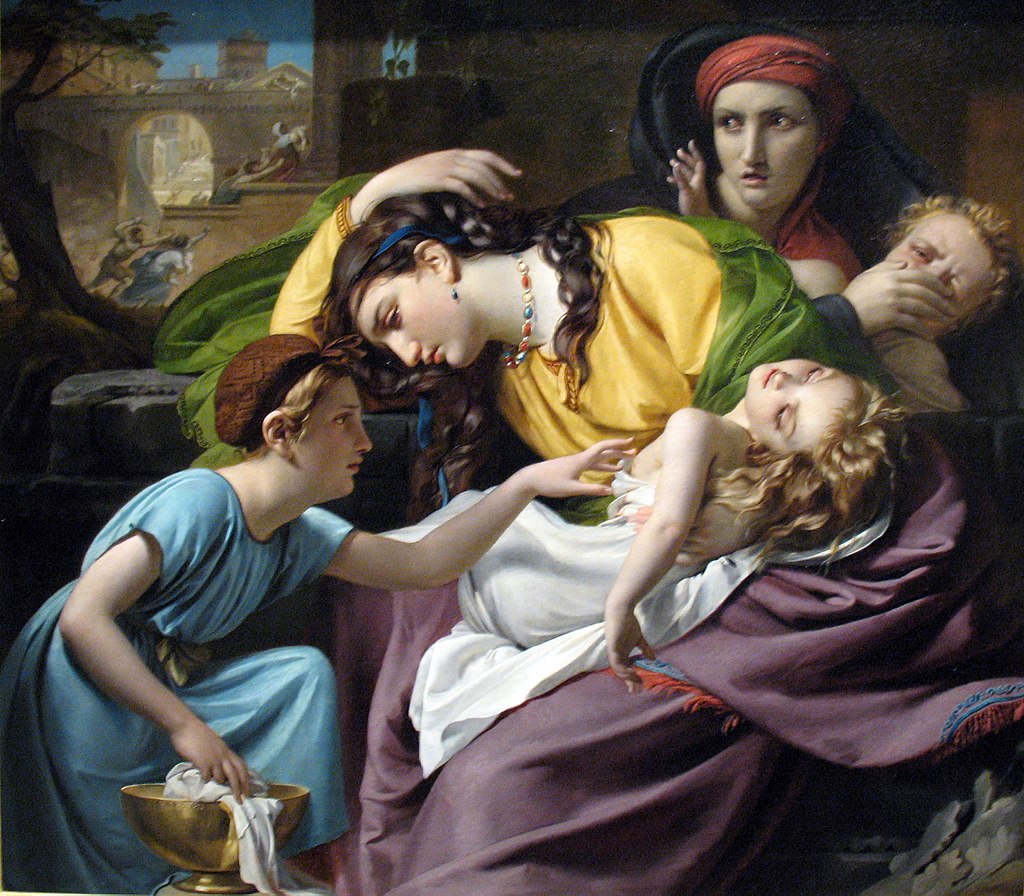
Francois-Joseph Naves, The Massacre of the Innocents (1824)

Knowing some of Herod the Great’s story may make the actions attributed to Herod in Matthew’s gospel understandable in his worldview and yet this story seems shocking to our modern ears. While the slaughter of the children of Bethlehem is not recorded in any sources external to Matthew, I do believe it is consistent with not only Herod but also the violent nature of the ancient world. Bethlehem was a small town and the number of children killed would have been smaller than an event like Columbine or Sandy Hook in our times, yet for the people of Bethlehem (and Columbine and Sandy Hook and others) these children would become one more example of the terror that violence can bring into families and communities without notice. As humans we attempt to make sense of these stories of violence and Matthew attempts to do this by linking this prophetically to the reign of terror in Egypt. Herod in this story is not a ‘King of the Jews’ but is instead a new Pharaoh whose policies bring death to those he is to shepherd.

I think we also need to remember that the world at the time of Jesus was a violent place and that there were no news reporters to carry the violence to the broader world. In recent times we saw ISIS beheading people as a terrorist act and are rightly horrified, but I think it is worth remembering that in Jesus’ time beheading was a noble way to die, especially in light of crucifixion and other practices. The ancient world was a violent world and the death of innocents rarely makes it into recorded history. Yet, within the gospels we do see a willingness to embrace the prophetic voice that was willing to challenge those in power and in many ways by his very being Jesus becomes a challenge to the Herods of the world.

Scripture speaks for a second time in this section by quoting Jeremiah 31: 15, and with this quotation the additional frame of the Babylonian exile is introduced into the narrative. Rachel crying for her children would be particularly poignant for Bethlehem because it is the site where Rachel is buried according to Genesis 35: 19-20:

So Rachel died, and she was buried on the way to Ephrath (that is, Bethlehem), and Jacob set up a pillar at her grave; it is the pillar of Rachel’s tomb which is there to this day.

Now this matriarch of the Jewish people which cried out at the at the loss of her children during the deportation to Babylon mourns with the mothers who have lost their children as a result of the actions of Herod. Now Herod who attempts to build his credentials as the King of Judea by building the temple is also framed as Nebuchadnezzar who is the destroyer of Jerusalem and the temple. Yet, within this particular choice in Jeremiah is the broader context of hope coming out of the destruction, Rachel’s weeping proceeds a prophesy of the end of the exile. As the next two verses of Jeremiah can state:

Thus says the LORD: Keep your voice from weeping, and your eyes from tears; for there is a reward for your work, says the LORD: they shall come back from the land of the enemy;  there is hope for your future, says the LORD: your children shall come back to their own country. Jeremiah 31: 16-17

The allusions and quotations of scripture in this chapter point to something larger that Matthew wants to communicate about who Jesus is and how he embodies Israel’s story. Matthew’s carefully constructed gospel wants us to understand through tapping into key portions of Israel’s story a bigger picture of who Jesus is and what he will mean for Israel and by extension for the rest of the world. As Richard B. Hays can describe Matthew as an interpreter of scripture:

Matthew is not merely looking for random Old Testament prooftexts that Jesus might somehow fulfill (as is sometimes suggested); rather, he is thinking about the specific shape of Israel’s story and linking Jesus’ life with key passages that promise God’s unbreakable redemptive love for his people. That is why Matthew’s comments on Herod’s slaughter of the children by selecting a citation from the same chapter in Jeremiah that also promises “a new covenant with the house of Israel and the house of Judah.” (Jer 31:31) (Hays, 2016, p. 116)

O. Wesley Allen highlighted that Matthew modifies his normal word pattern when introducing a direct quotation from scripture. Normally Matthew will say that something happens ‘so that’ (Greek hina) but instead Matthew simply says “then (Greek tote) was fulfilled what had been spoken through the prophet Jeremiah.” For those who are familiar with the recurring pattern in scriptures it shouldn’t be surprising that God’s action to set people free is met by violence by those invested in the current order. Yet, even though this violence may be a response to God’s initiative that does not make it God’s will. The slaughter of the innocents may be in Matthew’s view a fulfillment of scripture but unlike the other places where scripture is quoted it doesn’t link this to divine causality. (Allen, 2013, p. 32)

Herod the Great’s death makes the return of Jesus and his family to Israel possible. Herod’s death doesn’t remove his family from the scene and Herod Archelaus (simply called Archelaus here) is reigning in Judea. We aren’t given any clues why Herod Archelaus would be perceived as a threat and his brother Herod Antipas (ruling in Galilee) was not, perhaps it was merely a return to Bethlehem that would have caused questions by those in power. Joseph continues to be guided by the angel of the Lord appearing to him in dreams and this places the family in Nazareth for the beginning of the Jesus’ adult story. Perhaps to answer the perception we see in the gospel of John voiced by Nathanael, “Can anything good come out of Nazareth?” (John 1: 46) Matthew includes this what final attribution to the prophets that Jesus will be called a Nazorean. Matthew is referencing the tradition of Nazorites who were set aside for the Lord as holy (see Numbers 6, both Samson and Samuel were Nazorites).

Even though Matthew will reference multiple pieces of scripture and allude to two major stories of the Jewish people to frame this passage he is also communicating that in Jesus, God is doing a new thing. The original texts will have their meaning broadened and expanded upon. As Anna Case-Winters can state,

For Matthew, new meaning break forth from these texts as God is doing a new thing. Matthew reimagines these texts, if you will, to make a theological claim that God is at work in all these happenings and is bringing to fulfilment what was promised of old. (Case-Winters, 2015, p. 32)

Even though the Herods of the world may seem to be the ones who wield power in these texts, Matthew wants us to understand that God is at work in ways that may seem hidden, but which to a person familiar with the rhythms of scripture are familiar. God is speaking both through scripture, the angel of the Lord, through dreams and the stars in the heavens for those with eyes to see and ears to hear. The king of the Judeans may be acting as Pharaoh, but God has heard the cries of God’s people and even in this time to use Martin Luther’s words in a Mighty Fortress “this tyrant’s doomed to fail: God’s judgment must prevail! One little word shall triumph” (A Might Fortress is our God, verse 3 Fredrick H. Hedge translation)

Matthew 2: 1-12 Magi, the Creation and Scriptures Point to Jesus

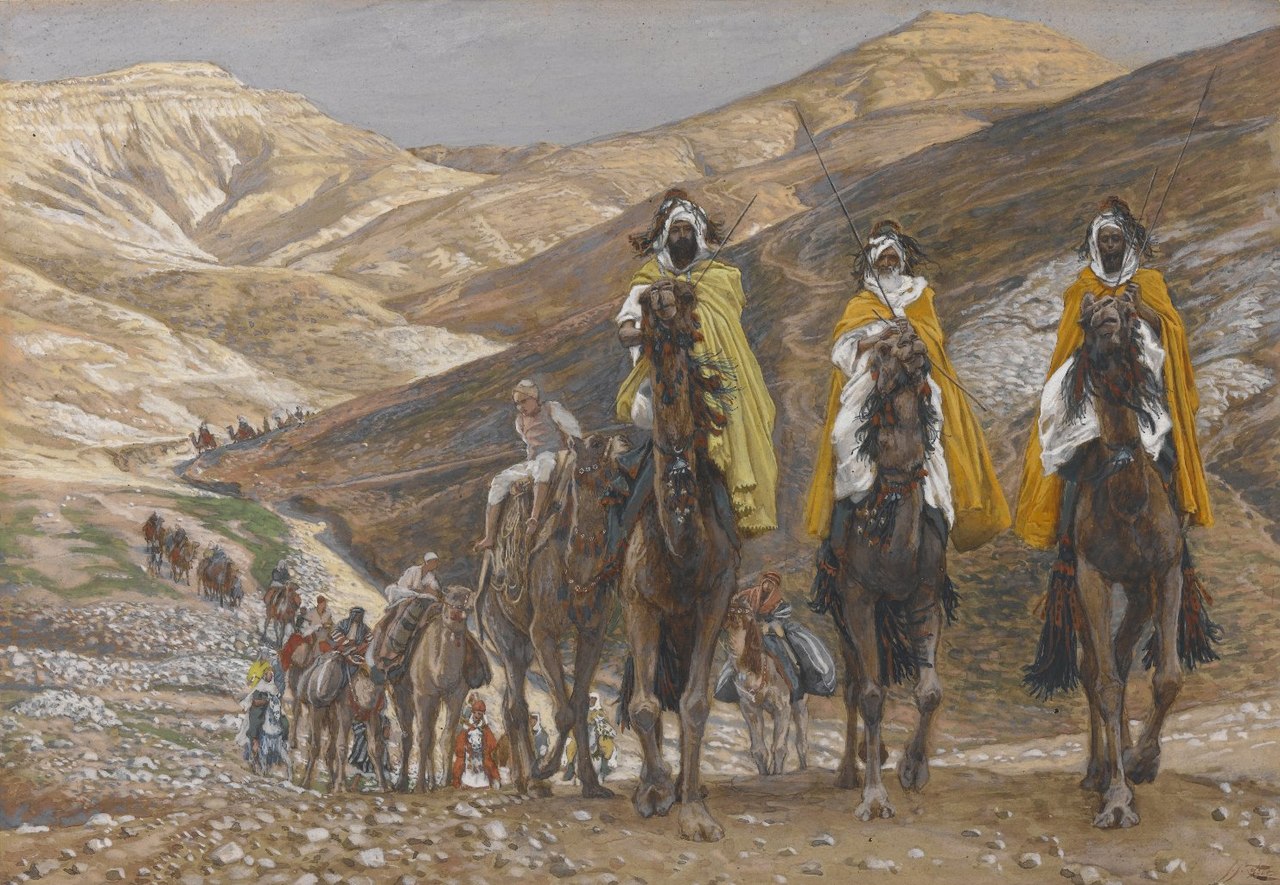
James Tissot, The Magi Journeying (Between 1886 and 1894)

Matthew 2:1-12

1 In the time of King Herod, after Jesus was born in Bethlehem of Judea, wise men from the East came to Jerusalem, 2 asking, “Where is the child who has been born king of the Jews? For we observed his star at its rising, and have come to pay him homage.” 3 When King Herod heard this, he was frightened, and all Jerusalem with him; 4 and calling together all the chief priests and scribes of the people, he inquired of them where the Messiah was to be born. 5 They told him, “In Bethlehem of Judea; for so it has been written by the prophet:

 6 ‘And you, Bethlehem, in the land of Judah, are by no means least among the rulers of Judah; for from you shall come a ruler who is to shepherd my people Israel.'”

7 Then Herod secretly called for the wise men and learned from them the exact time when the star had appeared. 8 Then he sent them to Bethlehem, saying, “Go and search diligently for the child; and when you have found him, bring me word so that I may also go and pay him homage.” 9 When they had heard the king, they set out; and there, ahead of them, went the star that they had seen at its rising, until it stopped over the place where the child was. 10 When they saw that the star had stopped, they were overwhelmed with joy. 11 On entering the house, they saw the child with Mary his mother; and they knelt down and paid him homage. Then, opening their treasure chests, they offered him gifts of gold, frankincense, and myrrh. 12 And having been warned in a dream not to return to Herod, they left for their own country by another road.

I am a person who loves to read fantasy novels and to play games set within worlds filled with magic and yet I know that for most of the history of both Christianity and Judaism people who were looked upon as magic users were viewed as dangers to the faithful, at a minimum, and sometimes enemies of the faith aligned with demonic powers. It may be tempting to mock conservative Christians who forbid their children to read the Harry Potter novels, for example, but to understand the scandal of the story of the wise men we need to begin with the beliefs of the Jewish people at the time of Jesus about those who used things like astrology as a tool to understand their world. The advisors to Pharaoh who attempted to replicate the signs and wonders God did through Moses, Balaam who was called upon to curse Israel in Numbers 22-24 and the medium that Saul employs to talk to Samuel are all viewed as cautionary tales that warn against putting one’s trust in those who employ the magical arts. Numerous places in the law prohibit various types of magical practices, for example:

9 When you come into the land that the LORD your God is giving you, you must not learn to imitate the abhorrent practices of those nations. 10 No one shall be found among you who makes a son or daughter pass through fire, or who practices divination, or is a soothsayer, or an augur, or a sorcerer, 11 or one who casts spells, or who consults ghosts or spirits, or who seeks oracles from the dead. 12 For whoever does these things is abhorrent to the LORD; it is because of such abhorrent practices that the LORD your God is driving them out before you. 13 You must remain completely loyal to the LORD your God. 14 Although these nations that you are about to dispossess do give heed to soothsayers and diviners, as for you, the LORD your God does not permit you to do so. (Deuteronomy 18: 9-14, see also Exodus 22: 18 and Leviticus 20:27)

Contrary to our world where we assume magic belongs to the realm of fantasy, a part of the disenchanted worldview that we live in; in the ancient world magic was viewed as a real and dangerous thing. For the Jewish people it was viewed as a temptation which often lured people away from their faith in the God of Israel (and given the number of kings of Israel which would embrace the very practices that Deuteronomy prohibited they must have been a persuasive alternative). Even within the New Testament we hear the story of Simon the Magician in Acts 8 who views the gift of the Holy Spirit in terms of magical power and is condemned by Peter and John and responds by asking for their prayers. Simon, we learn, believed and was baptized and seems to have given up his former magical practices seeing the evidence of the Spirit’s power in the apostles. Likewise, in Acts 19 several former practitioners of magic burn their magical texts as a part of their acceptance of the faith of Christ. Yet, these wise men would not have been looked upon by most Jewish people as simply foreigners, but they would be both foreigners and people whose practices would be viewed, in Deuteronomy’s language, as abhorrent.

The magi were likely Zoroastrians from the Parthian Empire (also known as Persia, modern day Iran) who were known for their practices of discerning events from the stars. The description of the wise men as being from the East also lends support to the idea that these magi were coming from Parthia. Parthia also represented, for the people of the Roman empire, the external threat—they were people from beyond the boundaries of the empire and that in the century before Christ’s birth had harassed and humiliated the Romans and even briefly driven Herod the Great into hiding at Masada (until Rome would regain control of the region).  The star was seen beyond the beyond the boundaries of the Roman Empire and those who came searching to pay tribute to the King of the Jews may have also been potential collaborators with a foreign empire. The magi were not kings themselves, but they were practitioners of a strange religion from a hostile empire. Yet, in line with the scriptures, the God of Israel frequently uses foreigners and even the movement of empires to be a part of God’s working in the world.

Another theme that will occur in Matthew is the way that creation itself reacts to the presence of Jesus. Even though the Jewish people may not have been looking to the heavens for a sign in the stars to let them know that the long-awaited Messiah has come, the creation shows signs that those who know how to see can observe. Many solutions for the start that the magi follow have been proposed, an interesting one is a conjunction of Jupiter and Saturn three times in 7 BCE. Jupiter was known as the “royal” planet and Saturn was thought to represent the Jews, (Case-Winters, 2015, p. 27) but ultimately we will likely never prove exactly what the magi observed. Yet, for those able to see, the creation provides multiple witnesses to who Jesus is and this will be highlighted in the crucifixion scene where Matthew includes not only darkness but also an earthquake which opens the tombs and the resurrection of many who are dead. For Matthew the presence of Jesus, the Emmanuel (God with us), provokes a reaction from the earth and stars as they respond to the presence of their creator.

When I was growing up, I imagined this scene as literally following a star that was in motion like a comet, but likely the magi observed the signs in the heavens and moved to where they anticipated the observed phenomenon occurring. This may be the reason they end up in Jerusalem, in looking for the one born King of the Jews it is only natural to look at the center of power, both religious and spiritual, of the Jewish people. Bethlehem, while it was the birthplace of David, was a seemingly inconsequential place compared to Jerusalem with the temple and with King Herod’s palace. The magi come to the center of power looking for a king who is to be born and probably assume that the king is affiliated with he current king reigning in Jerusalem.

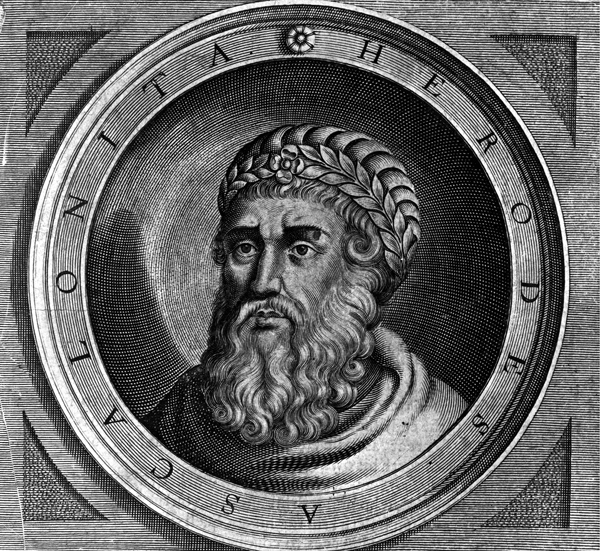
Herod the Great, the ruler of Judea was a shrewd political leader who could be merciless even on his own family. Herod was now Jewish, he was born in Idumea which is south of Judea, but he was raised religiously as Jewish by his father. Herod would reign as the King of Judea for roughly thirty-six years, dying in 4 BCE (shortly after the events narrated in these chapters) and his domain would be divided between his remaining sons. Even though Herod was granted the title ‘King of Judea’ by the Roman Senate his reign was dependent upon the favor of those in power in Rome, his ability to maintain the flow of tax revenue from his region and his ability to navigate the numerous internal threats to his reign. From a modern perspective we may view Herod as paranoid and power hungry, but the world he lived in was much more ruthless than our own and those who held power. Herod’s reaction is foreshadowed by the words that ‘Herod was frightened, and all Jerusalem with him;”

The chief priests and scribes of the people are called upon to unravel the mystery of this child whose birth is written in the heavens and who these magi come seeking. In Matthew’s gospel the ability to read what is going on in the heavens only takes the magi so far, to complete their journey they need the gift of what is written in scripture. The chief priests and the scribes, who along with the ruling authorities like the Herods and the Romans will find themselves frequently at odds with Jesus in Matthew’s gospel, are now called upon to interpret the voice of scriptures. The chief priests and the scribes can, from the scriptures, pull the correct answer. The words in Matthew are closest to Micah 5:2

But you, O Bethlehem of Ephrathah, who are one of the little clans of Judah, from you shall come forth for me one who is to rule in Israel, whose origin is from of old, from ancient days.

As Stanley Hauerwas can remark Herod, the chief priest and the scribes may ultimately oppose Jesus, but they have a role play in the narrative of the life of Jesus. As he states, “without Herod the wise men might not have found the one they sought. The enemies of the kingdom often serve the movement begun in Jesus.” (Hauerwas, 2006, p. 40)

Throughout the gospel Matthew will use scripture to begin to illuminate who Jesus is and what he means. Just as in the genealogy we are linked back to the line of David and the promise of a new David that would lead the people. In the two explicit references to scripture at this point we have heard that Jesus is ‘’God with us” and “the ruler who is to shepherd Israel” (a role that in both Jeremiah and Ezekiel is claimed by God in opposition to the current shepherds). The scriptural claim about a new ruler from an ancient line who is to shepherd the people of Israel also undercuts Herod’s tenuous claim as king of the Judeans due to his political alliance with Rome and his political maneuverings in Judea.

Herod meets with the magi in secret, again this points out the scandal of the magi in a Jewish worldview. King Herod, ever attentive to threats to his power, passes on the information the magi need to complete their search by giving them the location where the scriptures reveal the child is to be born, Bethlehem. With this final piece of information, the search is completed, the heavens align, and these Gentiles can find the new king of the Jews that the chief priests, the scribes, and even King Herod had not. God uses foreigners who are not in possession of the law to be a part of the revelation of God’s story. Just like the genealogy with Gentiles are singled out as a critical part of the story of God’s chosen people and Matthew foreshadows that this gospel, although a Jewish gospel, will be open in the most expansive prophetic hope to the Gentiles who will come to be a part of what God is doing in Israel.

The magi bring their gifts: gold, frankincense and myrrh. There are three gifts, but there are not necessarily three magi. Later tradition would attribute the names Melchior, Caspar and Balthazar with the magi of this story, but in Matthew they are unnumbered and unnamed. Unlike the song “We Three Kings of Orient Are” they were probably not kings and probably not three. Yet, these Gentile magi come from outside the empire and outside the Jewish faith based on how they see the stars move to pay tribute to this one born as a king.

Within the gospel there is an openness to the faith of the outsider and some of the greatest witnesses of faith will be non-Jewish in Matthew’s gospel. These magi are outsiders and yet they too show great faithfulness in coming in search of Jesus, bringing their gifts and paying him homage. They also, like Joseph, will be attentive to the way God will speak to them in dreams and in obedience to the vision they have in the night they leave the country without returning to Herod to report on Jesus and his family.

A Brief Introduction to Herod the Great

Herod the Great

The World Around Judea in the Time Before Herod

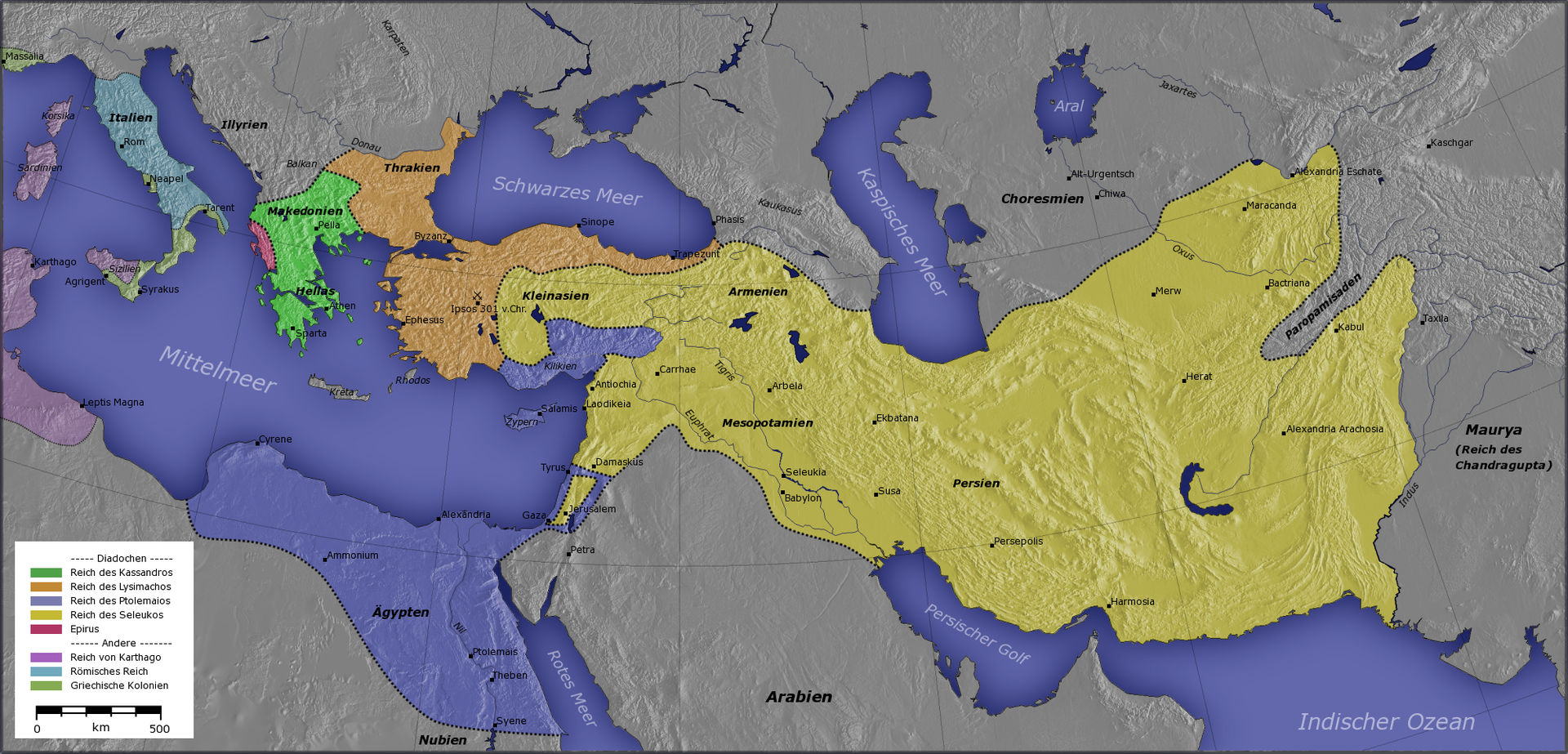
After the Maccabean Revolt in 167-160 BCE the Judean people had a time of independence and were ruled by Hasmonean kings who were descendants of the Maccabees who are credited with, in tradition, of leading the revolt that would grant them independence from the collapsing Seleucid Empire (the northern half of the former Greek empire).

The Macedonian Empire and the Kingodm of the Diadochi in 301 BC and 200 BC Atlas by William R. Shepherd, 1911 courtesy of the University of Texas at Austin, Seleucid Empire shown in yellow on map

The Hasmoneans ruled Judea autonomously from 140-63 BCE when Pompey conquered Judea. The Hasmoneans retained their titles once Rome established Judea as a client state, but they no longer had the autonomy they once did. The Hasmoneans continued to vie for power, and it was during the power struggle between two brothers (Hyrcanus and Aristobolos) that Antipater (Herod the Great’s father) was able to attain the position of Chief minister of Judea with the responsibility of collecting taxes for Rome.

The assassination of Julius Caesar in 44 BCE brought instability throughout the Roman empire and while Marc Anthony and Octavian battled for dominance and the Parthian empire pushed against the divided Roman forces. Antipater would be assassinated by a rival, Malchus, in 43 BCE but Herod and his brothers, Antipater’s son would avenge their father’s death.

Herod the King of Judea

In either 40 or 39 BCE Herod is appointed King of Judea by the Imperial Senate at Anthony’s request. Because of the ongoing civil war between Anthony and Octavian and the continued Parthian incursions Herod was left with autonomy to deal with both civil unrest, particularly in Galilee, as well as internal threats from his own family.

There are times where Herod’s reign sounds like something out of George R. R. Martin’s Game of Thrones, where the intrigue between family members is often lethal. The Hasmoneans still had influence in both the political and religious spheres when Herod assumed power and Herod has married Mariamne I, the daughter of the Hasmoneans Alexander and Alexandra. To attempt to regain some of their lost power Herod’s mother-in-law, Alexandra, appealed to Cleopatra, now married to Marc Anthony, to help place her son, Aristobolus III, as high priest for Jerusalem.  While Herod did grant Aristobolus III the office of high priest he ensured that both Alexandra and Aristobolus III were kept under tight surveillance. In 36 BCE Herod would have Aristobolus III killed. In 29 BCE he would have his wife Mariamne I executed for adultery, and his mother-in-law Alexandra is executed after she declares Herod unfit to rule and attempts to assume the crown for herself. In 28 BCE he executes his brother-in-law Kostobar for conspiracy. In 27 BCE an assassination attempt on Herod’s life was foiled. Towards the end of his reign his sons became the threats to his power with his two sons from Mariamne I executed in 7 BCE, and his first born son, Antipater, who had been his heir was executed in 4 BCE while Herod was dying a painful death to an unknown illness.

In addition to navigating the internal threats Herod also had to navigate the tricky relationship with Rome during an unsettled time. In the civil war between Anthony and Octavian Herod had sided with Marc Anthony. When Octavian (who later assumed the title Augustus) defeated Marc Anthony’s forces in 31 BCE Herod had to demonstrate that he could be a loyal client king of the new Roman emperor. Herod was able to make the argument that his continued reign in Judea would help retain Rome’s access to the resources of both Egypt and Syria. Herod’s efficient administration of Judea, in Roman eyes, and his ability to keep local revolutionaries contained meant that Rome granted Herod a large amount of authority in relation to the people of Judea.

Herod rule would be viewed as despotic in modern terms and it is impossible to judge the reaction of the average person in Judea to his reign. Herod did use secret police to monitor and report on the population and that he had a large personal guard which was composed of both Jewish and mercenary forces. Herod’s building projects, including the rebuilding of the temple, harbors, fortresses and several cities for non-Jewish portions of the population in Judea placed a great tax burden on the people in addition to the taxes that Herod would send to Rome and to other dominions.

Herod, because of his Idumean background and in contrast to the Hasmoneans who came before him, had to maintain his identity as a monarch of the Jewish people. Yet, he also continually had to play the role of a client king of the Roman empire. Herod, even though he was brought up Jewish, sometimes displayed a poor judgment of Jewish sensitivities (or perhaps at times didn’t care). Herod’s most famous blunder was erecting a golden eagle at the gate of the temple which many Jewish religious leaders felt was idolatrous. Herod managed to stay in power for roughly thirty-six years facing both internal and external threats and was probably both efficient and ruthless. Herod did not tolerate threats to his continued reign and as the Roman writer Macrobius (c. 400 CE) would report that Emperor Augustus, on hearing that Herod has ordered the death of his own sons, said, “It is better to be Herod’s pig than his son” Herod, attempting to maintain a Jewish identity, would never slaughter a pig to eat, but Herod did put to death several of his sons and other relations.

Josephus in his two major works the Jewish War and Jewish Antiquities gives several details of Herod the Great’s reign roughly seventy years after his death. There is a lot of scholarly work on Herod the Great and his role in both Jewish and Christian narratives. His life can be confusing to attempt to follow because it occurs at the intersection of many large historical events. After Herod the Great’s death in 4 BCE his reign is divided among four of his remaining sons, the map below shows the reach of Herod the Great’s reign.

The Herodian Tetrarchy as establish by Augustus in 4 BCE until 6 CE when Herod Archelaus is ousted and Judea is annexed by Rome shared under creative commons attribution-share alike 4.0

Matthew 1: 18-24 The Birth of Jesus

Jean-Marie Pirot (aka Arcabas) The angel of the Lord speaks to Joseph in a Dream

Matthew 1: 18-24

18 Now the birth of Jesus the Messiah took place in this way. When his mother Mary had been engaged to Joseph, but before they lived together, she was found to be with child from the Holy Spirit. 19 Her husband Joseph, being a righteous man and unwilling to expose her to public disgrace, planned to dismiss her quietly. 20 But just when he had resolved to do this, an angel of the Lord appeared to him in a dream and said, “Joseph, son of David, do not be afraid to take Mary as your wife, for the child conceived in her is from the Holy Spirit. 21 She will bear a son, and you are to name him Jesus, for he will save his people from their sins.” 22 All this took place to fulfill what had been spoken by the Lord through the prophet:

 23 “Look, the virgin shall conceive and bear a son, and they shall name him Emmanuel,”

 which means, “God is with us.” 24 When Joseph awoke from sleep, he did as the angel of the Lord commanded him; he took her as his wife, 25 but had no marital relations with her until she had borne a son; and he named him Jesus.

 Matthew’s birth narrative is extremely short and yet, in its efficiency, it links us into the story of God’s people and introduces us to a pattern for what the life of the people of God will look like in this new age. Most Christians know the two highpoints of the church year are Christmas and Holy Week which form the bookends of the life, death and resurrection of Jesus. The ancient creeds of the church (the Apostles Creed and the Nicene Creed) spend almost all their words about Jesus focused on the birth, death and resurrection. Matthew simply tells us, “Now the birth of Jesus the Messiah took place in this way.” And then in seven short, but packed verses, takes us from the announcement of Jesus’ impending birth to the birth and naming of this child from the Holy Spirit.

In contrast to the Lukan birth narratives which primarily focus in on Mary and her relatives Elizabeth and Zechariah, Mary is in the background of Matthew’s narrative. Mary is found to be with child, Matthew informs us that it is from the Holy Spirit, but Joseph initially is placed in the position of having to decide about his betrothed who is suddenly pregnant. Marriages were negotiated between families and during this time men typically were significantly older than women when they married so they could establish a household. The natural assumption by Joseph is that Mary has had intimate relations with another man during this time of betrothal. The legal penalty for her in the law is outlined in Deuteronomy 22: 24-27

23 If there is a young woman, a virgin already engaged to be married, and a man meets her in the town and lies with her, 24 you shall bring both of them to the gate of that town and stone them to death, the young woman because she did not cry for help in the town and the man because he violated his neighbor’s wife. So you shall purge the evil from your midst.
 25 But if the man meets the engaged woman in the open country, and the man seizes her and lies with her, then only the man who lay with her shall die. 26 You shall do nothing to the young woman; the young woman has not committed an offense punishable by death, because this case is like that of someone who attacks and murders a neighbor. 27 Since he found her in the open country, the engaged woman may have cried for help, but there was no one to rescue her.

The practice of stoning was probably no longer used for adultery in the time of Mary and Joseph, but Mary’s public humiliation by Joseph could place her in a vulnerable state and labeled as a sinner and an outcast from the community that she knew. Joseph is called a righteous man, and in the character of Joseph we are exposed for to what righteousness will look like for Matthew’s gospel. Instead of righteousness being a strict adherence to the letter of the law it will be a far more gracious understanding of righteousness. Joseph’s resolution to quietly end the engagement and not expose Mary to public shaming is viewed as a model for the righteousness of the kingdom of heaven. Joseph must resolve how he will interpret the commands of the law in his life and he becomes one who hungers and thirsts for righteousness and will be filled, who shows mercy and will have mercy shown to him as Jesus will later say in the Beatitudes.

Joseph’s namesake in the Hebrew Scriptures is a dreamer and an interpreter of dreams, so it is fitting that Jesus’ father receives his revelations in dreams. The angel of the Lord, the mouthpiece of God in much of the Hebrew Scriptures, appears to Joseph in his dreams and reveals the origin of Mary’s child and tells Joseph to take her as his wife. The only speaker in this narrative is the angel of the Lord, Joseph acts in obedience to the angel’s words in his dream but we never hear him utter a word in the gospel. Two additional times Joseph will receive guidance from the angel of God in a dream and all three times Joseph will obediently follow the instructions of the dreams. Joseph will take Mary as his wife, Mary will bear their son, Joseph will name him, and both the angel and scripture will speak about this child to be born.

The name Jesus, or Iesous in Greek, is the adaptation of the name rendered Joshua in the Hebrew Scriptures. The name means ‘God saves’ and like the original Joshua who brought the people of Israel into the promised land, Jesus will be responsible for bringing about the kingdom of heaven. The act of Joseph naming Jesus also means that Joseph acknowledges the child as his own responsibility and a part of his own household.  But beyond the name of Jesus, we also are told by the angel what his role will be: “He will save his people from their sins.”

The role of Jesus, to save the people from their sins, has received multiple interpretations in recent scholarship. Most people have traditionally linked this to the forgiveness of sins that a person would receive in confession and that Jesus’ ministry is primarily concerned with wiping away the individual transgressions they have made. Yet, I think that Matthew is connecting this vocation with the story of the people of Israel. As Richard B. Hays can state:

Here we see an example of the hermeneutical significance of the genealogy: it compels the reader to understand the “sins” from which God’s people are saved are not merely the petty individual transgressions of a scrupulous legal code but rather the national sins of injustice and idolatry that finally led to the collapse of the Davidic monarchy and the Babylonian captivity. The Messiah, in Matthew’s narrative world, is precisely the one who saves his people from the consequences of their sins by closing the chapter of powerlessness and deprivation that began with the “deportation to Babylon.” The opening chapter of Matthew’s Gospel is strongly consonant with interpretations of Jesus’ work as bringing about an end of Israel’s exile. (Hays, 2016, p. 111)

Just as the first Joshua would close the chapter of the people’s wandering in the wilderness after their liberation from Egypt and initiate their dwelling in the promised land, so Jesus closes the chapter of powerlessness and deprivation that occurred in the exile. Something new is happening in Jesus’ birth.

The other voice that speaks, in addition to the angel of the Lord, is the voice of scripture and here the quotation comes from Isaiah 7:14:

Therefore the Lord himself will give you a sign. Look, the young woman is with child and shall bear a son, and shall name him Immanuel.

Matthew quotes from the Septuagint, the Greek translation of the Hebrew Scriptures, where the Hebrew ‘almah is rendered parthenos in Greek. Unfortunately, any translation into another language locks in certain meanings and while ‘almah is a broader term that includes young women of marriageable age and one gloss of the meaning could be a virgin, in the Greek the term parthenos means virgin. This caused quite a stir in the history of bible translations and is one of the reasons there was a break between RSV (now NRSV) and NIV (and later TNIV) translations. When the RSV translated Isaiah 7:14 as ‘young woman’ many conservative Christian traditions demanded a translation that was harmonious and the NIV translation was formed to address this need.

Aside from the disagreement over a word requiring a new translation is the broader question about how Matthew interprets scripture and how we are to interpret scripture. The language of scripture has been the language of faith and Matthew more than any other gospel will introduce short passages of scripture that prefigure what he and other followers of Christ have experienced in Jesus of Nazareth. This is one of ten times that Matthew will introduce a quotation with, “this took place to fulfill what had been spoken by the Lord through the prophet.”

In the original context of Isaiah 7, King Ahaz of Judah is fearful on an attack by King Rezin of Aram and King Pekah of Israel who have formed an alliance against Judah. The Lord speaks to Ahaz through Isaiah to reassure him and gives him permission to ask for a sign that the words of the Lord will come to pass. When Ahaz refuses to put the Lord to the test, the sign he is given is that a young woman will become pregnant, name her child Immanuel (God with us) and before the child is old enough to choose right from wrong Israel and Aram will no longer be a threat. Matthew applies this verse to his own time, and this is not an unusual practice in scripture-the texts seem to have a certain elasticity in how they were used throughout the bible-and hears in this verse not only a prefiguring of Jesus’ birth by Mary by the Holy Spirit but also a critical idea of who Jesus is, Emmanuel, an idea so important he needs to emphasize it by translating it, ‘God is with us.’

While Mark’s gospel throughout its narrative will allude to the mysterious way that in Jesus, somehow, we are experiencing the presence of God, Matthew will, from the very beginning of the gospel, emphasize that Jesus linkage to several title associated with God throughout the scriptures. The idea that Jesus is Emmanuel, God with us, forms a bookend of the gospel of Matthew. In this first chapter we hear Jesus given this title in a quotation from Isaiah and in the final chapter the resurrected Christ will remind his disciples that,” I am with you always, to the end of the age.” Somehow Jesus will embody God’s presence among the disciples and in taking the language of the scriptures and the presence of the angel of the Lord we are quickly introduced to who this child will be.

Joseph never speaks, but he does obey. Joseph dreams and acts upon those dreams. He will embody a righteousness that is both obedient and merciful. Joseph takes Mary as his wife but waits to consummate the marriage until the birth of Jesus. Joseph gives Jesus the name he receives from the angel of the Lord in the dream, but unlike Luke we don’t hear any stories of shepherd and angels from the night of his birth, instead Matthew has set the scene with the announcement and scripture of who this child is and we end this chapter waiting to see how the world will receive him.

Matthew 1: 1-17 How the Story Begins

Jesse Tree Window from the Notre Dame Cathedral in Paris

Matthew 1: 1-17

1 An account of the genealogy of Jesus the Messiah, the son of David, the son of Abraham.

2 Abraham was the father of Isaac, and Isaac the father of Jacob, and Jacob the father of Judah and his brothers, 3 and Judah the father of Perez and Zerah by Tamar, and Perez the father of Hezron, and Hezron the father of Aram, 4 and Aram the father of Aminadab, and Aminadab the father of Nahshon, and Nahshon the father of Salmon, 5 and Salmon the father of Boaz by Rahab, and Boaz the father of Obed by Ruth, and Obed the father of Jesse, 6 and Jesse the father of King David.

And David was the father of Solomon by the wife of Uriah, 7 and Solomon the father of Rehoboam, and Rehoboam the father of Abijah, and Abijah the father of Asaph, 8 and Asaph the father of Jehoshaphat, and Jehoshaphat the father of Joram, and Joram the father of Uzziah, 9 and Uzziah the father of Jotham, and Jotham the father of Ahaz, and Ahaz the father of Hezekiah, 10 and Hezekiah the father of Manasseh, and Manasseh the father of Amos, and Amos the father of Josiah, 11 and Josiah the father of Jechoniah and his brothers, at the time of the deportation to Babylon.

12 And after the deportation to Babylon: Jechoniah was the father of Salathiel, and Salathiel the father of Zerubbabel, 13 and Zerubbabel the father of Abiud, and Abiud the father of Eliakim, and Eliakim the father of Azor, 14 and Azor the father of Zadok, and Zadok the father of Achim, and Achim the father of Eliud, 15 and Eliud the father of Eleazar, and Eleazar the father of Matthan, and Matthan the father of Jacob, 16 and Jacob the father of Joseph the husband of Mary, of whom Jesus was born, who is called the Messiah.

17 So all the generations from Abraham to David are fourteen generations; and from David to the deportation to Babylon, fourteen generations; and from the deportation to Babylon to the Messiah, fourteen generations.

This is not the way we would begin a story today. If you are like most modern readers when you reach the numerous genealogies in the bible you either skip them entirely or skim them quickly and move along but I want to invite you to slow down a dwell here for a little bit. The way we tell our stories matter. As a person who has grown up during the end of the twentieth century and has lived much of my adult life in the twenty first, I grew expecting stories to tell me about the person who crafted their own path through life. Our stories are of self-made men and women who pull themselves up by their own bootstraps and though they may be aided by others along their heroic quest for a position, power, wealth, the love of a man or woman, or in the realm of both fiction and occasionally nonfiction to save the world, we follow the development of the man (frequently) or woman (less frequently) as they encounter struggle, as they grow and develop their identity and in most of our stories overcome the incredible odds stacked against them to succeed. The stories we read also shape the way we understand our own lives and the culture in which we live in profound ways.

It wasn’t very long ago, in the realm of history, that people thought very differently about their stories. There has been a massive philosophical shift in the way we understand who we are and how we construct our lives. One of the great gifts of my job is getting to listen to people’s stories and over the last fifteen years as a pastor I’ve had the opportunity to hear many stories of people from across the spectrum of experiences and from the past several generations. We are losing the last generation of people believed their stories were handed on to them by their parents and by the expectations of the society around them. Particularly women of that generation had very few opportunities to choose from: their main choices included being a mother, teacher, secretary or nurse. I can celebrate that my own daughter will have a seemingly endless set of possible career and lifestyle paths before her, and many of these new choices came through decades of struggles of women (with some men as allies) trying to break through many of the barriers set before them. Yet, there is a psychological toll that has come from the new responsibility that people feel in creating their own stories.

We once received our identity from our parents and from the society around us. Modern beliefs in social mobility where we are capable of charting our own paths and creating our own future are modern beliefs, they are not timeless. One of the struggles of people today is spending our lives attempting to figure out who we are and searching for a life that is worth living, rather than accepting that our parents and grandparents would pass on to us the life we would live. My father was a firefighter and my mother worked for a bank, my parents were both very intelligent but neither had the opportunity to pursue a bachelor’s degree out of high school. They both would work their way up through their respective workplaces and through life, but the life they pursued would be very different from the life that I would have. Another change I experienced, partially due to education and career choices, was frequently moving to new areas of the country. My parents once they settled in San Antonio continued to work there throughout their adult lives. My son grew up living in Louisiana, Iowa, Wisconsin, Arkansas, Oklahoma, Nebraska and finally graduated high school in Texas. The days where most employees will work for one company throughout their careers or only hold one type of job until they retire are nearly gone. Companies no longer offer the type of guarantees they once did for their employees, the technological landscape has changed things dramatically to where workers will be continually expected to learn new skills throughout their lives and most critically the responsibility for navigating all of this has been increasingly placed on the individual in the workforce rather than the employer.

Why this matters to hearing the story Matthew’s gospel wants us to hear is highlighted at the very beginning of the gospel. How we begin a narrative gives the reader a clue to the story we are about to tell. If I begin a story, ‘once upon a time’ you know I am most likely beginning a fairy tale, or if the first thing you see is a date and place you might suspect I am going to narrate a historical tale (December 7, 1941 in Hawaii might be used to start a story with the United States involvement in World War II). Beginnings matter and each of the four gospels has their own unique way of beginning the story. Mark’s gospel simply announces, “The beginning of the good news of Jesus Christ, the Son of God.” launches into a composite quotation of scripture and then launches into the story with John the Baptist appearing in the wilderness. Luke’s gospel begins with an address to a reader, Theophilius (who may be a real or fictional reader, Theophilius means ‘friend of God’) letting us know that what is to come is an orderly account of the life of Jesus received from eyewitnesses and then begins by fixing the time telling us we are in the time of King Herod of Judea. John’s gospel begins with the poetic prologue, ‘In the beginning was the Word, and the Word was with God, and the Word was God.’ John’s poetic introduction wants us to understand the significance of the one referred to throughout the gospel. Matthew’s gospel begins with a genealogy.

Although there is a rediscovered fascination with genealogy, for most of us we look at the first seventeen verses of Matthew’s gospel and wonder why the story would begin this way. We may rush forward to the second half of the chapter where we move towards the birth of Jesus but I want to encourage us to slow down and listen to the story being told by the beginning of the gospel in the way Matthew chooses. There are things that this beginning gives us important information about that will shape the way in which the rest of the story is to be heard. Remember that for most of history identities have been inherited. The people we are is due to the life that our parents and grandparents lived. As Matthew begins his story he enters into a story that has been woven for dozens of generations, it is a story of the Jewish people. From the very beginning this is a Jewish gospel and we are placed into the long running story that Matthew chooses to begin with Abraham. It is a story of struggle, triumph and failure, of faithfulness and unfaithfulness. It is not a perfect story but it is the story of the relationship between God and the people of Israel, and in particular Judah, and even though we enter a critical juncture in the story what comes from this point forward is related to what came before.

Before I enter into the genealogy itself, I want to state that I believe there is a lot to learn from this way of telling a story. Although we may celebrate stories of self-made men and women they rarely are what they appear. To use the example of the last two stories of the men who were elected President of the United States: one was incredibly wealthy and told his story in a way that he started with a loan from his father which he turned into a vast empire, one was the son of a divorced mother who would study at Columbia University and then Harvard Law School and move from community organizing into politics. The reality is that both of their stories is far more complex than this and both received assistance form their extended family networks in starting and continuing their stories. In my own case my parents made it possible for me and for my sisters to start our careers by attending college and they would assist each of us in various ways throughout the beginning of our adult lives. Our families may provide a more secure launching point and supporting role in our lives than we often acknowledge. On the other hand, families will pass on disfunction from one generation to another as well. You don’t have to spend very long looking into Family Systems models of understanding therapy to see patterns emerge that often go unseen. Values and biases are handed down, often unconsciously, from generation to generation. Our families can be sources of great support or they may damage us psychologically, and often they are a mixture of both. The social situation our families grow up within also dramatically shapes our values and ways at looking at the world. None of this even begins to approach the cultural, religious and social ways that school systems, communities of faith, neighborhoods, and countless other factors imprint upon our identities their values and beliefs. Our stories are far more complex than the narratives we often try to place them within. Our story began long before we took our first breath, it depends upon the family we are born into and the world we encounter even before we take our first breath.

Matthew reminds us of this Jewish story and the way he narrates this genealogy is important. On the one hand he structures the genealogy in patterns of fourteen to communicate that at each juncture there is a critical event in the story and the story of Jesus is the next crucial event in this running narrative. If we tell the story of our family we often do it in a way that highlights the best aspects of that family to bring honor and glory to ourselves and we often bury the portions that embarrass us. Sometimes this inability to talk about the unspoken secrets in the family does unspeakable harm because the patterns that emerge are never discussed, and so I find the way that Matthew relates the story of Jesus’ heritage refreshing. Matthew not only brings up the family secrets in these verses they are highlighted.

The Genesis of Jesus the Messiah

Beginning with verse one we have a linkage back to the very beginning of the story of God and God’s people. Throughout the genealogy we will be given a clue that the story that comes afterwards will be a Jewish story but one told within the expansive horizon of the call of Abraham (Abram) expressed in Genesis 12: 1-3:

Now the LORD said to Abram, “Go from your country and your kindred and your father’s house to the land that I will show you. 2 I will make of you a great nation, and I will bless you, and make your name great, so that you will be a blessing. 3 I will bless those who bless you, and the one who curses you I will curse; and in you all the families of the earth shall be blessed.”

The linkage with the story of Abraham isn’t only highlighted by Abraham’s primary position within the genealogy but also by the language of verse one which uses the Greek word genesis for genealogy. In this story not only will the children of Abraham or the children of Israel, his grandson, be blessed but this is a narrative in which all the families of the earth shall be blessed. This blessing is highlighted by an unusual addition to the normal patterns of genealogies.

The Women of Matthew’s Genealogy

The role of women in the society continues to change. Although we still have a long way to go in giving women an equal voice, the status of women in modern society is viewed much higher than would’ve been imagined in most ancient societies. The role of women in the Hebrew scriptures is complex: there are times where women occupy positions of extremely high positions, the women in the early stories in Genesis often are incredibly influential in how the stories are told, in Exodus women are often instrumental in resisting the decrees of Pharaoh, and there are stories, like those highlighted in the genealogy, where women boldly act to secure their own future and their own part of the story. Yet, the assumed role of women in the Hebrew scriptures is that they are the property of their fathers and then their husbands. When their voice is heard it is the exception, not the rule. In Matthew’s genealogy they will also be the exception, not the rule, but as it is throughout the remainder of Matthew’s gospel when they appear they are the outsider making a place for themselves among the promises of God. Like the Canaanite woman they refused to allow their circumstances to determine their future, they forced the men of the story to acknowledge their claim and they made a space for a more expansive reading of the boundaries of God’s promises to the people.

The narrative begins with Abraham, Isaac and Jacob. Although Matthew doesn’t mention the women of most of the story of Genesis (Sarah and Hagar, Rebekah, Rachel, Leah, Bilhah and Zilpah) Jewish people would know these stories. Yet, as we enter the story of Judah we encounter our first woman mentioned in the genealogy: Tamar. Matthew could have chosen to not mention this woman, he chose to exclude Sarah, Rebekah and Leah before her, especially as he links Jesus to the line of Judah, but he does. He highlights this lesser know story of Tamar and Judah, an odd story of a woman who refuses to be left out of the story.

The story of Judah and Tamar is told in Genesis 38. Tamar is most likely a Canaanite woman, like Judah’s wife who bears his first three sons, who is given to be the wife of Er the first son of Judah. Er does not live long enough to pass on an heir through Tamar, Genesis makes the theological claim that Er was wicked in the eyes of the LORD and the LORD caused his early death. According to custom Judah’s second son, Onan, was now to take on the role of husband for her and to continue the family line for his brother through her. Yet Onan refused to get Tamar pregnant because the inheritance would pass to his brother’s line instead of his and again Genesis tells us that this displeased God and that God caused him also to have an early death. Judah, fearing to give his last son to this woman who was probably viewed as cursed in some manner, promised her that when his last son was an adult she would be his wife but the promised union never came and she remained a widow in her father’s household. After Judah’s wife, the unnamed daughter of Shua, dies Tamar takes actions into her own hands. She sees that the final son, Shelah, had grown and she was not given to be his bride so she puts aside her widow’s garments, places a veil upon her face and waits. Judah, passing through the area, assumes she is a prostitute and sleeps with her giving her his signet and cord and staff as a guarantee of payment. Then Tamar returns to her father’s home, takes up her widow’s garments and Judah is unable to find the person he assumed was a prostitute to pay her the promised young goat from the flock. Three months later when it is discovered she is pregnant Judah goes to demand that she is punished for her infidelity by burning her, but through her father-in-law she produces the signet and cord and staff indicating that Judah is the father. Judah’s acknowledgment that, “She is more righteous than I, since I did not give her my son Shelah.” She would bear Perez and Zerah who the line of Judah would pass through. Like the one who will enter Matthew’s gospel in Matthew 15: 21-28, who is told that there is no place in the promise for her she will claim her own place, her own righteousness, her own promise. It may not be a story that brings great honor to Judah, yet it highlights the way in which the promise will be extended to her and she becomes the first of the women highlighted in Matthew’s story of Jesus heritage that points to an inclusive vision of what this story might become.

The genealogy continues through four more generations as we move through a time where the story of these generations disappear. Hezron, Aram, Aminadab, and Nahshon are a part of the lost generations from the time in Egypt and the first generation of the Exodus. One thing to understand about the genealogy is that it doesn’t necessarily include every piece of the story and it is possible that some of these generations truly were lost in the four hundred thirty years that the Israelites are recorded living in Egypt from when Joseph brought his brothers down until Moses liberated the people. While there is a lot that happens in the story of Israel through Moses, Aaron, and Miriam the lineage of Jesus’ father Joseph does not pass through the line of Levi but through the line of Judah. We will see how Jesus takes up the mantle and story of Moses and the Exodus shortly in Matthew’s gospel, but currently we are following the line of the kings of Judah, their story and the story that Jesus narrative is a part of.

As we exit these lost generations we come to Salmon and Rahab in this long line that is introducing us to the family story of Jesus. Once again, a woman is mentioned and once again she is an outsider. Rahab, in Joshua 2, is a recorded as a prostitute who welcomes the two unnamed spies of Joshua into her home and hides them from servants of the king of Jericho. Salmon may be one of these unnamed spies but the narrative of Joshua is silent on his name but records Rahab’s. She hides the two spies among the flax laid out on the roof but she is recorded relating to them:

I know that the LORD has given you the land, and that dread of you has fallen on us, and that all the inhabitants of the land melt in fear before you. For we have heard how the LORD dried up the water of the Red Sea before you when you came out of Egypt, and what you did to the two kings of the Amorites that were beyond the Jordan, to Sihon and Og, whom you utterly destroyed. As soon as we heard it our hearts melted and there was no courage left in any of us because of you. The LORD your God is indeed God in heaven above and on earth below. (Joshua 2: 9-11)

In return for hiding them from the king’s servants, sending the king’s servants in the wrong direction to pursue them and providing them with a way out of the city and a way to avoid capture the two men promise to preserve her and her family if she ties a crimson cord in the window she let them escape through. When the Israelites come to the city of Jericho, Joshua instructs the two young men who were spies to bring Rahab and her household out, which they do, and they are spared. They are initially set outside the camp, but they come to be a part of Israel. As Joshua reports, “Her family has lived in Israel ever since.” (Joshua 6: 25)

Scholars have since debated whether Rahab was a prostitute or whether she kept an inn and there is within some Christian circles a discomfort with accepting the possibility of a prostitute being an integral part of the story of the people of God. Yet, throughout the gospel, Jesus will be accused of associating with the wrong type of people. Prostitution was also looked upon differently in the ancient world than we do today. If you ask most Christians what they think adultery is they will tell you it is, ‘sex outside of marriage’ but it is much more complicated than that in ancient Judaism. Adultery in the Hebrew Scriptures is related to sex with someone who belongs to someone else, whether a husband, a betrothed, or even a father and while prostitution was considered an occupation that a father was not to sell his daughter into, it was an accepted part of society. Prostitutes may have been considered ‘sinners’ and there are certainly portions of the bible that use prostitution as a metaphor for what is wrong in the worship or life of Israel, the metaphor works because the practice is well known. Still, to have Rahab, an outsider and one recorded in both the Hebrew Scriptures and in the two additional places she is mentioned in the New Testament (Hebrews 11: 31 and James 2: 5) as a prostitute who is highlighted in the lineage of Jesus’ family and story and like Tamar she creates a path for her story to be joined to the story of the people of Israel and ultimately to the story of Jesus.

Our story resumes with the mention of another woman, another outsider, and yet a story which has its own book dedicated to it in the scriptures. Boaz is the son of Nahshon and Rahab, a Canaanite former resident of Jericho, and he will end up marrying Ruth the Moabitess. Ruth’s story is better known than Tamar or Rahab, and yet it also is somewhat scandalous. Ruth has to create a place for herself within the story of Israel and within the family line of Judah. Ruth is a widow and a daughter-in-law of Naomi. Naomi and her husband Elimelech move during a famine to Moab to survive. While they are there they are apparently met with hospitality and arrange marriages for their two sons to Moabite women, Orpah and Ruth. Elimelech dies and ten years late Naomi’s sons Mahlon and Chilion (whose names may be symbolic in the story since they come from Hebrew roots for ‘sickness’ and ‘destruction’) also die leaving their wives widows as well. Naomi encourages her daughters-in-law to return to their family but Ruth refuses and returns with Naomi, now renaming herself Mara (bitter), and both Naomi and Ruth seem to have no future. Ruth uses the provision in the law which requires the leavings of the field to be available for the poor and goes out to glean during the barley harvest where she is seen and noticed by Boaz who extends his protection and ensures that she has an adequate gleaning. In his words he is returning the kindness she has shown for Naomi and he blesses her for seeking refuge under the wings of the LORD, the God of Israel. Naomi plots with Ruth to attempt to secure a future for them both after the conclusion of the harvest by having Ruth go and observe where Boaz lies down after threshing, eating and drinking. Ruth is putting herself at Boaz’ mercy and Ruth propositions Boaz, asking for him to extend his cloak over her and symbolically bringing her into his house as his wife. Boaz settles the matter the next day, takes over the role of not only kinsman-redeemer but husband of Ruth. Ruth the Moabitess, like Tamar and Rahab before her, would make a place for herself in the people of Israel and in the line of Judah that would lead to her great-grandson, King David.

The line from Boaz and Ruth to David is listed in both the book of Ruth and here in Matthew. David’s role within the Hebrew Scriptures transcends his individual story because he becomes almost an Arthurian character in the imagination of the people, a once and future king. King David’s dynasty would be near the apex of a very short period where the people of Israel were a unified people and they were active players on the world stage. The Son of David will be one of the titles often used for Jesus indicating his royal status. Yet, David’s story is full of drama, far more than can be mentioned in this brief coverage, but one critical moment is highlighted by the introduction of our fourth woman in this genealogy, a woman the genealogy doesn’t name directly but rather indirectly in a way that highlights the scandal of David’s action against both Uriah and Bathsheba.

David’s notice of Bathsheba bathing upon the rooftops and the set of deceptions and betrayals his lying with her leads to is one of many troubling parts of David’s story. Uriah the Hittite is one of several outsiders who fought in David’s army and Bathsheba may have been a Hittite as well or may have been of another group or even a part of Israel, yet she was the wife of this warrior in David’s army and presumably (by the location of his house so close to the house of David) one of his well respected warriors. Bathsheba has often been portrayed as a temptress attempting to seduce David, but this probably is not accurate. David as king had the power to have her brought to him and she presumably had little ability to resist the king’s desires. Whether the union was rape or consensual the scriptures place the responsibility completely on David’s shoulders. When David is unable to cover up his part in Bathsheba’s pregnancy due to the honorable action of Uriah the Hittite, David gives orders for Uriah to be killed in battle by positioning him in the hardest portion of the fight and then abandoning him for his enemies to overwhelm him. Yet, Bathsheba will later ensure that the kingship will pass from David to her son Solomon instead of Adonijah. Bathsheba may not have had any choice about being brought into the story of King David, but once she was a part of that story, she refused to allow the line of kings to pass through anyone other than her son. She may have been an outsider and her place within the story certainly illustrates one of the scandalous portions of David’s rule as king, and yet she too would ensure that the story would not forget her or her original husband.

For the first fourteen generations listed in Matthew, I have included where their story is referenced in the Hebrew Scriptures here.

The Line of Kings and the Line of Nobodies

The first fourteen generations led us from Abraham to King David and even though there are some lost generations in this portion of the genealogy we enter the remaining two sections that I will refer to as the line of kings and the line of nobodies. David’s son, Solomon, will oversee what is recorded as the height of power of the United Kingdom of Israel but this will not last. Solomon is known by many Christians for his wisdom and the construction of the temple, yet all throughout 1 Kings’ narrative of Solomon’s reign there is an underlying criticism of Solomon’s drift away from faithfulness to the LORD the God of Israel. 1 Kings makes a theological judgement that it is God who is behind the increasing resistance at the end of Solomon’s reign. When Solomon’s son, Rehoboam is asked for relief from the heavy burdens placed upon the people during Solomon’s reign and he responds in a way that indicated he would increase the burdens on the people the kingdom splits in two with most of Israel following Jeroboam and the tribes of Judah and Benjamin remaining under Rehoboam and the Davidic line of kings.

The story of the kings of Israel and Judah can be a little challenging to follow and Matthew doesn’t list every king who would be in the family line of Jesus, there is also a theological point Matthew wants to make about God’s time and the orderliness of the number fourteen gives the genealogy its structure, but the kings that are listed are representative of the best and worst of the kings of Judah. I have provided a quick guide to the line of the kings of Judah here linking both to the narrative tellings of their reigns in 1&2 Kings and the parallel narratives in 1&2 Chronicles and, when applicable, to which prophets were ministering and writing during their reign. Although the Davidic line of kings will be a focal point in the hope of the book of Psalms, the prophets and the narrative of the scriptures, the kings of Judah will be deposed by Babylon and we will enter the line of nobodies.

The final fourteen people in the genealogy have no reference in scripture other than in this genealogy, they are a part of the lost generations who lived in exile in Babylon and who, at least in part, returned to Judea and Galilee in the years after Cyrus the Great of Persia allows for the remnant of Judah to resettle Jerusalem and the surrounding area. We simply do not know their stories, perhaps people in Matthew’s community may have known some of their stories but they are a line of nobodies in the remembrance of scripture. Yet, these nobodies and kings, patriarchs and the women who forced their way into the story make up the back story that Matthew sets his story within.

Luke 3: 23-28 also lists a genealogy for Jesus but it is not a parallel to Matthew’s genealogy. Luke’s genealogy starts earlier but also traces a different path from David to Joseph. Ultimately, there is no way to historically verify which genealogy is closer to the parentage of Jesus and both ultimately serve the story that each gospel writer wants to tell. For Matthew the linkage to the stories of Abraham, the women mentioned, and the line of David are important, where Luke wants us to understand Jesus’ linkage of God and all of humanity. Also, for Matthew the orderly pattern of fourteen allows us to see that Jesus is a closing of the chapter of exile and powerlessness that begins with he deportation into Babylon and the beginning of a new chapter for the people of God.

The Line of Kings in Matthew compared with the Hebrew Scriptures

Giovanni Francesco Barberi (il Guercino), King David (1651)

United Kingdom of Israel

David (1010-970 BCE)

Replaced Saul,

Narrative of David runs from 1 Samuel 16-1 Kings 1 in the 1 &2 Samuel, 1 & 2 Kings telling of Israel’s story. It runs from 1 Chronicles 11-22 in Chronicles telling of Israel’s story. David is attributed as the author of much of the book of Psalms and is mentioned frequently throughout the scriptures as a model of what a king should be and as a figure from which the hope for the people will come.


  1. Solomon (970-922 BCE)

Narrative of Solomon is told in 1 Kings 3-11 in the 1 & 2 Kings telling of Israel’s story. It runs from 1 Chronicles 11-22 in Chronicles telling of Israel’s story. Solomon is the attributed author of some of the Psalms, the book of Proverbs, Ecclesiastes and the Song of Songs (although he is probably not the author of these varied works as judged by the language). Builds the first temple, initially favored by God but there is an underlying critique of Solomon’s reign in the scriptures and he eventually turns away from the way of the Lord.

Kingdom of Judah

  1. Rehoboam (922-915)

Narrative of Rehoboam is told in 1 Kings 12, 14:21-31 in the 1 & 2 Kings telling of Israel’s story. It runs from 2 Chronicles 9-12 in Chronicles telling of Israel’s story. He is viewed as an unwise and unfaithful king whose arrogance causes a split in the nation of Israel.


  1. Abijah (Abijam) (915-913)

Narrative of Abijah (Abijam)is told in 1 Kings 15: 1-8 in the 1 & 2 Kings telling of Israel’s story. It occurs in 2 Chronicles 13 in Chronicles telling of Israel’s story. Kings and Chronicles have a very different view of Abijah, Kings narrates that he continued in the sins of his father (Rehoboam) while Chronicles narrates him as a heroic figure that defies the king of Israel.


  1. Asa (Asaph in Matthew) (913-873)

Narrative of Asa is told in 15: 9-24 in the 1 & 2 Kings telling of Israel’s story. It runs from 2 Chronicles 13-16 in Chronicles telling of Israel’s story. His 41-year reign is viewed positively in both chronicles and he is viewed as a person who does what is right in the sight of the LORD. His only other mention is as the creator of the cistern into which the prophet Jeremiah will be thrown into (long after Asa’s death)


  1. Jehoshapat (873-849)

Narrative of Jehoshapat is told in 1 Kings 22: 41-50 in the 1 & 2 Kings telling of Israel’s story. It runs from 2 Chronicles 17-20 in Chronicles telling of Israel’s story. His 25 years reign is also viewed positively in both narratives.


  1. Jehoram (Joram in Matthew) (849-843)

Narrative of Jehoram is told in 2 Kings 8: 16-24 the 1 & 2 Kings telling of Israel’s story. It occurs in 2 Chronicles 21 in Chronicles telling of Israel’s story. Viewed as a king who betrayed the reforms of his father and grandfather and returned the people to worshipping other gods. Elijah the prophet enters the narrative during the reign of Jehoram.


Ahaziah (843-842) neglected in Matthew’s genealogy

Narrative of Ahaziah is told in 2 Kings 8: 23-29, 9:27 in the 1 & 2 Kings telling of Israel’s story. It occurs in 2 Chronicles 22 in Chronicles telling of Israel’s story. His one-year reign is viewed negatively in both narratives and he is killed by Jehu son of Nimshi. With only reigning one year it is perhaps an understandable negation from Matthew’s line, but the genealogy would go through Ahaziah.


Athaliah (842-837) neglected in Matthew’s genealogy

Mother of Ahaziah, seizes the throne after her son’s murder. Narrative of Athaliah is told in 2 Kings 11 in the 1 & 2 Kings telling of Israel’s story. It runs from 2 Chronicles 22:10-23:21 in Chronicles telling of Israel’s story. Joash is preserved in the line of kings after she orders the death of royal family of Judah.  Since Athaliah was a queen rather than a king this wouldn’t normally appear in a genealogy. However, Matthew did include several women previously who would normally be overlooked.


Joash (837-800) neglected in Matthew’s genealogy

Narrative of Joash is told in 2 Kings 11:4-12, 17-21 and 12: 1-21 in the 1 & 2 Kings telling of Israel’s story. It occurs in 2 Chronicles 24 in Chronicles telling of Israel’s story. Joash is kept alive and mentored by the priest Jehoiada and for most of his life did what was right in God’s sight. He is famous for repairing the temple but Chronicles states that late in his life, after Jehoiada dies and under the influence of the nobles of Judah, he returns to the ways of the unrighteous kings. This is perhaps the most unusual negation.


Amaziah (800-783) neglected in Matthew’s genealogy

Narrative of Amaziah is told in 2 Kings 14: 1-22 in the 1 & 2 Kings telling of Israel’s story. It occurs in 2 Chronicles 25 in Chronicles telling of Israel’s story. Amaziah is listed in 2 Kings as one who did what was right in the site of the LORD but the major event in both narratives is his failed battle with Israel where the wall of Jerusalem is breached and the gold and silver from the temple and the king’s house are stolen. Another unusual negation.


  1. Uzziah (Azariah in 2 Kings) (783-742)

Narrative of Uzziah/Azariah is told in 2 Kings 15: 1-7 in the 1 & 2 Kings telling of Israel’s story. It occurs in 2 Chronicles 26 in Chronicles telling of Israel’s story. Uzziah did what was right in the site of the LORD with some qualifications in both 2 Kings and 2 Chronicles. In 2 Chronicles he is afflicted with leprosy after attempting to offer a sacrifice himself instead of through the priests.  Uzziah’s reign is also at the beginning of Isaiah’s time as a prophet (or first Isaiah, Isaiah 1 and 6 mention Uzziah) as well as the time of Amos and Hosea. Also, the prophet Zechariah mentions an earthquake in the time of king Uzziah (Zechariah 14:6)


  1. Jothan (742-735)

Narrative of Jothan is told in 2 Kings 15: 32-38 in the 1 & 2 Kings telling of Israel’s story. It occurs in 2 Chronicles 27 in Chronicles telling of Israel’s story. Jothan is listed as a king who did right in the eyes of the LORD but who did not eliminate the practices of the people that were displeasing to God in the view of 2 Kings and 2 Chronicles. His reign is described as prosperous and peaceful. The ministries of Micah and Hosea occur in part during the reign of Jothan.

  1. Ahaz (735-727 or 715)

Narrative of Ahaz is told in 2 Kings 16 in the 1 & 2 Kings telling of Israel’s story. It occurs in 2 Chronicles 28 in Chronicles telling of Israel’s story. Ahaz is a king who did not do what was right in the site of the lord in the narratives and is oppressed by Israel, the Edomites and the Philistines. Ahaz appeals to Assyria for help and attempts to bribe Assyria with items from his house and the officials in tribute, but Assyria rebuffs their call for aid. Isaiah 7 is during the reign of King Ahaz and Isaiah 14:28 begins an oracle in the year of Ahaz’ death.


  1. Hezekiah (727 or 715 to 687)

Narrative of Hezekiah is told in 2 Kings 18-20 in the 1 & 2 Kings telling of Israel’s story. It occurs in 2 Chronicles 29-32 in Chronicles telling of Israel’s story. Hezekiah is a righteous king and reigns during an important transition in the region. The Assyrian empire conquers Israel and marches on Judah, but their conquest is stopped, and Judah survives. King Hezekiah is attributed with ensuring that Proverbs 25-29 are preserved. Isaiah records the Assyrian invasion by King Sennacherib of Assyria and the dialogue between God, Isaiah, and Hezekiah as well as a later illness of Hezekiah and Hezekiah’s interaction with envoys from Babylon in Isaiah 36-39. The prophets Hosea and Micah also conclude their ministries during Hezekiah’s reign.


  1. Manasseh (687-642)

Narrative of Manasseh is told in 2 Kings 21: 1-18 in the 1 & 2 Kings telling of Israel’s story. It runs from 2 Chronicles 33: 1-20 in Chronicles telling of Israel’s story. Manasseh is listed as one of the kings who did evil by adopting the practices of the surrounding nations and worshipping other gods. Jeremiah 15:4 lists the evils of Manasseh as the reason for the judgment against Judah.


  1. Amos (Amon) (642-640)

Narrative of Manasseh is told in 2 Kings 21: 19-26 in the 1 &2 Samuel, 1 & 2 Kings telling of Israel’s story. It runs from 2 Chronicles 33: 21-25 in Chronicles telling of Israel’s story. He also did what was evil in God’s sight and was killed by the servants in his house or the people of the land depending on whether you read Chronicles or Kings.


  1. Josiah (640-609)

Narrative of Josiah is told in 2 Kings 22:1-23:30 in the 1 & 2 Kings telling of Israel’s story. It runs from 2 Chronicles 34-35 in Chronicles telling of Israel’s story. Josiah is remembered as the great reformer king who reintroduced the law to Judah. He dies in a battle against Pharaoh Neco, which seems to have been an unnecessary battle. Josiah’s reign is a time of great hope in Judah and there are even hopes of a new Israel, this is after the northern kingdom is conquered by Assyria, which practices the law and worships at the temple in Jerusalem. The optimism of the reforms of King Josiah are the context for the beginning of Jeremiah’s long ministry. Jeremiah soon sees the reforms are not changing the people and begins to warn that judgment is coming.


Jehoahaz (609) neglected in Matthew’s genealogy

Jehoahaz’ three-month reign is told in 2 Kings 23: 31-35 and 2 Chronicles 36: 1-4. He is enthroned by the people but deposed by Egypt and Egypt replaces him with his brother Eliakim who changes his name to Jehoiachim. Judah is now caught between the rising empire of Babylon in the north and Egypt in the south. Jehoahaz would not be in the genealogy of Jesus as Matthew traces it.


Jehoiachim (Eliakim) (609-598)

Jehoiachim’s reign is told briefly in 2 Kings 23: 36-24:7 and 2 Chronicles 36: 5-8.  In the eleven years he reigned Judah is caught between Babylon and Egypt. Jehoiachim serves Babylon for a time but then rebelled and was taken in chains to Babylon. Many of the proclamations of the prophet Jeremiah occur during the reign of Jehoiachim. The removal of Jehoiachim also sets the context for the beginning of the book of Daniel, where Daniel is among the young nobles brought to Babylon.


  1. Jehoiachin (598-597)

The son of Jehoiachim who is only eight or eighteen during his brief reign. His reign is told in 2 Kings 24: 8-18 and 2 Chronicles 36: 9-10. At the end of the reign is the deportation to Babylon of the officials, warriors, artisans, smiths and anyone who might exercise leadership among the people and a weak administration under his uncle Mattaniah, renamed Zedekiah. Jeremiah refers to Jehoiachin as Coniah.


Zedekiah (597-586)

Zedekiah is placed in his position by Babylon to attempt to retain peace among the remnant of Judah. His reign and the fall of Judah is told in 2 Kings 24: 18-30 (includes the governorship of Gedaliah) and 2 Chronicles 36: 11-21. More of Jeremiah’s proclamations come during the time of Zedekiah, in the final gasps of Judah and Jerusalem before Babylon’s final invasion and exile, than at any other time. Jerusalem is destroyed in 586 and more of the population is brought into exile in Babylon. There is a final rebellion during the governorship of Gedaliah) but the remnant of Judah that survives goes into exile in Babylon. The book of Jeremiah narrates the collapse of Judah in Jeremiah 34-44 and 52.

From Abraham to David in Matthew’s Genealogy

Jozsef Molnar, Abraham’s Journey from Ur to Canaan (1850)

  1. Abraham

Abraham’s (earlier known as Abram) story runs from Genesis 12-25 and this marks the beginning of the covenant that God will make with Abraham and his descendants. The story follows Abraham and Sarah, Hagar and Ishmael, and their interactions with God and the world as they travel from Ur to the promised land, to Egypt and then return to the promised land

  1. Isaac

Isaac, the long-awaited child of Abraham and Sarah, has his story told in Genesis 21-28. Isaac’s wife Rebekah also plays a major role in the story and is decisive in ensuring that Jacob is blessed rather than Esau and that the line continues through the mother’s favored child rather than the father’s.

  1. Jacob

Jacob (later renamed Israel) is the father of the twelve brothers who the tribes of Israel will be named for. Jacob is portrayed from his birth onward as a trickster, but God works with him to set up the beginning of the nation of Israel. Jacob’s narrative runs from Genesis 25: 19-Genesis 50 with his death in Egypt and burial in the promised land.

  1. Judah and Tamar

Judah is the third son of Jacob and Leah (Jacob’s first wife).  His birth occurs in Genesis 29: 35 and he will continue to be present throughout the end of Genesis even though Joseph will be the primary character. The narrative of Judah and Tamar is in Genesis 38, where Tamar is Judah’s daughter-in-law but when she outlives two of Judah’s children without an heir she takes matters into her own hands and becomes pregnant by Judah and secures a place in the line of Judah and is an ancestor to the line of kings.

  1. Perez

Perez is born in Genesis 38: 29. The Perezites clan of Judah are named for him.

  1. Hezron

Other than being mentioned in genealogies the bible doesn’t relate any stories of Hezron, Aram, Aminadab

  1. Aram (Ram)

Listed as Ram in the book of Ruth, but otherwise unremarked upon except in genealogies

  1. Aminadab (Amminadab)

He is a father-in-law to Aaron, the high priest in the Exodus narrative (Exodus 6:23) and father of Nahshon in multiple genealogies

  1. Nahshon

Nahshon is listed as the leader of the people of Judah during the exodus (Numbers 2:3) and acts in that capacity in the book of Numbers

  1. Salmon and Rahab

Salmon only appears in genealogies but Rahab is most likely the prostitute first introduced in Joshua 2:1 who shelters the Israelite spies in Jericho.

  1. Boaz and Ruth

Boaz and Ruth are two of the major figures in the book of Ruth. Ruth is from Moab and is brought into the story by remaining faithful to her mother-in-law after the death of her husband in Moab.

  1. Obed

Obed only appears in genealogies, there are no biblical stories about him other than his birth to Boaz and Ruth at the end of the book of Ruth.

  1. Jesse

Jesse is mainly known for being the father of David. He receives Samuel the prophet who anoints his son David in 1 Samuel 16. He also sends his son David to carry food to his brothers in 1 Samuel 17, when David volunteers to face Goliath

  1. David (see the line of kings)