Julius Schnorr von Carolsfeld – Woodcut “Die Bibel in Bildern” 1860
Matthew 26:1-16
Parallel Mark 14:1-11, Luke 22:3-6, 7:36-50
When Jesus had finished saying all these things, he said to his disciples, 2 “You know that after two days the Passover is coming, and the Son of Man will be handed over to be crucified.”
3 Then the chief priests and the elders of the people gathered in the palace of the high priest, who was called Caiaphas, 4 and they conspired to arrest Jesus by stealth and kill him. 5 But they said, “Not during the festival, or there may be a riot among the people.”
6 Now while Jesus was at Bethany in the house of Simon the leper, 7 a woman came to him with an alabaster jar of very costly ointment, and she poured it on his head as he sat at the table. 8 But when the disciples saw it, they were angry and said, “Why this waste? 9 For this ointment could have been sold for a large sum, and the money given to the poor.” 10 But Jesus, aware of this, said to them, “Why do you trouble the woman? She has performed a good service for me. 11 For you always have the poor with you, but you will not always have me. 12 By pouring this ointment on my body she has prepared me for burial. 13 Truly I tell you, wherever this good newsis proclaimed in the whole world, what she has done will be told in remembrance of her.”
14 Then one of the twelve, who was called Judas Iscariot, went to the chief priests 15 and said, “What will you give me if I betray him to you?” They paid him thirty pieces of silver. 16 And from that moment he began to look for an opportunity to betray him.
Matthew abruptly transitions from parables to narrative by closing with a transitional formula similar to what he used in 7:28, 11:1, 13:53, and 19:1. As mentioned previously, Matthew’s language for these transitions is similar to Deuteronomy’s transitions at the end of Moses’ teaching (see Deuteronomy 31:1, 31:24 and 32:45) and many have attempted to draw a correlation between the five distinct teaching blocks in Matthew and the five books attributed to Moses (Genesis-Deuteronomy). Whether Matthew intended this structure of five teachings to point back to the first five books of the bible is an open question, but for Matthew the conclusion of these parables concludes the long blocks of teaching which form the most significant differences between Matthew and Mark, and even though Luke may share many of the teachings with Matthew they are often scattered throughout his gospel. Now the transition returns us to the basic narrative structure that Mark and Matthew share in common as we enter the passion narrative.
The passion narrative begins with a final prediction of the Son of Man’s being handed over[1] and crucified. We have just left a parable where the Son of Man comes in glory, but we quickly are returned to the quickly approaching suffering and death of the Son of Man. Jesus continues to use this title as a self-reference, and as readers we have seen the tension between Jesus and the religious leaders continue to rise and have had multiple predictions of Jesus’ upcoming betrayal, capture, and crucifixion. The gathering of the chief priests and elders in the courtyard[2] of Caiaphas to conspire to arrest Jesus in a cunning[3] way that leads to his death without provoking an uproar from the people sets the stage for the unfolding drama of the next two chapters. From the perspective of Caiaphas and these priests and elders Jesus is a dangerous influence on the people who needs to be eliminated, yet the feast of Passover with its symbolism and with the increased population in Jerusalem makes this a time where the passions of the crowd must be managed if they are to maintain control. There is the danger of an public uprising which could bring about military action by the Romans, but there is also the danger of their own authority being stolen in the midst of an uprising.
The scene quickly shifts from the courtyard of Caiaphas to the house of Simon the Leper at Bethany where Jesus is anointed by an unnamed woman. The title Christ or Messiah means ‘anointed one’ and although the title Son of God and beloved are revealed at the baptism, here in an unexpected person we see Jesus anointed. Anointing is frequently associated with both the priesthood (Exodus 29:7, Leviticus 21:10) and kings (1 Samuel 10:1, 16:13, 24:6; 1 Kings 1:39, 19:16; 2 Kings 9:3,6) and although the anointing ones in the above stories are often prophets of priests, here this unnamed woman completes this anointing of Jesus while he reclines[4] at the table. Peter has confessed that Jesus is the ‘anointed one,’ but he and the rest of the disciples (they are viewed as a group here) respond to this action indignantly.[5] Their objection is that this expensive ointment is now destroyed when it could have been sold to help the poor, and while the ministry to the poor is a significant part of Jesus’ ministry they misunderstand the implications of the woman’s actions. What they view as wasteful or destructive Jesus views as a good work.[6] Jesus also interprets her action of pouring (literally throwing in Greek) the ointment on him in light of his upcoming death and burial. She becomes the first woman to begin preparing Jesus’ body for its upcoming burial, and women will often take the lead in the passion narrative as the male disciples fail in their desire to remain steadfast during this time. The women during the crucifixion and resurrection stay closer to Jesus and become those who are the last faithful witnesses at the cross and the first at the empty tomb. This unnamed woman’s action becomes intimately connected with the proclamation of this gospel, and her action is to be told as an integral part of it. This woman is aware of the time in which she stands, unlike the disciples: she is aware that she stands in the presence of the bridegroom that will soon be taken from them (9:15) Although she remains unnamed her action is told in memory of her and highlight the actions of the many other unnamed and unremembered women who are integral to the continued proclamation of the gospel.
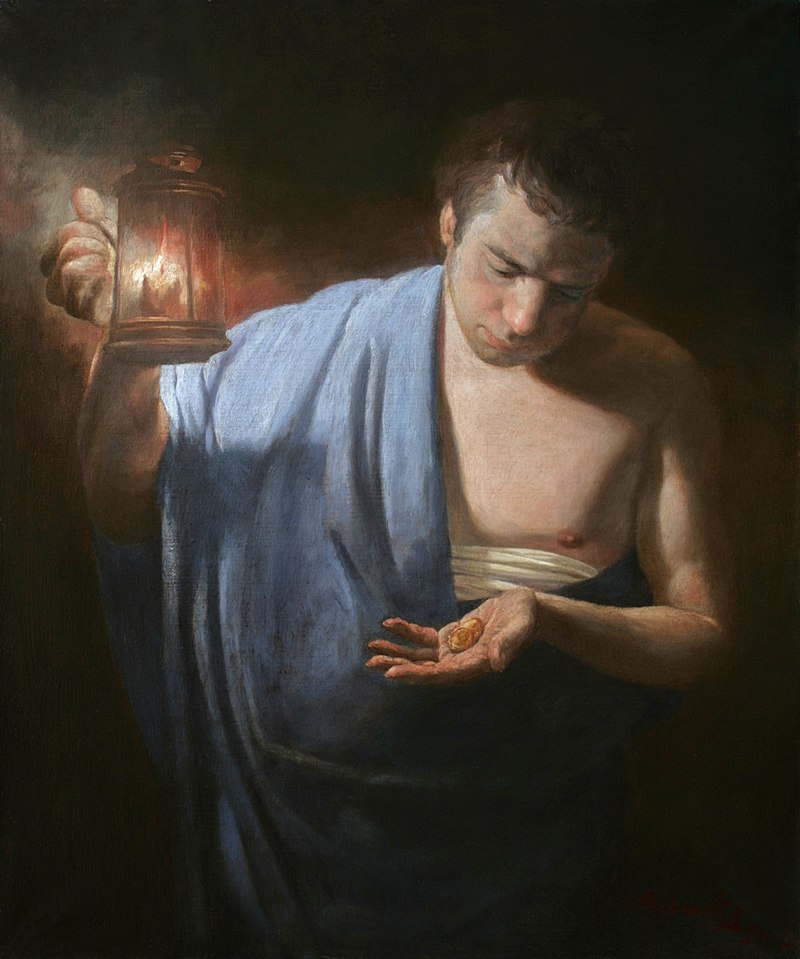
One of the twelve, Judas Iscariot, moves from indignation to action against the anointed one. The woman has spent and extravagant amount on the ointment, but Judas merely asks what they wish to give him to hand Jesus over to them. The price of thirty silver coins, which most likely are thirty shekels-about 120 days wage for a day laborer, is not an extravagant price. As Anna Case-Winters says well:
The woman at Bethany is “a bright foil to the dark plotting of the enemies and Judas.” Her extravagant gift in preparation for Jesus’ burial is in stark contrast to Judas’ greedy grasping after a paltry sum to hand Jesus over to die. (Case-Winters 2015, 293)
These four quick scenes which conclude Jesus’ teaching and prepare the reader for the upcoming betrayal and crucifixion of Jesus move us towards the rapidly approaching event of the Passover and the crucifixion. The chief priests and the scribes at the beginning of the gospel gave both the magi and King Herod the location of Jesus (2:5-6), now they are trying to discern his location for their own purposes. The disciples, even though they have been warned multiple times, seem unable to grasp who Jesus is or the symbolic nature of this work by the unnamed woman, but women will continue to bridge the gap between the struggles of these male disciples around the passion of Jesus and Jesus return to these disciples in Galilee. Yet, the handing over of Jesus comes from one of the twelve, one whose indignation has proven how inexpensive his loyalty to the ‘anointed one’ is.
[1] The Greek paradidomi is used throughout the gospel and particularly in the passion narrative. English translations may render it ‘hand over’ or ‘betray’ (both translations are apparent in this section).
[2] The Greek aule primarily means “courtyard, an enclosed space, open to the sky, near a house or surrounded by buildings” (BAGD, 121) While the household of Caiaphas may have been elaborate, the NRSV’s choice to translate this as palace tends to evoke for most English readers medieval imagery of castles.
[3] The Greek dolos has the darker meanings of treachery and deceit, and while stealth may cover the desire for secrecy it does not carry the negative connotations cunning, treachery or deceit may carry in English.
[4] Dining in Jesus time was done ‘reclining at the table’ with tables lower to the ground, rather than sitting elevated in chairs like most modern people assume.
[5]Aganakteo is traditionally translated indignant. Modern translations have gone to the more general term of anger, but anger is a large emotion covering a lot of more complex feelings.
[6] Greek ergazomai is work. The translation of service probably is due to some translators avoiding the terminology of good works in light of the conflict over this between reformation and Roman Catholic perspectives, but the simplest translation is good work.
If you’ve been to the welcome page of SignoftheRose you’ve seen that I have a book coming out in 2021. This is the cover artwork for that book and for me this was a chance to collaborate with my daughter Jey White. I am thrilled with how it evolved and with the finished product. I’ll be sharing more about the work in the coming weeks and I am excited to put some of my work out in a new format.
Separation of the Sheep and the Goats, 6th Century Mosaic. This file was donated to Wikimedia Commons as part of a project by the Metropolitan Museum of Art. See the Image and Data Resources Open Access Policy, CC0, https://commons.wikimedia.org/w/index.php?curid=60952241
Matthew 25: 31-46
31 “When the Son of Man comes in his glory, and all the angels with him, then he will sit on the throne of his glory. 32 All the nations will be gathered before him, and he will separate people one from another as a shepherd separates the sheep from the goats, 33 and he will put the sheep at his right hand and the goats at the left. 34 Then the king will say to those at his right hand, ‘Come, you that are blessed by my Father, inherit the kingdom prepared for you from the foundation of the world; 35 for I was hungry and you gave me food, I was thirsty and you gave me something to drink, I was a stranger and you welcomed me, 36 I was naked and you gave me clothing, I was sick and you took care of me, I was in prison and you visited me.’ 37 Then the righteous will answer him, ‘Lord, when was it that we saw you hungry and gave you food, or thirsty and gave you something to drink? 38 And when was it that we saw you a stranger and welcomed you, or naked and gave you clothing? 39 And when was it that we saw you sick or in prison and visited you?’ 40 And the king will answer them, ‘Truly I tell you, just as you did it to one of the least of these who are members of my family,you did it to me.’ 41 Then he will say to those at his left hand, ‘You that are accursed, depart from me into the eternal fire prepared for the devil and his angels; 42 for I was hungry and you gave me no food, I was thirsty and you gave me nothing to drink, 43 I was a stranger and you did not welcome me, naked and you did not give me clothing, sick and in prison and you did not visit me.’ 44 Then they also will answer, ‘Lord, when was it that we saw you hungry or thirsty or a stranger or naked or sick or in prison, and did not take care of you?’ 45 Then he will answer them, ‘Truly I tell you, just as you did not do it to one of the least of these, you did not do it to me.’ 46 And these will go away into eternal punishment, but the righteous into eternal life.”
This final parable in Matthew’s gospel builds upon the foundation laid by the previous five parables but also steps beyond them into cosmic setting of dividing the blessed ones of Father and the cursed ones. This final parable brings together imagery from across the gospel as well as several resonant images from the Hebrew Scriptures woven into a tightly woven tapestry. Like a tapestry, you can appreciate the pattern from an initial glance but when you look closely you can discern how the individual threads are brought together to form this final image. Unfortunately, I think this parable is sometimes treated like an ancient tapestry that seems out of place in the modern homes we’ve constructed and some would perhaps like to confine it to a museum as a witness to the artistic stylings of an ancient culture but for those with eyes to see and ears to hear it concludes the teaching of Matthew’s gospel and prepares us for the passion narrative which follows.
Matthew has, in the previous two parables, used imagery often associated with Israel’s relationship with their God: God as bridesmaid and God as ‘house master’ entrusting the stewardship of the household to slaves who wield great power on their master’s behalf. Now we are thrust into the cosmic sphere with the reintroduction of the title the Son of Man, in a way that closely links this title with Daniel’s introduction of this figure in Daniel 7:13-14:
As I watched the night visions, I saw one like a human being (Son of Man) coming with the clouds of heaven. And he came to the Ancient One and was presented before him. To him was given dominion and glory and kingship, that all peoples, nations, and languages should serve him. His dominion is an everlasting dominion that shall not pass away, and his kingship is one that shall never be destroyed.
Throughout the gospel the Son of Man has been linked to suffering, but here we also see it linked to glory. The suffering and glory of the Son of Man are held together in the trial before Caiaphas the high priest when Jesus states, “From now on you will see the Son of Man seated at the right hand of Power and coming on the clouds of heaven.” (26:64) But for the moment the parable looks beyond the upcoming suffering to the time when the Son of Man is seated on the throne of his glory and the peoples are gathered to him.
There are two possible readings of this parable which rotate on how one views the ones gathered and these littlest ones who their Lord is now seen through. One reading is that the Greek ethnos is translated simply as nations indicating all the nations (Jews and Gentiles) gathered before the Son of Man and sorted by how they respond to the ‘least of these.’ In this reading “the least of these who are members of my family” are the hungry, thirsty, strangers, naked, sick/weak, and prisoners of the world. The second reading translates ethnos as Gentiles understanding the ‘least of these who are members of my family” as the followers of Jesus who carry the message of Jesus to the nations. There are strengths to both readings and the text can encompass both meanings. However, most of what follows will focus on the second reading since it highlights a way of thinking about this parable less common in the church. The reading here will also move away from an individualistic way of thinking about this parable to a framework that fits within the Jewish communal ideas of righteousness and hospitality.
Although there are portions of the Hebrew Scriptures which talk about the care for those who are less fortunate in the sense of an individual’s action, like Proverbs 19:17[1]: “Whoever is kind to the poor lends to the LORD, and will be repaid in kind.“ But the individual’s actions are a part of the community which seeks to live in the covenant they have received from their God as a witness to the world. When Isaiah challenged the community to care for the hungry, the homeless, the naked, and the afflicted he could use singular pronouns to talk about the improper collective actions of the community:
Is this not the fast I choose; to loose the bonds of injustice, to undo the thongs of the yoke, to let the oppressed go free, and to break every yoke: Is it not to share your bread with the hungry, and bring the homeless poor into your house; when you see the naked, to cover them, and not to hide yourself from your own kin? Then your light shall break forth like the dawn, and your healing shall spring up quickly; your vindicator shall go before you, the glory of the LORD be your rear guard. Then you shall call, and the LORD will answer; you shall cry for help, and he will say, Here I am. If you remove the yoke from among you, the pointing of the finger, the speaking of evil, if you offer your food to the hungry and satisfy the needs of the afflicted, then your light shall rise in the darkness and your gloom be like the noonday. Isaiah 58:6-10
Israel and the church were intended to be communities of righteousness that would be lights that would illuminate the nations. Part of this expectation includes hospitality, which these new disciples were to expect in the places they go to both in Israel (10:5-15 where they are to rely on the hospitality of the villages and towns they come to) but also in the future when they are sent to go into ‘all nations.’ Particularly in Western societies we tend to read the scriptures in terms of individual responsibility, but a community of hospitality and righteousness doesn’t allow a person to remain hungry, thirsty, naked, sick/weak, or in prison without receiving care. Mark Allan Powell, when discussing the parable of the Prodigal Son in Luke, highlights this in talking to American, Russian and finally Tanzanian students for their interpretation of the parable. American students tended to highlight the son’s actions which lost his inheritance, Russian students tended to highlight the famine which brought about hunger in the land, but for me the most insightful was the answer he received in Tanzania:
The boy was in a far country. Immigrants often lose their money. They don’t know how things work—they might spend all their money when they shouldn’t because they don’t know about the famines that come. People think they are fools just because they don’t know how to live in that country. But the Bible commands us to care for the stranger and the alien in our midst. It is a lack of hospitality not to do so. This story, the Tanzanians told me, is less about personal repentance than it is about society. Specifically, it is about the kingdom of God. (Powell 2007, 27)emphasis mine
As we saw in Matthew 10:5-15, the judgment on communities that do not receive these disciples coming to them as strangers will receive a harsher judgment than Sodom and Gomorrah who failed to show hospitality to the divine visitors who entered their community.
In this cosmic parable where the Son of Man assumes his glory before all the peoples, nations and languages and some find themselves on the right[2] and others on the left judged for the way they received this unexpected divine visitation in the presence of these ‘little ones of God’s family.’ The attentive listener may hear the way Matthew has once again has pointed to the unique ways that ‘God is with us’ in these little faith ones sent out into the world needing care, welcome and compassion. It also creates a link between the beginning of the Sermon on the Mount and the two texts help interpret one another: perhaps the poor in spirit who are blessed or those who hunger and thirst for righteousness are found among those who are hungry, thirsty, strangers, naked, sick/weak, and imprisoned. The peoples of the world are blessed for how they receive these strangers and aliens in their midst. Are they the kind of society where their needs will be met or are they the type of society that hides themselves from their own kin?
The ‘blessed ones’ inherit the kingdom which was prepared for them from the ‘foundation of the cosmos.’ In hospitality they gave food to those hungering, drink to the thirst, gathered together[3] with the strangers, clothed the naked, visited the weak/sick,[4] and ‘came towards’ the ones in prison. On the one hand a community which does this towards the ‘little ones of God’s family’ probably practices this hospitality towards any strangers who find themselves in their midst, but probably in this parable they are blessed for the way they show hospitality for the least of God’s family[5] and by their actions show their righteousness. In contrast, the unrighteous do not practice this hospitality towards the strangers in their midst and find themselves left outside the kingdom of heaven. These ‘cursed ones’ have chosen the way of the devil and his angels and find themselves outside God’s promised ‘age of life’ enduring the ‘age of punishment’ or ‘age of fire.’[6]
Matthew’s gospel has continually pondered what the Jewish covenantal idea of righteousness looks like in practice for this community of Christ followers. Often this is framed in the wise/foolish framework of wisdom literature where the wise can take part in the celebration, or the master’s joy, or the kingdom prepared from the beginning of the cosmos while the foolish find themselves outside where there is weeping and gnashing of teeth. Righteousness does not look like individual piety, and there are those who may call on the name of the Lord, and who have heard the words of the Lord, but have not built their lives upon those words. This community of little ones go out as strangers among the nations expecting to see signs of the kingdom of God among those who welcome them, but conversely the nations are blessed or cursed based on the way they receive these humble messengers. Ultimately, any judgment remains in the hands of the Son of Man or God and not the disciples, the most they can do is shake the dust off their sandals. Just as the ‘housemaster’ continued to send slaves to his vineyard looking for the harvest from his vines, so the Son of Man continues to send slaves to the nations looking for the fruit of hospitality.
[6] Most translations render the Greek aion (eon) as eternal, but as throughout this translation I’ve attempted to avoid these terms which carry a lot of baggage in Christian thought. Matthew has a conception of righteousness and condemnation for wickedness which is never fully developed. For a fuller discussion see Gehenna, Tartaros, Sheol, Hades, and Hell
14 “For it is as if a man, going on a journey, summoned his slaves and entrusted his property to them; 15 to one he gave five talents,to another two, to another one, to each according to his ability. Then he went away. 16 The one who had received the five talents went off at once and traded with them, and made five more talents. 17 In the same way, the one who had the two talents made two more talents. 18 But the one who had received the one talent went off and dug a hole in the ground and hid his master’s money. 19 After a long time the master of those slaves came and settled accounts with them. 20 Then the one who had received the five talents came forward, bringing five more talents, saying, ‘Master, you handed over to me five talents; see, I have made five more talents.’ 21 His master said to him, ‘Well done, good and trustworthy slave; you have been trustworthy in a few things, I will put you in charge of many things; enter into the joy of your master.’ 22 And the one with the two talents also came forward, saying, ‘Master, you handed over to me two talents; see, I have made two more talents.’ 23 His master said to him, ‘Well done, good and trustworthy slave; you have been trustworthy in a few things, I will put you in charge of many things; enter into the joy of your master.’ 24 Then the one who had received the one talent also came forward, saying, ‘Master, I knew that you were a harsh man, reaping where you did not sow, and gathering where you did not scatter seed; 25 so I was afraid, and I went and hid your talent in the ground. Here you have what is yours.’ 26 But his master replied, ‘You wicked and lazy slave! You knew, did you, that I reap where I did not sow, and gather where I did not scatter? 27 Then you ought to have invested my money with the bankers, and on my return I would have received what was my own with interest. 28 So take the talent from him, and give it to the one with the ten talents. 29 For to all those who have, more will be given, and they will have an abundance; but from those who have nothing, even what they have will be taken away. 30 As for this worthless slave, throw him into the outer darkness, where there will be weeping and gnashing of teeth.’
This second parable, in a group of three, shifts from feminine to assumed masculine imagery and from the setting of the wedding feast to the stewardship of the household. Jesus has used this type of imagery multiple times in parables in Matthew, and although they are now organized in a different manner the theme of a lord ‘settling words’[1] with those charged with managing the household of the master. Keeping the framework of wise and foolish from the first parable, we know see these ideas cast within an economic metaphor. These slaves are entrusted with resources according to their power[2] and then the lord departs on a journey.
In this parable there are two slaves who act wisely and one who acts foolishly. The first two slaves who have greater power and receive a greater portion of the master’s possessions to manage immediately begin to work[3] with the property entrusted to them. As we encountered in 18:23-35, where slaves are also entrusted with ‘talents’, this is an extremely large measure of economic resources. These wise slaves continue to work from the moment of their master’s departure until his return as earnest stewards of the resources entrusted to them, and as faithful exercises of the power they have in the master’s household. In their work they gain[4]additional talents. They look forward to their master’s return in expectation instead of fear. They are called ‘good and faithful[5] and can enter into the joyful celebration of their master’s long-awaited return.
In contrast to the work of the wise slaves, the foolish slave responds in fear. His only work during the master’s long absence, that we are aware of, is the act of burying the master’s silver in the earth. While the wise slaves continue to sow and scatter, reap and gather for their master, the only thing this slave plants is the money itself. This slave’s icy words which accuse the master of benefiting from the work of those in his household and quick return the master’s possession from its place where it laid fruitless in the earth indicate the unwise posture of this slave. In contrast to the ‘good and faithful’ slaves who worked with the talents entrusted to them, this slave is ‘evil[6] and lazy.’ In contrast to the valorous woman of Proverbs 31 (see the previous section) this slave does eat ‘the bread of sloth’ in this time while the master is away. He avoids even the minimal option of investing the silver with the moneychangers or bankers which would not involve physical labor but would have returned some gain to the master’s household. Like the foolish bridesmaids this ‘evil and lazy’ slave finds himself on the outside of the celebration of the master’s return in the outer darkness.
Unfortunately, the best known line from this parable is the penultimate one, “For to all those who have, more will be given, and they will have an abundance; but from those who have nothing, even what they have will be taken away. Taken out of context this has often been read as a statement of the reality that the poor become poorer and the rich become richer, but this is not a proverb which can be extracted faithfully from this parable. Although the parable uses the metaphor of economics to talk about the kingdom of God, the kingdom of God as we will see in our final parable, is a place where the hungry, thirsty, the stranger, the naked, the sick, and the prisoner are all places the master is met in the world. It also forms a contrast from the reality of most of Jesus’ early followers who were not the wealthy of the world. It is important to understand that the language of the parable is the language of metaphor which creates a word comparison to highlight an aspect of the kingdom. The kingdom of heaven is certainly not an acceptance of the status quo of the power structures at work in the world, but Jesus’ parables use the experiences that his hearers would understand to point beyond themselves to a different type of household or kingdom.
At the end of the Sermon on the Mount Jesus said, “Everyone then who hears these words of mine and acts on them will be like a wise man who build his house on a rock.” (7:24) and now these slaves of the master who await the master’s return must settle their action (or lack of action) on these words. The foolish may proclaim, in the words of José A. Pagola:
Here is your gospel, your project of the reign of God, your message of love for those who suffer. We have kept it faithfully. We haven’t used it to transform our life or to introduce your kingdom to the world. We didn’t want to take chances. But here it is, undamaged. (Pagola 2012, 39)
The darkness of the earth that enclosed the entrusted silver of the master granted to do the work of the household are now matched by the outer darkness which forms the life separated from the master’s joy. The foolish in these parables are foils to those who wisely work in hopeful expectation of their master’s return. These ‘faithful and wise slaves’ that the master places over the household to work on its behalf and who are at work when their master arrives (24:45-47) are the ones who await the return of the Son of Man with persistent hope and joyful expectation.
[1] Greek suvairei logon is literally settling words and although most translations smooth this to settling accounts, the older language points to the importance of words spoken and written in agreements.
[2] Greek dunamis is a common word meaning power. Ability has nuances in English of skill or intelligence that power does not.
[3] Most translations link the action of the first two slave to the minimum option given to the final slave of ‘investing it with the moneychanger/bankers, but the word here is not trading or investing in a modern sense of financial markets but instead ‘to work.’ (Greek ergazomai) This probably is invested in the household of the master for future harvests in a primarily agricultural world rather than trading in merchandise and stock. There is an active sense that these two wise slaves’ continued work gains the additional talents.
[4] Greek kerdaivo. In English the idea of receiving has the connotation of payment for a job, but here the ‘gain’ is not held by the slaves except to return to the master’s estate.
[5] Greek pistos has been used to talk about faith throughout the gospel. While there is an element of trust in this term, to translate it ‘trustworthy’ here obscures the linkage with faith throughout Matthew.
“Then the kingdom of heaven will be like this. Ten bridesmaidstook their lamps and went to meet the bridegroom. 2 Five of them were foolish, and five were wise. 3 When the foolish took their lamps, they took no oil with them; 4 but the wise took flasks of oil with their lamps. 5 As the bridegroom was delayed, all of them became drowsy and slept. 6 But at midnight there was a shout, ‘Look! Here is the bridegroom! Come out to meet him.’ 7 Then all those bridesmaidsgot up and trimmed their lamps. 8 The foolish said to the wise, ‘Give us some of your oil, for our lamps are going out.’ 9 But the wise replied, ‘No! there will not be enough for you and for us; you had better go to the dealers and buy some for yourselves.’ 10 And while they went to buy it, the bridegroom came, and those who were ready went with him into the wedding banquet; and the door was shut. 11 Later the other bridesmaidscame also, saying, ‘Lord, lord, open to us.’ 12 But he replied, ‘Truly I tell you, I do not know you.’ 13 Keep awake therefore, for you know neither the day nor the hour.
Matthew concludes his final teaching discourse with three parables found only in Matthew about how a wise disciple responds to the unknown day and hour of the coming of the Son of Man in glory. Those who are wise will be able to enter into the joy of their master and celebrate the long-awaited banquet, and those who are foolish may find themselves on the outside desiring to be a part of the celebration of the wise with the bridegroom. There are a number of connections throughout these parables with the Sermon on the Mount in particular and Jesus’ teaching and parables in general, and Matthew as a skillful editor has structurally used these parables of faithful preparation and stewardship to highlight the need for a community of wise disciples who can live faithfully in uncertain times when their master seems delayed or distant.
There will be wise and foolish in any community, but Matthew in this initial parable brings together a group of wise and a group of foolish virgins[1] who are awaiting the wedding feast and the bridegroom who the wedding feast celebrates. Throughout Matthew, we have seen Jesus use the wise/foolish pattern that is frequently used throughout the scriptures, particularly in wisdom literature, to help individuals and the community discern what wisdom looks like in practice. Here as Jesus begins his final trio of parables, wisdom is reflected in being prepared for the delayed coming of the bridegroom. As M. Eugene Boring can state:
Readiness in Matthew is, of course, living the life of the kingdom, living the quality of life described in the Sermon on the Mount. Many can do this for a short while; but when the kingdom is delayed, the problems arise. Being a peacemaker for a day is not as demanding as being a peacemaker year after year when hostility breaks out again and again, and the bridegroom is delayed. Being merciful for an evening can be pleasant; being merciful for a lifetime, when the groom is delayed, requires preparedness. (NIB VIII: p. 451)
I find the grouping of five wise virgins helpful in this first parable because it is a group of the invited ones who have acted in a way that the parable views as wise and responsible, while the foolish are like those sown on the rocky soil without roots who are unprepared when the life of discipleship becomes challenging (13:5, 20). The community will endure suffering for their testimony and faith, and the metaphor of the wise virgins who come prepared for the delay reflects the course on both wise individuals and wise communities whose practices form faithful disciples that live each day in perseverance, preparation and hope. Sometimes preachers and readers have become focused on the foolish virgins, but scripture never calls on the reader to focus on the foolish, but instead to focus on the wise. The consequences of foolishness in the parable may be an encouragement to take the path of the wise, but preachers and readers should never become focused on the foolish to the point of ignoring the positive portrayal of these wise virgins who do participate in the long-awaited wedding banquet. Women throughout Matthew’s gospel have both been exemplars of faith [see for example the highlighting of women in the genealogy (1:1-17), the Canaanite woman (15:21-28), and the unnamed woman at Bethany (26:6-13)] and have been used in parables as illustrations of the kingdom of heaven (13:33) and although less frequently noted than men, their references have generally been positive.
With the next parable dealing with an economic illustration, it may be worth looking at wisdom as an economic concept. In the words of E. F. Schumacher:
From an economic point of view, the central concept of wisdom is permanence…Nothing makes economic sense unless its continuance for a long time can be projected without running into absurdities. (Schumacher 1989, 33-34)
In her discussion of wisdom and sloth, Ellen Davis highlights the ‘valorous woman’[2] which Proverb 31: 10-31 praises.
She opens her mouth with wisdom, and the teaching of kindness is on her tongue. She looks well to the ways of her household, and does not eat the bread of idleness (sloth). Proverbs 31:26-27
This final character of wisdom in the book of Proverbs is a woman who can speak wisdom and in Ellen Davis’ words:
This woman who “does not eat the bread of sloth” (v.27), is a consummate practitioner of the economics of permanence as Israel understood it, maintaining the integrity of her household. (Davis 2009, 154)
These wise virgins, which become a metaphor for the faithful community, bring permanence to the practices of the Sermon on the Mount in this time of delay, but those who cry out to the closed gates “Lord, Lord’ find they cannot enter the kingdom of heaven (7:21-23) and they are like foolish builders who built their house on sand. (7:24-27)
The identity of the bridegroom traditionally in scripture for Israel has been God. The image of God becoming Israel’s husbands (or Israel’s infidelity to that relationship) are a frequent theme in the prophets.[3] But in Matthew, Jesus has already referred to himself as the bridegroom (9:15) and has used the image of a wedding banquet for the son of the king in a previous parable. (22:1-14) In Matthew, Jesus continues to weave images and roles that have been traditionally used to talk about the God of Israel in evocative ways which point to the identity of Jesus. Those wise women and men whose continue to persevere in faithful lives in their time of awaiting the advent of the kingdom of heaven continue to illuminate the way that in Jesus they have met their bridegroom and even in the bridegrooms delay they remain ready to light their lamps and enter the banquet in joy.
There are many times in history where large groups of people choose paths that are foolish, that choose short term gain over permanence. Dietrich Bonhoeffer reflecting on the foolishness or stupidity of people in his own time (Germany at the end of 1942) could state:
It would seem that stupidity is perhaps less a psychological than a sociological problem. It is a particular form of the impact of historical circumstances on human beings, a psychological concomitant of certain external conditions. (DBWE 8:43)
Bonhoeffer knew people who could remain “remarkable agile intellectually yet stupid” because they were captured by the societal pressures, rhetoric, and they become a “mindless tool…capable of any evil and at the same time incapable of seeing that it is evil” (DBWE 8:44) In Bonhoeffer’s time the Third Reich and its power to shape a stupid or foolish society were to be resisted in a church where the community was formed for faithfulness of wisdom. Even when the church and society both failed to resist the sociological problem of the stupidity of the people under the sway of the Nazi regime, Bonhoeffer still, even in prison, attempts to reimagine a church that can faithfully bear light to Christ in the darkness of a ‘world come of age.” In the United States many faithful have been concerned about the foolishness of the church and people who have made easy alliances between political and religious groups for the sake of gaining political power and influence. The temptation to abandon the practices of the Christian community for the sake of power, wealth, and influence have always been a powerful alternative for those initially drawn to Christ. The wise are called to form communities that can still maintain wisdom’s light in the midst of the sometimes overwhelming darkness of foolishness in the world.
[1] The Greek parthenos is a term for virgin in general. Although virgins may serve as bridesmaids, the bride is never mentioned in the parable. Most translations by translating the virgins as ‘bridesmaids’ assigns greater specificity than the parable requires. This is also the same term used in 1:23 (quoting Isaiah 7:14) in reference to Mary as a virgin. Foolish throughout this parable is the Greek moros where we get the English ’moron’ from.
[2] Even though English translations often render this ‘a capable wife’ the woman in the poem is viewed in her relationship to her work, and even though the woman in the poem is married the focus is on her and not her husband or their relationship.
[3] For example: Isaiah 54:5, Jeremiah 31:32 and Hosea 2:16, although for both Jeremiah and Hosea this is a recurring theme condemning the people for their unfaithfulness to this marriage.
Parallel: Mark 13: 28-32; Luke 21: 29-33, 17:26-36, 12:39-40
32 “From the fig tree learn its lesson: as soon as its branch becomes tender and puts forth its leaves, you know that summer is near. 33 So also, when you see all these things, you know that heis near, at the very gates. 34Truly I tell you, this generation will not pass away until all these things have taken place. 35 Heaven and earth will pass away, but my words will not pass away.
36 “But about that day and hour no one knows, neither the angels of heaven, nor the Son, but only the Father. 37 For as the days of Noah were, so will be the coming of the Son of Man. 38 For as in those days before the flood they were eating and drinking, marrying and giving in marriage, until the day Noah entered the ark, 39 and they knew nothing until the flood came and swept them all away, so too will be the coming of the Son of Man. 40 Then two will be in the field; one will be taken and one will be left. 41 Two women will be grinding meal together; one will be taken and one will be left. 42 Keep awake therefore, for you do not know on what day your Lord is coming. 43 But understand this: if the owner of the house had known in what part of the night the thief was coming, he would have stayed awake and would not have let his house be broken into. 44 Therefore you also must be ready, for the Son of Man is coming at an unexpected hour.
45 “Who then is the faithful and wise slave, whom his master has put in charge of his household, to give the other slaves their allowance of food at the proper time? 46 Blessed is that slave whom his master will find at work when he arrives. 47Truly I tell you, he will put that one in charge of all his possessions. 48 But if that wicked slave says to himself, ‘My master is delayed,’ 49 and he begins to beat his fellow slaves, and eats and drinks with drunkards, 50 the master of that slave will come on a day when he does not expect him and at an hour that he does not know. 51 He will cut him in pieces and put him with the hypocrites, where there will be weeping and gnashing of teeth.
These three parables, which Mark only shares the first and Luke has the remaining two scattered throughout the gospel, show Matthew’s careful organization of material in a memorable format using his typical pattern of three. These three parables prepare us for the final three parables in chapter twenty-five. Yet, most English readers wouldn’t think of these small images as parable. It is helpful to know that the original Greek of the opening verse of this section begins “But from the fig tree learn the parable (parabole).” We have already encountered a fig tree as an object lesson in Matthew 21: 18-22, and Jesus again uses a familiar image which is associated with Israel to make a point about living a life ready for the coming of the kingdom of heaven and the return of the Son of Man. Like much of Matthew, these phrases are exceptionally packed with meaning. Previously the fig tree did not produce fruit at the appointed time, but now the fig tree’s preparation for summer provides a metaphor for the nearness of the Son of Man, his presence at the door.[1] There is perhaps a double sense of fulfillment in these images, both at the crucifixion/resurrection and at the expected arrival of God’s kingdom, and perhaps the first sense is the fulfillment that this generation will experience.
Matthew’s weaving in of Jesus as ‘Emmanuel’ continues to appear throughout the gospel in unexpected ways. Even though both Mark and Luke share the sentence, Heaven and earth will pass away, but my words will not pass away the boldness of this statement should cause us to ask who could make a statement like this and have it be true? The sense is heightened when one hears the echo from Isaiah:
The grass withers, the flower fades, when the breath of the LORD blows upon it; surely the people are grass, The grass withers, the flower fades; but the word of our God will stand forever. (Isaiah 40: 7-8)
As Richard B. Hays can insightfully state:
Christian interpreters lulled by familiarity with Matthew’s Gospel may not fully appreciate the theological boldness of the Christological assertations made at every turn by Matthew. But there can be no doubt that the word spoken by Jesus in Matthew 24:35 can be true only if it really is “the word of God,” only if the speaker who says “my words will not pass away” is in fact the God of Israel, God with us. (Hays 2016, 169-170)
Matthew has used a large number of titles, metaphors, narratives and teachings to help us discern with the eyes of faith who is near, at the very door, and whose words we are holding onto as we watch the seasons turn. Even in the midst of the impermanence of the individual disciples and the incompleteness of their faith stands the unending faithfulness of the words of the God who is ‘with them’ in Jesus.
Yet, even with being able to discern the nearness of the coming[2] Son of Man, the discernment of a day or hour remains not only outside the purview of the disciples but also the celestial beings that serve the heavenly Father and even Jesus does not know the time when the kingdom of heaven will arrive in its fullness. In contrast to many Christian groups throughout history who have attempted to divine from piecing together portions of scripture to provide a roadmap for the coming of the Son of Man and the advent of God’s kingdom, the second parable points to the sign of Noah. The flood[3] had no signs of its coming which anyone, other than Noah and his family, had received. As David Garland can rightly state, “Unlike the ample warnings portending the destruction of Jerusalem, the final cataclysm will be as sudden and unforeseen as the one that overtook the generation of Noah.” (Garland 2001, 245) It is perhaps ironic that one of the verses taken out of context in many who expect a rapture comes in the midst of this parable where two are in a field or grinding meal and one is taken and one is left where, as mentioned earlier, in that theology to be ‘taken’ is a good things and to be ‘left’ is bad. The word for ‘taken’ [4] can have the connotation of taking into custody or arresting especially when contrasted with the word translated ‘left’[5] has the connotation of letting go or forgiving. Within both the imagery of the flood of Noah’s time and the image of the advancing kingdom of God and the imagery of a military advance the hope for any bystander would be to not be apprehended and imprisoned as an enemy of the new kingdom.
Within each of these three parables (the fig tree, the flood/cataclysm, and the slave put in charge by the house master) there is the theme of delay, and this theme will carry over into the upcoming parables of Matthew 25. Ultimately the followers of Christ in both Matthew’s time and our own have to navigate living between the times and between competing kingdoms. Their life in the present is to reflect their hope for the future. They trust that the Herods and the Caesars will not reign forever. There is a common tale about Martin Luther’s response when asked what he would do if Christ returned tomorrow, Luther in this story reportedly responded, “I would plant a tree.” Although it is likely that Luther never said this, it points to an orientation towards living life the right way today with the probability that Christ will not return tomorrow but the hope that Christ does.
I think the NRSV and other translations miss the proper breaks of these parables, and there is a sense that they flow one from another, but I believe that it makes sense to group verses 43-51 as the final parable dealing with the ‘housemaster’[6] and his slave put in charge of the household. Admittedly the metaphor changes from a thief breaking into he ‘housemaster’s’ property to the master returning to find the slave responsible for overseeing the household abusing the property, but the central focus on the household remains consistent. Just as the ‘housemaster’ does not know the time[7] the thief is coming, nor do the disciples or the slave in the parable know[8] the hour or day of the coming of the Son of Man. Those hearing this parable are to choose the path of the wise and faithful slave who manage ‘the household’[9] rather than the path of the wicked slave who ‘says to himself’[10]my master is delayed and then abuses the household and abides with drunkards. Matthew is not afraid to use the threat of punishment and the loss of one’s position as a motivation for ethical behavior.
Sometimes fiction can help illuminate a parable. Professor Alan Jacobs in an August 13, 2020 Trinity Forum Conversation proposed an illustration using the character of Gandalf from the Lord of the Rings as the “Gandalf option” for thinking about one’s role as a follower of Christ. He points to a scene in The Return of the King where Gandalf confronts Denethor, the steward of Gondor. Denethor, thinking in terms of control, believe Gandalf is coming to claim power from him, and Gandalf after much patience responds:
Denethor, my lord steward, you need to understand something. The rule of no realm is mine, neither Gondor nor anywhere else. It’s not what I do. I’m not here to rule. I am here to try to nourish and to care for all the good things I find in the world…When I come across something that is alive and capable of bearing beauty, then I want to nurture that, and that is my call…If anything survives that can flower and bear fruit in the days after, then my work will not have been in vain. For I am also a steward.
I searched the Lord of the Rings for this, and although Gandalf does touch on some of these points this may be like the Luther quote above, illustrative even if not from the source mentioned. Like Alan Jacobs, I l find these insightful to the slave’s role when they are placed in charge of the household awaiting the master’s return. They are not to rule over, but to serve, to nurture beauty and life and try to keep the household fruitful to hand over to the rightful king. They pay attention to the season they work in, but they go about their work waiting for their master’s return but not being discouraged when the master is delayed. They are too busy caring for the master’s household in the interim.
[1] The Greek thura, it is helpful to translate this door or opening, especially since its other use in Matthew will be at the tomb (27:60)
[8] The disciples in 44 find the Son of Man coming at an hour ‘that they are not thinking’ (ou dokeite) while the slave’s master returns ‘in a day which they did not look for (prosdoka-same verb with preposition pros added to the front)
[9] Translating this ‘other slaves’ as many translations do misses the connection to the housemaster and the larger responsibility than merely caring for the other ‘slaves.’ This ‘slave’ is charged with caring for the property, the animals, and perhaps even children in the ‘housemasters’ absence.
[10] Literally ‘being in the heart of him’ the heart in Hebrew thought is the organ of will
Matthew 24: 29-31 Learning to Read Scriptures and the Times
Parallel Mark 13: 24-27; Luke 21: 25-28
29 “Immediately after the suffering of those days the sun will be darkened, and the moon will not give its light; the stars will fall from heaven, and the powers of heaven will be shaken. 30 Then the sign of the Son of Man will appear in heaven, and then all the tribes of the earth will mourn, and they will see ‘the Son of Man coming on the clouds of heaven’ with power and great glory. 31 And he will send out his angels with a loud trumpet call, and they will gather his elect from the four winds, from one end of heaven to the other.
Through suffering comes a new hope, and through the time of affliction a way of understanding scripture emerges. This brief passage brings together imagery from the prophets to help sustain the community in the midst of the troubling events for the community and the troubling signs in the cosmos. Throughout the gospel of Matthew, the community has been warned that following Christ will not lead to a life free of suffering, rather it is a community that learns to find God’s blessing in the midst of persecution. Suffering and glory are bound together. This may run against the cultural version of Christianity in the United States which in H. Richard Niebuhr’s famously described as:
A God without wrath brought men without sin into a kingdom without judgment through the ministrations of Christ without a cross. (Niebuhr 1937, 150)
These initial disciples of Jesus believed in a God who would judge the world of sinful men and women, and that the only Christ they would know would be the crucified and resurrected one. In a culture where there are numerous churches which claim to be Christian who proclaim a gospel of prosperity based on faith and belonging, these passages seem out of place and may be ignored in some and recast in terms of glory by others. But Matthew wants us to learn how to read scriptures in a way that can hold suffering and salvation together. Christine McSpadden reflections on the actions of Herod in Matthew 2 are helpful here:
We may be disappointed that the gospel does not at this point remove the scandal of innocent suffering, on which so many would-be believers have stumbled. No, what the gospel does instead point to how inextricably the mystery of salvation is bound up with the mystery of human evil. (McSpadden 2003, 139)
Human evil and the devilish resistance to the kingdom of God’s coming bring about suffering for the disciples. Yet, the events that the community of Christ followers are participating in is a cosmic struggle reflected not only in the suffering of these disciples but in the very movements of the sun, moon, and stars. Yet, for the hearer familiar with the language of scripture, Matthew weaves in three images from the prophets. From Joel:
The sun and moon are darkened and the stars withdraw their shining (Joel 2:10, 3: 15)
From Daniel:
I saw one like a human being (Son of Man) coming with the clouds of heaven. And he came to the Ancient One and was presented before him. To him was given dominion and glory and kingship that all peoples, nations, and languages should serve him. (Daniel 7: 13-14)
And from Isaiah:
And on that day, a great trumpet will be blown, and those lost in the land of Assyria and those who were driven out of the lang of Egypt will come and worship the LORD on the holy mountain of Jerusalem. (Isaiah 27: 13)
Each of these allusions point to the regathering of God’s people and the revealing of God’s action and the ending of the time of judgment for the faithful ones. The ‘oppression’[1] of those days and the signs in the heavens which affect the heavenly bodies can be read by these faithful ones as signs to continue to endure. As the parables immediately following this will highlight, all these things are signs to be ready but they do not give a time or day to look for. Yet, they live in trust that when the Son of Man is finally revealed to the nations then the tribes of the earth will mourn that they could not see where God approached them. But for the faithful it will be a time when they are gathered from their dispersion among the nations to worship their God.
[1] This again is Greek word thlipsis which occurs frequently in this chapter
I am heartbroken, but not surprised that this will be the legacy of the Trump presidency. I was saddened when he was elected, and I voiced several of those concerns on that day with the prayer and hope that I was wrong. I have prayed for him to grow into the role of President, to understand the magnitude of the responsibility he carried on his shoulders, that those around him would be able to give him good counsel that he may steward the responsibility of the office. Yet, throughout his four years in office he has maintained his belligerent tone when addressing the nation enhancing the polarization already present in our political discourse.
January 6 in the Christian calendar is Epiphany, the day when traditionally the magi arrive to honor the child Jesus after the revelation of his birth by a star. But the word epiphany can also mean:
3 a (1)A usually sudden manifestation or perception of the essential nature or meaning of something
(2) an intuitive grasp of reality through something (such as an event) usually simple and striking
(3) an illuminating discovery, realization, or disclosure
3b. a revealing scene or moment. From Miriam-Webster.com
This is, I believe, a revealing scene or moment in the life of our country and about the danger of continuing to allow there to be no consequences for those who have impeded the transition of power from President Trump to President Elect Biden. The narrative of election fraud which is spoken on media from new programs to talk shows to social media pages by public officials and those who are associated with them without demonstrated proof of that election fraud needs to stop. It may make for good fundraising or for good ‘entertainment’ which exploits peoples’ fears and anxieties but we need to state honestly that this is radicalizing a portion of our population in the same way that Islamic extremists have radicalized people to become terrorists. This is strong language and I own that, but when we look at the actions at the capital today it moves well beyond the boundaries of protest. The people who entered the capital building are at least rioters and at worst domestic terrorists.
It has been common to wrap religious language around our secular symbols: the flag becomes sacred when people feel that it is dishonored for example. If we want to use religious symbolism as a metaphor to talk about our national symbols, then we need to also be willing to state that what happened today was (to use the language of Daniel, Mark, Matthew, and Luke) a desolating sacrilege or blasphemy of the central symbols and actions of our democracy. The breaking into the capital building and the disruption of the certification of the election by a mob incited by a president in his last two weeks in office should be viewed as an attack on one of our three primary branches of government fulfilling its constitutional duty. The dishonoring and in some cases looting that went on in the capital building was a jarring symbol of disrespect towards the symbolic building and the government it represents.
I know that we have not seen the dying gasp of ‘Trumpism’ or of right-wing conspiracies, but I do believe that the United States is better than this. I hope this can be a revealing moment where we see the essential nature or meaning of what this type of politics and rhetoric leads to. For those who have lifted up Trump as the savior of Christianity, or in some cases using explicitly ‘messianic’ language, may we have the realization that what we have is a false Christ/messiah propped up by false prophets.
This should never have happened. This is the reason that in previous elections there is a concession speech, even in a contested election like the 2000 election which was decided at the supreme court Vice President Al Gore conceded so that the country could move on and president elect George W. Bush could begin transition and ultimately governing. I have always advocated that the words and actions of leaders have power and because they have power they should also bear consequences when they undermine the symbols, structures and ultimately the good of the nation they swear an oath to serve.
Section of the Arch of Titus showing the Spoils of Jerusalem
Matthew 24: 1-28
Parallel Mark 13:1-28; Luke 17:5-24,37b
As Jesus came out of the temple and was going away, his disciples came to point out to him the buildings of the temple. 2 Then he asked them, “You see all these, do you not? Truly I tell you, not one stone will be left here upon another; all will be thrown down.”
3 When he was sitting on the Mount of Olives, the disciples came to him privately, saying, “Tell us, when will this be, and what will be the sign of your coming and of the end of the age?” 4 Jesus answered them, “Beware that no one leads you astray. 5 For many will come in my name, saying, ‘I am the Messiah!and they will lead many astray. 6 And you will hear of wars and rumors of wars; see that you are not alarmed; for this must take place, but the end is not yet. 7 For nation will rise against nation, and kingdom against kingdom, and there will be faminesand earthquakes in various places: 8 all this is but the beginning of the birth pangs.
9 “Then they will hand you over to be tortured and will put you to death, and you will be hated by all nations because of my name. 10 Then many will fall away,and they will betray one another and hate one another. 11 And many false prophets will arise and lead many astray. 12 And because of the increase of lawlessness, the love of many will grow cold. 13 But the one who endures to the end will be saved. 14 And this good newsof the kingdom will be proclaimed throughout the world, as a testimony to all the nations; and then the end will come.
15 “So when you see the desolating sacrilege standing in the holy place, as was spoken of by the prophet Daniel (let the reader understand), 16 then those in Judea must flee to the mountains; 17 the one on the housetop must not go down to take what is in the house; 18 the one in the field must not turn back to get a coat. 19 Woe to those who are pregnant and to those who are nursing infants in those days! 20 Pray that your flight may not be in winter or on a sabbath. 21 For at that time there will be great suffering, such as has not been from the beginning of the world until now, no, and never will be. 22 And if those days had not been cut short, no one would be saved; but for the sake of the elect those days will be cut short. 23 Then if anyone says to you, ‘Look! Here is the Messiah!’or ‘There he is!’ — do not believe it. 24 For false messiahsand false prophets will appear and produce great signs and omens, to lead astray, if possible, even the elect. 25 Take note, I have told you beforehand. 26 So, if they say to you, ‘Look! He is in the wilderness,’ do not go out. If they say, ‘Look! He is in the inner rooms,’ do not believe it. 27 For as the lightning comes from the east and flashes as far as the west, so will be the coming of the Son of Man. 28 Wherever the corpse is, there the vultures will gather.
Among Christians in the United States, this chapter which is sometimes called the ‘little apocalypse’ has become difficult to hear for two opposing reasons. The first reason is the way this, and other texts in both the New Testament and Hebrew Scriptures often labeled apocalyptic have been used and obsessed over in various Christian theologies and groups which focus on the return or coming (Greek parousia) of Christ and the advent of God’s kingdom almost like a script out of a horror movie where a vengeful God inflicts God’s wrath on all who oppose God’s will. While there is a grain of truth in this perspective when it comes to God’s judgment, it is helpful to remember that the grain of truth has often been overwhelmed by a barn full of chaff laid upon it in many modern Christian theologies. The second struggle is that the enlightenment has regarded the apocalyptic as an embarrassment and has often attempted to distance itself from the concept of God’s intervention in the world. It is important to realize that what we often transform into fear was the hope of the early followers of Jesus, they longed for Christ’s return and expected it and were willing to endure the struggles of their time to proclaim what they felt was a gospel of hope. This message also helped the early church endure the loss of several key symbols to the Jewish worldview and to see the suffering of the present as the painful but ultimately life-giving birth pangs of God’s new kingdom emerging in the midst of the world.
The temple was a focal point of the Jewish people in Judea and beyond. The temple in Jerusalem takes up a large amount of the city’s overall footprint and as N.T. Wright can state helpfully,
Jerusalem was not, like Corinth for example, a large city with lots of little temples dotted here and there. It was not so much a city with a temple in it; more like a temple with a small city round it. (Wright 1992, 225)
Matthew is not explicit that with Jesus departing the temple that the presence of God has left the temple, but with Matthew’s Emmanuel theology which permeates the gospel it may be implied in this scene. The temple, for all the grandeur of its reconstruction, will soon for not only the Christians but also for the rest of the Jewish people, will be displaced as a central symbol of their faith with its destruction. The coming destruction of the temple and Jerusalem, which occurs in the Jewish War of 66-70 CE, will cause a crisis which forces both the Jewish people and the early followers of Jesus, both Jew and Gentile, to reexamine their faith in terms of a new central place where God will meet them. For the followers of Jesus, one greater than the temple is currently among them and for Matthew’s community they await his return.
One of the consistent struggles of the disciples throughout the gospel is attempting to understand Jesus’ message in light of the traditional symbols and paradigms the learned. They are still ‘little faith ones’ which see in part, trust in part but still are struggling to let go of the beliefs and practices they learned over a lifetime. They see the temple primarily as a structure dedicated to God’s service, and so the destruction of the temple and Jerusalem seem like the opposite of what to expect after the coming of the long-awaited Messiah. Just like Jeremiah’s message which often fell on deaf ears before the destruction of the temple and Jerusalem by Babylon, only to be remembered as the people reconstructed their identity in exile, these words of Jesus which at the time seemed strange, provided meaning, and hope in a future where the followers of Jesus are scattered among the nations. At a time when the Roman empire seems to be consumed by struggles for power, and when the early Christians themselves may be beginning to experience exclusion from their identity with the Jewish people and persecution among the nations these words encourage them to persevere.
Jesus’ proclamation of the kingdom of heaven has prepared his followers to expect God’s intervention in the world, and there are others in Judaism of the time who also expected God’s intervention in various ways. We know the Essenes and the Pharisees expected God to intervene in history to deliver Israel from its enslavement to foreign powers and (in the Essenes case) unfaithful shepherds leading in the temple. Jewish hope was not for an ending of the world, as is present in popular culture and several late Christian movements, but rather for a reordering of the world around God’s reign through Israel. When the disciples ask about Jesus’ coming (parousia) at the end of the eon (suntelias tou aionos)[1] they are not asking about the end of the world but the advent of God’s kingdom which will replace the kingdoms of Herod or the empire of Caesar. The idea of Christ’s return is probably imagined in imagery similar to a celebration after one of King David’s victories. The other source of imagery would be the celebrations of imperial might by Caesar, but these would be considered only a parody of the expected victorious celebration of the advent of the kingdom of heaven on earth. Yet, Jesus does not answer the disciples with signs of his coming to inaugurate the kingdom of heaven but instead gives warnings about events, false prophets and false messiahs/Christs which will lead people to trust in the wrong things.
Jesus warns his disciples “See (blepete) that no one leads you astray.” While the NRSV’s use of beware does capture the sense of warning, the disciples are to take an active role in ensuring that they do not follow false prophets and false Christs. It is helpful to remember that Christ and Messiah are the same term, ultimately meaning anointed king, in Greek and Hebrew respectively rather than a part of Jesus’ name. Others will come claiming the same title that Peter has previously applied to Jesus, and they will gather followers. It is helpful to know that in the decades after Jesus’ death there would be those making the claim to be the ‘king of the Jews’ who would lead the people of Judea in multiple uprisings against Rome (not only the Jewish War of 66-70 which resulted in the destruction of Jerusalem, but also the 115-117 Jewish revolts in Egypt, Cyrene and Cyprus and the 133-135 rebellion of Bar-Kochba). This was a violent time for the Jewish people, and these followers of Jesus were not to follow these claimants who are attempting to establish God’s kingdom by force. Jesus’ followers are not to look for certain events which herald the advent of God’s kingdom on earth but to continue in their mission of teaching and proclamation to all nations. As Richard B. Hays can state, “The reality of the final judgment is crucial for Matthew, but not its timing.” (Hays 1996, 104) If these followers of Christ seek meaning in the midst of the struggle that is coming it can be read in the feminine imagery of ‘birth pangs’ that must occur before the advent of the new kingdom, or new creation in Paul’s language[2].
The suffering of these followers of Jesus in the midst of wars and rumors of wars, famines, and earthquakes in to be expected. As Jesus could tell them in the Sermon on the Mount, “Blessed are those who are persecuted for righteousness’ sake, for theirs is the kingdom of heaven.” (5:10) now they are told they will face ‘oppression’[3] and some will be killed. Matthew, unlike Mark and Luke, indicates that this oppression will come from the nations[4] instead of perhaps their own people which may be assumed in Mark and Luke and this may reflect the situation of Matthew’s community being away from Judea and experiencing persecution primarily from sources outside the Jewish people. Even among the community of Jesus followers some may be ‘caused to stumble,’[5] and others will ‘hand over,’[6] and hate will enter into these communities formed around loving God and one’s neighbor. In addition to false Christs there will be false prophets who tell people a message that did not come from God. The identity of the community is at stake here. Anna Case-Winters helpfully illustrates:
Lawlessness will afflict them and “the love of many will grow cold (v.12). This latter is perhaps the most serious threat for Matthew. Lawlessness (Greek anomia) is the ultimate crisis for a community centered around Torah. For love to “grow cold” signifies the loss of the very heart of Torah, which is love of God and neighbor. (Case-Winters 2015, 271)
The crisis of oppression, death, stumbling, betrayal, and hate threaten to extinguish[7] the love that the community is grounded in. But those who endure to the completion[8] will not be left on their own. This scene anticipates the great commission with its promise of both the authority and presence of Christ as well as the commission to take this gospel to all nations. As David Garland can helpfully state,
the church is not to circle the wagons until the danger passes but is to engage in active mission. In spite of the trauma, the community’s responsibility to love and proclaim the gospel of the kingdom remains in force. (Garland 2001, 242)
Matthew, who has been intent throughout the gospel in helping the reader understand scripture, adds the citation of Daniel to the comment about the ‘blasphemy’[9] standing in the holy place so the reader might find:
Forces sent by him shall occupy and profane the temple and fortress. They shall abolish the regular burnt offering and set up the abomination that makes desolate. Daniel 11:31
Daniel, which most scholars would say is pointing to Antiochus IV Epiphanes a Seleucid king who persecuted the Jewish people leading to the Maccabean revolt, is now read in light of the actions of the Romans conquering the temple and removing the holy items for their victory parade in Rome. Instead of being drawn into this conflict with the empire of Rome, those followers of Christ in Judea are to flee. The war, which will continue beyond 70 as the imperial forces continue to quell their rebellious Jewish province, will indeed bring great suffering for the people of Judea. Ironically, these warnings to flee throughout this chapter are misread drastically by some later Christians into talking about a ‘rapture’ where the hope is to be the one taken but to the original hearers they would understand this as a warning to prepare to flee on short notice. They may need to flee without packing, without re-entering the house or taking additional garments.[10] Into this time of great affliction (thlipsis) those claiming authority as leaders, or those who claim the authority to interpret God’s will as prophets will come claiming to create meaning out of the suffering, but they are telling a false story. These false prophets and false Christs, who most likely portrayed themselves as being the saviors of Israel from her oppressors, were probably an attractive alternative to the message of Matthew’s community and the gospel they proclaimed. Yet, they are warned not to go out seeking these leaders and prophets.
To the early community of Jesus followers these warnings probably were intended to keep them away from the revolutionary movements gaining strength in Judea, Galilee and beyond. Matthew’s closing line that Wherever the corpse is, there the eagles[11]will gather may refer to the massing of Roman standards (eagles) gathered around Jerusalem. Although I believe Warren Carter rightly discerns the echo of Rome in this verse, I believe he misinterprets the direction of the verse. Carter indicates that the verse indicates a judgment on Rome and the corpse is the Roman army, (Carter 2001, 87-88) but I believe the plainer reading in the context is to avoid Judea and Jerusalem in revolt where the legions assemble to wage war against the revolt. The corpse may refer to the crucifixion, to the temple (especially in the context of this chapter) or to Jerusalem, but the geographical location would be understood.
In a passage like this one, especially where I have covered a lot of historical ground, it is perhaps more difficult to allow it to speak to the church today, yet I believe there is no way to separate Christianity from the apocalyptic portions of its scriptures. Every time one prays the Lord’s Prayer asking for God’s kingdom to come and God’s will to be done on earth as it is in heaven, one is praying for God’s intervention to bring about God’s promised new eon. Yet, throughout the gospel and throughout history there have been forces which are opposed to God’s reign and the changes that will bring. What may be perceived as a blessing to the poor in spirit, the meek, those hungering and thirsting for righteousness and the others mentioned in the beatitudes may be experienced as a woe to those who have become invested in the maintaining of the current order or who may want to bring about God’s order in their own terms. This chapter, even as it has been frequently misused in modern times, holds a key insight for the way of Christ: it is a way of hope even as one endures suffering. The Christians were not zealots who attempted to bring about God’s order by driving out the Gentiles from the promised land, rather they were those sent into the nations bearing witness to the gospel of peace. They meet violence by turning the other cheek, the learn to find blessing even when they are oppressed, and they find meaning amidst the times of affliction and tribulation by trusting in God’s hearing of their prayers and acting on them. This is a hope that would be at home in the psalms and the prophets and has sustained Christians for millennia. It is a hope that has sustained non-violent groups through the years and as I write this the lyrics of “We Shall Overcome,” used in the civil rights movement but has its origins in Charles Tindley’s adaptation of the 19th Century Spiritual “No More Auction Block for Me.” Oh deep in my heart, I do believe, that we shall overcome one day, and that overcoming comes when God changes the world bringing down the mighty and lifting up the lowly. Until that day we work, and we wait, and we suffer, and we hope. We hold fast to what we have received and are alert for false prophets and false messiahs which proclaim cheap and easy paths to claiming God’s kingdom
[1] We again encounter the common Matthew word telos, here with the prefix sun attached to it, meaning completion, consummation, end. I think the older word eon is helpful, since it is both a direct transliteration of the Greek aion but also does not have some of the baggage of ‘the end of the age’ in Christian parlance.
[2] Paul can also use the imagery of labor pains of the creation giving birth to something new in Romans 8:18-25
[3] This is the Greek word thlipsis which occurs twice in this passage meaning ‘oppression, affliction, or tribulation’
[5] This is a passive form Scandalizo, where we get the English scandalize from, which has the connotation of stumbling. Has been used frequently in Matthew.
[6]Paradidomi is an important word in all the gospels which means both betray, but more literally to hand over (presumably into another’s custody)
[7] The Greek Psucho can mean grow cold or extinguish. I think the future indicative tense leads to the more absolute reading, especially when paired with lawlessness.
[8]Telos again used as a term of completion in verses 13 and 14.






 Sign of the Rose