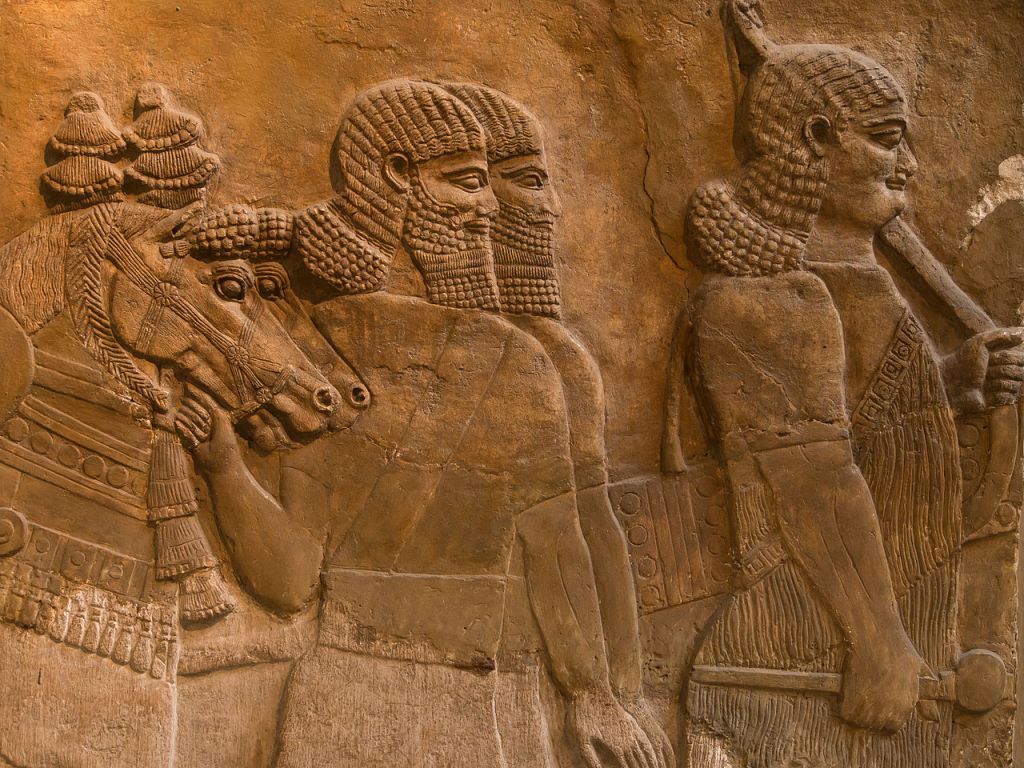
A neo-Assyrian relief of Assyrians in a procession, Photo by Denis Bourez in the Brittish Museum, London. Shared under CC 2.0 https://en.wikipedia.org/wiki/Assyria#/media/File:Denis_Bourez_-_British_Museum,_London_(8748213226).jpg
2 Kings 17: 1-6 King Hoshea the Last King in Samaria and the End of the Northern Kingdom of Israel
1 In the twelfth year of King Ahaz of Judah, Hoshea son of Elah began to reign in Samaria over Israel; he reigned nine years. 2 He did what was evil in the sight of the LORD, yet not like the kings of Israel who were before him. 3 King Shalmaneser of Assyria came up against him; Hoshea became his vassal and paid him tribute. 4 But the king of Assyria found treachery in Hoshea, for he had sent messengers to King So of Egypt and offered no tribute to the king of Assyria, as he had done year by year; therefore the king of Assyria confined him and imprisoned him.
5 Then the king of Assyria invaded all the land and came to Samaria; for three years he besieged it. 6 In the ninth year of Hoshea the king of Assyria captured Samaria; he carried the Israelites away to Assyria. He placed them in Halah, on the Habor, the river of Gozan, and in the cities of the Medes.
The brief description of the reign of King Hoshea of Samaria, the capture of Samaria, and the scattering of the Northern Kingdom of Israel is accomplished in six terse verses. Yet, this major event will prompt a much longer reflection of the why the exile of Israel occurs and the resettlement of the land under the Assyrian king. The dissolution of the Kingdom of Samaria does not end the dream of a reunification of Judah and Israel among the prophetic imagination, but it does mark a significant shift in the narrative of 2 Kings. The bulk of 1 and 2 Kings to this point has focused on the events of the northern kingdom of Israel while it tracks the kings of Judah and the occasional event or interaction with the northern kingdom, but now after this chapter the entire focus of the narrator will orient on the remaining kingdom of Judah. The siege of Samaria, the capture of Israel and the dispersal of the population were traumatic for the people involved and the narrative of the book of Kings is designed to provide a theological rationale for this catastrophic event (and the eventual exile of Judah) among the people of the covenant.
King Hoshea comes to power around 732 BCE and roughly five years into his reign the powerful king Tiglath-pileser III dies and his son Shalmaneser V assumes control of the Assyrian empire. Shalmaneser V only reigns for five years, and it is possible that his replacement Sargon II is not his heir and that he meets a violent end. The transition to Shalmaneser V was likely viewed in the region as an opportunity for nations to extract themselves from Assyrian rule and King Hoshea’s withholding of tribute payments and appeals to King So of Egypt[1] are acts of rebellion that Shalmaneser V responds to violently by besieging Samaria and occupying the land. It is possible that Shalmaneser V dies during the three-year long siege and Sargon II completed it (Assyrian records seem to indicate this) but ultimately the result is the same. The destruction of Samaria, the exile of Israel and the resettlement of the land.
One would expect that the king of Samaria who reigns during the destruction of the nation would receive a harsh judgment, but instead he receives a more favorable judgment than any other northern king. His toned-down judgement is unique among the northern kings. Rabbinical commentators have often indicated that Hoshea paid off the tribute to Assyria by removing the golden statues in Bethel and Dan, and this was viewed favorably by the God of Israel and that Hoshea removed the barriers for people from Israel to worship in Jerusalem.[2] The narrator of the book of Kings also tends to view accommodation with the empire of the day as a sign of unfaithfulness so it the better, if not positive evaluation, may be in part due to the resistance of Hoshea to the king of Assyria.
In the aftermath of the fall of Samaria, 2 Kings describes the exile of the population to two places in modern day Iraq and one in modern day Iran. The Assyrians scattered captured populations to prevent a concentration in one area where they could rise against Assyria, but it also is likely that the entire population of northern Israel is not exiled. Some do apparently migrate to Judah and Alex Israel notes that archeology shows an increase in the population of Judah during this period. (Israel, 2019, p. 269) Other portions of the population likely remained in place and were mixed with the people that Assyrian resettled in the region. The northern tribes of Israel ceased to be a unified people, but that does not stop the prophets of Judah from imagining a future where Judah and Ephraim can be reunited as the people of God.[3]
2 Kings 17: 7-23 Theological Rationale for the Exile of Israel (Samaria)
7 This occurred because the people of Israel had sinned against the LORD their God, who had brought them up out of the land of Egypt from under the hand of Pharaoh king of Egypt. They had worshiped other gods 8 and walked in the customs of the nations whom the LORD had driven out before the people of Israel and in the customs that the kings of Israel had introduced. 9 The people of Israel did things that were not right against the LORD their God. They built for themselves high places at all their towns, from watchtower to fortified city; 10 they set up for themselves pillars and sacred poles on every high hill and under every green tree; 11 there they made offerings on all the high places, as the nations did whom the LORD had carried away before them. They did wicked things, provoking the LORD to anger; 12 they served idols, of which the LORD had said to them, “You shall not do this.” 13 Yet the LORD warned Israel and Judah by every prophet and every seer, saying, “Turn from your evil ways and keep my commandments and my statutes, in accordance with all the law that I commanded your ancestors and that I sent to you by my servants the prophets.” 14 They would not listen but were stubborn, as their ancestors had been, who did not believe in the LORD their God. 15 They despised his statutes and his covenant that he had made with their ancestors and the warnings that he had given them. They went after false idols and became false; they followed the nations that were around them, concerning whom the LORD had commanded them that they should not do as they did. 16 They rejected all the commandments of the LORD their God and made for themselves cast images of two calves; they made a sacred pole, worshiped all the host of heaven, and served Baal. 17 They made their sons and their daughters pass through fire, used divination and augury, and sold themselves to do evil in the sight of the LORD, provoking him to anger. 18 Therefore the LORD was very angry with Israel and removed them out of his sight; none was left but the tribe of Judah alone.
19 Judah also did not keep the commandments of the LORD their God but walked in the customs that Israel had introduced. 20 The LORD rejected all the descendants of Israel; he punished them and gave them into the hand of plunderers, until he had banished them from his presence.
21 When he had torn Israel from the house of David, they made Jeroboam son of Nebat king. Jeroboam drove Israel from following the LORD and made them commit great sin. 22 The people of Israel continued in all the sins that Jeroboam committed; they did not depart from them 23 until the LORD removed Israel out of his sight, as he had foretold through all his servants the prophets. So Israel was exiled from their own land to Assyria until this day.
The narrator of the book of Kings is both narrating the history of the kings of Israel and Judah (and by extension the people of both nations) but also looking back from two exilic events (the Assyrian exile of Israel and the Babylonian exile of Judah) and utilizing the historical narrative told through a theological lens to explain how the nation went from its highpoint as a unified kingdom under Solomon to Samaria’s scattering and Judah’s exile. At this first moment of crisis, the narrator steps back from the events to explain why this crisis occurred. The rise of Assyria may form the political background of the story, but through the lens of the narrator Assyria is merely a tool of the LORD because of the multiple sins of the people. The sins of the people of Israel, and Judah, are couched in the language of idolatry, a violation of the central commandment given to the Hebrew people whether in the Ten Commandments[4] or in the Shema[5]. As Choon-Leong Seow can state about this section of chapter seventeen:
The text is ultimately more than a justification of the doom that God brought upon a nation long ago. It is a homily to those of us for whom there is still an opportunity to do what is right. It is a homily about what happens when we violate the first commandment and betray God, from whom no secrets can be kept. (NIB III: 257)
The language of this section is the language of the covenant in Exodus, Leviticus, and Deuteronomy. The people worshipped other gods and adopted the practices of the nations that surrounded them. As people of the covenant, they were intended to be a treasured possession, a priestly nation, and a holy people,[6] but instead they have become indistinguishable from the people the LORD drove out before them in the book of Joshua. The language seems to be hyperbole with the statement of setting up high places in all their towns and sacred poles on every high hill and under every green tree, but the intent of this section is to convey the pervasiveness of the corruption of Israel and Judah. From the Golden Calf during the exodus,[7] to the sins of Jeroboam constructing the golden calves at Bethel and Dan [8], to the practices of Ahab opposed by Elijah, and finally to this moment of exile the people have continued to violate the commandments and statutes of the LORD their God.
The command not to worship other gods or to adopt the practices of the land is one of the most frequently repeated injunctions throughout the law. Deuteronomy 18: 9-11 is a representative example which our text echoes:
“When you come into the land that the LORD your God is giving you, you must not learn to imitate the abhorrent practices of those nations. No one shall be found among you who makes a son or daughter pass through fire, or who practices divination, or is a soothsayer, or an augur, or a sorcerer, or one who casts spells, or who consults ghosts or spirits, or who seeks oracles from the dead.
The people of Israel and Judah have gone after the false practices of the nations and they have become false. They have worshipped idols who were false instead of worshipping the God who is unseen but real. The word translated false by the NRSVue is the Hebrew word hebel (or hevel) which is famously translated in Ecclesiastes as ‘vanity.’ Hebel is an evanescent word which means wind, vapor, smoke, or mist and is something transitory that cannot be grasped onto.[9] Walter Brueggemann picks up on this when he says of the people, “They worshipped “vapor” and they became vapor”” (Brueggemann, 2000, p. 480)
Even though the narrator of 1 and 2 Kings rarely notes the existence of the prophets who we have in the bible (after Elijah and Elisha), the last several chapters have been times when the biblical books of Amos, Hosea, Micah, and the first section of Isaiah address. There are prophets active in both Israel and Judah, in addition to the seers mentioned which also paint a troubled future with the LORD the God of Israel due to the disobedience of the people. This section which serves as both a summary of the history of disobedience and as a warning for Judah closes the narration of Israel but also points to the reality that this is an intentional action of the LORD the God of Israel. As Brueggemann helpfully summarizes:
The condemning action of Yahweh is summarized in a series of harsh verbs: reject, punish, gave into, banished, removed. The deportation is not an accident. It is not a matter of Assyrian policy. It is the sure and inevitable enactment of covenant curses that have been known from the outset of Sinai. (Brueggemann, 2000, p. 481)
The narrative of Israel has been viewed through the lens of the covenant and the cause of the exile of Israel is not Assyria, but God’s actions in response to their continual pattern of disregarding the covenant and adopting the worship and the practices of the nations of the region.
2 Kings 17: 24-41 The Ressettlement of Samaria by Assyria
24 The king of Assyria brought people from Babylon, Cuthah, Avva, Hamath, and Sepharvaim and placed them in the cities of Samaria in place of the people of Israel; they took possession of Samaria and settled in its cities. 25 When they first settled there, they did not worship the LORD; therefore the LORD sent lions among them that killed some of them. 26 So the king of Assyria was told, “The nations that you have carried away and placed in the cities of Samaria do not know the law of the god of the land; therefore he has sent lions among them; they are killing them because they do not know the law of the god of the land.” 27 Then the king of Assyria commanded, “Send there one of the priests whom you carried away from there; let him go and live there and teach them the law of the god of the land.” 28 So one of the priests whom they had carried away from Samaria came and lived in Bethel; he taught them how they should worship the LORD.
29 But every nation still made gods of its own and put them in the shrines of the high places that the people of Samaria had made, every nation in the cities in which they lived; 30 the people of Babylon made Succoth-benoth, the people of Cuth made Nergal, the people of Hamath made Ashima; 31 the Avvites made Nibhaz and Tartak; the Sepharvites burned their children in the fire to Adrammelech and Anammelech, the gods of Sepharvaim. 32 They also worshiped the LORD and appointed from among themselves all sorts of people as priests of the high places, who sacrificed for them in the shrines of the high places. 33 So they worshiped the LORD but also served their own gods, after the manner of the nations from among whom they had been carried away. 34 To this day they continue to practice their former customs.
They do not worship the LORD, and they do not follow the statutes or the ordinances or the law or the commandment that the LORD commanded the children of Jacob, whom he named Israel. 35 The LORD had made a covenant with them and commanded them, “You shall not worship other gods or bow yourselves to them or serve them or sacrifice to them, 36 but you shall worship the LORD, who brought you out of the land of Egypt with great power and with an outstretched arm; you shall bow yourselves to him, and to him you shall sacrifice. 37 The statutes and the ordinances and the law and the commandment that he wrote for you, you shall always be careful to observe. You shall not worship other gods; 38 you shall not forget the covenant that I have made with you. You shall not worship other gods, 39 but you shall worship the LORD your God; he will deliver you out of the hand of all your enemies.” 40 They would not listen, however, but continued to practice their former custom.
41 So these nations worshiped the LORD but also served their carved images; to this day their children and their children’s children continue to do as their ancestors did.
The Assyrians would resettle captured lands with displaced populations, here the text notes populations from Babylon, Cuthah, Avva, Hamath, and Sepharvaim (modern day Iraq and Syria). These resettled populations bring their native gods and practices and are tormented by lions in the land. Lions have previously been used by God to deal with prophets who disobeyed God’s instructions,[10] and now become a judgment of the God of the land on these new people who do not know the LORD. Leviticus notes wild animals as one of God’s methods of punishing the disobedience of the people of the land:
I will let loose wild animals against you, and they shall bereave you of your children and destroy your livestock; they shall make you few in number, and your roads shall be deserted. Leviticus 26:22
Mordechai Cogan and Hayim Tadmor note how lions as predators would become more dangerous in the aftermath of wars devastation and depopulation, (Cogan, 1988, p. 210) but for the narrator of 2 Kings this is a part of God’s causing some partial, if incomplete in the view of 2 King’s narrator, worship of the LORD. The king of Assyria dispatched a priest who formerly served at Bethel to teach the people the worship of the LORD, but in the narrators view what emerges is an amalgamation of practices from the worship of the resettled people and the worship of the LORD taught by one of the priests at one of the shrines where the improper worship of the LORD, in the view of the narrator, began. This section becomes an origin story for the Samaritans of later generations who will be viewed with suspicion by their neighbors in Judah.
[1] Historians are unsure which King of Egypt this name is intended to refer to.
[2] 2 Chronicles narrates King Hezekiah of Judah inviting Israel to participate in the Great Passover, and even though most of Israel scorns this invitation a few attend (2 Chronicles 30:11)
[3] For example, Isaiah 11:10-16, Jeremiah 31, and Ezekiel 37 all imagine a reconstituted Israel (comprised of both Judah and Ephraim) under a Davidic king.
[4] Exodus 20: 2-6; Deuteronomy 5: 6-10.
[9] See a fuller discussion of hebel in my discussion of Ecclesiastes 1.





 Sign of the Rose
.jpg)