Monthly Archives: August 2024

Ezekiel 27 A Satirical Lament for Tyre

Tyre, Lebanon – columns of what is believed to be palaestra (athletes’ training area) at the Al Mina excavation area By Heretiq – Own work, CC BY-SA 2.5, https://commons.wikimedia.org/w/index.php?curid=555876

Ezekiel 27

1The word of the LORD came to me: 2Now you, mortal, raise a lamentation over Tyre, 3and say to Tyre, which sits at the entrance to the sea, merchant of the peoples on many coastlands, Thus says the Lord GOD:
O Tyre, you have said,
“I am perfect in beauty.”
4Your borders are in the heart of the seas;
your builders made perfect your beauty.
5They made all your planks
of fir trees from Senir;
they took a cedar from Lebanon
to make a mast for you.
6From oaks of Bashan
they made your oars;
they made your deck of pines
from the coasts of Cyprus,
inlaid with ivory.
7Of fine embroidered linen from Egypt
was your sail,
serving as your ensign;
blue and purple from the coasts of Elishah
was your awning.
8The inhabitants of Sidon and Arvad
were your rowers;
skilled men of Zemer were within you,
they were your pilots.
9The elders of Gebal and its artisans were within you,
caulking your seams;
all the ships of the sea with their mariners were within you,
to barter for your wares.
10Paras and Lud and Put
were in your army,
your mighty warriors;
they hung shield and helmet in you;
they gave you splendor.
11Men of Arvad and Helech
were on your walls all around;
men of Gamad were at your towers.
They hung their quivers all around your walls;
they made perfect your beauty.
12Tarshish did business with you out of the abundance of your great wealth; silver, iron, tin, and lead they exchanged for your wares. 13Javan, Tubal, and Meshech traded with you; they exchanged human beings and vessels of bronze for your merchandise. 14Beth-togarmah exchanged for your wares horses, war horses, and mules. 15The Rhodians traded with you; many coastlands were your own special markets; they brought you in payment ivory tusks and ebony. 16Edom did business with you because of your abundant goods; they exchanged for your wares turquoise, purple, embroidered work, fine linen, coral, and rubies. 17Judah and the land of Israel traded with you; they exchanged for your merchandise wheat from Minnith, millet, honey, oil, and balm. 18Damascus traded with you for your abundant goods — because of your great wealth of every kind — wine of Helbon, and white wool. 19Vedan and Javan from Uzal entered into trade for your wares; wrought iron, cassia, and sweet cane were bartered for your merchandise. 20Dedan traded with you in saddlecloths for riding. 21Arabia and all the princes of Kedar were your favored dealers in lambs, rams, and goats; in these they did business with you. 22The merchants of Sheba and Raamah traded with you; they exchanged for your wares the best of all kinds of spices, and all precious stones, and gold. 23Haran, Canneh, Eden, the merchants of Sheba, Asshur, and Chilmad traded with you. 24These traded with you in choice garments, in clothes of blue and embroidered work, and in carpets of colored material, bound with cords and made secure; in these they traded with you. 25The ships of Tarshish traveled for you in your trade.
So you were filled and heavily laden
in the heart of the seas.
26Your rowers have brought you
into the high seas.
The east wind has wrecked you
in the heart of the seas.
27Your riches, your wares, your merchandise,
your mariners and your pilots,
your caulkers, your dealers in merchandise,
and all your warriors within you,
with all the company
that is with you,
sink into the heart of the seas
on the day of your ruin.
28At the sound of the cry of your pilots
the countryside shakes,
29and down from their ships
come all that handle the oar.
The mariners and all the pilots of the sea
stand on the shore
30and wail aloud over you,
and cry bitterly.
They throw dust on their heads
and wallow in ashes;
31they make themselves bald for you,
and put on sackcloth,
and they weep over you in bitterness of soul,
with bitter mourning.
32In their wailing they raise a lamentation for you,
and lament over you:
“Who was ever destroyed like Tyre
in the midst of the sea?
33When your wares came from the seas,
you satisfied many peoples;
with your abundant wealth and merchandise
you enriched the kings of the earth.
34Now you are wrecked by the seas,
in the depths of the waters;
your merchandise and all your crew
have sunk with you.
35All the inhabitants of the coastlands
are appalled at you;
and their kings are horribly afraid,
their faces are convulsed.
36The merchants among the peoples hiss at you;
you have come to a dreadful end
and shall be no more forever.”

This lament or dirge that Ezekiel is commanded to compose has been viewed in several manners. Historians have looked upon the list of goods and locations as a witness to the trade networks of the Tyrians of this time. Like many lists of goods and locations it contains many words rarely used in the Hebrew Bible and scholars have attempted to designate which type of wood or which city or nation is being referenced. Yet, for all the detail in portraying Tyre metaphorically as a trading ship filled with agricultural and luxury goods from across the known world its accumulated wealth and beauty are wrecked in a simple line, the east wind has wrecked you in the heart of the sea. Tyre, wealthy city of traders, is lamented by those who participated in trade with her.

Extracted from its placement in Ezekiel it would be easy to read this passage as a genuine lament from the author’s point of view because Tyre was a city of great resources and was a trading hub for the Mediterranean. Yet, within its placement in Ezekiel it is in the middle of a set of oracles against Tyre it is clear the author’s intent is satirical. Even so, with the detailed list of trade and trading partners, there may be a sense of envy for the wealth of the city. If this is written close to the oracles of the previous chapter, it also would share the bitterness of Tyre still standing after the fall of Jerusalem.

The initial imagery of Tyre as a ship is bracketed by the statements, “I am perfect in beauty” and “they have made perfect your beauty.” Between these two statements is a list of the materials used to construct this metaphorical ship, the crew of the ship and the soldiers who protect this vessel. Without getting into the weeds of types of wood, these are high quality timbers used for purposes appropriate to their strengths. For example, the mast made of a tall cedar tree from Lebanon, oars made of hard wood. The practical use of these fine materials is also combined with luxury when the deck is also inlaid with ivory, the sail which also serves to identify the ship comes from finely embroidered material and the coverings for the deck are made with royal colors. The crew come from Phoenicia: Sidon, Arvad, Gebul (Byblos) all cities along the coast and allies with Tyre. The defense of the ship comes from across the world: soldiers from Paras (Persia?), Lud and Put (Asia Minor and Libya) as well as archers from Arvad, Helech and Gamad.[1]

The poetic metaphor of the beautiful ship is temporarily interrupted by a list of nations and their resources which are filling the ship. Perhaps Ezekiel viewed the ship as in port taking on goods and it is surprising that Ezekiel would have the knowledge of trade that a list like this would require. Yet, Ezekiel has in other places shown an eclectic array of knowledge. Tarshish, Jonah’s hoped destination in Jonah 1:3, is probably a Phoenician port in southern Spain at the edge of the Mediterranean Sea.[2]Juvan, Tubal and Meshech are listed as traders in both vessels of bronze but also slave trafficking. Slave trafficking was an accepted part of the commerce of the ancient world and there is no indication that Ezekiel is highlighting these three trading partners or Tyre for their participation in this trade. However, Joel 3:6 accuses the people of Tyre and Sidon of selling the people of Judah and Jerusalem as slaves to the people of Juvan.[3] Judah and Israel are in the middle of the list as vendors of agricultural goods, and the rest of the list comprises a mixture of luxury and agricultural goods from across the region.  As the list concludes the metaphor resumes with the ship weighed down from goods brought in by land and sea and stored in the ship holds.

The east wind in the Mediterranean Sea has a reputation for destruction in the bible. Psalm 48:7 has the east winds shattering the ships of Tarshish, and we have seen Ezekiel use the east wind twice previously in metaphors to dry up the vine of Israel.[4] Now this wind proves disastrous for the ship of Tyre heavily laden with both crew and the wealth of the nations. All Tyre has accumulated in the metaphor are gone in an instant and the people who traded with her mourn. Tyre had been a central hub in the trading of the region, and many had made their profits in her harbors, and in the metaphor those who were once her patrons are now appalled by the fate of this city. The metaphorical destruction of Tyre upsets not only the merchants and people of the coastlands, but even kings are horribly afraid. The fear of kings may relate to the perceived impregnability of Tyre, and if this island fortress can fall to Babylon what hope do they have before this unstoppable force.

Tyre functioned like New York or Los Angeles, bringing goods into port for distribution throughout the region and as a location where the goods of the region were sent to the Mediterranean. The trading network of this time is smaller than modern cross ocean trade, but Tyre’s trade network spread across North Africa, the Middle East, and Southern Europe as far a Spain. The city would be a rich treasure if captured by any army, but being an island nation, it also proved a difficult city to conquer. Historically we know that Babylon was easily able to capture the sister cities on land who provided the food that normally fed the city, but without a blockade Tyre was able to sustain itself during the siege. As mentioned in the previous chapter, Babylon never captures Tyre. They are reported to have the city under siege for thirteen years and at the end they take the king of Tyre into captivity, but the city remains, in terms of the metaphor, seaworthy. Ironically the lament for Tyre here, and the briefer lament in the previous chapter, provide a pattern for Revelation’s lament over Babylon in Revelation 18.[5]

[1] Arvad is mentioned above. Helech may be Cilicia and the location of Gamad is uncertain.

[2] Jeremiah 10:9 refers to beaten silver brought from Tarshish. (NIB VI:1378)

[3] NRSV translates this are Greeks in Joel 3:6. The Juvans were the Ionians, the Greeks of western Asia Minor.

[4] Ezekiel 17:10; 19:12.

[5] Babylon in Revelation is a cypher for Rome, but the irony of using a lament for a city besieged by Babylon as a model for the lament of Babylon remains.

Ezekiel 26 Against Tyre

Prophesied Destruction of Tyre By John Martin – -gF2vHlFlZ8p2A at Google Cultural Institute maximum zoom level, Public Domain, https://commons.wikimedia.org/w/index.php?curid=21880083

Ezekiel 26

1In the eleventh year, on the first day of the month, the word of the LORD came to me: 2Mortal, because Tyre said concerning Jerusalem,
“Aha, broken is the gateway of the peoples;
it has swung open to me;
I shall be replenished,
now that it is wasted,”
3therefore, thus says the Lord GOD:
See, I am against you, O Tyre!
I will hurl many nations against you,
as the sea hurls its waves.
4They shall destroy the walls of Tyre
and break down its towers.
I will scrape its soil from it
and make it a bare rock.
5It shall become, in the midst of the sea,
a place for spreading nets.
I have spoken, says the Lord GOD.
It shall become plunder for the nations,
6and its daughter-towns in the country
shall be killed by the sword.
Then they shall know that I am the LORD.
7For thus says the Lord GOD: I will bring against Tyre from the north King Nebuchadrezzar of Babylon, king of kings, together with horses, chariots, cavalry, and a great and powerful army.
8Your daughter-towns in the country
he shall put to the sword.
He shall set up a siege wall against you,
cast up a ramp against you,
and raise a roof of shields against you.
9He shall direct the shock of his battering rams against your walls
and break down your towers with his axes.
10His horses shall be so many
that their dust shall cover you.
At the noise of cavalry, wheels, and chariots
your very walls shall shake,
when he enters your gates
like those entering a breached city.
11With the hoofs of his horses
he shall trample all your streets.
He shall put your people to the sword,
and your strong pillars shall fall to the ground.
12They will plunder your riches
and loot your merchandise;
they shall break down your walls
and destroy your fine houses.
Your stones and timber and soil
they shall cast into the water.
13I will silence the music of your songs;
the sound of your lyres shall be heard no more.
14I will make you a bare rock;
you shall be a place for spreading nets.
You shall never again be rebuilt,
for I the LORD have spoken,
says the Lord GOD.
15Thus says the Lord GOD to Tyre: Shall not the coastlands shake at the sound of your fall, when the wounded groan, when slaughter goes on within you? 16Then all the princes of the sea shall step down from their thrones; they shall remove their robes and strip off their embroidered garments. They shall clothe themselves with trembling, and shall sit on the ground; they shall tremble every moment, and be appalled at you. 17And they shall raise a lamentation over you, and say to you:
How you have vanished from the seas,
O city renowned,
once mighty on the sea,
you and your inhabitants,
who imposed your terror
on all the mainland!
18Now the coastlands tremble
on the day of your fall;
the coastlands by the sea
are dismayed at your passing.
19For thus says the Lord GOD: When I make you a city laid waste, like cities that are not inhabited, when I bring up the deep over you, and the great waters cover you, 20then I will thrust you down with those who descend into the Pit, to the people of long ago, and I will make you live in the world below, among primeval ruins, with those who go down to the Pit, so that you will not be inhabited or have a place in the land of the living. 21I will bring you to a dreadful end, and you shall be no more; though sought for, you will never be found again, says the Lord GOD.

In contrast to the relatively brief oracles against Ammon, Moab, Edom, and Philistia, Tyre receives a sprawling collection of oracles only eclipsed by Ezekiel’s words against Egypt. Tyre and their partner Sidon had been present in the discussion of envoys in Jeremiah 27: 1-7 and continued to resist Babylon even after the fall of Jerusalem. Egypt and Tyre become the only two powers left to resist the Babylonians, and Tyre’s position as a major trading site made it an attractive but difficult target for the Babylonians.

If you visit Tyre in modern day Lebanon it is a peninsula, but at this point Tyre was an island roughly six hundred yards from the coastline. It has two ports, one facing north towards Sidon (twenty-five miles away) and one facing south towards Egypt and Africa. Tyre as a city has ancient origins but began its “golden age” under Hiram I (969-936 BCE). This coincided with the golden age of the Davidic monarchy under David and Solomon, and both partnered with Hiram I. Hiram provided material and masons to build David’s house (2 Samuel 5:11) and would later provide material and masons for Solomon’s ambitious building projects. (1 Kings 5) Solomon gained great wealth copying the practices of Tyre, but this also brought about Solomon’s demise as his adoption of the economic practices brought him into alliances by marriage and the adoption of the worship of his wives. Tyre would later form alliances with Samaria, most famously with King Ahab who marries the daughter of King Ethbaal of the Sidonians (whose throne was in Tyre).[1] Tyre often receives condemnation in the Bible for its commercial wealth, but they were often allied with Judah and Israel for trade.

The dating of this oracle against Tyre is incomplete and there is no straightforward way to resolve its intended date. In the date there is no month, and the fall of Jerusalem comes in the eleventh year of King Zedekiah in the fourth month on the ninth day.[2] Presumably this is a time close to the fall of Jerusalem, which fits with what we know about the beginning of Nebuchadrezzar’s siege of Tyre. If Daniel Block’s hypothesis that it is the first day eleventh month of the eleventh year (February 3, 585 BCE), then you can fix an exact date. (Block, 1998, p. 35) Yet, a date within a year of the fall of Jerusalem makes sense and is close enough for any reasonable attempt at dating, especially since the siege of Tyre lasts for thirteen years according to ancient sources.

Tyre’s offense is seeing an opportunity for profit in the aftermath of Jerusalem’s demise. Jerusalem is a central location for overland trade between Egypt and Africa in the south and Babylon, Cyprus, and Greece to the north and east. Although Jerusalem and Tyre had a mutually beneficial trading relationship in the past, Tyre may see the unrest on the overland routes in the countries along the Eastern Mediterranean as a boon to their maritime trading. Yet, for Ezekiel this schadenfreude exhibited by the residents of Tyre is the reason for the LORD’s condemnation of them.

Initially the opponent against Tyre is the LORD the God of Israel directly. God hurls the nations at Tyre like the sea breaking against the rock of the island. God personally scrapes the soil from the island making it a bare rock while the nations break down the walls and towers that protect the city. Tyre will become the plunder for the nations, and the ‘daughter-towns’ which are the land cities which provide the water and food the city requires are killed by the sword. The first oracle ends with the declaration that amid this destruction the people of Tyre will know that the one who has brought about their destruction in the LORD. The sovereignty of God is an important point for Ezekiel but throughout the book the nations are never streaming to the LORD in adoration, only in subjugation.

The second oracle begins with announcing the tool that the LORD will use in this judgment: Nebuchadrezzar. This is the first time the King of Babylon is mentioned by name. He brings his military might against the city. The description of siege warfare is detailed and reflective of practices of the day for assaulting a city on land. Yet, the issue is that Tyre is an island, and it is nearly impossible to set up a ramp against an island fortress or bring the battering ram to bear. In contrast to the expectations of Ezekiel, the siege of Tyre lasted for thirteen years but the city is never captured or destroyed. Nebuchadrezzar at the end of the siege deported the king of Tyre and exacted tribute, but the city would not be destroyed until Alexander the Great created a land bridge and captured the city in 332 BCE. The land bridge continued to gather deposits from the sea and now forms the peninsula that connects Tyre to the coast of Lebanon. Ezekiel acknowledges the failed siege of Tyre and promises Egypt as a payment to Nebuchadrezzar in Ezekiel 29: 17-20.

A lament for the city of Tyre begins in verse fifteen. The princes of the sea may be kings and rulers who traded with Tyre, or they may be merchants who made their living off the trade through their ports. The imagined removal of Tyre as a trading partner and a military power in the region causes the surrounding region to tremble and mourn. A similar tone is struck in Revelation 18 at the lament over Babylon (which is significantly longer than this short lament).

The final declaration of God in this chapter brings mythological language into the destruction of Tyre. God brings up the deep (Hebrew tehom) over them. Tehom is often used in scripture as the cosmic waters or chaos that can resist God or can be that which creation is pulled from, but here it becomes a tool like Nebuchadrezzar utilized for God’s judgment. After the deep comes over the city the residents go down to the Pit, the place of the dead. As a place of the dead, it is not necessarily a place of torment, like the much later notion of hell, but it is a place that separates the living from the dead. Here it is a ruin separated from the dwelling places of the living. The chapter closes with the first instance of “I will bring you to a dreadful end, and you shall be no more; though sought for, you will never be found again” which structurally helps provide a marker for these three chapters of words against Tyre. Tyre, like Ammon and Moab, is to be no more in this prophecy.

Like the previous chapter with its oracles against the nations surrounding Judah, this is the cry of a conquered people attempting to make sense of their place with God and the nations. Jerusalem and the temple are destroyed and yet the nations who taunt them seem to prosper. The only person they can turn to for vengeance in their humiliation is their God. These chapters are difficult as a modern reader. Troubling for some readers is the reality that the events described by Ezekiel do not occur as the prophet foresaw.  Other readers may be troubled by the portrayal of a vengeful God. Yet, our struggles with this text are miniscule compared to the struggle to reinterpret the faith of the people of Judah in the aftermath of the destruction of their society.


[1] Tyre and Sidon are often mentioned together and often the term Sidonians refers to both.

[2] 2 Kings 25:3, Jeremiah 39:3.

Ezekiel 25 Against Ammon, Moab, Edom and the Philistines

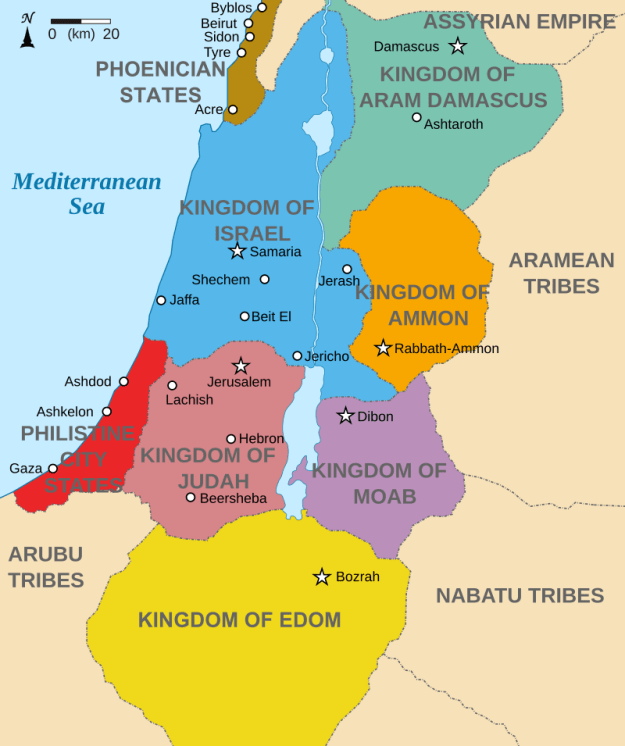
Kingdoms around Israel 830 BCE. *Oldtidens_Israel_&_Judea.svg: FinnWikiNoderivative work: Richardprins (talk)derivative work: Richardprins (talk) – Kingdoms_of_Israel_and_Judah_map_830.svg, CC BY-SA 3.0, https://commons.wikimedia.org/w/index.php?curid=10876701

Ezekiel 25: 1-7 Against Ammon

1The word of the LORD came to me: 2Mortal, set your face toward the Ammonites and prophesy against them. 3Say to the Ammonites, Hear the word of the Lord GOD: Thus says the Lord GOD, Because you said, “Aha!” over my sanctuary when it was profaned, and over the land of Israel when it was made desolate, and over the house of Judah when it went into exile; 4therefore I am handing you over to the people of the east for a possession. They shall set their encampments among you and pitch their tents in your midst; they shall eat your fruit, and they shall drink your milk. 5I will make Rabbah a pasture for camels and Ammon a fold for flocks. Then you shall know that I am the LORD. 6For thus says the Lord GOD: Because you have clapped your hands and stamped your feet and rejoiced with all the malice within you against the land of Israel, 7therefore I have stretched out my hand against you, and will hand you over as plunder to the nations. I will cut you off from the peoples and will make you perish out of the countries; I will destroy you. Then you shall know that I am the LORD.

Ezekiel is a book in the bible that has relatively few readers except for certain well-known passages, and within the book these chapters proclaiming judgment against other nations are probably the least likely to be read and dwelt upon. Yet, within many of the prophets there is a pattern of completing the judgment against Israel or Judah, turning to a judgment against the nations, and then the emergence of hope for a new beginning. Isaiah and Zephaniah follow this pattern and in its Septuagint arrangement Jeremiah does as well.[1] Ezekiel will highlight seven nations in these judgments: Ammon, Moab, Edom, Philistia, Tyre, Sidon, and Egypt. The section is structures with the first six nations receiving their judgments followed by a brief word of hope in Ezekiel 28: 24-26 followed by a judgment against Egypt which is equal in length to the first six nations’ judgments combined. (Block, 1998, p. 5) Although many readers may skim or pass these eight chapters of judgements against the nations, I am going to continue my pattern of working through the book sequentially and reflect upon these sections.

When peering back this far into history there are relatively few sources to help give a broader context to these words against Ammon, Moab, Edom and Philistia. All these nations are neighbors to Israel and have at various times been enemies and allies. Ammon and Moab, according to Genesis, have their origins with Lot, Abraham’s nephew.[2] It makes sense to begin with the judgment against Ammon since they were mentioned as the road not taken by the Babylonians in Ezekiel 21: 18-32 when they proceeded to Jerusalem. Jeremiah also mentions Ammon (along with Moab, Tyre, and Sidon) as the nations who convene with King Zedekiah to discuss forming an alliance against Babylon[3] (presumable with the support of Egypt). There is no way of knowing whether an alliance was formed or whether Ammon or the other nations worked in support of Jerusalem or against them in their conflict against Babylon. Both Jeremiah[4] and Ezekiel indicate that Ammon celebrates the destruction of the city. They shout “Aha” and clapped their hands and stamped their feet against them. Ezekiel had been commanded to clap his hands and stamp his feet against the abominations occurring in the temple (Ezekiel 6:11) and later God strikes God’s hands together against the people (Ezekiel 21: 14, 17; 22:13) but now in the aftermath of the destruction God has once again taken a protective stance towards the people.

Ammon’s judgment is here given to the ‘people of the east.’ These are probably nomadic raiders coming out of the Arabian desert. Josephus (writing shortly after the time of Jesus) states that five years after the destruction of Jerusalem Babylon would conquer both Ammon and Moab, but that is probably not what this prophecy refers to. Ultimately in the oracle Ammon disappears from the list of nations. The prophecy indicates destruction, but historically it seems that the Ammonites assimilated to and merged into the Babylonian, Persian, Greek, and finally Roman empires.

Ezekiel 25: 8-11 Against Moab

8Thus says the Lord GOD: Because Moab said, The house of Judah is like all the other nations, 9therefore I will lay open the flank of Moab from the towns on its frontier, the glory of the country, Beth-jeshimoth, Baal-meon, and Kiriathaim. 10I will give it along with Ammon to the people of the east as a possession. Thus Ammon shall be remembered no more among the nations, 11and I will execute judgments upon Moab. Then they shall know that I am the LORD.

Moab and Ammon share a common origin in Genesis and a common fate in this set of declarations against the surrounding nations. Like Ammon their judgment is left to the ‘people of the east’ and they are to be remembered ‘no more among the nations.’ It was also one of the nations who sent emissaries to King Zedekiah in Jeremiah 27 and who did not assist Jerusalem in the conflict with Babylon. The primary offense laid against Moab is their consideration of Judah like the other nations. Israel and Judah have frequently desired to be like the other nations, but they are not like other nations before God or in relation to the world. As mentioned above Josephus refers to the conquest of Moab by Babylon five years after the destruction of Jerusalem, but Moab, like Ammon seems to have assimilated into the Babylonian, Persian, Greek, and finally Roman empires. Moab receives an entire chapter in Jeremiah’s oracles against the nations. (Jeremiah 48)

Ezekiel 25: 12-14 Against Edom

12Thus says the Lord GOD: Because Edom acted revengefully against the house of Judah and has grievously offended in taking vengeance upon them, 13therefore thus says the Lord GOD, I will stretch out my hand against Edom, and cut off from it humans and animals, and I will make it desolate; from Teman even to Dedan they shall fall by the sword. 14I will lay my vengeance upon Edom by the hand of my people Israel; and they shall act in Edom according to my anger and according to my wrath; and they shall know my vengeance, says the Lord GOD.

Edom seems to have taken a more active role in the humiliation of Judah and Jerusalem. Edom biblically has its origins in Esau, Jacob’s older brother,[5] and the conflicted relationship of the brothers continued in the troubled relationship between the nations. Edom is not present at the discussions with King Zedekiah mentioned in Jeremiah 27. Their actions in this time evoke multiple reactions among scriptural writers. Psalm 137:7 records them crying out against Jerusalem:

Remember, O LORD, against the Edomites the day of Jerusalem’s fall, how they said, “Tear it down! Tear it down! Down to its foundations!”

While Obadiah’s vision is almost completely focused on the Edomites, and Jeremiah’s language for the Edomites is harsh, declaring that they will become an object of horror.[6] In a hopeful note for the people of Judah, they are once again declared ‘God’s people’ and are raised up to take an active role in the vengeance against Edom. Edom is later called Idumea, and this will be the area that Herod the Great and his ancestors hail from.

Ezekiel 25: 15-17 Against the Philistines

15Thus says the Lord GOD: Because with unending hostilities the Philistines acted in vengeance, and with malice of heart took revenge in destruction; 16therefore thus says the Lord GOD, I will stretch out my hand against the Philistines, cut off the Cherethites, and destroy the rest of the seacoast. 17I will execute great vengeance on them with wrathful punishments. Then they shall know that I am the LORD, when I lay my vengeance on them.

The Philistines were the long-time antagonists of Israel and are frequently mentioned in the stories of King Saul and King David. Yet, there is no knowledge of what role the Philistines took in the actions against Jerusalem. Ezekiel and Jeremiah 47 both indicate that the Philistines are to be destroyed and cut off. The Babylonians to conquer the area of the Philistines and take them into exile where they maintain an identity as men of Gaza or Ashkelon but between the Babylonian and Persian period they assimilate with the population between periods of exile and resettlement.

Ezekiel, unlike Jeremiah, is not in Jerusalem to witness any actions by Ammon, Moab, Edom, or the Philistines. His voice is one from a shattered people who have seen their nation humiliated and yet continue to believe that the God of Israel is also the God of the nations. If Judah’s actions have resulted in punishment, so will the actions of these nations who celebrated or participated in Judah’s humiliation. These chapters of judgment on other nations are always difficult to deal with since the other nations are not in a covenantal relationship with the God of Israel. Yet, the scripture spends far less time on these nations than they do on the condemnation of Judah or Israel’s unfaithfulness.

[1] The Septuagint is the Greek translation of the Bible. In English translations (following the Hebrew ordering) Jeremiah concludes his book with these judgments against the nations. (Jeremiah 47-51)

[2] Genesis 19: 30-38.

[3] Jeremiah 27: 1-7. Jeremiah’s focus is on God’s message to these envoys, not on the content or result of these conversations, which it is unlikely that Jeremiah had access to.

[4] Jeremiah 49: 1-6

[5] Genesis 36: 1-8.

[6] Jeremiah 49: 7-22.