Monthly Archives: April 2013

Two Excerpts for Martin Luther King, Jr.’s Letter from a Birmingham Jail

Martin_Luther_King_Jr_NYWTS

Fifty years ago today Martin Luther King, Jr. wrote and incredible open letter in response to eight white clergymen in Alabama who had written “A Call for Unity”. The letter still rings true even fifty years later when we read it. Here are two excerpts from the letter itself, you can read the letter in its entirety here.

…Rather, I have tried to say that this normal and healthy discontent can be channeled into the creative outlet of nonviolent direct action. And now this approach is being termed extremist. But though I was initially disappointed at being categorized as an extremist I gradually gained a measure of satisfaction from the label. Was not Jesus an extremist for love: “Love you enemies, bless them that curse you, do good to them that hate you, and pray for them which despitefully use you, and persecute you.” Was not Amos an extremist for justice:”Let justice roll down like waters and righteousness like an ever flowing stream.” Was not Paul an extremist for the Christian gospel: “I bear in my body the marks of the Lord Jesus.” Was not Martin Luther an extremist: “Here I stand; I cannot do otherwise, so help me God.” And John Bunyan: “I will stay in jail to the end of my days before I make a butchery of my conscience.” And Abraham Lincoln, “This nation cannot survive half slave and half free.” And Thomas Jefferson: “We hold these truths to be self evident, that all men are created equal…” So the question is not whether we will be extremists, but what kind of extremists we will be. Will we be extremists for hate or for love? Will be be extremists for the preservation of injustice or for the extension of justice? In that dramatic scene on Calvary’s hill three men were crucified. We must never forget that all three were crucified for the same crime—the crime of extremism. Two were extremists for immorality, and thus fell below their environment. The other, Jesus Christ, was an extremist for love, truth and goodness, and thereby rose above his environment. Perhaps the South, the nation and the world are in dire need of creative extremists.

Yes, these questions are still in my mind. In deep disappointment I have wept over the laxity of the the church. But be assured that my tears have been tears of love. There can be no deep disappointment where there is not deep love. Yes, I love the church. How could I do otherwise? I am in the rather unique position of being the son, the grandson and the great grandson of preachers. Yes, I see the church as the body of Christ. But oh! How we have blemished and scarred that body through social neglect and the fear of being nonconformist.

There was a time when the church was very powerful—in the time when the early Christians rejoiced at being deemed worthy to suffer for what they believed. In those days the church was not merely a thermometer that recorded the ideas and principles of popular opinion; it was a thermostat that transformed the mores of society. Whenever the early Christians entered a town, the people in power became disturbed and immediately sought to convict the Christians for being “disturbers of the peace” and “outside agitators.” But the Christians pressed on, in the conviction that they were “a colony of heaven,” called to obey God rather than man. Small in number, they were big in commitment. They were too God-intoxicated to be “astronomically intimidated.” By their effort and example they brought an end to such ancient evils as infanticide and gladiatorial contests. Things are different now. So often the contemporary church is a weak, ineffectual voice with an uncertain sound. So often it is an archdefender of the status quo. Far from being disturbed by the presence of the church, the power structure of the average community is consoled by the church’s silent—and often even vocal—sanction of things as they are.

But the judgment of God is upon the church as never before. If today’s church does not recapture the sacrificial spirit of the early church, it will lose its authenticity, forfeit the loyalty of millions, and be dismissed as an irrelevant social club with no meaning for the twentieth century. Every day I meet young people whose disappointment with the church has turned into outright disgust.

purple rose 01 by picsofflowers.blogspot.com

God the Wounded Lover: Jeremiah 4: 1-4

The Prophet Jeremiah by Michelangelo

The Prophet Jeremiah by Michelangelo

Jeremiah 4: 1-4

If you return, O Israel, says the LORD,
                if you return to me,
 if you remove your abominations from my presence,
 and do not waver,
 2 and if you swear, “As the LORD lives!”
 in truth, in justice, and in uprightness,
 then nations shall be blessed by him,
and by him they shall boast.
 3 For thus says the LORD to the people of Judah
 and to the inhabitants of Jerusalem:
 Break up your fallow ground,
 and do not sow among thorns.
 4 Circumcise yourselves to the LORD,
 remove the foreskin of your hearts,
 O people of Judah and inhabitants of Jerusalem,
or else my wrath will go forth like fire,
 and burn with no one to quench it,
 because of the evil of your doings.
 

One of the gifts of having been through a divorce that I did not want or seek, that I did everything in my power to prevent is being able to resonate with the emotions of the God portrayed in Jeremiah. A God who is wrestling with a feeling of absolute betrayal, and yet still has deep feelings for the beloved one. The desire is there to start again, to do everything within their power to rebuild the relationship. Everything, that is, except force the other party to remain within the relationship with them. Yet if the relationship is to be reconciled it requires faithfulness and it requires the ending of the affairs that created the separation in the first place.

I am writing this during the season of lent (often there is a significant lag between when I write something and when I publish it as is here apparent), preparing for Holy week, and one of the traditional services for Good Friday includes a long series of solemn reproaches that I think capture some of the emotion of this part of Jeremiah:

O my people, O my church, what have I done to you?
How have I offended you? Answer me.
I led you out of slavery into freedom,
And delivered you through the waters of rebirth,
But you have prepared a cross for your Savior….
O my people, O my church, what more could I have done for you?
Answer me.
I struck down your enemies, but you struck my head with a reed;
I gave you peace, but you draw the sword in my name,
And you have prepared a cross for your Savior
(Evangelical Lutheran Worship Leaders Edition, 639ff)

Even against the wisdom of Torah (the law) God still yearns for the relationship with his covenant people, and if it can be resumed it will have to be in a new type of relationship. God is not like King Ahasuerus in Esther who is bound by royal decrees and laws, no God is more like Joseph in Matthew’s gospel, portraying a different kind of righteousness. A legalistic understanding of righteousness or a punitive understanding would say here is the rule, the law that was broken and here is the punishment that this infraction dictates. Every action has a consequence, every offence has a punishment and reconciliation rests in the hands of the one who offended. But I use the example of Joseph, because he was a righteous man as Matthew tells the story, but rather than look for justice when he learns of Mary’s pregnancy he looks for mercy. In Jeremiah and in the New Testament we find a God for whom relationships are more important than rules, who desires and works for the return of the departed even while they are still turned away. Who desires nothing more than to resume the relationship as it was meant to be.

Perhaps God is naïve in the nature of relationships among humans, perhaps God is an idealistic fool—or perhaps God loves and that love is greater than the wound that the brokenness has caused.

purple rose 01 by picsofflowers.blogspot.com

What I learned about myself, life and God from my son on the Autistic Spectrum: Part 3

Autism by 1 footonthedawn(deviantart.com)

Autism by 1 footonthedawn(deviantart.com)

5. We often value people for very superficial reasons part 1: There are a whole set of criteria that people are judged by constantly by those around them including, but not limited to: physical appearance and dress, weight, proportions, muscle tone, skin coloration, the manner in which a person carries themselves, appropriate social interactions and even smell plays into game of subconscious evaluation of others based on appearance. In less formal language we quickly determine who is cool and who is not within a group of peers, which people are noticed for being popular, who are the geeks, who are the outcast and who are the invisible members of a group. One of the gifts of learning to see things through my son’s eyes is that none of these things matter to him, he would say that he honestly doesn’t care about other’s evaluation of him even though he is entering an age where these things are very important to his peers. I found it interesting that his first real friend at his current school is another student who is also very smart but has Cerebral Palsy, and so is also unable to interact in the same manner as many of their peers. In fact Aren finds most of the social games played by his classmates as not only distracting but annoying. To me one of the gifts of the Christian tradition is the practice of communion or the Lord’s Supper where we gather around the table with others who have been drawn to be a part of the fellowship we share in Christ and around the table none of the typical valuations matter. All come on an equal footing to share in the foretaste of the feast that God promises us God’s kingdom. In the community I serve we have a number of people who may not rank very high on the social ladder for many of the reasons listed above and yet they are all people of value in the body of Christ.

6. We often judge people for very superficial reasons part 2: I am a very smart, tough and capable person and throughout my experience in schooling, the army and even within the church I learned quickly to judge a person based upon how competent they were. Competence looks like different things in different environments but this reduces a person’s worth to their functionality. My son is a very smart and capable young man but in a world that judges by physical attraction and social interaction he is at a disadvantage, on the other hand he tends to view the world even more harshly in terms of functionality than I ever did. There may be ways in which we use metrics to measure a person’s competence at a skill or a task, this is the whole world of testing in both the academic and business world, but we should never confuse competence with value. People have value regardless of their level of competence or physical or social traits. Within the world of competence also falls status, wealth, education, political power and fame which we also learn increase the value of a person in our eyes, yet this is precisely the type of valuation that Christians should be immune to (but apparently even the early church struggled with this due to the frequency it is addressed in the letters within the New Testament). I have on my wall a plaque that Nate Frambach, my advisor in seminary, gave me upon my graduation which states, “Neil Eric White, you are a baptized child of God, whatever else you are remember you are that for that is the basis of all that you are.” My valuation comes not from my own personal competence, wealth, power, physical appearance, social prowess or any other measure-it is a gift from God that I am valued (and not only me, and I would argue not only Christians).

7. Just because someone doesn’t seem to be paying attention doesn’t mean they aren’t listening and watching what you are doing. Now this applies to people regardless, but I mention it because in learning to see the world through my son’s eyes I realized that not everyone has to look to pay attention. I was always taught (and yes, I realize this is a very masculine way of approaching things) to look a person in the eye when they talk to you and by extension that if a person did not look at you they weren’t paying attention. The eyes for most of us take in a lot of the information that we interpret in our brains and in a world where eye contact is not only a symbol of paying attention but at times a symbol of confidence (in contrast not looking a person in the eye was perceived as either dishonesty or lack of trust in one’s ability). Most autistic people do not like to make direct eye contact, it is uncomfortable for them, and they may be involved in one task that seems unrelated to what is going on around them yet be able to see, hear and perceive everything that is being said. In fact for my son he actually listens better when he is not directly looking at something. That being said he watches and listens to everything. I remember Nate Frambach once sharing, “don’t worry that your kids aren’t listening to you, worry intensely that they are watching everything you are doing.” Over the past ten years I have become increasingly aware of the number of ways that people listen and process information and I have learned to become much more aware of my own biases in the ways I learned to communicate.

Still not done, so stay tuned for at least one more installment

purple rose 01 by picsofflowers.blogspot.com

The Modern Necromancers

zombies2

Consume and be filled
That is the purpose, for that you were summoned
Up from the depths to view the treasures of heaven
Paraded before your eyes by the modern necromancers
Marketing the latest cure for the emptiness
The emptiness that is an unfilled void within the breast
Calling out to be filled, yet never satisfied for more than an instant
Once they were men and women with hopes and dreams
But through some devilry they were warped into mindless thralls
Enslaved by commerce rather than some dark magic
Yearning for the next item that promises to satisfy the unending hunger
For they are consumers, that is the only drive they know
Consume and be filled

Composed Neil White 2013

The inspiration for this was an article linking George Romero’s Night of the Living Dead, the forefather of most modern zombie movies, games and shows, with a critique of the capitalistic drive for consumption. To follow through on the imagery it gave rise to some dark words.

purple rose 01 by picsofflowers.blogspot.com

What I learned about myself, life and God from my son on the autistic spectrum: Part 2

Autism by 1 footonthedawn(deviantart.com)

Autism by 1 footonthedawn(deviantart.com)

This is part 2 of a reflection in honor of Autism awareness month.

3. We live in an incredibly complex world and human communication is even more complex. Because of what I do, as a pastor, I am constantly interacting with other people in various formats. I, like most people, took the process of communicating for granted because I naturally picked up the ability to read eyes, body language, vocal tone and inflection, pay attention to the environment selectively in addition to paying attention to the words being said. I am actually a fairly gifted watcher and listener, and this comes in particularly when I am counseling people (so much so that some people have remarked I am almost clairvoyant in reading not only messages but people). The entire process of communication involves knowing what to pay attention to and what not to pay attention to, and as I tried to understand the process of communication from my son’s perspective I began to realize how many incredible functions my eyes, ears, other senses and ultimately my mind was taking in, sorting and analyzing and responding to. For example, Aren has difficult understanding many types of verbal humor because it involves the way something is said as much as what is said  One example of how easy it is to misunderstand communication came up when he was in elementary school and we went to meet with Aren’s teachers because Aren felt he was being picked on by one student when this student had been wanting to play with Aren and Aren never responded (he is quite happy being on his own) and the student, who couldn’t understand this at this point, kept asking to play with him. This has made me more sensitive to the polyvalent character of communication, one group of words can have several sets of meaning based on context, environment, vocal inflection, body language and so much more. As an interpreter of texts, I have become increasingly aware of how important the reader’s predisposition is to what is actually being said, and we necessarily impose meaning on words to give them a broader picture. When I was growing up, one of the churches I attended tended to approach reading the Bible in a way that was flat and conveyed no emotion, so as not to impose meaning on the text (unfortunately they did impose meaning on the text, but it was a meaning that it was flat, dull and emotionless). People also have very different abilities to hear and to communicate, some have a natural talent for this and in general women are better at reading and responding to communication than men-yet everyone has something to contribute.

4. Spirituality is a function of imagination. This is a huge statement and something I am wrestling through and before people get up in arms about it let me explain what I am attempting to say. Spirituality (not religion, per se) involves the ability to wonder and to try to understand the world in a way that is not based entirely on empirical observations. A person in the modern world can understand the world, their existence and their values based entirely upon a scientific worldview and feel no need for anything more (this is not a new phenomenon). I find it interesting that both atheism and religious fundamentalism there is a huge need to convert others to their dogmatic view of the world and I believe that part of the common issue is a need to lock everything within a concrete system which often leaves little room for questioning and wonder. My son struggles with the concept of God (which is interesting and at time challenging as a pastor) but I also am aware of many autistic children and adults who are fundamentalist Christians who find great comfort in the dogmatic worldview. There is a desire for simplicity that is simply not there in the world (nor the Bible for that matter) and there tends to be less openness to a sense of spirituality which can doubt, question and wonder. I am by no means an expert at the relationship between imagination, wonder, doubt and the ability to ask questions that challenge preconceptions but my theory is that they are related. (Perhaps something to explore, another good question) We live in a world where imagination is viewed as a function of childhood, and therefore something which is not highly valued, but I believe that imagination is more vital part of our lives than we often understand. What I do know is that it is difficult for my son to understand and approach the world in the way I have learned to do, especially in the last couple years. This doesn’t make him any less valuable than me, but his view of spirituality will be different than mine (like the manners and ways in which he expresses emotions, love and communicates). My spirituality and the imaginative act of understanding God and the world doesn’t force me to be confined within my understanding. I have also learned to value those who feel more comfortable within a more rigid view of the world, much like the compression my son needed for emotional and cognitive stabilization when he was a child his worldview provides comfort for him in his life.

More to come…

purple rose 01 by picsofflowers.blogspot.com

Remembering Bonhoeffer: The Powers of Good

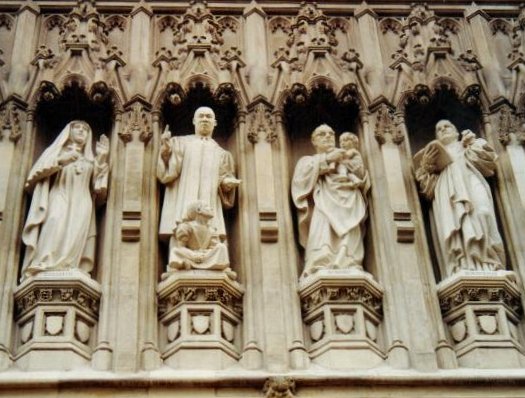
Four of the ten 20th Century Martyrs above the west door of Westminster Abby, installed in 2000. From left to right: Grand Archduchess Elizabeth of Russia, Martin Luther King, Jr., Bishop Romero, Pastor Bonhoeffer

Four of the ten 20th Century Martyrs above the west door of Westminster Abby, installed in 2000. From left to right: Grand Archduchess Elizabeth of Russia, Martin Luther King, Jr., Bishop Romero, Pastor Bonhoeffer

Dietrich Bonhoeffer was executed at Flossenberg Concentration Camp on April 9, 1945, and at some other point I am sure I will share more reflections since his writings have definitely shaped me in many ways, but today I am just going to share one of his lesser known poems. Many people will share his famous “Who Am I” poem, but this is one of my favorites (and if you look back at Golgatha you will probably see some resonance):

Powers of Good (December 28, 1944)


With every power for good to stay and guide me,

comforted and inspired beyond all fear,

I’ll live these days with you in thought beside me,

and pass, with you, into the coming year.


The old year still torments our hearts, unhastening;

the long days of our sorrow still endure;

Father, grant to the souls thou hast been chastening

that thou has promised, the healing and the cure


Should it be ours to drain the cup of grieving

even to the dregs of pain, at thy command,

we will not falter, thankfully receiving

all that is given by thy loving hand.


But should it be thy will once more to release us

to life’s enjoyment and its good sunshine,

that which we’ve learned from sorrow shall increase us,

and all our life be dedicate as thine.


Today, let candles shed their radiant greeting;

lo, on our darkness are they not thy light

leading us, haply, to our longed-for meeting?

Thou canst illumine even our darkest night.


When now the silence deepens for our harkening,

grant we may hear thy children’s voices raise

for all the unseen world around us darkening

their universal paean, in thy praise.


While all the powers of good aid and attend us,

boldly we’ll face the future, come what may.

At even and at morn God will befriend us,

and oh, most surely on each newborn day!

(Bonhoeffer 1953, 400f)

purple rose 01 by picsofflowers.blogspot.com

The God Who Wouldn’t Give Up: Jeremiah 3

Orthodox Icon of the Prophet Jeremiah

Orthodox Icon of the Prophet Jeremiah

Jeremiah 3

If a man divorces his wife and she goes from him and becomes another man’s wife,
 will he return to her? Would not such a land be greatly polluted?
                You have played the whore with many lovers; and would you return to me?
 says the LORD.
 2 Look up to the bare heights, and see!
Where have you not been lain with?
By the waysides you have sat waiting for lovers, like a nomad in the wilderness.
                You have polluted the land with your whoring and wickedness.
 3 Therefore the showers have been withheld, and the spring rain has not come;
 yet you have the forehead of a whore, you refuse to be ashamed.
 4 Have you not just now called to me, “My Father, you are the friend of my youth–
 5 will he be angry forever, will he be indignant to the end?”
 This is how you have spoken, but you have done all the evil that you could.

  6 The LORD said to me in the days of King Josiah: Have you seen what she did, that faithless one, Israel, how she went up on every high hill and under every green tree, and played the whore there? 7 And I thought, “After she has done all this she will return to me”; but she did not return, and her false sister Judah saw it. 8 She saw that for all the adulteries of that faithless one, Israel, I had sent her away with a decree of divorce; yet her false sister Judah did not fear, but she too went and played the whore. 9 Because she took her whoredom so lightly, she polluted the land, committing adultery with stone and tree. 10 Yet for all this her false sister Judah did not return to me with her whole heart, but only in pretense, says the LORD.

  11 Then the LORD said to me: Faithless Israel has shown herself less guilty than false Judah. 12 Go, and proclaim these words toward the north, and say:
  Return, faithless Israel, says the LORD. I will not look on you in anger,
 for I am merciful, says the LORD; I will not be angry forever.
 13 Only acknowledge your guilt, that you have rebelled against the LORD your God,
 and scattered your favors among strangers under every green tree,
 and have not obeyed my voice, says the LORD.
 14 Return, O faithless children, says the LORD, for I am your master;
 I will take you, one from a city and two from a family, and I will bring you to Zion.

  15 I will give you shepherds after my own heart, who will feed you with knowledge and understanding. 16 And when you have multiplied and increased in the land, in those days, says the LORD, they shall no longer say, “The ark of the covenant of the LORD.” It shall not come to mind, or be remembered, or missed; nor shall another one be made. 17 At that time Jerusalem shall be called the throne of the LORD, and all nations shall gather to it, to the presence of the LORD in Jerusalem, and they shall no longer stubbornly follow their own evil will. 18 In those days the house of Judah shall join the house of Israel, and together they shall come from the land of the north to the land that I gave your ancestors for a heritage.

 19 I thought how I would set you among my children,
and give you a pleasant land, the most beautiful heritage of all the nations.
 And I thought you would call me, My Father, and would not turn from following me.
 20 Instead, as a faithless wife leaves her husband,
so you have been faithless to me, O house of Israel, says the LORD.
 21 A voice on the bare heights is heard, the plaintive weeping of Israel’s children,
because they have perverted their way, they have forgotten the LORD their God:
 22 Return, O faithless children, I will heal your faithlessness.
“Here we come to you; for you are the LORD our God.
 23 Truly the hills are a delusion, the orgies on the mountains.
Truly in the LORD our God is the salvation of Israel.

  24 “But from our youth the shameful thing has devoured all for which our ancestors had labored, their flocks and their herds, their sons and their daughters. 25 Let us lie down in our shame, and let our dishonor cover us; for we have sinned against the LORD our God, we and our ancestors, from our youth even to this day; and we have not obeyed the voice of the LORD our God.”

Jeremiah and the other prophets open us to the story of a God who loves, which may be a bit naïve about relationships, but refuses to give up. Unlike earthly kings portrayed in the bible who are bound by the law they have written(think for example of King Darius in Daniel 6 [the story of Daniel and the lions’ den] or King Xerses in the book of Esther) God’s love for God’s people will not be undone by their disobedience. In a direct allusion to Deuteronomy 24: 1-4 where the law states such a wife may not return (granted this is not a fair world-women could not divorce husbands but husbands could divorce wives) and this sets up the argument to come, God is not going to be bound by this. God desires the return of both Israel (the northern kingdom) and Judah (the southern kingdom). And yet God is working through God’s own woundedness by the brokenness of the relationship. God is the vulnerable one, God loved and was hurt by it and yet rather than give up God is willing to risk humiliation and defilement to continue to be in relationship. Much as the prophet Hosea and his adulterous wife, God is acting as the Father/husband who has not given up on the relationship and is taking the first step of reconciliation and restoration.

Judah and Israel have to want to come home though, God is allowing the consequences of their actions to run its course and is withholding God’s support for them. Much as a loved one doing the difficult wait for an addict to hit rock bottom, God waits. God wants desperately for Israel and Judah to come home and yet they cannot come home as they are. As Brueggeman states “the poet tears at the heart of God, who yearns, but who will not be mocked, trivialized or used.” (Brueggemann 1998, 45) Even in the midst of the fickleness of Judah we find the firmness of God’s resolve to establish a new relationship.  It will have to be something new, even after reconciliation there will need to be changes but the opportunity for that new relationship is left wide open by the wounded but loving God. Much as in Ezekiel 34 where God will replace the shepherds who have abused the sheep, God promises in verse 15 new leaders:

 15 I will give you shepherds after my own heart, who will feed you with knowledge and understanding

And there will be a chance for an even greater level of closeness.

God is seeking a new beginning, willing to set aside the brokenness of the past not to go back to the old but to begin something new. There must be a change on Israel’s part and on Judah’s part, and that may not be any easier than giving up an addiction, but the space has been made available for a return. And somehow God while not determining the actions of Judah or Israel as a puppeteer creates the space through love where a return is possible. To remember Martin Luther’s words in the Heidelberg Disputation:

“The love of God does not find, but creates, that which is pleasing to it.” (Luther 1989, 32)

Judah and Israel’s actions may not make them seem very loveable and yet God refuses to see them through that lens, but rather through the lens of love that makes a new future possible.

purple rose 01 by picsofflowers.blogspot.com

What I learned about myself, life and God from my son on the autistic spectrum: Part 1

Autism by 1 footonthedawn(deviantart.com)

Autism by 1 footonthedawn(deviantart.com)

I remember vividly standing in the backyard of the parsonage in Blanchardville, Wisconsin the day we finally received my son’s diagnosis of PDD-NOS (Pervasive Developmental Disorder-Not Otherwise Specified) and yelling at God, “What more do you want from me, I’ve followed you to seminary, I’m trying to do what you tell me to do, what more do you want?”  For those who are not as familiar with the landscape of the autistic spectrum this is one of the diagnoses within the spectrum that falls under the autism umbrella. That was ten years ago, my son was four at that point and my ex-wife were pouring our time and effort into my son and his newborn baby sister, trying to make ends meet and get him the therapy he needed while in seminary and on internship prior to my ordination in 2004. At that point in my life I was dealing with too many broken dreams to see the gift that Aren has become, but now ten years later I realize how much he has taught me about love, being human and in a strange way I have learned to see God in a different light through these experiences.

1.       Broken dreams do not necessarily mean a broken relationship. As I stood there yelling at God, I was in the process of mourning a broken set of dreams and expectations for my son. We all have a set of expectations for our children, that in some ways they will follow in our footsteps and make us proud. Prior to going into the ministry I had graduated from the Corps of Cadets at Texas A&M and then served for four and a half years as an officer in the military. Aren was born while I was stationed at Ft. Polk, Louisiana and as a proud father I dreamed of one day seeing my son put on his senior boots at Texas A&M. It had been such a rich and formative opportunity for me at that stage in my life and I wanted the same for him, and that was one of the dreams that laid there on the floor shattered that day. I never stopped loving and caring for my son, even in the midst of his worst temper tantrums at that stage, or at the moments where I couldn’t understand how or why his speech wasn’t developing like most children’s speech just naturally did. Yet, somehow that dream for him had to die so that I could accept him where he was. Ten years later, as my son is on the threshold of entering high school, I am very proud of him for who he is. Even though he is incredibly smart and very well behaved and will probably do very well with his life there are still times where I watch his peers and grieve a little because there are things that I just can’t share with him because they are not important to him. Over the last ten years I have come to know more about Thomas the Tank Engine, Spongebob Squarepants, Fairly Odd Parents, Phineas and Ferb and countless other cartoons as he has recited to me entire episodes (which I have already seen anyways), I have become the subject matter expert on dinosaurs, sea creatures, space exploration, monsters and mythology and the latest video game on the Wii or DS or PS3. These are the places I can meet him and see what brings him joy, and so I learn about things that may not be of great interest to me, because I value my son and I want him to know that he is loved and valued.

2.       Relationships do not have to be reciprocal. Every parental relationship starts with the parents pouring love into their children when they are born. At the earliest stages of life children are not able to reciprocate the love and emotion and nurturing that their parents pour into them, but as children develop there is the expectation that there will be a reciprocation of the love they have received. It is not that autistic children do not love, or even that they do not express love, but they are not hardwired to provide the love and feedback in the same way that most children will. It doesn’t mean that their parents love them less—in fact most parents of autistic children have invested more in their children to try to set them up for success even without the reward of the hugs and kisses that other children begin to give. As I have tried to learn, as best I can, to see the world through my sons eyes and to attempt to understand things the way he might. I have learned to love him for who he is and to value the ways in which he is able to express his affection. He will always be my son, and that relationship is not dependent on any reciprocity. It reminds me of the baptism service which end with the child (or adult) is marked with oil and the words of promise are “name, child of God, you have been sealed by the Holy Spirit and marked with the cross of Christ forever.” Parents and even God may desire reciprocity in their relationship with their children, but the relationship is not contingent on that reciprocity. We are who we are by the relationship because by birth or by adoption we have been joined to be a part of a family and we will be valued for who we are.

More to Come…

purple rose 01 by picsofflowers.blogspot.com

Rhetorical Overkill: Jeremiah 2: 20-37

Apophysis-Betrayal (1footonthedawn at deviantart.com)

Apophysis-Betrayal (1footonthedawn at deviantart.com)

Jeremiah 2: 20-37
20 For long ago you broke your yoke
and burst your bonds, and you said, “I will not serve!”
On every high hill and under every green tree
you sprawled and played the whore.
21 Yet I planted you as a choice vine, from the purest stock.
How then did you turn degenerate and become a wild vine?
22 Though you wash yourself with lye and use much soap,
the stain of your guilt is still before me,
says the Lord GOD.
23 How can you say, “I am not defiled, I have not gone after the Baals”?
Look at your way in the valley; know what you have done—
a restive young camel interlacing her tracks,
24 a wild ass at home in the wilderness, in her heat sniffing the wind!
Who can restrain her lust?
None who seek her need weary themselves; in her month they will find her.
25 Keep your feet from going unshod and your throat from thirst.
But you said, “It is hopeless, for I have loved strangers,
and after them I will go.”
26 As a thief is shamed when caught, so the house of Israel shall be shamed—
they, their kings, their officials, their priests, and their prophets,
27 who say to a tree, “You are my father,” and to a stone, “You gave me birth.”
For they have turned their backs to me, and not their faces.
But in the time of their trouble they say,
“Come and save us!”
28 But where are your gods that you made for yourself?
Let them come, if they can save you, in your time of trouble;
for you have as many gods as you have towns, O Judah.
29 Why do you complain against me?
You have all rebelled against me, says the LORD.
30 In vain I have struck down your children; they accepted no correction.
Your own sword devoured your prophets like a ravening lion.
31 And you, O generation, behold the word of the LORD!
Have I been a wilderness to Israel, or a land of thick darkness?
Why then do my people say, “We are free, we will come to you no more”?
32 Can a girl forget her ornaments, or a bride her attire?
Yet my people have forgotten me, days without number.
33 How well you direct your course to seek lovers!
So that even to wicked women you have taught your ways.
34 Also on your skirts is found the lifeblood of the innocent poor,
though you did not catch them breaking in.
Yet in spite of all these things
35 you say, “I am innocent; surely his anger has turned from me.”
Now I am bringing you to judgment for saying, “I have not sinned.”
36 How lightly you gad about, changing your ways!
You shall be put to shame by Egypt as you were put to shame by Assyria.
37 From there also you will come away with your hands on your head;
for the LORD has rejected those in whom you trust, and you will not prosper through them.

One of the things you will see if you spend much time with the prophets is what I and others have called rhetorical overkill. Not only is the person unfaithful, but they are having sex under every green tree, they are like a wild ass in heat, etc….that is the language and it is what it is. You can try to explain it away, you can say it is a metaphor, you might find it offensive, it might work differently in different cultures, but it is using figurative language to express the depth of pain of the betrayed by the betrayer. In this case God is the betrayed one and out of the language of God’s pain comes this set of metaphors shifting from sexual to agricultural and back to sexual to cultic and legal and back to sexual. This is the language of a person in pain trying to make sense of how their view of a person could be so different from the reality. What is the offense that caused this level of pain and disillusionment? Two are lifted up in this section: idolatry and injustice.
Idolatry may constitute a whole range of things from people at this time going out and doing practices which honor other gods, conducting worship of other nations gods, conducting practices which are not approved by God or they may not be worshipping God correctly (away from the temple in Jerusalem or it may be worship without justice). Somehow there has been a distortion of the vision that God had for God’s people. Injustice is lifted up when the prophet says : 34 Also on your skirts is found the lifeblood of the innocent poor, though you did not catch them breaking in. Justice in the ancient world, even more than in the modern world, often depended upon one’s social standing, wealth and power more than any modern understanding of guilt or innocence, and yet this was not the society that the Lord envisioned.
The vine and vineyard image is one that recurs several times throughout scriptures because the vine was one of the most important and common agricultural images. In Isaiah 5, Isaiah morns of a vineyard that the vineyard’s owner did everything for and yet it does not produce, in Mark 12: 1-10 and parallels the image is once again brought up with a vineyard and unfaithful tenants and here in Jeremiah it is a choice vine which goes wild. People would have understood the agricultural imagery because this was an agrarian society.
One additional thing to consider is that we have a theological interpretation of reality going on, which we should expect from the prophets. This is not the world of power politics which the kings and princes are dealing with, they are trying to appease Assyria and Egypt, the powers that could conceivably invade and conquer Judah and they are attempting to maintain security through political alliances, military power and economic policy. Judah is a very desirable piece of property because it is at the trade crossroads between Assyria, Babylon, Persian and the far East and Egypt and Northern Africa and as N.T. Wright notes over the course of its history of 4,000 years on average every 40 years another army will march in or through it. (Wright 1992, 3) The prophets, kings and people are all looking at different strategies of survival and security. Security becomes the most important thing, more important than justice, more important than God, more important than freedom.
Security is perhaps the greatest idol that many in America face. We want to ensure that we have enough for ourselves at the exclusion of a societal concern for others and this runs headlong in contrast with the prophet’s and by extension God’s vision of shalom and justice. While many would read these words and be immediately drawn to condemn personal immorality as a method of societal corruption the prophet reverses this societal corruption, the loss of justice and trust in God’s way, is pointed to using a rhetorically inflated image of personal immorality where the woman in this image represents Judah.

purple rose 01 by picsofflowers.blogspot.com

The Wounded God: Jeremiah 2: 1-19

Apophysis-Betrayal (1footonthedawn at deviantart.com)

Apophysis-Betrayal (1footonthedawn at deviantart.com)

Jeremiah 2: 1-19

The word of the LORD came to me, saying: 2 Go and proclaim in the hearing of Jerusalem, Thus says the LORD:
I remember the devotion of your youth,
your love as a bride, how you followed me in the wilderness,
in a land not sown.
3 Israel was holy to the LORD,
the first fruits of his harvest.
All who ate of it were held guilty;
disaster came upon them,
says the LORD.
4 Hear the word of the LORD, O house of Jacob, and all the families of the house of Israel. 5 Thus says the LORD:
What wrong did your ancestors find in me
that they went far from me,
and went after worthless things, and became worthless themselves?
6 They did not say, “Where is the LORD
who brought us up from the land of Egypt,
who led us in the wilderness,
in a land of deserts and pits,
in a land of drought and deep darkness,
in a land that no one passes through,
where no one lives?”
7 I brought you into a plentiful land
to eat its fruits and its good things.
But when you entered you defiled my land,
and made my heritage an abomination.
8 The priests did not say, “Where is the LORD?”
Those who handle the law did not know me;
the rulers transgressed against me;
the prophets prophesied by Baal,
and went after things that do not profit.
9 Therefore once more I accuse you,
says the LORD,
and I accuse your children’s children.
10 Cross to the coasts of Cyprus and look,
send to Kedar and examine with care;
see if there has ever been such a thing.
11 Has a nation changed its gods,
even though they are no gods?
But my people have changed their glory
for something that does not profit.
12 Be appalled, O heavens, at this,
be shocked, be utterly desolate,
says the LORD,
13 for my people have committed two evils:
they have forsaken me,
the fountain of living water,
and dug out cisterns for themselves,
cracked cisterns
that can hold no water.
14 Is Israel a slave? Is he a homeborn servant?
Why then has he become plunder?
15 The lions have roared against him,
they have roared loudly.
They have made his land a waste;
his cities are in ruins, without inhabitant.
16 Moreover, the people of Memphis and Tahpanhes
have broken the crown of your head.
17 Have you not brought this upon yourself
by forsaking the LORD your God,
while he led you in the way?
18 What then do you gain by going to Egypt,
to drink the waters of the Nile?
Or what do you gain by going to Assyria,
to drink the waters of the Euphrates?
19 Your wickedness will punish you,
and your apostasies will convict you.
Know and see that it is evil and bitter
for you to forsake the LORD your God;
the fear of me is not in you,
says the Lord GOD of hosts.

Can it hurt to be God? For many people their image of God is shaped more by stoicism and philosophy than the picture of God we find in the Bible. This is not a new thing, it was a consequence of the church entering into the Greek speaking and thinking world right at the very beginning of its life where in Greek thought (where stoicism comes from) the ideal person (and thus God) is not swayed by emotions, but is instead logical and rational. God being the unmoved mover who created the world would not be motivated by pleasure, joy or even love and conversely would not get angry, hurt, wounded, or really feel much of anything. Ultimately this is the picture of an apathetic God (apathy is the opposite of pathos, the ability to suffer, a-pathos) but it in no way reflects the God we encounter anywhere in scriptures. I remember Duane Larson, who was president at Wartburg Theological Seminary while I was there, stating, “We have a pathetic God”, we have a God who can feel, who does suffer and so yes, it can hurt to be God. An openness to the pain of rejection and loss are the risks of love.
Now I also approach this from the perspective of having gone through a divorce, and so I hear very clearly in the midst of this the language of a heartbroken God trying to make sense of a relationship that is broken. “What did I do wrong? I gave you everything you asked for…I did this, I did that, look around, what makes you think this an acceptable way to treat your partner…” There is a romanticizing of the past, “I remember the devotion of your youth, your love as a bride, how you followed me in the wilderness…” Really, is this the same people who remember this journey in Exodus, Leviticus, Numbers and Deuteronomy…at least the way that memory is recorded they are hardly paragons of faithfulness and trust. It is like the person who exhibits all types of relational issues during dating and early in a marriage and then when the relationship is broken the other partner looks back and overlooks all those red flags and initially remembers that time better than what it was. God in effect says, “I provided for you, I protected you, I gave you the place you always wanted, what more could I give?” To quote Jeremiah “What wrong did your ancestors find in me that they went far from me?” (vs. 5). The priests, interpreters of the law and the prophets, those who are charged with honoring and pointing to this relationship have turned away as well. The honeymoon is over and the relationship is broken, distorted and in serious jeopardy. God is still reaching out, but Judah and Jerusalem are not.
God tells them go to the east (Kedar) and the west (Cyprus) and you won’t find others doing this, even when their partners aren’t able to give the things that God has given. They don’t change their gods, but Israel has. They have also looked to the powers of the day: Assyria and Egypt-they look at the power in the North and the power in the South and through playing politics they try to ensure their survival. In one sense it is a very rational move, to negotiate with the superpowers of the day who Judah finds itself geographically caught between. But they have put their trust in the way things are rather than the God who has made new things occur in the past.
Adam C. Welch makes the following suggestion:
There was no cause (for other nations) to forsake such gods, because It involved so little to follow them. …The iron core was that Israel could only have Yahweh of His own terms…Yahwism was no colorless faith which was simply the expression of the people’s pride in itself and its destiny. It laid a curb on men, it had a yoke and bonds. The bonds were those of love, but love’s bonds are the most enduring and the most exacting.
Israel’s central command from Deuteronomy 6:5 “You shall love the Lord your God with all your heart, and with all your soul, and with all your might”perhaps is the most difficult commandment to keep. (Breuggemann 1998, 36)

God’s vision of shalom (harmony and peace) and justice were much different from the world around the people of Judah, and so even though I can easily see myself in the shoes of the people who Jeremiah is addressing, I can also understand the brokenhearted God who longs for this people to return, to come home, to live in the covenant and blessing he desires for them. The road of reconciliation ahead, if it is to happen will be a difficult one, and it will require hard words to get past the devastated feelings. It will take the relationship, as it is, dying if there is to be a chance for rebirth. We will not get there quickly, there is hard work that is required by both partners, but God’s woundedness has left the door open.

purple rose 01 by picsofflowers.blogspot.com