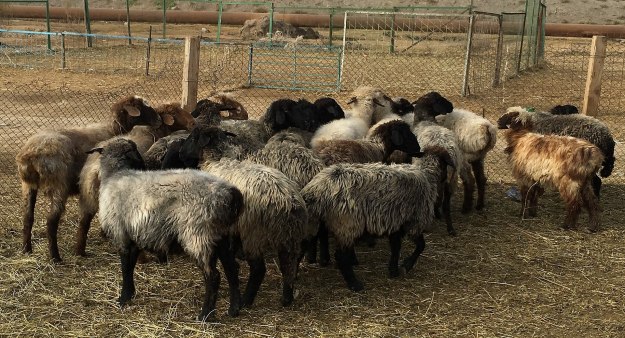
Sheep in Turkmenistan By Bayram A – Own work, CC BY-SA 4.0, https://commons.wikimedia.org/w/index.php?curid=104988739
Ezekiel 34: 1-10 Against the Unfaithful Shepherds of Israel
1 The word of the LORD came to me: 2 Mortal, prophesy against the shepherds of Israel: prophesy, and say to them — to the shepherds: Thus says the Lord GOD: Ah, you shepherds of Israel who have been feeding yourselves! Should not shepherds feed the sheep? 3 You eat the fat, you clothe yourselves with the wool, you slaughter the fatlings; but you do not feed the sheep. 4 You have not strengthened the weak, you have not healed the sick, you have not bound up the injured, you have not brought back the strayed, you have not sought the lost, but with force and harshness you have ruled them. 5 So they were scattered, because there was no shepherd; and scattered, they became food for all the wild animals. 6 My sheep were scattered, they wandered over all the mountains and on every high hill; my sheep were scattered over all the face of the earth, with no one to search or seek for them.
7 Therefore, you shepherds, hear the word of the LORD: 8 As I live, says the Lord GOD, because my sheep have become a prey, and my sheep have become food for all the wild animals, since there was no shepherd; and because my shepherds have not searched for my sheep, but the shepherds have fed themselves, and have not fed my sheep; 9 therefore, you shepherds, hear the word of the LORD: 10 Thus says the Lord GOD, I am against the shepherds; and I will demand my sheep at their hand, and put a stop to their feeding the sheep; no longer shall the shepherds feed themselves. I will rescue my sheep from their mouths, so that they may not be food for them.
Scripture utilize the metaphor of shepherd to refer to the king or leaders among the people frequently, and this taps into a broader utilization of this metaphor in literature throughout the region.[1] This is not the first time that Ezekiel has criticized the leaders who led the people of Judah to disaster, but this is the first time the prophet taps into this well understood metaphor. These shepherds who are responsible for a flock that is entrusted to them have looked to their own welfare instead of the welfare of the flock they are to care for. Instead of feeding the flock in the metaphor they feed on the flock. They have not cared for the vulnerable, which was to be the responsibility of the leaders of Israel, instead they have profited from the produce of the sheep. They either drink the milk from or eat the fat of the sheep,[2] wear the wool from the sheep, and slaughter the fatlings of the flock. These leaders have fleeced their followers, and the very ones charged with protecting and feeding them have abused them. This metaphor is very similar to Jeremiah 23:1-6, and it is plausible that Ezekiel would be familiar with Jeremiah’s utilization of this imagery as well.
The founding story of the people of Israel is the Exodus, and their existence as slaves under Pharoah was to be the antitheses of their existence as the people of God. Yet now the leaders are ruling with force and harshness. The word translated harshness (parak) is the same work utilized in Exodus 1:13-14 for Pharoah’s oppression of the Israelites. Leviticus 25: 43, 46, and 53 explicitely warns against treating fellow Israelites in with harshness (parak). In addition to the metaphor of the shepherds not caring for and even eating the flock we now have an allusion to these princes in Judah acting like the Pharoah of ancient times towards the people.
Micaiah son of Imlah predicted the failure of King Ahab’s campaign against Aram stating, “I saw all Israel scattered on the mountains, like sheep that have no shepherd; and the LORD said, ‘These have no master; let each one go home in peace.’” (1 Kings 22:17) Although the people of Judah have recently suffered a military defeat, these inattentive shepherds have already created a situation similar to the confusion after Ahab’s death. In the metaphor these sheep are without a shepherd and wander not only over the mountains of Israel but are scattered over all the face of the earth.
These unfaithful shepherds who have failed the sheep now have to account for the sheep they have failed to care for. The owner of the sheep is not the shepherds but is the LORD the God of Israel. God, as the owner of the flock, will now have to find a different arrangement to ensure the health of the flock, but the shepherds are under judgment. Since the shepherds would not search for or gather the flock, the remainder of the chapter turns to a hopeful note for the flock where good shepherds are given responsibility for the care of the flock.
Ezekiel 34: 11-22 God the Shepherd
11 For thus says the Lord GOD: I myself will search for my sheep, and will seek them out. 12 As shepherds seek out their flocks when they are among their scattered sheep, so I will seek out my sheep. I will rescue them from all the places to which they have been scattered on a day of clouds and thick darkness. 13 I will bring them out from the peoples and gather them from the countries, and will bring them into their own land; and I will feed them on the mountains of Israel, by the watercourses, and in all the inhabited parts of the land. 14 I will feed them with good pasture, and the mountain heights of Israel shall be their pasture; there they shall lie down in good grazing land, and they shall feed on rich pasture on the mountains of Israel. 15 I myself will be the shepherd of my sheep, and I will make them lie down, says the Lord GOD. 16 I will seek the lost, and I will bring back the strayed, and I will bind up the injured, and I will strengthen the weak, but the fat and the strong I will destroy. I will feed them with justice.
17 As for you, my flock, thus says the Lord GOD: I shall judge between sheep and sheep, between rams and goats: 18 Is it not enough for you to feed on the good pasture, but you must tread down with your feet the rest of your pasture? When you drink of clear water, must you foul the rest with your feet? 19 And must my sheep eat what you have trodden with your feet, and drink what you have fouled with your feet?
20 Therefore, thus says the Lord GOD to them: I myself will judge between the fat sheep and the lean sheep. 21 Because you pushed with flank and shoulder, and butted at all the weak animals with your horns until you scattered them far and wide, 22 I will save my flock, and they shall no longer be ravaged; and I will judge between sheep and sheep.
Throughout the Hebrew Scriptures the image of God being the shepherd for the people is connected with God being the king for the people.[3] Although the time period of the judges, early in Israel’s story, was a time of conflict and the people desired a king to unify the people for military campaigns or security, there is always an element where Israel was to embody a different way of being than the surrounding nations. There is a strong voice in the Hebrew Scriptures that resists the appointment of a king over the people which critiques the failures of the kings to stay within the restrained vision of kingship that texts like Deuteronomy 17: 14-20 present. Yet, the kings of Judah and Israel have now lost their authority, and as we saw previously it because of their unfaithfulness in their care for the people. The prophets and poets of the people have imagined a reality where God is their king, and now continuing the shepherd metaphor now God does what the unfaithful shepherds did not.
The previous shepherds have allowed the flock to be scattered throughout the earth, and now God is the one to regather the flock and bring then back to the rich pastures of the land of Israel. This is one of the images of a hopeful future for the people beyond exile in Babylon. Even beyond the exiles of Judah in Babylon and Egypt, there is probably also a hope for the tribes of the Northern Kingdom that were scattered throughout the Assyrian empire being reunified into a healed nation of Israel. This is a hopeful vision for those who are weak, injured, lost and strayed but life in this renewed kingdom is a life of justice. The fat and the strong who have exploited the weak and injured will now be fed with justice. There is an imagined leveling of society in this image.
Even within the flock there are those who refuse to live in a way that is beneficial for the community. Using two complementary images: sheep who trample the pasture and foul the waters and fat sheep who pushed the weak animals away from the food and water, these exploiters are highlighted. God’s concern is for the larger flock, and if there are individual animals who prevent the weaker animals from having the pasture and water they need the LORD will see and deal with them.
Ezekiel 34: 23-31 David as Shepherd
23 I will set up over them one shepherd, my servant David, and he shall feed them: he shall feed them and be their shepherd. 24 And I, the LORD, will be their God, and my servant David shall be prince among them; I, the LORD, have spoken.
25 I will make with them a covenant of peace and banish wild animals from the land, so that they may live in the wild and sleep in the woods securely. 26 I will make them and the region around my hill a blessing; and I will send down the showers in their season; they shall be showers of blessing. 27 The trees of the field shall yield their fruit, and the earth shall yield its increase. They shall be secure on their soil; and they shall know that I am the LORD, when I break the bars of their yoke, and save them from the hands of those who enslaved them. 28 They shall no more be plunder for the nations, nor shall the animals of the land devour them; they shall live in safety, and no one shall make them afraid. 29 I will provide for them a splendid vegetation so that they shall no more be consumed with hunger in the land, and no longer suffer the insults of the nations. 30 They shall know that I, the LORD their God, am with them, and that they, the house of Israel, are my people, says the Lord GOD. 31 You are my sheep, the sheep of my pasture and I am your God, says the Lord GOD.
Ezekiel, like Jeremiah, has been involved in dismantling a ‘Zion theology’ which placed its trust in the Davidic king, the city of Jerusalem, the temple, and the land as signs of God’s unending favor. Each of these things have been lost by the people, but now Ezekiel begins to rebuild and reimagine each of these former signs of God’s favor beginning with the line of David. In a reunified and gathered Israel there is a new shepherd appointed by God, David. Yet, this new Davidic figure is not given the title of king, but the title of prince. God remains king while David is the prince chosen to faithfully shepherd the people in this time of blessing and prosperity.
Ezekiel and the other prophets of both the exile and post exile refer to a Davidic figure as a symbol of a new time of prosperity under God. In Ezekiel the figure is David, but elsewhere the prophets will utilize imagery of a righteous branch raised up for David, raising up the fallen booth of David, or a child on the throne of David.[4] Even for all of Ezekiel’s critique of the princes of Israel, it would probably be unimaginable to return to a time where there was no earthly representative of God’s rule for the people.
God initiates for the people a covenant of peace where the wild animals are banished from the land. The banishment of the wild animals I believe is a continuation of the sheep/shepherd metaphor since sheep are often prey to many predators. God is creating a safe space of prosperity for the flock to pasture and be watered in, and the fields and trees will have the water in the proper time to ensure plenty of food. They will be rescued from their captivity and returned to a land of plenty. This people who has known the humiliation of military defeat, the destruction of their homeland, and the reality of exile among the nations will now be brought home to heal. The result of God’s action on their behalf is that they will know the LORD. They will recognize that their prosperity and security come from God and they, like sheep under a good shepherd in good pastures, will have all they need for their life.
[1] Daniel Block and many other commentators point to the connection with Sumerian and Babylonian literature. (Block, 1998, pp. 280-281)
[2] Translation depends in whether the Hebrew consonants hhlb. The Septuagint (Greek) and Vulgate (Latin) translations read this as hehalab (milk) while the MT (Hebrew text) has haheleb (fat). Arguments can be made for either translation.
[3] Jeremiah 23:3, Psalm 23, Micah 2:12.
[4] Jeremiah 23:5, Isaiah 11:1, Amos 9:11, Isaiah 9: 6-7.
 Sign of the Rose