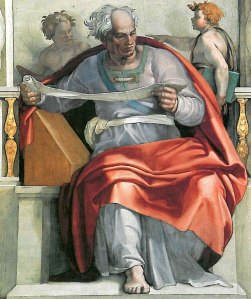
The Prophet Joel painted by Michelangelo and his assistants for the Sistine Chapel in the Vatican between 1508 to 1512
The prophet Joel is one of several books in the bible that often are overlooked by Christians. We may hear the shrill words of Joel 2: 1-2, 12-17 as one of the options to call congregations to repentance on Ash Wednesday to begin the Lenten journey or hear Peter’s reference to Joel 2: 28-29 on the day of Pentecost, but this short text is otherwise a mystery to most people of faith. A very attentive reader may remember the plague of locusts which begins the book, but it is far more likely that this book that resides between Hosea and Amos will be forgotten. One of my goals in these reflections is to dive into the parts of scripture that I am less familiar with, and the prophet Joel certainly matches that description.
The prophet Joel is one of the ‘twelve prophets’ or ‘minor prophets’ in the Hebrew Scriptures. The term the ‘twelve prophets’ comes from when the books were written on scrolls. Isaiah, Jeremiah, and Ezekiel are each long enough that they require their own scroll while Hosea, Joel, Amos, Obadiah, Jonah, Micah, Nahum, Habakkuk, Zephaniah, Haggai, Zechariah, and Malachi[1] were written together on a single scroll. Knowing the context that the prophet is speaking to can be very beneficial for the reader but in the case of Joel this is difficult to pinpoint since Joel doesn’t mention any specific historical events. Scholars use the following clues to make a best guess of Joel’s rough time period:
-
- Joel is well versed in the scriptures referencing Exodus, Deuteronomy, Obadiah, Isaiah (or Micah), and Amos. (Nogalski, 2023) So, these references would presume a date after these books. Many argue that with the exception of Daniel, Joel is one of the last books added to the Hebrew Scriptures/Old Testament.
- Joel frequently mentions Jerusalem, Zion, and the temple and the priesthood as a functioning organization but never mentions a king. This probably indicates that Joel is a post-exilic prophet within the time period of the middle to late Persian empire.
- The “political constellation presumed in Joel 3: 4-8 (4: 4-8),[2] with its assumptions of cooperative efforts between Tyre, Sidon, and the Philistines, best fits the late Persian period prior to Sidon’s destruction by Artxerxes III in 343 BCE.”(Nogalski, 2023, p. 31)
Most scholars now view Joel as a 4th Century prophet before 343 BCE which means that Jerusalem has been resettled after the Babylonian exile, the temple has been rebuilt, and Israel (now referring to the remnant of Judah centered around Jerusalem, is a province of the Persian Empire (based out of modern-day Iran). There would be no king of the Hebrew people, instead this time period reflects the reality after Ezra and Nehemiah where Judah is a vassal state of Persia yet is still troubled by marauding nations and is unable to adequately defend itself.
As with my previous reflections I utilize the work of several authors who have spent a long time studying this portion of scripture. Below are the people whose reflections I am studying alongside my own writing and reflections.:
Elizabeth Achtemeier, “The Book of Joel” in The New Interpreter’s Bible. Volume VII. Nashville: Abingdon Press, 1996.
Bruce C. Birch, Hosea, Joel, and Amos. Louisville, KY: Westminster John Knox Press, 1997.
John J. Collins. Joel, Obadiah, Haggai, Zechariah, Malachi. Collegeville, MC: Liturgical Press,2007.
James D. Nogalski. The Books of Joel, Obadiah, and Jonah. Grand Rapids, MI: William B. Eerdman’s Publishing Company, 2023
The book of Joel is a short book, but I am excited to begin walking intentionally through these three chapters.
[1] In the Christian organization of the Bible Daniel is included among the prophets but in the Jewish organization of scripture Daniel is included among the writings. The Jewish organization also includes Joshua, Judges, 1&2 Samuel, and 1&2 Kings in the prophets.
[2] The numbering of the book of Joel in English and Hebrew is different. Hebrew treats Joel 2: 28-32 as a separate chapter (Joel 3: 1-5) and the third chapter of Joel in English translations is the fourth chapter in Hebrew.
 Sign of the Rose