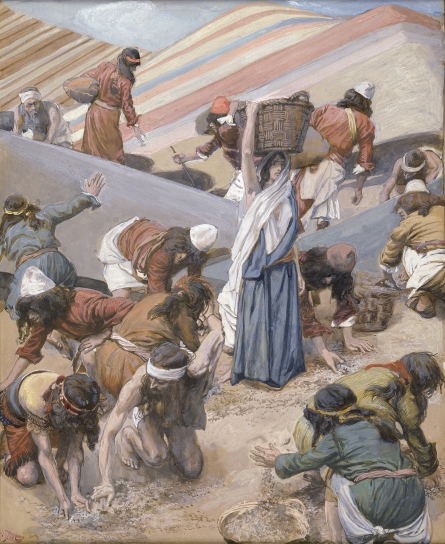
James Tissot, The Gathering of Manna (between 1896 and 1902)
Exodus 16: 1-36
The whole congregation of the Israelites set out from Elim; and Israel came to the wilderness of Sin, which is between Elim and Sinai, on the fifteenth day of the second month after they had departed from the land of Egypt. 2 The whole congregation of the Israelites complained against Moses and Aaron in the wilderness. 3 The Israelites said to them, “If only we had died by the hand of the LORD in the land of Egypt, when we sat by the fleshpots and ate our fill of bread; for you have brought us out into this wilderness to kill this whole assembly with hunger.”
4 Then the LORD said to Moses, “I am going to rain bread from heaven for you, and each day the people shall go out and gather enough for that day. In that way I will test them, whether they will follow my instruction or not. 5 On the sixth day, when they prepare what they bring in, it will be twice as much as they gather on other days.” 6 So Moses and Aaron said to all the Israelites, “In the evening you shall know that it was the LORD who brought you out of the land of Egypt, 7 and in the morning you shall see the glory of the LORD, because he has heard your complaining against the LORD. For what are we, that you complain against us?” 8 And Moses said, “When the LORD gives you meat to eat in the evening and your fill of bread in the morning, because the LORD has heard the complaining that you utter against him — what are we? Your complaining is not against us but against the LORD.”
9 Then Moses said to Aaron, “Say to the whole congregation of the Israelites, ‘Draw near to the LORD, for he has heard your complaining.'” 10 And as Aaron spoke to the whole congregation of the Israelites, they looked toward the wilderness, and the glory of the LORD appeared in the cloud. 11 The LORD spoke to Moses and said, 12 “I have heard the complaining of the Israelites; say to them, ‘At twilight you shall eat meat, and in the morning you shall have your fill of bread; then you shall know that I am the LORD your God.'”
13 In the evening quails came up and covered the camp; and in the morning there was a layer of dew around the camp. 14 When the layer of dew lifted, there on the surface of the wilderness was a fine flaky substance, as fine as frost on the ground. 15 When the Israelites saw it, they said to one another, “What is it?”1 For they did not know what it was. Moses said to them, “It is the bread that the LORD has given you to eat. 16 This is what the LORD has commanded: ‘Gather as much of it as each of you needs, an omer to a person according to the number of persons, all providing for those in their own tents.'” 17 The Israelites did so, some gathering more, some less. 18 But when they measured it with an omer, those who gathered much had nothing over, and those who gathered little had no shortage; they gathered as much as each of them needed. 19 And Moses said to them, “Let no one leave any of it over until morning.” 20 But they did not listen to Moses; some left part of it until morning, and it bred worms and became foul. And Moses was angry with them. 21 Morning by morning they gathered it, as much as each needed; but when the sun grew hot, it melted.
22 On the sixth day they gathered twice as much food, two omers apiece. When all the leaders of the congregation came and told Moses, 23 he said to them, “This is what the LORD has commanded: ‘Tomorrow is a day of solemn rest, a holy sabbath to the LORD; bake what you want to bake and boil what you want to boil, and all that is left over put aside to be kept until morning.'” 24 So they put it aside until morning, as Moses commanded them; and it did not become foul, and there were no worms in it. 25 Moses said, “Eat it today, for today is a sabbath to the LORD; today you will not find it in the field. 26 Six days you shall gather it; but on the seventh day, which is a sabbath, there will be none.”
27 On the seventh day some of the people went out to gather, and they found none. 28 The LORD said to Moses, “How long will you refuse to keep my commandments and instructions? 29 See! The LORD has given you the sabbath, therefore on the sixth day he gives you food for two days; each of you stay where you are; do not leave your place on the seventh day.” 30 So the people rested on the seventh day.
31 The house of Israel called it manna; it was like coriander seed, white, and the taste of it was like wafers made with honey. 32 Moses said, “This is what the LORD has commanded: ‘Let an omer of it be kept throughout your generations, in order that they may see the food with which I fed you in the wilderness, when I brought you out of the land of Egypt.'” 33 And Moses said to Aaron, “Take a jar, and put an omer of manna in it, and place it before the LORD, to be kept throughout your generations.” 34 As the LORD commanded Moses, so Aaron placed it before the covenant,1 for safekeeping. 35 The Israelites ate manna forty years, until they came to a habitable land; they ate manna, until they came to the border of the land of Canaan. 36 An omer is a tenth of an ephah.
The title ‘a crisis of trust’ which I gave to this section reflects on two different directions. On one hand, there is a crisis of trust in the people of Israel for the LORD their God. They quickly revert to their default position of accepting their identity as slaves who had food and water as preferable to their current identity as a free people of God whose food supply is in question at the beginning of this chapter. As they enter the appropriately named (even though the name is simply a transliteration of the Hebrew letters) wilderness of Sin the people have a crisis of trust in the LORD their God and Moses and Aaron the representatives of God. On the other hand, the crisis creates the question of trustworthiness. Crises bring about questions of faith, questions of identity and ultimately can lead the person undergoing the trial to question God’s involvement in their life and in the crisis.
People who are dealing with hunger, and more generally with poverty, often make poor choices. Yet, it is far too easy to blame those who are poor or hungry for the bad choices that they make when a person is sitting in comfort and not having to make choices under the same conditions of scarcity as those struggling. Recent studies have found that people suffering with poverty can have their IQ decline as much as 13 points, comparable to the effects of chronic drinking or sleep deprivation on decision making. The experience of scarcity can lead us to make poor decisions, to revert to unhealthy behaviors and not to trust those who may be able to aid.
As the congregation of the Israelites, the first time they are given this title, moves from the oases of Elim into the wilderness of Sin they encounter the challenges of scarcity. The lack of food creates a crisis of faith. They imagine a return into slavery, to their oppression in Egypt where they remember having their fill of food. Memory in times of crisis can be particularly unreliable and lead to all kinds of poor decisions based on idealistic representations of the past. Here the congregation of Israel turns on its leaders, Moses and Aaron, and ultimately complains about the provision of the LORD on this stage of their journey. The easy position and an interpreter would be to blame the congregation of Israelites for their lack of faith after the LORD has through many signs led them out of Egypt, through the sea and into their journey, but here (in contrast to the parallel scene in Numbers 11) the LORD does not get angry but instead provides for their need in an abundant way.
The name of the wilderness of Sin gives an opportunity to reflect upon the way in which a vision of scarcity in contrast to God’s promise of provision can be an appropriate way to talk about sin. Sin, as Saint Augustine, Martin Luther and later Karl Barth could all refer to it is a state of homo incurvatus in se (the human turned inwards on oneself). A belief that there are a finite number of goods and that one must secure one’s own portion at the expense of the neighbors’ portions and that one’s own needs are more important than the neighbors’ needs leads to hoarding and the consolidation of wealth and power. This is the system that the people of Israel have left behind in Egypt, a pyramid scheme (pardon the pun) where the deprivation of the many allows for the abundance of the privileged few. Here in the provision of manna and the declaration of the sabbath the LORD begins to point to another way of imagining the world and our relationship with our neighbors.
In the Lord’s prayer the petition, “Give us this day our daily bread” refers to the foundational idea in both Judaism and Christianity that God provides for us the things that we need each day. Faith allows a person to receive the food, drink, clothing, job, home, relationships and more as a gift from God to be thankful for and to trust that God will continue to provide. Even in difficult times it provides a way to trust that the LORD will provide enough to help the person of faith in their journey through the wilderness. Here in the wilderness of Sin with the provision of manna this theological concept is given a practical narrative. The journey in the wilderness will be a journey of learning to trust in the LORD’s provision for the congregation of the Israelites in a land that would not normally support them.
The people in the wilderness still operate out of a scarcity mindset, when the manna appears some go out and gather more, others little. Some try to save some of the daily bread for the next day only to find it rotten and infested with worms. Whether they gather much or a little they all end up with the roughly two quarts (omer) per person they needed. This time of testing is a time of learning to imagine the world through a different lens, through the lens of God’s provision. It will be natural to revert to the ways of Pharaoh, to the lessons of their time of enslavement and oppression. Perhaps if we want to use the language of an original Sin, it is the natural state of seeking out for one’s own interest and hoarding resources and providing for one’s own future rather than trusting in God’s provision. It is far too easy for the formerly oppressed to become the oppressor and to construct their own pyramid schemes.
Sabbath becomes a way of enacting this trust in the LORD’s provision as well. There is no theological reason given for the sabbath here (it will be linked to creation in Genesis 2 and in the ten commandments in Exodus 20 and to the experience of being slaves in Egypt and the LORD’s liberation in Deuteronomy 5) Perhaps obedience comes before understanding, sabbath as a practice begets sabbath as a theological concept. Practice gives rise to meaning, or in Prosper of Aquitaine’s phrase lex orandi, lex credenda (the rule of worship leads to the rule of faith). For former slaves the idea of a day of rest would have been foreign, yet now it was to become a part of their life and a weekly practice of trust in the provision of their LORD.

Tamarisk tree near Revivim, Israel, Picture taken by Michael Baranovsky. Shared under creative commons 3.0
Finally, there will be many people who look for a natural explanation of the manna in the wilderness. For example, some people will claim the manna was the resin of the Tamarisk tree or a form of lichen based on the descriptions provided in Exodus and elsewhere. Even if manna is from one of these sources, and remember many of God’s signs throughout the book of Exodus use natural elements, it still doesn’t eliminate the LORD’s provision for the people. As a book of faith, the book of Exodus sees the LORD’s provision of quail and manna as a reflection of God’s provision for the people in the hostile wilderness. If the LORD uses natural phenomena to feed the people or whether the manna itself is an unknown and miraculous substance do not subtract from the provision of God for the people in their wilderness journey. Unfortunately, the omer of manna placed in a jar and kept as a remembrance has long been lost and we have only the story to remind us of the experience of the people in the wilderness. Yet, the story reminds us of the struggle we still face today to trust in God’s provision and to imagine a world where we are content with enough and instead of attempting to secure our own future we can imagine a world where we can ‘love our neighbor as ourselves.’



 Sign of the Rose