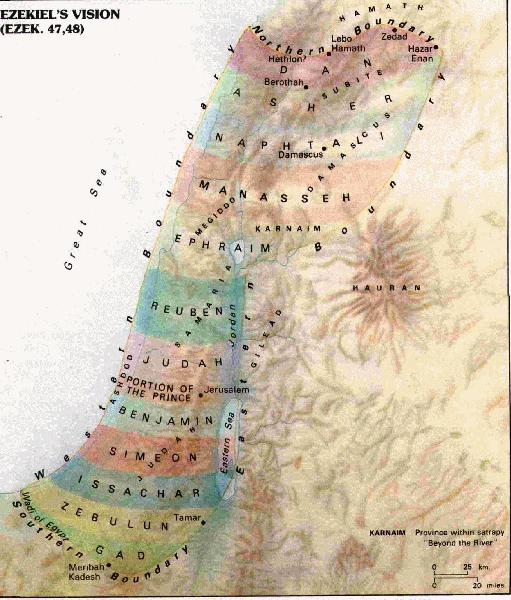
Ezekiel 48: 1-29 The Tribes and the Territory
1These are the names of the tribes: Beginning at the northern border, on the Hethlon road, from Lebo-hamath, as far as Hazar- enon (which is on the border of Damascus, with Hamath to the north), and extending from the east side to the west, Dan, one portion. 2Adjoining the territory of Dan, from the east side to the west, Asher, one portion. 3Adjoining the territory of Asher, from the east side to the west, Naphtali, one portion. 4Adjoining the territory of Naphtali, from the east side to the west, Manasseh, one portion. 5Adjoining the territory of Manasseh, from the east side to the west, Ephraim, one portion. 6Adjoining the territory of Ephraim, from the east side to the west, Reuben, one portion. 7Adjoining the territory of Reuben, from the east side to the west, Judah, one portion.
8Adjoining the territory of Judah, from the east side to the west, shall be the portion that you shall set apart, twenty-five thousand cubits in width, and in length equal to one of the tribal portions, from the east side to the west, with the sanctuary in the middle of it. 9The portion that you shall set apart for the LORD shall be twenty-five thousand cubits in length, and twenty thousand in width. 10These shall be the allotments of the holy portion: the priests shall have an allotment measuring twenty- five thousand cubits on the northern side, ten thousand cubits in width on the western side, ten thousand in width on the eastern side, and twenty-five thousand in length on the southern side, with the sanctuary of the LORD in the middle of it. 11This shall be for the consecrated priests, the descendants of Zadok, who kept my charge, who did not go astray when the people of Israel went astray, as the Levites did. 12It shall belong to them as a special portion from the holy portion of the land, a most holy place, adjoining the territory of the Levites. 13Alongside the territory of the priests, the Levites shall have an allotment twenty-five thousand cubits in length and ten thousand in width. The whole length shall be twenty-five thousand cubits and the width twenty thousand. 14They shall not sell or exchange any of it; they shall not transfer this choice portion of the land, for it is holy to the LORD.
15The remainder, five thousand cubits in width and twenty-five thousand in length, shall be for ordinary use for the city, for dwellings and for open country. In the middle of it shall be the city; 16and these shall be its dimensions: the north side four thousand five hundred cubits, the south side four thousand five hundred, the east side four thousand five hundred, and the west side four thousand five hundred. 17The city shall have open land: on the north two hundred fifty cubits, on the south two hundred fifty, on the east two hundred fifty, on the west two hundred fifty. 18The remainder of the length alongside the holy portion shall be ten thousand cubits to the east, and ten thousand to the west, and it shall be alongside the holy portion. Its produce shall be food for the workers of the city. 19The workers of the city, from all the tribes of Israel, shall cultivate it. 20The whole portion that you shall set apart shall be twenty-five thousand cubits square, that is, the holy portion together with the property of the city.
21What remains on both sides of the holy portion and of the property of the city shall belong to the prince. Extending from the twenty-five thousand cubits of the holy portion to the east border, and westward from the twenty-five thousand cubits to the west border, parallel to the tribal portions, it shall belong to the prince. The holy portion with the sanctuary of the temple in the middle of it, 22and the property of the Levites and of the city, shall be in the middle of that which belongs to the prince. The portion of the prince shall lie between the territory of Judah and the territory of Benjamin.
23As for the rest of the tribes: from the east side to the west, Benjamin, one portion. 24Adjoining the territory of Benjamin, from the east side to the west, Simeon, one portion. 25Adjoining the territory of Simeon, from the east side to the west, Issachar, one portion. 26Adjoining the territory of Issachar, from the east side to the west, Zebulun, one portion. 27Adjoining the territory of Zebulun, from the east side to the west, Gad, one portion. 28And adjoining the territory of Gad to the south, the boundary shall run from Tamar to the waters of Meribath- kadesh, from there along the Wadi of Egypt to the Great Sea. 29This is the land that you shall allot as an inheritance among the tribes of Israel, and these are their portions, says the Lord GOD.
As we come to the end of Ezekiel’s final vision recorded in the book of Ezekiel, we are given a vision of a perfectly ordered arrangement of the tribes surrounding a perfectly ordered temple and city. Ezekiel takes us back to the memory of the tribal order of Israel prior to the monarchy. Solomon had centralized much of the power in Israel[1] and later kings likely continued to centralize power. Yet, for Ezekiel the nasi (prince) does not exercise the same type of authority as previous monarchs. Reestablishing the twelve tribes in the land is a regathering of both the exiles in Babylon and Egypt from Judah, but also a reconstitution of the northern tribes which have been separated from Judah for almost four centuries and have were scattered among the Assyrian empire two and a half centuries ago. Any close look at a topographical map will cause most readers to realize that, in Daniel Block’s words, we are looking at, “a cartographic painting by an artist with a particular theological agenda.” (Block, 1998, p. 723)
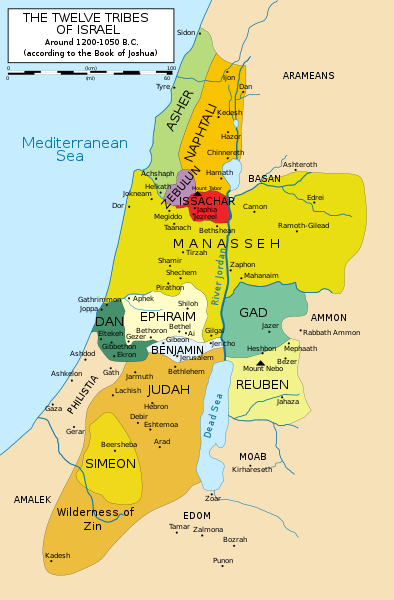
The positions of the tribe do not match the original assignments in Joshua[2] or the tribal areas reflected throughout the Deuteronomic history. The territory east of the Jordan, which Reuben, Gad, and one half of Manesseh settled in is not a part of the territory of Israel. Issachar, Zebulun, and Gad are now in the south instead of the north, and even in this equalizing scheme of granting each tribe one portion, there is a reality of assigning Judah and Benjamin, the former royal tribes, a position closest to the temple and city while the tribes descended from Zilpah and Bilhah occupy the farthest distance from the temple. The breadth of the land also is significantly wider in the north than in the south but since there are no dimensions given for the portions that may be accounted for by making the northern portions narrower. The biggest problem with this map is topographical. Each tribal boundary crosses the coastal plains, the northern spine and the Jordan rift valley and travel north and south along those natural boundaries is easier than east and west inside the territory. Ezekiel never mentions the topography of this recreated Israel so in his mind the mountains may be made low and the low places raised up, but this is never alluded to in his visions.
Between the tribes in the north and the tribes in the south is the set aside area for the prince, the priests and Levites, and especially in Ezekiel’s view the temple. This area was previously discussed in Ezekiel 45:1-8, and this is another example of Ezekiel discussing an item at a previous point and then revisiting it in a later portion of the text. For Ezekiel this perfectly ordered land is centered on the temple and has an equitable distribution of land for each of the reconstituted tribes. Pragmatic difficulties are set aside as Ezekiel discloses this vision of a renewed land and people.
Ezekiel 48: 30-35 The City Named the LORD is There
30These shall be the exits of the city: On the north side, which is to be four thousand five hundred cubits by measure, 31three gates, the gate of Reuben, the gate of Judah, and the gate of Levi, the gates of the city being named after the tribes of Israel. 32On the east side, which is to be four thousand five hundred cubits, three gates, the gate of Joseph, the gate of Benjamin, and the gate of Dan. 33On the south side, which is to be four thousand five hundred cubits by measure, three gates, the gate of Simeon, the gate of Issachar, and the gate of Zebulun. 34On the west side, which is to be four thousand five hundred cubits, three gates, the gate of Gad, the gate of Asher, and the gate of Naphtali. 35The circumference of the city shall be eighteen thousand cubits. And the name of the city from that time on shall be, The LORD is There.
Ancient cities are tiny in comparison to modern cities since the effort of creating a wall to protect a city is expensive. This newly created city is roughly one and a half miles on each of its four sides. Ancient walled cities normally had one or a small number of gates that are easier to defend and a twelve gated city is unusual, although the Jerusalem of Ezekiel’s youth had at least six. (Block, 1998, p. 736) This perfectly square city with a gate named for each of the twelve tribes fits within Ezekiel’s scheme and if the city is a place where ‘the LORD is there’ the defensive needs of a walled city are less important.
The new city name ‘YHWH samma’ (the LORD is there) is phonetically similar to Jerusalayim, but there is more than a simple renaming of the city occurring in this image. (NIB VI: 1607) This city placed in the center of the tribes is no longer the city of David, or the capital of Judah, instead the twelve gates indicate it is the city of all the people. The names of the tribes are organized by their mother, with the tribes descended from Leah comprising the north and south gates, Rachel’s two children are on the west, Zilpah’s two children are on the east, and Bilhah’s two children fill in the remaining slots on east and west. It is a perfectly square city near the perfectly ordered temple in the center of a perfectly ordered land. But centrally, the city like the temple is a place where the LORD is there.
[2] Joshua 13-19.
 Sign of the Rose