Tag Archives: Thirteen Attributes of God

Psalm 90 Remembering the Character of God in Crisis

Grigory Mekheev, Exodus (2000) artist shared work under Creative Commons Attribution-Share Alike 3.0

 Psalm 90

<A Prayer of Moses, the man of God.>
1 Lord, you have been our dwelling place in all generations.
2 Before the mountains were brought forth, or ever you had formed the earth and the world, from everlasting to everlasting you are God.
3 You turn us back to dust, and say, “Turn back, you mortals.”
4 For a thousand years in your sight are like yesterday when it is past, or like a watch in the night.
5 You sweep them away; they are like a dream, like grass that is renewed in the morning;
6 in the morning it flourishes and is renewed; in the evening it fades and withers.
7 For we are consumed by your anger; by your wrath we are overwhelmed.
8 You have set our iniquities before you, our secret sins in the light of your countenance.
9 For all our days pass away under your wrath; our years come to an end like a sigh.
10 The days of our life are seventy years, or perhaps eighty, if we are strong; even then their span is only toil and trouble; they are soon gone, and we fly away.
11 Who considers the power of your anger? Your wrath is as great as the fear that is due you.
12 So teach us to count our days that we may gain a wise heart.
13 Turn, O LORD! How long? Have compassion on your servants!
14 Satisfy us in the morning with your steadfast love, so that we may rejoice and be glad all our days.
15 Make us glad as many days as you have afflicted us, and as many years as we have seen evil.
16 Let your work be manifest to your servants, and your glorious power to their children.
17 Let the favor of the Lord our God be upon us, and prosper for us the work of our hands — O prosper the work of our hands!

We can only guess at the reason the editor of Psalms assembled the collections of songs and prayers in the order they did, but the ending of book three with the darkest two psalms of the collection which enter the dark night of the individual soul and the community lament over the loss of the Davidic king, the land, the temple, and Zion is suggestively answered by a psalm attributed to Moses. A community that has lost its land now learns again that God is their dwelling place. A community wondering about how they will survive in a foreign land remembers the person that God used to lead them out of the land of Egypt. In a time when God’s judgment seems like it will never end the people of Israel are taken back to when their lives were threatened by God’s anger and Moses stood between God and the people asking God to change God’s mind about the judgment God intended.

The beginning of this psalm is often used in funeral services and many people may stop at the comforting tone of verse one. Beth Tanner notes that the translation of the Hebrew by many translations as “our dwelling place” misses the emphasis of the Hebrew which translated literally is “Lord, a dwelling place YOU have been to us.” (Nancy deClaisse-Walford, 2014, p. 691) God has provided a place for the people as a place of refuge and safety, rather than the people being entitled to God being that dwelling place. The psalm rests in the space of insecurity where the people are reliant upon God’s steadfast love and compassion for their continued existence, and they do not take this for granted. They know that their lives hang in the balance between their experience of God’s wrath and the promise of God’s compassion.

This psalm attributed to Moses also mirrors the language of Exodus 32-34 where Moses stands in the space between God and the people. Moses led the people to Mount Sinai where Moses received the commandments and the instructions for the Tabernacle, but while Moses was on the mountain the people constructed the golden calf. God’s anger burns hot against the people and poses a lethal threat to the people of Israel. Moses confronts both the people of Israel and the God of Israel and boldly asks God to repent of God’s anger and spare God’s people. In Exodus 34 God’s declaration makes it clear that God is choosing to be a God who is “merciful and gracious, slow to anger, and abounding in steadfast love and faithfulness.” (Exodus 34: 6-7) God’s anger had threatened to consume the people, but now God’s presence will continue to abide among the people in their wilderness journey and in their new residence in the promised land. God chooses to continue to be a dwelling place for a people who have failed to keep God’s covenant.

The psalm oscillates between the permanence and steadfast nature of God and the frailty and transience of human life. In the Hebrew God is the eternal and mighty great birth mother[1] of the world while humans are pulverized dust.[2] The seventy or eighty years of a mortal life is comparatively a couple hours of lost sleep to God (a watch in the night). Reminding God of the fragility of human life the psalmist asks for God’s compassion upon these frail beings unable to live in the presence of God’s wrath without being consumed. The psalmist asks God for the ability to count the days of God’s anger so they will understand that there is an end.

I am writing this post near the end of August in Texas in 2023 which has been a brutally hot summer in the Dallas/Fort Worth metroplex where I live. Through July and the first twenty days of August there have been over forty days above 100 degrees, no rain, and temperatures rarely drop below 80 degrees at night. Looking at the forecast through the end of August, there is no change in sight and although I know that the temperature has to change at some point as we enter into the fall, the oppressive temperatures and the worsening drought makes every day harder. As the plants die and the soil is blown about by the hot winds it can seem like the present experience will never change. Yet, I know that September is on the horizon, and that eventually the cooler temperatures will come. It may seem trivial compared to the struggles of the people of Israel during the Exodus or during the exile in Babylon, but without a hope that things will change in the future the blast furnace of the present would be hard to endure. And just as I have no control over the weather, the people of Israel could not control how long they would be in exile. They rely upon their God’s compassion to change their situation.

For the people of Israel their problem is that God is angry with them, and that God has been angry for a long time. In the midst of God’s anger, they are like grass dying under unrelenting temperatures and persistent drought. They are waiting for the return of God’s compassion to nourish their life and God’s steadfast love to cause them to grow again. They hope, pray, and long for the end of this time of tribulation and hope to know and even longer time of gladness, joy, and growth. In their sojourn in a land that is not their own they can only rely upon God to be a place of shelter in their homelessness.


[1] The NRSV follows the Greek Septuagint reading “to mold or to form” but the Hebrew indicates that God gives birth to the earth and the world. Parallel language to Deuteronomy 32:18You were unmindful of the Rock that bore you; you forgot the God who gave you birth.” (Nancy deClaisse-Walford, 2014, p. 692)

[2] It is possible that there is an echo of Genesis 3:19, but a different word for dust is used here. The word in Psalms is only used here and is likely derived from the word for being crushed or pulverized. (Nancy deClaisse-Walford, 2014, p. 692)

Psalm 86 A Servant’s Plea For Their Lord’s Deliverance

Love is Not a Victory March by Marie -Esther@deviantart.com

Psalm 86

<A Prayer of David.>
1 Incline your ear, O LORD, and answer me, for I am poor and needy.
2 Preserve my life, for I am devoted to you; save your servant who trusts in you. You are my God;
3 be gracious to me, O Lord, for to you do I cry all day long.
4 Gladden the soul of your servant, for to you, O Lord, I lift up my soul.
5 For you, O Lord, are good and forgiving, abounding in steadfast love to all who call on you.
6 Give ear, O LORD, to my prayer; listen to my cry of supplication.
7 In the day of my trouble I call on you, for you will answer me.
8 There is none like you among the gods, O Lord, nor are there any works like yours.
9 All the nations you have made shall come and bow down before you, O Lord, and shall glorify your name.
10 For you are great and do wondrous things; you alone are God.
11 Teach me your way, O LORD, that I may walk in your truth; give me an undivided heart to revere your name.
12 I give thanks to you, O Lord my God, with my whole heart, and I will glorify your name forever.
13 For great is your steadfast love toward me; you have delivered my soul from the depths of Sheol.
14 O God, the insolent rise up against me; a band of ruffians seeks my life, and they do not set you before them.
15 But you, O Lord, are a God merciful and gracious, slow to anger and abounding in steadfast love and faithfulness.
16 Turn to me and be gracious to me; give your strength to your servant; save the child of your serving girl.
17 Show me a sign of your favor, so that those who hate me may see it and be put to shame, because you, LORD, have helped me and comforted me.
 
Psalm 72 (and Book II of the Psalter) ends with the note that “The prayers of David son of Jesse are ended.” The notation at the beginning of Psalm 86 has led many writers to assume this is a psalm which comes from a later time which does use several themes that are a part of the psalms of David. Whether David or a later author composed this prayer asking for God’s help in their crisis, it does use well known words and themes to articulate their dependence and trust in God. This prayer uses the language of faith learned in the worshipping community to provide the words needed to speak to God and appeal for God’s intervention.

The prayer comes from a poor and needy servant of God who needs their Lord to hear their words and preserve their life.[1] Throughout the psalm the speaker is ‘your servant’ (Hebrew ‘ebed) and God is frequently referred to as Lord (Hebrew ‘adon).[2] Servant and lord are paired roles in the culture of Israel. As James Mays explains:

An ‘ebed was a person who belonged to an ‘adon, who lived and worked in the sphere of the purposes and decisions of the ‘adon and who had the right to the support and protection of the ‘adon. (Mays, 1994, p. 279)

The servant and lord dynamic in the psalm is inherited where the psalmist is the ‘child of your serving girl. ´ The dependance on their God as a faithful Lord is something that the psalmist learned from his family and has been a part of their life from the very beginning.

The characteristics of God are the characteristics of God that Israel has always relied upon. The LORD is a God of forgiveness and steadfast love (hesed), is merciful and gracious, and slow to anger and abounding in steadfast love (hesed) which alludes back to the thirteen attributes of God which originates in Exodus 34: 6-7.  God is also incomparable with any other gods and the psalmist trusts that in time the nations will also see and prostrate themselves before the LORD. The psalmist trusts that the God of Israel can and will help God’s faithful servant in their time of need.

The servant is ‘devoted’[3] to their Lord, while those who oppose them are insolent and a band of ruffians. The language of the servant’s plea indicates that they are facing an existential threat with enemies who threaten their life. Their deep need is matched by their deep trust in their faithful Lord who will protect and deliver them. Their life depends upon God’s steadfast love for the servant of the Lord. The sign the psalmist desires is to see their deliverance from their present danger and to see their enemies put to shame. Yet, the psalmist also asks for their Lord to grant them “an undivided heart to revere your name “. The servant desires to be shaped to be more faithful to their Lord.

The language learned in the congregation shapes the language of our prayers that we speak in the time of need. The faithful speaker does not need to find novel phrases to communicate their needs to their Lord. The language of prayer is the familiar language articulated in scripture and shared in the community of the faithful. The speaker leans into the familiar characteristics of God and into the experience they learned in both their family and the household of faith to speak to God in their moments of crisis. The experience of the faithful one and the memory of the community of the faithful give them the confidence that their Lord will incline the ear to hear the cry of the faithful servant and will deliver them in their time of need.

[1] The word used for ‘life’ in verse 2 and ‘soul’ in verse 4 is the Hebrew nephesh. The Hebrew idea of ‘nephesh’ is not the Greek idea of soul, but ‘self’ or ‘life.’

[2] When LORD is in all capital letters in the Hebrew Scriptures it refers to the Divine Name (YHWH-which the reader is given indications in the Hebrew text to say as Adonai (translated Lord). This psalm uses both LORD and Lord (‘adon or Adonai) to highlight the servant/master (lord) relationship.

[3] Hebrew hasid which is related to hesed. The speaker is living in faithfulness to the covenant God made with God’s people and in dependence on God upholding God’s hesed (steadfast love) towards the servant.

Psalm 77 Searching for God in a Shattered World

Marc Chagall, Solitude (1933)

Psalm 77

<To the leader: according to Jeduthun. Of Asaph. A Psalm.>
1 I cry aloud to God, aloud to God, that he may hear me.
2 In the day of my trouble I seek the Lord; in the night my hand is stretched out without wearying; my soul refuses to be comforted.
3 I think of God, and I moan; I meditate, and my spirit faints. Selah
4 You keep my eyelids from closing; I am so troubled that I cannot speak.
5 I consider the days of old, and remember the years of long ago.
6 I commune with my heart in the night; I meditate and search my spirit:
7 “Will the Lord spurn forever, and never again be favorable?
8 Has his steadfast love ceased forever? Are his promises at an end for all time?
9 Has God forgotten to be gracious? Has he in anger shut up his compassion?” Selah
10 And I say, “It is my grief that the right hand of the Most High has changed.”
11 I will call to mind the deeds of the LORD; I will remember your wonders of old.
12 I will meditate on all your work, and muse on your mighty deeds.
13 Your way, O God, is holy. What god is so great as our God?
14 You are the God who works wonders; you have displayed your might among the peoples.
15 With your strong arm you redeemed your people, the descendants of Jacob and Joseph. Selah
16 When the waters saw you, O God, when the waters saw you, they were afraid; the very deep trembled.
17 The clouds poured out water; the skies thundered; your arrows flashed on every side.
18 The crash of your thunder was in the whirlwind; your lightnings lit up the world; the earth trembled and shook.
19 Your way was through the sea, your path, through the mighty waters; yet your footprints were unseen.
20 You led your people like a flock by the hand of Moses and Aaron.

The shattering of the world that we know can often lead to a crisis of faith where we wonder if God is present or if God’s ways have changed. Like the other Psalms of Asaph that open book three of the psalter, it is likely that this psalm originates in the world-shattering experience of the destruction of Jerusalem and the exile of the Jewish people in Babylon. Perhaps to a person sitting in a sheltered place these agonized meditations about the faithfulness of God in the moment may seem dangerously close to heresy but this is a place where the solidness of the tradition handed on to the psalmist is challenged by the acuteness of experience (Brueggemann, 2014, p. 335). The very question of God’s identity is at stake for the psalmist as they move between the agonizing questions their present evokes and the narrative of God’s covenant they received throughout their life.

The initial verse is more jagged than translations, “my voice unto God” is repeated twice as the psalmist tries to bring their pain into a coherent speech. In many places I have written about a heartbroken God who mourns the state of the people, but here we have the utterances of a heartbroken psalmist who feels abandoned and forsaken by God. Prayer has given way to these agonized meditations which are seeking to make sense of their world which has been shattered. They are unable to sleep in this anxious state of questioning as they sit with their feelings, prayers, broken dreams, and questions not only about the future but also their relationship to God.

The acuteness of their experience has made them question whether God has changed and whether the covenant still holds. Has God spurned the individual forever? Has God broken God’s promises? Is the LORD no longer faithful? Had God’s anger and wrath overwhelmed the motherly compassion God has for the individual and the people? The wording of these questions reflects a person formed in the faith of Israel. In particular they reference the thirteen attributes of God which are seen first in Exodus 34:

“The LORD, the LORD,
a God merciful and gracious,
slow to anger,
and abounding in steadfast love and faithfulness,
7 keeping steadfast love for the thousandth generation,
 forgiving iniquity and transgression and sin,
yet by no means clearing the guilty,
but visiting the iniquity of the parents upon the children
and the children’s children,
to the third and the fourth generation Exodus 34: 6-7

When the psalmist asks, “Has his steadfast love ceased forever? Are his promises at an end for all time? Has God forgotten to be gracious? Has he in anger shut up compassion?[1]What is being referenced are key pieces of this identity that God declared for Godself. In addition to these three attributes of God is the irrevocable promise/covenant that God made with the people. The right hand, the action of the God of Israel, has changed towards the people causing the psalmist grief[2]. The psalmist in their meditation questions the justice of God’s withheld action, grace, compassion, and steadfast love. In Melanchthon’s famous phrase, “To know Christ is to know his benefits.” (Melanchton, 2014, p. 24) In the psalmist’s situation where the benefits and characteristics of God are unknown or unseen they begin to wonder if they truly know the LORD their God.

The psalm’s tone changes abruptly in verse eleven and this has led some interpreters to question if this is two psalms joined together. The two sections make sense as a part of a common meditation where in the acuteness of their experience the psalmist again attempts to hold onto the solidness of the tradition. In a time where God’s hand is turned away they go back to the memory of times when God’s strong arm redeemed the people. In a time of disasters, they remember the wonder working God. In a time where the holy places have been defiled they cling to the holiness of their God. The theological crisis posed by their experience and highlighted in their meditation is not met with logic but with memory.

The dynamic of the life of faith moves between experience and memory. In times of crisis the belief that things will change is often rooted in the experience of times of faithfulness in the past. Often the life of prayer is a life of calling upon God to be God, to exhibit the characteristics that God identifies Godself with, to recall the covenant and deliver the people. The words that desperately cling to faith in the difficult time may seem impertinent in times of peace, but that is a part of the rich gift of the scriptures which attempt to witness to the life of faith in both the times of peace and the times where the world of the author has been shattered and they are attempting to make sense of their world, their life, and God’s place within it.


[1] Hesed (steadfast love), hannot (gracious)t, and rahamim (compassion) in Hebrew, rahamim is translated as merciful in Exodus 34:6

[2] Literally sickness in Hebrew

Exodus 34: Restoring the Covenant


Hebrew Letters for the Name of God

Exodus 34: 1-10 The LORD Reclaims Identity Post Betrayal

The LORD said to Moses, “Cut two tablets of stone like the former ones, and I will write on the tablets the words that were on the former tablets, which you broke. 2 Be ready in the morning, and come up in the morning to Mount Sinai and present yourself there to me, on the top of the mountain. 3 No one shall come up with you, and do not let anyone be seen throughout all the mountain; and do not let flocks or herds graze in front of that mountain.” 4 So Moses cut two tablets of stone like the former ones; and he rose early in the morning and went up on Mount Sinai, as the LORD had commanded him, and took in his hand the two tablets of stone. 5 The LORD descended in the cloud and stood with him there, and proclaimed the name, “The LORD.” 6 The LORD passed before him, and proclaimed,
“The LORD, the LORD,
a God merciful and gracious,
slow to anger,
and abounding in steadfast love and faithfulness,
7 keeping steadfast love for the thousandth generation,
 forgiving iniquity and transgression and sin,
yet by no means clearing the guilty,
but visiting the iniquity of the parents upon the children
and the children’s children,
to the third and the fourth generation.”

 8 And Moses quickly bowed his head toward the earth, and worshiped. 9 He said, “If now I have found favor in your sight, O Lord, I pray, let the Lord go with us. Although this is a stiff-necked people, pardon our iniquity and our sin, and take us for your inheritance.”

 10 He said: I hereby make a covenant. Before all your people I will perform marvels, such as have not been performed in all the earth or in any nation; and all the people among whom you live shall see the work of the LORD; for it is an awesome thing that I will do with you.

This chapter represents a remarkable turn in the story. In chapter 32 the people turn away from the way of the LORD and for the LORD this is an incredible betrayal which plunges the LORD into intense emotional pain and causes the LORD to distance from the people. The LORD’s wrath threatens to consume Israel, but Moses stands between God and the people. In chapter 33 Moses attempts to reconcile the people and God, and here, as we begin this chapter, the healing begins with God reclaiming God’s identity. There will be a new covenant, a new beginning and God will be who God will be despite of the peoples’ disobedience.

Pain can threaten to obscure our identities and can cause people to act in ways that seem discordant to the way they would normally act. In Exodus, the LORD’s merciful and gracious nature is threatened by the other portion of the LORD’s identity that expects faithfulness and obedience. The LORD’s emotions in Exodus are surprisingly human in nature. Yet, here after a time of grieving and making sense of the broken relationship the LORD moves in the direction of forgiveness and reclaims the identity the LORD chooses.

The name of the LORD is proclaimed multiple times and there is an almost joyous quality in this proclamation. This seems to be a moment of rediscovery for God and then we for the first time hear what is known as the Thirteen Attributes of God. These attributes are repeated fourteen times throughout the Hebrew Bible and alluded to many others. (Myers, 2005, p. 264) Within God’s identity lies a paradox: forgiving iniquity, transgressions and sins yet also accountability for iniquity. The LORD chooses to be both gracious and just. The LORD chooses to be slow to anger and yet to remain in Ellen Davis’ words a ‘fool for love’ (Davis, 2001, p. 153) God chooses the path of being vulnerable to the people of Israel.

Many people I have talked to question the final portion of these thirteen attributes where it talks about visiting the iniquity of the parent upon the third and fourth generation. On the one hand, this contrasts the steadfast love that goes until the thousandth generation which attempts to contrast the expansiveness of God’s steadfast love with the limited nature of the judgment of God. It also is something that God will respond to in Jeremiah 31: 29-30 where the children will no longer be held accountable for their parent’s sins but instead everyone will be accountable for their own sins. Finally, it is also something that I have seen play out within family systems where an iniquity, violation, brokenness or sin has impacts not only on the person who commits it but for generations to come. Regardless this is a part of the paradox of God’s identity, a God who refuses to be taken for granted, a God who cares enough to be wounded by the brokenness of God’s followers and yet chooses to be merciful, gracious, slow to anger and abounding in steadfast love.

God has chosen to reclaim God’s own identity and now God chooses to reclaim the people of Israel. God again moves towards them, restates that God will provide for them and go with them as they move toward the promised land. This is one of the steps toward a renewed relationship. God chooses the people again and reenters into the covenant with them. God moves beyond God’s pain and back towards God’s people.

Exodus 34: 11-28 Restating the Commandments

 11 Observe what I command you today. See, I will drive out before you the Amorites, the Canaanites, the Hittites, the Perizzites, the Hivites, and the Jebusites. 12 Take care not to make a covenant with the inhabitants of the land to which you are going, or it will become a snare among you. 13 You shall tear down their altars, break their pillars, and cut down their sacred poles 14 (for you shall worship no other god, because the LORD, whose name is Jealous, is a jealous God). 15 You shall not make a covenant with the inhabitants of the land, for when they prostitute themselves to their gods and sacrifice to their gods, someone among them will invite you, and you will eat of the sacrifice. 16 And you will take wives from among their daughters for your sons, and their daughters who prostitute themselves to their gods will make your sons also prostitute themselves to their gods.

 17 You shall not make cast idols.

 18 You shall keep the festival of unleavened bread. Seven days you shall eat unleavened bread, as I commanded you, at the time appointed in the month of Abib; for in the month of Abib you came out from Egypt.

 19 All that first opens the womb is mine, all your male livestock, the firstborn of cow and sheep. 20 The firstborn of a donkey you shall redeem with a lamb, or if you will not redeem it you shall break its neck. All the firstborn of your sons you shall redeem.

 No one shall appear before me empty-handed.

 21 Six days you shall work, but on the seventh day you shall rest; even in plowing time and in harvest time you shall rest. 22 You shall observe the festival of weeks, the first fruits of wheat harvest, and the festival of ingathering at the turn of the year. 23 Three times in the year all your males shall appear before the LORD God, the God of Israel. 24 For I will cast out nations before you, and enlarge your borders; no one shall covet your land when you go up to appear before the LORD your God three times in the year.

 25 You shall not offer the blood of my sacrifice with leaven, and the sacrifice of the festival of the passover shall not be left until the morning.

 26 The best of the first fruits of your ground you shall bring to the house of the LORD your God. You shall not boil a kid in its mother’s milk.

27 The LORD said to Moses: Write these words; in accordance with these words I have made a covenant with you and with Israel. 28 He was there with the LORD forty days and forty nights; he neither ate bread nor drank water. And he wrote on the tablets the words of the covenant, the ten commandments.

Several portions of the exposition of the law are revisited here as the covenant is reestablished. Verses 11-16 restate and heighten the words of Exodus 23: 20-33 where the commandment not to have other gods is highlighted in the context of their coming occupation of the promised land. Here in addition to making no covenant with the people of the land they are also told not to intermarry with them. The people have already shown a predisposition to copy the practices of the other nations and this serves as another reminder that they are to worship the LORD alone. After the command not to create idols is restated there is a reminder of the festivals of Exodus 23: 14-19, the reminder of the dedication of firstborns which is outlined in Exodus 13: 11-16, the essential nature of Sabbath in Exodus 23: 10-13. While I could restate much of what I have written before exploring these commandments here I think it is important to highlight the necessity of restating them as the covenant is being renewed. With the new tablets which bear the ten commandments (or ten words of God, see Exodus 20) there is also a renewal of the expectation of living in obedience to these commandments. There is a new chance for the people to order their society in a manner that reflects the justice of a covenant people. Restating the expectations for the relationship between the LORD and the people becomes another step in restoring the relationship.

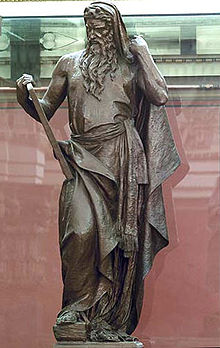
Statue of Moses at the Library of Congress, Washington D.C.

Exodus 34: 29-35: The Radiance of Moses

29 Moses came down from Mount Sinai. As he came down from the mountain with the two tablets of the covenant in his hand, Moses did not know that the skin of his face shone because he had been talking with God. 30 When Aaron and all the Israelites saw Moses, the skin of his face was shining, and they were afraid to come near him. 31 But Moses called to them; and Aaron and all the leaders of the congregation returned to him, and Moses spoke with them. 32 Afterward all the Israelites came near, and he gave them in commandment all that the LORD had spoken with him on Mount Sinai. 33 When Moses had finished speaking with them, he put a veil on his face; 34 but whenever Moses went in before the LORD to speak with him, he would take the veil off, until he came out; and when he came out, and told the Israelites what he had been commanded, 35 the Israelites would see the face of Moses, that the skin of his face was shining; and Moses would put the veil on his face again, until he went in to speak with him.

The time spent by Moses in the presence of God has a transforming effect upon Moses. While the changes are invisible to Moses they are clearly seen by Aaron and the people and it is a cause for fear. This time in God’s presence has made Moses different from the rest of the people, he continues to stand apart. In his role as mediator between God and the people he seems to have brought a little bit of God’s presence back with him.

The presence of God does change people. Moses enjoys a far greater intimacy with God than any other person among the Israelites. Moses has shown great faithfulness to God and to the people as well. Moses is more than an emissary for God or even a prophet of God but one who God trusts and speaks to like one speaks to a friend. Moses has something that even Aaron will never have. Aaron and the priests will need things to announce them before God and will only be allowed to enter God’s presence rarely. Moses dwells both with God and the people. Yet, Moses seems to belong more with God now than the people. Among the people Moses needs to wear a veil to fit in, but in God’s presence Moses doesn’t need to hide the radiance of who he is.