Tag Archives: Solomon’s Temple

Ezekiel 41 The Center of the New Temple

Schematic of Ezekiel’s Temple drawn by Dutch architect Bartelmeüs Reinders, Sr. (1893–1979) released into public domain by artist.

Ezekiel 41: 1-15a

1 Then he brought me to the nave, and measured the pilasters; on each side six cubits was the width of the pilasters. 2 The width of the entrance was ten cubits; and the sidewalls of the entrance were five cubits on either side. He measured the length of the nave, forty cubits, and its width, twenty cubits. 3 Then he went into the inner room and measured the pilasters of the entrance, two cubits; and the width of the entrance, six cubits; and the sidewalls of the entrance, seven cubits. 4 He measured the depth of the room, twenty cubits, and its width, twenty cubits, beyond the nave. And he said to me, This is the most holy place.

5 Then he measured the wall of the temple, six cubits thick; and the width of the side chambers, four cubits, all around the temple. 6 The side chambers were in three stories, one over another, thirty in each story. There were offsets all around the wall of the temple to serve as supports for the side chambers, so that they should not be supported by the wall of the temple. 7 The passageway of the side chambers widened from story to story; for the structure was supplied with a stairway all around the temple. For this reason the structure became wider from story to story. One ascended from the bottom story to the uppermost story by way of the middle one. 8 I saw also that the temple had a raised platform all around; the foundations of the side chambers measured a full reed of six long cubits. 9 The thickness of the outer wall of the side chambers was five cubits; and the free space between the side chambers of the temple10 and the chambers of the court was a width of twenty cubits all around the temple on every side. 11 The side chambers opened onto the area left free, one door toward the north, and another door toward the south; and the width of the part that was left free was five cubits all around.

12 The building that was facing the temple yard on the west side was seventy cubits wide; and the wall of the building was five cubits thick all around, and its depth ninety cubits.

13 Then he measured the temple, one hundred cubits deep; and the yard and the building with its walls, one hundred cubits deep; 14 also the width of the east front of the temple and the yard, one hundred cubits.

15 Then he measured the depth of the building facing the yard at the west, together with its galleries on either side, one hundred cubits.

Ezekiel is brought into the center of this new temple complex, which is similar in description to the temple of Solomon in 1 Kings 6, although the dimensions here are larger (assuming I am reading the layout correctly) than what 1 Kings indicates. The description of the temple, especially in verse five and beyond, is full of rarely used architectural expressions and translation is uncertain. The description, even if all the words are translated correctly, is difficult to fully comprehend and once again is lacking the details to fully realize this structure. This may be intentional to prevent someone from attempting to replicate this vision, but enough pieces are clear to give an overall idea of this central section of the temple.

The ’nave’ or ‘great hall’ which stands before the most holy place was a space that only the priests would enter to place the showbread on the table before the holiest place daily. This twenty by forty cubit[1] rectangular space is larger than the space in Solomon’s temple if the measurements are for the internal space of the room. For both the ‘nave’ and the most holy place the thickness of the walls is massive, equivalent to the wall surrounding the entire structure, six cubits (roughly ten feet) thick. Along this wall which spans three stories are a total of ninety chambers, presumably for storage. This structure, which is similar to Solomon’s temple, is difficult to visualize because it is unclear whether there is some type of stairway to access these side chambers. The most holy space is half the size of the nave as a twenty cubit square. On the outside was another large building, larger than the nave and most holy space combined: seventy cubits by ninety cubits.[2] The purpose of this final structure is not indicated here.

The primary concern throughout this structural description is the setting aside of spaces that separate the mundane from the holy. As we proceed from the outer doors of the structure to the most holy space the doorways decrease in size to restrict admittance and to demarcate the increasing sacredness of the intended space. With the smaller doors also comes the physical ascent to this holy space. Although there will be some description of the furnishings and decorations below, this is significantly different from the descriptions of the lavish resources committed to the construction of the tabernacle and Solomon’s temple.

Ezekiel 41: 15b- 26

The nave of the temple and the inner room and the outer vestibule 16 were paneled, and, all around, all three had windows with recessed frames. Facing the threshold the temple was paneled with wood all around, from the floor up to the windows (now the windows were covered), 17 to the space above the door, even to the inner room, and on the outside. And on all the walls all around in the inner room and the nave there was a pattern. 18 It was formed of cherubim and palm trees, a palm tree between cherub and cherub. Each cherub had two faces: 19 a human face turned toward the palm tree on the one side, and the face of a young lion turned toward the palm tree on the other side. They were carved on the whole temple all around; 20 from the floor to the area above the door, cherubim and palm trees were carved on the wall.

21 The doorposts of the nave were square. In front of the holy place was something resembling 22 an altar of wood, three cubits high, two cubits long, and two cubits wide; its corners, its base, and its walls were of wood. He said to me, “This is the table that stands before the LORD.” 23 The nave and the holy place had each a double door. 24 The doors had two leaves apiece, two swinging leaves for each door. 25 On the doors of the nave were carved cherubim and palm trees, such as were carved on the walls; and there was a canopy of wood in front of the vestibule outside. 26 And there were recessed windows and palm trees on either side, on the sidewalls of the vestibule.

The temple is decorated with cherubim and palm trees, although each cherub has only two faces instead of the four in the initial visions.[3] This decorative paneling covers the entire space from floor to above the door. The table seems to serve as the table for showbread (Exodus 25: 23-30) but Ezekiel needs to have it explained because it is double the size of the previous table. It is not a table for burnt offerings since a wooden altar would burn with the offering. The final detail is the doors which are similar to the doors in Solomon’s temple (1 Kings 6: 33-36). In comparison with both the tabernacle and the temple there is surprisingly little focus on ornamentation or the usage of gold and other precious resources. Perhaps Ezekiel, like the narrative of 1 Kings, is critical of the ostentatious nature of Solomon’s expenditure of wealth on both the temple and his own household but it is also likely that the primary purpose of this nature is not to focus on furnishings but the dimensions to set aside a sacred space.

[1] Thirty-four feet by sixty eight feet.

[2] One hundred twenty feet by one hundred fifty feet.

[3] Ezekiel 1 and 10.

Ezekiel 8 The Corruption of the Temple and the People

James Tissot, Solomon Decicates the Temple (1896-1902)

Ezekiel 8

1 In the sixth year, in the sixth month, on the fifth day of the month, as I sat in my house, with the elders of Judah sitting before me, the hand of the Lord GOD fell upon me there. 2 I looked, and there was a figure that looked like a human being; below what appeared to be its loins it was fire, and above the loins it was like the appearance of brightness, like gleaming amber. 3 It stretched out the form of a hand, and took me by a lock of my head; and the spirit lifted me up between earth and heaven, and brought me in visions of God to Jerusalem, to the entrance of the gateway of the inner court that faces north, to the seat of the image of jealousy, which provokes to jealousy. 4 And the glory of the God of Israel was there, like the vision that I had seen in the valley.

5 Then God said to me, “O mortal, lift up your eyes now in the direction of the north.” So I lifted up my eyes toward the north, and there, north of the altar gate, in the entrance, was this image of jealousy. 6 He said to me, “Mortal, do you see what they are doing, the great abominations that the house of Israel are committing here, to drive me far from my sanctuary? Yet you will see still greater abominations.”

7 And he brought me to the entrance of the court; I looked, and there was a hole in the wall. 8 Then he said to me, “Mortal, dig through the wall”; and when I dug through the wall, there was an entrance. 9 He said to me, “Go in, and see the vile abominations that they are committing here.” 10 So I went in and looked; there, portrayed on the wall all around, were all kinds of creeping things, and loathsome animals, and all the idols of the house of Israel. 11 Before them stood seventy of the elders of the house of Israel, with Jaazaniah son of Shaphan standing among them. Each had his censer in his hand, and the fragrant cloud of incense was ascending.12 Then he said to me, “Mortal, have you seen what the elders of the house of Israel are doing in the dark, each in his room of images? For they say, ‘The LORD does not see us, the LORD has forsaken the land.'” 13 He said also to me, “You will see still greater abominations that they are committing.”

14 Then he brought me to the entrance of the north gate of the house of the LORD; women were sitting there weeping for Tammuz. 15 Then he said to me, “Have you seen this, O mortal? You will see still greater abominations than these.”

16 And he brought me into the inner court of the house of the LORD; there, at the entrance of the temple of the LORD, between the porch and the altar, were about twenty-five men, with their backs to the temple of the LORD, and their faces toward the east, prostrating themselves to the sun toward the east. 17 Then he said to me, “Have you seen this, O mortal? Is it not bad enough that the house of Judah commits the abominations done here? Must they fill the land with violence, and provoke my anger still further? See, they are putting the branch to their nose! 18 Therefore I will act in wrath; my eye will not spare, nor will I have pity; and though they cry in my hearing with a loud voice, I will not listen to them.”

Ezekiel’s prophecies as reported in the book of Ezekiel have been directed first at Jerusalem, then at the land of Judah, and now the next two chapters orient on the temple and prepare us for the departure of the LORD’s presence from the temple. Ezekiel from his exile in Babylon is transported by God to view the actions of idolatry which have aroused the LORD’s passion so violently. During this time where the prophet is given a look within the walls of the temple the LORD shows four different examples of idolatrous practices among the people which cause the God of Israel disgust. These syncretistic[1] practices by themselves are enough, in the book of Ezekiel’s view, to justify God’s anger. The anger of God is increased by the way the infection of idolatrous worship is leading to practices of violence which further provoke God.

The beginning of this oracle fixes the date of this vision precisely: September 18, 592 BCE (by our calendar), fourteen months after the inaugural vision. This is close to the number of days that Ezekiel is instructed to lie on his right and left side (if this occurs immediately after the initial vision) outlined in Ezekiel 4: 4-8. Yet, even in this short time the prophet’s actions have attracted the notice of the elders in exile with Ezekiel and they sit before Ezekiel. Perhaps they have come to Ezekiel seeking an oracle or they are watching the performance of his sign act of lying on his side, but during this time when the elders are present Ezekiel is transported to Jerusalem. There is no indication of what the elders perceive during this event, whether they perceive Ezekiel having a prophetic episode or whether they see him lifted up and transported. The description of the LORD’s appearance does not have the divine chariot that is described in the first two chapters and only focuses on the image of the humanlike but divinely bright character who lifts the prophet up. One reason the chariot may not be present is that God is picking Ezekiel up in Babylon and transporting him to the place where the LORD’s presence is supposed to rest in Jerusalem. The prophet is taken by a lock of hair, but the spirit at the same time is lifting the prophet up so it is plausible that the experience is not one of being lifted by one’s hair, but instead of being carefully picked up by what can be described as the hand of God and the spirit of God simultaneously. Yet, the method of divine transportation is merely the prelude to the vital imagery of idolatry that God desires the prophet to see and communicate.

Ezekiel is transported to the altar gate of the temple to see the ‘image of jealousy’ which has clearly aroused the LORD’s passionate anger. I am not certain whether Ezekiel is standing near the entrance to the holy of holies, where the ark of the covenant resides and where God’s presence is expected to rest, or whether he is perhaps between the holy place and the vestibule, nearer to where the altar would be, but the presence of a statue to a different god within the temple complex would have been a shocking abomination to this prophet concerned with the holiness of the temple.

The description of the abominations in Ezekiel 8 parallel the pattern of prohibitions laid out in Deuteronomy 4: 15-20:

15 Since you saw no form when the LORD spoke to you at Horeb out of the fire, take care and watch yourselves closely, 16 so that you do not act corruptly by making an idol for yourselves, in the form of any figure — the likeness of male or female, 17 the likeness of any animal that is on the earth, the likeness of any winged bird that flies in the air, 18 the likeness of anything that creeps on the ground, the likeness of any fish that is in the water under the earth.19 And when you look up to the heavens and see the sun, the moon, and the stars, all the host of heaven, do not be led astray and bow down to them and serve them, things that the LORD your God has allotted to all the peoples everywhere under heaven. 20 But the LORD has taken you and brought you out of the iron-smelter, out of Egypt, to become a people of his very own possession, as you are now.

This image of jealousy is likely one of the Canaanite gods that continually work their ways into the practices of the people of Israel and Judah and the Canaanite gods often appear as figures or male of female likeness as prohibited in Deuteronomy 4:16. King Manasseh of Judah placed a carved image of Asherah within the house of the LORD (2 Kings 21:7) but Josiah destroyed this idol during his reforms (2 Kings 23:6). Yet, Josiah’s reforms did not endure long after his death in battle and it is possible that a later king or individual had the audacity to place another image like Manasseh’s Asherah within the temple. It is also possible that with the physical transportation of the prophet to the temple that there is a temporal transportation to this time when the statue of Asherah existed within the temple grounds. While the temporal transportation is possible with God, and there is an element where we are seeing a compilation of offenses that may not all be occurring simultaneously, it is also likely that the people of Judah continued to revert to syncretistic practices of worshiping other gods alongside the LORD that are continually indicated in the Deuteronomic history.[2]

The second abomination that the LORD wants the prophet to see involves the elders offering incense to their rooms of images. The prophet is shown a recess or hiding place (NRSV hole) in the wall that the prophet is instructed to dig through.[3] The excavation of this hiding place takes Ezekiel into a secret room where seventy elders including Jaazaniah son of Shaphan are conducting their secretive incense offerings before walls decorated with images in a way prohibited by Deuteronomy 4:17-18. In addition to the misplaced actions of offering incense before the creeping things and loathsome animals is the reality that it is the elders and not the priests who are conducting this offering. The images may be like the walls in Egyptian burial chambers or the Ishtar gate in Babylon, but it also may indicate the conglomeration of personal shrines that are in the households of the elders of Israel. The presence of seventy elders echoes the presence of seventy elders in Exodus 24: 9-18 and Number 11:16-30 where the elders are gathered to share in Moses in the burden of leading the people. In contrast these seventy elders, distinct from the elders gathered around Ezekiel in exile, are one of the causes of the condemnation of the people. If Jaazaniah son of Shaphan, the recognized and named elder, is a son of the Shaphan mentioned in 2 Kings 22, a court official involved in the reforms of Josiah, then as Kathyrn Pfister Darr indicates, “the presence of this elder within the secret chamber signaled not only the failure of the reform (of Josiah), but also the ubiquity of Israelite idolatry.” (NIB VI: 1176) The elders may state that the LORD does not see them and that the LORD has forsaken the land, but the prophet is shown that the LORD does see and wants the prophet to see as well. These secretive mysterious rituals being conducted in the dark have been unearthed by the prophets excavation, and what they conducted in darkness has now been brought into the light.

Detail from the Ishtar Gate (Reconstruction in Berlin’s Pergamon Museum)

The third abomination the prophet sees is the practice of women weeping for Tammuz. Tammuz is not mentioned elsewhere in scripture, but we do know about this practice comes from existing inscriptions from the surrounding region. Tammuz is a Sumerian myth involving the decent of Tammuz into the underworld and then rebirth corresponding to the agricultural seasons. If this practice is corresponding to the practices of the surrounding culture, then the timing would be off for this lament to be given during September (the time of the vision) but as mentioned above there is likely some element of temporal transport along with the physical transport to highlight multiple practices that the LORD finds offensive.

The final transport takes the prophet to the temple again where twenty-five men have turned their backs on the LORD to bow down to the rising sun. This again follows the prohibitions of Deuteronomy 4:19 against bowing down to the sun, moon, or any astral body. These practices are seemingly present in every portion of society in Judah: within the temple, practiced by the elders, by women and by men. The temple has not prevented the spiritual deterioration of the people because the temple itself has been corrupted by the ‘image of jealousy’ and the practices of the elders, the women, and the men within the temple compound.

Yet, the idolatrous acts of worship have also corrupted the way of life of the people of Judah. Although the idolatrous worship is enough, the people have gone further and committed acts of violence (Hebrew hamas).[4] Rimon Kasher explains the meaning of the Hebrew word hamas as:

Ĥamas is violent social injustice… The expression occurs in the story of the Flood, so what we have here is more than merely a hint of the punishment that awaits Judah. What the verse means is that God’s anger towards Israel arises not only from their religious abominations, but also from their sins in the moral and social sphere. (Ganzel, 2020, p. 76)

The idolatrous and violent actions of the people have grieved God’s heart like the story of the flood, and now Judah has put the branch to the God’s nose. The enigmatic phrase ‘sticking the branch up my nose’  has been described by interpreters as everything from a phallic symbol to the actions involved in the worship of one of the indicated idols, or simply an insulting gesture, but as Daniel Block indicates it is used to describe how the LORD feels his subjects have treated him disrespectfully. (Block, 1997, p. 299) This place that was to be a place reserved for the worship of the LORD and honoring the divine name has become transformed into a place where idolatrous practices obscure the worship of their God and have caused God to feel disgust towards the temple and those who are misusing it.


[1] Syncretism is the merging or combining of various religious practices. The theology of the Hebrew Scriptures is continually opposed to syncretism but it also narrates numerous instances of syncretic practice throughout the story of Israel and Judah.

[2] The Deuteronomic history, so called by scholars because the theological perspective echoes the book of Deuteronomy, includes the books Joshua, Judges, 1 & 2 Samuel, and 1 & 2 Kings.

[3] As Katheryn Pfister Darr notes if there was already a hole in the wall why would God command the prophet to dig a hole. (NIB VI:1175)

[4] The Hebrew word hamas is not the root of the Palestinian group Hamas. The Hamas currently involved in the Hamas-Israel conflict derives its name from an acronym of Harakata al-Muqawama al-Islamiya (translated as Islamic resistance Movement).

1 Kings 6 The Construction of Solomon’s Temple

The Temple by Radojavor@deviantart.com

1 Kings 6

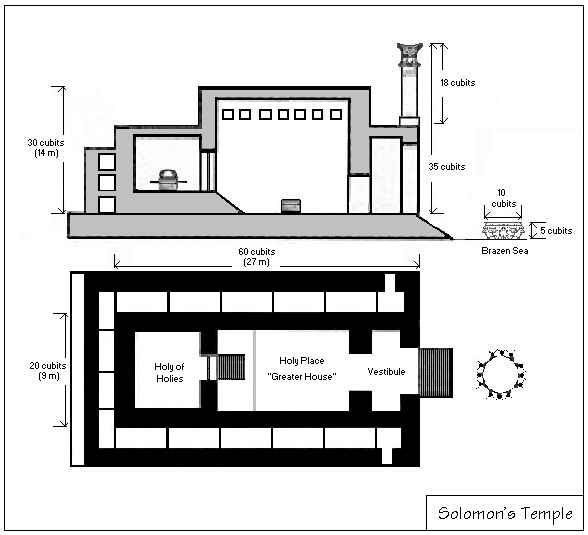
1 In the four hundred eightieth year after the Israelites came out of the land of Egypt, in the fourth year of Solomon’s reign over Israel, in the month of Ziv, which is the second month, he began to build the house of the LORD. 2 The house that King Solomon built for the LORD was sixty cubits long, twenty cubits wide, and thirty cubits high. 3 The vestibule in front of the nave of the house was twenty cubits wide, across the width of the house. Its depth was ten cubits in front of the house. 4 For the house he made windows with recessed frames. 5 He also built a structure against the wall of the house, running around the walls of the house, both the nave and the inner sanctuary; and he made side chambers all around. 6 The lowest story was five cubits wide, the middle one was six cubits wide, and the third was seven cubits wide; for around the outside of the house he made offsets on the wall in order that the supporting beams should not be inserted into the walls of the house.

7 The house was built with stone finished at the quarry, so that neither hammer nor ax nor any tool of iron was heard in the temple while it was being built.

8 The entrance for the middle story was on the south side of the house: one went up by winding stairs to the middle story, and from the middle story to the third. 9 So he built the house, and finished it; he roofed the house with beams and planks of cedar. 10 He built the structure against the whole house, each story five cubits high, and it was joined to the house with timbers of cedar.

11 Now the word of the LORD came to Solomon, 12 “Concerning this house that you are building, if you will walk in my statutes, obey my ordinances, and keep all my commandments by walking in them, then I will establish my promise with you, which I made to your father David. 13 I will dwell among the children of Israel, and will not forsake my people Israel.”

14 So Solomon built the house, and finished it. 15 He lined the walls of the house on the inside with boards of cedar; from the floor of the house to the rafters of the ceiling, he covered them on the inside with wood; and he covered the floor of the house with boards of cypress. 16 He built twenty cubits of the rear of the house with boards of cedar from the floor to the rafters, and he built this within as an inner sanctuary, as the most holy place. 17 The house, that is, the nave in front of the inner sanctuary, was forty cubits long. 18 The cedar within the house had carvings of gourds and open flowers; all was cedar, no stone was seen. 19 The inner sanctuary he prepared in the innermost part of the house, to set there the ark of the covenant of the LORD. 20 The interior of the inner sanctuary was twenty cubits long, twenty cubits wide, and twenty cubits high; he overlaid it with pure gold. He also overlaid the altar with cedar. 21 Solomon overlaid the inside of the house with pure gold, then he drew chains of gold across, in front of the inner sanctuary, and overlaid it with gold. 22 Next he overlaid the whole house with gold, in order that the whole house might be perfect; even the whole altar that belonged to the inner sanctuary he overlaid with gold.

23 In the inner sanctuary he made two cherubim of olivewood, each ten cubits high. 24 Five cubits was the length of one wing of the cherub, and five cubits the length of the other wing of the cherub; it was ten cubits from the tip of one wing to the tip of the other. 25 The other cherub also measured ten cubits; both cherubim had the same measure and the same form. 26 The height of one cherub was ten cubits, and so was that of the other cherub. 27 He put the cherubim in the innermost part of the house; the wings of the cherubim were spread out so that a wing of one was touching the one wall, and a wing of the other cherub was touching the other wall; their other wings toward the center of the house were touching wing to wing. 28 He also overlaid the cherubim with gold.

29 He carved the walls of the house all around about with carved engravings of cherubim, palm trees, and open flowers, in the inner and outer rooms. 30 The floor of the house he overlaid with gold, in the inner and outer rooms.

31 For the entrance to the inner sanctuary he made doors of olivewood; the lintel and the doorposts were five-sided. 32 He covered the two doors of olivewood with carvings of cherubim, palm trees, and open flowers; he overlaid them with gold, and spread gold on the cherubim and on the palm trees.

33 So also he made for the entrance to the nave doorposts of olivewood, four-sided each, 34 and two doors of cypress wood; the two leaves of the one door were folding, and the two leaves of the other door were folding. 35 He carved cherubim, palm trees, and open flowers, overlaying them with gold evenly applied upon the carved work. 36 He built the inner court with three courses of dressed stone to one course of cedar beams.

37 In the fourth year the foundation of the house of the LORD was laid, in the month of Ziv. 38 In the eleventh year, in the month of Bul, which is the eighth month, the house was finished in all its parts, and according to all its specifications. He was seven years in building it.

The construction of the temple of Solomon in Jerusalem is a central event in the narration of the story of Israel. For the era this temple is a massive building roughly one hundred five feet long, thirty feet wide and forty-five feet tall. It is twice the length and breadth of the tabernacle and three times as tall with ten times the internal space which is correspondingly lit by ten menorahs. (Israel, 2013, pp. 177-179) It is a project of impressive scope and a phenomenal investment of resources for this relatively young and small monarchy, and it is a project which will be a central part of Jerusalem for around four hundred years.

Theologically the completion of the temple is viewed as a completion of the promises God made to the people when they left Egypt. Calendars are important in Hebrew thought and the four hundred eighty years is significant as the multiple of twelve and forty. Twelve is of course the number of tribes of Israel while forty is often a number of completion (forty days and forty nights of rain, forty years in the wilderness) and forty years is often viewed as the length of a generation in the bible. Now twelve generations later the nation has reached its adulthood and is building a permanent home for its God in the promised land.

The act of constructing the temple concentrates the resources of the nation into this great project, and yet despite the grandeur of the temple God’s presence within this space is contingent upon obedience to the statutes, ordinances, and commandments of God. The pious act of constructing the temple and offering sacrifices is never sufficient to replace covenant obedience to the God of Israel. Like the tabernacle it is to be a place where God can dwell among God’s people, but God’s presence and blessing require fidelity.

The design and construction of the temple is similar to other religious sites excavated in the Middle East, and it is likely that Solomon uses the worship sites of other nations as a guide for the construction of the temple in Jerusalem. Especially with craftsmen sent from Tyre, it is likely that lessons learned in construction of other sites are applied to this project. As a project showing Solomon’s devotion to the LORD, it likely uses the best of design and knowledge to build a structure that will endure.

Evaluating the construction of the temple often depends upon the perspective one examines it from. For much of the history of both Judaism and Christianity holy spaces were constructed to bring a small piece of heaven to earth. If one enters a Catholic cathedral you see the evidence of the very best resources of the people being brought together to create a beautiful space where God’s presence might be encountered in the beauty of the space. The Protestant Reformation with its democratization of space often constructed worship sites that were much more austere and functional rather than beautiful and awe inspiring. The lavish use of gold and cedar in the temple of Jerusalem is designed to be an awe-inspiring space which reflects its place as a place where God’s name can dwell.

First Kings views the construction of the temple as a high point in the reign of Solomon and of the people of Israel in general. There is the subtle critique of placing too much focus on the temple at the expense of covenant fidelity as well as a subtle questioning of the deal that Solomon makes to acquire the resources for the temple in the previous chapter. Yet, the completion of the temple in all its majesty is viewed as an accomplishment for both Solomon and the people. This massive temple with its ornate doors, gold plated walls, and massive gold covered cherubim is a place where God can be present among the people. Its completion at the end of seven years (also a theologically significant number) and its overall evaluation of being perfect is representative the building’s calling to be a place where God’s presence can be encountered.