Tag Archives: Seven Trumpets

Revelation 11 Pausing for Hope, Witness and Worship

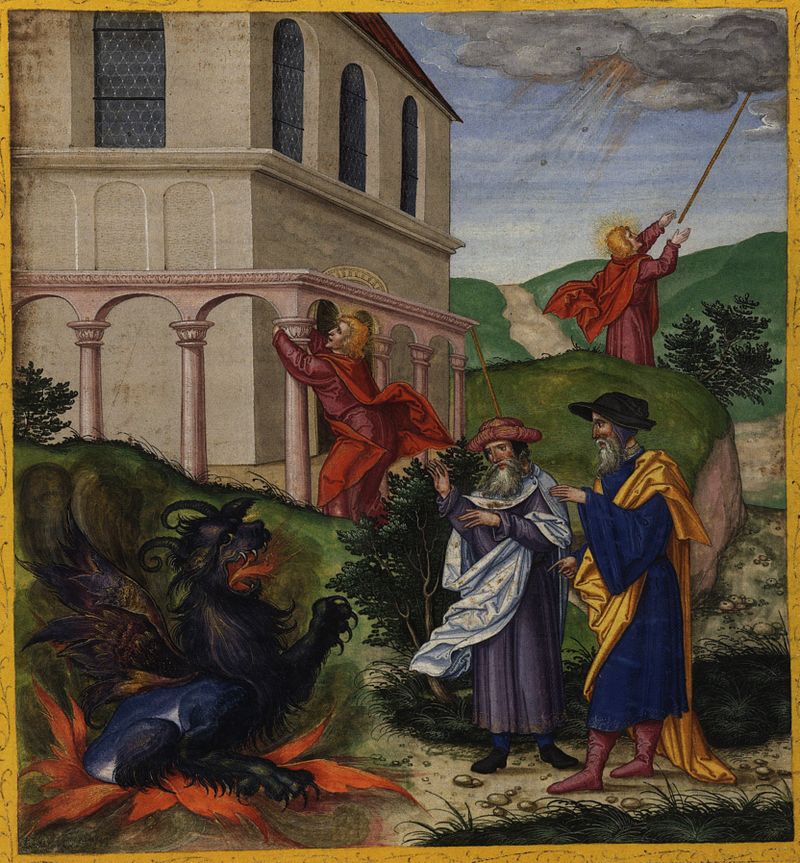
Matthias Gerung from the Ottheinrich Bible (1530-1532)

Revelation 11:1-2 Measuring the Temple

1 Then I was given a measuring rod like a staff, and I was told, “Come and measure the temple of God and the altar and those who worship there, 2 but do not measure the court outside the temple; leave that out, for it is given over to the nations, and they will trample over the holy city for forty-two months.

John is not merely an observer in the receiving of Revelation, but actively is called to participate in symbolic actions that help provide meaning. This measurement of the temple has a close correlation to Ezekiel 40 where the LORD has Ezekiel observe the measurement of the temple to demonstrate that the exile that Ezekiel and his fellow Judeans were a part of would last only for a time. In addition, the period articulated matches the period at the end of Daniel for the duration until the end of the wonders (and persecution) of the people who receive Daniel’s message (which most scholars date late in the time of the persecution under Antiochus Epiphanies IV in the time of the revolt of the Maccabees, roughly 166 BCE). Here is where Daniel asks how long this will last:

Then I, Daniel, looked, and two others appeared, one standing on this bank of the stream and one on the other. One of them said to the man clothed in linen, who was upstream, “How long shall it be until the end of these wonders?” The man clothed in linen, who was upstream, raised his right hand and his left hand toward heaven. And I heard him swear by the one who lives forever that it would be for a time, two times, and half a time, and that when the shattering of the power of the holy people comes to an end, all these things would be accomplished. (Daniel 12: 5-7)

A time, two times, and a half a time is three and a half and when the unit of time is years the forty-two months is three and a half years. This is also the one thousand two hundred and sixty days below (based on a thirty-day month). This extended quotation from Daniel also resonates with the figure of the angel in Revelation 10 who stands on the land and the sea and lifts his hand to the heavens. By combining resonant images of Daniel and Ezekiel, both images of hope during persecution, the act of measuring the temple and the time set aside point to the limited duration of the suffering of the churches hearing this message. Ultimately the God who unveils to John these images will bring an end to the trampling of the holy people of God.

Philip Medhurst, Revelation 11: 7-12 The Beast Shall Fight Against Them

Revelation 11: 3-14 The Witnesses

3 And I will grant my two witnesses authority to prophesy for one thousand two hundred sixty days, wearing sackcloth.”4 These are the two olive trees and the two lampstands that stand before the Lord of the earth. 5 And if anyone wants to harm them, fire pours from their mouth and consumes their foes; anyone who wants to harm them must be killed in this manner. 6 They have authority to shut the sky, so that no rain may fall during the days of their prophesying, and they have authority over the waters to turn them into blood, and to strike the earth with every kind of plague, as often as they desire.

7 When they have finished their testimony, the beast that comes up from the bottomless pit will make war on them and conquer them and kill them, 8 and their dead bodies will lie in the street of the great city that is prophetically called Sodom and Egypt, where also their Lord was crucified. 9 For three and a half days members of the peoples and tribes and languages and nations will gaze at their dead bodies and refuse to let them be placed in a tomb; 10 and the inhabitants of the earth will gloat over them and celebrate and exchange presents, because these two prophets had been a torment to the inhabitants of the earth.

11 But after the three and a half days, the breath of life from God entered them, and they stood on their feet, and those who saw them were terrified. 12 Then they heard a loud voice from heaven saying to them, “Come up here!” And they went up to heaven in a cloud while their enemies watched them. 13 At that moment there was a great earthquake, and a tenth of the city fell; seven thousand people were killed in the earthquake, and the rest were terrified and gave glory to the God of heaven.

14 The second woe has passed. The third woe is coming very soon.

Revelation continues to portray a God who desires for the people to place their trust in God instead of the forces that are opposed to God. Revelation continues its long pause to make a space for witness to the world so that the nations may give glory to God. During this one thousand two hundred sixty-day period we are introduced to the two witnesses that are two olive trees and two lampstands whose mission is to prophesy and proclaim God’s power, might and desires against the forces of the beast and Satan who is behind the beast. These verses foreshadow the larger narrative that will unfold in Revelation 12-13 which symbolically portray the devil and Rome as a dragon and beast respectively.

The identity of the witnesses has been debated and different interpreters have come to different answers about these witnesses. Some interpreters believe that the two witnesses are two concrete individuals who are given this task and specific powers which enable them to carry out this task. These two individuals would have the powers demonstrated by Elijah and Moses previously in scripture. Some have taken the two witnesses to be Elijah and Moses returned, other Elijah and Enoch (since both were bodily brought up into heaven) and others take these two witnesses to stand for the church or a portion of the church. Regardless of who one takes as the witnesses in one’s interpretation the message of the witnesses is clear and like prophets of all times and places they are viewed as a hindrance to the powers that claim to be in control. Eventually the beast (who we will see shortly is a way of representing Rome) acts to eliminate the pesky witnesses and many people rejoice that they have been silenced. Yet, God stands on the side of the witnesses and death is not the final word. The beast and those with the beast can persecute the witnesses of God but the God of Revelation is a God of resurrection. They may know humiliation and even death for a time, two times and a half a time but God will invite them to take their places at God’s kingdom.

The city, unnamed but indicated by what it is prophetically called as well as its location as where the Lord is crucified points to Jerusalem. Like all things in this vision there is a plasticity that has allowed interpreters to point to multiple interpretations but as I lay out my reading I start with the plain sense reading of the place where the witnesses begin their work being in Jerusalem. For me this scene deals with the mission of the whole church, since it is the work of the whole church to witness and to call for all the peoples, language, nations and tribes to turn to God. Are there unique witnesses within the whole? Certainly, but all are called to the vocation of witnesses. There are times where the church’s ability to speak and respond seems dead or powerless but ultimately this is a narrative of God’s power and control, God can resurrect a dead witness or a dead church. For me an interesting part of this narrative is the earthquake and its response: in the earthquake the damage is reduced from previous calamities (from one fourth in the seals, one third in the trumpets but here one tenth) and response is to give glory to God. Again, taking the city as Jerusalem I take this as a suggestive nod towards an acknowledgement by the people of Jerusalem (and by extension Israel) of the sovereignty of God. Even though the church symbolically assumes many of the roles of Israel throughout Revelation I view this portion in line with Paul’s argument in Romans 9-11 about the irrevocable call of God to Israel.
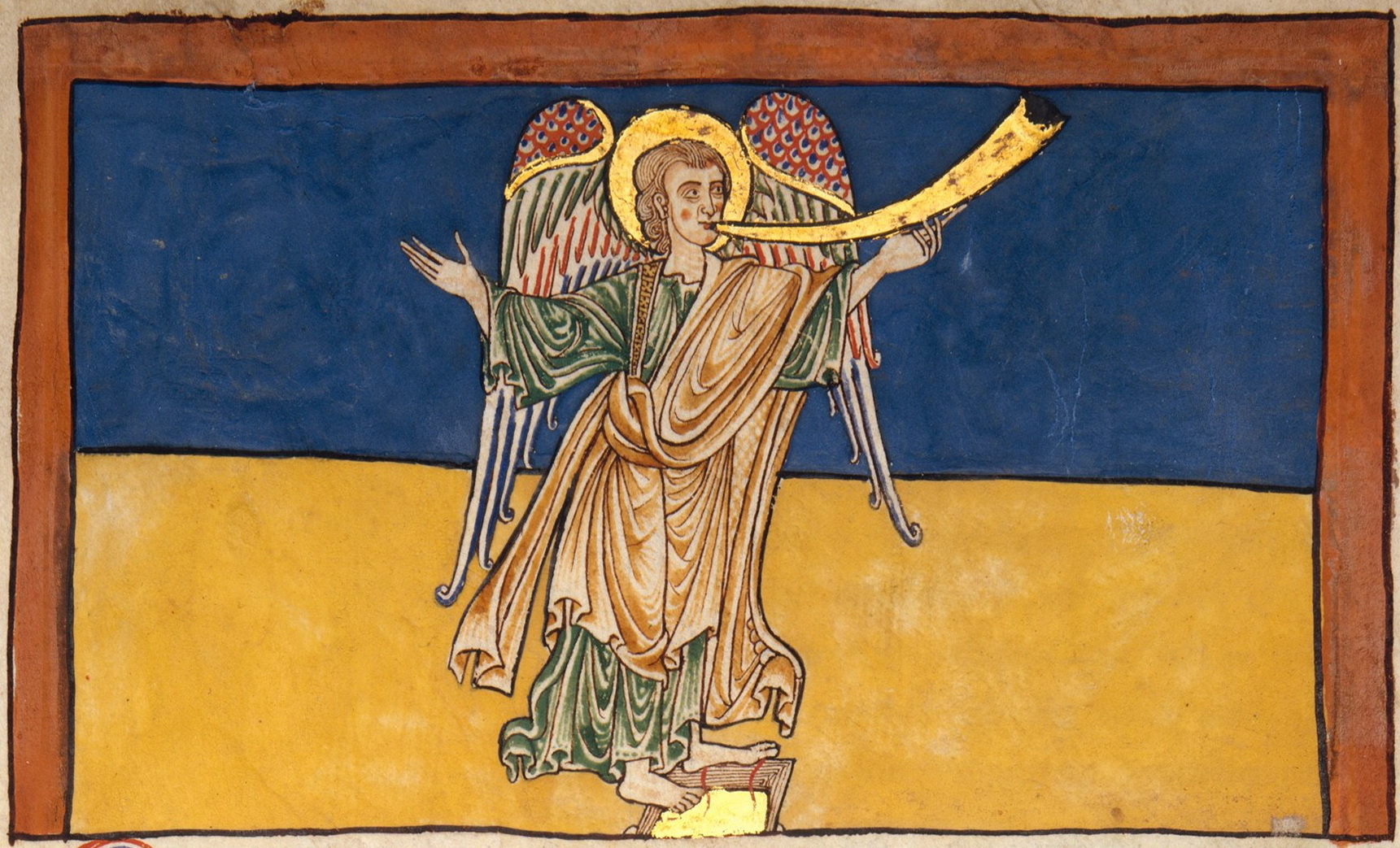
The Seventh Angel of the Apocalypse Proclaiming the Reign of the Lord, Unknown Spanish Miniaturist around 1180

Revelation 11: 15-19 The Final Trumpet

15 Then the seventh angel blew his trumpet, and there were loud voices in heaven, saying,

“The kingdom of the world has become the kingdom of our Lord and of his Messiah, and he will reign forever and ever.”

16 Then the twenty-four elders who sit on their thrones before God fell on their faces and worshiped God, 17 singing,

“We give you thanks, Lord God Almighty, who are and who were, for you have taken your great power and begun to reign. 18 The nations raged, but your wrath has come, and the time for judging the dead, for rewarding your servants, the prophets and saints and all who fear your name, both small and great, and for destroying those who destroy the earth.”

19 Then God’s temple in heaven was opened, and the ark of his covenant was seen within his temple; and there were flashes of lightning, rumblings, peals of thunder, an earthquake, and heavy hail.

The preceding section warns us that the third woe is coming soon and upon the final trumpet blast we are prepared for that final woe to come, and yet we instead see a different perspective on reality. We expect to focus on the earth and the chaos and struggle on the earth but instead we find ourselves focused on heaven and the order and worship and praise going on as the world is declared the kingdom of God. This is a pivotal scene in Revelation because the coming chapters we will see how in multiple symbolic ways the agents who have been at work destroying God’s order and creation are first unmasked and then overthrown. Satan will be banished from heaven; Rome and its heralds will be shown as beasts serving Satan and then later as a prostitute but both Rome and Satan’s power will come to an end. Here we have the announcement that God is now moving towards the earth. The desire of God to be a part of the creation and to dwell among God’s people will no longer wait. God’s time of patient waiting to give space and time for repentance are coming to an end. God’s power is being revealed, God’s covenant with God’s people is being renewed and in heaven there is worship.

Revelation continues to remind its reader that even though chaos may appear to reign on earth that God’s will indeed be done on earth as it is in heaven. The nations may rage but God’s judgment will decide the final victory, those servants who have been oppressed, misused and who have felt powerless will be rewarded. It is a time where the powerful will be brought low and the meek will be lifted up. For the faithful this is a time of celebration and joy while for those who have aligned themselves against God it is an announcement of God’s coming in strength and power.
Revelation 9: The First Two Woes

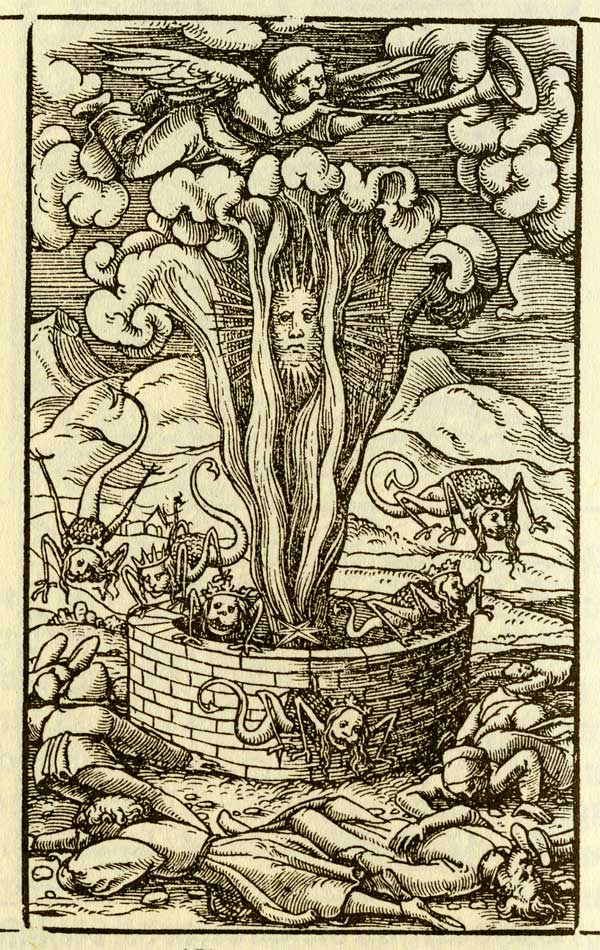
Hans Holbein from the 1531 Zwingli bible

Revelation 9: 1-12: The First Woe-The Locusts of the Abyss

1 And the fifth angel blew his trumpet, and I saw a star that had fallen from heaven to earth, and he was given the key to the shaft of the bottomless pit; 2 he opened the shaft of the bottomless pit, and from the shaft rose smoke like the smoke of a great furnace, and the sun and the air were darkened with the smoke from the shaft. 3 Then from the smoke came locusts on the earth, and they were given authority like the authority of scorpions of the earth. 4 They were told not to damage the grass of the earth or any green growth or any tree, but only those people who do not have the seal of God on their foreheads. 5 They were allowed to torture them for five months, but not to kill them, and their torture was like the torture of a scorpion when it stings someone. 6 And in those days people will seek death but will not find it; they will long to die, but death will flee from them.

7 In appearance the locusts were like horses equipped for battle. On their heads were what looked like crowns of gold; their faces were like human faces, 8 their hair like women’s hair, and their teeth like lions’ teeth; 9 they had scales like iron breastplates, and the noise of their wings was like the noise of many chariots with horses rushing into battle. 10 They have tails like scorpions, with stingers, and in their tails is their power to harm people for five months. 11 They have as king over them the angel of the bottomless pit; his name in Hebrew is Abaddon, and in Greek he is called Apollyon.

12 The first woe has passed. There are still two woes to come.

The first four trumpets saw the earth and sea and sky become the bearers of God’s judgment to provide an opportunity for the recalcitrant portions humanity to repent. Now in the fifth trumpet the recipients of the suffering begins to shift to humanity and specifically the portions of humanity not sealed with the seal of God. Like in the book of Exodus where the chosen people of Israel are not inflicted with the signs and wonders that God does against Egypt; so here the Israel sealed and protected will not be stung by the demonic locust swarm that is released from the abyss.

While the star that fell in Revelation 8:10 was referring to a meteor which falls from the heavens into the waters of the earth contaminating them the star here most likely refers to an angel of God. In Revelation 1: 20 we see the seven stars referred to as the seven angels of the churches. Some have taken this figure to be Satan falling from heaven coming to unleash the forces of the abyss and while this is possible (and there is language later in Revelation about Satan being cast out of heaven as well Jesus’ statement in Luke 10:18 about seeing Satan fall from heaven like a flash of lightning) it seems odd that God or an agent of God would hand Satan the key to the abyss. Initiating the first woe an angel opens the demonic realm of the abyss.

The abyss in Revelation is a demonic realm. It is not the same as under the earth, where the creatures that live there will give God praise. Instead this is the realm of the Destroyer and those forces that are opposed to the Creator. In Revelation 11 the beast will come up from the abyss, and in Revelation 20 Satan will be confined there. John observes the abyss being opened and the smoke arising from it along with the emergence of the locusts, but John does not dwell on the abyss itself and instead focuses on the impact of the abyss being opened upon the people of the earth.

These first two woes demonstrate a removal of restraints by God. The creatures of the abyss have been imprisoned there and only upon being released is their destruction seen and felt. The locusts of the abyss are demonic in every way and counter to the natural order. In some respects their description mirrors the Greek mythological creature of the manticore with its human, lion and scorpion traits and yet these demonic locusts are distinct even from this mythical creature which blurred the boundaries of species and reality. The locusts do not act like regular locusts: they fly through the smoke where normal locusts will become inactive in smoke, they do not consume the grass and plants of the field like normal locusts do and instead of their mouths it is their stingers that are the troubling aspect. The comparison of the locusts to horses emphasizes their military aspect and they, like the demonic cavalry that come with the sixth trumpet. Their description being like ‘horses equipped for battle’ echoes Joel 2: 4-5:

They have the appearance of horses, and like war-horses they charge. As with the rumbling of chariots. They leap on the tops of the mountains, like the crackling of a flame of fire devouring stubble, like a powerful army drawn up for battle.

The description of the demonic locusts indicates their menace and these locust act like a military unit attacking the people and yet they are not given the power to kill only to torture with their sting. The people wish for death due to the pain of the sting, but they are ultimately allowed to live, they are given the opportunity to repent after being incapacitated by the sting for an extended time.

For me the key to understanding this section comes in verses 20-21 where they people don’t repent and return to the worship of demons. As I’ve mentioned throughout this section the locusts and their master, Abaddon or Apollyon, are demonic forces of destruction that are in opposition to God the creator. The action of the angel in opening the abyss turns the people who worship, in John’s view, demons over to the demonic forces they worship, and they are tormented by them. Revelation is a vision of disclosure that attempts to illuminate the world through its strange images. God no longer restrains the demonic in order to unmask the idols that people are giving their allegiance to in order that they might turn to the Lord. But even here at the first woe there is restraint that prevents the demonic horde of locusts the ability to bring death even to the unrepentant.

It is also worth noting the similarities between the locusts of the first woe and the first rider from the first seal. The first rider on the white horse also wears a crown and is given the power to conquer. There is also a progression from this image to the image of war in both the second seal and the second woe. (See Revelation 6: 1-4)

Revelation 9: 13-21 The Second Woe-the Angels and the Cavalry Horde

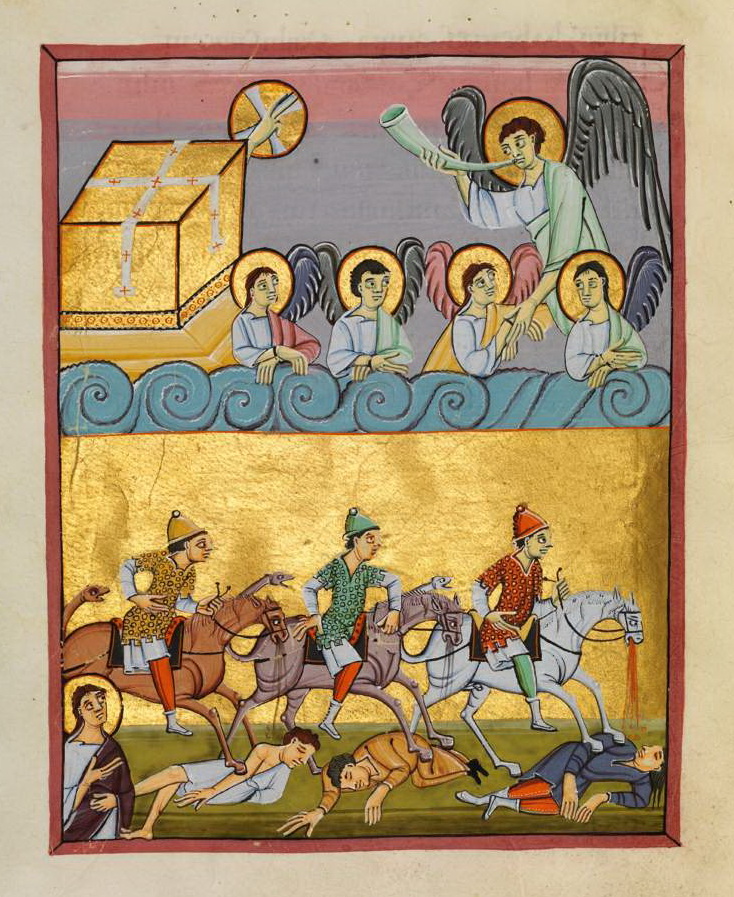
The Sixth Trumpet from the Bamberg Apocalypse

13 Then the sixth angel blew his trumpet, and I heard a voice from the four horns of the golden altar before God, 14 saying to the sixth angel who had the trumpet, “Release the four angels who are bound at the great river Euphrates.” 15 So the four angels were released, who had been held ready for the hour, the day, the month, and the year, to kill a third of humankind. 16 The number of the troops of cavalry was two hundred million; I heard their number. 17 And this was how I saw the horses in my vision: the riders wore breastplates the color of fire and of sapphire and of sulfur; the heads of the horses were like lions’ heads, and fire and smoke and sulfur came out of their mouths. 18 By these three plagues a third of humankind was killed, by the fire and smoke and sulfur coming out of their mouths. 19 For the power of the horses is in their mouths and in their tails; their tails are like serpents, having heads; and with them they inflict harm.

20 The rest of humankind, who were not killed by these plagues, did not repent of the works of their hands or give up worshiping demons and idols of gold and silver and bronze and stone and wood, which cannot see or hear or walk. 21 And they did not repent of their murders or their sorceries or their fornication or their thefts.

With the sixth trumpet a second group of creatures, this time angels, are released to bring about judgment. Much like the opening of the abyss, here creatures that are bent on destroying humanity are unleashed and with them a seemingly impossible number of demonic cavalry. Like in the second seal, war is unleashed upon the earth and death follows shortly afterwards. Structurally there seems to be a connection between the angels unleashed here and the four angels retraining the four winds of heaven in Revelation 7:1. These angels bound at the river Euphrates are not the same angels, but while the first angels hold back judgment these angels of death become the summoners of destruction and desolation. Yet, even in the midst of the destruction and devastation, Revelation wants us to hear that by releasing these angels of death that even here God remains firmly in control.

The angels at the beginning of this woe are bound, like Satan will be in Revelation 20:2 (see also the evocative language of binding the strongman in Mark 3:27). Perhaps they are bound as they emerge from the abyss and they are fallen angels like Satan, perhaps they are fallen angels that have been chained here at the Euphrates for countless years, or perhaps they were simply created to be vessels that God will use to bring about the judgment of the people. For me the angels themselves seem to be fallen creatures and the cavalry they will summon also is full of demonic aspects in its description and mission. Ultimately these creatures which are unleashed upon the creation are also forces of death and destruction and bring about the death of large portions of humanity. Yet the command to release the angels comes from the altar of God and, as mentioned above, God remains firmly in control despite the chaos the people of the earth would experience from the unleashing of the forces of war and destruction.

The description of the cavalry has its closest resonance in the mythical Chimera (which has a lion’s head, snake for a tail and a goat’s head arising from it’s back). They are not like a normal troop of cavalry and John reminds us that we are seeing this in a vision. The horses kill with fire, smoke and sulfur and in addition inflict harm with their snake-like tails. The vision shows us a distortion of the created order. The image is one of war and the destruction that comes with it and cavalry was the most powerful military unit of the time of Revelation. Looking back on the last century of warfare it may be tempting to assign to these creatures correlations with the technology of warfare in our time, but the images are a visionary representation of God’s judgment and attempting to lock down the image to a concrete time or technology robs it of its flexibility.

Ultimately the goal of Revelation’s visions and judgments is to bring about change. God’s desire is for people to turn away from the created things that they worship and the works of human hands so that they can join creation in worshipping the Creator. A frequent theme in the bible is the way that humanity “exchanges the glory of the immortal God for images resembling a mortal human being or birds or four- footed animals or reptiles.” (Romans 1: 23) God desires humanity to turn both from its worship of demons and the work of human hands but also to turn from their practices which are listed in opposition to God. Yet judgment alone does not bring about repentance. Ultimately, God will provide witnesses to the people who now become the prophets to all the nations calling people to, ‘return to the LORD their God.’ Judgment and witness ultimately are employed in the service of God to bring about repentance. God desires for people to turn from the forces that are working to destroy the creation and to give their allegiance to the Creator of the heavens and the earth.

Revelation 8 God’s Action Unsealed

Image from https://pixabay.com/en/angel-wing-blowers-golden-trumpet-4928/ image free for public use through Creative Commons CC0

Revelation 8: 1-5 The Final Seal

1 When the Lamb opened the seventh seal, there was silence in heaven for about half an hour. 2 And I saw the seven angels who stand before God, and seven trumpets were given to them.

3 Another angel with a golden censer came and stood at the altar; he was given a great quantity of incense to offer with the prayers of all the saints on the golden altar that is before the throne. 4 And the smoke of the incense, with the prayers of the saints, rose before God from the hand of the angel. 5 Then the angel took the censer and filled it with fire from the altar and threw it on the earth; and there were peals of thunder, rumblings, flashes of lightning, and an earthquake.

The seventh seal is open, and the content of the scroll can now be revealed. We enter a period of silence. With the sixth seal the inhabitants of the earth realize that God is about to act and now even in heaven the praise of the countless multitude is interrupted. The silence may reflect a type of silent reverence toward God or the message that has just been unsealed, or it may provide a space where the prayers of the saints can come before God so that God may hear the oppression of God’s people as God did in Exodus. Speech and song may stop but action continues as the seven angels before the throne are handed trumpets and a different angel offers up incense and prayers.

The seven angels may be the seven archangels listed in 1 Enoch 20: 1, a part of the Jewish Pseudepigrapha (a collection of works that were not included in the canon of scripture). Yet, while many are fascinated by attempting to catalogue the ranks of the angels of heaven only Michael will be named in Revelation and while these angels have a role to play within Revelation as those called to blow the trumpets which enact judgment we have no further information on their identity or role beyond this action.

While the seven angels and the trumpets given to them will form the progression of the next cycle of Revelation, the angel with the censer occupies the central role in this pivotal scene. When the fifth seal was opened in Revelation 6: 9-11 the ones slaughtered for their testimony called out to their God for judgment and for their blood to be avenged. Now as this angel occupying a priestly role by offering incense offered up with the prayers of the saints. This action echoes the poetic language of Psalm 141:

Let my prayers be counted as incense before you, and the lifting up of my hands as an evening sacrifice. (Psalm 141:2)

Incense in the tabernacle or temple was burned to honor God and to protect the priest from being harmed by the divine presence of God. John sees the angel’s offering of incense and prayer rise up before God. The scene ends with the prayers going up and fire coming down. The fire which is taken from the altar is thrown to earth and it is received as thunder, lightning and an earthquake, all signs of divine judgment in the ancient world.

Revelation 8: 6-13 The First Four Trumpets

6 Now the seven angels who had the seven trumpets made ready to blow them.

7 The first angel blew his trumpet, and there came hail and fire, mixed with blood, and they were hurled to the earth; and a third of the earth was burned up, and a third of the trees were burned up, and all green grass was burned up.

8 The second angel blew his trumpet, and something like a great mountain, burning with fire, was thrown into the sea. 9 A third of the sea became blood, a third of the living creatures in the sea died, and a third of the ships were destroyed.

10 The third angel blew his trumpet, and a great star fell from heaven, blazing like a torch, and it fell on a third of the rivers and on the springs of water. 11 The name of the star is Wormwood. A third of the waters became wormwood, and many died from the water, because it was made bitter.

12 The fourth angel blew his trumpet, and a third of the sun was struck, and a third of the moon, and a third of the stars, so that a third of their light was darkened; a third of the day was kept from shining, and likewise the night.

13 Then I looked, and I heard an eagle crying with a loud voice as it flew in midheaven, “Woe, woe, woe to the inhabitants of the earth, at the blasts of the other trumpets that the three angels are about to blow!”

The trumpets begin a new cycle of visions of destruction and judgment. While I view the seals as a prelude illuminating the world that the content of the scroll, which is revealed symbolically through the rest of the book, will address. With the trumpets we see God’s action in response to the prayers that have been lifted up and the cries of those whose blood has been shed. Like in Exodus 3: 7, the LORD has observed the misery of God’s people and God’s response is a combination of action and sending Moses as a witness.

In the cycle of the trumpets and cycle of the bowls in Revelation 16 there are similarities with the plagues in Exodus 7-12. While the similarities are closer with Revelation 16 they are worth noting here in addition to Psalm 78 and 105 which also echo the plagues on Egypt:

Exodus 7-12 Psalm 78 Psalm 105 Revelation 8-9 (Trumpets) Revelation 16 (bowls)
River Changes to blood (7: 14-25)  78:44 105: 29 Rivers become bitter, seas turn to blood (8: 8-11) Sea changes to blood (16:3)
Frogs (8: 1-15) 78:45 105:30   Froglike Spirits (16: 12-16)
Gnats (8:16-19)   105:31    
Flies (8: 23-32) 78:45 105:31    
Cattle, disease (9: 1-7) Cattle are given to hail (combining 5 &7) 78:48      
Sores (9: 8-12)       Painful sores (16:2)
Hail, fire, thunder (9: 13-35) 78:48 105:32 Hail and Fire mixed with blood (8:7) Huge hailstones (16: 21)
Locusts (10: 1-20) 78:46 105: 34-35 ‘Demonic Locusts’ (9:1-11)  
Darkness (10:21-29)   105:28 1/3 of lights in sky darkened (8: 12) Darkness over kingdom of beast (16: 10-11)
Death, Destroying angel (12: 29-32) 78:51 105:36 1/3 of humankind killed (9: 13-19)  

See similar chart in Craig Koester’s Revelation. (Koester, 2014, p. 446)

These cycles of judgment have been both fascinating and terrifying to Christians. Some early Christians, like Marcion, a second century church leader who was later declared to be a heretic, couldn’t reconcile the God of love that Jesus testified to with this God who judges.  Yet, Christians throughout history have been troubled by the violent language of Revelation. Many traditions, including my own, rarely use this book and I know in discussions with people who have been a part of my walking through the book with them that many had been afraid to read Revelation. Even well-meaning scholars may shy away or attempt to reframe the language of Revelation in a less harsh way. For example: Richard B. Hays, a scholar I respect greatly, attempting to interpret Revelation in light of the rest of the New Testament can state:

One of the major hermeneutical implications of reading Revelation within the canonical framework of the New Testament is to serve as a check and corrective on interpretations that seek to read the violent militaristic imagery of the Apocalypse literalistically. If Jesus wins his victory over the world through his faithful death on a cross (as all the rest of the New Testament documents insist), and if Revelation’s figurative depictions are to be read in intertextual concert with these other texts, then the triumphant rider who is “clothed in a robe dipped in blood” (Rev 19: 13) must be wearing a garment drenched with his own blood, and the “sharp sword” that comes “from his mouth…to strike down the nations” (Rev 19: 15) must be the proclaimed word of the gospel (as in Eph 6:17), not a literal sword of iron that kills enemies. (Richard B. Hays and Stefan Alikier, 2015) (Richard B. Hays and Stefan Alikier, 2015, p. 81)

While I would agree that the violent militaristic imagery of Revelation is not to be read literalistically, it is far too easy to attempt to create an image of God that fits nicely with a life of privilege and therefore does not respond to the saints calls for justice or for their blood to be avenged. In 2004, during my final semester of seminary, I had the opportunity to read for the first of many times Miroslav Volf’s Exclusion and Embrace which helped me understand the need for God’s judgment or wrath in a way I hadn’t before. Perhaps it was some of the connections between Dr. Volf’s stories and influences in my own story that made his poignant reflection so powerful since the unit I served with in the military had just returned from a peacekeeping mission in Bosnia and I heard many reflections on the way that Croatians had been targeted for ethnic cleansing, perhaps it was the vulnerable blending of personal experience and academics but the book resonated with me. This book became one of the works I have returned to again and again as I reflect on what an embodied Christian faith looks like. The final chapter of Exclusion and Embrace, ‘Violence and Peace’, may not be exclusively about Revelation but it dances with the imagery of Revelation multiple times as he argues for the necessity of divine judgment for Christians to practice reconciliation and non-violence. It is worth quoting here at length:

Most people who insist on God’s “nonviolence” cannot resist using violence themselves (or tacitly sanctioning its use by others). They deem the talk of God’s judgment irreverent, but think nothing of entrusting judgment into human hands, persuaded presumably that this is less dangerous and more humane than to believe in a God who judges! That we should bring “down the powerful from their thrones” (Luke 1: 51-52) seems responsible; the God should do the same, as the song of that revolutionary Virgin explicitly states, seems crude. And so violence thrives, secretly nourished by belief in a God who refuses to wield the sword.

My thesis that the practice of nonviolence requires a belief in divine vengeance will be unpopular with many Christians, especially theologians in the West. To the person who is inclined to dismiss it, I suggest imagining that you are delivering a lecture in a war zone (which is where a paper that underlies this chapter was originally delivered). Among your listeners are people whose cities and villages have been first plundered, then burned and leveled to the ground, whose daughters and sisters have been raped, whose fathers and brothers have had their throats slit. The topic of the lecture: a Christian attitude toward violence. The thesis: we should not retaliate since God is perfect noncoercive love. Soon you would discover it takes the quiet suburban home for the birth of the thesis that human nonviolence corresponds to God’s refusal to judge. In a scorched land, soaked in the blood of the innocent, it will invariably die. And as one watches it die, one will do well to reflect about many other pleasant captivities of the liberal mind. (Volf, 1996, pp. 303-304)

To Christians who live in easy accommodation with the ways of power, like those in the churches in Sardis and Laodicea we met in chapter three, the language of judgment may be uncomfortable or unwanted. As a person who serves in a privileged and predominantly affluent suburb in the United States it may be easier to deal with a God who allows things to remain as they are or to rely upon my own power for action and to take judgment into my own hands. But if vengeance is mine, then perhaps I too have fallen prey to the temptation the serpent put before Eve in the garden of Eden: to be like God. On the other hand, those who dwell on the violent portions of Revelation often miss the restraint that is a part of this and other places where divine judgment is involved. From the story of Noah onward we see that wrath or violence does not change the inclination of the human heart and punishment alone does not bring about repentance.

Another reflection from my time in the military that may also be a part of the costly patience of God has to do with the impact of these actions upon the people and the earth. Conflict that involves military force is always destructive and while modern military action often is restrained in its use of force there are always innocent casualties and damage to environment where the action occurs. While there is restraint in God’s actions as the trumpets sound here in Revelation the damage to the earth is dramatic. Like in Exodus 7-12, where God’s actions until the very last sign and wonder attempt to limit the death of the people of Egypt, the predominant ‘victim’ of the divine action is the earth. In Genesis 3:17, when God is judging Adam and Eve after they eat the fruit of the tree of the knowledge of good and evil, the earth bears the curse for humanity and likewise here in Revelation it will be the plants, the waters and even the sun and stars that will suffer prior to the sixth seal where death is unleashed and 1/3 of humankind is killed.

The first trumpet is hail mixed with fire and blood. Fire mixed with hail was one of the signs and wonders used against the Egyptians while the Israelites were slaves (Exodus 9: 13-35) and later in the book of Ezekiel it was prophesied against Gog and its allies (Ezekiel 38:22). Blood falling with rain is also a portent of war in Greco-Roman writings. (Koester, 2014, p. 448) As mentioned above it is the earth that feels the impact of this hail, fire and blood. That doesn’t mean people would be unaffected. The grass was used for feeding the flocks and the wood was used for everything from shelter to furniture to fuel for heat and cooking. One third of the earth being consumed by fires would be both an ecological and a financial disaster for the people and yet it allows for survival so that there remains an opportunity for continued witness and the hope of repentance.

The second trumpet impacts the seas and the creatures that live within it. While there are ships that are destroyed, the earth again bears the primary impact of this trumpet of judgment.  The loss of sea life would impact the diet of the people throughout the Roman empire who ate seafood and the loss of shipping would be an economic disaster for those who lost ships, cargo and crews. Yet, life continues to remain possible.

Artemisia Absinthium, also called ‘wormwood’

The third trumpet impacts the fresh waters by making them undrinkable. The naming of the star ‘wormwood’ references artemisia abisinthium which is bitter and whose oil would make food and water unpalatable. Even though this plant is now used for medicinal purposes, the reference here is to water that is no longer potable. While many died from undrinkable water there much of the waters that are not impacted so that life can continue and there remains the opportunity for change.

Finally, the fourth trumpet eliminates a third of the light of the sun, moon and stars. Even the heavens are altered by the narrative of Revelation. Combined the first four trumpets bring about an ecological disaster impacting the skies, the seas and the land. When I was growing up in the 1980s at the height of the Cold War the popular interpretations of passages like this were based on a nuclear war. While I don’t think John was witnessing a nuclear war being unveiled to him I do think it is important to realize that many of these images are portents of a devastating war and the ecological disaster it can bring. When I was growing up there were individuals who hoped for this war because they believed it would signal the beginning of the ‘apocalypse’ and would bring about God’s return. I wonder now how anyone could hope for the type of ecological and humanitarian disaster that a nuclear war would bring. There will always be a temptation to link concrete events with the language of Revelation, and at times of crisis like World War II, Revelation was viewed by some as a promise that the terror would have a limited span and that the horror would end. Revelation may prove a beacon of hope for those dealing with disasters and terrors across history but I prefer to allow the images to retain their plasticity and their ability to speak to multiple times and experiences.

The chapter ends with an eagle crying out “Woe, woe, woe” for the remaining trumpet blasts. This dire statement brings us into the expectation that the final trumpet blasts will be more severe than the four that came before. Yet, even these woes that are coming have limits placed upon them to allow for continued witnessing and calling for repentance.