Tag Archives: Satan

Reflection: A Split in the Identity of God

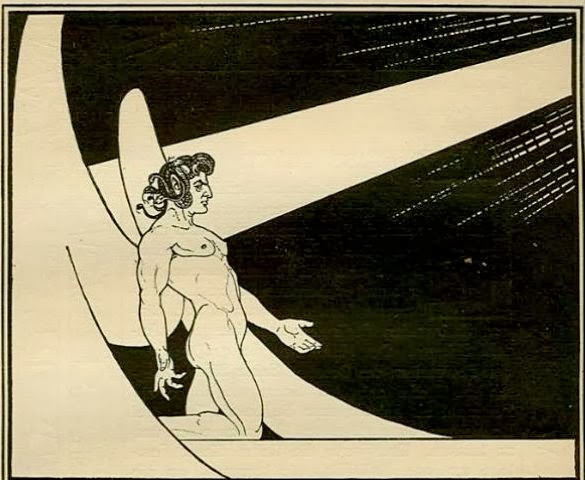
Satan Appears Before the Divine Presence, Ephraim Moses Lillen (1874-1925) Image from https://commons.wikimedia.org/wiki/Category:Book_of_Job#/media/File:Satan_appears_before_the_divine_presence.jpg

One of the difficult to reconcile portions of the prophetic witness to God is the all-encompassing view of God being responsible for all things. In the words of the prophet Isaiah:

I am the LORD, and there is no other; besides me there is no god. I arm you, though you do not know me, so that they may know, from the rising of the sun and from the west, that there is no one besides me; I am the LORD, and there is no other. I form light and create darkness, I make weal and create woe; I the LORD do all these things. Isaiah 45:5-7

Whatever is happening on the earth is directly attributable to the LORD who is not only the God of Israel but works through the movements of nations, natural disasters, the presence or absence of rain, the fruitfulness of both harvest, animals, and children. Everything for good or ill comes from God and can be attributed to either the faithfulness or unfaithfulness of the people. Yet, something shifts theologically in the post-exilic period and prior to the time of Jesus. My theory is that this shift occurs due to the experience of the faithful enduring suffering and the wicked prospering both at the individual and international level.

There seemed to be forces resisting the justice of God, forces larger than what the faithful could account for. Several solutions present themselves within Bible, one being that the ‘gods’ or ‘princes’ of the nations were resisting the forces of the God of Israel. This occurs in Daniel 10 where the ‘prince of the kingdom of Persia’ resists the divine messenger sent to respond to Daniel’s prayers for twenty-one days before the LORD dispatches Michael, ‘one of the chief princes’ to subdue this prince of the kingdom of Persia and allow the messenger to reach Daniel. Michael will later in Revelation 12 be viewed as the commander of the angel. Yet, one answer to this question of resistance to the justice of God was given by some of the faithful as being attributed to these divine protectors or princes of the nation. They were still subservient to the LORD the God of the earth, but their desires are not always aligned with the LORD.

Most people are unaware that throughout the Hebrew Scriptures there are no demons, no devil[1] and the character of Satan who only appears in Job, 1 Chronicles, and Zechariah is not the devilish opponent of God but rather acts as like a prosecuting attorney testing the people of God in God’s presence.  The most famous example of this is from Job:

One day the heavenly beings came to present themselves before the LORD, and Satan also came among them. The LORD said to Satan, “Where have you come from?” Satan answered the LORD, “From going to and fro on the earth, and from walking up and down on it.” The LORD said to Satan, “Have you considered my servant Job? There is no one like him on the earth, a blameless and upright man who fears God and turns away from evil.”  Then Satan  answered the LORD, “Does Job fear God for nothing? Have you not put a fence around him and his house and all that he has, on every side? You have blessed the work of his hands, and his possessions have increased in the land. But stretch out your hand now, and touch all that he has, and he will curse you to your face.” Job 1: 6-11

 Similarly in 1 Chronicles 21:1 Satan is responsible for convincing David to conduct his ill-conceived census and in Zechariah 3 Satan is the prosecuting attorney accusing the high priest Joshua before God. Satan is the accuser[2] and although he is responsible for deceiving David, convincing God to test the righteous Job, and accusing the high priest Joshua he is still considered one of the heavenly beings who works for God. He may be an uncomfortable character, but he is not considered evil or opposed to God.

There are others far more familiar with the intertestamental literature than I am, but one thing is clear between the conclusion of the Hebrew Scriptures and the beginning of the New Testament: the cosmology has drastically changed. The devil and demons are present and actively resist the kingdom of God, mislead the nations, and generally have an active role in the current governance of the world. Now instead of God being responsible for making weal and creating woe, now there are cosmic and demonic forces that create woe, while God is primarily resisting their activity to bring about good. There are a variety of imagery that the New Testament applies to these forces: demons, Satan, the devil in Matthew, Mark, and Luke. Sin (as an embodied and possessing forces) and Death in Paul’s letters as well as referring to cosmic rulers (particularly in Ephesians and Colossians) while these forces become embodied in the beasts and the dragon of Revelation.

Somewhere between the New Testament and the Hebrew Scriptures there evolves a view of the cosmos with entities actively opposed to God which help to explain for the prevalence of injustice and suffering in the world. It is different from the all-encompassing view of God being responsible for all things, both good and evil. The question of theodicy, of the persistence of evil in the presence of a powerful and righteous creator, becomes personified in the New Testament. Evil is concentrated in the devil and demons, Sin and Death (as entities) and the cosmic powers which are behind the nations resisting God. Revelation brings these forces into a personified conflict between the beasts of the land and sea, and the dragon which are defeated by the forces of God. The uncompromising prophetic view of God would have to view God in conflict with Godself to explain the injustice of the world, but by the New Testament there seems to be a split in the prophetic identity of God into God working for weal and these anti-God forces working to create woe.

[1] Some will argue that the serpent in the Garden of Eden is the devil, but he is never named thus in the Hebrew Scriptures.

[2] The title ha-satan in Hebrew means the Accuser.
Revelation 12 The Woman and the Dragon

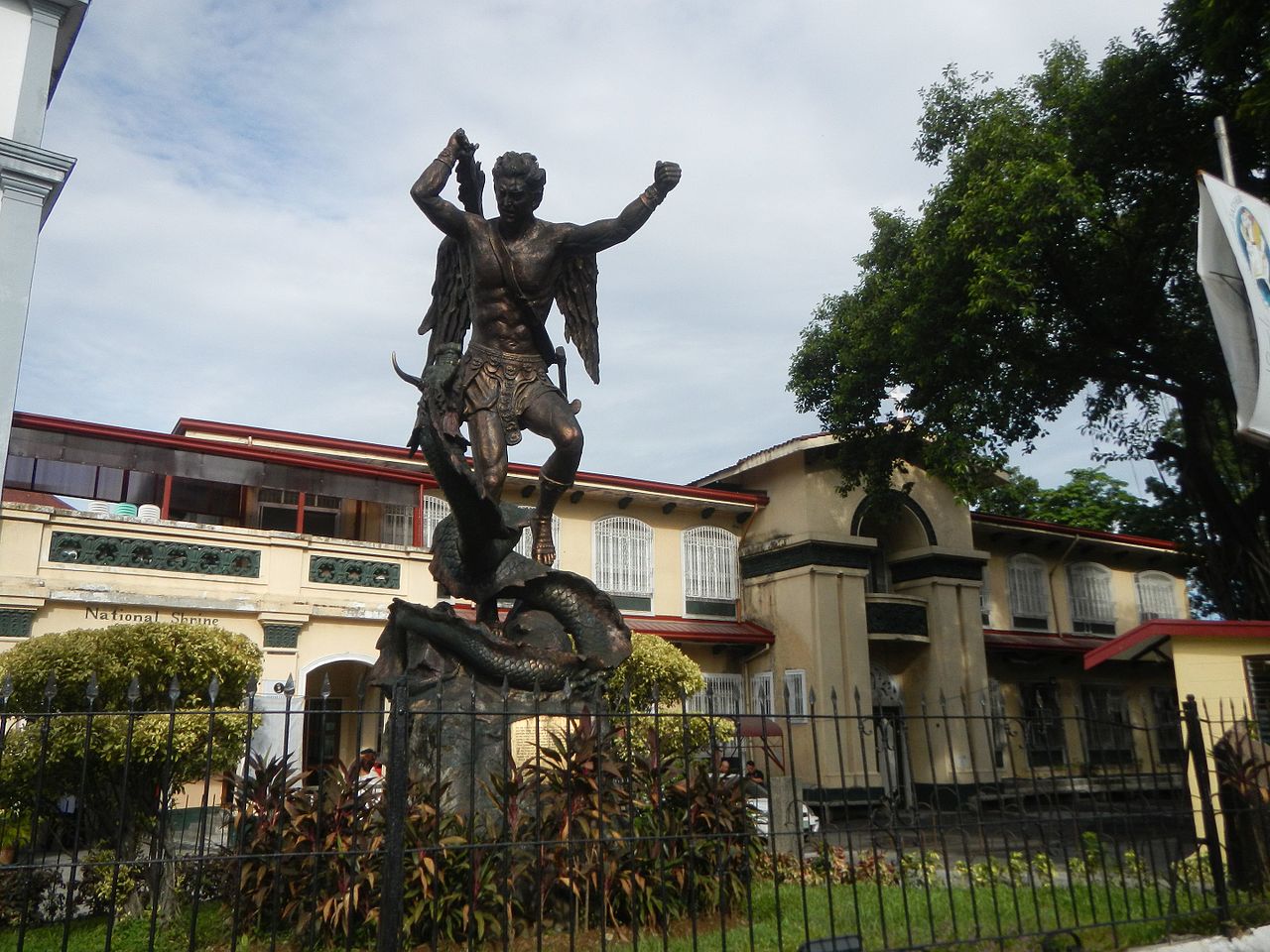
Saint Michael bronze statue at San Miguel Church (Manila) The Regal Parish and National Shrine of Saint Michael and the Archangels

Revelation 12

1 A great portent appeared in heaven: a woman clothed with the sun, with the moon under her feet, and on her head a crown of twelve stars. 2 She was pregnant and was crying out in birth pangs, in the agony of giving birth. 3 Then another portent appeared in heaven: a great red dragon, with seven heads and ten horns, and seven diadems on his heads. 4 His tail swept down a third of the stars of heaven and threw them to the earth. Then the dragon stood before the woman who was about to bear a child, so that he might devour her child as soon as it was born. 5 And she gave birth to a son, a male child, who is to rule all the nations with a rod of iron. But her child was snatched away and taken to God and to his throne; 6 and the woman fled into the wilderness, where she has a place prepared by God, so that there she can be nourished for one thousand two hundred sixty days.

7 And war broke out in heaven; Michael and his angels fought against the dragon. The dragon and his angels fought back, 8 but they were defeated, and there was no longer any place for them in heaven. 9 The great dragon was thrown down, that ancient serpent, who is called the Devil and Satan, the deceiver of the whole world — he was thrown down to the earth, and his angels were thrown down with him. 10 Then I heard a loud voice in heaven, proclaiming,

“Now have come the salvation and the power and the kingdom of our God and the authority of his Messiah, for the accuser of our comrades has been thrown down, who accuses them day and night before our God. 11 But they have conquered him by the blood of the Lamb and by the word of their testimony, for they did not cling to life even in the face of death. 12 Rejoice then, you heavens and those who dwell in them! But woe to the earth and the sea, for the devil has come down to you with great wrath, because he knows that his time is short!”

13 So when the dragon saw that he had been thrown down to the earth, he pursued the woman who had given birth to the male child. 14 But the woman was given the two wings of the great eagle, so that she could fly from the serpent into the wilderness, to her place where she is nourished for a time, and times, and half a time. 15 Then from his mouth the serpent poured water like a river after the woman, to sweep her away with the flood. 16 But the earth came to the help of the woman; it opened its mouth and swallowed the river that the dragon had poured from his mouth. 17 Then the dragon was angry with the woman, and went off to make war on the rest of her children, those who keep the commandments of God and hold the testimony of Jesus. 18 Then the dragon took his stand on the sand of the seashore.

The previous chapter gives us a key to understanding the unfolding images of the second half of Revelation when the twenty-four elders proclaim:

The nations raged but your wrath has come, and the time for judging the dead, for rewarding your servants, the prophets and saints and all who fear your name, both small and great, and for destroying those who destroy the earth. (Revelation 11: 18 emphasis added)

Up through the first eleven chapters of Revelation the cycle of the seals and trumpets may have caused destruction, but the desire was for those who were opposed to God and who were a part of the forces destroying the earth to see the Lord’s wrath, to hear the witness of the faithful and to repent. Now the narrative shifts decisively against those forces that are destroying the creation. The battle begins in chapter 12 with Satan being cast out of heaven and culminates with the casting of Satan into the lake of fire in Revelation 20.  Revelation in these chapters is revealing how the struggles the faithful are enduring are a part of the epic struggle between good and evil and how their faithful witness to the crucified and risen Jesus and their perseverance until the end is a part of the larger ways in which God’s kingdom overcomes the destructive forces aligned with the devil.

Revelation 12 is organized around three scenes with the critical scene in the middle. Scene A (1) runs from verse 1-6 and deals with the woman who gives birth and the dragon who wants to destroy her child. Scene B deals with the dragon being expelled from heaven by the angel Michael. Scene A (2) returns to the dragon pursuing the woman and making war on her and all her children. So visually the organization would look like:

Scene A (1) The woman in labor pursued by the dragon
Scene B The dragon is cast out of heaven
Scene A (2) The dragon makes war against the woman

There are a couple ways to interpret the figure of the woman: she could be viewed as Israel, as the church or as Mary. Ultimately these approaches are not mutually exclusive and interpreters throughout the history of the church have seen her in multiple ways. If she is Israel, then allegorically she is giving birth to Jesus, the child who the dragon wants to destroy, and the twelve stars could be the twelve tribes of Israel. The woman also could represent the church as the people of God. As we have seen earlier in Revelation, John has no trouble speaking of the church in terms of Israel’s vocation and promises and even Victorinus, who wrote the earliest known commentary on Revelation in the third century, the woman encompassed both Israel and the early church. (Koester, 2014, p. 525) If it is interpreted as the early church exclusively then the twelve stars become the twelve apostles allegorically. Finally, the story of the birth could be a cosmic explanation of the birth of Christ from Mary, his mother. This approach was favored especially as the Catholic church developed a high Mariology. As I mentioned above these approaches are not mutually exclusive: the church is viewed by John as having a vocation that is described in the same terms as the people of Israel had their vocation described and Mary has often been represented as the mother and representative of the church as a whole. In my reading I do see this being the case: the woman is Mary, but she is also by representation the whole people of God who the dragon is attempting to persecute. The dragon works through Herod the Great to bring a threat to Mary’s child and she is snatched away to flee through the wilderness into Egypt, but it also represents the displacement of the people of God who are also scattered by the oppression they feel. Mary’s story viewed in this light becomes their story and their story is linked to hers. They become, with her, a part of the cosmic drama unfolding as God begins to deal with the forces that are destroying the earth.

The dragon is named as the Devil and Satan. There are countless narratives in the ancient world of the conflict between and hero and a dragon, where the dragon represents the terrifying forces of uncontrollable destruction but here there is a difference. For example, in the Greek story of Leto and Apollo being pursued by the serpent Python or the goddess Isis being pursued by Typhon may have a similar pattern of a serpent creature attempting to destroy a goddess or god, but the specifics of the stories vary greatly. Ultimately the seven headed dragon is the source of all the forces that oppose the will of God and the coming of the child and that the beasts in the next chapter will derive their power from. Yet, the dragon here is cast out of heaven which both initiates the process that will ultimately lead to the dragon’s destruction but also increases its wrath and influence upon the earth.

The middle scene where Michael and his angels fight against the dragon and defeat them provide the interpretive key for both this chapter and the rest of Revelation.  As Craig Koester can succinctly state:

Then a heavenly voice announces the victory of God, the Lamb and the faithful and warns that the devil is furious because he has only a short time left in which to work (12:10-12). The point is that the evil one does not rage so fiercely on earth because he is so powerful, but because he is losing and desperate. Satan lashes out like a caged and wounded animal before his final defeat. (Koester, 2014, p. 555)

The banishment of Satan from heaven is a demonstration of the limits of the power of his malice but it is still a woe to those who must deal with his attempts to persecute them on earth. I’ve used a historical example when talking about this with members in my congregation: during the Civil War the decisive battle was ultimately Gettysburg, the war would rage on for years after this battle, but the Confederate army’s strategy would be dictated from that point onward by the superior manpower and logistics of the Union. The only way there could have been a different outcome after Gettysburg was if the Northern states decided the war was too costly or no longer worth fighting. Here in Revelation we are to see that the dragon has already been defeated, and it only took an emissary of God to cast down the great dragon. The conflict may continue for those who are aligned with God’s will and who are faithful to the Lamb, but the final victory is certain.

The woman returns in the final scene and becomes, along with her children the object of pursuit by the dragon. Yet now both heaven and earth work against the dragon. The woman in the vision is given the ability to fly away into the wilderness where she is protected for a time, and times and a half time. Even the earth itself works to protect the woman by opening its mouth to swallow the flood that the dragon pours out to attempt to overwhelm her. This is truly a cosmic struggle where the earth itself resists the forces that have set out to destroy the woman and the rest of creation.

This chapter, like the previous chapter have several parallel images with Daniel 12, and these images will figure heavily in the coming chapters of Revelation. Here two images reflect directly on this chapter: at the beginning of Daniel 12 we have the emergence of Michael.

“At that time Michael, the great prince, the protector of your people, shall arise. There shall be a time of anguish, such has never occurred since nations first came into existence. But at that time your people shall be delivered, everyone who is found written in the book. Daniel 12: 1

Michael is the guardian of the Jewish people in Daniel who rises to protect them during their persecution. Here Michael’s action on behalf of the woman/Israel/church/people of God sets in motion the beginning of the end for the Devil, but also in doing so initiates a time of great suffering for those on earth. The time of the woman’s residence in the wilderness also echoes the time, two times and a half time of Daniel 12: 7. In addition to the two images from Daniel 12, the casting of the stars from the heavens by the dragon also echoes Daniel 8: 10 when a blasphemous horn grows as high of the host of heaven and throws down some of the stars to the earth. Revelation takes several of these images from the book of Daniel and they become language used to describe this cosmic battle between the forces that are opposed to God and the creation and the forces that may seem small and insignificant, the woman and her children, but ultimately are aligned with the forces of God and heaven and whose victory will eventually come.