Tag Archives: Reign of God

Psalm 98 A Joyous Song of God’s Salvation

Statue of Watts, Abney Park Cemetery


Psalm 98

<A Psalm.>
1 O sing to the LORD a new song, for he has done marvelous things. His right hand and his holy arm have gotten him victory.
2 The LORD has made known his victory; he has revealed his vindication in the sight of the nations.
3 He has remembered his steadfast love and faithfulness to the house of Israel. All the ends of the earth have seen the victory of our God.
4 Make a joyful noise to the LORD, all the earth; break forth into joyous song and sing praises.
5 Sing praises to the LORD with the lyre, with the lyre and the sound of melody.
6 With trumpets and the sound of the horn make a joyful noise before the King, the LORD.
7 Let the sea roar, and all that fills it; the world and those who live in it.
8 Let the floods clap their hands; let the hills sing together for joy
9 at the presence of the LORD, for he is coming to judge the earth. He will judge the world with righteousness, and the peoples with equity.

Isaac Watt’s well known Christmas song “Joy to the World” is inspired by Psalm 98, (Mays, 1994, p. 312) although instead of heaven and nature singing as in “Joy to the World”, the seas and the nations sing in the text of the psalm. The appropriate response of the people of God, the nations of the earth, and the elements and residents of the waters to the victory (or salvation)[1] of God is the boisterous music of praise and worship. The vocal and instrumental music of humanity joins with the harmonic and percussive notes of the earth and the land. The approach of the LORD the God of Israel to judge the world with righteousness and the peoples of the earth with equity is a moment of celebration for all the earth. The faithful ones are the sentinels announcing to the peoples of the world that the time has come to join in the song of creation as the marvel and salvation of God.

The salvation of God and the reign of God’s righteousness is a moment of joyous expectation for all of creation. The house of Israel has experienced God’s steadfast love[2] and faithfulness, but all the nations of the earth also witnessed God’s salvation and the creation itself responds in joy. As Ellen Davis can state,

Judgment is the positive and passionate assertion of God’s will for the world, beginning with the deep foundation of God’s rule in the human heart; therefore, it gives no quarter to deception and self-delusion. (Nancy deClaisse-Walford, 2014, p. 728)

The faithful ones know the internal dimension of God’s reign in their lives and yearn for the revelation of God’s reign in the world seen across governments and nations. Yet, the longing of the faithful is also the longing of the creation for God’s judgement which brings God’s kingdom to earth, so the ways of steadfast love and faithfulness experienced in the heavens may be done on earth. The only response is the joyous song of lyre, trumpet and voice joining the collection of the sounds of the sea, the rains, and the hills. Nature joins the song of heaven and both the faithful and the wicked bear witness to the moment when heaven and nature sing along with the upraised voices of people throughout the world.

[1] The Hebrew verb ysh is typically translated salvation and it occurs in each of the first three verses (victory in NRSV’s translation).

[2] Hebrew hesed.
Psalm 97 The Righteous Reign of God

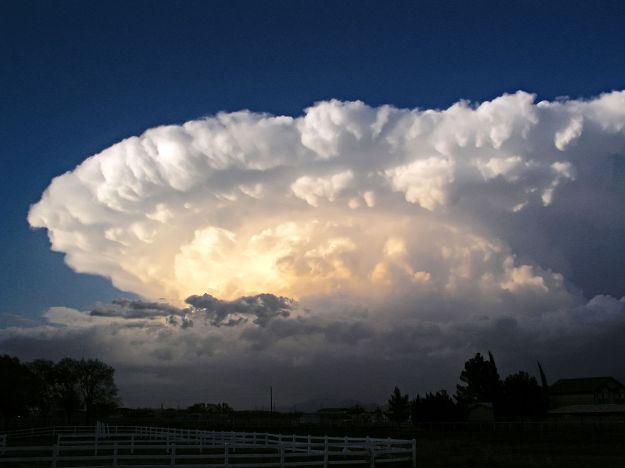
Supercell Thunderstorm over Chaparral, New Mexico on April 3, 2004

Psalm 97

1 The LORD is king! Let the earth rejoice; let the many coastlands be glad!
2 Clouds and thick darkness are all around him; righteousness and justice are the foundation of his throne.
3 Fire goes before him, and consumes his adversaries on every side.
4 His lightnings light up the world; the earth sees and trembles.
5 The mountains melt like wax before the LORD, before the Lord of all the earth.
6 The heavens proclaim his righteousness; and all the peoples behold his glory.
7 All worshipers of images are put to shame, those who make their boast in worthless idols; all gods bow down before him.
8 Zion hears and is glad, and the towns of Judah rejoice, because of your judgments, O God.
9 For you, O LORD, are most high over all the earth; you are exalted far above all gods.
10 The LORD loves those who hate evil; he guards the lives of his faithful; he rescues them from the hand of the wicked.
11 Light dawns for the righteous, and joy for the upright in heart.
12 Rejoice in the LORD, O you righteous, and give thanks to his holy name!

One of the losses of our modern, technology filled world is the patient hope of the psalmist and the prophets for the arrival of God’s kingdom. James L. Mays notes that Psalm 97 shares several key images and ideas with the portions of Isaiah most scholars attribute to Judah’s time in exile.[1] (Mays, 1994, p. 311) The psalmist’s proclamation of God’s reign causing the earth, Judah, and the righteous to rejoice were always contested claims. Israel and Judah lived in a world of multiple religious options and empires who exercised military, economic, and political might over Israel or Judah. Yet, the psalms and the prophets exhibit a persistent faith that despite the evidence to the contrary the God of Israel reigns over creation, is chief among the gods of the nations, and continues to sow joy and righteousness in the upright in heart. It is only through the eyes of faith that these poets can rejoice with the earth and the coastland because their vision has revealed to them that the LORD, the God of Israel and Judah, is king.

The vision of God in the psalms and the prophets may, as Brueggemann and Bellinger comment, retain the “remnants of a storm god.” (Brueggemann, 2014, p. 418) but as in Psalm 29 the use of the language of clouds and darkness, fire, lightning, and earthquake takes the primary language for the power of the Canaanite god Baal and now uses it to describe the power of the LORD the God of Israel. This imagery also resonates with the appearance of the LORD to the people at Mount Sinai in Exodus 19:16-19. The psalmist longs for the day for all the people to see what the eyes of faith trust: that the idols of the nations are worthless, that the kings of the earth and the gods of the nations are powerless before the LORD who is king, and that the power of the wicked over the faithful will end as God rescues them.

God’s righteousness and justice are the foundation of God’s throne, and they are also the foundation for the hopeful imagination of the psalmist. The heavens can proclaim God’s righteousness and the people of Judah can find reasons for rejoicing and gladness because of God’s judgments. Because God’s reign is based on righteousness it opens the possibility that people in Judah and beyond the borders of Judah can live as righteous ones rather than adopting the ways of the wicked. The response throughout the poem to the righteousness and justice of God is joy and gladness. The earth can rejoice, and the coastlands can be glad because the creation bears witness to the just reign of God. Zion can be glad, and the towns of Judah can rejoice because God judges with righteousness. The ones loving the LORD will hate evil[2] and God will guard their lives and sows[3] light and joy in these faithful ones of upright hearts. These righteous ones planted with light and joy in the rejoicing earth now join the earth’s joy at the celebration of God’s reign.

[1] See for example Isaiah 40: 5, 9-11; 42:17, and 52: 7-10

[2] In both the MT (Hebrew) and LXX (Greek translation) the direct translation is “The ones loving the LORD hate evil” as the NIV captures. The NRSV follows the translation of scholars who in their attempt to smooth our the translation change the subject to God, but there is no reason to make this change to the original text. (Nancy deClaisse-Walford, 2014, p. 724)

[3] Some change this word to a similar Hebrew word for ‘rise, shine’ (hence the NRSV translation) but the metaphor of sowing light fits with the imagination of the psalmist. (Nancy deClaisse-Walford, 2014, p. 724)

Psalm 93 God the King

Stained Glass window at the Melkite Catholic Annunciation Cathedral in Roslindale, MA depicting Christ the King with the regalia of a Byzantine Emperor


Psalm 93

1 The LORD is king, he is robed in majesty; the LORD is robed, he is girded with strength. He has established the world; it shall never be moved;
2 your throne is established from of old; you are from everlasting.
3 The floods have lifted up, O LORD, the floods have lifted up their voice; the floods lift up their roaring.
4 More majestic than the thunders of mighty waters, more majestic than the waves of the sea, majestic on high is the LORD!
5 Your decrees are very sure; holiness befits your house, O LORD, forevermore.

This short psalm focused on the image of God as king makes explicit one of the assumptions of the psalter and the bible as a whole. Underneath the praise, lament, prayers, and appeals of the psalter is the understanding of God’s position of sovereignty and strength in relation to the people of God, the nations, and the world itself. God is able to respond because God is the sovereign over all creation. The God who is over all gods and who is the creator to whom the creation gives praise is also the object of the worship and the source of hope for the people of is the God. They confess that this God reigns in majesty and strength from everlasting.

The sovereignty of God is not linked to the king of Israel or Judah as in Psalm 2 and it is possible that this psalm emerges in a time where there is no earthly king who is entrusted with authority on behalf of God. In both Christianity and Judaism, “the reign of God is always proclaimed amid circumstances that seem to deny it.” (NIB IV: 1055) No matter the political situation the person proclaiming this psalm finds themselves within, the confession of God’s continuing reign over creation, the nations, and the world becomes a bedrock for the faith of the community. God’s decrees remain established and no floods or crashing waves can wash them away. No rulers or gods can rival God’s sovereignty.

Proclaiming God’s sovereignty in the midst of a secular world is an act of faith and defiance. It is only through the eyes of faith that the faithful one can witness the forces of creation giving praise to God. There may be moments where the reign of God is clearly visible to the faithful, but it often remains hidden by ‘circumstances that seem to deny it.’ Yet, the bedrock trust that God remains in control of the creation and that God reigns in strength is central to the life of faith.