Tag Archives: Prophet Elisha

2 Kings 9 The Violent End of the Omri Dynasty Begins

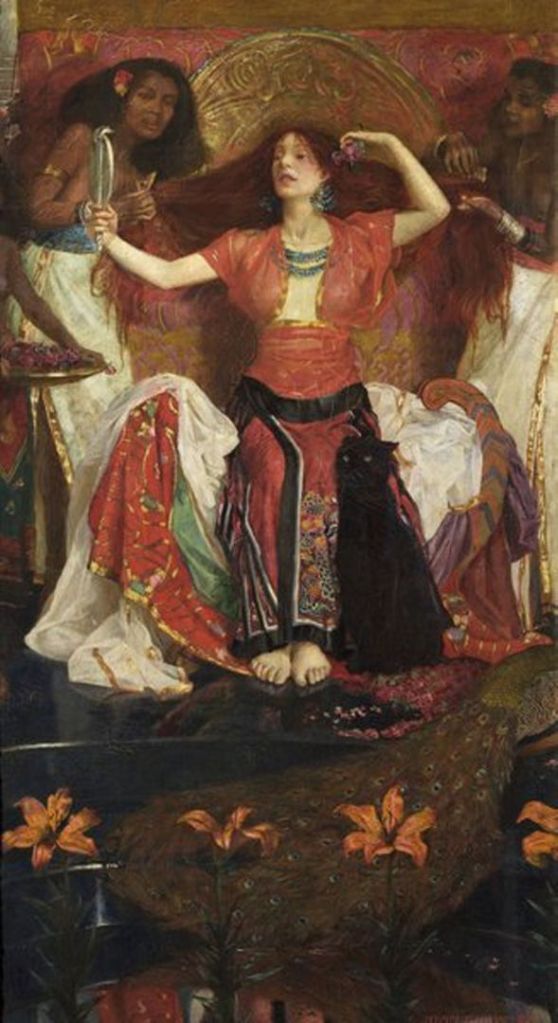
John Liston Byram Shaw, Jezebel. Museum: Russell-Cotes Art Gallery and Museum, Bournemouth, UK

2 Kings 9: 1-13 The Anointing of Jehu

1Then the prophet Elisha called a member of the company of prophets and said to him, “Gird up your loins; take this flask of oil in your hand, and go to Ramoth-gilead. 2When you arrive, look there for Jehu son of Jehoshaphat son of Nimshi; go in and get him to leave his companions, and take him into an inner chamber. 3Then take the flask of oil, pour it on his head, and say, ‘Thus says the Lord: I anoint you king over Israel.’ Then open the door and flee; do not linger.”
  4
So the young man, the young prophet, went to Ramoth-gilead. 5He arrived while the commanders of the army were in council, and he announced, “I have a message for you, commander.” “For which one of us?” asked Jehu. “For you, commander.” 6So Jehu got up and went inside; the young man poured the oil on his head, saying to him, “Thus says the LORD the God of Israel: I anoint you king over the people of the LORD, over Israel. 7You shall strike down the house of your master Ahab, so that I may avenge on Jezebel the blood of my servants the prophets and the blood of all the servants of the Lord. 8For the whole house of Ahab shall perish; I will cut off from Ahab every male, bond or free, in Israel. 9I will make the house of Ahab like the house of Jeroboam son of Nebat and like the house of Baasha son of Ahijah. 10The dogs shall eat Jezebel in the territory of Jezreel, and no one shall bury her.” Then he opened the door and fled.
  11
When Jehu came back to his master’s officers, they said to him, “Is everything all right? Why did that madman come to you?” He answered them, “You know the sort and how they babble.” 12They said, “Liar! Come on, tell us!” So he said, “This is just what he said to me: ‘Thus says the LORD, I anoint you king over Israel.’ ” 13Then hurriedly they all took their cloaks and spread them for him on the bare steps, and they blew the trumpet and proclaimed, “Jehu is king.”

In the previous chapter the long-delayed mission given to Elijah in 1 Kings 19: 15-18 to bring about the end of the Omri dynasty begins in earnest with the prophet Elisha acting as a catalyst in the rise of Hazael “son of nobody” to kill his master Ben-hadad and become the king of Aram. Now Elisha sets in motion God’s second instrument in the destruction of the Omri dynasty, Jehu. The prophet sends another member of the sons of the prophets (NRSVue company of prophets) to carry out this task of anointing Jehu, one of the commanders of the army, as the new king of Israel. Elisha may have been too well known to enter into the camp at Ramoth-gilead without creating whispers, but this young prophet goes in his stead to set Jehu in motion.

Choon Leong-Seow makes an educated assumption that these officers may be already plotting a coup based on how quickly they fall in line behind Jehu. (NIB III:217) Ultimately the narrative of 2 Kings does not give us any indication of this as the young prophet approaches, but a wounded and beaten leader recovering away from his military leaders is often viewed as vulnerable. It is also possible that some of these leaders may have viewed Elijah and Elisha favorably, and Jehu in particular is very aware of the words of Elijah and may even have a relationship with the sons of the prophets. This is all speculative, but it makes Jehu’s quick following of the young prophet to a place where he is anointed plausible.

The commissioning of Jehu as king is instrumental in his fulfilling of Elijah’s earlier condemnation of King Ahab’s line and Jezebel in the aftermath of the murder of Naboth in Jezreel to allow the king to take possession of his vineyard. (1 Kings 21) Jehu is named as the son of Jehoshaphat and the grandson of Nimshi, and while the inclusion of the grandfather in the patronym is unusual and may indicate the grandfather’s greater stature in the memory of the people than the father, it is likely that the inclusion of the grandfather’s name is to differentiate his line from Jehoshaphat son of Asa, the former king of Judah. Jehu is not coming from a royal bloodline, yet he is not a nobody. He is a commander of the army who the other commanders quickly acknowledge publicly as their leader.

In the aftermath of the prophet’s dangerous action and rapid departure, Jehu is questioned by his fellow officers about the message of ‘that madman.’ Prophets may have been viewed as mad because they were known to have ecstatic experiences, but they also were frequently (during the Omri dynasty) people who challenged the royal power. The anointing of Jehu is a dangerous action for Jehu if his colleagues view him as a traitor and he initially downplays the prophet’s purpose and message. After being convinced by his fellow officers to speak, these fellow officers join in this public act of declaring Jehu king. This act echoes the coming together of religious leaders and military leaders who anoint and blow the trumpet to declare Solomon king at the instructions of David. (1 Kings 1: 32-40) Jehu anointed by both the prophets and the military leaders moves quickly to become God’s instrument (in the view of 2 Kings) to remove the descendants of Ahab and his former wife Jezebel from their positions of power in Israel.


2 Kings 9: 14-29 Jehu Kills Joram and Ahaziah

  14Thus Jehu son of Jehoshaphat son of Nimshi conspired against Joram. Joram with all Israel had been on guard at Ramoth-gilead against King Hazael of Aram, 15but King Joram had returned to be healed in Jezreel of the wounds that the Arameans had inflicted on him when he fought against King Hazael of Aram. So Jehu said, “If this is your wish, then let no one slip out of the city to go and tell the news in Jezreel.” 16Then Jehu mounted his chariot and went to Jezreel, where Joram was lying ill. King Ahaziah of Judah had come down to visit Joram.
  17
In Jezreel, the sentinel standing on the tower spied the company of Jehu arriving and said, “I see a company.” Joram said, “Take a horseman; send him to meet them, and let him say, ‘Is it peace?’ ” 18So the horseman went to meet him; he said, “Thus says the king, ‘Is it peace?’ ” Jehu responded, “What have you to do with peace? Fall in behind me.” The sentinel reported, saying, “The messenger reached them, but he is not coming back.” 19Then he sent out a second horseman, who came to them and said, “Thus says the king, ‘Is it peace?’ ” Jehu answered, “What have you to do with peace? Fall in behind me.” 20Again the sentinel reported, “He reached them, but he is not coming back. It looks like the driving of Jehu son of Nimshi, for he drives like a maniac.”
  21
Joram said, “Get ready.” And they got his chariot ready. Then King Joram of Israel and King Ahaziah of Judah set out, each in his chariot, and went to meet Jehu; they met him at the property of Naboth the Jezreelite. 22When Joram saw Jehu, he said, “Is it peace, Jehu?” He answered, “What peace can there be, so long as the many prostitutions and sorceries of your mother Jezebel continue?” 23Then Joram reined about and fled, saying to Ahaziah, “Treason, Ahaziah!” 24Jehu drew his bow with all his strength and shot Joram between the shoulders, so that the arrow pierced his heart, and he sank in his chariot. 25Jehu said to his aide Bidkar, “Lift him out and throw him on the plot of ground belonging to Naboth the Jezreelite, for remember when you and I rode side by side behind his father Ahab how the Lord uttered this oracle against him: 26For the blood of Naboth and for the blood of his children that I saw yesterday, says the LORD, I swear I will repay you on this very plot of ground.’ Now, therefore, lift him out and throw him on the plot of ground in accordance with the word of the LORD.”

  27
When King Ahaziah of Judah saw this, he fled in the direction of Beth-haggan. Jehu pursued him, saying, “Shoot him also!” And they shot him in the chariot at the ascent to Gur, which is by Ibleam. Then he fled to Megiddo and died there. 28His officers carried him in a chariot to Jerusalem and buried him in his tomb with his ancestors in the city of David.
  29
In the eleventh year of Joram son of Ahab, Ahaziah began to reign over Judah.

Both King Joram of Samaria and King Ahaziah of Judah are at Jezreel and Joram lies ill after the battle with the Arameans. With the rest of the military remaining at Ramoth-gilead, Jehu acts quickly with his co-conspirators, preventing word from reaching Jezreel in advance of Jehu’s plot. Jehu mounts his chariot and heads west from Ramoth-gilead, across the Jordan river to Jezreel. Jehu is not traveling alone and is, in the later words of the sentinel driving his company like a madman[1] which is something Jehu is apparently known for. The sentinel dispatches a first horsemen who asks on behalf of the king, “Is it shalom (peace)” to which Jehu responds “What have you to do with shalom? Fall in behind me.” The first and later the second horseman, which echoes these words, obediently fall in behind Jehu rather than return to their post in Jezreel. Jehu is apparently a commander who the men respect and follow even in the violation of their king’s orders.

Finally, both Kings Joram and Ahaziah each mount up in their chariots to meet this approaching company under Jehu, and they meet at the property that once belonged to Naboth the Jezreelite. King Joram once again asks Jehu, ”Is it shalom?” Jehu’s response leaves no doubt his intentions are not peaceful, and King Joram is able to cry to Ahaziah “treason” before he is shot with a single arrow, similar to his father Ahab’s death in 1 Kings 22: 34. Unlike his father he is likely shot in the back while fleeing (the shot is literally between the arms so technically could be from the front but it is less likely to pierce the heart if the king is wearing a breastplate) and unlike his father who receives a royal burial in Samaria he is cast in the field taken from the murdered Naboth.

King Ahaziah of Judah also married into the family of King Ahab, and we learned that he was practicing the ways of the Omri dynasty as well. He is also mortally wounded in the conflagration, but he is taken to Jerusalem for a royal burial. In this moment of treachery, in the view of Joram and Ahaziah, or judgment, in the view of Jehu and Elisha, the leaders of both Samaria and Jerusalem are gone. Now Jehu turns his attention Jezebel who the texts views as the force behind the corruption of the leaders in both Israel and Judah.


2 Kings 9: 30-37 The Death of Jezebel

  30When Jehu came to Jezreel, Jezebel heard of it; she painted her eyes and adorned her head and looked out of the window. 31As Jehu entered the gate, she said, “Is it peace, Zimri, murderer of your master?” 32He looked up to the window and said, “Who is on my side? Who?” Two or three eunuchs looked out at him. 33He said, “Throw her down.” So they threw her down; some of her blood spattered on the wall and on the horses, which trampled on her. 34Then he went in and ate and drank; he said, “See to that cursed woman and bury her, for she is a king’s daughter.” 35But when they went to bury her, they found no more of her than the skull and the feet and the palms of her hands. 36When they came back and told him, he said, “This is the word of the LORD, which he spoke by his servant Elijah the Tishbite: In the territory of Jezreel the dogs shall eat the flesh of Jezebel; 37the corpse of Jezebel shall be like dung on the field in the territory of Jezreel, so that no one can say, ‘This is Jezebel.’ ”

Jezebel is viewed by 1&2 Kings as a corrupting influence on Israel and recently Judah through the marriage of her daughter Athaliah to Jehoram, who is the mother of the current king Ahaziah. Jezebel had brought the practices of royalty in Tyre to Samaria. Yet, in the midst of Jehu’s uprising she puts on makeup and dresses in a way that denotes her position as the queen mother. Most modern readers discount Jehu’s accusation of Jezebel’s prostitutions and sorceries (v. 22) as reflecting her worship of other gods and practices outside the laws and statues of Israel, but it is entirely possible that Jehu believes that she practices magic of some type. She mocks Jehu from her tower with the memory of Zimri (1 Kings 16: 9-16) another army officer who reigned briefly after striking down his king. Ironically Zimri was defeated by an army led by Omri, the father of Ahab-Jezebel’s late husband.

Two or three eunuchs throw Jezebel from her tower which in a moment, “transformed the narcissistic queen to a piece of rubbish in the streets.” (Brueggemann, 2000, p. 388) Jehu is unbothered by this gory site and enters the tower to eat and drink after his chariot ride and bloody work. He sends men to see to her body, although his remark that she is a king’s daughter may be ironic since he has already cast a king’s son out on the land of Naboth. Ultimately, there is not enough of Jezebel to bury which fulfills Elijah’s words in 1 Kings 21:23. The assassination of Jezebel does end a half-century alliance between Samaria and Tyre (Cogan, 1988, p. 120) but the writer of 2 Kings ultimately views this as a positive. The prophet Hosea would later criticize Jehu (Hosea 1:4) but the author of 2 Kings views his actions in this time as a necessary violence to bring about the needed end of the Omri dynasty which had corrupted northern Israel as well as Judah.


[1] This is the same Hebrew word, shuggah, used to refer to the young prophet in the previous section.

2 Kings 8 Transitioning from Prophetic Time to a Major Transition in Royal Time

Ivory carving found at Arslan Tash, Syria. A cache of ivories found at the Assyrian outpost of Arslan Tash was undoubtedly booty taken from Hazael’s palace in Damascus. The regal figure depicted on this piece is probably Hazael himself. (Louvre Museum, Paris)

2 Kings 8: 1-6 

1Now Elisha had said to the woman whose son he had restored to life, “Get up and go with your household and settle wherever you can, for the LORD has called for a famine, and it will come on the land for seven years.” 2So the woman got up and did according to the word of the man of God; she went with her household and settled in the land of the Philistines seven years. 3At the end of the seven years, when the woman returned from the land of the Philistines, she set out to appeal to the king for her house and her land. 4Now the king was talking with Gehazi the servant of the man of God, saying, “Tell me all the great things that Elisha has done.” 5While he was telling the king how Elisha had restored a dead person to life, the woman whose son he had restored to life appealed to the king for her house and her land. Gehazi said, “My lord king, here is the woman, and here is her son whom Elisha restored to life.” 6When the king questioned the woman, she told him. So the king appointed an official for her, saying, “Restore all that was hers, together with all the revenue of the fields from the day that she left the land until now.”

Elisha continues to provide for this woman who showed him hospitality and warns her and her child to flee the coming famine. The husband is not mentioned and is likely dead at this point in their story and this woman acts as a head of household. The seven years of famine matches the seven-year cycle of Genesis 41: 25-30 which causes the sons of Israel to seek food in Egypt, but here the famine is far more localized. Seven is a common biblical number of completion or a long time, and so the actual span of the drought may be longer or shorter than this commonly used number to designate a completed time. The woman makes her temporary home in Philistia, roughly 100 miles away, and avoids the impact of the famine. The famine is not explicitly stated as God’s judgment on the Omri dynasty in Samaria and is likely linked to the famine mentioned in the previous chapter during the siege of Samaria, but the famine as a part of God’s judgment against the Omri dynasty can be implied in the story. The stories of the last several chapters which chronicle the works of Elisha probably exist beyond the twelve years of King Jehoram of Judah (even though Jehoram’s reign brackets these stories). The king who is interested in the works of Elisha is the king of Israel, but likely not Jehoram or any other king of the Omri line.

Gehazi reemerges in the story, and this may either precede his affliction with leprosy/skin disease,[1] after some unmentioned healing of his disease, or he may remain afflicted. Whatever his condition he is able to converse with the king of Israel about the acts of Elisha. As he describes Elisha’s raising of the woman’s son, he points to this woman who has come to “cry out” (NRSVue appeal)[2] for the return of her property. The Torah imagines a world where the property of a family would be held by that family in perpetuity, but the narrative of scripture points to a different reality. It is possible that in her absence a relative or even squatters have come in and taken over her land, or that in her absence it became crown land, but this once well-connected woman now comes to appeal for her property. Her connection to Elisha allows her appeal to be heard by this king who is interested in the acts of Elisha, and her “crying out” is heard by the king who appoints an official[3] to restore not only her land but also the revenue from the land in the time of her absence.

2 Kings 8: 7-15

  7Elisha went to Damascus while King Ben-hadad of Aram was ill. When it was told him, “The man of God has come here,” 8the king said to Hazael, “Take a present with you and go to meet the man of God. Inquire of the LORD through him, whether I shall recover from this illness.” 9So Hazael went to meet him, taking a present with him, all kinds of goods of Damascus, forty camel loads. When he entered and stood before him, he said, “Your son King Ben-hadad of Aram has sent me to you, saying, ‘Shall I recover from this illness?’ ” 10Elisha said to him, “Go, say to him, ‘You shall certainly recover,’ but the LORD has shown me that he shall certainly die.” 11He fixed his gaze and stared at him to the point of embarrassment. Then the man of God wept. 12Hazael asked, “Why does my lord weep?” He answered, “Because I know the evil that you will do to the people of Israel; you will set their fortresses on fire; you will kill their young men with the sword, dash in pieces their little ones, and rip up their pregnant women.” 13Hazael said, “What is your servant, who is a mere dog, that he should do this great thing?” Elisha answered, “The LORD has shown me that you are to be king over Aram.” 14Then he left Elisha and went to his master Ben-hadad, who said to him, “What did Elisha say to you?” And he answered, “He told me that you would certainly recover.” 15But the next day he took the bedcover and dipped it in water and spread it over the king’s face, until he died. And Hazael succeeded him.

The prophet Elijah when he was instructed to anoint Elisha to be prophet in his place was also commanded to appoint Hazael as king over Aram and Jehu as king over Israel (1 Kings 19: 15-17). Elijah did call Elisha, but now it is Elisha who is engaged in Hazael’s ascension to power in Damascus. The story is an inversion of the story in 2 Kings 1 where King Ahaziah, king in Samaria, sends to inquire of Baal-zebub, the god of Ekron. While the king of Israel appeals to the god of Ekron, now a foreign king appeals to the prophet of Israel to inquire of the LORD his God. Yet, this inquiry of Ben-hadad sets in motion his demise despite the affirmative answer of the prophet. The prophetic messenger appoints Hazael to do the work that prophets do not do. The involvement of the prophet in both a lie and the politics of a foreign power has caused discomfort for some readers.

In the scriptures God often works through foreign powers, even if these powers are unaware of their participation in God’s action of judgment or deliverance. Hazael, the servant of Ben-hadad approaches the prophet with a large gift for this emissary of the God of Israel, but unlike Naaman’s large gift we never learn the disposition of the forty camel loads of gifts offered to the prophet. Hazael is informed of his role even though the prophet regrets the damage he will do to the people of Israel. Although Elisha gives Hazael the message that the king will recover from the illness, he also sets in motion a chain of events that lead to King Ben-hadad’s death at the hands of his servant. The prophet Amos views Hazael’s ascension as God’s act as well, but as a judgment on Ben-hadad (Amos 1: 3-4) but in Elisha’s view what is important is Hazael’s actions towards Israel. Following the original commissioning of Elijah to set Hazael over Aram and Jehu over Israel, both Aram and Jehu (and Elisha) are the swords that shall kill many. Many modern readers recoil at the violence of the actions attributed to Hazael in the prophet’s words, but war in the ancient world was violent. War of all times is violent, and innocent people often pay a heavy cost but armies in the ancient world did not act with the same restraint that modern militaries do in attempting to limit the destructiveness of the soldiers unleashed to practice violence on the enemy land and people. Hazael acknowledges that the violence the prophet describes would be a “great thing” and his only protest is that he is too insignificant to be able to accomplish this great thing. God has designated Hazael as a part of God’s plan for Israel, but Hazael is a blunt instrument that will incur a lot of damage in the removal of the Omri dynasty.

Elisha may weep for the future that he sees but he remains faithful to God’s vision. The ways of the Omri dynasty have led the people of Israel away to following other gods and unjust practices. Elisha may have wrestled with his role in being a part of the (ultimately) violent solution to the wicked (in the view of 2 Kings) kings of Israel who have now corrupted even the line of kings in Judah (see below). Many of the stories of Elisha have shown him working with individuals and groups in miraculous ways to help them navigate this world of famines and sieges. Yet, the narrative of 2 Kings attempts to understand how God is at work in the collapse of both Israel and Judah working through Aram, Assyria, and Babylon. Hazael, son of a nobody, as a large basalt statue of Shalmaneser refers to him derogatorily, (Cogan, 1988, p. 90) may not be anointed by Elisha in this story, but Elisha gives him the vision that leads to the suffocation of his ailing master and allows the son of a nobody to grasp power in Aram and to become God’s blunt instrument utilized in the judgment of Israel.

2 Kings 8: 16-29

  16In the fifth year of King Joram son of Ahab of Israel, Jehoram son of King Jehoshaphat of Judah began to reign. 17He was thirty-two years old when he became king, and he reigned eight years in Jerusalem. 18He walked in the way of the kings of Israel, as the house of Ahab had done, for the daughter of Ahab was his wife. He did what was evil in the sight of the LORD. 19Yet the LORD would not destroy Judah, for the sake of his servant David, since he had promised to give a lamp to him and to his descendants forever.
  20
In his days Edom revolted against the rule of Judah and set up a king of their own. 21Then Joram crossed over to Zair with all his chariots. He set out by night and attacked the Edomites and their chariot commanders who had surrounded him, but his army fled home. 22So Edom has been in revolt against the rule of Judah to this day. Libnah also revolted at the same time. 23Now the rest of the acts of Joram and all that he did, are they not written in the Book of the Annals of the Kings of Judah? 24So Joram slept with his ancestors and was buried with them in the city of David; his son Ahaziah succeeded him.

  25
In the twelfth year of King Joram son of Ahab of Israel, Ahaziah son of King Jehoram of Judah began to reign. 26Ahaziah was twenty-two years old when he began to reign; he reigned one year in Jerusalem. His mother’s name was Athaliah, a granddaughter of King Omri of Israel. 27He also walked in the way of the house of Ahab, doing what was evil in the sight of the LORD, as the house of Ahab had done, for he was son-in-law to the house of Ahab.
  28
He went with Joram son of Ahab to wage war against King Hazael of Aram at Ramoth-gilead, where the Arameans wounded Joram. 29King Joram returned to be healed in Jezreel of the wounds that the Arameans had inflicted on him at Ramah, when he fought against King Hazael of Aram. King Ahaziah son of Jehoram of Judah went down to see Joram son of Ahab in Jezreel because he was wounded.

The bulk of the first eight chapters of 2 Kings have broken from the typical construction of the story around the reigns of kings and has focused instead on the end of the prophet Elijah’s story and then multiple stories centered on the prophet Elisha. We will return to Elisha for a few final stories, but the narrator of 2 Kings returns us to the timeline of kings, particularly the kings in Judah. The narration of the book of kings has focused almost entirely on the northern kingdom of Samaria or Israel since the reign of Jehoshaphat in Judah in 1 Kings 22: 41-51. In contrast to his father and grandfather who followed the ways of the LORD, Jehoram[4] the new king of Judah follows the ways of the kings of Israel and is allied with these kings by marriage to Athaliah, a sister of king Joram of Israel. Like Jezebel, king Ahab’s wife, Athaliah is viewed as a corrupting influence upon both Jehoram and her son Ahaziah.

2 Chronicles reports a letter from Elijah to Jehoram:

12A letter came to him from the prophet Elijah, saying, “Thus says the LORD, the God of your father David: Because you have not walked in the ways of your father Jehoshaphat or in the ways of King Asa of Judah 13but have walked in the way of the kings of Israel and have led Judah and the inhabitants of Jerusalem into unfaithfulness, as the house of Ahab led Israel into unfaithfulness, and because you also have killed your brothers, members of your father’s house, who were better than you, 14see, the LORD will bring a great plague on your people, your children, your wives, and all your possessions, 15and you yourself will have a severe sickness with a disease of your bowels until your bowels come out, day after day, because of the disease.” 2 Chronicles 21:12-14

Both 2 Chronicles and 2 Kings view the time of Jehoram as a time which corrupted the house of David and jeopardized the enduring line promised to David. God restrains the judgement on these two unfaithful kings of Judah because of God’s loyalty to David, but Judah is in danger of becoming like the north.

Kings in the ancient world[5] are judged by their ability to maintain power and here we see the beginning of a deterioration of Judah’s control of Edom as well as one of its own cities. The narrative sets the infidelity toward the LORD of these two kings of Judah alongside their loss of power over their vassals. Readers can make a judgement about the connection between their inability to project power over their vassals and their unfaithfulness to the LORD (Brueggemann, 2000, p. 375) but the theological perspective of the narrator of 2 Kings would probably view them as connected. Alex Israel suggests that Libnah, as a Levite city, may have been demonstrating against the idolatrous religious orientation of Jehoram (Israel, 2019, p. 159) and while there were likely Levites and other people faithful to the LORD who were distressed about the direction of Judah under Jehoram and Ahaziah it is probably unlikely that one city would simply separate itself from Judah without the intervention of other powers. However, Alex Israel’s description of Judah under Jehoram is pointed and accurate:

we may certainly summarize his dismal eight-year reign as a period of national disintegration: religious deviation, internecine royal infighting, a collapse of regional influence, and failure to defend his country’s borders. Judah is in decline on all fronts. (Israel, 2019, p. 159)

The introduction of Ahaziah’s brief reign over Judah sets the stage for the violent transitions in Samaria and Jerusalem in the next three chapters. King Joram is wounded in battle like his father Ahab (1 Kings 22: 29-40) and Ahaziah goes to visit him at this critical moment where Elisha anoints Jehu which brings about the ending of the Omri dynasty and the violent transition in Jerusalem.


[1] See the discussion on skin disease/leprosy in chapter five.

[2] The Hebrew za’aq as Brueggemann notes is frequently used of those who are abused or oppressed “crying out” to God or someone who can intervene on their behalf. (Brueggemann, 2000, p. 366)

[3] Mordechai Cogan and Hayim Tadmor note that saris means ‘eunuch’ based on linguistic evidence. (Cogan, 1988, p. 112)

[4] Both Jehoram and Joram have the same name, they are differentiated in translations to make it easier to refer to these kings in Samaria and Judah which reign concurrently.

[5] The bible, particularly 1&2 Kings, evaluates kings on a completely different set of values, but in general kings in the ancient world were supposed to maintain or increase their territory and wealth. Wealth was primarily generated through land as a producer of agriculture, livestock, and mineral resources.

2 Kings 6:24-7:20 The Siege and Deliverance of Samaria

Hills Near the Ruins of Samaria By Daniel Ventura – Own work, CC BY-SA 3.0, https://commons.wikimedia.org/w/index.php?curid=32449397

2 Kings 6:24-7:2

24Some time later King Ben-hadad of Aram mustered his entire army; he marched against Samaria and laid siege to it. 25As the siege continued, famine in Samaria became so great that a donkey’s head was sold for eighty shekels of silver and one-fourth of a kab of dove’s dung for five shekels of silver. 26Now as the king of Israel was walking on the city wall, a woman cried out to him, “Help, my lord king!” 27He said, “If the LORD does not help you, where would my help come from? From the threshing floor or from the winepress?” 28But then the king asked her, “What is your complaint?” She answered, “This woman said to me, ‘Give up your son; we will eat him today, and we will eat my son tomorrow.’ 29So we cooked my son and ate him. The next day I said to her, ‘Give up your son, and we will eat him.’ But she has hidden her son.” 30When the king heard the words of the woman he tore his clothes—now since he was walking on the city wall, the people could see that he had sackcloth on his body underneath 31and he said, “So may God do to me and more, if the head of Elisha son of Shaphat stays on his shoulders today.” 32So he dispatched a man from his presence.
  Now Elisha was sitting in his house, and the elders were sitting with him. Before the messenger arrived, Elisha said to the elders, “Are you aware that this murderer has sent someone to take off my head? When the messenger comes, see that you shut the door and hold it closed against him. Is not the sound of his master’s feet behind him?” 33
While he was still speaking with them, the king came down to him and said, “This trouble is from the LORD! Why should I hope in the LORD any longer?”

71But Elisha said, “Hear the word of the LORD: Thus says the Lord: Tomorrow about this time a measure of choice meal shall be sold for a shekel and two measures of barley for a shekel, at the gate of Samaria.” 2Then the captain on whose hand the king leaned said to the man of God, “Even if the LORD were to make windows in the sky, could such a thing happen?” But he said, “You shall see it with your own eyes, but you shall not eat from it.”

The final seven verses of chapter six are connected to the story that continues through the seventh chapter of 2 Kings. The verses and chapters were added at a later point, and the chapter division highlights the prophecy of Elisha by bookending the seventh chapter, but the narrative which evokes the word of the LORD begins at verse twenty-four. One of the Aramean kings named Ben-hadad[1] lays siege to Samaria creating the severe crisis of the story.

Siege warfare works by denying the encircled city the resources it needs to survive while the surrounding army has access to food from the land and if necessary, brought in from the besieging country. The first to feel the impact of the food shortages are the poor and the vulnerable as the cost of the food necessary to survive climbs as the supply dwindles. In our story the cost of once unpalatable foods has reached a point unreachable to all but the wealthiest households. The ‘dove’s dung’ has a couple possible interpretations. It may be the droppings from birds who are able to eat from the grain fields that the population no longer has access to, and this may form a disgusting but necessary source of nutrition for the captured population. Some translations like the NEB and NJPS follow a linguistic trail to translate this as the “seeds of the (false) carob” which is a plant of limited nutritional value. However one translates the ‘dove’s dung,’ the situation in the city has become desperate to the point where hunger is creating an inhumane situation.

The woman at the wall who calls upon the king of Israel for help is met with a pious sounding answer, “If the LORD does not help you, where would my help come from.” To me this resonates like the empty ‘thoughts and prayers’ of a politician who has no interest in resolving the crisis of the individual who comes to them for help. Yet, in Israel there is a tradition of people coming to their kings to judge difficult and life changing matters and the kings of Israel are supposed to be guardians of the vulnerable. This story resonates with Solomon’s judging between the two women fighting over a child in 1 Kings 3: 16-28, but in this story of famine now the women are fighting over children to be eaten in their starvation. The situation echoes the darkest warnings against disobedience in Deuteronomy 28: 52-57:

52 It shall besiege you in all your towns until your high and fortified walls, in which you trusted, come down throughout your land; it shall besiege you in all your towns throughout the land that the LORD your God has given you. 53 In the desperate straits to which the enemy siege reduces you, you will eat the fruit of your womb, the flesh of your own sons and daughters whom the LORD your God has given you. 54 Even the most refined and gentle of men among you will begrudge food to his own brother, to the wife whom he embraces, and to the last of his remaining children, 55 giving to none of them any of the flesh of his children whom he is eating, because nothing else remains to him, in the desperate straits to which the enemy siege will reduce you in all your towns. 56 She who is the most refined and gentle among you, so gentle and refined that she does not venture to set the sole of her foot on the ground, will begrudge food to the husband whom she embraces, to her own son, and to her own daughter, 57 begrudging even the afterbirth that comes out from between her thighs, and the children that she bears, because she is eating them in secret for lack of anything else, in the desperate straits to which the enemy siege will reduce you in your towns.

The woman’s situation in this siege echoes the narration of the later siege of Jerusalem by Babylon in Ezekiel 5:10 and Lamentations 2:20 and 4:10. It is a world where the bond between mother and child has been broken by hunger and people lose their humanity in the horror of the siege. The king who has been sheltered from the worst aspects of the deprivation of the siege is horrified by the woman’s situation and yet still claims no power to alleviate her condition. The stores of grain and wine even for the king are likely depleted and we learn that he is wearing sackcloth, a sign of mourning and repentance, under his clothes which he tears on hearing the woman’s story. In response he rashly declares that he will kill Elisha.

Elisha may be the target of the king’s rage as the representative of the LORD who the king of Israel blames for this unbroken siege, or he may simply be a scapegoat in the king’s powerlessness. Elisha did in the previous chapter deliver into Samaria an Aramean army who he instructed the king to feed and allow them to depart in peace. The peace which Elisha brokered did not endure and the king of Israel may blame the prophet for the situation. It is also possible that the king feels that the prophet, who has provided food miraculously, has not performed a miracle to provide food for the suffering city. If this unnamed king of Israel is Jehoram, as the order of the stories implies, there is a long animosity between the Omri dynasty that Jehoram is a member of and Elijah as well as Elisha. It is possible that the king has never approached the prophet until this point in the siege although it is worth noting that the elders are with the prophet during this scene.

The story becomes a bit confused in verses 32-33 where a messenger arrives and later the king. Mordechai Cogan and Hayim Tadmor point to Josephus’ reconstruction of the events as being as sensible as any:

“But you,” (Elisha) said, “when the man arrives who has been given this order be on guard as he is about to enter, and press him back against the door and hold him there, for the king will follow him and come to me, having changed his mind.” So, when the man came who had been sent by the king to make away with Elisha, they did as he had ordered. But Joram, repenting of his wrath against the prophet and fearing that the man who had been ordered to kill him might already be doing so, hastened to prevent the murder and even save the prophet. Antiquities ix, 69-70. (Cogan, 1988, pp. 80-81)

Despite the king’s earlier murderous words, the king, the prophet, and the elders all share in hearing the word of the LORD that Elisha receives declaring that the crisis will end suddenly in roughly twenty-four hours. The immediate availability of cheap food prophesied is unbelievable to the captain of the king, and Elisha adds a final note that this captain will see the prophecy fulfilled but be unable to partake in it.

2 Kings 7:3-20

  3Now there were four men with a defiling skin disease outside the city gate who said to one another, “Why should we sit here until we die? 4If we say, ‘Let us enter the city,’ the famine is in the city, and we shall die there, but if we sit here, we shall also die. Therefore, let us desert to the Aramean camp; if they spare our lives, we shall live, and if they kill us, we shall but die.” 5So they arose at twilight to go to the Aramean camp, but when they came to the edge of the Aramean camp there was no one there at all. 6For the Lord had caused the Aramean army to hear the sound of chariots and of horses, the sound of a great army, so that they said to one another, “The king of Israel has hired the kings of the Hittites and the kings of Egypt to fight against us.” 7So they fled away in the twilight and abandoned their tents, their horses, and their donkeys, leaving the camp just as it was, and fled for their lives. 8When these diseased men had come to the edge of the camp, they went into a tent, ate and drank, carried off silver, gold, and clothing, and went and hid them. Then they came back, entered another tent, carried off things from it and went and hid them.
  9
Then they said to one another, “What we are doing is wrong. This is a day of good news; if we are silent and wait until the morning light, we will be found guilty; therefore let us go and tell the king’s household.” 10So they came and called to the gatekeepers of the city and told them, “We went to the Aramean camp, but there was no one to be seen or heard there, nothing but the horses tied, the donkeys tied, and the tents as they were.” 11Then the gatekeepers called out and proclaimed it to the king’s household. 12The king got up in the night and said to his servants, “I will tell you what the Arameans have prepared against us. They know that we are starving, so they left the camp to hide themselves in the open country, thinking, ‘When they come out of the city, we shall take them alive and get into the city.’ ” 13One of his servants said, “Let some men take five of the remaining horses, since those left here will suffer the fate of the whole multitude of Israel that have perished already; let us send and find out.” 14So they took two mounted men, and the king sent them after the Aramean army, saying, “Go and find out.” 15So they went after them as far as the Jordan; the whole way was littered with garments and equipment that the Arameans had thrown away in their haste. So the messengers returned and told the king.
  16
Then the people went out and plundered the camp of the Arameans. So a measure of choice meal was sold for a shekel and two measures of barley for a shekel, according to the word of the LORD. 17Now the king had appointed the captain on whose hand he leaned to have charge of the gate; the people trampled him to death in the gate, just as the man of God had said when the king came down to him. 18For when the man of God had said to the king, “Two measures of barley shall be sold for a shekel and a measure of choice meal for a shekel, about this time tomorrow in the gate of Samaria,” 19the captain had answered the man of God, “Even if the LORD were to make windows in the sky, could such a thing happen?” And he had answered, “You shall see it with your own eyes, but you shall not eat from it.” 20It did indeed happen to him; the people trampled him to death in the gate.

The resolution to the crisis begins in the desperation of four men who are unclean and left outside the city. As mentioned above it is the vulnerable, and these four men with an affliction traditionally translated as leprosy would be vulnerable as they are excluded outside the city’s protective walls. In a situation where staying where they are would lead to death and entering the city would lead to death, they make the choice to surrender to the Arameans because the worst they can do is kill them. This decision to give up to the besieging forces sets in motion the deliverance of Samaria.

I have mixed feelings about the NRSVue decision throughout these texts to translate what is traditionally rendered ‘leprosy’ as a ‘defiling skin disease’ or ‘skin disease.’ On the one hand, what we now categorize as leprosy or Hansen’s disease is probably not what is referred to throughout the bible. But I wonder if the more generic skin disease disconnects the average reader from the severity of this diagnosis in the ancient world of Judaism. It is telling that Leviticus thirteen and fourteen are dedicated to the identification, the exclusion of the infected individuals from the community, and the necessary examination to allow their re-inclusion if the skin disorder clears up. These lepers are ‘unclean’ and unable to participate in the life of the community. Yet these outsiders will provide deliverance for the people trapped inside the city.

Before the four men approach the camp, the Arameans flee in panic because they hear the sound of horses and chariots approaching and fear that the king of Israel has paid Egypt and the Hittites to come and break the siege for them. The horses and chariots echo the appearance of the ‘horses and chariots of Israel’ in the previous story (2 Kings 6:15) and now instead of opening the eyes of the servant the LORD in a different manner opens the ears of the Arameans. The panic of the Arameans in the story is enough that they abandon not only their encampment but also their horses and donkey and leave a trail of discarded items in the path of their retreat. There are resources and wealth to feed and equip an army surrounding the city, much of the food likely taken from Israel’s fields, and there waiting to be discovered by the starving city.

The Jewish sages identified the four men with Gehazi and his sons (Israel, 2019, p. 129) which makes sense with this story being between Gehazi having Naaman’s leprosy cling to him and his family (2 Kings 5:27) and Gehazi’s reemergence talking with the king in the upcoming chapter (2 Kings 8: 4-5). This identification while interesting is not necessary for the story as these four men proceed to the camp, find it empty, ate and drank, pillaged some of the wealth they found, and eventually notify the gatekeepers of the situation. These men excluded as outsiders because of their skin condition still consider themselves a part of the people and have an obligation to those suffering inside the city. They appeal through the gatekeeper to the king’s household.

The king initially views this report from the four men as a trap set by the Aramean army to draw him out, but eventually one of his servants convinces the king to send out scouts with horses to examine the situation, lest the remaining horses perish with the people inside the city. Once the messengers return to the king it sets in motion the availability of food promised by the prophecy of Elisha as well as the death of the captain of the king. As mentioned in the previous section, the current chapter divisions highlight the words of Elisha at the beginning and ending of the chapter to demonstrate their fulfillment. A siege which reduced men and women to inhuman actions is now ended by four men whose humanity is compromised by the unclean disease carried on their skin. The God of Israel’s unseen host is now heard by the Aramean causing them to abandon their siege and to provide the food the city needs. The prophet once blamed by the king for the situation inside the city has now accurately predicted the cities deliverance by the LORD the God of Israel.


[1] Mordechai Cogan and Hayim Tadmor note there are at least two and possibly three kings name Ben-Hadad,  whose name means the son of (the God) Hadad, “At least two, if not three persons by this name are known: Ben-hadad, contemporary of Baasha (1 Kgs 15:18); Ben-hadad, foe of Abab (1 Kgs 20: 1; he is identical with mAdad-idri of Assyrian inscriptions…and Ben-hadad, son of Hazael (2 Kgs 13:3).” (Cogan, 1988, p. 78)

2 Kings 6: 1-23 Floating Iron and Opened Eyes

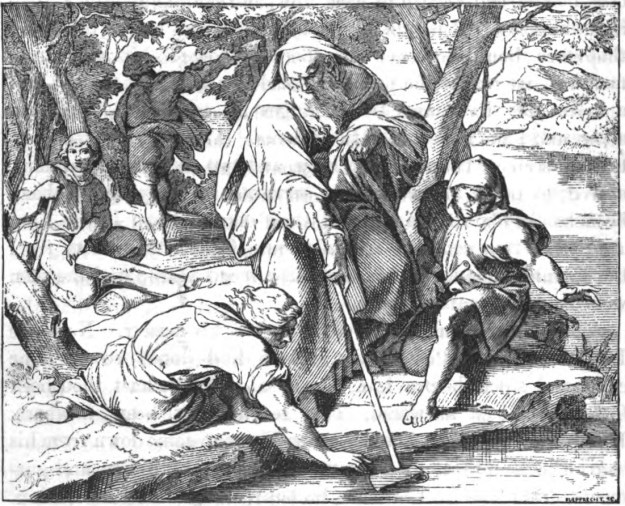
‘Elisha makes the Axe Head Swim’ illustration from The story of the Bible from Genesis to Revelation (1873)

2 Kings 6: 1-7 

1Now the company of prophets said to Elisha, “As you see, the place where we live under your charge is too small for us. 2Let us go to the Jordan, and let us collect logs there, one for each of us, and build a place there for us to live.” He answered, “Do so.” 3Then one of them said, “Please come with your servants.” And he answered, “I will.” 4So he went with them. When they came to the Jordan, they cut down trees. 5But as one was felling a log, his ax head fell into the water; he cried out, “Alas, master! It was borrowed.” 6Then the man of God said, “Where did it fall?” When he showed him the place, he cut off a stick and threw it in there and made the iron float. 7He said, “Pick it up.” So he reached out his hand and took it.

To the modern reader this may seem like a strange story to include among the miracles that are handed on about Elisha. In a world where an ax is a relatively inexpensive tool the loss of an ax head seems like a trivial matter to trouble the prophet Elisha with. But the world of Elisha’s time was very different from our world. At this time iron is a precious resource and smiths in ancient Israel would be rare. This was also a time when Israel is at war with Aram so most iron would be going to create weapons for the military of Israel. Much as the story of Elisha and the widow’s oil (2 Kings 4:1-7), the prophet’s action likely saved this member of the company of prophets from a debt they could not hope to repay. (NIB III: 199) Many of the stories in the previous two chapters have the company of prophets relying on the prophet Elisha to provide food in their want and Gehazi’s foolish (in the eyes of 2 Kings) request for recompense from Naaman (2 Kings 5: 19b-27) is also informed by the group’s poverty. Even if the neighbor who loaned the unfortunate man the ax would not attempt to collect the value of the lost tool, there is a strong concern for neighborly rights among the world envisioned in the Torah.

The story takes place at the Jordan geographically linking it to the previous healing of Naaman. At the Jordan Elisha provided healing for Naaman from his skin disease and relief for this fellow member of the company of prophets with the sunken ax head. Some scholars, both Jewish and Christians, have taken this story and attempted to create a non-miraculous version: the stick was cut to be able to fit into the aperture of the ax head or to have a flat surface for the ax head to rest on as the prophet lifts it out are two examples. Yet, to tell these stories the commenters in their desire to make the story more reasonable have missed the point that the man of God is able to do what others cannot. Elisha who can heal disease or provide adequate food can also through his connection with God make metal float and make an army captive.

2 Kings 6: 8-23

  8Once when the king of Aram was at war with Israel, he took counsel with his officers. He said, “At such and such a place shall be my camp.” 9But the man of God sent word to the king of Israel, “Take care not to pass this place, for the Arameans are going down there.” 10The king of Israel sent word to the place of which the man of God spoke. More than once or twice he warned a place so that it was on the alert.
  11
The mind of the king of Aram was greatly perturbed because of this; he called his officers and said to them, “Now tell me: Who among us is betraying us to the king of Israel?” 12Then one of his officers said, “No one, my lord king. It is Elisha, the prophet in Israel, who tells the king of Israel the words that you speak in your bedchamber.” 13He said, “Go and find where he is; I will send and seize him.” He was told, “He is in Dothan.” 14So he sent horses and chariots there and a great army; they came by night and surrounded the city.
  15
When an attendant of the man of God rose early in the morning and went out, an army with horses and chariots was all around the city. His servant said, “Alas, master! What shall we do?” 16He replied, “Do not be afraid, for there are more with us than there are with them.” 17Then Elisha prayed, “O LORD, please open his eyes that he may see.” So the LORD opened the eyes of the servant, and he saw; the mountain was full of horses and chariots of fire all around Elisha. 18When the Arameans came down against him, Elisha prayed to the Lord and said, “Strike this people, please, with blindness.” So he struck them with blindness as Elisha had asked. 19Elisha said to them, “This is not the way, and this is not the city; follow me, and I will bring you to the man whom you seek.” And he led them to Samaria.
  20
As soon as they entered Samaria, Elisha said, “O LORD, open the eyes of these men so that they may see.” The Lord opened their eyes, and they saw that they were inside Samaria. 21When the king of Israel saw them he said to Elisha, “Father, shall I strike them? Shall I strike them?” 22He answered, “No! Would you strike those whom you have taken captive with your sword and with your bow? Set food and water before them so that they may eat and drink, and let them go to their master.” 23So he prepared for them a great feast; after they ate and drank, he sent them on their way, and they went to their master. And the Arameans no longer came raiding into the land of Israel.

The Arameans are a continual danger to the people of Israel throughout the end of 1 Kings and the beginning of 2 Kings. Yet, Elisha through the previous and following chapter will play a pivotal role in the conflict between the king of Aram and the king of Samaria. Through Naaman, these soldiers who are brought captive by the prophet to Samaria, and the eventual defeat of the siege of Samaria the Arameans will come to know that there is a prophet in Samaria who king Ben-hadad of Aram will eventually consult (2 Kings 8: 7-15). Also reappearing in this story are the ‘horsemen and chariots of Israel’ which are the host of Israel’s God which Elisha first saw at Elijah’s ascension.

The conflict between the king of Aram and the prophet is precipitated by the prophet’s repeated warning of the king of Israel of the movements of Aram’s armies. Convinced that one of his leaders is betraying him, he summons them and asks how this is occurring. One of his officers knows that it is Elisha that is handing on this information, and the king of Aram orders a force sent to seize the prophet from his current location at Dothan. What the king’s men and the prophet’s men are blind to is the ‘horsemen and chariots of Israel’ which are surrounding the prophet and are more numerous than the forces sent by the king of Aram. Apparently, one’s eyes must be opened to be able to see the host of the LORD and that is exactly what Elisha prays for his servant to receive.

Throughout the narrative the movement between blindness and sight plays a critical role. Elisha’s servant may be able to see the forces of Aram, but he is blind to the forces of the LORD who Elisha serves until his eyes are opened. The prophet was able to provide vision for the king of Israel to elude the maneuvers of the king of Aram’s army and so the king of Aram attempts to remove the eyes of Israel by eliminating the prophet. The armies of Aram are struck with blindness by the LORD and led by the prophet to Samaria where the prophet asks for their sight to be restored.

The story ends with the king of Israel asking whether he should strike down this army that has been delivered by the prophet into his city and the prophet opening his eyes to another way. The king of Israel did not capture the Arameans, and their lives are in the prophet’s hands, and the prophet shows a way of peace. The book of Proverbs states, “If your enemies are hungry, give them bread to eat; and if they are thirsty, give them water to drink.” Proverbs 25:21 The prophet models this way of wisdom for the king who prepares a great feast for his enemies, and this brings at least a pause to the conflicts between Israel and Aram. The story moved from blindness to sight and from conflict to peace. Just like Naaman would discover that there is a prophet in Samaria, now these soldiers of Aram would also know both the power of the prophet’s God and the rescue provided in their desperate situation.

2 Kings 3 A Strange Story of Kings, Elisha, and Conflict

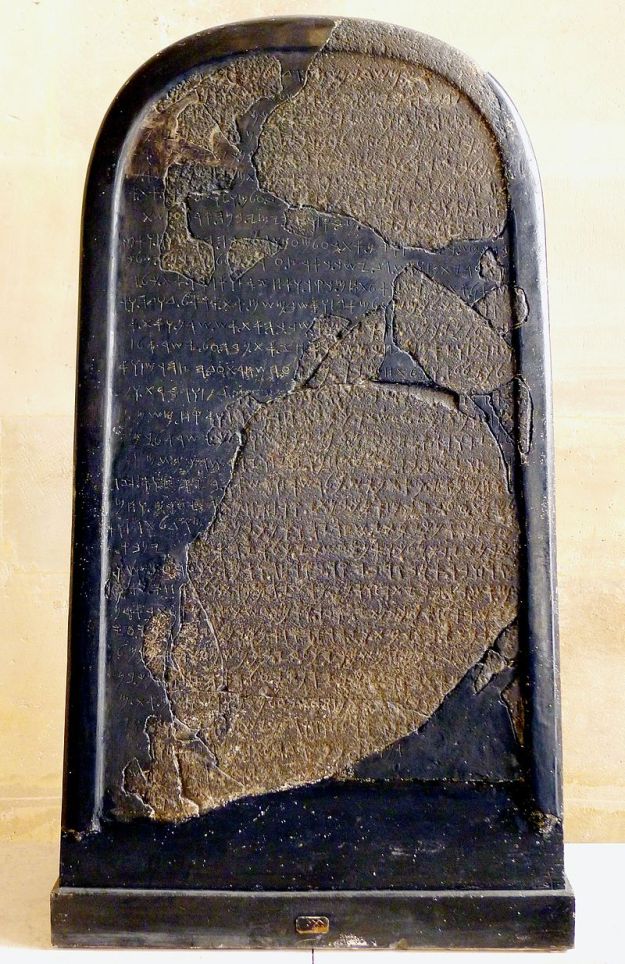
The ‘Mesha Stele’ also known as the Moabite Stone discovered in 1868 which tells of the revolt of Mesha. By Unknown artist – Mbzt 2012, CC BY 3.0, https://commons.wikimedia.org/w/index.php?curid=22090379

2 Kings 3


  1In the eighteenth year of King Jehoshaphat of Judah, Jehoram son of Ahab became king over Israel in Samaria; he reigned twelve years. 2He did what was evil in the sight of the Lord, though not like his father and mother, for he removed the pillar of Baal that his father had made. 3Nevertheless, he clung to the sin of Jeroboam son of Nebat that he caused Israel to commit; he did not depart from it.
  4
Now King Mesha of Moab was a sheep breeder who used to deliver to the king of Israel one hundred thousand lambs and the wool of one hundred thousand rams. 5But when Ahab died, the king of Moab rebelled against the king of Israel. 6So King Jehoram marched out of Samaria at that time and mustered all Israel. 7As he went he sent word to King Jehoshaphat of Judah, “The king of Moab has rebelled against me; will you go with me to battle against Moab?” He answered, “I will; I am as you are; my people are your people; my horses are your horses.” 8Then he asked, “By which way shall we march?” Jehoram answered, “By the way of the wilderness of Edom.”
  9
So the king of Israel, the king of Judah, and the king of Edom set out, and when they had made a roundabout march of seven days, there was no water for the army or for the animals that were with them. 10Then the king of Israel said, “Alas! The Lord has summoned these three kings to hand them over to Moab.” 11But Jehoshaphat said, “Is there no prophet of the Lord here through whom we may inquire of the Lord?” Then one of the servants of the king of Israel answered, “Elisha son of Shaphat, who used to pour water on the hands of Elijah, is here.” 12Jehoshaphat said, “The word of the Lord is with him.” So the king of Israel and Jehoshaphat and the king of Edom went down to him.
  13
Elisha said to the king of Israel, “What have I to do with you? Go to your father’s prophets or to your mother’s.” But the king of Israel said to him, “No; it is the Lord who has summoned these three kings to hand them over to Moab.” 14Elisha said, “As the Lord of hosts lives, whom I serve, were it not that I have regard for King Jehoshaphat of Judah, I would give you neither a look nor a glance. 15But get me a musician.” And then, while the musician was playing, the hand of the Lord came on him. 16And he said, “Thus says the Lord: I will make this wadi full of pools. 17For thus says the Lord: You shall see neither wind nor rain, but the wadi shall be filled with water, so that you shall drink, you, your army, and your animals. 18This is only a trifle in the sight of the Lord, for he will also hand Moab over to you. 19You shall conquer every fortified city and every choice city; every good tree you shall fell, all springs of water you shall stop up, and every good piece of land you shall ruin with stones.” 20The next day, about the time of the morning offering, suddenly water began to flow from the direction of Edom until the country was filled with water.
  21
When all the Moabites heard that the kings had come up to fight against them, all who were able to put on armor, from the youngest to the oldest, were called out and were drawn up at the frontier. 22When they rose early in the morning and the sun shone upon the water, the Moabites saw the water opposite them as red as blood. 23They said, “This is blood; the kings must have fought together and killed one another. Now then, Moab, to the spoil!” 24But when they came to the camp of Israel, the Israelites rose up and attacked the Moabites, who fled before them; as they entered Moab, they continued the attack. 25The cities they overturned, and on every good piece of land everyone threw a stone until it was covered; every spring of water they stopped up, and every good tree they felled. Only at Kir-hareseth did the stone walls remain until the slingers surrounded and attacked it. 26When the king of Moab saw that the battle was going against him, he took with him seven hundred swordsmen to break through opposite the king of Edom, but they could not. 27Then he took his firstborn son who was to succeed him and offered him as a burnt offering on the wall. And great wrath came upon Israel, so they withdrew from him and returned to their own land.

This is a strange story for several reasons. On the one hand it is a story of a bad, but not as bad as his predecessors, king of Israel who calls on an alliance with the kings of Judah and Edom. The king of Israel is not portrayed in a favorable light and Elisha has no regard for him. The act of prophesy by Elisha is also linked to a performance of a musician which sets the mood for a prophetic state. The prophetic command is also strange since it contradicts the rules for war outlined in Deuteronomy. Finally, the strangest note is at the end when the king of Moab’s sacrifice of his firstborn son turns the tide and Israel withdraws. Yet, this is also an interesting passage for historians who have the ‘Mesha Stele’ which provides an independent witness to this time-period from the perspective of Moab.

From a historical perspective the discovery of the ‘Mesha Stele’ confirms several points of the 2 Kings narrative. King Mesha of Moab was ‘oppressed’ by the Omri dynasty, likely paying tribute to the king. In the view of King Mesha this situation is due to Chemosh, the god of the Moabites, being displeased with his people. Finally, it confirms an uprising of Mesha against a son of Omri, presumably Jehoram, in which King Mesha accomplishes some victories. The precipitating events which cause the king of Israel to reach out to his allies and begin to take military action against Moab are given an independent witness by this discovery. This also makes sense within the previous narrative where King Ahab dies and Moab rebels in 2 Kings 1:1. Ahaziah’s brief reign, cut short by his fall and then sending messengers to Ekron seeking insight from Baal-zebub, made him too weak of a leader to respond to this rebellion.

There are numerous similarities between this narrative and the conflict between Aram and the Israel and Judah mentioned in 1 Kings 22. In both narratives King Jehoshaphat of Judah replies both as and ally, but also the weaker party in the relationship, willingly committing his forces to the king of Israel’s conflict. In both stories it is the king of Judah who requests that they seek out the opinion of a prophet of the LORD that is not tied to the royal apparatus of the king of Israel. Unlike the previous story the outcome is mostly favorable for both the king of Israel and the king of Judah.

King Mesha is noted as a sheep-breeder, and his tribute is an excessive quantity of both lambs and wool. There is no time-period for the tribute so it may be an annual tribute, or it may be the tribute over the time of subservience. Although King Mesha may simply preside, “over a semi-nomadic economy in Moab. The principle industry is sheep and the principle products are wool and lamb.” (Brueggemann, 2000, p. 306) It is also worth noting that throughout scripture kings are often portrayed metaphorically as shepherds. The king may be directly involved in sheep-breeding, but it is equally likely that he is the ‘shepherd’ of a people whose primary livelihood revolves around sheep.

The king of Israel moves his army through Judah and through Edom to attack Moab from the south. This move is likely to approach Moab from a direction they do not expect and to utilize the element of surprise, but any advantage quickly dissipates when the army runs out of water.  It is possible that springs or waters they expected to utilize had dried up or that they simply failed to adequately plan and scout the route, but the situation results in an army foundering in the wilderness and vulnerable to the king of Moab’s attack. Jehoram interprets this as a sign of the LORD’s displeasure, but Jehoshaphat suggests they inquire of a prophet of the LORD. Apparently, Elisha has either been traveling in proximity of the company or has at some earlier point moved to the wilderness of Edom to be available at this moment of the kings’ peril.

According to the evaluation of 2 Kings, Jehoram is still a bad king but not as bad as his predecessors. Sometime in his reign he is reported to have removed the pillar of Baal (likely after the LORD’s deliverance in this narrative) and according to the narrative of 2 Kings, he believes that the LORD the God of Israel has called the three kings together in this mission and is also punishing them. Even though it is King Jehoshaphat of Judah who asks to consult a prophet of the LORD, King Jehoram does not seem to resist the kings going to consult with Elisha nor does he push back against Elisha’s harsh words. Elisha, like his predecessor Elijah, has little use for the kings of the Omri dynasty but he does respect the king of Judah.

Elisha requests a musician and then has a moment when the hand of the LORD comes upon him. The hand of the LORD coming upon Elisha was likely viewed by the observers as an ecstatic experience and there is an expectation of prophets being overtaken by an experience they cannot control.[1] Elisha’s message brings an answer not only to the immediate problem of water, but it also foretells victory over their Moabite opponents. Yet, strangely, the prophet’s commands violate the expectations of conflict outlined in Deuteronomy which prohibits the chopping down of trees.[2] There is a biblical desire to preserve the land. In ancient warfare it is common attempt to deny your enemy the fruitfulness of the land, which is what the prophet’s guidance indicates, but the tension between the law in Deuteronomy and the prophet’s guidance is one additional strange element to this strange story.  

The Hebrew storytellers love wordplay and allusion to other narratives, and in the Moabites response to these kings in the wilderness. The waters being red as blood recalls on of God’s first major actions to bring the people out of Egypt by turning the waters of the Nile to blood.[3] But the scene also plays on the origin story of Edom in Genesis being Esau, Jacob/Israel’s brother, whose name means ‘red’ and is famous for selling his birthright for ‘red stuff.’[4] We don’t know why the Moabites interpret the red looking water as blood, but it causes them to camp of Israel in a less cautious manner.

The overall progression of the battle is portrayed as a rout where Israel and its allies overwhelm the Moabite advance on their camp and then proceed to follow Elisha’s guidance against the land and the cities. Only Kir-hareseth’s[5] stone wall briefly stops the advance before slingers attack it. The victories of Israel are not strange in this narrative, but the halting of the success is.

The final verse of this chapter has provoked the greatest debate among interpreters as they wrestle with how to deal with the implications of wrath coming upon Israel as a result of the King of Moab’s sacrifice. The bible shares with the rest of the ancient world the belief that there is power in blood and there is in many ancient belief systems an idea that appears in many fantasy worlds that connects blood, particularly the shedding of blood, in the practice of magic or appeasing deities or demons. The most literal interpretation of the words is that King Mesha sacrifices his first-born heir to Chemosh on the wall and this awakens Chemosh who grants the Moabites power against their foes. The Hebrew scriptures are insistent that the LORD is above all other gods, but it also assumes a world where these other gods of the nations do have power. The offense of this interpretation is that Chemosh successfully resists the LORD and halts the prophesied conquest over Moab. Rabbinic exegetes give an explanation that the son sacrificed is the son of the king of Edom, the ally of Israel and Judah, and this sacrifice causes Edom to turn against his allies. (Cogan, 1988, p. 48) Brueggemann speaks for a lot of modern readers when he states, “The most remarkable fact about the narrative is that everything we would most like to know is left unsaid.” (Brueggemann, 2000, p. 315) It is a strange ending to a strange story. It is unusual that a story where another god may have prevented the outcome the LORD’s prophet indicated to be completed. Yet, the story does not give any reason for the King Mesha of Moab being able to finally resist the kings of Israel, Judah and Edom as well as the LORD who stands behind them.


[1] 1 Samuel 10: 9-13; 19: 23-24.

[2] Deuteronomy 20:19.

[3] Exodus 7: 14-25.

[4] Genesis 25: 25, 30.

[5] Brueggemann notes on Kir-hareseth, “Nothing is known of this city, the site of Israel’s last success in this military campaign. However, the mention of the city in Isa 16;7, Jer 48:31, 36 as a poetic parallel for “Moab” suggest that it was a major site, certainly a freighted item in the prophet’s imagination. (Brueggemann, 2000, p. 313)