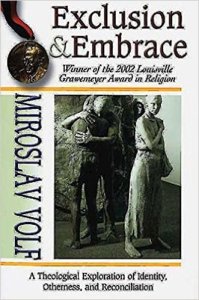
Review of Exclusion and Embrace: A Theological Exploration of Identity, Otherness, and Reconciliation (1996) by Miroslav Volf.
This is the volume that introduced me to the work of Miroslav Volf and from the first page of the preface, where he lays out what is at stake in this theological exploration, through the final chapter on Violence and Peace it is a passionate and articulate formulation of a theology of the cross for our time. Volf is both honest about the challenges of reconciliation while holding before the reader the dream and hope of embrace as the end for which we are called to work. He powerfully weaves together theology, scripture, philosophy, and personal experience into a work that I have gone back to multiple times in my own ministry. Re-reading this work over twenty years after my initial reading Exclusion and Embrace is still a powerful work, but it also highlights my own evolution as a reader and scholar in the years between readings.
I first saw Exclusion and Embrace at the bookstore at Wartburg Seminary, and I felt drawn to it. I integrated it into an independent study attempting to flesh out Luther’s theology of the cross for our time in my senior year of seminary. At that point I was a young scholar reading everything I could get my hands on, and Volf’s work combined a deeply personal search for a Christian practice that was authentic with an academic rigor that was inspiring. This was the type of scholar I hoped to be. I was still attempting to integrate the diverse voices I had encountered in the previous two years of seminary into something that I could carry beyond the seminary walls. I was still wrestling with postmodernism as a way of thinking, knowing enough to be attracted and repelled by this alien way of encountering the world I was introduced to tangentially (although rarely under the name postmodernism) in academics. In Volf I found someone who was far more versed in authors like Nietzsche, Foucault, Deleuze, Said, and many other authors from a variety of perspectives who still took the scriptures, theology, and Christian practice seriously.
One of the major differences between my original and this reading is I have engaged enough with postmodern, feminist, and other voices to have developed my own perspective. I understand the influence of postmodern voices and perspectives, but in my own journey I have walked away from these perspectives because at their root I find them nihilistic. They serve as good critiques which fail to provide a viable alternative to the modernity they critique. Exclusion and Embrace is still an incredibly valuable work, but I found the central chapters speaking to dialogue partners who have little interest in a constructive dialogue with Christianity. I still believe the first two chapters and final chapter are incredibly important and make this a book that deserves wide reading. These are the places I have found myself referencing over the past twenty years and have caused me to read most of what Volf has written before and after Exclusion and Embrace.
One of the things I am most thankful for in Volf’s work is the way he bridges the divide between the academic world and the world which the academy often neglects. Like the three cities which form the concrete background of the reflection of the initial chapter (Los Angeles where Volf taught at the time, Berlin where he was giving the presentation that formed the chapter, and Sarajevo the war torn city from the land of Volf’s background as a Croatian) this is deals with the broken stories in need of forgiveness. Volf’s critique of the “pleasant captivities of the liberal mind” when he critiques the ‘God of perfect non-coercive love’ (Volf, 1996, p. 304) has stuck with me for the life of my ministry and resonates with my engagement with scriptures. This is a work that helped form my theology and gave me tools that would help me continue to grow as a pastor who engaged the scriptures and the questions of the surrounding world.
 Sign of the Rose