Tag Archives: obedience

Reflections on the Journey through Ezekiel

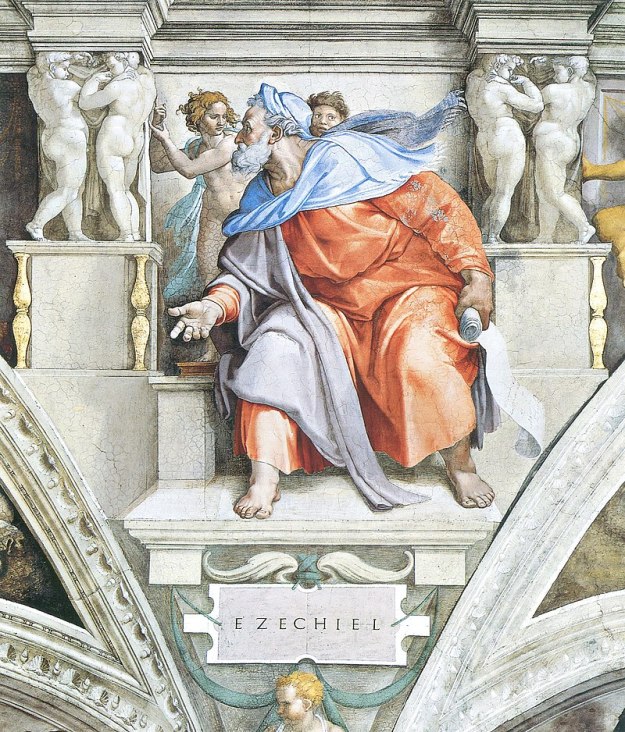
Ezekiel as depicted by Michelangelo on the Sistene Chapel ceiling

I am glad to be coming to the end of this long journey with the prophet Ezekiel and I appreciate the work of scholars who make this book in particular their life work. Working through both Jeremiah and Ezekiel has given me a much richer view of the time leading up to and after the Babylonian exile. I have a much richer view of the history, technology, and culture of the time but also of the way this people of Israel and these prophets had to deconstruct and reconstruct their view of the world. Prior to the exile, for Judah, the Davidic king, the temple of Solomon, the city of Jerusalem (or Zion), and the land were all central images for the faith of the people and Babylon shattered all of these. Ezekiel as a prophet of primarily written word due to communicating to Jerusalem from the exile in Babylon, although many of his visions, sign acts, and proclamations were likely done for a local audience first, is a part of the transition of the people of Judah from being the people of the land, temple and king to being a people of the book. Ezekiel’s perspectives are very different, even from his elder contemporary Jeremiah and there was a lot I gained from this protracted study.

Jeremiah has often been called the ‘wailing prophet’ and his dialogues with God are often honest and pathos filled while Ezekiel only protests when God asks him to do something that offends his priestly sensibilities. In this book obedience to God is a central idea and Ezekiel is a contrast to a disobedient and rebellious people. I do think both Jeremiah and Ezekiel illustrate different aspects of a faithful relationship to the God of Israel and especially for an independently minded person like myself in an independent and individualistic culture Ezekiel’s obedience was both uncomfortable but also provided a necessary correction for me.

 Ezekiel’s priestly perspective on holiness was also an uncomfortable but necessary corrective for me. Within many Protestant traditions the focus on the intimacy of the relationship with God or the closeness of God has obscured the dangerous and holy God that Ezekiel knows. This holiness in Ezekiel impacts everything from the design of the new temple to God’s reaction to the disobedience of the people. God’s holiness and the careless actions of idolatry and abomination committed by the people which defile this holiness form Ezekiel’s justification (or God’s justification in Ezekiel) for the death and suffering caused by the Babylonian destruction of Jerusalem and the exile of the people. This way of thinking and believing enabled Ezekiel and those who heard and passed on his words to make sense of the disorienting reality of their homes and beliefs being shattered by the armies of Chaldeans and their allies.

Ezekiel’s imagery can be offensive. The culture that I live in can occasionally silence offensive voices, especially in academic circles, and promote offensive voices in other contexts. Sometimes the offensive message, as in Ezekiel, can point to an uncomfortable truth. Would there be different images or words we would utilize in our context, almost certainly, but there is a reason these words have been transmitted for more than two millennia (often by hand copying the words). I think in general much of the church’s response to Ezekiel has been either embarrassment or neglect. Ezekiel may never be our favorite messenger, but I am thankful that I have taken this time to reflect on his strange and uncomfortable messages.

There were several times as I was working through Ezekiel that I noted his influence on Revelation. Even when I worked through Revelation in 2018, I wished that I could have worked through Ezekiel and Daniel first, but now the echoes of Ezekiel in Revelation are much clearer. Ezekiel may not be at the center of the cannon within the cannon for the Lutheran tradition I am a part of, but I am beginning to have a fuller grasp of the breadth, depth and width of the scriptures which have been handed on to us and the ways in which the law, the prophets, the poetry and narratives of the Hebrew Scriptures enrich and inform the New Testament and ultimately my faith.

This is the thirteenth book I have walked through, and it was one of the hardest. My faith and life were enriched by this journey, and I can appreciate this book in ways I didn’t before. Next, I will be returning to Psalms, now for Psalm 101-110, before selecting another book to begin. Back in 2022 I mapped out the journey through 1 Kings, Joel, and Ezekiel with ten psalms surrounding each reading and I am finally approaching the final leg of this group of texts from the Hebrew Scriptures.
Psalm 95 Lifting Up Voices and Listening in Silence

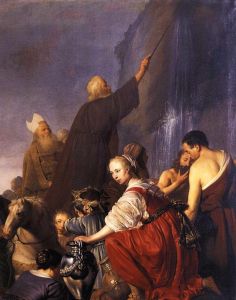
Pieter de Grebber, Moses Striking the Rock (1630)

Psalm 95

1 O come, let us sing to the LORD; let us make a joyful noise to the rock of our salvation!
2 Let us come into his presence with thanksgiving; let us make a joyful noise to him with songs of praise!
3 For the LORD is a great God, and a great King above all gods.
4 In his hand are the depths of the earth; the heights of the mountains are his also.
5 The sea is his, for he made it, and the dry land, which his hands have formed.
6 O come, let us worship and bow down, let us kneel before the LORD, our Maker!
7 For he is our God, and we are the people of his pasture, and the sheep of his hand. O that today you would listen to his voice!
8 Do not harden your hearts, as at Meribah, as on the day at Massah in the wilderness,
9 when your ancestors tested me, and put me to the proof, though they had seen my work.
10 For forty years I loathed that generation and said, “They are a people whose hearts go astray, and they do not regard my ways.”
11 Therefore in my anger I swore, “They shall not enter my rest.”

Psalm 95 is a psalm which invites the hearer to move with the faithful into a noisy and jubilant time of worship which then is silenced so that God (or a prophet or priest speaking for God) can instruct the people in obedience. The life of worship and a life of obedience are linked here as it is frequently in the psalms and prophets. God in this psalm is the great God who reigns over all gods, is the master and creator of the earth and sea, and the one to whom the faithful owe their obedience. History and the memory of the disobedience of their ancestors becomes the invitation for the current generation to respond with obedience.

The first word of this psalm is the imperative form of the Hebrew halak[1] (to walk) and it impels the people to get moving to meet God in celebration and worship. Yet, within the command to move is also an allusion to a way of walking that is in accordance with God’s commandments and within the movement of the psalm is both the uplifted voices of the worshipping faithful but also the lives of obedience which listen to the voice of God. The invitation to ‘sing’ and ‘make a joyful noise’ while familiar in English are not as strong as the Hebrew verbs which they translate.[2] This is not a timid action of worship but instead is a community in full voice shouting and singing to their God and King. The praise of God echoes the sentiment of Psalm 24, where the earth is the LORD’s and all that is in it. The worldview of the psalms assumes the pluralistic world where the surrounding nations worship other gods, but the LORD is the sovereign over both the gods of the nations and the earth itself. The faithful come in jubilant acclamation to worship, bow down, and kneel before the God who is their maker, their king, and their shepherd who provides shelter and pasture for them. The movement and the noise climax in this acclamation and prepares the people for the time of silence that they may hear the words from their God (or God’s messenger).

The second movement of the psalm begins in the second half of verse seven with the command to listen. The congregation is to move from full voice to silence and from motion to stillness. The command to listen is the Hebrew shema which is the critical verb at key points in the declaration of the law:

Now therefore, if you obey (shema) my voice and keep my covenant, you shall be my treasured possession our of all the peoples. Indeed the whole earth is mine, but you shall be for me a priestly kingdom and a holy nation. These are the words that you shall speak to the Israelites.”  Exodus 19:5-6 (immediately before consecrating the people and receiving the commandments)

Hear (shema) O Israel: The LORD is our God , the LORD alone. You shall love the LORD your God with all your heart, and with all your soul, and with all your might. Deuteronomy 6: 4-5[3]

Hearing or listening in Hebrew is not merely listening to the words but also involves living in response to the words. Lifting up praise to God in full voice without hearing and obeying God’s commands is often condemned in the psalms and prophets[4] and here the actions of the people of Israel at Meribah and Massah (Exodus 17: 1-7; Numbers 20: 1-13) are used as an example of the high cost of disobedience. The inability of their ancestors to listen is remembered as the reason for the long journey in the wilderness and the inability of the first generation that left Egypt to enter their rest in the promised land. The relationship between God and the people of Israel is a covenantal relationship which requires obedience. If the people will listen and obey then God will provide for them in the land, but if they do not hear and obey then they may end up without God’s guidance and blessing.

The two parts of the psalm, the movement and raucous noise and the obedient silence and reverential hearing, belong together. The faithful should move to the place where they can praise God in full voice in a jubilant and joyful way, but we must also remember that God desires our obedience. As Beth Tanner can state truthfully, “In worship today, God can be seen as too friendly, too nice, and too forgiving. We can easily forget the great power of the King God.” (Nancy deClaisse-Walford, 2014, p. 718) The previous psalm reminded us, “Happy are those whom you discipline, O LORD, and whom you teach out of your law,” (Psalm 94: 12). Now Psalm 95 uses the story of the people of Israel as an illustration of the dangers when the people refuse to follow God’s way of walking. The life of the faithful is one of coming (walking, halak), hearing (shema), and living in obedience to the ways of God in both jubilant worship, silent listening, and faithful living.

[1] Halak is an important word in Hebrew. Halakha which derives from halak is the collective body of the Hebrew laws (both oral and written) and it means ‘the way of walking.’ This movement at the beginning of the psalm is both the physical motion to the place of worship and the way of walking in accordance with God’s will.

[2] Ranan and rua in the intensified piel form mean to “call loudly” and “lift up a war-cry or cry of alarm.” (Nancy deClaisse-Walford, 2014, p. 716)

[3] Deuteronomy 6: 4-5 has a central place in the practice of the Jewish people and this entire command is often called the shema because of the command to ‘hear.’

[4] See for example Psalm 50, 81, Isaiah 1, and Amos 5: 21-24

Matthew 7: 13-29 Choosing the Way of Christ

Fra Angelico, Fresco in the Cloister of Mark in Florenz (1437-1445)

Matthew 7:13-29

Parallel Luke 13: 23-24, Luke 6: 43-46, 13: 25-27, Luke 6: 47-49, Mark 1: 21-22

13 “Enter through the narrow gate; for the gate is wide and the road is easy that leads to destruction, and there are many who take it. 14 For the gate is narrow and the road is hard that leads to life, and there are few who find it.

15 “Beware of false prophets, who come to you in sheep’s clothing but inwardly are ravenous wolves. 16 You will know them by their fruits. Are grapes gathered from thorns, or figs from thistles? 17 In the same way, every good tree bears good fruit, but the bad tree bears bad fruit. 18 A good tree cannot bear bad fruit, nor can a bad tree bear good fruit. 19 Every tree that does not bear good fruit is cut down and thrown into the fire. 20 Thus you will know them by their fruits.

21 “Not everyone who says to me, ‘Lord, Lord,’ will enter the kingdom of heaven, but only the one who does the will of my Father in heaven. 22 On that day many will say to me, ‘Lord, Lord, did we not prophesy in your name, and cast out demons in your name, and do many deeds of power in your name?’ 23 Then I will declare to them, ‘I never knew you; go away from me, you evildoers.’

24 “Everyone then who hears these words of mine and acts on them will be like a wise man who built his house on rock. 25 The rain fell, the floods came, and the winds blew and beat on that house, but it did not fall, because it had been founded on rock. 26 And everyone who hears these words of mine and does not act on them will be like a foolish man who built his house on sand. 27 The rain fell, and the floods came, and the winds blew and beat against that house, and it fell — and great was its fall!”

28 Now when Jesus had finished saying these things, the crowds were astounded at his teaching, 29 for he taught them as one having authority, and not as their scribes.

The conclusion of the Sermon on the Mount brings together several contrasting choices between wise and foolish choices, encouraging the hearer to follow the right way, recognize true prophets, and to enact right actions. This would be familiar to hearers familiar with the pattern of wise and foolish choices that Proverbs, Psalms, and the prophets often use as a rhetorical framework to encourage a wise course of action. These short but vivid images attempt to capture the weight of the decision to live out these words that Jesus articulates. The road to obedience may be challenging, there may be others who proclaim an easier less costly way but what Jesus has been presenting is a way that leads towards life and away from destruction. The Jesus we meet in Matthew’s gospel is merciful and yet does expect his followers to be obedient. Jesus, in the Sermon on the Mount, is inviting his followers to be a part of a community that embodies these teachings. The people of Israel were called into a life of obedience to the Law and there were blessings if they remained obedient and consequences for being unfaithful. Jesus reinterprets the Law to this new community and this is the way of living in the covenant of the kingdom of heaven. The path does involve wisdom, holding mercy and obedience together, discerning between Jesus’ authority and those of other teachers, and the commitment to hearing these words and acting on them.

The translation of the Greek hodos as road, while proper obscures that throughout most of the New Testament this word is translated as way. A frequent theme of Mark’s gospel of Jesus being ‘on the way’ and in Acts we learn that Jesus’ earliest followers were referred to as belonging to ‘the Way.’ (Acts 9: 2) Just as critical for Matthew would be the numerous linkages with how ‘the way’ is used to call the  people of God to be attentive to God’s way in the law, wisdom literature and the prophets. In Deuteronomy, for example, we see the basic pattern of blessing for obedience to the commandments and curses for turning from the way commanded:

the blessing, if you obey the commandments of the LORD your God that I am commanding you today;  and the curse, if you do not obey the commandments of the LORD your God, but turn from the way that I am commanding you today, to follow other gods that you have not known. Deuteronomy 11: 27-28 (see also Deuteronomy 9: 12, 16)

For I know that after my death you will surely act corruptly, turning aside from the way that I have commanded you. In time to come trouble will befall you, because you will do what is evil in the sight of the LORD, provoking him to anger through the work of your hands.” Deuteronomy 31:29

The linking of obedience to the metaphor of a way or a road occurs in several places in Psalms and Proverbs and throughout the prophets, a couple of examples include

for the LORD watches over the way of the righteous, but the way of the wicked will perish. Psalm 1:6

Their feet run to evil, and they rush to shed innocent blood; their thoughts are thoughts of iniquity, desolation and destruction are in their highways. The way of peace they do not know, and there is no justice in their paths. Their roads they have made crooked; no one who walks in them knows peace. Isaiah 59: 7-8

And to this people you shall say: Thus says the LORD: See, I am setting before you the way of life and the way of deathJeremiah 21: 8 

False prophets are a concern throughout the Hebrew Scriptures and within the early church as well. Again, this echoes Deuteronomy with how to determine if a prophet is an authentic process.

If a prophet speaks in the name of the LORD but the thing does not take place or prove true, it is a word that the LORD has not spoken. The prophet has spoken it presumptuously; do not be frightened by it. Deuteronomy 18: 22

Like the community of Israel after Moses, Matthew’s community is having to learn how to live without the immediate presence of Jesus. Like Moses, Jesus now is setting up the community to continue once he is no longer present to speak with them. Just as the disciples have been called to a whole or complete life, so those who speak on behalf of Jesus or God will have good fruits that reflect that life.

Mere confession of Jesus as Lord is insufficient for Matthew, this confession must be linked with obedience to the law as Christ articulates it and the practices of righteousness and mercy. Hearing and even speaking words ultimately do not prove an adequate foundation for the life and community Jesus wants to build. The words which are heard must ultimately be acted upon for a life that will resist the storms that come. The Sermon on the Mount is designed to create a community which is modeled by Christ and faithful to the vision of the kingdom of heaven. It is a community that is visible by its distinct practices of mercy, reconciliation, and righteousness and it exists for the sake of the world.

Jesus takes up the mantle of Moses, and unlike the scribes whose authority is derivative and who cannot go beyond what was given to Moses, Jesus will take what was said in the law and with his own authority reframe, extend and reshape what the law states. Jesus speaks in the language of the law, and yet one greater than Moses is here speaking to the crowds. Jesus speaks in the language of wisdom, and yet one greater than Solomon is sharing the wisdom of the kingdom of heaven. The crowds are astounded because either Jesus has transgressed the boundaries of what is accepted by the interpreters of the law or he has the authority to speak a new way of relating to God and the community into being. Jesus has invited the hearers of his words to become doers who wisely choose that way of life instead of the way of destruction. Even though I’ve moved away from framing this in terms of moralistic perfection, obedience is still a part of the complete life that the disciples are called into as a part of the community. Matthew’s gospel is concerned about establishing a community where the disciples can live this life of peace and reconciliation, of righteousness and mercy, of obedience and trust and any interpretation of Matthew should be judged by its fruits: by how it helps communities of disciples build their lives by acting on these words of Jesus.

The Disconnect Between Worship and Obedience:Jeremiah 6: 15-21

Jeremiah Lamenting the Destruction of Jerusalem by Rembrandt van Rijn 1630

Jeremiah Lamenting the Destruction of Jerusalem by Rembrandt van Rijn 1630

15 They acted shamefully, they committed abomination;
yet they were not ashamed, they did not know how to blush.
Therefore they shall fall among those who fall;
at the time that I punish them, they shall be overthrown, says the LORD.
16 Thus says the LORD: Stand at the crossroads, and look, and ask for the ancient paths, where the good way lies; and walk in it, and find rest for your souls. But they said, “We will not walk in it.”
17 Also I raised up sentinels for you: “Give heed to the sound of the trumpet!”
But they said, “We will not give heed.”
18 Therefore hear, O nations, and know, O congregation, what will happen to them.
19 Hear, O earth; I am going to bring disaster on this people,
the fruit of their schemes, because they have not given heed to my words;
and as for my teaching, they have rejected it.
20 Of what use to me is frankincense that comes from Sheba, or sweet cane from a distant land?
Your burnt offerings are not acceptable, nor are your sacrifices pleasing to me.
21 Therefore thus says the LORD:
See, I am laying before this people stumbling blocks against which they shall stumble;
parents and children together, neighbor and friend shall perish.

Apparently the reality that some people may be faithful church attenders while they live lives that are fundamentally out of touch with God’s desire for their lives is not a new reality. As Walter Brueggemann states:

In place of torah, Israel has substituted cultic action (Jer. 6:20-21): frankincense, cane, sacrifices. Israel has devised a form of religion that reflects affluence, which can be safely administered, and which brackets out all questions of obedience.” (Brueggemann 1998, 73)

It is a nice, safe, easy religion that has allowed the people to slip into a sense of cultic complacency. So long as we have the temple and we keep bringing our offerings to God nothing will happen to us. This is the picture of gods that are common in the ancient world, that you bring pleasing offerings to the gods to entreat their favor and to get them fight for you in your battles, allow your crops to prosper, etc. But this is to fundamentally misunderstand the relationship God wants for God’s people. It is not coincidence that the Old Testament prophets frequently rail against the sacrificial system (and Jesus also directly confronts the temple in his own day). The way things are will not continue indefinitely, God is speaking through the prophet. God is taking away the things that people have placed their trust in, and the temple and the priestly sacrificial system is one of these things.

purple rose 01 by picsofflowers.blogspot.com