Tag Archives: Miracles of Elisha

2 Kings 6: 1-23 Floating Iron and Opened Eyes

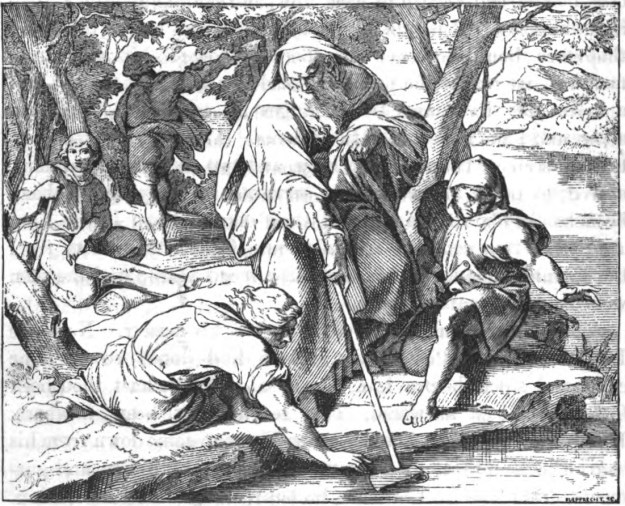
‘Elisha makes the Axe Head Swim’ illustration from The story of the Bible from Genesis to Revelation (1873)

2 Kings 6: 1-7 

1Now the company of prophets said to Elisha, “As you see, the place where we live under your charge is too small for us. 2Let us go to the Jordan, and let us collect logs there, one for each of us, and build a place there for us to live.” He answered, “Do so.” 3Then one of them said, “Please come with your servants.” And he answered, “I will.” 4So he went with them. When they came to the Jordan, they cut down trees. 5But as one was felling a log, his ax head fell into the water; he cried out, “Alas, master! It was borrowed.” 6Then the man of God said, “Where did it fall?” When he showed him the place, he cut off a stick and threw it in there and made the iron float. 7He said, “Pick it up.” So he reached out his hand and took it.

To the modern reader this may seem like a strange story to include among the miracles that are handed on about Elisha. In a world where an ax is a relatively inexpensive tool the loss of an ax head seems like a trivial matter to trouble the prophet Elisha with. But the world of Elisha’s time was very different from our world. At this time iron is a precious resource and smiths in ancient Israel would be rare. This was also a time when Israel is at war with Aram so most iron would be going to create weapons for the military of Israel. Much as the story of Elisha and the widow’s oil (2 Kings 4:1-7), the prophet’s action likely saved this member of the company of prophets from a debt they could not hope to repay. (NIB III: 199) Many of the stories in the previous two chapters have the company of prophets relying on the prophet Elisha to provide food in their want and Gehazi’s foolish (in the eyes of 2 Kings) request for recompense from Naaman (2 Kings 5: 19b-27) is also informed by the group’s poverty. Even if the neighbor who loaned the unfortunate man the ax would not attempt to collect the value of the lost tool, there is a strong concern for neighborly rights among the world envisioned in the Torah.

The story takes place at the Jordan geographically linking it to the previous healing of Naaman. At the Jordan Elisha provided healing for Naaman from his skin disease and relief for this fellow member of the company of prophets with the sunken ax head. Some scholars, both Jewish and Christians, have taken this story and attempted to create a non-miraculous version: the stick was cut to be able to fit into the aperture of the ax head or to have a flat surface for the ax head to rest on as the prophet lifts it out are two examples. Yet, to tell these stories the commenters in their desire to make the story more reasonable have missed the point that the man of God is able to do what others cannot. Elisha who can heal disease or provide adequate food can also through his connection with God make metal float and make an army captive.

2 Kings 6: 8-23

  8Once when the king of Aram was at war with Israel, he took counsel with his officers. He said, “At such and such a place shall be my camp.” 9But the man of God sent word to the king of Israel, “Take care not to pass this place, for the Arameans are going down there.” 10The king of Israel sent word to the place of which the man of God spoke. More than once or twice he warned a place so that it was on the alert.
  11
The mind of the king of Aram was greatly perturbed because of this; he called his officers and said to them, “Now tell me: Who among us is betraying us to the king of Israel?” 12Then one of his officers said, “No one, my lord king. It is Elisha, the prophet in Israel, who tells the king of Israel the words that you speak in your bedchamber.” 13He said, “Go and find where he is; I will send and seize him.” He was told, “He is in Dothan.” 14So he sent horses and chariots there and a great army; they came by night and surrounded the city.
  15
When an attendant of the man of God rose early in the morning and went out, an army with horses and chariots was all around the city. His servant said, “Alas, master! What shall we do?” 16He replied, “Do not be afraid, for there are more with us than there are with them.” 17Then Elisha prayed, “O LORD, please open his eyes that he may see.” So the LORD opened the eyes of the servant, and he saw; the mountain was full of horses and chariots of fire all around Elisha. 18When the Arameans came down against him, Elisha prayed to the Lord and said, “Strike this people, please, with blindness.” So he struck them with blindness as Elisha had asked. 19Elisha said to them, “This is not the way, and this is not the city; follow me, and I will bring you to the man whom you seek.” And he led them to Samaria.
  20
As soon as they entered Samaria, Elisha said, “O LORD, open the eyes of these men so that they may see.” The Lord opened their eyes, and they saw that they were inside Samaria. 21When the king of Israel saw them he said to Elisha, “Father, shall I strike them? Shall I strike them?” 22He answered, “No! Would you strike those whom you have taken captive with your sword and with your bow? Set food and water before them so that they may eat and drink, and let them go to their master.” 23So he prepared for them a great feast; after they ate and drank, he sent them on their way, and they went to their master. And the Arameans no longer came raiding into the land of Israel.

The Arameans are a continual danger to the people of Israel throughout the end of 1 Kings and the beginning of 2 Kings. Yet, Elisha through the previous and following chapter will play a pivotal role in the conflict between the king of Aram and the king of Samaria. Through Naaman, these soldiers who are brought captive by the prophet to Samaria, and the eventual defeat of the siege of Samaria the Arameans will come to know that there is a prophet in Samaria who king Ben-hadad of Aram will eventually consult (2 Kings 8: 7-15). Also reappearing in this story are the ‘horsemen and chariots of Israel’ which are the host of Israel’s God which Elisha first saw at Elijah’s ascension.

The conflict between the king of Aram and the prophet is precipitated by the prophet’s repeated warning of the king of Israel of the movements of Aram’s armies. Convinced that one of his leaders is betraying him, he summons them and asks how this is occurring. One of his officers knows that it is Elisha that is handing on this information, and the king of Aram orders a force sent to seize the prophet from his current location at Dothan. What the king’s men and the prophet’s men are blind to is the ‘horsemen and chariots of Israel’ which are surrounding the prophet and are more numerous than the forces sent by the king of Aram. Apparently, one’s eyes must be opened to be able to see the host of the LORD and that is exactly what Elisha prays for his servant to receive.

Throughout the narrative the movement between blindness and sight plays a critical role. Elisha’s servant may be able to see the forces of Aram, but he is blind to the forces of the LORD who Elisha serves until his eyes are opened. The prophet was able to provide vision for the king of Israel to elude the maneuvers of the king of Aram’s army and so the king of Aram attempts to remove the eyes of Israel by eliminating the prophet. The armies of Aram are struck with blindness by the LORD and led by the prophet to Samaria where the prophet asks for their sight to be restored.

The story ends with the king of Israel asking whether he should strike down this army that has been delivered by the prophet into his city and the prophet opening his eyes to another way. The king of Israel did not capture the Arameans, and their lives are in the prophet’s hands, and the prophet shows a way of peace. The book of Proverbs states, “If your enemies are hungry, give them bread to eat; and if they are thirsty, give them water to drink.” Proverbs 25:21 The prophet models this way of wisdom for the king who prepares a great feast for his enemies, and this brings at least a pause to the conflicts between Israel and Aram. The story moved from blindness to sight and from conflict to peace. Just like Naaman would discover that there is a prophet in Samaria, now these soldiers of Aram would also know both the power of the prophet’s God and the rescue provided in their desperate situation.

2 Kings 4 A Series of Miracles Performed by Elisha

Carmelite chapel – “Elisha resurrecting the son of the Shunammitee” by Jean-Baptiste Despax (1710-1773)

2 Kings 4:1-7

 1Now the wife of a member of the company of prophets cried to Elisha, “Your servant my husband is dead, and you know that your servant feared the LORD, but a creditor has come to take my two children as slaves.” 2Elisha said to her, “What shall I do for you? Tell me, what do you have in the house?” She answered, “Your servant has nothing in the house except a jar of oil.” 3He said, “Go outside, borrow vessels from all your neighbors, empty vessels—and not just a few. 4Then go in, shut the door behind you and your children, and start pouring into all these vessels; when each is full, set it aside.” 5So she left him and shut the door behind her and her children; they kept bringing vessels to her, and she kept pouring. 6When the vessels were full, she said to her son, “Bring me another vessel.” But he said to her, “There are no more.” Then the oil stopped flowing. 7She came and told the man of God, and he said, “Go sell the oil and pay your debts, and you and your children can live on the rest.”

The fourth chapter of 2 Kings again departs from the normal royal time that structures the book. Throughout these four stories of miracles that Elisha performs the kings of Israel and Judah are never mentioned. The four stories all have thematic connections with the miracles of Elijah and the widow of Zarephath in 1 Kings 17: 8-24 and the four miracle stories where Elijah has two may thematically model the doubling of Elijah’s spirit that Elisha received as his prophetic heir. The stories can be viewed within the chapter as two stories related women and their children and two stories of providing food, of as two stories of miraculous provision which surround two stories of rescue from death. Ultimately all four stories weave together in a tapestry of stories about the man of God who leads the company of prophets.[1]

The kings of Israel and Judah are not ever mentioned in these stories, but in their absence we get in this first story a window into the world at the time of Elisha and the view is not flattering. The story provides, “a disturbing glance of the cruel socioeconomic reality of ancient Israel.” (Israel, 2019, p. 65) A world that is strikingly different from the world imagined in the law. A world in which widows, one of the vulnerable groups in the ancient world, and their children stand vulnerable to creditors. In Exodus widows, along with resident aliens and orphans, are mentioned as recipients of God’s special protection.

You shall not abuse any widow or orphan. If you do abuse them, when they cry out to me, I will surely hear their cry; my wrath will burn, and I will kill you with the sword, and your wives shall become widows and orphans. Exodus 22: 22-24

This entire story responds to this small portion of Exodus 22 when the oppressor in the story turns out to be a creditor/moneylender (Hebrew nosheh) which is mentioned in the verses immediately following Exodus’ warning not to abuse widows and orphans.

If you lend money to my people, to the poor among you, you shall not deal with them as a creditor (nosheh); you shall not exact interest from them. If you take your neighbor’s cloak in pawn, you shall restore it before the sun goes down; for it may be your neighbor’s only clothing to use as cover; in what else shall that person sleep? And if your neighbor cries out to me, I will listen, for I am compassionate. Exodus 22: 25-27

The company of prophets throughout these stories seem to operate from a place of poverty, and there is no economic ability within the community to pay off the creditor without the miracle. This is a story of provision that comes from God acting through the man of God.[2] Interestingly throughout these stories Elisha rarely mentions God and assumes that God will act upon his words.

The action that Elisha narrates for the woman does involve both participation from herself and her children, the community of people around them, and most importantly God. The woman and her children are to collect vessels from the surrounding community. Although the text does not specifically indicate that she does this[3] there are an unknown number of vessels available for her and her children to fill behind closed doors.[4] The oil in the house fills all the available vessels and provides a means to paying off the creditors, providing a source of income for the widow and her children, and providing protection in an world that would enslave the children for their father’s debts.

2 Kings 4: 8-37


  8 One day Elisha was passing through Shunem, where a wealthy woman lived, who urged him to have a meal. So whenever he passed that way, he would stop there for a meal. 9 She said to her husband, “Look, I am sure that this man who regularly passes our way is a holy man of God. 10 Let us make a small roof chamber with walls and put there for him a bed, a table, a chair, and a lamp, so that he can stay there whenever he comes to us.”
  11 One day when he came there, he went up to the chamber and lay down there. 12 He said to his servant Gehazi, “Call the Shunammite woman.” When he had called her, she stood before him. 13 He said to him, “Say to her: Since you have taken all this trouble for us, what may be done for you? Would you have a word spoken on your behalf to the king or to the commander of the army?” She answered, “I live among my own people.” 14 He said, “What then may be done for her?” Gehazi answered, “Well, she has no son, and her husband is old.” 15 He said, “Call her.” When he had called her, she stood at the door. 16 He said, “At this season, in due time, you shall embrace a son.” She replied, “No, my lord, O man of God; do not deceive your servant.”
  17 The woman conceived and bore a son at that season, in due time, as Elisha had declared to her.
  18 When the child was older, he went out one day to his father among the reapers. 19 He complained to his father, “Oh, my head, my head!” The father said to his servant, “Carry him to his mother.” 20 He carried him and brought him to his mother; the child sat on her lap until noon, and he died. 21 She went up and laid him on the bed of the man of God, closed the door on him, and left. 22 Then she called to her husband and said, “Send me one of the servants and one of the donkeys, so that I may quickly go to the man of God and come back again.” 23 He said, “Why go to him today? It is neither new moon nor Sabbath.” She said, “It will be all right.” 24 Then she saddled the donkey and said to her servant, “Urge the animal on; do not hold back for me unless I tell you.” 25 So she set out and came to the man of God at Mount Carmel.
  When the man of God saw her coming, he said to Gehazi his servant, “Look, there is the Shunammite woman; 26 run at once to meet her and say to her: Are you all right? Is your husband all right? Is the child all right?” She answered, “It is all right.” 27 When she came to the man of God at the mountain, she caught hold of his feet. Gehazi approached to push her away, but the man of God said, “Let her alone, for she is in bitter distress; the LORD has hidden it from me and has not told me.” 28 Then she said, “Did I ask my lord for a son? Did I not say, ‘Do not mislead me?’ ” 29 He said to Gehazi, “Gird up your loins, and take my staff in your hand, and go. If you meet anyone, give no greeting, and if anyone greets you, do not answer, and lay my staff on the face of the child.” 30 Then the mother of the child said, “As the Lord lives and as you yourself live, I will not leave without you.” So he rose up and followed her. 31 Gehazi went on ahead and laid the staff on the face of the child, but there was no sound or sign of life. He came back to meet him and told him, “The child has not awakened.”
  32 When Elisha came into the house, he saw the child lying dead on his bed. 33 So he went in and closed the door on the two of them and prayed to the LORD. 34 Then he got up on the bed and lay upon the child, putting his mouth upon his mouth, his eyes upon his eyes, and his hands upon his hands, and while he lay bent over him, the flesh of the child became warm. 35 He got down, walked once to and fro in the room, then got up again and bent over him; the child sneezed seven times, and the child opened his eyes. 36 Elisha summoned Gehazi and said, “Call the Shunammite woman.” So he called her. When she came to him, he said, “Take your son.” 37 She came and fell at his feet, bowing to the ground; then she took her son and left.

Elisha, traveling through the country of Israel, becomes a regular guest of a well-off woman and her husband. This woman shows hospitality to the man of God by providing both a meal and eventually building a room for the prophet and his companions. Elisha seeks to reward the hospitality of the woman and her husband by speaking to the political and military powers in the region, but she has no need to have the prophet speak on her behalf. This woman seems to be a formidable individual even though she is childless. Gehazi, the servant of Elisha, suggests that she is childless and her husband is old, so Elisha promises her in due time she will bear a son.

This story bears a strong resonance with the story of Sarah being promised Isaac in Genesis 18. God promises to return in due season and Sarah will have a child. Sarah challenges God by saying, “I did not laugh,” while this wealthy woman pushes back to the prophet, “do not deceive your servant.” In both stories both age and barrenness are a factor. Yet, in both cases in due season a child comes to a previously childless mother and an aged father.

Yet, after this incredible birth comes an unimaginable tragedy. The promised son mysteriously experiences pain in his head at a time when he is old enough to visit his father in the fields. He dies tragically on his mother’s lap; she lays him on the prophet’s bed and moves into action. This woman gives commands to her husband to provide both a donkey and a servant for her journey to the prophet[5] and this woman sets out do demand the man of God’s presence in this time. Like the story in 1 Kings 17, where the widow goes to Elijah on behalf of her son, it is the woman who impels the man of God to act.

Behind the woman’s response and the prophet’s questions of things being all right is the Hebrew term shalom. When she speaks to her husband she tells him, “It will be shalom.” Elisha’s questions to her (spoken through Gehazi), “Is it shalom to you? Is it shalom to your husband? Is it shalom to your son?” She answers, “It is shalom.” This indomitable woman will not settle for Gehazi as a substitute for the man of God, she clings to his feet and echoes back to him her initial challenge, “Did I not say, ’Do not mislead me.’” Even though Gehazi is dispatched with the staff of Elisha, this woman will not be satisfied without the prophet’s presence and so they both return to the Shunammite woman’s house. Gehazi proves unable to revive the child and so Elisha comes into the house and closes the door.

Elisha attempts to resuscitate the child but is only able to warm the child’s skin. The two of them, presumably Elisha and Gehazi, pray and Elisha walks to and fro in the room before bending over the child one additional time when the child sneezes seven times and revives. Elisha has Gehazi summon the Shunammite woman and restores her son to her. This woman, who like the later Syrophoenician woman in Mark or the Canaanite woman in Matthew, refused to be denied the man of God’s action has their child restored.

2 Kings 4: 38-44

  38 When Elisha returned to Gilgal, there was a famine in the land. As the company of prophets was sitting before him, he said to his servant, “Put the large pot on, and make some stew for the company of prophets.” 39 One of them went out into the field to gather herbs; he found a wild vine and gathered from it a lapful of wild gourds and came and cut them up into the pot of stew, not knowing what they were. 40 They served some for the men to eat. But while they were eating the stew, they cried out, “O man of God, there is death in the pot!” They could not eat it. 41 He said, “Then bring some flour.” He threw it into the pot and said, “Serve the people and let them eat.” And there was nothing harmful in the pot.

  42 A man came from Baal-shalishah bringing food from the first fruits to the man of God: twenty loaves of barley and fresh ears of grain in his sack. Elisha said, “Give it to the people and let them eat.” 43 But his servant said, “How can I set this before a hundred people?” So he repeated, “Give it to the people and let them eat, for thus says the LORD: They shall eat and have some left.” 44 He set it before them; they ate and had some left, according to the word of the LORD.

As mentioned above, the company of prophets throughout this chapter live in a vulnerable position when there is famine in the land. Through both stories God provides for these prophets through the actions of Elisha. The first story is a story of making a poisonous stew palatable. Elisha returns to the company of prophets at Gilgal and has them put a large pot on. One member of the company finds some wild gourds, possibly citrullus colcynthus a small yellow melon known as the “Apple of Sodom” which “is a strong purgative and has been known to be fatal.” (Cogan, 1988, p. 58) Elisha makes the poisonous stew palatable by adding flour and serving it to the company.

The second miracle of provision takes twenty loaves and fresh grain providing more than enough for the hundred people present at Gilgal. A man comes bringing an offering to God to the man of God. This man from Baal-shalishah comes to the man of God instead of the royal shrine at Bethel and the prophet takes on the position as the mediator between the people and God. Elisha’s servant, likely Gehazi from the previous and following story, wonders how it can be enough for such a large group. Elisha declares that the LORD says they will all eat and have some left. Like Elijah with the widow of Zarephath’s meal and oil or the loaves and fishes in the hands of Jesus, the loaves of brought to Elisha are more than enough in the provision of God.


[1] Literally the sons of the prophets, the Benei HaNavi’im in Hebrew.

[2] Throughout the chapter Elisha is mainly referred to by his title ‘the man of God’ rather than his name. This may be due to the honor paid as the leader of the company of prophets and as the heir to Elijah.

[3] Some take this absence as a comment on the woman’s faith and limits the benefit she receives. For me this is reading too much into the story.

[4] In both this and the following miracle the action takes place behind closed doors and out of the public view.

[5] It is possible in the narrative that the father is unaware of his son’s death.