Tag Archives: Levites

Ezekiel 45 Land, Justice, Sacrifices, and the Passover

Grigory Mekheev, Exodus (2000) artist shared work under Creative Commons Attribution-Share Alike 3.0

Ezekiel 45: 1-8 The Set Aside Portions of the LORD and the Prince

1When you allot the land as an inheritance, you shall set aside for the LORD a portion of the land as a holy district, twenty-five thousand cubits long and twenty thousand cubits wide; it shall be holy throughout its entire extent. 2Of this, a square plot of five hundred by five hundred cubits shall be for the sanctuary, with fifty cubits for an open space around it. 3In the holy district you shall measure off a section twenty-five thousand cubits long and ten thousand wide, in which shall be the sanctuary, the most holy place. 4It shall be a holy portion of the land; it shall be for the priests, who minister in the sanctuary and approach the LORD to minister to him; and it shall be both a place for their houses and a holy place for the sanctuary. 5Another section, twenty- five thousand cubits long and ten thousand cubits wide, shall be for the Levites who minister at the temple, as their holding for cities to live in.
6Alongside the portion set apart as the holy district you shall assign as a holding for the city an area five thousand cubits wide, and twenty- five thousand cubits long; it shall belong to the whole house of Israel.
7And to the prince shall belong the land on both sides of the holy district and the holding of the city, alongside the holy district and the holding of the city, on the west and on the east, corresponding in length to one of the tribal portions, and extending from the western to the eastern boundary 8of the land. It is to be his property in Israel. And my princes shall no longer oppress my people; but they shall let the house of Israel have the land according to their tribes.

As a modern Protestant Christian entering the worldview of Ezekiel the experience can seem disorienting or alien. The focus on holiness contrasts strongly with the modern Protestant Christian emphasis on the closeness and even intimacy of the relationship with God. The need to set aside holy space separated from the rest of the world has been lost to most modern people, but perhaps even stranger to us is Ezekiel’s focus on the land belonging to the LORD. The allotment of the land (literally casting lots for the land) indicates that all the land belongs to God and God can allocate the land however God chooses. The priests and Levites are highlighted for relying on God for their inheritance.

This section will be more fully developed in chapter forty eight (48:8-22) with the allocation of land to all the tribes, yet here we are given a way of looking at the holy space of the sanctuary with its bordering regions of buffer from the rest of the population. The location of this portion will be shown in chapter forty-eight, but here the focus is on the dimensions of this space surrounding the temple. This portion of land set aside by the LORD for the temple, the priests, and the Levites is slightly more than eight miles in length and six and a half miles in width, fifty square miles or 33,500 acres. (Block, 1998, p. 652) At the heart of this large section of the land is the 500 cubit square of the sanctuary and the fifty cubit buffer zone around the sanctuary.[1] The next layer of buffer is provided by the living area that the LORD provides for the priests. One half of this space (minus the area dedicated to the temple) is for the priests and their families who minister before the LORD. The remaining half of the space is for the Levites and their families. This space, designated as ‘arim which recollects the Levitical cities of Numbers 35:1-8, yet now instead of towns spread throughout the territory there is a concentrated space for the Levites to dwell. There are numerous changes throughout this section of Ezekiel to the original design of territory allocated in Numbers and Joshua, but worship is centralized in a common location in Ezekiel’s vision so the concentration of the priests and Levites in proximity to the temple is logical.

The next section that separates the holy space of the temple, priests, and Levites from the people is the ‘ahazzat ha’ir which is set aside for the whole house of Israel. This may have been a designated place for pilgrims to come to offer sacrifices or participate in the festivals to stay for the celebrations. Although there may have been a vision for structures to serve as temporary housing for the pilgrims that come, it may have also been an open space for people to set up camps or booths. Finally, there is a large section of land given to the prince (nasi) of Israel. The two sections of land for the prince should be sufficient that the prince does not need to claim the land of the people while still being able to provide for the proper sacrifices and festivals around the temple.

Ezekiel 45: 9-12 Just Expectations of Leaders and Trade

9Thus says the Lord GOD: Enough, O princes of Israel! Put away violence and oppression, and do what is just and right. Cease your evictions of my people, says the Lord GOD.
10You shall have honest balances, an honest ephah, and an honest bath. 11The ephah and the bath shall be of the same measure, the bath containing one-tenth of a homer, and the ephah one-tenth of a homer; the homer shall be the standard measure. 12The shekel shall be twenty gerahs. Twenty shekels, twenty-five shekels, and fifteen shekels shall make a mina for you.

We live with the expectation of common standards for measurement where governments maintain the standards for economic commerce. That was also expected in the practice of Hebrew society, but the lack of common measurements that allowed merchants or nobles to exploit the population were a common protest of the prophets. The best-known example is probably Amos:

Hear this, you that trample on the needy, and bring ruin to the poor of the land, saying, “When will the new moon be over so that we may sell grain; and the sabbath, so that we may offer wheat for sale? We will make the ephah small and the shekel great, and practice deceit with false balances, buying the poor for silver and the needy for a pair of sandals, and selling the sweepings of the wheat. Amos 8:4-6

Even Proverbs opines that, “A false balance is an abomination to the LORD, but an accurate weight is his delight.” Proverbs 11:1.

The prince of Israel has just received a sizeable grant of land from the LORD, and now the attention turns to the unjust ways the princes of Israel have preyed upon the people.[2] This new future for a reordered people centered around a holy temple will also be expected to be a just people. Sometimes holiness and justice, or righteousness, are looked upon as contradictory impulses but in the prophets, both are expectations of covenantal faithfulness to the LORD. Rather than preying upon the people and evicting them from their land, the LORD has provided a substantial portion for the prince with the expectation of righteousness by these princes of Israel.

The ephah and the bath are the dry and liquid units of measurement for the people. An ephah is one tenth of a homer, a unit that comes from what a donkey could carry (NIB VI: 1583)[3] Both the ephah and the bath are roughly 22 liters (5.8 gallons). The unit of measure also needs to correspond to a consistent unit of payment in the shekel and mina. Ezekiel’s shekel would be 11.4 g (0.4 oz), and the sixty-shekel mina probably is inspired by Babylon’s “sexagesimal system.” (Block, 1998, p. 657)

Ezekiel 45: 13-17 The Temple Offerings

13This is the offering that you shall make: one-sixth of an ephah from each homer of wheat, and one-sixth of an ephah from each homer of barley, 14and as the fixed portion of oil, one-tenth of a bath from each cor (the cor, like the homer, contains ten baths); 15and one sheep from every flock of two hundred, from the pastures of Israel. This is the offering for grain offerings, burnt offerings, and offerings of well-being, to make atonement for them, says the Lord GOD. 16All the people of the land shall join with the prince in Israel in making this offering. 17But this shall be the obligation of the prince regarding the burnt offerings, grain offerings, and drink offerings, at the festivals, the new moons, and the sabbaths, all the appointed festivals of the house of Israel: he shall provide the sin offerings, grain offerings, the burnt offerings, and the offerings of well-being, to make atonement for the house of Israel.

A rebuilt and rededicated temple exists for the sacrifice of the offerings of the people. Although instruction was undoubtably a part of the activities of the temple, much of the actions and learning is associated with the cultic practices of sacrifice of well-being, to atone for sin, and to give thanks for the prosperity of the people. Just as the land is a grant from God that can be rescinded, so is the prosperity the people enjoy. The requested sacrifices are modest as a percentage of the bounty of the field and flock:

To provide for these offerings wheat and barley are to be taxed at the rate of 1/6 of an ephah for every homer of grain, which amounts to a 1/60 levy, or 1.6 percent. The rate for olive oil is 1/10 a bath for every homer, or 1 percent. Sheep are to be taxed at one animal per 200, that is, at the rate of 0.5 percent. (Block, 1998, p. 659)

The people participate in bringing in the offering, but ultimately it is the responsibility of the prince to collect or provide for the actions of the temple and supply the sacrifices for the festivals as well as the regular offerings. The actions of worship are centralized in the temple and the prince centralizes the provision of offerings.

Ezekiel 45: 18-25 First Month Purification of Temple and Passover

18Thus says the Lord GOD: In the first month, on the first day of the month, you shall take a young bull without blemish, and purify the sanctuary. 19The priest shall take some of the blood of the sin offering and put it on the doorposts of the temple, the four corners of the ledge of the altar, and the posts of the gate of the inner court. 20You shall do the same on the seventh day of the month for anyone who has sinned through error or ignorance; so you shall make atonement for the temple.
21In the first month, on the fourteenth day of the month, you shall celebrate the festival of the passover, and for seven days unleavened bread shall be eaten. 22On that day the prince shall provide for himself and all the people of the land a young bull for a sin offering. 23And during the seven days of the festival he shall provide as a burnt offering to the LORD seven young bulls and seven rams without blemish, on each of the seven days; and a male goat daily for a sin offering. 24He shall provide as a grain offering an ephah for each bull, an ephah for each ram, and a hin of oil to each ephah. 25In the seventh month, on the fifteenth day of the month and for the seven days of the festival, he shall make the same provision for sin offerings, burnt offerings, and grain offerings, and for the oil.

Calendars matter in the ancient world. My one reading of the Old Testament Pseudepigrapha was enough to reinforce that reality since many of the documents struggle over calendar. The beginning of a year, particularly the beginning of a year in this new temple, requires a purification of the site for its utilization throughout the year. Although there is some debate about whether the purification done here is an annual event or an initial event with the opening of the temple at the beginning of the new year, my gut tells me that Ezekiel intends this as an annual event. The closest analogue is Exodus 40:2 where the tabernacle is set up on the first day of the first month, and the echo is likely intentional. This parallel lends support to readers who view this as an initial event, but the beginning of the year is a significant event in most cultures and an annual purification in a worldview concerned with the holiness of this space seems appropriate. The offering of the young bull without blemish on the first and seventh day of the month seems reasonable accommodation to make atonement for the temple.

Ezekiel’s brief description of the Passover is shocking for its differences from the original celebration. Passover as initially outlined in Exodus 12: 1-28 is an event that occurs at the familial level, but now the event is centralized and is a festival that people are expected to make a pilgrimage for. In Exodus 34:21-24 it appears that the Passover is one of the three times the people are to gather and Deuteronomy 16: 1-8 does envision a central place where the people would gather for the Passover, but now the prince takes the central role in providing for the Passover rather than the family and the sacrifice moves from lamb to bull, ram, and goats. “Ezekiel retains the label of the ancient rite as Passover, his ordinances call for a dramatic transformation of the festival.” (Block, 1998, p. 667) Both Hezekiah and Josiah in their reforms bring the people together to celebrate the Passover and add bulls and goats to the offering of lambs (2 Chronicles 30, 35). Yet here the lamb, so central to the imagery and story of the original Passover, is gone as is the familial role in the celebration.

Ezekiel’s perspective values a centralization of worship and activities around the temple. In addition, there is a value for the role of the prince of Israel as a provider for the festival. This may look back fondly on the times of Hezekiah and Josiah where these two kings reestablished the festival from their own resources. Another factor may be the inability of families to ensure the faithful execution of the festival in the past. The practice of the Passover in Israel seems to quickly disappear without royal and priestly encouragement. For Ezekiel, who has seen the disastrous results of the people’s idolatry and their abominable practices, a return to a less centralized celebration of this critical festival may be unthinkable.


[1] This agrees with the dimensions of 42:20.

[2] See Ezekiel 19.

[3] A homer is approximately four to six bushels.

Ezekiel 44 The Sealed Gate, the Levites, and the Priests

The Temple by Radojavor@deviantart.com

Ezekiel 44: 1-3 The Sealed Gate of the Temple

1Then he brought me back to the outer gate of the sanctuary, which faces east; and it was shut. 2The LORD said to me: This gate shall remain shut; it shall not be opened, and no one shall enter by it; for the LORD, the God of Israel, has entered by it; therefore it shall remain shut. 3Only the prince, because he is a prince, may sit in it to eat food before the LORD; he shall enter by way of the vestibule of the gate, and shall go out by the same way.

The eastern gate of this temple is to remain closed for all human traffic because it is the path that the LORD has utilized to enter the temple. Even the priests and the prince (mentioned here for the first time in Ezekiel 40-48) must enter by the north or south gateways. The repetition of this gate remaining shut emphasizes the important nature of this command for the sanctity of the temple and the safety of the people. It also may serve as a polemic against the Babylonian New Year’s festival where Marduk is paraded from the temple and then reenters in procession to that temple’s central space. On the one hand, the LORD the God of Israel does not need human hands to carry the presence of God into the temple. Additionally, this permanent closing reinforces the LORD’s intention to be among the people forever and not to depart as the LORD’s presence did in Ezekiel 10.

The presence of the prince (Hebrew nasi) in this section will be expanded on later in Ezekiel 45:21-46:12 as the provider of offerings at festivals and a participant in those celebrations. Yet even this expansion does not offer a lot of specificity about the role of this prince of the people. On the one hand, the prince is permitted to eat before the LORD and has a special relation to the LORD. The presence of a new prince has been promised in both in Ezekiel 34: 23-24 and 37: 24-25 as a new David and one who is a faithful shepherd. Yet, this prince does not construct this temple like Solomon and Ezekiel’s focus is less upon this prince who shepherds the people, and more on the Levites and Zadokite priests who will keep the people from defiling the temple. This prince may have an honored role in God’s future but Ezekiel’s concern is primarily with priestly things and not princely things.

Ezekiel 44:4-31 The Levites and the Zadokite Priests

4Then he brought me by way of the north gate to the front of the temple; and I looked, and lo! the glory of the LORD filled the temple of the LORD; and I fell upon my face. 5The LORD said to me: Mortal, mark well, look closely, and listen attentively to all that I shall tell you concerning all the ordinances of the temple of the LORD and all its laws; and mark well those who may be admitted to the temple and all those who are to be excluded from the sanctuary. 6Say to the rebellious house to the house of Israel, Thus says the Lord GOD: O house of Israel, let there be an end to all your abominations 7in admitting foreigners, uncircumcised in heart and flesh, to be in my sanctuary, profaning my temple when you offer to me my food, the fat and the blood. You have broken my covenant with all your abominations. 8And you have not kept charge of my sacred offerings; but you have appointed foreigners to act for you in keeping my charge in my sanctuary.
9Thus says the Lord GOD: No foreigner, uncircumcised in heart and flesh, of all the foreigners who are among the people of Israel, shall enter my sanctuary. 10But the Levites who went far from me, going astray from me after their idols when Israel went astray, shall bear their punishment. 11They shall be ministers in my sanctuary, having oversight at the gates of the temple, and serving in the temple; they shall slaughter the burnt offering and the sacrifice for the people, and they shall attend on them and serve them. 12Because they ministered to them before their idols and made the house of Israel stumble into iniquity, therefore I have sworn concerning them, says the Lord GOD, that they shall bear their punishment. 13They shall not come near to me, to serve me as priest, nor come near any of my sacred offerings, the things that are most sacred; but they shall bear their shame, and the consequences of the abominations that they have committed. 14Yet I will appoint them to keep charge of the temple, to do all its chores, all that is to be done in it.
15But the levitical priests, the descendants of Zadok, who kept the charge of my sanctuary when the people of Israel went astray from me, shall come near to me to minister to me; and they shall attend me to offer me the fat and the blood, says the Lord GOD. 16It is they who shall enter my sanctuary, it is they who shall approach my table, to minister to me, and they shall keep my charge. 17When they enter the gates of the inner court, they shall wear linen vestments; they shall have nothing of wool on them, while they minister at the gates of the inner court, and within. 18They shall have linen turbans on their heads, and linen undergarments on their loins; they shall not bind themselves with anything that causes sweat. 19When they go out into the outer court to the people, they shall remove the vestments in which they have been ministering, and lay them in the holy chambers; and they shall put on other garments, so that they may not communicate holiness to the people with their vestments. 20They shall not shave their heads or let their locks grow long; they shall only trim the hair of their heads. 21No priest shall drink wine when he enters the inner court. 22They shall not marry a widow, or a divorced woman, but only a virgin of the stock of the house of Israel, or a widow who is the widow of a priest. 23They shall teach my people the difference between the holy and the common, and show them how to distinguish between the unclean and the clean. 24In a controversy they shall act as judges, and they shall decide it according to my judgments. They shall keep my laws and my statutes regarding all my appointed festivals, and they shall keep my sabbaths holy. 25They shall not defile themselves by going near to a dead person; for father or mother, however, and for son or daughter, and for brother or unmarried sister they may defile themselves. 26After he has become clean, they shall count seven days for him. 27On the day that he goes into the holy place, into the inner court, to minister in the holy place, he shall offer his sin offering, says the Lord GOD.
28This shall be their inheritance: I am their inheritance; and you shall give them no holding in Israel; I am their holding. 29They shall eat the grain offering, the sin offering, and the guilt offering; and every devoted thing in Israel shall be theirs. 30The first of all the first fruits of all kinds, and every offering of all kinds from all your offerings, shall belong to the priests; you shall also give to the priests the first of your dough, in order that a blessing may rest on your house. 31The priests shall not eat of anything, whether bird or animal, that died of itself or was torn by animals.

Charles Taylor, in his massive work A Secular Age, talks about the way the ancient world was viewed by its inhabitants as a ‘porous’ place with specific thin places where the holiness of the divine or the profanity of the demonic could come into contact with the people. These spaces were both places of great blessing and great danger, and it required the actions of the entire community to maintain a proper relationship with the divine to prevent the holiness of the God the community worshipped from either abandoning the protection of the community or actively inflicting punishment on the community. (Taylor, 2007, pp. 25-90) The purpose of the ordinances and regulations, the Levites, the priests, and the prophets within this world is to protect the holiness of the temple, the holy place for the city and people, as well as the life and prosperity of the people. Proximity to the LORD the God of Israel is a fraught reality and careless trespassing of the LORD’s holy space, in addition to the other ethical covenant violations of the people led to the departure of the LORD from the previous temple and the exile of the people. In this reconfigured world where the LORD will be present in the temple, the priests and Levites must maintain this holy space in a proper and respectful manner to the powerful God who resides at the center of the temple.

Up to this point in the temple vision Ezekiel has been asked to see and observe, but now Ezekiel’s focus moves to hearing and reporting. As Katheryn Pfisterer Darr states:

Until this point in the vision, Ezekiel has been called to focus attention upon everything his guide shows him (40:4); now, he is told to focus attention upon everything Yahweh tells him (44:5)… attention turns from the visual revelation of Yahweh’s glory filling the Temple (v.4) to God’s aural revelation in the form of ordinances and instructions concerning access to the Temple and its personnel. (NIB VI:1573)

Ezekiel is now giving actions that prescribe and prohibit activities within the temple to ensure that the temple remains undefiled and the people are protected from the holy and yet dangerous presence of God. The Levites, the priests, and the structure all separate the mundane from the holy, the clean from the unclean.

This temple vision which includes the return of the LORD to Israel is a renewal of Ezekiel’s call. The people have been receiving messages of hope from the prophet but now his role is to form a new way of being for the people to operate in this hopeful and reordered future. To ensure this future Ezekiel becomes a new lawgiver providing critical actions the people must do to remain in a good relationship with their God and covenant partner. The departure of the people from Mosaic Torah has been drastic, and even the Levites have followed the people in their abandonment of the LORD. Now the reorganized temple and people have restated laws and ordinances to order their lives.

Although foreigners working in the temple was not mentioned earlier in Ezekiel 8 when the previous temple was examined the influence of foreigners on the policies and worship of Israel and Judah has been a regular part of the narration of Israel’s history. These foreigners may have been visiting dignitaries who participated in the celebrations of the people, but they may also have had some official function in the temple. It is conceivable that they would serve as guards since most kings of this time had foreigners who served in their household and military.[1] It is also possible that Israel and Judah, in their fascination with their neighbors, brought other religious leaders into the temple. Leviticus rejects even offerings coming from a foreigner as unacceptable,[2] yet this seems to be one of many ordinances that were either forgotten or ignored in the practice of the people. Now a reordered temple requires the right people performing the right tasks to ensure that the LORD’s offerings are holy.

The Levites were originally set apart for responding faithfully to Moses when the rest of the people abandoned themselves to the worship of the golden calf.[3] Now as the people strayed from following the covenant of the LORD the Levites followed the people and some may have led the people astray. The Levites are to bear responsibility for the space of worship and bear the responsibility for their own offenses and the offenses that happen within that space.[4] They stand between God and Israel and the consequences for their actions. Daniel Block quotes Jacob Milgrom’s note on the implications of this position for the Levites:

the Levites function as a “lightning rod to attract God’s wrath upon themselves” for Israel’s sin… for their own failure to guard the house against encroachment, the Levites will experience Yahweh’s punishment. Because of their guilt they may not perform the most sacred aspects of the temple ritual. (Block, 1998, p. 629)

The Levites serve as a focal point for God’s punishment and they become the ones who must bear it for the people. They also are charged with the security of the temple and ensuring the separation of the holy from the mundane. They will not participate in the full work of the Zadokite priests, but they do serve as a buffer between the people and the priests. The access of the people to the inner court has been removed and the priests now stand in this place securing the sanctuary but also preparing the burnt offerings and other sacrifices for the people.

The priests were originally Aaron and his family, referred to as the Elide line of the priesthood. The descendants of Aaron by the time of Eli had become corrupt and were eliminated by God (1 Samuel 3-4). Zadok becomes high priest under David and is one of the people who backs Solomon in his ascension to kingship at the end of David’s life.[5] Ezekiel may come from this line of Zadok and Ezra who will lead the renewal of the temple in a rebuilt Jerusalem is also from this line.[6] Ezekiel implies that the Zadokites never departed from the covenant while the Levites did, and because of their faithfulness they are given the central role in the ministry of the temple. We encountered the Zadokites previously in 40:46 as the priests who have charge of the altar and in 43:19 in the purification of the altar. Now these Zadokite priests have the privilege and responsibility of ministering before the LORD.

To minister before the LORD requires attention to the care of one’s body and clothing. The vestments, mentioned earlier in 42:14 where these vestments are to be stored, are to be linen, and the priest is not to wear any wool that would cause perspiration before the LORD. Sweat or any bodily excretion was viewed as a defiling thing.[7] In a similar manner the regulations on cutting hair or disfigurement are brought forward from Leviticus 21. Just as the animals brought for the sacrificial acts were to be unblemished, those who were to stand before God were not to be sweaty, not to have shaved their heads nor have unkempt hair. They also were not to drink and by their inebriation do something that would bring defilement to the space and offend the presence of God. For these priests there is an element of cleanliness being required to be in the space of godliness. Everything in this reordered temple among the reestablished priesthood was to have its proper actions and places. The Zadokites have no inheritance among the land, they are to trust in the LORD and the people of God to provide for them. They have no other responsibility than the maintenance of the holy temple. These priests are given the privilege of eating the offerings provided for the LORD, and that should satisfy them.

The priests are also to be holy in their relationships. Priests are only allowed to marry a virgin from the house of Israel or the widow of another priest. Their presence in this critical role before God requires a certain distance from the people. This concern for purity was also behind Ezra’s denunciation of mixed marriages for both priests, Levites, and even the people of Israel.[8] The priest were also not allowed to be in the presence of a dead person unless it is a very close relative (father, mother, son, daughter, brother, or unmarried sister) and even in the case of a close relative they must undergo a week for purification before they can resume priestly duties. Their job before the LORD is of critical importance in the life of the people and it impacts every aspect of their lives and relationships.

The priestly role has three components. First, they are commanded to educate the people in matters holy and profane, unclean and clean. Second, the priests are charged with responsibility for the administration of justice according to the law. The priests and religious leaders in Israel have been the ones with access to the law of God and are charged with ensuring that judgments are handled according to God’s law. Finally, the priests were to be models of obedience to the will of God. (Block, 1998, pp. 642-643) The temple was to be the center of life for the people, and the priests who ministered in the temple were to ensure that the actions that defiled the temple and the people in the past are not repeated.


[1] For example many of David’s mighty men are foreigners (2 Samuel 23:8-38).

[2] Leviticus 22:25.

[3] Exodus 32:28.

[4] Numbers 18:23.

[5] 1 Kings 1.

[6] Ezra 7:2.

[7] Deuteronomy 23:9-14 discusses nocturnal emissions and the necessity of covering excrement. For Ezekiel sweat likely falls under this type of consideration for defiling this holy space. Sweat is not prohibited in the camp, but only in this place in close proximity to the LORD.

[8] Ezra 9: 1-4.

Deuteronomy 18: Priests, Prophets and Forbidden Magic

Deuteronomy 18: 1-8: The Levitical Priests

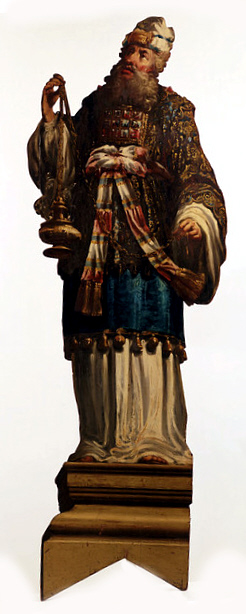
Painted board of Aaron, oil on wood panel, British, ca 1708

Painted board of Aaron, oil on wood panel, British, ca 1708

1 The levitical priests, the whole tribe of Levi, shall have no allotment or inheritance within Israel. They may eat the sacrifices that are the LORD’s portion 2 but they shall have no inheritance among the other members of the community; the LORD is their inheritance, as he promised them.

3 This shall be the priests’ due from the people, from those offering a sacrifice, whether an ox or a sheep: they shall give to the priest the shoulder, the two jowls, and the stomach. 4 The first fruits of your grain, your wine, and your oil, as well as the first of the fleece of your sheep, you shall give him. 5 For the LORD your God has chosen Levi out of all your tribes, to stand and minister in the name of the LORD, him and his sons for all time.

6 If a Levite leaves any of your towns, from wherever he has been residing in Israel, and comes to the place that the LORD will choose (and he may come whenever he wishes), 7 then he may minister in the name of the LORD his God, like all his fellow-Levites who stand to minister there before the LORD. 8 They shall have equal portions to eat, even though they have income from the sale of family possessions.

In addition to judges and the king outlined in Deuteronomy 16 and 17 respectively now a third ordering portion of society is added, already alluded to in Deuteronomy 17: 8-13 with their role being the final judicial appeal for cases too difficult for the regional judges. This third pillar of the society is the priesthood, a group set aside to minister before the LORD and who serve cultic, teaching and judicial roles for the people of Israel.

The Levites do not have an inheritance of agricultural land, they will have places to live but not the fields for growing crops or animals like the other tribes. On the one hand they are independent of the necessity to work in the fields and are able to dedicate their time to their work of ministering on behalf of the community. On the other hand, they are incredibly vulnerable and dependent on the other tribes providing for them and continuing to offer before the LORD their sacrifices and bringing in their first fruits. If Israel remains faithful to their calling to bring in from the fields their first fruits of grain, wine and oil as well as offering the firstlings of the flock and the other offerings that are outlined the Levites will be taken care of. If Israel becomes a more secular society then the economic security of the Levites is undercut because they do require the other tribes to provide the portion that they are living off of. They have no inheritance other than the LORD which gives them, perhaps, a closer sense of communion with their God but also depends upon receiving the blessing of the LORD through the labor and work of the other tribes.

Israel was intended to be a society structured around this covenantal relationship with their God, not a secular society. In this society structured around a particular understanding of justice the people will care for the tabernacle and later the temple and those who minister to it. The remembered reality is often far different: the priests would often fail in being faithful by abusing their position, the temple and tabernacle would fall into disrepair, the people and kings would be attracted by the ways of the other nations and the economy would become indistinguishable from the nations that surrounded them or the practices of Egypt where they were enslaved.

It is possible that the reference to Levites leaving the towns and coming to minister at the temple/tabernacle may reference the reforms of King Josiah in 2 Kings 23: 8-9, where he tries to centralize the worship of Judah in the temple and eliminates the high places. In the theology of Deuteronomy and the books that come after it, the high places are places where the worship of the LORD is not done correctly, perhaps blending in the elements of the surrounding nations. Perhaps this is also referencing the practices mentioned in 16: 20. The centralization of the cultic functions in Jerusalem does cause a concentration of a large number of levites, but the ongoing narrative also is aware of priests that are scattered throughout the nation. There would be tensions that would arise between the rural priests and the urban priests who became a part of the power structure in Jerusalem, but these verses imagine a situation where rural priests would be welcomed into Jerusalem as equals.

We live in a very different world than the one imagined in Deuteronomy. In Deuteronomy the Levites become one of the central parts of the society ordered around the worship of the LORD. In the United States where there is a strange hybrid relationship between the religious and the secular those in religious callings that are dependent upon the support of their congregations share the blessing and insecurity imagined for the Levites. There is the gift of being able to dedicate one’s time to the ministry that they fell called to be a part of. Yet, particularly in our increasingly spiritual but not religious age where many congregations are aging and shrinking and fewer people identify themselves religiously as a part of a congregation much less support one financially, many leaders of religious communities are finding their calling very tenuous. Unlike the Levites there is the opportunity in a diverse economy for dual callings where the religious role becomes one of two or more roles that sustain a person and their family, but in the ancient world where wealth was tied to land the Levites were placed in a vulnerable state if the other tribes did not support the religious system.

Deuteronomy 18: 9-14: Forbidden Magic

9 When you come into the land that the LORD your God is giving you, you must not learn to imitate the abhorrent practices of those nations. 10 No one shall be found among you who makes a son or daughter pass through fire, or who practices divination, or is a soothsayer, or an augur, or a sorcerer, 11 or one who casts spells, or who consults ghosts or spirits, or who seeks oracles from the dead. 12 For whoever does these things is abhorrent to the LORD; it is because of such abhorrent practices that the LORD your God is driving them out before you. 13 You must remain completely loyal to the LORD your God. 14 Although these nations that you are about to dispossess do give heed to soothsayers and diviners, as for you, the LORD your God does not permit you to do so.

We live in a world where magic is predominantly a part of fiction and the magicians we may see are illusionists that are able to trick our senses through various forms of deception. There are still people who look to horoscopes, palm readers, mediums and other spiritual forms of divining the future but for most people in our society theses are looked upon in terms of entertainment rather than items to place one’s trust in. In the world of Deuteronomy, the practices listed were apparently real and persuasive options available in the world they lived within. All of these forms of magic and divining the future were not to be things that the people of Israel were to heed.

Many of the prohibited practices relate to trying to predict the future or discern how a person is to act to bring about a desired future, whether through practices like augury or by inquiring of the dead. In many respects this vacancy is to be filled by the role of the prophet talked about in the coming verses, even though the biblical prophets are primarily concerned with the present and its impact on the immediate future. Perhaps one of the key differences comes from a different view of the universe. For many people in the ancient world the future was fixed and many ancient religions have some idea of fate. For the people of Israel the future rested in God’s freedom and their relationship with their God. Ultimately God would decide the course of their lives based upon their obedience to the covenant. Deuteronomy will echo repeatedly: if you follow the ways of the covenant you will be blessed and your lives will be long, if you do not follow the commandments and ordinances you will be cursed.

In verse 13, the command is that “you must remain completely loyal to the LORD your God.” Walter Brueggemann points out when speaking about the word translated completely loyal, “The Hebrew term tāmîm means “integrated, whole, undivided, as one unit.” This idea and term likely lies behind Jesus’ teaching in Matthew 5:48 which gets translated, “Be perfect, therefore, as your heavenly Father is perfect.” The translation in the gospel as perfect could mislead the reader to think this is about some type of moral perfection which is different from the direction of the Sermon on the Mount within which this verse is contained. Jesus and Deuteronomy are both calling for unreserved loyalty and living a whole integrated life within the followers ongoing relationship with their God. (Brueggemann, 2001 , p. 194)

Deuteronomy 18: 15-22 The Prophetic Voice

Jeremiah Lamenting the Destruction of Jerusalem by Rembrandt van Rijn 1630

Jeremiah Lamenting the Destruction of Jerusalem by Rembrandt van Rijn 1630

15 The LORD your God will raise up for you a prophet like me from among your own people; you shall heed such a prophet. 16 This is what you requested of the LORD your God at Horeb on the day of the assembly when you said: “If I hear the voice of the LORD my God any more, or ever again see this great fire, I will die.” 17 Then the LORD replied to me: “They are right in what they have said. 18 I will raise up for them a prophet like you from among their own people; I will put my words in the mouth of the prophet, who shall speak to them everything that I command. 19 Anyone who does not heed the words that the prophet shall speak in my name, I myself will hold accountable. 20 But any prophet who speaks in the name of other gods, or who presumes to speak in my name a word that I have not commanded the prophet to speak– that prophet shall die.” 21 You may say to yourself, “How can we recognize a word that the LORD has not spoken?” 22 If a prophet speaks in the name of the LORD but the thing does not take place or prove true, it is a word that the LORD has not spoken. The prophet has spoken it presumptuously; do not be frightened by it.

 The fourth and final pillar of the Israelite society is the voice of the prophet. The judges, priests and king will all be voices charged with defending the faithfulness of Israel and protecting the justice for all the people, especially the vulnerable. Yet, the judges, priests and king will all compose the ruling class of the people and come from privileged positions which may skew their perspective on justice at times. With Moses all of these roles are held within one person but in the coming future without Moses these gifts will need to be spread among the community, yet the prophetic voice, the one charged with speaking on behalf of God, is a unique gift of the Hebrew people. The prophets may or may not come from the priestly Levites, but they are charged with standing between God and the people as a mouthpiece. Often their words will be uncomfortable: they will challenge kings and sometimes be thought of as traitors. In Deuteronomy 13 it is the faithfulness of the prophet to the LORD that is the critical discernment as to whether the prophet is a true or false prophet, but sometimes a situation may arise, as in Jeremiah 28 where Hananiah and Jeremiah are proclaiming two very different prophecies and both apparently in the name of the LORD. Now the actual occurrence of the prophecy becomes a key part of discerning who the true and false prophet is. Being a true prophet of God is often a dangerous and lonely vocation because it often challenges the monarchy, priestly and judicial powers calling them back to justice and their vocation on behalf of the LORD. Only certain people seem to be able to hear the voice of the LORD, and this story places this back with the reception of the law at Mount Horeb/Sinai (see Exodus 20: 18-21). The word of God being enfleshed in messengers rather than appearing in its terrifying unveiled power is a concession to the people’s plea. Yet, in this enfleshment in the prophets there is also the potential for abuses even in this office. The story of Israel will be full of false prophets who tell people what they want or expect to hear or those who ensnare others. The prophets will also be those who at least in some cases, like Elijah and Elisha, are able to act as an extension of God’s power towards (or against) the people of Israel.

Within the person of Moses he bears together the roles of leader, priest, judge and prophet. From a Christian perspective these roles come together in a very different way with Jesus. Because of this it is not surprising that the gospel of Matthew spends a lot of time placing Jesus and Moses alongside each other and understands who Jesus is in light of Moses story and role. It is very early in the Christian church that you can find references to the three roles of Christ: as prophet, priest and king. And perhaps it is underappreciated how Jesus was seen by the people of his time as a prophet because his words and his actions would have called to mind some of the biblical prophets that had been a part of the story of Israel.

Deuteronomy 17: A Society Structured Around One Lord

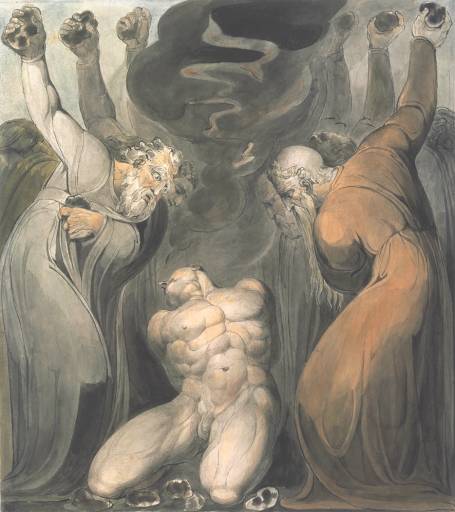
The Blasphemer, as in Leviticus 24: 13-23, by William Blake circa 1800

The Blasphemer, as in Leviticus 24: 13-23, by William Blake circa 1800

Deuteronomy 16:20-17:7 Only the LORD your God

1You must not sacrifice to the LORD your God an ox or a sheep that has a defect, anything seriously wrong; for that is abhorrent to the LORD your God.

                2 If there is found among you, in one of your towns that the LORD your God is giving you, a man or woman who does what is evil in the sight of the LORD your God, and transgresses his covenant 3 by going to serve other gods and worshiping them– whether the sun or the moon or any of the host of heaven, which I have forbidden– 4 and if it is reported to you or you hear of it, and you make a thorough inquiry, and the charge is proved true that such an abhorrent thing has occurred in Israel, 5 then you shall bring out to your gates that man or that woman who has committed this crime and you shall stone the man or woman to death. 6 On the evidence of two or three witnesses the death sentence shall be executed; a person must not be put to death on the evidence of only one witness. 7 The hands of the witnesses shall be the first raised against the person to execute the death penalty, and afterward the hands of all the people. So you shall purge the evil from your midst.

For the author of Deuteronomy the first and central commandment that the people are only to have the LORD as their God. It comes at the head of the Ten Commandments in Deuteronomy 5:6:

I am the LORD your God, who brought you out of the land of Egypt, out of the house of slavery; you shall have no other gods before me

and in Deuteronomy 6: 4-5:

Hear, O Israel: The LORD is our God, the LORD alone. You shall love the LORD your God with all your heart, and with all your soul, and with all your might.

Even before this Deuteronomy 4 emphasizes this same theme, as do Deuteronomy 7, 8, and 9. Deuteronomy 12 again addresses this issue in relation to destroying places of worship for other gods, and all of Deuteronomy 13 addresses this issue in stark terms of what the punishment is to be for violating this covenant relationship by individuals or by entire towns. It comes up here again at the end of 16 and beginning of 17 because it is such a central issue for the Deuteronomist that the author wants no chance for the hearer/reader to miss it. Being an aural culture the things that are central will be repeated over and over to ensure that they are heard by the listening audience. The death penalty for following other gods may seem harsh to us, and I address this question in greater detail when I talk about Deuteronomy 13, but this unique relationship with the LORD is to be at the center of the life of the people of Israel.

The LORD is not to be worshiped in the same way that the gods of the nations around the people are worshiped, there is to be no blending of the gods of the nations and the LORD. The people are also to bring their best to the worship of their LORD, not the animals that are defective. For the Deuteronomist these are life and death decisions, and yet they are still bound by the due process of the law. Justice is expected and a thorough investigation of any claims of idolatry are to be made. Deuteronomy 17 probably lays behind the command in Matthew 18.16 of wanting claims to be confirmed with the testimony of two or three witnesses and also behind the command for the one who is without sin to ‘cast the first stone’ in John 8 (even though this deals with adultery). In a contemporary fictional setting it is similar to the insistence of Ned Stark in the Game of Thrones that the one who passes the sentence should swing the sword, but instead here it is the witness who has testified against a person who must cast the initial stone of the community’s judgment. As Walter Brueggemann can state, “The book of Deuteronomy is committed to a rule of law even if it is a severe rule of law.” (Brueggemann, 2001 , p. 181) The nation of Israel is to be a theocracy where ultimately the LORD their God is at the center of their judicial, religious and political life and the central place of their LORD their God should, in the view of Deuteronomy, impact the way they structure the leadership and judicial life of their community

Deuteronomy 17:8-13 The Levitical Judicial Function

8 If a judicial decision is too difficult for you to make between one kind of bloodshed and another, one kind of legal right and another, or one kind of assault and another– any such matters of dispute in your towns– then you shall immediately go up to the place that the LORD your God will choose, 9 where you shall consult with the levitical priests and the judge who is in office in those days; they shall announce to you the decision in the case. 10 Carry out exactly the decision that they announce to you from the place that the LORD will choose, diligently observing everything they instruct you. 11 You must carry out fully the law that they interpret for you or the ruling that they announce to you; do not turn aside from the decision that they announce to you, either to the right or to the left. 12 As for anyone who presumes to disobey the priest appointed to minister there to the LORD your God, or the judge, that person shall die. So you shall purge the evil from Israel. 13 All the people will hear and be afraid, and will not act presumptuously again.

The vision of Deuteronomy is for a theocracy, a nation that is an extension of the covenantal relationship with the LORD their God, and so all of the functions of life are structured around trying to create that type of a nation. In many respects ancient Judaism and Islam share this desire to create nations that are structured in this manner and so in ancient Judaism, like some Muslim states, the highest court of appeals is a religious court and not a secular one. For people who live in Europe or the United States this may seem a strange concept because we live in a post-enlightenments modern society where religion is viewed as a private portion of a person’s life, but this is a relatively recent development. The law for the Jewish people was a reflection of their covenantal relationship with their God and it was viewed as a gift that God had given them. Even the judges that were a part of the tribes were expected to judge in accordance with the ideals outlined in the law. It doesn’t take long reading through books like Judges or 1 Samuel to find ways in which the judges often failed in this respect, but the ideal was that those entrusted with ministering to the LORD in the tabernacle or temple would be those most focused on the ideals of justice that the LORD called for. People are to obey the judgments of this religious and tribal courts, for a judge whose sentence holds no power is not going to be effective in enforcing this justice. So again, it is a harsh justice, where the penalty for disobeying a priest or a judge in their sentences is execution.

Deuteronomy 17: 14-20 The Model King

                14 When you have come into the land that the LORD your God is giving you, and have taken possession of it and settled in it, and you say, “I will set a king over me, like all the nations that are around me,” 15 you may indeed set over you a king whom the LORD your God will choose. One of your own community you may set as king over you; you are not permitted to put a foreigner over you, who is not of your own community. 16 Even so, he must not acquire many horses for himself, or return the people to Egypt in order to acquire more horses, since the LORD has said to you, “You must never return that way again.” 17 And he must not acquire many wives for himself, or else his heart will turn away; also silver and gold he must not acquire in great quantity for himself. 18 When he has taken the throne of his kingdom, he shall have a copy of this law written for him in the presence of the levitical priests. 19 It shall remain with him and he shall read in it all the days of his life, so that he may learn to fear the LORD his God, diligently observing all the words of this law and these statutes, 20 neither exalting himself above other members of the community nor turning aside from the commandment, either to the right or to the left, so that he and his descendants may reign long over his kingdom in Israel.

Willem de Poorter, 'De afgoderij van konig Solomo'-Solomon's decent into idolatry (between 1630 and 1648)

Willem de Poorter, ‘De afgoderij van konig Solomo’-Solomon’s decent into idolatry (between 1630 and 1648)

Most people assume that the monarchy, and particularly the Davidic monarchy, was universally embraced by scriptures and particularly King David and Solomon are the great kings where everything went well during their reign. The bible is not unanimous in endorsing having a king at all and for example in 1 Samuel 8, when the people are demanding of Samuel a king the LORD’s response is telling:

“Listen to the voice of the people in all that they say to you; for they have not rejected you, but they have rejected me from being king over them. Just as they have done to me, from the day I brought them up out of Egypt to this day, forsaking me and serving other gods, so also they are doing to you. Now then, listen to their voice; only—you shall solemnly want them, and show them the ways of the king who shall reign over them.” 1 Samuel 8: 7-9

The Deuteronomic history (the books beginning with Judges and stretching through 2 Kings) is pretty unromantic when it describes the failings of the kings that would rule over Judah and Israel, and it is telling the way that Deuteronomy describes the aspects of who the king is to be, they are the opposite of King Solomon. Most Christians know little of the story of Solomon, other than his request for wisdom and his building of the temple, but the way 1 Kings tells of his reign he quickly is drawn into a quest for wealth, military power and in making alliance is led astray from being faithful to the LORD, the God of Israel. Solomon imports horses from Egypt and has 12,000 horses and 1,400 chariots. Horses in the ancient world are a sign of military might. With power centralized and the military muscle to back up that power the king of Israel may begin to act like the Pharaohs of Egypt and the people become plunged into dependence under the burden of supplying for the hunger of a large military budget. 1 Kings goes at length into describing the wealth that Solomon accumulates as well as the incredible investment in projects beyond the temple, like his own palace. Solomon’s reign is reported to have brought in more than five tons of gold a year in addition to countless other resources. Finally Solomon is lifted up as having seven hundred princesses and three hundred concubines. All of these are direct counters to Deuteronomy’s vision of what a king is to be, and are ultimately blamed for the rising opposition to Solomon in his life and the splitting of the kingdom in two after his death. I tell about this briefly in the Place of Authority posts.

The title of the book of Deuteronomy comes from verse 18 where it refers to a copy of the law (in greek deutero nomos-second law) that the king is to read from each night and to be the way in which the king stays grounded in the covenantal life the people are called to.  Ultimately in the view of Deuteronomy the king is subservient to the will of the LORD. In reality, this rarely seemed to be the case in the story of the people of Judah and Israel. In a time where the majority of the population would be illiterate and not have access to written copies of the law they did rely upon the leaders including the king and the religious authorities guiding them in their actions. The bible evaluates the kings theologically: were they faithful to the LORD their God or did they lead the people to follow other gods?

I am writing from a Christian perspective, and in the church year we are approaching Christ the King Sunday and perhaps as Christians it might be worth examining how Jesus who we call Messiah or Christ (which means anointed king) lives into this identity. In Paul’s short statement of who Christ was in Philippians 2:

Who, though he was in the form of God, did not regard equality with God as something to be exploited, but emptied himself, taking the form of a slave, being born in human likeness. And being found in human form, he humbled himself and became obedient to the point of death—even death on a cross. Philippians 2: 6-8.

Many of the servant songs from Isaiah, which Christians read as talking about Jesus probably originally were trying to consider a monarch that might embody the vision of passages like Deuteronomy 17. Perhaps when the New Testament talks about explaining who Jesus was from the law and the prophets this is one of the places in the law where the early Christians went back to.