Tag Archives: Leprosy

2 Kings 6:24-7:20 The Siege and Deliverance of Samaria

Hills Near the Ruins of Samaria By Daniel Ventura – Own work, CC BY-SA 3.0, https://commons.wikimedia.org/w/index.php?curid=32449397

2 Kings 6:24-7:2

24Some time later King Ben-hadad of Aram mustered his entire army; he marched against Samaria and laid siege to it. 25As the siege continued, famine in Samaria became so great that a donkey’s head was sold for eighty shekels of silver and one-fourth of a kab of dove’s dung for five shekels of silver. 26Now as the king of Israel was walking on the city wall, a woman cried out to him, “Help, my lord king!” 27He said, “If the LORD does not help you, where would my help come from? From the threshing floor or from the winepress?” 28But then the king asked her, “What is your complaint?” She answered, “This woman said to me, ‘Give up your son; we will eat him today, and we will eat my son tomorrow.’ 29So we cooked my son and ate him. The next day I said to her, ‘Give up your son, and we will eat him.’ But she has hidden her son.” 30When the king heard the words of the woman he tore his clothes—now since he was walking on the city wall, the people could see that he had sackcloth on his body underneath 31and he said, “So may God do to me and more, if the head of Elisha son of Shaphat stays on his shoulders today.” 32So he dispatched a man from his presence.
  Now Elisha was sitting in his house, and the elders were sitting with him. Before the messenger arrived, Elisha said to the elders, “Are you aware that this murderer has sent someone to take off my head? When the messenger comes, see that you shut the door and hold it closed against him. Is not the sound of his master’s feet behind him?” 33
While he was still speaking with them, the king came down to him and said, “This trouble is from the LORD! Why should I hope in the LORD any longer?”

71But Elisha said, “Hear the word of the LORD: Thus says the Lord: Tomorrow about this time a measure of choice meal shall be sold for a shekel and two measures of barley for a shekel, at the gate of Samaria.” 2Then the captain on whose hand the king leaned said to the man of God, “Even if the LORD were to make windows in the sky, could such a thing happen?” But he said, “You shall see it with your own eyes, but you shall not eat from it.”

The final seven verses of chapter six are connected to the story that continues through the seventh chapter of 2 Kings. The verses and chapters were added at a later point, and the chapter division highlights the prophecy of Elisha by bookending the seventh chapter, but the narrative which evokes the word of the LORD begins at verse twenty-four. One of the Aramean kings named Ben-hadad[1] lays siege to Samaria creating the severe crisis of the story.

Siege warfare works by denying the encircled city the resources it needs to survive while the surrounding army has access to food from the land and if necessary, brought in from the besieging country. The first to feel the impact of the food shortages are the poor and the vulnerable as the cost of the food necessary to survive climbs as the supply dwindles. In our story the cost of once unpalatable foods has reached a point unreachable to all but the wealthiest households. The ‘dove’s dung’ has a couple possible interpretations. It may be the droppings from birds who are able to eat from the grain fields that the population no longer has access to, and this may form a disgusting but necessary source of nutrition for the captured population. Some translations like the NEB and NJPS follow a linguistic trail to translate this as the “seeds of the (false) carob” which is a plant of limited nutritional value. However one translates the ‘dove’s dung,’ the situation in the city has become desperate to the point where hunger is creating an inhumane situation.

The woman at the wall who calls upon the king of Israel for help is met with a pious sounding answer, “If the LORD does not help you, where would my help come from.” To me this resonates like the empty ‘thoughts and prayers’ of a politician who has no interest in resolving the crisis of the individual who comes to them for help. Yet, in Israel there is a tradition of people coming to their kings to judge difficult and life changing matters and the kings of Israel are supposed to be guardians of the vulnerable. This story resonates with Solomon’s judging between the two women fighting over a child in 1 Kings 3: 16-28, but in this story of famine now the women are fighting over children to be eaten in their starvation. The situation echoes the darkest warnings against disobedience in Deuteronomy 28: 52-57:

52 It shall besiege you in all your towns until your high and fortified walls, in which you trusted, come down throughout your land; it shall besiege you in all your towns throughout the land that the LORD your God has given you. 53 In the desperate straits to which the enemy siege reduces you, you will eat the fruit of your womb, the flesh of your own sons and daughters whom the LORD your God has given you. 54 Even the most refined and gentle of men among you will begrudge food to his own brother, to the wife whom he embraces, and to the last of his remaining children, 55 giving to none of them any of the flesh of his children whom he is eating, because nothing else remains to him, in the desperate straits to which the enemy siege will reduce you in all your towns. 56 She who is the most refined and gentle among you, so gentle and refined that she does not venture to set the sole of her foot on the ground, will begrudge food to the husband whom she embraces, to her own son, and to her own daughter, 57 begrudging even the afterbirth that comes out from between her thighs, and the children that she bears, because she is eating them in secret for lack of anything else, in the desperate straits to which the enemy siege will reduce you in your towns.

The woman’s situation in this siege echoes the narration of the later siege of Jerusalem by Babylon in Ezekiel 5:10 and Lamentations 2:20 and 4:10. It is a world where the bond between mother and child has been broken by hunger and people lose their humanity in the horror of the siege. The king who has been sheltered from the worst aspects of the deprivation of the siege is horrified by the woman’s situation and yet still claims no power to alleviate her condition. The stores of grain and wine even for the king are likely depleted and we learn that he is wearing sackcloth, a sign of mourning and repentance, under his clothes which he tears on hearing the woman’s story. In response he rashly declares that he will kill Elisha.

Elisha may be the target of the king’s rage as the representative of the LORD who the king of Israel blames for this unbroken siege, or he may simply be a scapegoat in the king’s powerlessness. Elisha did in the previous chapter deliver into Samaria an Aramean army who he instructed the king to feed and allow them to depart in peace. The peace which Elisha brokered did not endure and the king of Israel may blame the prophet for the situation. It is also possible that the king feels that the prophet, who has provided food miraculously, has not performed a miracle to provide food for the suffering city. If this unnamed king of Israel is Jehoram, as the order of the stories implies, there is a long animosity between the Omri dynasty that Jehoram is a member of and Elijah as well as Elisha. It is possible that the king has never approached the prophet until this point in the siege although it is worth noting that the elders are with the prophet during this scene.

The story becomes a bit confused in verses 32-33 where a messenger arrives and later the king. Mordechai Cogan and Hayim Tadmor point to Josephus’ reconstruction of the events as being as sensible as any:

“But you,” (Elisha) said, “when the man arrives who has been given this order be on guard as he is about to enter, and press him back against the door and hold him there, for the king will follow him and come to me, having changed his mind.” So, when the man came who had been sent by the king to make away with Elisha, they did as he had ordered. But Joram, repenting of his wrath against the prophet and fearing that the man who had been ordered to kill him might already be doing so, hastened to prevent the murder and even save the prophet. Antiquities ix, 69-70. (Cogan, 1988, pp. 80-81)

Despite the king’s earlier murderous words, the king, the prophet, and the elders all share in hearing the word of the LORD that Elisha receives declaring that the crisis will end suddenly in roughly twenty-four hours. The immediate availability of cheap food prophesied is unbelievable to the captain of the king, and Elisha adds a final note that this captain will see the prophecy fulfilled but be unable to partake in it.

2 Kings 7:3-20

  3Now there were four men with a defiling skin disease outside the city gate who said to one another, “Why should we sit here until we die? 4If we say, ‘Let us enter the city,’ the famine is in the city, and we shall die there, but if we sit here, we shall also die. Therefore, let us desert to the Aramean camp; if they spare our lives, we shall live, and if they kill us, we shall but die.” 5So they arose at twilight to go to the Aramean camp, but when they came to the edge of the Aramean camp there was no one there at all. 6For the Lord had caused the Aramean army to hear the sound of chariots and of horses, the sound of a great army, so that they said to one another, “The king of Israel has hired the kings of the Hittites and the kings of Egypt to fight against us.” 7So they fled away in the twilight and abandoned their tents, their horses, and their donkeys, leaving the camp just as it was, and fled for their lives. 8When these diseased men had come to the edge of the camp, they went into a tent, ate and drank, carried off silver, gold, and clothing, and went and hid them. Then they came back, entered another tent, carried off things from it and went and hid them.
  9
Then they said to one another, “What we are doing is wrong. This is a day of good news; if we are silent and wait until the morning light, we will be found guilty; therefore let us go and tell the king’s household.” 10So they came and called to the gatekeepers of the city and told them, “We went to the Aramean camp, but there was no one to be seen or heard there, nothing but the horses tied, the donkeys tied, and the tents as they were.” 11Then the gatekeepers called out and proclaimed it to the king’s household. 12The king got up in the night and said to his servants, “I will tell you what the Arameans have prepared against us. They know that we are starving, so they left the camp to hide themselves in the open country, thinking, ‘When they come out of the city, we shall take them alive and get into the city.’ ” 13One of his servants said, “Let some men take five of the remaining horses, since those left here will suffer the fate of the whole multitude of Israel that have perished already; let us send and find out.” 14So they took two mounted men, and the king sent them after the Aramean army, saying, “Go and find out.” 15So they went after them as far as the Jordan; the whole way was littered with garments and equipment that the Arameans had thrown away in their haste. So the messengers returned and told the king.
  16
Then the people went out and plundered the camp of the Arameans. So a measure of choice meal was sold for a shekel and two measures of barley for a shekel, according to the word of the LORD. 17Now the king had appointed the captain on whose hand he leaned to have charge of the gate; the people trampled him to death in the gate, just as the man of God had said when the king came down to him. 18For when the man of God had said to the king, “Two measures of barley shall be sold for a shekel and a measure of choice meal for a shekel, about this time tomorrow in the gate of Samaria,” 19the captain had answered the man of God, “Even if the LORD were to make windows in the sky, could such a thing happen?” And he had answered, “You shall see it with your own eyes, but you shall not eat from it.” 20It did indeed happen to him; the people trampled him to death in the gate.

The resolution to the crisis begins in the desperation of four men who are unclean and left outside the city. As mentioned above it is the vulnerable, and these four men with an affliction traditionally translated as leprosy would be vulnerable as they are excluded outside the city’s protective walls. In a situation where staying where they are would lead to death and entering the city would lead to death, they make the choice to surrender to the Arameans because the worst they can do is kill them. This decision to give up to the besieging forces sets in motion the deliverance of Samaria.

I have mixed feelings about the NRSVue decision throughout these texts to translate what is traditionally rendered ‘leprosy’ as a ‘defiling skin disease’ or ‘skin disease.’ On the one hand, what we now categorize as leprosy or Hansen’s disease is probably not what is referred to throughout the bible. But I wonder if the more generic skin disease disconnects the average reader from the severity of this diagnosis in the ancient world of Judaism. It is telling that Leviticus thirteen and fourteen are dedicated to the identification, the exclusion of the infected individuals from the community, and the necessary examination to allow their re-inclusion if the skin disorder clears up. These lepers are ‘unclean’ and unable to participate in the life of the community. Yet these outsiders will provide deliverance for the people trapped inside the city.

Before the four men approach the camp, the Arameans flee in panic because they hear the sound of horses and chariots approaching and fear that the king of Israel has paid Egypt and the Hittites to come and break the siege for them. The horses and chariots echo the appearance of the ‘horses and chariots of Israel’ in the previous story (2 Kings 6:15) and now instead of opening the eyes of the servant the LORD in a different manner opens the ears of the Arameans. The panic of the Arameans in the story is enough that they abandon not only their encampment but also their horses and donkey and leave a trail of discarded items in the path of their retreat. There are resources and wealth to feed and equip an army surrounding the city, much of the food likely taken from Israel’s fields, and there waiting to be discovered by the starving city.

The Jewish sages identified the four men with Gehazi and his sons (Israel, 2019, p. 129) which makes sense with this story being between Gehazi having Naaman’s leprosy cling to him and his family (2 Kings 5:27) and Gehazi’s reemergence talking with the king in the upcoming chapter (2 Kings 8: 4-5). This identification while interesting is not necessary for the story as these four men proceed to the camp, find it empty, ate and drank, pillaged some of the wealth they found, and eventually notify the gatekeepers of the situation. These men excluded as outsiders because of their skin condition still consider themselves a part of the people and have an obligation to those suffering inside the city. They appeal through the gatekeeper to the king’s household.

The king initially views this report from the four men as a trap set by the Aramean army to draw him out, but eventually one of his servants convinces the king to send out scouts with horses to examine the situation, lest the remaining horses perish with the people inside the city. Once the messengers return to the king it sets in motion the availability of food promised by the prophecy of Elisha as well as the death of the captain of the king. As mentioned in the previous section, the current chapter divisions highlight the words of Elisha at the beginning and ending of the chapter to demonstrate their fulfillment. A siege which reduced men and women to inhuman actions is now ended by four men whose humanity is compromised by the unclean disease carried on their skin. The God of Israel’s unseen host is now heard by the Aramean causing them to abandon their siege and to provide the food the city needs. The prophet once blamed by the king for the situation inside the city has now accurately predicted the cities deliverance by the LORD the God of Israel.


[1] Mordechai Cogan and Hayim Tadmor note there are at least two and possibly three kings name Ben-Hadad,  whose name means the son of (the God) Hadad, “At least two, if not three persons by this name are known: Ben-hadad, contemporary of Baasha (1 Kgs 15:18); Ben-hadad, foe of Abab (1 Kgs 20: 1; he is identical with mAdad-idri of Assyrian inscriptions…and Ben-hadad, son of Hazael (2 Kgs 13:3).” (Cogan, 1988, p. 78)
2 Kings 5 Elisha Heals Naaman and Gehazi’s Poor Choice

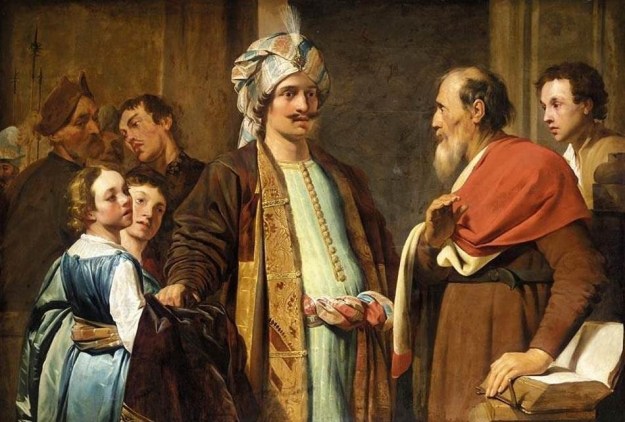
Pieter de Grebber, Elisha Refusing Gifts From Naaman (1630) https://www.theleidencollection.com/artwork/elisha-refusing-naamans-gifts/

2 Kings 5: 1-19a 

1Naaman, commander of the army of the king of Aram, was a great man and in high favor with his master because by him the Lord had given victory to Aram. The man, though a mighty warrior, suffered from a skin disease. 2Now the Arameans on one of their raids had taken a young girl captive from the land of Israel, and she served Naaman’s wife. 3She said to her mistress, “If only my lord were with the prophet who is in Samaria! He would cure him of his skin disease.” 4So Naaman went in and told his lord just what the girl from the land of Israel had said. 5And the king of Aram said, “Go, then, and I will send along a letter to the king of Israel.”
  He went, taking with him ten talents of silver, six thousand shekels of gold, and ten sets of garments. 6
He brought the letter to the king of Israel, which read, “When this letter reaches you, know that I have sent to you my servant Naaman, that you may cure him of his skin disease.” 7When the king of Israel read the letter, he tore his clothes and said, “Am I God, to give death or life, that this man sends word to me to cure a man of his skin disease? Just look and see how he is trying to pick a quarrel with me.”
  8
But when Elisha the man of God heard that the king of Israel had torn his clothes, he sent a message to the king, “Why have you torn your clothes? Let him come to me, that he may learn that there is a prophet in Israel.” 9So Naaman came with his horses and chariots and halted at the entrance of Elisha’s house. 10Elisha sent a messenger to him, saying, “Go, wash in the Jordan seven times, and your flesh shall be restored, and you shall be clean.” 11But Naaman became angry and went away, saying, “I thought that for me he would surely come out and stand and call on the name of the LORD his God and would wave his hand over the spot and cure the skin disease! 12Are not Abana and Pharpar, the rivers of Damascus, better than all the waters of Israel? Could I not wash in them and be clean?” He turned and went away in a rage. 13But his servants approached and said to him, “Father, if the prophet had commanded you to do something difficult, would you not have done it? How much more, when all he said to you was, ‘Wash, and be clean’?” 14So he went down and immersed himself seven times in the Jordan, according to the word of the man of God; his flesh was restored like the flesh of a young boy, and he was clean.
  15
Then he returned to the man of God, he and all his company; he came and stood before him and said, “Now I know that there is no God in all the earth except in Israel; please accept a present from your servant.” 16But he said, “As the LORD lives, whom I serve, I will accept nothing!” He urged him to accept, but he refused. 17Then Naaman said, “If not, please let two mule loads of earth be given to your servant, for your servant will no longer offer burnt offering or sacrifice to any god except the Lord. 18But may the LORD pardon your servant on one count: when my master goes into the house of Rimmon to worship there, leaning on my arm, and I bow down in the house of Rimmon, when I do bow down in the house of Rimmon, may the LORD pardon your servant on this one count.” 19He said to him, “Go in peace.”

The healing of Naaman, along with Elijah’s ascent in the whirlwind, are probably the two best-known and most frequently used stories from 2 Kings in the life of the church. This story, along with Elijah’s provision of meal and oil for the widow of Zarephath, is utilized in Luke 4:27 as an explanation for the expansiveness of Jesus’ ministry, but it is also paired with Jesus’ healing of lepers in the gospels. Naaman is both the victorious mighty warrior who occupies a privileged position with the king of Aram and has servants and slaves along with the access to considerable wealth and power, but in Israel he is also a Gentile, an unclean one, and an oppressor. The story illustrates the fundamental differences between the world envisioned by the king of Aram and Naaman at the beginning of the story and the prophet Elisha when he enters in the middle of the story.

The position of Naaman, in the view of 2 Kings, is a result of the LORD the God of Israel granting him victory leading the Arameans. On the one hand this provides an explanation for the defeat of Israel by a foreign power, the defeat is a judgment on the unfaithfulness of Samaria. On the other hand, it makes the mighty warrior subject, unknowingly at the beginning of the story, to the LORD the God of Israel. Even a captive young woman from Israel knows what this mighty warrior cannot, that the hope for healing resides in Samaria. This young woman who is a captive and the mighty man who is a leader of armies may be on opposite sides of the power differential but in the story they are linked. Captured slaves often have an unfavorable view of their masters, yet in Naaman throughout the story we see that this mighty man is both respected enough by his servants for them to speak truthfully and compassionately to him and Naaman as their master listens. The commander of warriors who can deliver victories depends upon the knowledge willingly shared by a captured young woman residing in his household.

The skin disease which has been traditionally translated as leprosy is probably not what we today categorize as leprosy (or Hansen’s disease) but it was something that ancient cultures took very seriously. Leviticus 13-14 deals with the priestly role in the diagnosis, the social implications for a person diagnosed with this skin disorder and the method that they can also be reintegrated into the community once they are healed. The seriousness of the disease can be demonstrated by the incredible amount of wealth (ten talents of silver, six thousand shekels of gold, and ten sets of garments)[1] which the king of Aram sends to the king of Israel to bring about the healing of his favored commander.

In the ancient world there was no concept of separation of religious and state powers. For most ancient kings, even in Israel, there are religious figures including prophets in the royal court. The prophet Nathan was involved in the court of king David, and earlier in the Omri dynasty we saw the conflict between the prophets who spoke favorably to king Ahab and Micaiah who was a faithful prophet of the LORD but not in royal favor. As Alex Israel notes about the contrasting views of prophets between the kings of Aram and Israel:

The king of Aram was incapable of imagining a scenario in which the prophet would not be fundamentally subordinate to the king, and so he sought the prophet by means of the latter. By contrast, the king of Israel couldn’t conceive a situation in which the prophet would be responsive to his control, and so he failed to entertain the prospect of appealing to Elisha! (Israel, 2019, p. 98)

The king of Aram views the king of Israel as his subordinate who he can command, but Elisha does not answer to the king of Israel. Yet, Elisha does hear of the king’s distress and instructs him to send Naaman to him.

Naaman has probably encountered other healers and prophets in Damascus who attempted to heal his skin disease, and he has ideas of how that process should look for a person of his station. As a person of high status, he anticipated personal attention from the prophet. His status as a mighty warrior and commander of the armies of Aram have allowed him to be a person who is able to fulfill their request, but now he finds that this status means nothing before the prophet, and he is reduced to a “supplicant who comes to the healer as a leper.” (Brueggemann, 2000, p. 334) Yet, as previously we saw with the young woman from Israel, Naaman is a master who his servants are willing to speak to in an honest and compassionate way. Once Naaman has completed his complaint about the command delivered by an emissary to wash in the Jordan, his servants are able to convince him that the prophet has not asked a hard thing, and it is in Naaman’s interest to attempt this novel cure.

The washing in the Jordan results in Naaman’s skin becoming like a young boy. The description of Naaman’s skin utilizing the masculine form of the words used to describe the young girl at the beginning of the story now link the two together. In some way Naaman is now like this enslaved young woman even though they occupy vastly different places in the social hierarchy. Both stand in a place of dependency before God and Naaman has not only learned that there is a prophet in Samaria, but that there is no God in all the earth except in Israel.

After the healing Naaman stands, with all his company before the prophet Elisha. Naaman attempts to offer payment, but Elisha swears that he will take no payment.[2] Naaman then makes two requests when payment continues to be refused. First Naaman requests to take two mule loads of earth. Naaman likely believes that the God of Israel is tied to the land of Israel and bringing the earth will allow him to build an altar or worship space where he can access this God whom he has discovered. Secondly, he requests that in his state functions that God would not hold it against him when he escorts his master into the worship space of Rimmon, the god of Damascus. Elisha does not judge Naaman for these requests and instructs him to depart in shalom.

2 Kings 5: 19b-27

  But when Naaman had gone from him a short distance, 20Gehazi, the servant of Elisha the man of God, thought, “My master has let that Aramean Naaman off too lightly by not accepting from him what he offered. As the LORD lives, I will run after him and get something from him.” 21So Gehazi went after Naaman. When Naaman saw someone running after him, he jumped down from the chariot to meet him and said, “Is everything all right?” 22He replied, “Yes, but my master has sent me to say, ‘Two members of a company of prophets have just come to me from the hill country of Ephraim; please give them a talent of silver and two changes of clothing.’ ” 23Naaman said, “Please accept two talents.” He urged him and tied up two talents of silver in two bags, with two changes of clothing, and gave them to two of his servants, who carried them in front of Gehazi. 24When he came to the citadel, he took the bags from them and stored them inside; he dismissed the men, and they left.
  25
He went in and stood before his master, and Elisha said to him, “Where have you been, Gehazi?” He answered, “Your servant has not gone anywhere at all.” 26But he said to him, “Did I not go with you in spirit when someone left his chariot to meet you? Is this a time to accept silver and to accept clothing, olive orchards and vineyards, sheep and oxen, and male and female slaves? 27Therefore the skin disease of Naaman shall cling to you and to your descendants forever.” So he left his presence diseased, as white as snow.

The stories of the previous chapter seem to indicate that the company of prophets (or sons of the prophets) continually struggle with poverty and this may inform Gehazi’s action contrary to his master Elisha. As Choon-Leong Seow remarks, “the faithfulness of Naaman’s slave girl at the beginning of the story stands in stark contrast to the treachery of Elisha’s servant at the end of the chapter.” (NIB III:192) While Elisha swore an oath (“as the LORD lives”) that he would accept no gift (literally blessing) from Naaman his servant Gehazi swears an oath that he will take something from this Gentile. Gehazi runs after Naaman’s party and Naaman, after dismounting his chariot asks, “Is all shalom?” Gehazi gives a reason for wanting a blessing/payment from Naaman, which Naaman is eager to grant giving double the initial request. For Naaman this is far less than the ten talents of silver he was willing to pay as payment for healing, but the roughly one hundred fifty pounds of silver with two sets of garments[3] which two of Naaman’s servants carry back to the citadel would be an incredible amount of wealth among the company of prophets. Yet, Gehazi’s secret is known by Elisha and the Hebrew indicates that Elisha’s heart went with Gehazi (NRSV ‘spirit’). Silver and clothing, land and livestock, servants and slaves for the company of the prophets is not where their security comes from. Gehazi has trusted in the same things that the king of Aram and Naaman trusted, and Elisha indicates that now Naaman’s skin disease will cling to Gehazi and his descendants.

The healing of Naaman does not end the conflict between Aram and Samaria which will continue in the narrative of the next two chapters. It is also not the end of Gehazi’s role in the story who will reappear in chapter eight. It is possible that the healing of Naaman is brought forward in the story to be a part of an Elisha cycle of miracles which reaches its peak with the thwarting of the king of Aram’s invasion of Israel. The king of Israel’s inability to heal his servant did not provide the provocation for a continued war, but ultimately the healing of Naaman did not end the conflict between Samaria and Damascus.


[1] The NIV notes that 10 shekels of silver is about 750 lbs (340 kg) of silver and 6,000 shekels of gold is about 150 lbs (70 kg).

[2] Numbers 22:18 and Daniel 5:17 are both times where two very different prophets (Balaam and Daniel) indicate that gold will not be acceptable to earn favor or as payment for a servant of the LORD.

[3] Garments in the ancient world are also expensive and an indicator of wealth.

Matthew 8: 1-4 Jesus Takes our Infirmities and Bears our Diseases part 1

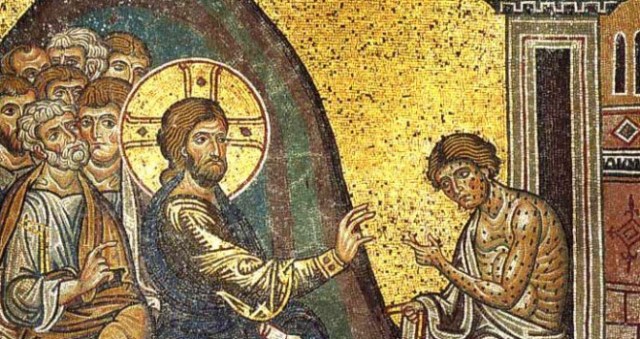
Mosaic, Cathedral of the Assumption in Monreale, Sicily (12-13th Century)

Matthew 8: 1-4

Parallels (Mark 1: 40-45, Luke 5: 12-16)

1 When Jesus had come down from the mountain, great crowds followed him; 2 and there was a leper who came to him and knelt before him, saying, “Lord, if you choose, you can make me clean.” 3 He stretched out his hand and touched him, saying, “I do choose. Be made clean!” Immediately his leprosy was cleansed. 4 Then Jesus said to him, “See that you say nothing to anyone; but go, show yourself to the priest, and offer the gift that Moses commanded, as a testimony to them.”

Jesus comes down the mountain after the Sermon on the Mount and we see the kingdom of heaven in conflict with the forces that keep people enslaved in the world. In chapters eight and nine of Matthew’s Gospel we see three patterns of three stories each separated by some manner of conflict with those hearing the message and some explanation of what we are seeing. It has been noted that like Moses participating in God’s liberation of the people from Egypt with the ten signs and wonders in Exodus 7-12, there are in these two chapters a total of ten acts of healing, exorcism or miracles, (Case-Winters, 2015, p. 125) and while I would agree there is a strong Moses typology in Matthew’s gospel that both places Jesus in comparison and in contrast to Moses these ten signs that announce the kingdom of heaven’s approach. There is also resistance from the forces of the world to the approach of the kingdom of heaven which occur each time Jesus descends a mountain in Matthew’s Gospel. In Matthew eight and nine at the end of each set of three stories there is an expansion of the effect of the individual acts to the many or crowds that are brought into the sphere of influence of the kingdom’s activity.

The first healing in Matthew’s gospel is a person rendered unclean by a skin disease, and while this probably isn’t leprosy, or Hanson’s disease as we have long translated this term, it is for the people of Israel a disease that rendered a person unclean and forced them to live isolated from the community. Skin diseases were a significant concern among the people and the priests are given the role of properly identifying this as a disease that makes one unclean and excluding and reuniting the person with the community. Leviticus 13-14 give the details of how the priest is to diagnose, proclaim unclean, and if the person recovers to ritually declare the person clean again. This type of uncleanness was viewed as a punishment by God, for example Numbers 12 with Miriam, and many diseases in this time were viewed as either an affliction by God or the act of some demonic corrupting force. Yet, I do think it is interesting to note in comparison with Moses that the second sign God gives Moses is turning his hand diseased (leprous in most translations) before Moses goes to witness to Israel. Here Jesus reaches out his hand and touches an unclean man with an affliction of the skin and makes it clean. Matthew in narrating Jesus’ story moves this story ahead of the healing of Peter’s mother-in-law in Mark’s Gospel and perhaps he alludes this connection early in Moses’ ministry.

Regardless of allusions, the issues of what righteousness and the relationship to the law which were important to the Sermon on the Mount are immediately brought into concrete expression as Jesus encounters one who is ritually unclean and acts in ways both contrary and in concert with the law. The law would declare the person unclean and untouchable and there is a view that uncleanness is contagious and because it not only was there a fear of contagion but a fear that the inclusion of the unclean one impacted the purity of the community in its standing before God. Yet, in the kingdom of heaven cleanness is contagious and can be transmitted. Jesus in many of the healings and exorcisms that occur in the next two chapters will cross a barrier to inclusion created by disease, possession, bleeding, being a Gentile, and even being dead. Jesus exercises the authority to make the unclean now clean, unlike the derivative authority of the priest which can only declare that which God has made clean as clean. Something greater than the law is at work here and yet there is still the insistence to offer the gift commanded by Moses as testimony to the priest.

Matthew removes the secrecy motif which is a part of Mark’s narration of this story. In Mark the cleansed leper is commanded not to tell anyone but spreads the word freely which prevents Jesus from being able to enter town. In Mark’s telling there is a great reversal where the formerly unclean leper goes into town telling the message he was to keep silent and Jesus now becomes unable to enter town but now people come from everywhere to touch him. In Matthew the narrative ends after the command to offer the gift to the priest. Matthew also places this story before the healing of Peter’s mother-in-law later in the chapter which has him entering the town of Capernaum. Another key portion of Matthew’s narration is the title people use to address Jesus. Here, and frequently in stories with positive attributions of faith in Matthew, Jesus is referred to as Lord instead of ‘teacher’ (often when faith is questioned) or ‘son of God’ (normally demons but also the Centurion at the cross) or ‘son of David’ (those who are blind but see what others cannot). Lord may simply be a polite address of authority, like ‘sir’ in English, but it also has a strong connection with how the people of Israel referred to the God of Israel (using Adonai, translated LORD instead of the name of the God of Israel). Matthew has already demonstrated a propensity for using language and vocations reserved for the God of Israel to talk about Jesus, so the frequent use of the term Lord in a positive light may point to the nature of faith seeing in Jesus the God who is with us. This is also highlighted by the action of the unclean one kneeling before Jesus in a stance that is appropriate to worship. The act of kneeling could be a stance giving honor to Jesus, but Matthew probably intends for the reader to see in this act the appropriate stance of giving worship to the Lord.