Tag Archives: Kings of Judah

Introduction to 2 Kings

Cry Of Prophet Jeremiah on the Ruins of Jerusalem by Ilya Repin 1870

1&2 Kings together form a narrative that runs from the pinnacle of the nation of Israel under Solomon to its nadir at the beginning of the Babylonian exile. First and Second Kings were initially a common book, the book of Kings, which was later divided into two books in the biblical canon.[1] I worked through 1 Kings in 2022-2023, and now it is time to walk through the remainder of this story of the northern kingdom’s destruction by the Assyrian empire in 721 BCE and the Babylonian empire’s conquering of Judah in roughly 587 BCE. 1 Kings ends during of the ministry of Elijah and Elisha the prophets in northern Israel.

In the Jewish division of the Hebrew Scriptures the Deuteronomic History (Joshua, Judges, 1&2 Samuel, and 1&2 Kings) are all grouped with the prophets. They are history viewed through a theological lens and with the intention of looking backwards to understand the situation of the people in exile. There is a tradition of associating these books with Jeremiah, and they do share a common worldview. This association is heightened by the reality that 2 Kings and Jeremiah end with a narration that is almost identical.

2 Kings narrates the collapse of the land of Israel and the monarchy of both Israel (Samaria) and Judah. The kings throughout the book of Kings are evaluated by the theological perspective of Deuteronomy and with a few notable exceptions most of these kings can be summarized by the phrase, “He committed all the sins that his father did before him; his heart was not true to the LORD his God like the heart of his father David.” (1 Kings 15:3 referring to Abijam, son of Rehoboam, son of Solomon but similar language is used for all the ‘bad’ kings).

If you spend much time working in the Hebrew Scriptures/Old Testament, the impact of the Babylonian exile is unavoidable. It is a central defining crisis for the people of Judah. The books of Jeremiah, Lamentations, and Ezekiel are all centered around this time-period and 2 Kings’ historical narrative ends at the exile. 2 Kings has some stories that are utilized in the life of the church, but as a book the stories of 2 Kings are probably less familiar than the stories of 1 Kings. My journey through 1 Kings provided me a much fuller appreciation of this portion of the story of God’s people, and I look forward to discovering the conclusion of this portion of the story of Israel in a richer way.

Resources Used For This Journey

Brueggemann, Walter. 1 & 2 Kings. Macon, GA: Smith & Helwys Publishing Incorporated. 2000

Walter Brueggemann is one of the most prolific Christian writers on the Hebrew Scriptures and brings a wide breadth of knowledge on both the collection of scripture as whole. His writing is consistently readable and insightful and tends to explore challenging perspectives. The Smith & Helwys Bible Commentary series is a very attractive resource bringing together commentary and discussion with artwork, maps, and other visual resources. This resource is closer to the blogging format which I write in than many books. More of a thematic commentary which is useful for preaching and teaching. I also utilized this volume during my reflections on 1 Kings.

Cogan, Mordechai and Hayim Takmor, II Kings: A New Translation with Introduction and Commentary (The Anchor Bible). New York City: Doubleday & Company, Inc. 1988

The Anchor Bible, Now the Anchor Yale Bible, is a detailed textual commentary. I utilized Mordechai Cogan’s first volume in my work on 1 Kings. This is the longest and most detailed of the works I used for this journey through 2 Kings. This is a volume more directed to the specialist rather than the preacher or teacher and some knowledge of Hebrew is helpful in using this resource.

Israel, Alex. II Kings: In A Whirlwind. (Maggid Studies in the Tanakh). Jerusalem: Maggid Books, 2019.

I utilized Rabbi Alex Israel’s first volume in my reflections on 1 Kings. When looking at a Hebrew Scripture text I like to have a Jewish voice and the Maggid Studies are an approachable resource. Rabbi Israel’s skill as a teacher is on display in this volume as he writes an approachable text which brings 2 Kings into dialogue with the historical context and rabbinic interpretation. A clear and insightful perspective on the people and events of 2 Kings.

Seow, Choon-Leong. “The Books of 1 and 2 Kings.” In New Interpreter’s Bible III: 1-295.12 Vols. Nashville: Abingdon Press. 1999.

The NIB (New Interpreter’s Bible) is a solid resource as a resource for preaching and teaching that covers the entire bible and goes into some textual issues, but it primarily is focused on giving a fuller context to the story. Choon-Leon Seow’s contribution on the 1 and 2 Kings goes into a little more depth on translational issues than some other portions of this commentary set I’ve utilized, and this was a positive since it identified some interesting things to explore in the Hebrew text. This was another solid portion of the NIB and it is a resource worth having on the shelf for a pastor.


[1] The division initially occurred in the translation of the Hebrew Text into Greek (the Septuagint).

1 Kings 1 An Uneasy Transition from David to Solomon

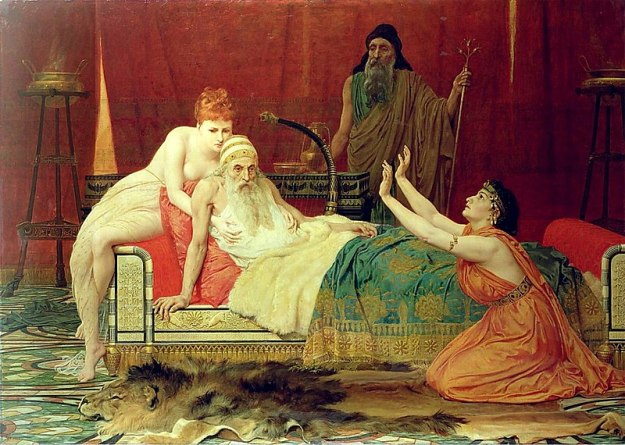
David, Bathsheba, and Abishag by Fredrick Goodall (1888)

1 Kings 1

1 Kings 1: 1-4 A Feeble King

1 King David was old and advanced in years; and although they covered him with clothes, he could not get warm. 2 So his servants said to him, “Let a young virgin be sought for my lord the king, and let her wait on the king, and be his attendant; let her lie in your bosom, so that my lord the king may be warm.” 3 So they searched for a beautiful girl throughout all the territory of Israel, and found Abishag the Shunammite, and brought her to the king. 4 The girl was very beautiful. She became the king’s attendant and served him, but the king did not know her sexually.

The initial chapter of 1 Kings serves as a bridge between the stories of 1 and 2 Samuel which culminates with the reign of King David and the transition to the narrative of the kings that come after David. People in the United States have generally taken for granted a peaceful transition of power and the political machinations of an election and swearing in of new leaders has, with one notable exception recently, been accepted as a matter-of-fact occurrence. The transition of power in the ancient world was often a matter of life and death for those who would claim the power to reign. King David was a warrior king who had forged a unified Israel by both his military prowess and his ability to forge alliances with various religious and tribal authorities.

1 Kings begins with “an enfeebled king, a mere shadow of the robust leader he once was,” (Cogan, 2001, p. 164) and in the absence of a robust leader coalitions are forming. The servants of the king have attempted to keep the king able to maintain power, but his health is failing him. The solution is to bring another young, beautiful woman into the king’s bed to keep him warm and to for her to lie in his bosom. The language of Abishag lying in the king’s bosom may intentionally echo the prophet Nathan’s parable to David after the affair with Bathsheba where the poor man’s ewe lamb “used to lie in his bosom” (2 Samuel 12:3) and if this echo is intentional it may help prepare us for the awkward conversation between David and Bathsheba while Abishag is warming the king’s bed.

David as a roughly seventy-year-old man is no longer physically able to hold the kingdom together and his physical frailty and lack of clear succession sets the stage for the conflict of the chapter. The chapter is a political narrative about the effective and ineffective use of symbols and alliances to gain power. It also lives in the shadows of the sins of the past which have weakened David’s house and the central presence of Nathan and Bathsheba throughout this episode as well as the parallels between Adonijah and Absalom bring us to the place where an enfeebled king is no longer able to effectively hold his broken house together. David remains passive as the conflict between those who see Adonijah and Solomon as the next king begins.

1 Kings 1: 5-10 Adonijah’s Bold Claim to Power

5 Now Adonijah son of Haggith exalted himself, saying, “I will be king”; he prepared for himself chariots and horsemen, and fifty men to run before him. 6 His father had never at any time displeased him by asking, “Why have you done thus and so?” He was also a very handsome man, and he was born next after Absalom. 7 He conferred with Joab son of Zeruiah and with the priest Abiathar, and they supported Adonijah. 8 But the priest Zadok, and Benaiah son of Jehoiada, and the prophet Nathan, and Shimei, and Rei, and David’s own warriors did not side with Adonijah.

9 Adonijah sacrificed sheep, oxen, and fatted cattle by the stone Zoheleth, which is beside En-rogel, and he invited all his brothers, the king’s sons, and all the royal officials of Judah, 10 but he did not invite the prophet Nathan or Benaiah or the warriors or his brother Solomon.

The perspective of 1 Kings is a complicated question, but in this initial chapter it frames the person and actions of Adonijah in a way that is parallel to Absalom (Israel, 2013, pp. 18-19). Both Absalom and Adonijah are described as being attractive men (2 Samuel 14:25) and this physical attraction is a part of their appeal as the future king (and a reason for David’s failure to correct his sons). Both Absalom and Adonijah attempt to secure the crown by their own machinations while David still lives, and each is the next in line by birth order. Both sons will have chariots and runners to demonstrate their power in the city (2 Samuel 15:1) and the presence of both chariots (the military technology of the day) and runners who were often counted on as loyal bodyguards indicate the military strength to defend his claim. Adonijah has developed a power base of both religious and military leaders and is actively excluding those who he feels may pose a challenge to his ascension as the next king. The act of sacrificing and dining with the royal sons (sans Solomon) the royal officials of Judah is a political action designed to further his aspirations of ruling in his father’s stead. One powerful claimant to the throne has been introduced and the enfeebled king has done nothing to oppose the actions of his attractive son and may be unaware of the machinations occurring in his kingdom.

1 Kings: 1: 11-37 Nathan and Bathsheba Rouse King David to Action

11 Then Nathan said to Bathsheba, Solomon’s mother, “Have you not heard that Adonijah son of Haggith has become king and our lord David does not know it?

 12 Now therefore come, let me give you advice, so that you may save your own life and the life of your son Solomon. 13 Go in at once to King David, and say to him, ‘Did you not, my lord the king, swear to your servant, saying: Your son Solomon shall succeed me as king, and he shall sit on my throne? Why then is Adonijah king?’ 14 Then while you are still there speaking with the king, I will come in after you and confirm your words.”

15 So Bathsheba went to the king in his room. The king was very old; Abishag the Shunammite was attending the king. 16 Bathsheba bowed and did obeisance to the king, and the king said, “What do you wish?” 17 She said to him, “My lord, you swore to your servant by the LORD your God, saying: Your son Solomon shall succeed me as king, and he shall sit on my throne. 18 But now suddenly Adonijah has become king, though you, my lord the king, do not know it. 19 He has sacrificed oxen, fatted cattle, and sheep in abundance, and has invited all the children of the king, the priest Abiathar, and Joab the commander of the army; but your servant Solomon he has not invited. 20 But you, my lord the king — the eyes of all Israel are on you to tell them who shall sit on the throne of my lord the king after him. 21 Otherwise it will come to pass, when my lord the king sleeps with his ancestors, that my son Solomon and I will be counted offenders.”

22 While she was still speaking with the king, the prophet Nathan came in. 23 The king was told, “Here is the prophet Nathan.” When he came in before the king, he did obeisance to the king, with his face to the ground. 24 Nathan said, “My lord the king, have you said, ‘Adonijah shall succeed me as king, and he shall sit on my throne’? 25 For today he has gone down and has sacrificed oxen, fatted cattle, and sheep in abundance, and has invited all the king’s children, Joab the commander of the army, and the priest Abiathar, who are now eating and drinking before him, and saying, ‘Long live King Adonijah!’ 26 But he did not invite me, your servant, and the priest Zadok, and Benaiah son of Jehoiada, and your servant Solomon. 27 Has this thing been brought about by my lord the king and you have not let your servants know who should sit on the throne of my lord the king after him?”

28 King David answered, “Summon Bathsheba to me.” So she came into the king’s presence, and stood before the king. 29 The king swore, saying, “As the LORD lives, who has saved my life from every adversity, 30 as I swore to you by the LORD, the God of Israel, ‘Your son Solomon shall succeed me as king, and he shall sit on my throne in my place,’ so will I do this day.” 31 Then Bathsheba bowed with her face to the ground, and did obeisance to the king, and said, “May my lord King David live forever!”

32 King David said, “Summon to me the priest Zadok, the prophet Nathan, and Benaiah son of Jehoiada.” When they came before the king, 33 the king said to them, “Take with you the servants of your lord, and have my son Solomon ride on my own mule, and bring him down to Gihon. 34 There let the priest Zadok and the prophet Nathan anoint him king over Israel; then blow the trumpet, and say, ‘Long live King Solomon!’ 35 You shall go up following him. Let him enter and sit on my throne; he shall be king in my place; for I have appointed him to be ruler over Israel and over Judah.” 36 Benaiah son of Jehoiada answered the king, “Amen! May the LORD, the God of my lord the king, so ordain. 37 As the LORD has been with my lord the king, so may he be with Solomon, and make his throne greater than the throne of my lord King David.”

The prophet Nathan and Bathsheba act to attempt to undercut the ambitions of Adonijah and to forward Bathsheba’s son Solomon as the next king of Israel. Together they come up with a plan to approach David and remind the king of his previous oath that Solomon would reign. Some commentators are dubious about this oath since it is not mentioned in 2 Samuel and believe that the prophet and Solomon’s mother are taking advantage of the king’s weakened mental faculties. While that is a possible interpretation, the David presented in the text will respond decisively and order a set of actions that are both clear and significant to ensure that Solomon is recognized by the people as the new king. David may have withdrawn from the administration of the kingdom due to his health, but when confronted by Nathan and Bathsheba he acts quickly.

Bathsheba enters the bedroom of the king while Abishag is attending to him. Bathsheba comes and does obeisance to the king and is granted the space to make her plea. Bathsheba’s plea comes from the perspective that the king is unaware of the actions of his son Adonijah that contradict his promises to her under oath. Bathsheba makes the reasonable claim that if Adonijah ascends to the throne she and Solomon will be perceived as ‘offenders’ or enemies of the throne and their lives will be at risk. As Nathan indicated while Bathsheba makes her appeal he also approaches the room of the king and is announced. The prophet Nathan confronts the king questioning his knowledge and at least tacit approval of Adonijah’s actions and lists several of the major political players who are now declaring that Adonijah is king. The acclamation, “long live Adonijah” (rendered by the NRSV king Adonijah) is the typical acclamation of a person who has been declared king. Apparently Bathsheba has left the room while the prophet Nathan has reported to the king, but King David summons her back and affirms his previous oath and declares that he will make it official this day.

David is apparently aware enough to summon the officials who are loyal to Solomon and who are not with Adonijah. The action of Solomon riding on King David’s mule is symbolic but also sends a different image than the chariots and runners of Adonijah. This is image of a king of peace riding on a mule or donkey will become an important prophetic image and will shape the action of Jesus in his approach to Jerusalem. Yet, Solomon is surrounded by those of religious and military power. They anoint him at Gihon, the central water source of the city so that it may be seen by many in the city. This is a very public action that King David decrees and then the symbolism is increased by having Solomon take his seat upon David’s throne. David, who has never acted to displease his son Adonijah in the past, now acts decisively and quickly once he is confronted by Bathsheba and Nathan.

Bathsheba and Nathan in this scene make their decisive reemergence after a long period of silence in the story of David. Both are central figures in a story where David’s actions to sleep with Bathsheba and ordering the death in combat of her husband Uriah to cover his actions bring about a judgment delivered by the prophet Nathan of both the death of their first son and the future unrest in David’s household. Yet, Nathan also delivers a message that God favors Solomon (2 Samuel 12:25) before he, Bathsheba, and Solomon recede into the background of the story as David struggles with the discord in his household and unrest in his reign. Yet, as David’s reign reaches its twilight Nathan and Bathsheba reemerge in the story to prepare for the ascension of Solomon.

1 Kings 1: 38-40 The Anointing of Solomon

38 So the priest Zadok, the prophet Nathan, and Benaiah son of Jehoiada, and the Cherethites and the Pelethites, went down and had Solomon ride on King David’s mule, and led him to Gihon. 39 There the priest Zadok took the horn of oil from the tent and anointed Solomon. Then they blew the trumpet, and all the people said, “Long live King Solomon!” 40 And all the people went up following him, playing on pipes and rejoicing with great joy, so that the earth quaked at their noise.

Adonijah had initiated an act of political theater to rally support for his claim to reign in David’s stead, but now the allies of Solomon, on King David’s instructions, have their own set of symbolically significant actions in the presence of the people to place Solomon on the throne. The priest and the prophet, the military leader and the servants of David place Solomon on David’s mule and lead him to Gihon. The Cherethites and the Pelethites are likely David’s own warriors indicated in 1:8 but they may also be mercenaries who provide “muscle for the throne a popular support ebbs.” (Brueggemann, 2000, p. 18) Solomon may symbolically be riding a mule instead of a chariot, but he is not without the military might to uphold his claim. In contrast to the action of Adonijah which takes place with the leaders outside of the city, this is done in the midst of the people of Jerusalem and the anointment and blowing of the trumpet to signal Solomon’s appointment as the new king is met with the declaration of the people declaring Solomon king and breaking into a spontaneous celebration. The city erupts into celebration and this joyous noise disrupts the gathering outside of town.

1 Kings 1: 41-53 Adonijah Concedes to Solomon

41 Adonijah and all the guests who were with him heard it as they finished feasting. When Joab heard the sound of the trumpet, he said, “Why is the city in an uproar?” 42 While he was still speaking, Jonathan son of the priest Abiathar arrived. Adonijah said, “Come in, for you are a worthy man and surely you bring good news.” 43 Jonathan answered Adonijah, “No, for our lord King David has made Solomon king; 44 the king has sent with him the priest Zadok, the prophet Nathan, and Benaiah son of Jehoiada, and the Cherethites and the Pelethites; and they had him ride on the king’s mule; 45 the priest Zadok and the prophet Nathan have anointed him king at Gihon; and they have gone up from there rejoicing, so that the city is in an uproar. This is the noise that you heard. 46 Solomon now sits on the royal throne. 47 Moreover the king’s servants came to congratulate our lord King David, saying, ‘May God make the name of Solomon more famous than yours, and make his throne greater than your throne.’ The king bowed in worship on the bed 48 and went on to pray thus, ‘Blessed be the LORD, the God of Israel, who today has granted one of my offspring to sit on my throne and permitted me to witness it.'”

49 Then all the guests of Adonijah got up trembling and went their own ways. 50 Adonijah, fearing Solomon, got up and went to grasp the horns of the altar. 51 Solomon was informed, “Adonijah is afraid of King Solomon; see, he has laid hold of the horns of the altar, saying, ‘Let King Solomon swear to me first that he will not kill his servant with the sword.'” 52 So Solomon responded, “If he proves to be a worthy man, not one of his hairs shall fall to the ground; but if wickedness is found in him, he shall die.” 53 Then King Solomon sent to have him brought down from the altar. He came to do obeisance to King Solomon; and Solomon said to him, “Go home.”

Adonijah has been playing a dangerous game and he was outmaneuvered politically by Nathan and Bathsheba. Adonijah likely saw King David’s lack of previous condemnation as a tacit approval of his actions or signs of the king’s lack of awareness of power. David’s instructions carried out publicly by Nathan the prophet, Zadok the priest, Benaiah and with the physical presence of the Cherethites and the Pelethites is met with public acclamation. When Jonathan, a man of worth,[1] reports in detail the proceedings in the city. The repetition of the details in the story reinforces the significance of the actions but Jonathan is also aware of the words of King David to affirm this from his bed. King David may be physically weak, but his position still holds power over the people and his blessing of the LORD for allowing Solomon to sit upon his throne adds the intimation of divine approval.

The actions on behalf of Solomon sends shockwaves through the assembled allies of Adonijah. Realizing that they have been outmaneuvered they retreat from the gathering and try to distance themselves from Adonijah. Adonijah recognizes the precarious nature of his position and flees to the temple for sanctuary, clinging to the horns of the altar. Solomon will either have to grant him clemency or spill blood on the altar. Solomon grants him an opportunity to prove himself loyal but the cost of any perceived action that would be harmful to Solomon’s authority will result in Adonijah’s death. Adonijah comes and bows down before Solomon before being sent home. The narrative is not concluded yet and Solomon will have to make choices in the future to secure his position, but the first chapter has moved us from the reign of King David to the new era under King Solomon in an initially bloodless transition.


[1] The Hebrew ‘is hayil is a person of economic and social status.

The Line of Kings in Matthew compared with the Hebrew Scriptures

Giovanni Francesco Barberi (il Guercino), King David (1651)

United Kingdom of Israel

David (1010-970 BCE)

Replaced Saul,

Narrative of David runs from 1 Samuel 16-1 Kings 1 in the 1 &2 Samuel, 1 & 2 Kings telling of Israel’s story. It runs from 1 Chronicles 11-22 in Chronicles telling of Israel’s story. David is attributed as the author of much of the book of Psalms and is mentioned frequently throughout the scriptures as a model of what a king should be and as a figure from which the hope for the people will come.


  1. Solomon (970-922 BCE)

Narrative of Solomon is told in 1 Kings 3-11 in the 1 & 2 Kings telling of Israel’s story. It runs from 1 Chronicles 11-22 in Chronicles telling of Israel’s story. Solomon is the attributed author of some of the Psalms, the book of Proverbs, Ecclesiastes and the Song of Songs (although he is probably not the author of these varied works as judged by the language). Builds the first temple, initially favored by God but there is an underlying critique of Solomon’s reign in the scriptures and he eventually turns away from the way of the Lord.

Kingdom of Judah

  1. Rehoboam (922-915)

Narrative of Rehoboam is told in 1 Kings 12, 14:21-31 in the 1 & 2 Kings telling of Israel’s story. It runs from 2 Chronicles 9-12 in Chronicles telling of Israel’s story. He is viewed as an unwise and unfaithful king whose arrogance causes a split in the nation of Israel.


  1. Abijah (Abijam) (915-913)

Narrative of Abijah (Abijam)is told in 1 Kings 15: 1-8 in the 1 & 2 Kings telling of Israel’s story. It occurs in 2 Chronicles 13 in Chronicles telling of Israel’s story. Kings and Chronicles have a very different view of Abijah, Kings narrates that he continued in the sins of his father (Rehoboam) while Chronicles narrates him as a heroic figure that defies the king of Israel.


  1. Asa (Asaph in Matthew) (913-873)

Narrative of Asa is told in 15: 9-24 in the 1 & 2 Kings telling of Israel’s story. It runs from 2 Chronicles 13-16 in Chronicles telling of Israel’s story. His 41-year reign is viewed positively in both chronicles and he is viewed as a person who does what is right in the sight of the LORD. His only other mention is as the creator of the cistern into which the prophet Jeremiah will be thrown into (long after Asa’s death)


  1. Jehoshapat (873-849)

Narrative of Jehoshapat is told in 1 Kings 22: 41-50 in the 1 & 2 Kings telling of Israel’s story. It runs from 2 Chronicles 17-20 in Chronicles telling of Israel’s story. His 25 years reign is also viewed positively in both narratives.


  1. Jehoram (Joram in Matthew) (849-843)

Narrative of Jehoram is told in 2 Kings 8: 16-24 the 1 & 2 Kings telling of Israel’s story. It occurs in 2 Chronicles 21 in Chronicles telling of Israel’s story. Viewed as a king who betrayed the reforms of his father and grandfather and returned the people to worshipping other gods. Elijah the prophet enters the narrative during the reign of Jehoram.


Ahaziah (843-842) neglected in Matthew’s genealogy

Narrative of Ahaziah is told in 2 Kings 8: 23-29, 9:27 in the 1 & 2 Kings telling of Israel’s story. It occurs in 2 Chronicles 22 in Chronicles telling of Israel’s story. His one-year reign is viewed negatively in both narratives and he is killed by Jehu son of Nimshi. With only reigning one year it is perhaps an understandable negation from Matthew’s line, but the genealogy would go through Ahaziah.


Athaliah (842-837) neglected in Matthew’s genealogy

Mother of Ahaziah, seizes the throne after her son’s murder. Narrative of Athaliah is told in 2 Kings 11 in the 1 & 2 Kings telling of Israel’s story. It runs from 2 Chronicles 22:10-23:21 in Chronicles telling of Israel’s story. Joash is preserved in the line of kings after she orders the death of royal family of Judah.  Since Athaliah was a queen rather than a king this wouldn’t normally appear in a genealogy. However, Matthew did include several women previously who would normally be overlooked.


Joash (837-800) neglected in Matthew’s genealogy

Narrative of Joash is told in 2 Kings 11:4-12, 17-21 and 12: 1-21 in the 1 & 2 Kings telling of Israel’s story. It occurs in 2 Chronicles 24 in Chronicles telling of Israel’s story. Joash is kept alive and mentored by the priest Jehoiada and for most of his life did what was right in God’s sight. He is famous for repairing the temple but Chronicles states that late in his life, after Jehoiada dies and under the influence of the nobles of Judah, he returns to the ways of the unrighteous kings. This is perhaps the most unusual negation.


Amaziah (800-783) neglected in Matthew’s genealogy

Narrative of Amaziah is told in 2 Kings 14: 1-22 in the 1 & 2 Kings telling of Israel’s story. It occurs in 2 Chronicles 25 in Chronicles telling of Israel’s story. Amaziah is listed in 2 Kings as one who did what was right in the site of the LORD but the major event in both narratives is his failed battle with Israel where the wall of Jerusalem is breached and the gold and silver from the temple and the king’s house are stolen. Another unusual negation.


  1. Uzziah (Azariah in 2 Kings) (783-742)

Narrative of Uzziah/Azariah is told in 2 Kings 15: 1-7 in the 1 & 2 Kings telling of Israel’s story. It occurs in 2 Chronicles 26 in Chronicles telling of Israel’s story. Uzziah did what was right in the site of the LORD with some qualifications in both 2 Kings and 2 Chronicles. In 2 Chronicles he is afflicted with leprosy after attempting to offer a sacrifice himself instead of through the priests.  Uzziah’s reign is also at the beginning of Isaiah’s time as a prophet (or first Isaiah, Isaiah 1 and 6 mention Uzziah) as well as the time of Amos and Hosea. Also, the prophet Zechariah mentions an earthquake in the time of king Uzziah (Zechariah 14:6)


  1. Jothan (742-735)

Narrative of Jothan is told in 2 Kings 15: 32-38 in the 1 & 2 Kings telling of Israel’s story. It occurs in 2 Chronicles 27 in Chronicles telling of Israel’s story. Jothan is listed as a king who did right in the eyes of the LORD but who did not eliminate the practices of the people that were displeasing to God in the view of 2 Kings and 2 Chronicles. His reign is described as prosperous and peaceful. The ministries of Micah and Hosea occur in part during the reign of Jothan.

  1. Ahaz (735-727 or 715)

Narrative of Ahaz is told in 2 Kings 16 in the 1 & 2 Kings telling of Israel’s story. It occurs in 2 Chronicles 28 in Chronicles telling of Israel’s story. Ahaz is a king who did not do what was right in the site of the lord in the narratives and is oppressed by Israel, the Edomites and the Philistines. Ahaz appeals to Assyria for help and attempts to bribe Assyria with items from his house and the officials in tribute, but Assyria rebuffs their call for aid. Isaiah 7 is during the reign of King Ahaz and Isaiah 14:28 begins an oracle in the year of Ahaz’ death.


  1. Hezekiah (727 or 715 to 687)

Narrative of Hezekiah is told in 2 Kings 18-20 in the 1 & 2 Kings telling of Israel’s story. It occurs in 2 Chronicles 29-32 in Chronicles telling of Israel’s story. Hezekiah is a righteous king and reigns during an important transition in the region. The Assyrian empire conquers Israel and marches on Judah, but their conquest is stopped, and Judah survives. King Hezekiah is attributed with ensuring that Proverbs 25-29 are preserved. Isaiah records the Assyrian invasion by King Sennacherib of Assyria and the dialogue between God, Isaiah, and Hezekiah as well as a later illness of Hezekiah and Hezekiah’s interaction with envoys from Babylon in Isaiah 36-39. The prophets Hosea and Micah also conclude their ministries during Hezekiah’s reign.


  1. Manasseh (687-642)

Narrative of Manasseh is told in 2 Kings 21: 1-18 in the 1 & 2 Kings telling of Israel’s story. It runs from 2 Chronicles 33: 1-20 in Chronicles telling of Israel’s story. Manasseh is listed as one of the kings who did evil by adopting the practices of the surrounding nations and worshipping other gods. Jeremiah 15:4 lists the evils of Manasseh as the reason for the judgment against Judah.


  1. Amos (Amon) (642-640)

Narrative of Manasseh is told in 2 Kings 21: 19-26 in the 1 &2 Samuel, 1 & 2 Kings telling of Israel’s story. It runs from 2 Chronicles 33: 21-25 in Chronicles telling of Israel’s story. He also did what was evil in God’s sight and was killed by the servants in his house or the people of the land depending on whether you read Chronicles or Kings.


  1. Josiah (640-609)

Narrative of Josiah is told in 2 Kings 22:1-23:30 in the 1 & 2 Kings telling of Israel’s story. It runs from 2 Chronicles 34-35 in Chronicles telling of Israel’s story. Josiah is remembered as the great reformer king who reintroduced the law to Judah. He dies in a battle against Pharaoh Neco, which seems to have been an unnecessary battle. Josiah’s reign is a time of great hope in Judah and there are even hopes of a new Israel, this is after the northern kingdom is conquered by Assyria, which practices the law and worships at the temple in Jerusalem. The optimism of the reforms of King Josiah are the context for the beginning of Jeremiah’s long ministry. Jeremiah soon sees the reforms are not changing the people and begins to warn that judgment is coming.


Jehoahaz (609) neglected in Matthew’s genealogy

Jehoahaz’ three-month reign is told in 2 Kings 23: 31-35 and 2 Chronicles 36: 1-4. He is enthroned by the people but deposed by Egypt and Egypt replaces him with his brother Eliakim who changes his name to Jehoiachim. Judah is now caught between the rising empire of Babylon in the north and Egypt in the south. Jehoahaz would not be in the genealogy of Jesus as Matthew traces it.


Jehoiachim (Eliakim) (609-598)

Jehoiachim’s reign is told briefly in 2 Kings 23: 36-24:7 and 2 Chronicles 36: 5-8.  In the eleven years he reigned Judah is caught between Babylon and Egypt. Jehoiachim serves Babylon for a time but then rebelled and was taken in chains to Babylon. Many of the proclamations of the prophet Jeremiah occur during the reign of Jehoiachim. The removal of Jehoiachim also sets the context for the beginning of the book of Daniel, where Daniel is among the young nobles brought to Babylon.


  1. Jehoiachin (598-597)

The son of Jehoiachim who is only eight or eighteen during his brief reign. His reign is told in 2 Kings 24: 8-18 and 2 Chronicles 36: 9-10. At the end of the reign is the deportation to Babylon of the officials, warriors, artisans, smiths and anyone who might exercise leadership among the people and a weak administration under his uncle Mattaniah, renamed Zedekiah. Jeremiah refers to Jehoiachin as Coniah.


Zedekiah (597-586)

Zedekiah is placed in his position by Babylon to attempt to retain peace among the remnant of Judah. His reign and the fall of Judah is told in 2 Kings 24: 18-30 (includes the governorship of Gedaliah) and 2 Chronicles 36: 11-21. More of Jeremiah’s proclamations come during the time of Zedekiah, in the final gasps of Judah and Jerusalem before Babylon’s final invasion and exile, than at any other time. Jerusalem is destroyed in 586 and more of the population is brought into exile in Babylon. There is a final rebellion during the governorship of Gedaliah) but the remnant of Judah that survives goes into exile in Babylon. The book of Jeremiah narrates the collapse of Judah in Jeremiah 34-44 and 52.