Tag Archives: King Ben-hadad of Damascus

2 Kings 6:24-7:20 The Siege and Deliverance of Samaria

Hills Near the Ruins of Samaria By Daniel Ventura – Own work, CC BY-SA 3.0, https://commons.wikimedia.org/w/index.php?curid=32449397

2 Kings 6:24-7:2

24Some time later King Ben-hadad of Aram mustered his entire army; he marched against Samaria and laid siege to it. 25As the siege continued, famine in Samaria became so great that a donkey’s head was sold for eighty shekels of silver and one-fourth of a kab of dove’s dung for five shekels of silver. 26Now as the king of Israel was walking on the city wall, a woman cried out to him, “Help, my lord king!” 27He said, “If the LORD does not help you, where would my help come from? From the threshing floor or from the winepress?” 28But then the king asked her, “What is your complaint?” She answered, “This woman said to me, ‘Give up your son; we will eat him today, and we will eat my son tomorrow.’ 29So we cooked my son and ate him. The next day I said to her, ‘Give up your son, and we will eat him.’ But she has hidden her son.” 30When the king heard the words of the woman he tore his clothes—now since he was walking on the city wall, the people could see that he had sackcloth on his body underneath 31and he said, “So may God do to me and more, if the head of Elisha son of Shaphat stays on his shoulders today.” 32So he dispatched a man from his presence.
  Now Elisha was sitting in his house, and the elders were sitting with him. Before the messenger arrived, Elisha said to the elders, “Are you aware that this murderer has sent someone to take off my head? When the messenger comes, see that you shut the door and hold it closed against him. Is not the sound of his master’s feet behind him?” 33
While he was still speaking with them, the king came down to him and said, “This trouble is from the LORD! Why should I hope in the LORD any longer?”

71But Elisha said, “Hear the word of the LORD: Thus says the Lord: Tomorrow about this time a measure of choice meal shall be sold for a shekel and two measures of barley for a shekel, at the gate of Samaria.” 2Then the captain on whose hand the king leaned said to the man of God, “Even if the LORD were to make windows in the sky, could such a thing happen?” But he said, “You shall see it with your own eyes, but you shall not eat from it.”

The final seven verses of chapter six are connected to the story that continues through the seventh chapter of 2 Kings. The verses and chapters were added at a later point, and the chapter division highlights the prophecy of Elisha by bookending the seventh chapter, but the narrative which evokes the word of the LORD begins at verse twenty-four. One of the Aramean kings named Ben-hadad[1] lays siege to Samaria creating the severe crisis of the story.

Siege warfare works by denying the encircled city the resources it needs to survive while the surrounding army has access to food from the land and if necessary, brought in from the besieging country. The first to feel the impact of the food shortages are the poor and the vulnerable as the cost of the food necessary to survive climbs as the supply dwindles. In our story the cost of once unpalatable foods has reached a point unreachable to all but the wealthiest households. The ‘dove’s dung’ has a couple possible interpretations. It may be the droppings from birds who are able to eat from the grain fields that the population no longer has access to, and this may form a disgusting but necessary source of nutrition for the captured population. Some translations like the NEB and NJPS follow a linguistic trail to translate this as the “seeds of the (false) carob” which is a plant of limited nutritional value. However one translates the ‘dove’s dung,’ the situation in the city has become desperate to the point where hunger is creating an inhumane situation.

The woman at the wall who calls upon the king of Israel for help is met with a pious sounding answer, “If the LORD does not help you, where would my help come from.” To me this resonates like the empty ‘thoughts and prayers’ of a politician who has no interest in resolving the crisis of the individual who comes to them for help. Yet, in Israel there is a tradition of people coming to their kings to judge difficult and life changing matters and the kings of Israel are supposed to be guardians of the vulnerable. This story resonates with Solomon’s judging between the two women fighting over a child in 1 Kings 3: 16-28, but in this story of famine now the women are fighting over children to be eaten in their starvation. The situation echoes the darkest warnings against disobedience in Deuteronomy 28: 52-57:

52 It shall besiege you in all your towns until your high and fortified walls, in which you trusted, come down throughout your land; it shall besiege you in all your towns throughout the land that the LORD your God has given you. 53 In the desperate straits to which the enemy siege reduces you, you will eat the fruit of your womb, the flesh of your own sons and daughters whom the LORD your God has given you. 54 Even the most refined and gentle of men among you will begrudge food to his own brother, to the wife whom he embraces, and to the last of his remaining children, 55 giving to none of them any of the flesh of his children whom he is eating, because nothing else remains to him, in the desperate straits to which the enemy siege will reduce you in all your towns. 56 She who is the most refined and gentle among you, so gentle and refined that she does not venture to set the sole of her foot on the ground, will begrudge food to the husband whom she embraces, to her own son, and to her own daughter, 57 begrudging even the afterbirth that comes out from between her thighs, and the children that she bears, because she is eating them in secret for lack of anything else, in the desperate straits to which the enemy siege will reduce you in your towns.

The woman’s situation in this siege echoes the narration of the later siege of Jerusalem by Babylon in Ezekiel 5:10 and Lamentations 2:20 and 4:10. It is a world where the bond between mother and child has been broken by hunger and people lose their humanity in the horror of the siege. The king who has been sheltered from the worst aspects of the deprivation of the siege is horrified by the woman’s situation and yet still claims no power to alleviate her condition. The stores of grain and wine even for the king are likely depleted and we learn that he is wearing sackcloth, a sign of mourning and repentance, under his clothes which he tears on hearing the woman’s story. In response he rashly declares that he will kill Elisha.

Elisha may be the target of the king’s rage as the representative of the LORD who the king of Israel blames for this unbroken siege, or he may simply be a scapegoat in the king’s powerlessness. Elisha did in the previous chapter deliver into Samaria an Aramean army who he instructed the king to feed and allow them to depart in peace. The peace which Elisha brokered did not endure and the king of Israel may blame the prophet for the situation. It is also possible that the king feels that the prophet, who has provided food miraculously, has not performed a miracle to provide food for the suffering city. If this unnamed king of Israel is Jehoram, as the order of the stories implies, there is a long animosity between the Omri dynasty that Jehoram is a member of and Elijah as well as Elisha. It is possible that the king has never approached the prophet until this point in the siege although it is worth noting that the elders are with the prophet during this scene.

The story becomes a bit confused in verses 32-33 where a messenger arrives and later the king. Mordechai Cogan and Hayim Tadmor point to Josephus’ reconstruction of the events as being as sensible as any:

“But you,” (Elisha) said, “when the man arrives who has been given this order be on guard as he is about to enter, and press him back against the door and hold him there, for the king will follow him and come to me, having changed his mind.” So, when the man came who had been sent by the king to make away with Elisha, they did as he had ordered. But Joram, repenting of his wrath against the prophet and fearing that the man who had been ordered to kill him might already be doing so, hastened to prevent the murder and even save the prophet. Antiquities ix, 69-70. (Cogan, 1988, pp. 80-81)

Despite the king’s earlier murderous words, the king, the prophet, and the elders all share in hearing the word of the LORD that Elisha receives declaring that the crisis will end suddenly in roughly twenty-four hours. The immediate availability of cheap food prophesied is unbelievable to the captain of the king, and Elisha adds a final note that this captain will see the prophecy fulfilled but be unable to partake in it.

2 Kings 7:3-20

  3Now there were four men with a defiling skin disease outside the city gate who said to one another, “Why should we sit here until we die? 4If we say, ‘Let us enter the city,’ the famine is in the city, and we shall die there, but if we sit here, we shall also die. Therefore, let us desert to the Aramean camp; if they spare our lives, we shall live, and if they kill us, we shall but die.” 5So they arose at twilight to go to the Aramean camp, but when they came to the edge of the Aramean camp there was no one there at all. 6For the Lord had caused the Aramean army to hear the sound of chariots and of horses, the sound of a great army, so that they said to one another, “The king of Israel has hired the kings of the Hittites and the kings of Egypt to fight against us.” 7So they fled away in the twilight and abandoned their tents, their horses, and their donkeys, leaving the camp just as it was, and fled for their lives. 8When these diseased men had come to the edge of the camp, they went into a tent, ate and drank, carried off silver, gold, and clothing, and went and hid them. Then they came back, entered another tent, carried off things from it and went and hid them.
  9
Then they said to one another, “What we are doing is wrong. This is a day of good news; if we are silent and wait until the morning light, we will be found guilty; therefore let us go and tell the king’s household.” 10So they came and called to the gatekeepers of the city and told them, “We went to the Aramean camp, but there was no one to be seen or heard there, nothing but the horses tied, the donkeys tied, and the tents as they were.” 11Then the gatekeepers called out and proclaimed it to the king’s household. 12The king got up in the night and said to his servants, “I will tell you what the Arameans have prepared against us. They know that we are starving, so they left the camp to hide themselves in the open country, thinking, ‘When they come out of the city, we shall take them alive and get into the city.’ ” 13One of his servants said, “Let some men take five of the remaining horses, since those left here will suffer the fate of the whole multitude of Israel that have perished already; let us send and find out.” 14So they took two mounted men, and the king sent them after the Aramean army, saying, “Go and find out.” 15So they went after them as far as the Jordan; the whole way was littered with garments and equipment that the Arameans had thrown away in their haste. So the messengers returned and told the king.
  16
Then the people went out and plundered the camp of the Arameans. So a measure of choice meal was sold for a shekel and two measures of barley for a shekel, according to the word of the LORD. 17Now the king had appointed the captain on whose hand he leaned to have charge of the gate; the people trampled him to death in the gate, just as the man of God had said when the king came down to him. 18For when the man of God had said to the king, “Two measures of barley shall be sold for a shekel and a measure of choice meal for a shekel, about this time tomorrow in the gate of Samaria,” 19the captain had answered the man of God, “Even if the LORD were to make windows in the sky, could such a thing happen?” And he had answered, “You shall see it with your own eyes, but you shall not eat from it.” 20It did indeed happen to him; the people trampled him to death in the gate.

The resolution to the crisis begins in the desperation of four men who are unclean and left outside the city. As mentioned above it is the vulnerable, and these four men with an affliction traditionally translated as leprosy would be vulnerable as they are excluded outside the city’s protective walls. In a situation where staying where they are would lead to death and entering the city would lead to death, they make the choice to surrender to the Arameans because the worst they can do is kill them. This decision to give up to the besieging forces sets in motion the deliverance of Samaria.

I have mixed feelings about the NRSVue decision throughout these texts to translate what is traditionally rendered ‘leprosy’ as a ‘defiling skin disease’ or ‘skin disease.’ On the one hand, what we now categorize as leprosy or Hansen’s disease is probably not what is referred to throughout the bible. But I wonder if the more generic skin disease disconnects the average reader from the severity of this diagnosis in the ancient world of Judaism. It is telling that Leviticus thirteen and fourteen are dedicated to the identification, the exclusion of the infected individuals from the community, and the necessary examination to allow their re-inclusion if the skin disorder clears up. These lepers are ‘unclean’ and unable to participate in the life of the community. Yet these outsiders will provide deliverance for the people trapped inside the city.

Before the four men approach the camp, the Arameans flee in panic because they hear the sound of horses and chariots approaching and fear that the king of Israel has paid Egypt and the Hittites to come and break the siege for them. The horses and chariots echo the appearance of the ‘horses and chariots of Israel’ in the previous story (2 Kings 6:15) and now instead of opening the eyes of the servant the LORD in a different manner opens the ears of the Arameans. The panic of the Arameans in the story is enough that they abandon not only their encampment but also their horses and donkey and leave a trail of discarded items in the path of their retreat. There are resources and wealth to feed and equip an army surrounding the city, much of the food likely taken from Israel’s fields, and there waiting to be discovered by the starving city.

The Jewish sages identified the four men with Gehazi and his sons (Israel, 2019, p. 129) which makes sense with this story being between Gehazi having Naaman’s leprosy cling to him and his family (2 Kings 5:27) and Gehazi’s reemergence talking with the king in the upcoming chapter (2 Kings 8: 4-5). This identification while interesting is not necessary for the story as these four men proceed to the camp, find it empty, ate and drank, pillaged some of the wealth they found, and eventually notify the gatekeepers of the situation. These men excluded as outsiders because of their skin condition still consider themselves a part of the people and have an obligation to those suffering inside the city. They appeal through the gatekeeper to the king’s household.

The king initially views this report from the four men as a trap set by the Aramean army to draw him out, but eventually one of his servants convinces the king to send out scouts with horses to examine the situation, lest the remaining horses perish with the people inside the city. Once the messengers return to the king it sets in motion the availability of food promised by the prophecy of Elisha as well as the death of the captain of the king. As mentioned in the previous section, the current chapter divisions highlight the words of Elisha at the beginning and ending of the chapter to demonstrate their fulfillment. A siege which reduced men and women to inhuman actions is now ended by four men whose humanity is compromised by the unclean disease carried on their skin. The God of Israel’s unseen host is now heard by the Aramean causing them to abandon their siege and to provide the food the city needs. The prophet once blamed by the king for the situation inside the city has now accurately predicted the cities deliverance by the LORD the God of Israel.


[1] Mordechai Cogan and Hayim Tadmor note there are at least two and possibly three kings name Ben-Hadad,  whose name means the son of (the God) Hadad, “At least two, if not three persons by this name are known: Ben-hadad, contemporary of Baasha (1 Kgs 15:18); Ben-hadad, foe of Abab (1 Kgs 20: 1; he is identical with mAdad-idri of Assyrian inscriptions…and Ben-hadad, son of Hazael (2 Kgs 13:3).” (Cogan, 1988, p. 78)
1 Kings 20 King Ahab and the Conflict with Aram

1 Kings 20: 1-21 The Conflict with King-Hadad of Aram Begins

1 King Ben-hadad of Aram gathered all his army together; thirty-two kings were with him, along with

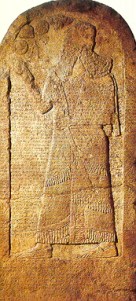
Assyrian stela of Shalmaneser that reports battle of Qarqar By Yuber – from en wiki, Public Domain, https://commons.wikimedia.org/w/index.php?curid=869262

horses and chariots. He marched against Samaria, laid siege to it, and attacked it. 2 Then he sent messengers into the city to King Ahab of Israel, and said to him: “Thus says Ben-hadad: 3 Your silver and gold are mine; your fairest wives and children also are mine.” 4 The king of Israel answered, “As you say, my lord, O king, I am yours, and all that I have.” 5 The messengers came again and said: “Thus says Ben-hadad: I sent to you, saying, ‘Deliver to me your silver and gold, your wives and children’; 6 nevertheless I will send my servants to you tomorrow about this time, and they shall search your house and the houses of your servants, and lay hands on whatever pleases them, and take it away.”

7 Then the king of Israel called all the elders of the land, and said, “Look now! See how this man is seeking trouble; for he sent to me for my wives, my children, my silver, and my gold; and I did not refuse him.” 8 Then all the elders and all the people said to him, “Do not listen or consent.” 9 So he said to the messengers of Ben-hadad, “Tell my lord the king: All that you first demanded of your servant I will do; but this thing I cannot do.” The messengers left and brought him word again. 10 Ben-hadad sent to him and said, “The gods do so to me, and more also, if the dust of Samaria will provide a handful for each of the people who follow me.” 11 The king of Israel answered, “Tell him: One who puts on armor should not brag like one who takes it off.” 12 When Ben-hadad heard this message — now he had been drinking with the kings in the booths — he said to his men, “Take your positions!” And they took their positions against the city.

13 Then a certain prophet came up to King Ahab of Israel and said, “Thus says the LORD, Have you seen all this great multitude? Look, I will give it into your hand today; and you shall know that I am the LORD.” 14 Ahab said, “By whom?” He said, “Thus says the LORD, By the young men who serve the district governors.” Then he said, “Who shall begin the battle?” He answered, “You.” 15 Then he mustered the young men who serve the district governors, two hundred thirty-two; after them he mustered all the people of Israel, seven thousand.

16 They went out at noon, while Ben-hadad was drinking himself drunk in the booths, he and the thirty-two kings allied with him. 17 The young men who serve the district governors went out first. Ben-hadad had sent out scouts, and they reported to him, “Men have come out from Samaria.” 18 He said, “If they have come out for peace, take them alive; if they have come out for war, take them alive.”

19 But these had already come out of the city: the young men who serve the district governors, and the army that followed them. 20 Each killed his man; the Arameans fled and Israel pursued them, but King Ben-hadad of Aram escaped on a horse with the cavalry. 21 The king of Israel went out, attacked the horses and chariots, and defeated the Arameans with a great slaughter.

This story of conflict between King Ben-hadad of Aram and King Ahab of Israel has puzzled many readers of 1 Kings.  Several historical scholars have argued that this conflict between Aram and Israel may actually have occurred during the reign of King Jehohaz (2 Kings 13: 1-9) at least thirty-five years later when Ben-hadad continues his father King Hazael’s work of oppressing Israel. It is possible that a later story was brought forward to make a point about King Ahab, but it is also plausible that a Ben-hadad attempted to oppress Israel at different times (names were often repeated in families).[1] Perhaps even more perplexing than the historical question is the vastly different allegiances of King Ahab from the previous chapters where he was in conflict with Elijah. Baal and the prophets of Baal are absent, a lone prophet of God becomes a central advisor, and the king is well acquainted enough with the prophets of the LORD to recognize a member of the ‘sons of the prophets’ when they speak to him later. (Israel, 2013, p. 273) Also missing in action are Elijah and Elisha. The ‘sons of the prophets’ will feature heavily in the Elisha stories, and it is possible that Elijah is preparing Elisha to assume the mantle of his work. Yet, as a foreign oppressor comes and the LORD promises to demonstrate God’s power by handing over a vastly superior force into the hands of Ahab these key prophets are absent.

Despite all the perplexing elements for the narrative the central theological point is clear: the fate and security of Israel rests in the LORD’s hands and not in the hands of the king or his limited military. King Ahab is not going to deliver Samaria by his military might, his political acumen, or his leadership through the conflict. The victory is a demonstration of the sovereignty of the LORD the God of Israel and the proper response is obedience. Ahab will ultimately fail, like many previous leaders, in this final test of obedience and will trust in his own ability to negotiate a favorable peace rather than trusting in the LORD who provided the victory. In the eyes of 1 Kings this is a critical theological error.

King Ben-hadad of the Arameans gathers a large coalition of leaders and sends a large force of chariots and horsemen which besiege Samaria. His initial demand is received as a demand that King Ahab become a vassal king of this large well-equipped coalition,[2] paying tribute and surrendering captives to ensure his loyalty. King Ahab initially consents to this proposal seeing it as a way to avoid a larger conflict and his initial response declares his willingness to subjugate himself to King Ben-hadad, yet the second demand is a more arduous invasion of King Ahab’s sovereignty and the kingdom. Ben-hadad’s promise to send his servants to take whatever pleases them is viewed as a provocation because it strips Ahab of his power to protect the people and his household. Ahab and the elders refuse to consent and in the initial war of words Ben-hadad taunts that he will reduce Samaria to destruction so completely that his followers will not be able to gather a handful of dust from their remains. Ahab replies with a taunt that one who is just preparing to fight should not boast like a victor taking off his armor. The negotiations are over, King Ahab has failed to avoid conflict with a superior coalition and the siege begins in earnest as the Aramean forces take positions around Samaria.

An unnamed prophet enters the narrative. Unlike previous times when the prophets of the LORD were hunted by Jezebel and those loyal to her, now a prophet has access to the king. The prophet declares that the upcoming victory is another demonstration to Ahab of the power of the LORD. This improbably victory is not due to the skill of the vastly outnumbered forces that Ahab can command, but instead is a way for Ahab and the people to know ‘that I am the LORD.’  Knowing that the God of Israel is the LORD is to acknowledge the sovereignty of the LORD the God of Israel also means obedience to the LORD’s expectations. The prophet does not invoke that this falls under the rules of a ‘holy war’[3] but instead answers the king’s questions about how to initiate the battle and how the king is to lead. The identity of the two hundred thirty-two men who serve the district governors[4] is not clear from the context and has been a source of debate. It is unlikely that they are ‘professional soldiers’ as we think of people who are a part of a standing military, and they may be the personal protectors or enforcers for the regional leaders. Regardless of their identity they will be the first ones sent out, followed by the seven thousand Israelites that will engage the Arameans. The number seven thousand intentionally links the reader to the seven thousand who have not bent their knee to Baal who are the faithful remnant that the LORD identifies to Elijah. (1 Kings 19:18)

When the initial representatives of Israel emerge from the city an already drunk King Ben-hadad gives the order to capture them alive whether they are seeking peace or conflict. In the early stage of a siege the expectation is that there is not much that the leaders need to supervise so the drunken kings may not be as surprising as it would be for a modern leader to be drunk on the battlefield. From a military perspective the Israelites have the element of surprise, and the momentum of the battle quickly springs in their favor as they encounter an opponent who focused on a later clash rather than the emergence of an immediate threat. The leaders of the Aramean coalition are inhibited from leading their forces by their heavy drinking and Ahab’s forces take advantage of this surprised force. Yet, 1 Kings writes from a theological perspective and from that perspective the entire strategy, execution and victory is the work of the LORD and a demonstration of the LORD’s power over a superior military force.

1 Kings 20: 22-30a The Defeat of King-Hadad

22 Then the prophet approached the king of Israel and said to him, “Come, strengthen yourself, and consider well what you have to do; for in the spring the king of Aram will come up against you.”

23 The servants of the king of Aram said to him, “Their gods are gods of the hills, and so they were stronger than we; but let us fight against them in the plain, and surely we shall be stronger than they. 24 Also do this: remove the kings, each from his post, and put commanders in place of them; 25 and muster an army like the army that you have lost, horse for horse, and chariot for chariot; then we will fight against them in the plain, and surely we shall be stronger than they.” He heeded their voice, and did so.

26 In the spring Ben-hadad mustered the Arameans and went up to Aphek to fight against Israel. 27 After the Israelites had been mustered and provisioned, they went out to engage them; the people of Israel encamped opposite them like two little flocks of goats, while the Arameans filled the country. 28 A man of God approached and said to the king of Israel, “Thus says the LORD: Because the Arameans have said, ‘The LORD is a god of the hills but he is not a god of the valleys,’ therefore I will give all this great multitude into your hand, and you shall know that I am the LORD.” 29 They encamped opposite one another seven days. Then on the seventh day the battle began; the Israelites killed one hundred thousand Aramean foot soldiers in one day. 30 The rest fled into the city of Aphek; and the wall fell on twenty-seven thousand men that were left.

The surprising victory at Samaria buys some time for King Ahab, but the survival of King Ben-hadad means that in the spring the Arameans will return to continue the fight. Again, the unnamed prophet is the central advisor in the story giving King Ahab advice which follows. Yet, on the opposite side of the conflict Ben-hadad’s advisor also gave him advice to prepare for the next battle. Both sets of advisors are coming from different theological perspectives as they provide military guidance for their respective leaders.

The advisors of Ben-hadad follow pretty conventional military advice for the technology of the day couched in a theological proposition about the God of Israel. There is a distinct advantage for a military force which depended on chariots as a key maneuver element to fight on level ground. Military planners often look for ground that will enhance their technological advantage or reduce their disadvantages. The Arameans will be the ones who choose the next battlefield, and they choose Aphek. There are multiple places in the region named Aphek, but this is most likely the Transjordan site near the modern day Golan Heights.[5] (Cogan, 2001, p. 466) Yet, the theological rationale for encouraging King Ben-hadad to make these decisions is that they believe the gods of Israel is are ‘gods of the hills’ whose ability to influence the fight will be negated by moving the location of the conflict.[6]

A second man of God comes to the king of Israel with a promise that the LORD will deliver this force into the hands of Israel both to demonstrate to the Arameans the error in their thinking and to demonstrate once again to Ahab that ‘I am the LORD.’ Even though the Arameans fill the country, and the Israelites look like two little flocks of goats, Israel is not reliant upon its military might but the LORD’s deliverance. The seven days wait before the conflict echoes the six days of marching and the fall of Jericho on the seventh day.[7] Like Jericho the defeat for the Arameans is massive. The number of one hundred twenty-seven thousand dead seems impossibly large, but the theological effect is that this massive army is removed by God’s action on the battlefield and at the wall of Aphek. Although the battle is never declared a ‘holy war’ the parallels with Jericho begin to give the battle that feel which will prove crucial in Ahab’s decision in the aftermath of the LORD’s triumph.

1 Kings 20: 30b-43 King Ahab’s Political Choice and Theological Blunder

Ben-hadad also fled, and entered the city to hide. 31 His servants said to him, “Look, we have heard that the kings of the house of Israel are merciful kings; let us put sackcloth around our waists and ropes on our heads, and go out to the king of Israel; perhaps he will spare your life.” 32 So they tied sackcloth around their waists, put ropes on their heads, went to the king of Israel, and said, “Your servant Ben-hadad says, ‘Please let me live.'” And he said, “Is he still alive? He is my brother.” 33 Now the men were watching for an omen; they quickly took it up from him and said, “Yes, Ben-hadad is your brother.” Then he said, “Go and bring him.” So Ben-hadad came out to him; and he had him come up into the chariot. 34 Ben-hadad said to him, “I will restore the towns that my father took from your father; and you may establish bazaars for yourself in Damascus, as my father did in Samaria.” The king of Israel responded, “I will let you go on those terms.” So he made a treaty with him and let him go.

35 At the command of the LORD a certain member of a company of prophets said to another, “Strike me!” But the man refused to strike him. 36 Then he said to him, “Because you have not obeyed the voice of the LORD, as soon as you have left me, a lion will kill you.” And when he had left him, a lion met him and killed him. 37 Then he found another man and said, “Strike me!” So the man hit him, striking and wounding him. 38 Then the prophet departed, and waited for the king along the road, disguising himself with a bandage over his eyes. 39 As the king passed by, he cried to the king and said, “Your servant went out into the thick of the battle; then a soldier turned and brought a man to me, and said, ‘Guard this man; if he is missing, your life shall be given for his life, or else you shall pay a talent of silver.’ 40 While your servant was busy here and there, he was gone.” The king of Israel said to him, “So shall your judgment be; you yourself have decided it.” 41 Then he quickly took the bandage away from his eyes. The king of Israel recognized him as one of the prophets. 42 Then he said to him, “Thus says the LORD, ‘Because you have let the man go whom I had devoted to destruction, therefore your life shall be for his life, and your people for his people.'” 43 The king of Israel set out toward home, resentful and sullen, and came to Samaria.

Throughout the conflict agents of the LORD the God of Israel have informed King Ahab that by these victories that Ahab will know that “I am the LORD.” These surprising military events should demonstrate to Ahab that God is the only refuge and support that the king needs. Yet, when presented with an opportunity to negotiate the reclamation of territory and trading rights for Israel, Ahab chooses to rely upon his skills in making a treaty. Ahab makes a political choice and a theological blunder. In the end Ahab trusts in crafting a commonsense deal rather than a zealous adherence to trusting in God and the results are disastrous for his household and Israel.

Ben-hadad’s servants convince their king to allow them to attempt to negotiate for his life. When they declare that the kings of Israel are ‘merciful’ kings they reference a central theological word often related to God: The Hebrew word hesed. Hesed is a rich word which can be rendered covenant faithfulness, grace, or mercy. It is God’s hesed that Israel relies upon. Now Ahab is to be manipulated by this property of hesed. The servants come out in sackcloth and with ropes on their heads to indicate their subservience to the Israelites. This has echoes of the way the Gibeonites trick the Israelites into sparing them in Joshua 9. These servants who may have been the same ones that would have been sent to plunder the house of Ahab, now come to make a humble appeal for the life of their king. Even though Ahab was previously treated with disdain by Ben-hadad, he extends the courtesy of calling him ‘brother’ and this allows Ben-hadad and Aram to negotiate terms of peace. With territory restored and trading rights promised King Ahab makes the political choice to allow his enemy to live. Peace between Aram and Israel will only last for three years.

King Ahab may have several political reasons to negotiate with the king of Aram. The return of land and the ability to expand trade with a neighbor are powerful incentives on their own. Ahab is also aware of the emergence of the Assyrians which will pose a threat to both Israel and Aram and may be looking for a military alliance with Aram to bolster the nations security. (Israel, 2013, p. 282) There is also the possibility that ‘class solidarity’ may play a part in Ahab’s considerations. (Brueggemann, 2000, p. 250) It may be fine for thousands of soldiers to be slaughtered but kings may be seen as ‘brothers.’ Ahab and Ben-hadad make a covenant[8] and the battle has ended.

Yet, the messengers of the LORD have to relay God’s displeasure at Ahab’s covenant which spares the life of Ben-hadad. We see the ‘sons of the prophets’ (NRSV company of prophets) appear for the first time. The sons of the prophets will feature heavily in the Elisha cycle, but now we encounter an unnamed prophet who declares to another to strike him. The failure of the first man to strike this prophet results in his death in a similar manner to the prophet who disobeyed in 1 Kings 13:24. Once the second man strikes the prophet and wounds him he departs to wait for the king. He is disguised with a bandage over his eyes because he is apparently known by sight to the king and portrays himself as a wounded soldier from the battle.

The prophet tells the king a ‘juridical parable’ where the offender is caught in the trap thinking the narrative is about someone else and then finding it refers to them. The most famous example of this type of parable is when the prophet Nathan confronts King David after sleeping with Bathsheba and ordering Uriah’s death.[9] Here the disguised prophet portrays himself as responsible for a man’s life and allows him to disappear in the chaos of the battlefield. Aram allows the words of the narrative to condemn the prophet only to find himself the one who has release one he was responsible for. King Ben-hadad was to be ‘devoted to destruction’ which translates the Hebrew herem. Herem is the practice of war referred to for the people that the Israelites were to eliminate in Deuteronomy 20: 16-18 (see also Deuteronomy 7: 1-5, 25-26). The story bears striking similarities to King Saul sparing King Agag of the Amalekites (1 Samuel 15) which results in the LORD’s rejection of Saul-although in the battle with the Amalekites the prophet Samuel invokes this concept of herem where they are to be completely committed to destruction. Only at the end of the narrative do we hear that the King of Aram was ‘devoted to destruction’ but like Saul, Ahab’s life and lineage are now marked.

This is a difficult passage to wrestle with. The theological blunder of Ahab is clear: he trusted in his own ability to bring about a better settlement for Israel even in the demonstration of the LORD’s might. The LORD wanted Ahab to acknowledge his power, authority, and protection and to respond with obedience and trust.  Even if the number of deaths here are significantly inflated, one of the difficult challenges for any reader of scripture is reconciling the God of hesed with the God who calls for herem. How does one balance mercy with obedience, political realism with faithfulness. These are not easy questions. I’ve wrestled with Violence and the Bible in other places in these reflections. But the overarching message that I believe the narrator of 1 Kings wants us to understand is that we are to orient our trust to be in the LORD and the LORD’s provision and protection and not in our own ability to negotiate.

[1] The prefix ‘Ben’ in names means ‘Son of’. Ben-hadad is literally the son of Hadad, likewise the common name Benjamin means ‘son of my right hand.’

[2] Chariots and horses were still viewed as the central military advantage in warfare of this time period.

[3] Hebrew herem, see the discussion of below on 20: 30b-43.

[4] Hebrew naari sarei hamedinot. This term not used at other times to help provide contextual clues for these ‘young men.’

[5] The Golan Heights is still a contentious piece of land that both Israel and Syria claim. Israel captured most of this territory in 1967 and annexed it in 1981. Syria still claims that the land is theirs.

[6] Judges also makes note of the Israelites being unable to clear the Canaanites and Philistines from the planes because of their iron chariots. (Judges 1:19) See also Joshua 17:16-18.

[7] Joshua 6

[8] Hebrew b’rith another key theological concept in the Hebrew Scriptures often linked with hesed.

[9] 2 Samuel 12, see also 2 Samuel 14 for another example when the woman of Tekoa confronts King David.