Tag Archives: King

Ecclesiastes 10: Wisdom, Life and the King

Paul Alexander Leroy, Haman and Mordecai (1884)

Paul Alexander Leroy, Haman and Mordecai (1884)

 Ecclesiastes 10

1 Dead flies make the perfumer’s ointment give off a foul odor; so a little folly outweighs wisdom and honor.
 2 The heart of the wise inclines to the right, but the heart of a fool to the left.
 3 Even when fools walk on the road, they lack sense, and show to everyone that they are fools.
 4 If the anger of the ruler rises against you, do not leave your post, for calmness will undo great offenses.
 5 There is an evil that I have seen under the sun, as great an error as if it proceeded from the ruler: 6 folly is set in many high places, and the rich sit in a low place. 7 I have seen slaves on horseback, and princes walking on foot like slaves.
 8 Whoever digs a pit will fall into it; and whoever breaks through a wall will be bitten by a snake.
 9 Whoever quarries stones will be hurt by them; and whoever splits logs will be endangered by them.
 10 If the iron is blunt, and one does not whet the edge, then more strength must be exerted; but wisdom helps one to succeed.
 11 If the snake bites before it is charmed, there is no advantage in a charmer.
 12 Words spoken by the wise bring them favor, but the lips of fools consume them.
 13 The words of their mouths begin in foolishness, and their talk ends in wicked madness;
 14 yet fools talk on and on. No one knows what is to happen, and who can tell anyone what the future holds?
 15 The toil of fools wears them out, for they do not even know the way to town.
 16 Alas for you, O land, when your king is a servant, and your princes feast in the morning!
 17 Happy are you, O land, when your king is a nobleman, and your princes feast at the proper time– for strength, and not for drunkenness!
 18 Through sloth the roof sinks in, and through indolence the house leaks.
 19 Feasts are made for laughter; wine gladdens life, and money meets every need.
 20 Do not curse the king, even in your thoughts, or curse the rich, even in your bedroom; for a bird of the air may carry your voice, or some winged creature tell the matter.

Wisdom is not the exclusive property of the wealthy or nobility as we heard at the end of the previous chapter when the author related the parable of the wise poor man who saved (or might have saved) a town. Yet, even knowing that those who rule are not necessarily wise or diligent, Ecclesiastes is deeply troubled by the thought of the ‘powerful being brought down from their thrones and the lowly being lifted up’ as Mary can sing in Luke 1: 52. The teacher in Ecclesiastes still ultimately believes that ‘a king is for a plowed field’ (Ecclesiastes 5: 9) even with all the oppression that can happen under the sun. Ecclesiastes version of wisdom seeks an ordered world, not necessarily a fair one, but one in which the wise person can learn to live and can make peace with their position within that world. Many other voices in the scriptures will attempt to challenge those in power, particularly the prophets. Ecclesiastes attempts to find a place for wisdom in the midst of all the folly and absurdity that are a part of life.

One bad apple can spoil the batch and a little folly can undo years of working wisely. Wisdom seems to be for Ecclesiastes a way of walking and thinking and acting that are continually cultivated. There is a sharp delineation between the walk of a foolish person and the walk of the wise. Wisdom may be the road less taken and it is a road that requires accountability but eventually the toil of the foolish wears them out.

The proverb in verse four about calmness in the face of the anger of the ruler reminds me of a time when I was a young lieutenant in the army. My unit had been assigned funeral duty, in a time before the omnipresence of cell phones, and we had been on this duty for many weeks. I had sat at home many weekends while my girlfriend at the time was 200 miles away. We would wait for a call to come in to tell us if we had any funerals on Saturday or Sunday but we were expected to remain close to Ft. Polk where I was stationed. One weekend I waited until late Friday, but no call came so I drove to spend the remainder of the weekend with my girlfriend in Texas. Saturday morning a request for a funeral came in and I was not reachable. I returned on Sunday to a couple messages on my phone. As hard as it was I first called my commander, then everyone else involved and apologized and was willing to accept whatever punishment was to come. Later I learned that my willingness to call and be open and honest about my mistake and willingness to accept the consequences earned me a lot of respect in the unit, but that day I was only trying to do what was right after I had made a mistake.

Ecclesiastes has already shown that it is well aware of how nobility and position do not automatically ensure wisdom. Foolish rulers and crooked officials were a part of the experience of the people of Israel. Unlike some other cultures that enshrined their elite with almost godlike status the Hebrew Scriptures have a skeptical view of kings and their motives. Even Solomon who is lifted up for his wisdom often ruled in ways, especially later in his life, that the texts considered unwise and ultimately led to the fracturing of the Davidic kingdom and monarchy. Yet, Ecclesiastes still holds onto the belief that the nobility and the king are ultimately a positive thing and anything that upsets that order or the appearance of that order (like slaves on horseback while a prince walks) upsets the ordered world of the teacher in Ecclesiastes.

One’s wise actions may not prevent the chances of life from coming about, but they still may prevent self-injury. If one refrains from digging a pit one also refrains from falling into it for example. The wise are measured in their speech and know when to remain silent but the foolish in contrast talk on and on. Blessed in the one, in Ecclesiastes view, who lives with the gift of good government and wise rulers who work during the day and celebrate only once the work is done. Laziness in rule and in life can destroy much and a little folly can outweigh wisdom and honor in a person’s home and in a kingdom. Yet, wisdom is not an ascetic’s life. The wise person can enjoy feasts and wine and wealth.

Finally, the chapter closes with a proverb similar to our own times saying that, ‘the walls have ears.’ Cursing those in power over you or complaining about them can make it back to their ears. There will always be people who will use our words to their advantage. Perhaps this also can evoke stories like the story of Esther where Haman’s words and plots become unraveled because he unknowingly plotted against Esther and Mordecai who could in their own way appeal to the king.  Words matter to the wise, speech matters and actions matter. Many things are beyond the control of the wise person but one’s speech, calmness, walk and how one lives are within one’s control.
Deuteronomy 17: A Society Structured Around One Lord

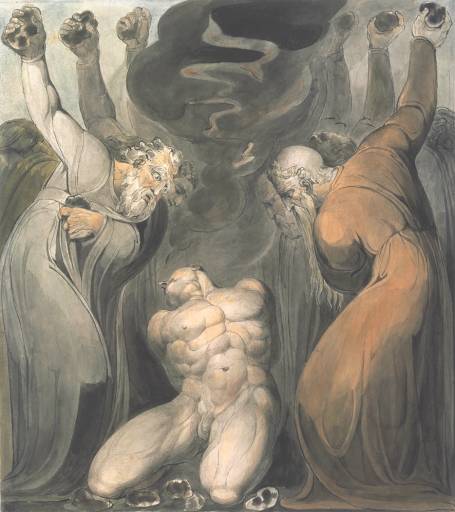
The Blasphemer, as in Leviticus 24: 13-23, by William Blake circa 1800

The Blasphemer, as in Leviticus 24: 13-23, by William Blake circa 1800

Deuteronomy 16:20-17:7 Only the LORD your God

1You must not sacrifice to the LORD your God an ox or a sheep that has a defect, anything seriously wrong; for that is abhorrent to the LORD your God.

                2 If there is found among you, in one of your towns that the LORD your God is giving you, a man or woman who does what is evil in the sight of the LORD your God, and transgresses his covenant 3 by going to serve other gods and worshiping them– whether the sun or the moon or any of the host of heaven, which I have forbidden– 4 and if it is reported to you or you hear of it, and you make a thorough inquiry, and the charge is proved true that such an abhorrent thing has occurred in Israel, 5 then you shall bring out to your gates that man or that woman who has committed this crime and you shall stone the man or woman to death. 6 On the evidence of two or three witnesses the death sentence shall be executed; a person must not be put to death on the evidence of only one witness. 7 The hands of the witnesses shall be the first raised against the person to execute the death penalty, and afterward the hands of all the people. So you shall purge the evil from your midst.

For the author of Deuteronomy the first and central commandment that the people are only to have the LORD as their God. It comes at the head of the Ten Commandments in Deuteronomy 5:6:

I am the LORD your God, who brought you out of the land of Egypt, out of the house of slavery; you shall have no other gods before me

and in Deuteronomy 6: 4-5:

Hear, O Israel: The LORD is our God, the LORD alone. You shall love the LORD your God with all your heart, and with all your soul, and with all your might.

Even before this Deuteronomy 4 emphasizes this same theme, as do Deuteronomy 7, 8, and 9. Deuteronomy 12 again addresses this issue in relation to destroying places of worship for other gods, and all of Deuteronomy 13 addresses this issue in stark terms of what the punishment is to be for violating this covenant relationship by individuals or by entire towns. It comes up here again at the end of 16 and beginning of 17 because it is such a central issue for the Deuteronomist that the author wants no chance for the hearer/reader to miss it. Being an aural culture the things that are central will be repeated over and over to ensure that they are heard by the listening audience. The death penalty for following other gods may seem harsh to us, and I address this question in greater detail when I talk about Deuteronomy 13, but this unique relationship with the LORD is to be at the center of the life of the people of Israel.

The LORD is not to be worshiped in the same way that the gods of the nations around the people are worshiped, there is to be no blending of the gods of the nations and the LORD. The people are also to bring their best to the worship of their LORD, not the animals that are defective. For the Deuteronomist these are life and death decisions, and yet they are still bound by the due process of the law. Justice is expected and a thorough investigation of any claims of idolatry are to be made. Deuteronomy 17 probably lays behind the command in Matthew 18.16 of wanting claims to be confirmed with the testimony of two or three witnesses and also behind the command for the one who is without sin to ‘cast the first stone’ in John 8 (even though this deals with adultery). In a contemporary fictional setting it is similar to the insistence of Ned Stark in the Game of Thrones that the one who passes the sentence should swing the sword, but instead here it is the witness who has testified against a person who must cast the initial stone of the community’s judgment. As Walter Brueggemann can state, “The book of Deuteronomy is committed to a rule of law even if it is a severe rule of law.” (Brueggemann, 2001 , p. 181) The nation of Israel is to be a theocracy where ultimately the LORD their God is at the center of their judicial, religious and political life and the central place of their LORD their God should, in the view of Deuteronomy, impact the way they structure the leadership and judicial life of their community

Deuteronomy 17:8-13 The Levitical Judicial Function

8 If a judicial decision is too difficult for you to make between one kind of bloodshed and another, one kind of legal right and another, or one kind of assault and another– any such matters of dispute in your towns– then you shall immediately go up to the place that the LORD your God will choose, 9 where you shall consult with the levitical priests and the judge who is in office in those days; they shall announce to you the decision in the case. 10 Carry out exactly the decision that they announce to you from the place that the LORD will choose, diligently observing everything they instruct you. 11 You must carry out fully the law that they interpret for you or the ruling that they announce to you; do not turn aside from the decision that they announce to you, either to the right or to the left. 12 As for anyone who presumes to disobey the priest appointed to minister there to the LORD your God, or the judge, that person shall die. So you shall purge the evil from Israel. 13 All the people will hear and be afraid, and will not act presumptuously again.

The vision of Deuteronomy is for a theocracy, a nation that is an extension of the covenantal relationship with the LORD their God, and so all of the functions of life are structured around trying to create that type of a nation. In many respects ancient Judaism and Islam share this desire to create nations that are structured in this manner and so in ancient Judaism, like some Muslim states, the highest court of appeals is a religious court and not a secular one. For people who live in Europe or the United States this may seem a strange concept because we live in a post-enlightenments modern society where religion is viewed as a private portion of a person’s life, but this is a relatively recent development. The law for the Jewish people was a reflection of their covenantal relationship with their God and it was viewed as a gift that God had given them. Even the judges that were a part of the tribes were expected to judge in accordance with the ideals outlined in the law. It doesn’t take long reading through books like Judges or 1 Samuel to find ways in which the judges often failed in this respect, but the ideal was that those entrusted with ministering to the LORD in the tabernacle or temple would be those most focused on the ideals of justice that the LORD called for. People are to obey the judgments of this religious and tribal courts, for a judge whose sentence holds no power is not going to be effective in enforcing this justice. So again, it is a harsh justice, where the penalty for disobeying a priest or a judge in their sentences is execution.

Deuteronomy 17: 14-20 The Model King

                14 When you have come into the land that the LORD your God is giving you, and have taken possession of it and settled in it, and you say, “I will set a king over me, like all the nations that are around me,” 15 you may indeed set over you a king whom the LORD your God will choose. One of your own community you may set as king over you; you are not permitted to put a foreigner over you, who is not of your own community. 16 Even so, he must not acquire many horses for himself, or return the people to Egypt in order to acquire more horses, since the LORD has said to you, “You must never return that way again.” 17 And he must not acquire many wives for himself, or else his heart will turn away; also silver and gold he must not acquire in great quantity for himself. 18 When he has taken the throne of his kingdom, he shall have a copy of this law written for him in the presence of the levitical priests. 19 It shall remain with him and he shall read in it all the days of his life, so that he may learn to fear the LORD his God, diligently observing all the words of this law and these statutes, 20 neither exalting himself above other members of the community nor turning aside from the commandment, either to the right or to the left, so that he and his descendants may reign long over his kingdom in Israel.

Willem de Poorter, 'De afgoderij van konig Solomo'-Solomon's decent into idolatry (between 1630 and 1648)

Willem de Poorter, ‘De afgoderij van konig Solomo’-Solomon’s decent into idolatry (between 1630 and 1648)

Most people assume that the monarchy, and particularly the Davidic monarchy, was universally embraced by scriptures and particularly King David and Solomon are the great kings where everything went well during their reign. The bible is not unanimous in endorsing having a king at all and for example in 1 Samuel 8, when the people are demanding of Samuel a king the LORD’s response is telling:

“Listen to the voice of the people in all that they say to you; for they have not rejected you, but they have rejected me from being king over them. Just as they have done to me, from the day I brought them up out of Egypt to this day, forsaking me and serving other gods, so also they are doing to you. Now then, listen to their voice; only—you shall solemnly want them, and show them the ways of the king who shall reign over them.” 1 Samuel 8: 7-9

The Deuteronomic history (the books beginning with Judges and stretching through 2 Kings) is pretty unromantic when it describes the failings of the kings that would rule over Judah and Israel, and it is telling the way that Deuteronomy describes the aspects of who the king is to be, they are the opposite of King Solomon. Most Christians know little of the story of Solomon, other than his request for wisdom and his building of the temple, but the way 1 Kings tells of his reign he quickly is drawn into a quest for wealth, military power and in making alliance is led astray from being faithful to the LORD, the God of Israel. Solomon imports horses from Egypt and has 12,000 horses and 1,400 chariots. Horses in the ancient world are a sign of military might. With power centralized and the military muscle to back up that power the king of Israel may begin to act like the Pharaohs of Egypt and the people become plunged into dependence under the burden of supplying for the hunger of a large military budget. 1 Kings goes at length into describing the wealth that Solomon accumulates as well as the incredible investment in projects beyond the temple, like his own palace. Solomon’s reign is reported to have brought in more than five tons of gold a year in addition to countless other resources. Finally Solomon is lifted up as having seven hundred princesses and three hundred concubines. All of these are direct counters to Deuteronomy’s vision of what a king is to be, and are ultimately blamed for the rising opposition to Solomon in his life and the splitting of the kingdom in two after his death. I tell about this briefly in the Place of Authority posts.

The title of the book of Deuteronomy comes from verse 18 where it refers to a copy of the law (in greek deutero nomos-second law) that the king is to read from each night and to be the way in which the king stays grounded in the covenantal life the people are called to.  Ultimately in the view of Deuteronomy the king is subservient to the will of the LORD. In reality, this rarely seemed to be the case in the story of the people of Judah and Israel. In a time where the majority of the population would be illiterate and not have access to written copies of the law they did rely upon the leaders including the king and the religious authorities guiding them in their actions. The bible evaluates the kings theologically: were they faithful to the LORD their God or did they lead the people to follow other gods?

I am writing from a Christian perspective, and in the church year we are approaching Christ the King Sunday and perhaps as Christians it might be worth examining how Jesus who we call Messiah or Christ (which means anointed king) lives into this identity. In Paul’s short statement of who Christ was in Philippians 2:

Who, though he was in the form of God, did not regard equality with God as something to be exploited, but emptied himself, taking the form of a slave, being born in human likeness. And being found in human form, he humbled himself and became obedient to the point of death—even death on a cross. Philippians 2: 6-8.

Many of the servant songs from Isaiah, which Christians read as talking about Jesus probably originally were trying to consider a monarch that might embody the vision of passages like Deuteronomy 17. Perhaps when the New Testament talks about explaining who Jesus was from the law and the prophets this is one of the places in the law where the early Christians went back to.