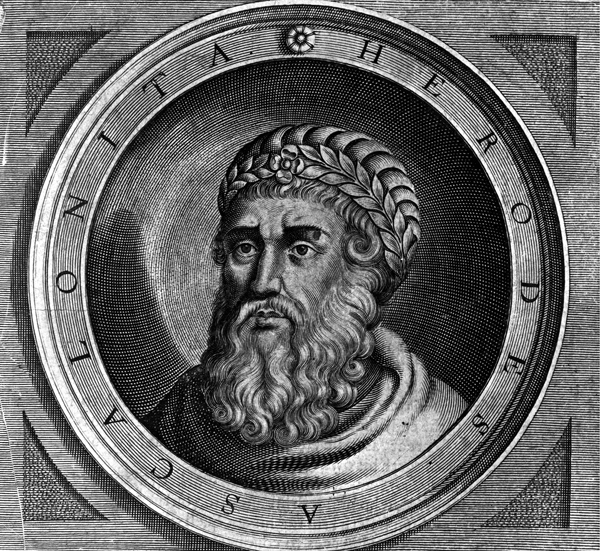
Herod the Great
The World Around Judea in the Time Before Herod
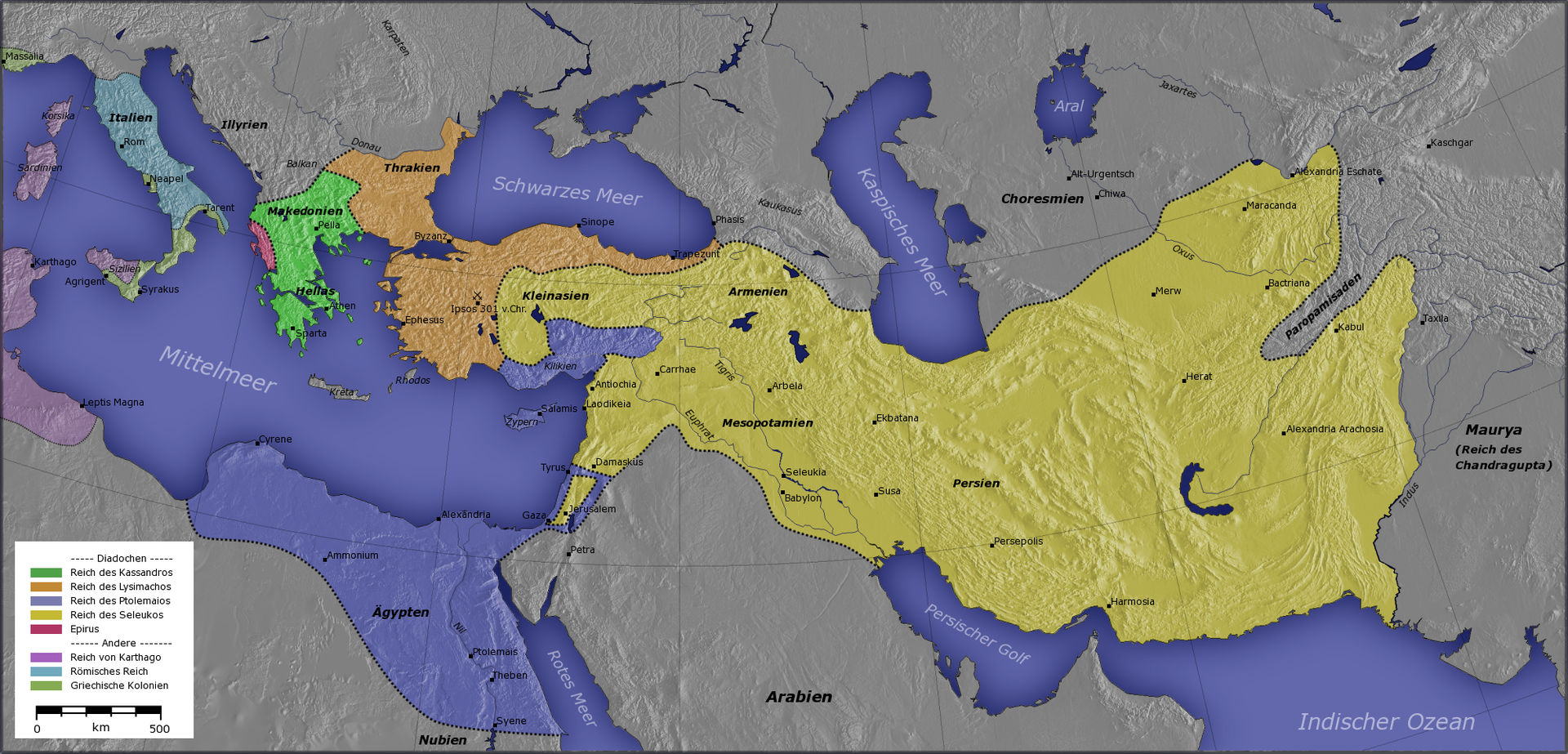
After the Maccabean Revolt in 167-160 BCE the Judean people had a time of independence and were ruled by Hasmonean kings who were descendants of the Maccabees who are credited with, in tradition, of leading the revolt that would grant them independence from the collapsing Seleucid Empire (the northern half of the former Greek empire).

The Macedonian Empire and the Kingodm of the Diadochi in 301 BC and 200 BC Atlas by William R. Shepherd, 1911 courtesy of the University of Texas at Austin, Seleucid Empire shown in yellow on map
The Hasmoneans ruled Judea autonomously from 140-63 BCE when Pompey conquered Judea. The Hasmoneans retained their titles once Rome established Judea as a client state, but they no longer had the autonomy they once did. The Hasmoneans continued to vie for power, and it was during the power struggle between two brothers (Hyrcanus and Aristobolos) that Antipater (Herod the Great’s father) was able to attain the position of Chief minister of Judea with the responsibility of collecting taxes for Rome.
The assassination of Julius Caesar in 44 BCE brought instability throughout the Roman empire and while Marc Anthony and Octavian battled for dominance and the Parthian empire pushed against the divided Roman forces. Antipater would be assassinated by a rival, Malchus, in 43 BCE but Herod and his brothers, Antipater’s son would avenge their father’s death.
Herod the King of Judea
In either 40 or 39 BCE Herod is appointed King of Judea by the Imperial Senate at Anthony’s request. Because of the ongoing civil war between Anthony and Octavian and the continued Parthian incursions Herod was left with autonomy to deal with both civil unrest, particularly in Galilee, as well as internal threats from his own family.
There are times where Herod’s reign sounds like something out of George R. R. Martin’s Game of Thrones, where the intrigue between family members is often lethal. The Hasmoneans still had influence in both the political and religious spheres when Herod assumed power and Herod has married Mariamne I, the daughter of the Hasmoneans Alexander and Alexandra. To attempt to regain some of their lost power Herod’s mother-in-law, Alexandra, appealed to Cleopatra, now married to Marc Anthony, to help place her son, Aristobolus III, as high priest for Jerusalem. While Herod did grant Aristobolus III the office of high priest he ensured that both Alexandra and Aristobolus III were kept under tight surveillance. In 36 BCE Herod would have Aristobolus III killed. In 29 BCE he would have his wife Mariamne I executed for adultery, and his mother-in-law Alexandra is executed after she declares Herod unfit to rule and attempts to assume the crown for herself. In 28 BCE he executes his brother-in-law Kostobar for conspiracy. In 27 BCE an assassination attempt on Herod’s life was foiled. Towards the end of his reign his sons became the threats to his power with his two sons from Mariamne I executed in 7 BCE, and his first born son, Antipater, who had been his heir was executed in 4 BCE while Herod was dying a painful death to an unknown illness.
In addition to navigating the internal threats Herod also had to navigate the tricky relationship with Rome during an unsettled time. In the civil war between Anthony and Octavian Herod had sided with Marc Anthony. When Octavian (who later assumed the title Augustus) defeated Marc Anthony’s forces in 31 BCE Herod had to demonstrate that he could be a loyal client king of the new Roman emperor. Herod was able to make the argument that his continued reign in Judea would help retain Rome’s access to the resources of both Egypt and Syria. Herod’s efficient administration of Judea, in Roman eyes, and his ability to keep local revolutionaries contained meant that Rome granted Herod a large amount of authority in relation to the people of Judea.
Herod rule would be viewed as despotic in modern terms and it is impossible to judge the reaction of the average person in Judea to his reign. Herod did use secret police to monitor and report on the population and that he had a large personal guard which was composed of both Jewish and mercenary forces. Herod’s building projects, including the rebuilding of the temple, harbors, fortresses and several cities for non-Jewish portions of the population in Judea placed a great tax burden on the people in addition to the taxes that Herod would send to Rome and to other dominions.
Herod, because of his Idumean background and in contrast to the Hasmoneans who came before him, had to maintain his identity as a monarch of the Jewish people. Yet, he also continually had to play the role of a client king of the Roman empire. Herod, even though he was brought up Jewish, sometimes displayed a poor judgment of Jewish sensitivities (or perhaps at times didn’t care). Herod’s most famous blunder was erecting a golden eagle at the gate of the temple which many Jewish religious leaders felt was idolatrous. Herod managed to stay in power for roughly thirty-six years facing both internal and external threats and was probably both efficient and ruthless. Herod did not tolerate threats to his continued reign and as the Roman writer Macrobius (c. 400 CE) would report that Emperor Augustus, on hearing that Herod has ordered the death of his own sons, said, “It is better to be Herod’s pig than his son” Herod, attempting to maintain a Jewish identity, would never slaughter a pig to eat, but Herod did put to death several of his sons and other relations.
Josephus in his two major works the Jewish War and Jewish Antiquities gives several details of Herod the Great’s reign roughly seventy years after his death. There is a lot of scholarly work on Herod the Great and his role in both Jewish and Christian narratives. His life can be confusing to attempt to follow because it occurs at the intersection of many large historical events. After Herod the Great’s death in 4 BCE his reign is divided among four of his remaining sons, the map below shows the reach of Herod the Great’s reign.

The Herodian Tetrarchy as establish by Augustus in 4 BCE until 6 CE when Herod Archelaus is ousted and Judea is annexed by Rome shared under creative commons attribution-share alike 4.0


 Sign of the Rose