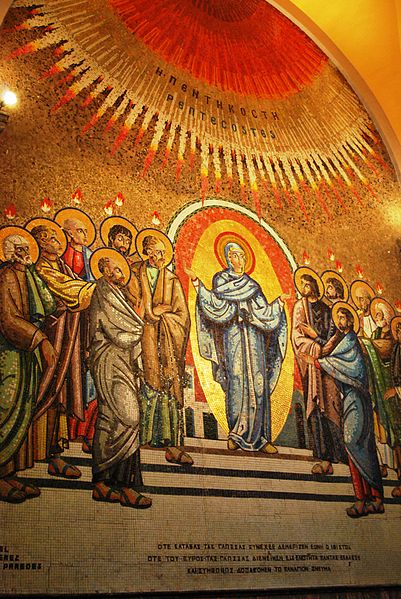
Mosaic Mural of Pentecost by Manuel Perez Paredes in Nuestro Senor del Veneno Temple, Mexico City
Joel 2: 28-32 (3:1-5 Hebrew)
28 Then afterward I will pour out my spirit on all flesh; your sons and your daughters shall prophesy, your old men shall dream dreams, and your young men shall see visions.
29 Even on the male and female slaves, in those days, I will pour out my spirit.
30 I will show portents in the heavens and on the earth, blood and fire and columns of smoke.
31 The sun shall be turned to darkness, and the moon to blood, before the great and terrible day of the LORD comes.
32 Then everyone who calls on the name of the LORD shall be saved; for in Mount Zion and in Jerusalem there shall be those who escape, as the LORD has said, and among the survivors shall be those whom the LORD calls.
This short portion of Joel is the best known among Christian readers because it is the scripture quoted by Peter to explain to the crowds what they were seeing at Pentecost. The final verse of this passage is also echoed by Paul in Romans 10:13 and may also influence Paul’s language in Galatians 3:28. Yet, it is important to hear this text both within its original context as well as these references in Acts and Romans. For Joel, this passage occurs within the context of the LORD turning the disaster of the locusts away and restoring the people to prosperity. Once the immediate needs of the people, the animals, and the land are met a prophetic vision of hope emerges.
Several prophets have a vision of God decisively turning the heart of the people around after the restoration of the covenant. For example:
The days are surely coming, says the LORD, when I will make a new covenant with the house of Israel and the house of Judah. It will not be like the covenant that I made with their ancestors when I took them by the hand to bring them out of the land of Egypt — a covenant that they broke, though I was their husband, says the LORD. But this is the covenant that I will make with the house of Israel after those days, says the LORD: I will put my law within them, and I will write it on their hearts; and I will be their God, and they shall be my people. No longer shall they teach one another, or say to each other, “Know the LORD,” for they shall all know me, from the least of them to the greatest, says the LORD; for I will forgive their iniquity, and remember their sin no more. Jeremiah 31: 31-34
I will sprinkle clean water upon you, and you shall be clean from all your uncleannesses, and from all your idols I will cleanse you. A new heart I will give you, and a new spirit I will put within you; and I will remove from your body the heart of stone and give you a heart of flesh. I will put my spirit within you, and make you follow my statutes and be careful to observe my ordinances. Ezekiel 36: 25-27
Just as the law is placed upon the hearts of the people and all know the LORD in Jeremiah, or the people are given a new heart and God’s spirit is placed within them in Ezekiel, now the LORD pours the Spirit of God on all flesh. It is likely that Joel understood ‘all flesh’ to be ‘all the remnant of Israel or Judah’ rather than ‘all humanity.’ Even the disciples at Pentecost probably understood this outpouring of the Spirit being to the faithful Jewish people and their remnant scattered among the nations, the book of Acts narrates this shift to accepting the Gentiles as a part of the community of faith. The radicality of Joel’s vision is that the recipients of God’s Spirit are both men and women, from young to old, and across social status.
Throughout the book of Joel, the day of the LORD has been reflected in an environmental disaster upon the earth. Locusts and drought were the armies that devastated the land, destroyed the crops and the pastures, and threatened the lives of both animals and humans. The day of the LORD continues to be reflected in the heavens. In language similar to the signs and wonders in Egypt and the experience of the exodus: the sun is darkened,[1] blood (like the Nile River turned to blood),[2] and a column of smoke becomes a visual representation of God’s presence.[3] New to Joel is the moon being turned to blood as a precursor of the day of the LORD. Yet, the day of the LORD is a time for repentance and calling on the name of the LORD. It is God who will allow the remnant to see the blessing on the other side of the great and terrible day of the LORD.
The words of Joel provide the scripture shaped language needed for Peter to describe the experience of God’s Spirit coming upon the disciples at Pentecost. The ability to speak in the tongues of the faithful from across the world becomes a new window into a vision when God pours out the Spirit generously upon the people. The early Christians would be shocked by the expansiveness of God’s vision as they are moved throughout the known world to share the gospel of Christ as they also see people of both genders, of every social class and age, and now from every nation brought into this new people of God who see visions and prophesy because they have received the gift of God’s Spirit.
[1] Exodus 10: 21-29
[2] Exodus 7: 14-25
[3] Exodus 13: 21-22
 Sign of the Rose