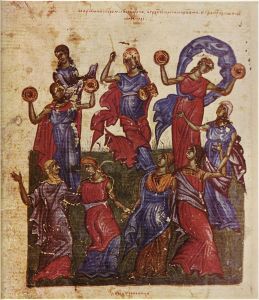
Tarnov literary and art school, Miriams Tanz, Miniatur aus dem bulfarischen Tomic Psalter (1360-1363)
Psalm 117
1 Praise the LORD, all you nations! Extol him, all you peoples!
2 For great is his steadfast love toward us, and the faithfulness of the LORD endures forever. Praise the LORD!
This is the shortest psalm in the psalter, but as James L. Mays states, “it thinks on a grand scale.” (Mays, 1994, p. 372) The people of Israel were never a world empire, nor were they a people who aggressively attempted to spread their beliefs and worship practices to the world around them. Yet, they do believe that the LORD is the God not only of Israel. The LORD created the heavens and the earth and all the peoples of the world. Just as the psalmist has encouraged the people gathered to worship to join in the hymn of all creation, now all the peoples of the nations are invited to participate in the end for which they were created: the praise of the LORD.
The motivation for the nations and peoples turning to the LORD in praise in this short psalm is not the acts of God but the character of God. The steadfast love (hesed) and faithfulness (‘emeth) of God are a frequently used pair of attributes that are rooted in God’s self-description in Exodus 34: 6-7. These attributes of the LORD are great[1] and powerful enough is the psalmist’s imagination to evoke a scene where all the nations of the earth join in proclaiming Hallelujah! (NRSV Praise the LORD)[2]
The apostle Paul quotes Psalm 117:1 in Romans 15:11 with several other references to the nations (Gentiles) praising God. This psalm helped shape his vision of a world where every knee could bow and every tongue confess that Jesus Christ is Lord to the glory of God the Father. (Philippians 2:10-11) Yet before the evangelistic movement of the early Christians into the nations there exists within the Jewish imagination a vision of a world where the nations join with them in their praise of God. Ultimately the telos[3] or end/goal of all humanity is the praise of God and in this psalm, we get to envision the world where all the nations are engaged in their proper work of praise.
[1] Brueggeman and Bellinger note that the term “great” in Hebrew is better translated might or strength with a military connotation. The term has the meaning of the strength to work one’s will. (Bellinger, 2014, p. 503)
[2] Hallelujah is the Hebrew word for praise (hallel) and shortened form of the name of God (yah) joined together.
[3] I’ve written about telos when working through the Gospel of Matthew in Perfection and Blamelessness in the Bible. I like the way Greg Lukianoff and Jonathan Haidt capture the idea of telos in The Coddling of the American Mind. “Aristotle often evaluated a thing with respect to its “telos”—its purpose, end, or goal. The telos of a knife is to cut. A knife that does not cut well is not a good knife.” (Haidt, 2018, p. 253)
1 I love the LORD, because he has heard my voice and my supplications.
2 Because he inclined his ear to me, therefore I will call on him as long as I live.
3 The snares of death encompassed me; the pangs of Sheol laid hold on me; I suffered distress and anguish.
4 Then I called on the name of the LORD: “O LORD, I pray, save my life!”
5 Gracious is the LORD, and righteous; our God is merciful.
6 The LORD protects the simple; when I was brought low, he saved me.
7 Return, O my soul, to your rest, for the LORD has dealt bountifully with you.
8 For you have delivered my soul from death, my eyes from tears, my feet from stumbling.
9 I walk before the LORD in the land of the living.
10 I kept my faith, even when I said, “I am greatly afflicted”;
11 I said in my consternation, “Everyone is a liar.”
12 What shall I return to the LORD for all his bounty to me?
13 I will lift up the cup of salvation and call on the name of the LORD,
14 I will pay my vows to the LORD in the presence of all his people.
15 Precious in the sight of the LORD is the death of his faithful ones.
16 O LORD, I am your servant; I am your servant, the child of your serving girl. You have loosed my bonds.
17 I will offer to you a thanksgiving sacrifice and call on the name of the LORD.
18 I will pay my vows to the LORD in the presence of all his people,
19 in the courts of the house of the LORD, in your midst, O Jerusalem. Praise the LORD!
Psalm 116 is the song of praise of one who has been delivered from the power of death. Throughout the psalms the LORD is the one who delivers the life (nephesh)[1] of this faithful one from the power of death. This individual praise has been brought into the practice of the Passover meal where the community now praises the LORD’s rescue of them from their death in Egypt. For Christians this psalm is traditionally read on Maundy Thursday (the Thursday before Easter) in connection with the last supper. In both the religious practice of Jews and Christians this psalm echoes a repeated theme in the psalms of a God who ransoms or save the life of the individual or people from the powers of death.[2]
Even though Deuteronomy 6:5 with its command, “You shall love the LORD your God with all your heart, with all your soul, and with all your might.” is one of the central commandments, and a part of the Shema which the people are to regularly recite, the psalms rarely refer to loving the LORD. J. Clinton McCann highlights three other psalms that reference loving God (Psalm 5:1; 32:23; and 40:16) (NIB IV: 1148) but even Psalm 40:16 refers to “those who love your salvation say continually, “Great is the LORD.” The NRSV and many other translations begin this psalm by stating “I love the LORD, because he has heard my voice and my supplications.” Yet, these translations deviate from the Hebrew which has the LORD as the subject of the verb hear. Nancy-deClaissé-Walford captures this in her translation, “I love because the LORD hears.” (Nancy deClaisse-Walford, 2014, p. 858) The rescued one is able to love because the LORD is one who saves from the time of trouble, who hears and inclines the ear of God to the one who calls upon God throughout their life.
God is the one who sustains life, but death is a constant threat throughout this poem. Death and Sheol are parallel terms for this realm or entity which attempts to lay hold of this faithful one. It is mythologized into a living being or force that can encompass with snares or afflict with pangs. This resonates with Paul usage of a personified death which is the last enemy to be defeated in 1 Corinthians 15:26. The LORD is the one who rescues the life of one who has been pulled close to the realm of death and has restored them to life. Now they walk before the LORD in the land of the living.
Even though this psalmist kept their faith in God in their time of distress other may have viewed this as a judgment from God like Job’s dialogue partners or like the enemies encountered in other psalms of lament. (Bellinger, 2014, p. 501) The psalmist may have had to dispute others who viewed their misfortune as indication of unfaithfulness or sin and who in the psalmist’s words were liars. Instead of receiving compassion from others, this one at death’s door may have received condemnation or even seen others plot to take advantage of his physical distress. Yet the psalmist’s faith was in a God who delivers from the snares of death and returns them to life.
The cup of salvation may have originated as a part of the drink offering or in an offering of thanksgiving for well being[3] but this reference to the cup of salvation likely led to the use of this psalm with the fourth cup at Passover. For Christians the linkage of the Passover with the Last Supper led to this being the traditional psalm on Maundy Thursday. Yet within the psalm this line is a part of the psalmist’s thankful reaction to the deliverance they have received. They pay their vows and the celebrate ritually what God has done for them.
Verse fifteen is a verse that is often used in a way that is opposite to its original intent. The NRSV’s translations Precious in the sight of the LORD is the death of his faithful ones makes it sound like the death of the faithful is something God welcomes when the entire direction of the psalm is about a God who rescues from death. The Hebrew yaqar translated as “precious” also has the meaning of costly or weighty. The NJPS translates this verse as grievous in the LORD’s sight. The word for faithful ones is hasid which are those who practice hesed or those who imitate God’s practice of steadfast love. Throughout the psalm the self-disclosure of God’s character in Exodus 34:6 as merciful and gracious…abounding in steadfast love and faithfulness is echoed in the Hebrew vocabulary of the psalm. For example, in verse five several of these same terms for God echo in this psalmist’s description of God.
For the psalmist the experience of rescue from the snares of death demonstrates the character of God. The psalmist lives in gratitude for the ability to love and live again. The come in worship and exaltation to the house of God and echo the Hallelujah (Praise the LORD) that the hallel psalms are named for. In knowing the deliverance of God, they have come to a fuller appreciation of the character of the God who delivers from death.
[1] The Hebrew nephesh is often translated ‘soul’ (as in verse seven and eight in the NRSV) but the modern concept of soul does not communicate the concept of nephesh. Nephesh is the essence of life or the center of life. Even in this psalm which discusses the place of the dead (Sheol) the contrast is between life and death, not life and afterlife.

 Sign of the Rose