Tag Archives: God as King

Psalm 99 The Universal King Worshipped By A Particular People

The Temple by Radojavor@deviantart.com

Psalm 99

1 The LORD is king; let the peoples tremble! He sits enthroned upon the cherubim; let the earth quake!
2 The LORD is great in Zion; he is exalted over all the peoples.
3 Let them praise your great and awesome name. Holy is he!
4 Mighty King, lover of justice, you have established equity; you have executed justice and righteousness in Jacob.
5 Extol the LORD our God; worship at his footstool. Holy is he!
6 Moses and Aaron were among his priests, Samuel also was among those who called on his name. They cried to the LORD, and he answered them.
7 He spoke to them in the pillar of cloud; they kept his decrees, and the statutes that he gave them.
8 O LORD our God, you answered them; you were a forgiving God to them, but an avenger of their wrongdoings.
9 Extol the LORD our God, and worship at his holy mountain; for the LORD our God is holy.

Psalm 8 can wonder, “what are human beings that you are mindful of them, mortals that you care for them?” and Psalm 99 can focus that wonder on a particular place and people through whom the world comes to know the ruler of the heavens and earth. The LORD is the one before whom all nations tremble and the earth shakes, but whose universal sovereignty is focused on a particular place: the temple in Zion. The description of God being enthroned above the cherubim almost always refers to the ark of the covenant (1 Samuel 4:4, 2 Samuel 6:2, Psalm 80:1) and the references to Zion and holy mountain indicate that the psalm is pointing to the temple in Jerusalem. Even the notation of God’s footstool also refers to the temple as a resting place for the ark (1 Chronicles 28:2, Psalm 132:7). God presence and power becomes known through a particular place.

At the same time the psalm links the knowledge of God to a holy place, it also becomes known through holy people. Book four of the psalter began with Psalm 90, the only psalm attributed to Moses, and it is likely intentional that the final enthronement psalm references Moses once again. Moses and Aaron are lifted up as priests of God, and they are responsible for the construction of the ark where God’s presence is met. Samuel is the other figure lifted up in the psalm, who also harkens back to pre-monarchic Israel. Samuel opposed the people’s request for a king because for Samuel only the LORD is king, a sentiment echoed by Psalm 99. It is possible that Psalm 99 comes from a time after the re-establishment of the temple in Jerusalem after the exile, a time when the line of Davidic kings seems to have ended.

The paradox of the psalmist’s faith is that the LORD the God of Israel is the universal king over all the earth and peoples who has revealed Godself through a particular place (the temple in Zion) and through particular people (Moses, Aaron, and Samuel in the psalm). Yet, the psalm yearns for a universal realization that transcends the particularity of Israel. Israel has the privileged position of being the people to whom the Mighty King revealed not only himself but also the vision of justice and righteousness that God’s kingdom would involve. So, in response to the universal wonder of Psalm 8, Psalm 99 can give the particular wonder of a people who says, “Who are we that the Mighty King, the lover of justice who establishes equity throughout the earth dwells in the temple on our holy mountain, and spoke to use through Moses, Aaron, and Samuel, Israel that you care for us?”

Psalm 97 The Righteous Reign of God

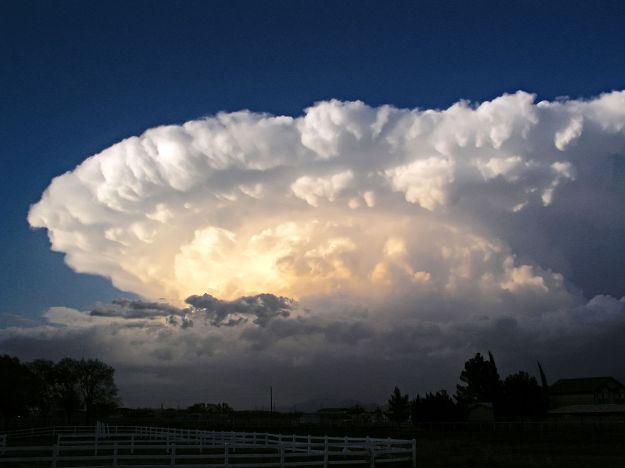
Supercell Thunderstorm over Chaparral, New Mexico on April 3, 2004

Psalm 97

1 The LORD is king! Let the earth rejoice; let the many coastlands be glad!
2 Clouds and thick darkness are all around him; righteousness and justice are the foundation of his throne.
3 Fire goes before him, and consumes his adversaries on every side.
4 His lightnings light up the world; the earth sees and trembles.
5 The mountains melt like wax before the LORD, before the Lord of all the earth.
6 The heavens proclaim his righteousness; and all the peoples behold his glory.
7 All worshipers of images are put to shame, those who make their boast in worthless idols; all gods bow down before him.
8 Zion hears and is glad, and the towns of Judah rejoice, because of your judgments, O God.
9 For you, O LORD, are most high over all the earth; you are exalted far above all gods.
10 The LORD loves those who hate evil; he guards the lives of his faithful; he rescues them from the hand of the wicked.
11 Light dawns for the righteous, and joy for the upright in heart.
12 Rejoice in the LORD, O you righteous, and give thanks to his holy name!

One of the losses of our modern, technology filled world is the patient hope of the psalmist and the prophets for the arrival of God’s kingdom. James L. Mays notes that Psalm 97 shares several key images and ideas with the portions of Isaiah most scholars attribute to Judah’s time in exile.[1] (Mays, 1994, p. 311) The psalmist’s proclamation of God’s reign causing the earth, Judah, and the righteous to rejoice were always contested claims. Israel and Judah lived in a world of multiple religious options and empires who exercised military, economic, and political might over Israel or Judah. Yet, the psalms and the prophets exhibit a persistent faith that despite the evidence to the contrary the God of Israel reigns over creation, is chief among the gods of the nations, and continues to sow joy and righteousness in the upright in heart. It is only through the eyes of faith that these poets can rejoice with the earth and the coastland because their vision has revealed to them that the LORD, the God of Israel and Judah, is king.

The vision of God in the psalms and the prophets may, as Brueggemann and Bellinger comment, retain the “remnants of a storm god.” (Brueggemann, 2014, p. 418) but as in Psalm 29 the use of the language of clouds and darkness, fire, lightning, and earthquake takes the primary language for the power of the Canaanite god Baal and now uses it to describe the power of the LORD the God of Israel. This imagery also resonates with the appearance of the LORD to the people at Mount Sinai in Exodus 19:16-19. The psalmist longs for the day for all the people to see what the eyes of faith trust: that the idols of the nations are worthless, that the kings of the earth and the gods of the nations are powerless before the LORD who is king, and that the power of the wicked over the faithful will end as God rescues them.

God’s righteousness and justice are the foundation of God’s throne, and they are also the foundation for the hopeful imagination of the psalmist. The heavens can proclaim God’s righteousness and the people of Judah can find reasons for rejoicing and gladness because of God’s judgments. Because God’s reign is based on righteousness it opens the possibility that people in Judah and beyond the borders of Judah can live as righteous ones rather than adopting the ways of the wicked. The response throughout the poem to the righteousness and justice of God is joy and gladness. The earth can rejoice, and the coastlands can be glad because the creation bears witness to the just reign of God. Zion can be glad, and the towns of Judah can rejoice because God judges with righteousness. The ones loving the LORD will hate evil[2] and God will guard their lives and sows[3] light and joy in these faithful ones of upright hearts. These righteous ones planted with light and joy in the rejoicing earth now join the earth’s joy at the celebration of God’s reign.

[1] See for example Isaiah 40: 5, 9-11; 42:17, and 52: 7-10

[2] In both the MT (Hebrew) and LXX (Greek translation) the direct translation is “The ones loving the LORD hate evil” as the NIV captures. The NRSV follows the translation of scholars who in their attempt to smooth our the translation change the subject to God, but there is no reason to make this change to the original text. (Nancy deClaisse-Walford, 2014, p. 724)

[3] Some change this word to a similar Hebrew word for ‘rise, shine’ (hence the NRSV translation) but the metaphor of sowing light fits with the imagination of the psalmist. (Nancy deClaisse-Walford, 2014, p. 724)

Psalm 96 A New Song of God’s Triumph

Psalm 96

1 O sing to the LORD a new song; sing to the LORD, all the earth.
2 Sing to the LORD, bless his name; tell of his salvation from day to day.
3 Declare his glory among the nations, his marvelous works among all the peoples.
4 For great is the LORD, and greatly to be praised; he is to be revered above all gods.
5 For all the gods of the peoples are idols, but the LORD made the heavens.
6 Honor and majesty are before him; strength and beauty are in his sanctuary.
7 Ascribe to the LORD, O families of the peoples, ascribe to the LORD glory and strength.
8 Ascribe to the LORD the glory due his name; bring an offering, and come into his courts.
9 Worship the LORD in holy splendor; tremble before him, all the earth.
10 Say among the nations, “The LORD is king! The world is firmly established; it shall never be moved. He will judge the peoples with equity.”
11 Let the heavens be glad, and let the earth rejoice; let the sea roar, and all that fills it;
12 let the field exult, and everything in it. Then shall all the trees of the forest sing for joy
13 before the LORD; for he is coming, for he is coming to judge the earth. He will judge the world with righteousness, and the peoples with his truth.

Psalm 96 is an exultant song of God’s glory and reign over all gods, nations, and the creation itself. 1 Chronicles 16 places the majority of this psalm within the song of thanksgiving appointed by David (1 Chronicles 16: 23-33) which marks the placing the placing of the ark of God in the tent. This psalm might have its origin in the songs of David, and its placement in 1 Chronicles creates an event that would make sense for this song of God’s triumphant ascension. However, this psalm also articulates the defiant faith of the chosen people in their God as they attempt to remain faithful in a multireligious world where they are not dominant among the nations. This new song allows the singers and hearers to articulate a vision of a world already giving glory and praise to the LORD who is enthroned over all gods and kings.

Three times the hearers are commanded to sing to the LORD, and the hearers are not limited to Judah or Israel. All the earth is to join in this song of blessing to the God of salvation. The song proclaims the gospel[1] that God has triumphed over the forces that opposed God’s reign. God’s works and glory are to extend to all the nations as the LORD transcends all the gods of the nations. The gods of the nations are ‘idols’ (NRSV), ‘nobodies’ ( (Brueggemann, 2014, p. 415) or ‘ineffective and incompetent.’ (Mays, 1994, p. 308) The LORD is the creator of the heavens compared to all the ineffective and incompetent nobodies who the nations once gave their allegiance to. The peoples and families of the earth are to bear witness to the glory and strength that is due to God. The nations are to stream to Jerusalem to bring an offering before God as the prophets envision. (Isaiah 2: 2-3, Micah 4: 1-2, Zechariah 8:21-23) The temple of God in Zion now occupies the central place in the world where all the families of the peoples come together in awe filled worship and celebration of the God who reigns over all the heavens and the earth.

God’s reign over the earth is to be a reign of justice that brings joy to the peoples of the earth and to the creation. The heavens, the sea, and the land all join in this praise of the nations. Those who have reigned with injustice, whose actions have done violence to people and the earth are now removed so the nations, the land, the sea, and the sky can all heal. The psalm envisions God’s kingdom coming and God’s will being done on earth as it is in heaven.

The faithful ones who worship God declare God does reign over the earth and then enter into the tension of a world where God’s reign is not realized. Injustice continues to occur. The heavens, sea, and the earth are polluted by those who improperly use the gifts of creation and the blood spilled in conflict and war. The nations continue to give their allegiance to idols that are ineffective nobodies who cannot deliver what they promise. This psalm may be easier to sing in moments of triumph, but the defiant faith of this psalm bears witness to the world of the reality faith allows them to see: that God’s kingdom is already present in the midst of the world and the time will come when the nations will all see, worship, and give glory to the God who reigns over the heavens and the earth.

[1] The Hebrew bissar is the verb “for the duty of the herald who precedes a victor to bring a report to those who await good news from the battle.” (Mays, 1994, p. 308) This verb is normally translated in the Septuagint as the Greek euangelion translated as gospel in the New Testament.

Psalm 93 God the King

Stained Glass window at the Melkite Catholic Annunciation Cathedral in Roslindale, MA depicting Christ the King with the regalia of a Byzantine Emperor


Psalm 93

1 The LORD is king, he is robed in majesty; the LORD is robed, he is girded with strength. He has established the world; it shall never be moved;
2 your throne is established from of old; you are from everlasting.
3 The floods have lifted up, O LORD, the floods have lifted up their voice; the floods lift up their roaring.
4 More majestic than the thunders of mighty waters, more majestic than the waves of the sea, majestic on high is the LORD!
5 Your decrees are very sure; holiness befits your house, O LORD, forevermore.

This short psalm focused on the image of God as king makes explicit one of the assumptions of the psalter and the bible as a whole. Underneath the praise, lament, prayers, and appeals of the psalter is the understanding of God’s position of sovereignty and strength in relation to the people of God, the nations, and the world itself. God is able to respond because God is the sovereign over all creation. The God who is over all gods and who is the creator to whom the creation gives praise is also the object of the worship and the source of hope for the people of is the God. They confess that this God reigns in majesty and strength from everlasting.

The sovereignty of God is not linked to the king of Israel or Judah as in Psalm 2 and it is possible that this psalm emerges in a time where there is no earthly king who is entrusted with authority on behalf of God. In both Christianity and Judaism, “the reign of God is always proclaimed amid circumstances that seem to deny it.” (NIB IV: 1055) No matter the political situation the person proclaiming this psalm finds themselves within, the confession of God’s continuing reign over creation, the nations, and the world becomes a bedrock for the faith of the community. God’s decrees remain established and no floods or crashing waves can wash them away. No rulers or gods can rival God’s sovereignty.

Proclaiming God’s sovereignty in the midst of a secular world is an act of faith and defiance. It is only through the eyes of faith that the faithful one can witness the forces of creation giving praise to God. There may be moments where the reign of God is clearly visible to the faithful, but it often remains hidden by ‘circumstances that seem to deny it.’ Yet, the bedrock trust that God remains in control of the creation and that God reigns in strength is central to the life of faith.