Tag Archives: Gehazi

2 Kings 8 Transitioning from Prophetic Time to a Major Transition in Royal Time

Ivory carving found at Arslan Tash, Syria. A cache of ivories found at the Assyrian outpost of Arslan Tash was undoubtedly booty taken from Hazael’s palace in Damascus. The regal figure depicted on this piece is probably Hazael himself. (Louvre Museum, Paris)

2 Kings 8: 1-6 

1Now Elisha had said to the woman whose son he had restored to life, “Get up and go with your household and settle wherever you can, for the LORD has called for a famine, and it will come on the land for seven years.” 2So the woman got up and did according to the word of the man of God; she went with her household and settled in the land of the Philistines seven years. 3At the end of the seven years, when the woman returned from the land of the Philistines, she set out to appeal to the king for her house and her land. 4Now the king was talking with Gehazi the servant of the man of God, saying, “Tell me all the great things that Elisha has done.” 5While he was telling the king how Elisha had restored a dead person to life, the woman whose son he had restored to life appealed to the king for her house and her land. Gehazi said, “My lord king, here is the woman, and here is her son whom Elisha restored to life.” 6When the king questioned the woman, she told him. So the king appointed an official for her, saying, “Restore all that was hers, together with all the revenue of the fields from the day that she left the land until now.”

Elisha continues to provide for this woman who showed him hospitality and warns her and her child to flee the coming famine. The husband is not mentioned and is likely dead at this point in their story and this woman acts as a head of household. The seven years of famine matches the seven-year cycle of Genesis 41: 25-30 which causes the sons of Israel to seek food in Egypt, but here the famine is far more localized. Seven is a common biblical number of completion or a long time, and so the actual span of the drought may be longer or shorter than this commonly used number to designate a completed time. The woman makes her temporary home in Philistia, roughly 100 miles away, and avoids the impact of the famine. The famine is not explicitly stated as God’s judgment on the Omri dynasty in Samaria and is likely linked to the famine mentioned in the previous chapter during the siege of Samaria, but the famine as a part of God’s judgment against the Omri dynasty can be implied in the story. The stories of the last several chapters which chronicle the works of Elisha probably exist beyond the twelve years of King Jehoram of Judah (even though Jehoram’s reign brackets these stories). The king who is interested in the works of Elisha is the king of Israel, but likely not Jehoram or any other king of the Omri line.

Gehazi reemerges in the story, and this may either precede his affliction with leprosy/skin disease,[1] after some unmentioned healing of his disease, or he may remain afflicted. Whatever his condition he is able to converse with the king of Israel about the acts of Elisha. As he describes Elisha’s raising of the woman’s son, he points to this woman who has come to “cry out” (NRSVue appeal)[2] for the return of her property. The Torah imagines a world where the property of a family would be held by that family in perpetuity, but the narrative of scripture points to a different reality. It is possible that in her absence a relative or even squatters have come in and taken over her land, or that in her absence it became crown land, but this once well-connected woman now comes to appeal for her property. Her connection to Elisha allows her appeal to be heard by this king who is interested in the acts of Elisha, and her “crying out” is heard by the king who appoints an official[3] to restore not only her land but also the revenue from the land in the time of her absence.

2 Kings 8: 7-15

  7Elisha went to Damascus while King Ben-hadad of Aram was ill. When it was told him, “The man of God has come here,” 8the king said to Hazael, “Take a present with you and go to meet the man of God. Inquire of the LORD through him, whether I shall recover from this illness.” 9So Hazael went to meet him, taking a present with him, all kinds of goods of Damascus, forty camel loads. When he entered and stood before him, he said, “Your son King Ben-hadad of Aram has sent me to you, saying, ‘Shall I recover from this illness?’ ” 10Elisha said to him, “Go, say to him, ‘You shall certainly recover,’ but the LORD has shown me that he shall certainly die.” 11He fixed his gaze and stared at him to the point of embarrassment. Then the man of God wept. 12Hazael asked, “Why does my lord weep?” He answered, “Because I know the evil that you will do to the people of Israel; you will set their fortresses on fire; you will kill their young men with the sword, dash in pieces their little ones, and rip up their pregnant women.” 13Hazael said, “What is your servant, who is a mere dog, that he should do this great thing?” Elisha answered, “The LORD has shown me that you are to be king over Aram.” 14Then he left Elisha and went to his master Ben-hadad, who said to him, “What did Elisha say to you?” And he answered, “He told me that you would certainly recover.” 15But the next day he took the bedcover and dipped it in water and spread it over the king’s face, until he died. And Hazael succeeded him.

The prophet Elijah when he was instructed to anoint Elisha to be prophet in his place was also commanded to appoint Hazael as king over Aram and Jehu as king over Israel (1 Kings 19: 15-17). Elijah did call Elisha, but now it is Elisha who is engaged in Hazael’s ascension to power in Damascus. The story is an inversion of the story in 2 Kings 1 where King Ahaziah, king in Samaria, sends to inquire of Baal-zebub, the god of Ekron. While the king of Israel appeals to the god of Ekron, now a foreign king appeals to the prophet of Israel to inquire of the LORD his God. Yet, this inquiry of Ben-hadad sets in motion his demise despite the affirmative answer of the prophet. The prophetic messenger appoints Hazael to do the work that prophets do not do. The involvement of the prophet in both a lie and the politics of a foreign power has caused discomfort for some readers.

In the scriptures God often works through foreign powers, even if these powers are unaware of their participation in God’s action of judgment or deliverance. Hazael, the servant of Ben-hadad approaches the prophet with a large gift for this emissary of the God of Israel, but unlike Naaman’s large gift we never learn the disposition of the forty camel loads of gifts offered to the prophet. Hazael is informed of his role even though the prophet regrets the damage he will do to the people of Israel. Although Elisha gives Hazael the message that the king will recover from the illness, he also sets in motion a chain of events that lead to King Ben-hadad’s death at the hands of his servant. The prophet Amos views Hazael’s ascension as God’s act as well, but as a judgment on Ben-hadad (Amos 1: 3-4) but in Elisha’s view what is important is Hazael’s actions towards Israel. Following the original commissioning of Elijah to set Hazael over Aram and Jehu over Israel, both Aram and Jehu (and Elisha) are the swords that shall kill many. Many modern readers recoil at the violence of the actions attributed to Hazael in the prophet’s words, but war in the ancient world was violent. War of all times is violent, and innocent people often pay a heavy cost but armies in the ancient world did not act with the same restraint that modern militaries do in attempting to limit the destructiveness of the soldiers unleashed to practice violence on the enemy land and people. Hazael acknowledges that the violence the prophet describes would be a “great thing” and his only protest is that he is too insignificant to be able to accomplish this great thing. God has designated Hazael as a part of God’s plan for Israel, but Hazael is a blunt instrument that will incur a lot of damage in the removal of the Omri dynasty.

Elisha may weep for the future that he sees but he remains faithful to God’s vision. The ways of the Omri dynasty have led the people of Israel away to following other gods and unjust practices. Elisha may have wrestled with his role in being a part of the (ultimately) violent solution to the wicked (in the view of 2 Kings) kings of Israel who have now corrupted even the line of kings in Judah (see below). Many of the stories of Elisha have shown him working with individuals and groups in miraculous ways to help them navigate this world of famines and sieges. Yet, the narrative of 2 Kings attempts to understand how God is at work in the collapse of both Israel and Judah working through Aram, Assyria, and Babylon. Hazael, son of a nobody, as a large basalt statue of Shalmaneser refers to him derogatorily, (Cogan, 1988, p. 90) may not be anointed by Elisha in this story, but Elisha gives him the vision that leads to the suffocation of his ailing master and allows the son of a nobody to grasp power in Aram and to become God’s blunt instrument utilized in the judgment of Israel.

2 Kings 8: 16-29

  16In the fifth year of King Joram son of Ahab of Israel, Jehoram son of King Jehoshaphat of Judah began to reign. 17He was thirty-two years old when he became king, and he reigned eight years in Jerusalem. 18He walked in the way of the kings of Israel, as the house of Ahab had done, for the daughter of Ahab was his wife. He did what was evil in the sight of the LORD. 19Yet the LORD would not destroy Judah, for the sake of his servant David, since he had promised to give a lamp to him and to his descendants forever.
  20
In his days Edom revolted against the rule of Judah and set up a king of their own. 21Then Joram crossed over to Zair with all his chariots. He set out by night and attacked the Edomites and their chariot commanders who had surrounded him, but his army fled home. 22So Edom has been in revolt against the rule of Judah to this day. Libnah also revolted at the same time. 23Now the rest of the acts of Joram and all that he did, are they not written in the Book of the Annals of the Kings of Judah? 24So Joram slept with his ancestors and was buried with them in the city of David; his son Ahaziah succeeded him.

  25
In the twelfth year of King Joram son of Ahab of Israel, Ahaziah son of King Jehoram of Judah began to reign. 26Ahaziah was twenty-two years old when he began to reign; he reigned one year in Jerusalem. His mother’s name was Athaliah, a granddaughter of King Omri of Israel. 27He also walked in the way of the house of Ahab, doing what was evil in the sight of the LORD, as the house of Ahab had done, for he was son-in-law to the house of Ahab.
  28
He went with Joram son of Ahab to wage war against King Hazael of Aram at Ramoth-gilead, where the Arameans wounded Joram. 29King Joram returned to be healed in Jezreel of the wounds that the Arameans had inflicted on him at Ramah, when he fought against King Hazael of Aram. King Ahaziah son of Jehoram of Judah went down to see Joram son of Ahab in Jezreel because he was wounded.

The bulk of the first eight chapters of 2 Kings have broken from the typical construction of the story around the reigns of kings and has focused instead on the end of the prophet Elijah’s story and then multiple stories centered on the prophet Elisha. We will return to Elisha for a few final stories, but the narrator of 2 Kings returns us to the timeline of kings, particularly the kings in Judah. The narration of the book of kings has focused almost entirely on the northern kingdom of Samaria or Israel since the reign of Jehoshaphat in Judah in 1 Kings 22: 41-51. In contrast to his father and grandfather who followed the ways of the LORD, Jehoram[4] the new king of Judah follows the ways of the kings of Israel and is allied with these kings by marriage to Athaliah, a sister of king Joram of Israel. Like Jezebel, king Ahab’s wife, Athaliah is viewed as a corrupting influence upon both Jehoram and her son Ahaziah.

2 Chronicles reports a letter from Elijah to Jehoram:

12A letter came to him from the prophet Elijah, saying, “Thus says the LORD, the God of your father David: Because you have not walked in the ways of your father Jehoshaphat or in the ways of King Asa of Judah 13but have walked in the way of the kings of Israel and have led Judah and the inhabitants of Jerusalem into unfaithfulness, as the house of Ahab led Israel into unfaithfulness, and because you also have killed your brothers, members of your father’s house, who were better than you, 14see, the LORD will bring a great plague on your people, your children, your wives, and all your possessions, 15and you yourself will have a severe sickness with a disease of your bowels until your bowels come out, day after day, because of the disease.” 2 Chronicles 21:12-14

Both 2 Chronicles and 2 Kings view the time of Jehoram as a time which corrupted the house of David and jeopardized the enduring line promised to David. God restrains the judgement on these two unfaithful kings of Judah because of God’s loyalty to David, but Judah is in danger of becoming like the north.

Kings in the ancient world[5] are judged by their ability to maintain power and here we see the beginning of a deterioration of Judah’s control of Edom as well as one of its own cities. The narrative sets the infidelity toward the LORD of these two kings of Judah alongside their loss of power over their vassals. Readers can make a judgement about the connection between their inability to project power over their vassals and their unfaithfulness to the LORD (Brueggemann, 2000, p. 375) but the theological perspective of the narrator of 2 Kings would probably view them as connected. Alex Israel suggests that Libnah, as a Levite city, may have been demonstrating against the idolatrous religious orientation of Jehoram (Israel, 2019, p. 159) and while there were likely Levites and other people faithful to the LORD who were distressed about the direction of Judah under Jehoram and Ahaziah it is probably unlikely that one city would simply separate itself from Judah without the intervention of other powers. However, Alex Israel’s description of Judah under Jehoram is pointed and accurate:

we may certainly summarize his dismal eight-year reign as a period of national disintegration: religious deviation, internecine royal infighting, a collapse of regional influence, and failure to defend his country’s borders. Judah is in decline on all fronts. (Israel, 2019, p. 159)

The introduction of Ahaziah’s brief reign over Judah sets the stage for the violent transitions in Samaria and Jerusalem in the next three chapters. King Joram is wounded in battle like his father Ahab (1 Kings 22: 29-40) and Ahaziah goes to visit him at this critical moment where Elisha anoints Jehu which brings about the ending of the Omri dynasty and the violent transition in Jerusalem.


[1] See the discussion on skin disease/leprosy in chapter five.

[2] The Hebrew za’aq as Brueggemann notes is frequently used of those who are abused or oppressed “crying out” to God or someone who can intervene on their behalf. (Brueggemann, 2000, p. 366)

[3] Mordechai Cogan and Hayim Tadmor note that saris means ‘eunuch’ based on linguistic evidence. (Cogan, 1988, p. 112)

[4] Both Jehoram and Joram have the same name, they are differentiated in translations to make it easier to refer to these kings in Samaria and Judah which reign concurrently.

[5] The bible, particularly 1&2 Kings, evaluates kings on a completely different set of values, but in general kings in the ancient world were supposed to maintain or increase their territory and wealth. Wealth was primarily generated through land as a producer of agriculture, livestock, and mineral resources.
2 Kings 5 Elisha Heals Naaman and Gehazi’s Poor Choice

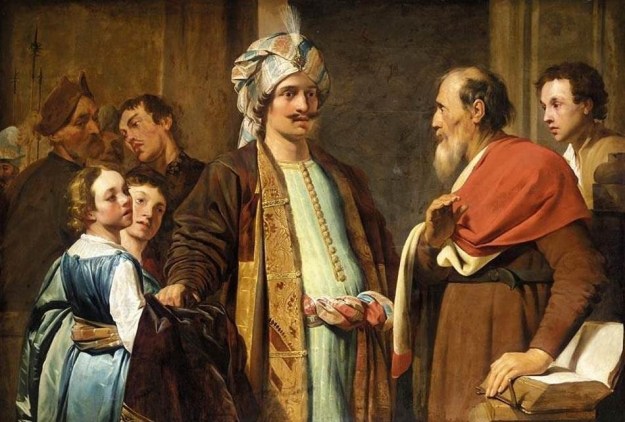
Pieter de Grebber, Elisha Refusing Gifts From Naaman (1630) https://www.theleidencollection.com/artwork/elisha-refusing-naamans-gifts/

2 Kings 5: 1-19a 

1Naaman, commander of the army of the king of Aram, was a great man and in high favor with his master because by him the Lord had given victory to Aram. The man, though a mighty warrior, suffered from a skin disease. 2Now the Arameans on one of their raids had taken a young girl captive from the land of Israel, and she served Naaman’s wife. 3She said to her mistress, “If only my lord were with the prophet who is in Samaria! He would cure him of his skin disease.” 4So Naaman went in and told his lord just what the girl from the land of Israel had said. 5And the king of Aram said, “Go, then, and I will send along a letter to the king of Israel.”
  He went, taking with him ten talents of silver, six thousand shekels of gold, and ten sets of garments. 6
He brought the letter to the king of Israel, which read, “When this letter reaches you, know that I have sent to you my servant Naaman, that you may cure him of his skin disease.” 7When the king of Israel read the letter, he tore his clothes and said, “Am I God, to give death or life, that this man sends word to me to cure a man of his skin disease? Just look and see how he is trying to pick a quarrel with me.”
  8
But when Elisha the man of God heard that the king of Israel had torn his clothes, he sent a message to the king, “Why have you torn your clothes? Let him come to me, that he may learn that there is a prophet in Israel.” 9So Naaman came with his horses and chariots and halted at the entrance of Elisha’s house. 10Elisha sent a messenger to him, saying, “Go, wash in the Jordan seven times, and your flesh shall be restored, and you shall be clean.” 11But Naaman became angry and went away, saying, “I thought that for me he would surely come out and stand and call on the name of the LORD his God and would wave his hand over the spot and cure the skin disease! 12Are not Abana and Pharpar, the rivers of Damascus, better than all the waters of Israel? Could I not wash in them and be clean?” He turned and went away in a rage. 13But his servants approached and said to him, “Father, if the prophet had commanded you to do something difficult, would you not have done it? How much more, when all he said to you was, ‘Wash, and be clean’?” 14So he went down and immersed himself seven times in the Jordan, according to the word of the man of God; his flesh was restored like the flesh of a young boy, and he was clean.
  15
Then he returned to the man of God, he and all his company; he came and stood before him and said, “Now I know that there is no God in all the earth except in Israel; please accept a present from your servant.” 16But he said, “As the LORD lives, whom I serve, I will accept nothing!” He urged him to accept, but he refused. 17Then Naaman said, “If not, please let two mule loads of earth be given to your servant, for your servant will no longer offer burnt offering or sacrifice to any god except the Lord. 18But may the LORD pardon your servant on one count: when my master goes into the house of Rimmon to worship there, leaning on my arm, and I bow down in the house of Rimmon, when I do bow down in the house of Rimmon, may the LORD pardon your servant on this one count.” 19He said to him, “Go in peace.”

The healing of Naaman, along with Elijah’s ascent in the whirlwind, are probably the two best-known and most frequently used stories from 2 Kings in the life of the church. This story, along with Elijah’s provision of meal and oil for the widow of Zarephath, is utilized in Luke 4:27 as an explanation for the expansiveness of Jesus’ ministry, but it is also paired with Jesus’ healing of lepers in the gospels. Naaman is both the victorious mighty warrior who occupies a privileged position with the king of Aram and has servants and slaves along with the access to considerable wealth and power, but in Israel he is also a Gentile, an unclean one, and an oppressor. The story illustrates the fundamental differences between the world envisioned by the king of Aram and Naaman at the beginning of the story and the prophet Elisha when he enters in the middle of the story.

The position of Naaman, in the view of 2 Kings, is a result of the LORD the God of Israel granting him victory leading the Arameans. On the one hand this provides an explanation for the defeat of Israel by a foreign power, the defeat is a judgment on the unfaithfulness of Samaria. On the other hand, it makes the mighty warrior subject, unknowingly at the beginning of the story, to the LORD the God of Israel. Even a captive young woman from Israel knows what this mighty warrior cannot, that the hope for healing resides in Samaria. This young woman who is a captive and the mighty man who is a leader of armies may be on opposite sides of the power differential but in the story they are linked. Captured slaves often have an unfavorable view of their masters, yet in Naaman throughout the story we see that this mighty man is both respected enough by his servants for them to speak truthfully and compassionately to him and Naaman as their master listens. The commander of warriors who can deliver victories depends upon the knowledge willingly shared by a captured young woman residing in his household.

The skin disease which has been traditionally translated as leprosy is probably not what we today categorize as leprosy (or Hansen’s disease) but it was something that ancient cultures took very seriously. Leviticus 13-14 deals with the priestly role in the diagnosis, the social implications for a person diagnosed with this skin disorder and the method that they can also be reintegrated into the community once they are healed. The seriousness of the disease can be demonstrated by the incredible amount of wealth (ten talents of silver, six thousand shekels of gold, and ten sets of garments)[1] which the king of Aram sends to the king of Israel to bring about the healing of his favored commander.

In the ancient world there was no concept of separation of religious and state powers. For most ancient kings, even in Israel, there are religious figures including prophets in the royal court. The prophet Nathan was involved in the court of king David, and earlier in the Omri dynasty we saw the conflict between the prophets who spoke favorably to king Ahab and Micaiah who was a faithful prophet of the LORD but not in royal favor. As Alex Israel notes about the contrasting views of prophets between the kings of Aram and Israel:

The king of Aram was incapable of imagining a scenario in which the prophet would not be fundamentally subordinate to the king, and so he sought the prophet by means of the latter. By contrast, the king of Israel couldn’t conceive a situation in which the prophet would be responsive to his control, and so he failed to entertain the prospect of appealing to Elisha! (Israel, 2019, p. 98)

The king of Aram views the king of Israel as his subordinate who he can command, but Elisha does not answer to the king of Israel. Yet, Elisha does hear of the king’s distress and instructs him to send Naaman to him.

Naaman has probably encountered other healers and prophets in Damascus who attempted to heal his skin disease, and he has ideas of how that process should look for a person of his station. As a person of high status, he anticipated personal attention from the prophet. His status as a mighty warrior and commander of the armies of Aram have allowed him to be a person who is able to fulfill their request, but now he finds that this status means nothing before the prophet, and he is reduced to a “supplicant who comes to the healer as a leper.” (Brueggemann, 2000, p. 334) Yet, as previously we saw with the young woman from Israel, Naaman is a master who his servants are willing to speak to in an honest and compassionate way. Once Naaman has completed his complaint about the command delivered by an emissary to wash in the Jordan, his servants are able to convince him that the prophet has not asked a hard thing, and it is in Naaman’s interest to attempt this novel cure.

The washing in the Jordan results in Naaman’s skin becoming like a young boy. The description of Naaman’s skin utilizing the masculine form of the words used to describe the young girl at the beginning of the story now link the two together. In some way Naaman is now like this enslaved young woman even though they occupy vastly different places in the social hierarchy. Both stand in a place of dependency before God and Naaman has not only learned that there is a prophet in Samaria, but that there is no God in all the earth except in Israel.

After the healing Naaman stands, with all his company before the prophet Elisha. Naaman attempts to offer payment, but Elisha swears that he will take no payment.[2] Naaman then makes two requests when payment continues to be refused. First Naaman requests to take two mule loads of earth. Naaman likely believes that the God of Israel is tied to the land of Israel and bringing the earth will allow him to build an altar or worship space where he can access this God whom he has discovered. Secondly, he requests that in his state functions that God would not hold it against him when he escorts his master into the worship space of Rimmon, the god of Damascus. Elisha does not judge Naaman for these requests and instructs him to depart in shalom.

2 Kings 5: 19b-27

  But when Naaman had gone from him a short distance, 20Gehazi, the servant of Elisha the man of God, thought, “My master has let that Aramean Naaman off too lightly by not accepting from him what he offered. As the LORD lives, I will run after him and get something from him.” 21So Gehazi went after Naaman. When Naaman saw someone running after him, he jumped down from the chariot to meet him and said, “Is everything all right?” 22He replied, “Yes, but my master has sent me to say, ‘Two members of a company of prophets have just come to me from the hill country of Ephraim; please give them a talent of silver and two changes of clothing.’ ” 23Naaman said, “Please accept two talents.” He urged him and tied up two talents of silver in two bags, with two changes of clothing, and gave them to two of his servants, who carried them in front of Gehazi. 24When he came to the citadel, he took the bags from them and stored them inside; he dismissed the men, and they left.
  25
He went in and stood before his master, and Elisha said to him, “Where have you been, Gehazi?” He answered, “Your servant has not gone anywhere at all.” 26But he said to him, “Did I not go with you in spirit when someone left his chariot to meet you? Is this a time to accept silver and to accept clothing, olive orchards and vineyards, sheep and oxen, and male and female slaves? 27Therefore the skin disease of Naaman shall cling to you and to your descendants forever.” So he left his presence diseased, as white as snow.

The stories of the previous chapter seem to indicate that the company of prophets (or sons of the prophets) continually struggle with poverty and this may inform Gehazi’s action contrary to his master Elisha. As Choon-Leong Seow remarks, “the faithfulness of Naaman’s slave girl at the beginning of the story stands in stark contrast to the treachery of Elisha’s servant at the end of the chapter.” (NIB III:192) While Elisha swore an oath (“as the LORD lives”) that he would accept no gift (literally blessing) from Naaman his servant Gehazi swears an oath that he will take something from this Gentile. Gehazi runs after Naaman’s party and Naaman, after dismounting his chariot asks, “Is all shalom?” Gehazi gives a reason for wanting a blessing/payment from Naaman, which Naaman is eager to grant giving double the initial request. For Naaman this is far less than the ten talents of silver he was willing to pay as payment for healing, but the roughly one hundred fifty pounds of silver with two sets of garments[3] which two of Naaman’s servants carry back to the citadel would be an incredible amount of wealth among the company of prophets. Yet, Gehazi’s secret is known by Elisha and the Hebrew indicates that Elisha’s heart went with Gehazi (NRSV ‘spirit’). Silver and clothing, land and livestock, servants and slaves for the company of the prophets is not where their security comes from. Gehazi has trusted in the same things that the king of Aram and Naaman trusted, and Elisha indicates that now Naaman’s skin disease will cling to Gehazi and his descendants.

The healing of Naaman does not end the conflict between Aram and Samaria which will continue in the narrative of the next two chapters. It is also not the end of Gehazi’s role in the story who will reappear in chapter eight. It is possible that the healing of Naaman is brought forward in the story to be a part of an Elisha cycle of miracles which reaches its peak with the thwarting of the king of Aram’s invasion of Israel. The king of Israel’s inability to heal his servant did not provide the provocation for a continued war, but ultimately the healing of Naaman did not end the conflict between Samaria and Damascus.


[1] The NIV notes that 10 shekels of silver is about 750 lbs (340 kg) of silver and 6,000 shekels of gold is about 150 lbs (70 kg).

[2] Numbers 22:18 and Daniel 5:17 are both times where two very different prophets (Balaam and Daniel) indicate that gold will not be acceptable to earn favor or as payment for a servant of the LORD.

[3] Garments in the ancient world are also expensive and an indicator of wealth.

2 Kings 4 A Series of Miracles Performed by Elisha

Carmelite chapel – “Elisha resurrecting the son of the Shunammitee” by Jean-Baptiste Despax (1710-1773)

2 Kings 4:1-7

 1Now the wife of a member of the company of prophets cried to Elisha, “Your servant my husband is dead, and you know that your servant feared the LORD, but a creditor has come to take my two children as slaves.” 2Elisha said to her, “What shall I do for you? Tell me, what do you have in the house?” She answered, “Your servant has nothing in the house except a jar of oil.” 3He said, “Go outside, borrow vessels from all your neighbors, empty vessels—and not just a few. 4Then go in, shut the door behind you and your children, and start pouring into all these vessels; when each is full, set it aside.” 5So she left him and shut the door behind her and her children; they kept bringing vessels to her, and she kept pouring. 6When the vessels were full, she said to her son, “Bring me another vessel.” But he said to her, “There are no more.” Then the oil stopped flowing. 7She came and told the man of God, and he said, “Go sell the oil and pay your debts, and you and your children can live on the rest.”

The fourth chapter of 2 Kings again departs from the normal royal time that structures the book. Throughout these four stories of miracles that Elisha performs the kings of Israel and Judah are never mentioned. The four stories all have thematic connections with the miracles of Elijah and the widow of Zarephath in 1 Kings 17: 8-24 and the four miracle stories where Elijah has two may thematically model the doubling of Elijah’s spirit that Elisha received as his prophetic heir. The stories can be viewed within the chapter as two stories related women and their children and two stories of providing food, of as two stories of miraculous provision which surround two stories of rescue from death. Ultimately all four stories weave together in a tapestry of stories about the man of God who leads the company of prophets.[1]

The kings of Israel and Judah are not ever mentioned in these stories, but in their absence we get in this first story a window into the world at the time of Elisha and the view is not flattering. The story provides, “a disturbing glance of the cruel socioeconomic reality of ancient Israel.” (Israel, 2019, p. 65) A world that is strikingly different from the world imagined in the law. A world in which widows, one of the vulnerable groups in the ancient world, and their children stand vulnerable to creditors. In Exodus widows, along with resident aliens and orphans, are mentioned as recipients of God’s special protection.

You shall not abuse any widow or orphan. If you do abuse them, when they cry out to me, I will surely hear their cry; my wrath will burn, and I will kill you with the sword, and your wives shall become widows and orphans. Exodus 22: 22-24

This entire story responds to this small portion of Exodus 22 when the oppressor in the story turns out to be a creditor/moneylender (Hebrew nosheh) which is mentioned in the verses immediately following Exodus’ warning not to abuse widows and orphans.

If you lend money to my people, to the poor among you, you shall not deal with them as a creditor (nosheh); you shall not exact interest from them. If you take your neighbor’s cloak in pawn, you shall restore it before the sun goes down; for it may be your neighbor’s only clothing to use as cover; in what else shall that person sleep? And if your neighbor cries out to me, I will listen, for I am compassionate. Exodus 22: 25-27

The company of prophets throughout these stories seem to operate from a place of poverty, and there is no economic ability within the community to pay off the creditor without the miracle. This is a story of provision that comes from God acting through the man of God.[2] Interestingly throughout these stories Elisha rarely mentions God and assumes that God will act upon his words.

The action that Elisha narrates for the woman does involve both participation from herself and her children, the community of people around them, and most importantly God. The woman and her children are to collect vessels from the surrounding community. Although the text does not specifically indicate that she does this[3] there are an unknown number of vessels available for her and her children to fill behind closed doors.[4] The oil in the house fills all the available vessels and provides a means to paying off the creditors, providing a source of income for the widow and her children, and providing protection in an world that would enslave the children for their father’s debts.

2 Kings 4: 8-37


  8 One day Elisha was passing through Shunem, where a wealthy woman lived, who urged him to have a meal. So whenever he passed that way, he would stop there for a meal. 9 She said to her husband, “Look, I am sure that this man who regularly passes our way is a holy man of God. 10 Let us make a small roof chamber with walls and put there for him a bed, a table, a chair, and a lamp, so that he can stay there whenever he comes to us.”
  11 One day when he came there, he went up to the chamber and lay down there. 12 He said to his servant Gehazi, “Call the Shunammite woman.” When he had called her, she stood before him. 13 He said to him, “Say to her: Since you have taken all this trouble for us, what may be done for you? Would you have a word spoken on your behalf to the king or to the commander of the army?” She answered, “I live among my own people.” 14 He said, “What then may be done for her?” Gehazi answered, “Well, she has no son, and her husband is old.” 15 He said, “Call her.” When he had called her, she stood at the door. 16 He said, “At this season, in due time, you shall embrace a son.” She replied, “No, my lord, O man of God; do not deceive your servant.”
  17 The woman conceived and bore a son at that season, in due time, as Elisha had declared to her.
  18 When the child was older, he went out one day to his father among the reapers. 19 He complained to his father, “Oh, my head, my head!” The father said to his servant, “Carry him to his mother.” 20 He carried him and brought him to his mother; the child sat on her lap until noon, and he died. 21 She went up and laid him on the bed of the man of God, closed the door on him, and left. 22 Then she called to her husband and said, “Send me one of the servants and one of the donkeys, so that I may quickly go to the man of God and come back again.” 23 He said, “Why go to him today? It is neither new moon nor Sabbath.” She said, “It will be all right.” 24 Then she saddled the donkey and said to her servant, “Urge the animal on; do not hold back for me unless I tell you.” 25 So she set out and came to the man of God at Mount Carmel.
  When the man of God saw her coming, he said to Gehazi his servant, “Look, there is the Shunammite woman; 26 run at once to meet her and say to her: Are you all right? Is your husband all right? Is the child all right?” She answered, “It is all right.” 27 When she came to the man of God at the mountain, she caught hold of his feet. Gehazi approached to push her away, but the man of God said, “Let her alone, for she is in bitter distress; the LORD has hidden it from me and has not told me.” 28 Then she said, “Did I ask my lord for a son? Did I not say, ‘Do not mislead me?’ ” 29 He said to Gehazi, “Gird up your loins, and take my staff in your hand, and go. If you meet anyone, give no greeting, and if anyone greets you, do not answer, and lay my staff on the face of the child.” 30 Then the mother of the child said, “As the Lord lives and as you yourself live, I will not leave without you.” So he rose up and followed her. 31 Gehazi went on ahead and laid the staff on the face of the child, but there was no sound or sign of life. He came back to meet him and told him, “The child has not awakened.”
  32 When Elisha came into the house, he saw the child lying dead on his bed. 33 So he went in and closed the door on the two of them and prayed to the LORD. 34 Then he got up on the bed and lay upon the child, putting his mouth upon his mouth, his eyes upon his eyes, and his hands upon his hands, and while he lay bent over him, the flesh of the child became warm. 35 He got down, walked once to and fro in the room, then got up again and bent over him; the child sneezed seven times, and the child opened his eyes. 36 Elisha summoned Gehazi and said, “Call the Shunammite woman.” So he called her. When she came to him, he said, “Take your son.” 37 She came and fell at his feet, bowing to the ground; then she took her son and left.

Elisha, traveling through the country of Israel, becomes a regular guest of a well-off woman and her husband. This woman shows hospitality to the man of God by providing both a meal and eventually building a room for the prophet and his companions. Elisha seeks to reward the hospitality of the woman and her husband by speaking to the political and military powers in the region, but she has no need to have the prophet speak on her behalf. This woman seems to be a formidable individual even though she is childless. Gehazi, the servant of Elisha, suggests that she is childless and her husband is old, so Elisha promises her in due time she will bear a son.

This story bears a strong resonance with the story of Sarah being promised Isaac in Genesis 18. God promises to return in due season and Sarah will have a child. Sarah challenges God by saying, “I did not laugh,” while this wealthy woman pushes back to the prophet, “do not deceive your servant.” In both stories both age and barrenness are a factor. Yet, in both cases in due season a child comes to a previously childless mother and an aged father.

Yet, after this incredible birth comes an unimaginable tragedy. The promised son mysteriously experiences pain in his head at a time when he is old enough to visit his father in the fields. He dies tragically on his mother’s lap; she lays him on the prophet’s bed and moves into action. This woman gives commands to her husband to provide both a donkey and a servant for her journey to the prophet[5] and this woman sets out do demand the man of God’s presence in this time. Like the story in 1 Kings 17, where the widow goes to Elijah on behalf of her son, it is the woman who impels the man of God to act.

Behind the woman’s response and the prophet’s questions of things being all right is the Hebrew term shalom. When she speaks to her husband she tells him, “It will be shalom.” Elisha’s questions to her (spoken through Gehazi), “Is it shalom to you? Is it shalom to your husband? Is it shalom to your son?” She answers, “It is shalom.” This indomitable woman will not settle for Gehazi as a substitute for the man of God, she clings to his feet and echoes back to him her initial challenge, “Did I not say, ’Do not mislead me.’” Even though Gehazi is dispatched with the staff of Elisha, this woman will not be satisfied without the prophet’s presence and so they both return to the Shunammite woman’s house. Gehazi proves unable to revive the child and so Elisha comes into the house and closes the door.

Elisha attempts to resuscitate the child but is only able to warm the child’s skin. The two of them, presumably Elisha and Gehazi, pray and Elisha walks to and fro in the room before bending over the child one additional time when the child sneezes seven times and revives. Elisha has Gehazi summon the Shunammite woman and restores her son to her. This woman, who like the later Syrophoenician woman in Mark or the Canaanite woman in Matthew, refused to be denied the man of God’s action has their child restored.

2 Kings 4: 38-44

  38 When Elisha returned to Gilgal, there was a famine in the land. As the company of prophets was sitting before him, he said to his servant, “Put the large pot on, and make some stew for the company of prophets.” 39 One of them went out into the field to gather herbs; he found a wild vine and gathered from it a lapful of wild gourds and came and cut them up into the pot of stew, not knowing what they were. 40 They served some for the men to eat. But while they were eating the stew, they cried out, “O man of God, there is death in the pot!” They could not eat it. 41 He said, “Then bring some flour.” He threw it into the pot and said, “Serve the people and let them eat.” And there was nothing harmful in the pot.

  42 A man came from Baal-shalishah bringing food from the first fruits to the man of God: twenty loaves of barley and fresh ears of grain in his sack. Elisha said, “Give it to the people and let them eat.” 43 But his servant said, “How can I set this before a hundred people?” So he repeated, “Give it to the people and let them eat, for thus says the LORD: They shall eat and have some left.” 44 He set it before them; they ate and had some left, according to the word of the LORD.

As mentioned above, the company of prophets throughout this chapter live in a vulnerable position when there is famine in the land. Through both stories God provides for these prophets through the actions of Elisha. The first story is a story of making a poisonous stew palatable. Elisha returns to the company of prophets at Gilgal and has them put a large pot on. One member of the company finds some wild gourds, possibly citrullus colcynthus a small yellow melon known as the “Apple of Sodom” which “is a strong purgative and has been known to be fatal.” (Cogan, 1988, p. 58) Elisha makes the poisonous stew palatable by adding flour and serving it to the company.

The second miracle of provision takes twenty loaves and fresh grain providing more than enough for the hundred people present at Gilgal. A man comes bringing an offering to God to the man of God. This man from Baal-shalishah comes to the man of God instead of the royal shrine at Bethel and the prophet takes on the position as the mediator between the people and God. Elisha’s servant, likely Gehazi from the previous and following story, wonders how it can be enough for such a large group. Elisha declares that the LORD says they will all eat and have some left. Like Elijah with the widow of Zarephath’s meal and oil or the loaves and fishes in the hands of Jesus, the loaves of brought to Elisha are more than enough in the provision of God.


[1] Literally the sons of the prophets, the Benei HaNavi’im in Hebrew.

[2] Throughout the chapter Elisha is mainly referred to by his title ‘the man of God’ rather than his name. This may be due to the honor paid as the leader of the company of prophets and as the heir to Elijah.

[3] Some take this absence as a comment on the woman’s faith and limits the benefit she receives. For me this is reading too much into the story.

[4] In both this and the following miracle the action takes place behind closed doors and out of the public view.

[5] It is possible in the narrative that the father is unaware of his son’s death.