Tag Archives: Family

Review of Go Tell It On The Mountain by James Baldwin (1953)

Time Magazine Top 100 Novels

Book 35: Go Tell It On The Mountain by James Baldwin (1953)

This is a series of reflections reading through Time Magazine’s top 100 novels as selected by Lev Grossman and Richard Lacayo published since 1923 (when Time magazine was founded). For me this is an attempt to broaden my exposure to authors I may not encounter otherwise, especially as a person who was not a liberal arts major in college. Time’s list is alphabetical, so I decided to read through in a random order, and I plan to write a short reflection on each novel.

Go Tell It On The Mountain starts on the birthday of John Grimes who is the central character in this book of religion and hypocrisy, love desired and rarely returned, a family of secrets and hurt, and the first arousals of sexuality in a young man who realizes he is attracted to other men. Gabriel, his father but not his biological father, Elizabeth, John’s mother, and Florence, John’s aunt and Gabriel’s sister, all contribute to the tension in this household as well as the younger son Roy, biological son of Gabriel, and the unclaimed memory of Royal, an out of wedlock son of Gabriel who died before this moment in the story. The event of John’s birthday, which his mother belatedly remembers, is pushed into the background when his belligerent younger brother storms out of the house only to return wounded by a knife. Even though it is his birthday and he had taken his mother’s belated gift of a little money to the theater, his father lashes out at him, his mother, and his aunt in exasperation about Roy’s wild ways. John eventually escapes to the storefront church where his father is a deacon and the theme of sexuality emerges as he wrestles with Elisha, an older boy in the church, as they set up for evening services.

The remainder of the book occurs in flashbacks and visions during the evening church service where first his aunt Florence remembers her life and reluctantly surrenders to prayer. Then his father’s life is revealed in his wild teenage years, his marriage, his affair which produces Royal who he never claims and eventually dies a violent death, and his marriage to Elizabeth, John’s mother. Then Elizabeth has her own vision of her weak mother and the father who she loved. After her mother’s death who she was taken from by her father by her aunt because of the work her father does. She grows up in a loveless childhood but finds love in a young man named Richard. Before she can tell Richard about her pregnancy he commits suicide after a wrongful arrest by the police. Finally, is John’s dark night of the soul before his vision and acceptance of Christ.

The book does a good job of showing both the brokenness and the strength of faith. The Pentecostal tradition has a strong emphasis on holiness and yet the book is open about the hypocrisy and closely held secrets of the men who lead the church. It is a story of several intertwined people who never experienced the love they desired from the fathers, mothers, and siblings in their lives and who continue to hand on their broken lives to the next generation. The visions in part two do a good job of telling the backstory of the characters but even among the revelations of the visions the brokenness between the family members remains entrenched to the end. Even as there should be celebration over the salvation of John, his father Gabriel remains closed off from him. The shattered relationship between Gabriel and Florence over Gabriel’s wild past and his unforgiving nature is never resolved even though Florence feels she is near the end of her life, and she holds a letter with the secret of Gabriel’s out of wedlock child which she threatens to release to the congregation. Apparently, the story is semi-autobiographical, and I can appreciate the way the author works through his broken home and broken heart through the pages of the book.

Matthew 12: 46-50 Redefining Community

James Tissot, The Exhortation to the Apostles (between 1886 and 1894)

Matthew 12: 46-50

Parallel Mark 3: 31-35; Luke 8: 19-21

46 While he was still speaking to the crowds, his mother and his brothers were standing outside, wanting to speak to him.47 Someone told him, “Look, your mother and your brothers are standing outside, wanting to speak to you.” 48 But to the one who had told him this, Jesus replied, “Who is my mother, and who are my brothers?” 49 And pointing to his disciples, he said, “Here are my mother and my brothers! 50 For whoever does the will of my Father in heaven is my brother and sister and mother.”

Central to one’s understanding of identity throughout the ancient world was the family and not merely the nuclear family of father and mother, brothers and sisters. There is a reason that one of the ten commandments is dedicated to honoring the familial bonds and relationships and why Matthew spends seventeen verses at the beginning of the gospel narrating the genealogy of Jesus. Yet, within Judaism, there is always a higher calling to follow God than one’s family. This is particularly highlighted in the Abraham narrative which begins with Abram (later renamed Abraham) being separated from his family:

Now the LORD said to Abram, “Go from your country and your kindred and your father’s house to the land that I will show you. I will make of you a great nation, and I will bless you, and make your name great, so that you will be a blessing. Genesis 12: 1-2

Even the bond between father and the long-awaited son Isaac is to be secondary to Abraham’s commitment to the LORD his God.

He (God) said, “Take your son, your only son Isaac, whom you love, and go to the land of Moriah, and offer him there as a burnt offering on one of the mountains that I shall show you.” Genesis 22: 2

Throughout Matthew’s gospel we have seen Jesus insisting that following him is more central than one’s commitment to family. In fact the arrival of Jesus may bring conflict within those relationships: a disciple is to follow Jesus rather than burying his father (8: 18-22), family members may betray other family members over conflicting views of Jesus (10: 21-22) and the presence of Jesus will create strife within families but the followers of Jesus are to love Jesus more than familial relationships. (10: 35-37) The people hearing Matthew’s gospel may understand these broken familial relationships at a personal level, but here they also hear Jesus elevating them above the level of his own earthly family. If they have given up their family, the community of those gathered around Jesus has become their new brothers and sisters.

Others will attempt to define Jesus from his family relations:

“Is not this the carpenter’s son? Is not his mother called Mary? And are not his brothers James and Joseph and Simon and Judas? And are not all his sisters with us? Where then did this man get all this?” Matthew 13: 55-56

And while the community of family is important for Matthew it cannot be central, only Jesus can occupy that position. Jesus is not opposed to families, many of his miracles are requested by family members and one of his conflicts with the Pharisees and scribes will center around keeping the commandment to honor father and mother (Matthew 15: 1-20). Yet, Jesus also occupies a place that previously only the God of Israel could occupy. He is one who can ask those who follow him to be willing to leave family behind so that they can be blessing to the nations.  After the rich young man has gone away grieving his unwillingness to give up his possessions to follow Jesus, Peter asks: “Look, we have left everything and followed you. What then will we have?” and Jesus’ answer in addition to their positions judging Israel includes “And everyone who has left houses or brothers or sisters or father or mother or children or fields, for my name’s sake, will receive a hundred-fold, and will inherit eternal life” (19: 29)

Many Christians in Matthew’s time and beyond have experienced broken families and have needed the community of disciples to be mother and brothers and sisters. Here Jesus also embraces this community of disciples above those family relationships which cared for him. Jesus is creating a new family, a new Israel and like God’s call to Abram, there are times where Jesus’ call means leaving previously central relationships behind, but it also involves the formation of a new family network to support and care for one another.

The Place of Authority Part 2-1: The Beginning of the Christian Story

Carl Heinrich Bloch, The Sermon on the Mount, Public Domain Image

Let the same mind be in you that was in Christ Jesus, who though he was in the form of God did not regard equality with God as something to be exploited, but emptied himself, taking the form of a slave, being born in human likeness. And being found in human form, he humbled himself and became obedient to the point of death—even death on a cross. Philippians 2.5-8

This project continues to evolve, and I have started a new major section with the beginning of the Christian story, so I have changed from a simple number (this would be number 6 I believe) to a combined number with a section and for lack of a better term a chapter. My intent was not to make a book, but we shall see how this continues to evolve.

The English New Testament Scholar N.T. Wright wisely states in his The New Testament and the People of God that, “it is impossible to talk about the origin of Christianity without being confronted with the question of God.” (Wright, 81) In Judaism the question of God was mediated throughout the time period we covered by temple or priest, prophet or king, judge or clan leader and yet in the very beginning of the Christian story we see things concentrated in one person like never before and within that early identity all of the previous sources of authority are at least re-evaluated if not completely redefined.

As movement Christianity has its origins in the ministry of Jesus of Nazareth and his message about God’s kingdom. In many respects it is a remarkable and unexpected story how a movement could be centered on an individual who was not wealthy, not one of the elites of the time, did not command armies or write any books. Instead Jesus lived a rather short life by our standards. Sometime in his thirties was taken prisoner by the Jewish religious authorities and the Jewish religious authorities in collusion with the Roman political authorities would have him crucified. Crucifixion was a scandalous death reserved for low class citizens and slaves.  An upper class citizen might have been beheaded for treason, but crucifixion was meant to be slow, painful and humiliating—the person was made into a dying billboard to be an example of what it means to mess with the powers that are in charge. Yet, there is something in this one Jewish man, among the thousands of Jews that will be crucified over the time of Roman rule that gave birth a movement that for 2,000 years has grown to become at points one of the major authorities of the western world. No person has probably had more written about him, has inspired more debate and devotion than Jesus of Nazareth.

I am not an unbiased in my examinations of this (and no one ever is really unbiased), I am a part of this movement some two millennia later. Even though I will not be spending much time on what happens in the movement from Good Friday where Jesus is crucified to Easter when his disciples come to accept he is alive and continues to be present with them, that doesn’t mean that this is not important. In fact, to me what is amazing is the way even at this time the followers of Jesus are either fit for the insane asylum or they are the bearers of a new message that will turn the world upside down.

Christianity has its beginnings in Galilee and Judea with the community that gathers around Jesus, who is understood by many following him initially as a prophet and at least by some as a potential king (the words Christ or Messiah both mean king). Jesus embodies for this community what his central message, the kingdom of God, is all about. For this community in the ministry and words of Jesus, “the kingdom of God has drawn near.” His message makes an impact, especially with the community that gathers around him that resonates long after his crucifixion. The community that gathered around him should have either died or found a new leader at that point, but somehow (and this is not the time or place to get into the debate of what happened and how it happened) his followers accepted that death for him was not the final answer, that he was alive and that he was somehow more than just another prophet and more than a ‘messianic pretender’ but that indeed titles like Lord, Son of Man, Son of God, Christ/Messiah, Immanuel and many more applied to him. Even more remarkable they began to see in Jesus a hope for what their lives might embody—that if death was not the final answer for him it was not the final answer for them either.

Post-Easter Jesus becomes even more central as a way in which these early followers of the Way (what the book of Acts reports the first Christians being called) centered their lives on Jesus. Their fellow Christians became their new family, displacing in many cases the authority of families they had grown up in (this was a huge scandal). The Jewish Scriptures (the Old Testament) began to be read through the lens of Jesus and his message and stories of Jesus began to supplement them. They viewed their authority to proclaim and enact this message as granted to them by God.

Then something else amazing happens, something probably present at least in a germinal form in the life and ministry of Jesus, these early followers move beyond the boundaries of the Jewish people. Partially through a sense of mission, partially through oppression and conflict, and somewhere in the midst of this with a sense of God’s design they spread out into the Gentile world. They began to negotiate what it would mean to be Christian and Jewish or Christian and Gentile. This was not an easy transition, there were struggles along the way, but it was a transition the early Christians made.  In the initial decades after Jesus’ crucifixion the community had two primary sources of authority, first was the apostles (those who had seen Jesus and had in some way been called and appointed by him) and the second was the scriptures (the Hebrew Bible or the Old Testament).

Beginning around the time of the Jewish war for very practical reasons the early Christian community began collecting the memory of what Jesus said and did into accounts to hand on the memory. The conflict between Rome and the heart of Judaism was one factor, Christianity had in that generation found itself on the outside of Judaism where it started and soon the Temple and Jewish homeland would be gone and the connection between the two would grow weaker. Second and probably the critical reason for recording the stories in the time between 70 and 120 CE was that the original witnesses would no longer be present to witness to and retell these stories.

Christianity began its journey into a strange new world, a world of Greeks and Romans and ‘Barbarians’ and within a generation (at least according to tradition) Christians would spread from modern day Spain to China and India, throughout Northern Africa and the Middle East, across the Roman empire and to the areas where Rome had not expanded.  It would encounter and both transform but also be transformed by each culture it encountered. It would be a minority movement of predominantly immigrants and slaves. It would not start out as something that would look like a threat to transform the most powerful empire of the day, but the level of authority its adherents would grant to Jesus would plant the seeds of a deep change coming.

 purple rose 01 by picsofflowers.blogspot.com

The Place of Authority: A Brief History Part 1: Families, Clans and Tribes

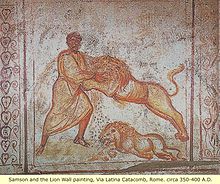
Samson and Lions, Rome 350-400 CE

Samson and Lions, Rome 350-400 CE

For those who despise history, and I know that there are many out there, I will warn you that I am beginning a long engagement with looking back through time at the narrative of where authority has rested at various points in time.  Originally I planned to do this in one, and then a couple, then three, and well I found our as I began wrestling through this I apparently had a lot to say, so to keep it in shorter bites this may be part 1 of many so read what you want, I will try to make it worth your while.

We often think of things in terms of secular and religious authority as if they are nice and discreet things, but that is a recent phenomenon. In reality, authority has rested in a couple key places at any one time but the distinction between secular and religious authority is not as defined as we might expect from our worldview.  Although the breakdown of the time periods is guided by Phyllis Tickle’s breakout in the Great Emergence, what follows are my own thoughts and reflections upon authority at each of these epochs.

Prior to 1,000 BCE, roughly 3,000 years ago authority rested heavily on a family’s ability to influence the course of actions for the realm around them.  For the Abrahamic faiths this is the time of Judges, when the people would rally around a great leader in the time of crisis and these men and at least one woman would provide stability for the rough confederation of tribes and families that would become Israel.  It is a time where these leaders and families would set up a shrine or worship sites but there is relatively little centralized authority.  Family is the central place where authority rests and there is a struggle internally between the tribes and externally with the people of Aram, Moab, Philistia, Cannan, and Ammon for land (the primary source of wealth) and power.  Much as in the song “Tradition” in Fiddler on the Roof a person’s role within the family and the practices, stories and traditions handed down from one generation to another shaped who they were and what they would become.

There was no centralized religious authority, there was no scripture, certainly there were stories but things were much more fluid than we often imagine.  Even in the remembered story of Israel we see that the memory is that of a chaotic time, even a brief survey of the book of Judges within the Bible points to this:

Joshua son of Nun, the servant of the LORD, died at the age of one hundred and ten years.  So they buried him within the bounds of his inheritance in Timnath-heres, in the hill country of Ephriam, north of Mount Gaash.  Moreover, that whole generation was gathered to their ancestors, and another generation grew up after them, who did not know the LORD or the work that he had done for Israel. Judges 2.8ff(NRSV)

Someone will say, but surely there would be the first five books of the bible and Joshua as scripture, and the short answer is no.  Even if one were to believe that Moses wrote the Penteteuch by himself and handed it on to Joshua and the people of Israel (which you would be hard pressed to find any reputable scholar of the Hebrew Scripture/Old Testament who does) even if that were the case, this was a time of very little literacy, very little true priestly/scribal organization, very little rule of law.  In a very real sense might did make right.  Take for example the story of Samson in Judges 13-16, one of those stories that many people have some acquaintance with, which is set within one of the times of crisis.  When I read the story Samson makes Conan the Barbarian look both ethical and smart, and yet the story tells of a person who judges Israel for 20 years, delivers them from the Philistines.  There is no centralized worship place or practice, families set up their own shrines, construct their own ‘idols’ or representations of who their god, gods, of God (depending on how one looks at it) are and if you need a good demonstration of this (this is one of many) take a look at Judges 17, the story of Micah and the Levite.

In a time of heavily decentralized authority, where family, clan and tribe hold the power and the wealth (i.e. land at this point) there is constant struggle and fighting to gain possession of more wealth, more power and to expand one’s familial authority.  The book of Judges for example does not remember this time fondly, it is a dark time where horrible things happen, where former allies are almost exterminated, where enemies are everywhere and as they looked around them and as they remembered their own story they began to see a different way.  As 1 Samuel remembers it:

Then all the elders of Israel gathered together and came to Samuel at Ramah, and said to him, “You are old and your sons do not follow in your ways; appoint for us, then, a king to govern us, like other nations” 1 Samuel 8.4f (NRSV)

And that is where we are heading next…

purple rose 01 by picsofflowers.blogspot.com