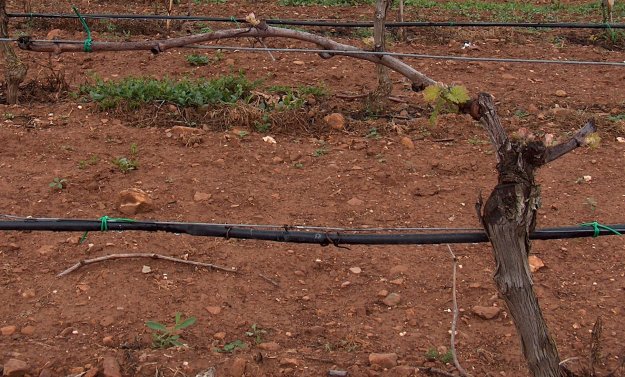
By Giancarlo Dessì – self-made (from archive of Istituto Professionale Statale per l’Agricoltura e l’Ambiente “Cettolini” di Cagliari), CC BY-SA 3.0, https://commons.wikimedia.org/w/index.php?curid=3859575
Ezekiel 15
1 The word of the LORD came to me: 2 O mortal, how does the wood of the vine surpass all other wood — the vine branch that is among the trees of the forest?
3 Is wood taken from it to make anything? Does one take a peg from it on which to hang any object?
4 It is put in the fire for fuel; when the fire has consumed both ends of it and the middle of it is charred, is it useful for anything?
5 When it was whole it was used for nothing; how much less — when the fire has consumed it, and it is charred — can it ever be used for anything!
6 Therefore thus says the Lord GOD: Like the wood of the vine among the trees of the forest, which I have given to the fire for fuel, so I will give up the inhabitants of Jerusalem. 7 I will set my face against them; although they escape from the fire, the fire shall still consume them; and you shall know that I am the LORD, when I set my face against them. 8 And I will make the land desolate, because they have acted faithlessly, says the Lord GOD.
One of the frequently used images in scripture as an allegory for Israel is the grapevine or the vineyard. In Psalm 80 Israel is the vine brought out of Egypt that God clears a place for, and it grows to fill the land under God’s protection, until God removes the walls that protect it from the wild animals (Psalm 80: 8-13). Isaiah’s parable of the unfruitful vineyard tells of a vineyard on a fertile hill that God does everything for, and it produces wild grapes where it should have yielded cultivated grapes (Isaiah 5: 1-7). Jeremiah uses similar imagery when he states:
Yet I planted you as a choice vine, from the purest stock. How then did you turn degenerate and become a wild vine? Jeremiah 2: 21[1]
According to Tova Ganzel Ezekiel uses allegories and metaphors more often than any other prophet. (Ganzel, 2020, p. 130) Ezekiel takes the familiar allegorical image of the grapevine or the vineyard and uses it in a unique way. Grapevines are useful for the production of grapes, and that is the focal point of most of the uses of the grapevine in the scriptures. Here Ezekiel assumes the vine is unfruitful and asks is it good for anything else?
The initial statement from the LORD is translated in the NRSV (and most other translations) as a comparative statement between the wood of the vine and the wood of the other trees, but in Hebrew it is not a comparison. Daniel Block translates this, “What becomes of the wood of the grapevine?” (Block, 1997, p. 453) The wood of the vine is not strong enough to build anything, even a peg. If it does not produce fruit it is only suitable for burning and once it is burned it is even less valuable. Allegorically if Israel is unfruitful and unusable before undergoing judgment, how much less useful is it once it has undergone these trials. The allegory is made specific once the interpretation of the image is given in verses six through eight. Jerusalem is an unproductive vine that is only good for the fire and therefore the LORD will set God’s face against them and make the land desolate because the vine is fruitless. The divine act of choosing Israel and placing it in the promised land is no replacement for Israel being fruitful in the place where they have been planted.
In our world we often use the language of rights without the discussion of responsibilities. Within both the Jewish and Christian worldview election (rights and benefits) are always connected with covenant responsibilities (obedience to God and one’s responsibilities towards one’s neighbors and the vulnerable in society). The fiber that the people of faith are made of, to use Ezekiel’s imagery, are not useful if they are fruitless, whether they are the original vine or the later grafts onto the vine.
[1] See also Hosea 9:10, 10:1; Ezekiel 19: 10-14.
 Sign of the Rose