Tag Archives: Ezekiel

The Book of Ezekiel

A tetramorph cherub, in Eastern Orthodox iconography 16th Century

This is a link to my reflections journeying through the Book of Ezekiel in 2024-2025.

Introduction to the Prophet Ezekiel

Ezekiel 1 Ezekiel’s Experience of the Divine Chariot in Exile

Ezekiel 2 A Prophet’s Call and a Message to Be Consumed

Ezekiel 3 A Consumed Word, a Commissioned Sentinel, and a Prophet Silenced

Ezekiel 4 The Siege of Jerusalem Portrayed

Ezekiel 5 An Image of Jerusalem’s Destruction

Ezekiel 6 Judgment Against the Land of Israel

Ezekiel 7 A Three Alarm Crisis

Ezekiel 8 The Corruption of the Temple and the People

Ezekiel 9 The Sealing of the Righteous and the Judgment of the City

Ezekiel 10 God Prepares to Leave the Temple

Ezekiel 11 Judgment on Jerusalem and Hope for the Exiles

Ezekiel 12 Judgment on the Leaders and People of Jerusalem

Ezekiel 13 Against False Prophets

Reflection: A Split in the Identity of God

Ezekiel 14 Unfaithful Elders, Deceived Prophets, and Representative Righteous Ones

Ezekiel 15 The Unfruitful Vine

Ezekiel 16 Jerusalem as an Unfaithful Bride

Ezekiel 17 A Parable of Two Great Eagles, Two Trees, and a Fickle Vine

Ezekiel 18 Life for the Righteous Ones

Ezekiel 19 A Lamentation for the Princes of Israel: Violent Lions and a Lofty Branch

Ezekiel 20 Retelling Israel’s Story in a Negative Light

Ezekiel 21 God’s Sword Against Judah

The Babylonian Empire

Ezekiel 22 A Bloody City, Impure Ore, and No One to Stand in the Breach

Ezekiel 23 Oholah and Oholibah: The Metaphor of Unfaithfulness Revisited

Ezekiel 24 The Painful Judgment of God

Ezekiel 25 Against Ammon, Moab, Edom, and the Philistines

Ezekiel 26 Against Tyre

Ezekiel 27 A Satirical Lament for Tyre

Ezekiel 28 Against the Rulers of Tyre, Sidon, and a Renewed Hope for Israel

Egypt’s Role in the Geopolitics of Israel/Judah During the Assyrian and Babylonian Empires

Military Actions as Economic Decisions in the Ancient World

Ezekiel 29 Against the Pharoah of Egypt

Ezekiel 30 Oracles Against Egypt Continued

Ezekiel 31Egypt as a Mighty Tree Cut Down

Ezekiel 32 Concluding the Oracles Against Egypt

Ezekiel 33 The Beginning of Ezekiel’s Role after Jerusalem’s Fall

Ezekiel 34 Unfaithful and Faithful Shepherd

Ezekiel 35 Judgment on Edom and Hope for Israel

Ezekiel 36 A Healed Land for a People Renewed Heart and Spirit

Ezekiel 37 The Valley of the Dry Bones and a Sign of Reunification

Ezekiel 38 The Forces of Gog and the Divine Warrior

Ezekiel 39 The Disposal of Gog and the Glorification of the LORD

Ezekiel 40 A New Temple for a New Beginning

Ezekiel 41 The Center of the New Temple

Ezekiel 42 Concluding the Survey of the New Temple

Ezekiel 43 The Presence of the LORD Returns and the New Altar

Ezekiel 44 The Sealed Gate, the Levites, and the Priests

Ezekiel 45 Land, Justice, Sacrifices, and the Passover

Ezekiel 46 Daily, Weekly, and Monthly Sacrifices, Land, and Sanctified Food

Ezekiel 47 The Waters of Life and the Boundaries of a Renewed Israel

Ezekiel 48 A Reconstituted Land, Tribes, and a New City

Resources on the Book of Ezekiel

Reflections on the Journey Through Ezekiel

Reflections on the Journey through Ezekiel

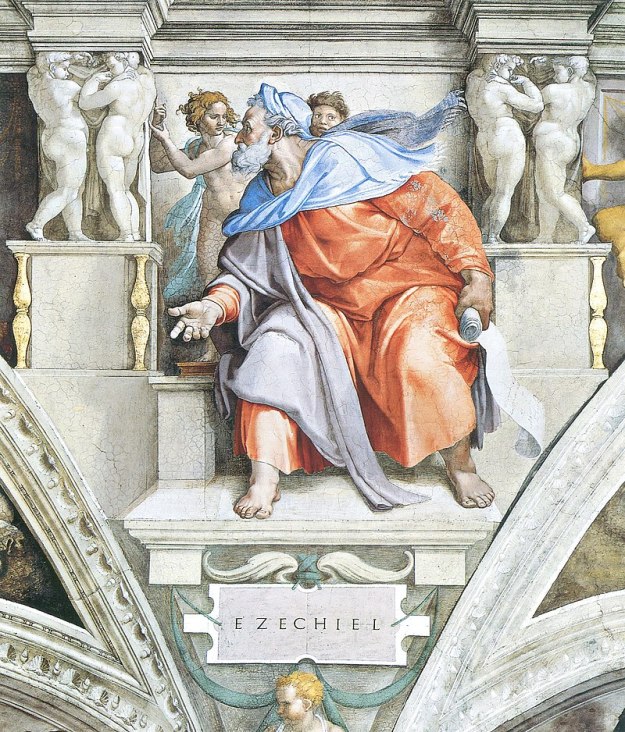
Ezekiel as depicted by Michelangelo on the Sistene Chapel ceiling

I am glad to be coming to the end of this long journey with the prophet Ezekiel and I appreciate the work of scholars who make this book in particular their life work. Working through both Jeremiah and Ezekiel has given me a much richer view of the time leading up to and after the Babylonian exile. I have a much richer view of the history, technology, and culture of the time but also of the way this people of Israel and these prophets had to deconstruct and reconstruct their view of the world. Prior to the exile, for Judah, the Davidic king, the temple of Solomon, the city of Jerusalem (or Zion), and the land were all central images for the faith of the people and Babylon shattered all of these. Ezekiel as a prophet of primarily written word due to communicating to Jerusalem from the exile in Babylon, although many of his visions, sign acts, and proclamations were likely done for a local audience first, is a part of the transition of the people of Judah from being the people of the land, temple and king to being a people of the book. Ezekiel’s perspectives are very different, even from his elder contemporary Jeremiah and there was a lot I gained from this protracted study.

Jeremiah has often been called the ‘wailing prophet’ and his dialogues with God are often honest and pathos filled while Ezekiel only protests when God asks him to do something that offends his priestly sensibilities. In this book obedience to God is a central idea and Ezekiel is a contrast to a disobedient and rebellious people. I do think both Jeremiah and Ezekiel illustrate different aspects of a faithful relationship to the God of Israel and especially for an independently minded person like myself in an independent and individualistic culture Ezekiel’s obedience was both uncomfortable but also provided a necessary correction for me.

 Ezekiel’s priestly perspective on holiness was also an uncomfortable but necessary corrective for me. Within many Protestant traditions the focus on the intimacy of the relationship with God or the closeness of God has obscured the dangerous and holy God that Ezekiel knows. This holiness in Ezekiel impacts everything from the design of the new temple to God’s reaction to the disobedience of the people. God’s holiness and the careless actions of idolatry and abomination committed by the people which defile this holiness form Ezekiel’s justification (or God’s justification in Ezekiel) for the death and suffering caused by the Babylonian destruction of Jerusalem and the exile of the people. This way of thinking and believing enabled Ezekiel and those who heard and passed on his words to make sense of the disorienting reality of their homes and beliefs being shattered by the armies of Chaldeans and their allies.

Ezekiel’s imagery can be offensive. The culture that I live in can occasionally silence offensive voices, especially in academic circles, and promote offensive voices in other contexts. Sometimes the offensive message, as in Ezekiel, can point to an uncomfortable truth. Would there be different images or words we would utilize in our context, almost certainly, but there is a reason these words have been transmitted for more than two millennia (often by hand copying the words). I think in general much of the church’s response to Ezekiel has been either embarrassment or neglect. Ezekiel may never be our favorite messenger, but I am thankful that I have taken this time to reflect on his strange and uncomfortable messages.

There were several times as I was working through Ezekiel that I noted his influence on Revelation. Even when I worked through Revelation in 2018, I wished that I could have worked through Ezekiel and Daniel first, but now the echoes of Ezekiel in Revelation are much clearer. Ezekiel may not be at the center of the cannon within the cannon for the Lutheran tradition I am a part of, but I am beginning to have a fuller grasp of the breadth, depth and width of the scriptures which have been handed on to us and the ways in which the law, the prophets, the poetry and narratives of the Hebrew Scriptures enrich and inform the New Testament and ultimately my faith.

This is the thirteenth book I have walked through, and it was one of the hardest. My faith and life were enriched by this journey, and I can appreciate this book in ways I didn’t before. Next, I will be returning to Psalms, now for Psalm 101-110, before selecting another book to begin. Back in 2022 I mapped out the journey through 1 Kings, Joel, and Ezekiel with ten psalms surrounding each reading and I am finally approaching the final leg of this group of texts from the Hebrew Scriptures.

Resources on the Book of Ezekiel

This is a list of the major sources I used on this fourteen-month journey through the book of Ezekiel. I selected each resource for a reason and below is a brief evaluation of each source. It is not a comprehensive evaluation of the literature on Ezekiel, but it may be a useful place to start for those interested in learning more about this book of scripture. Ezekiel is a very difficult book to approach from a scholarly perspective and yet I can now see the way some of the imagery of Ezekiel has influenced both later prophets and New Testament authors.

Version 1.0.0

Block, Daniel I. The Book of Ezekiel: Chapters 1-24. (New International Commentary on the Old Testament series) Grand Rapids, MI: William B. Eerdmans Publishing Company, 1997.

_______. The Book of Ezekiel: Chapters 25-48. (New International Commentary on the Old Testament series) Grand Rapids, MI: William B. Eerdmans Publishing Company, 1998.

Daniel Block’s massive two volume commentary on the prophet Ezekiel is probably more information than the casual reader will probably ever want, but it ended up being the source I referenced the most throughout this study. Daniel Block is both a phenomenal interpreter of the Hebrew text and very familiar with both the literature of the surrounding world and the archeological/historical context of the period around the Babylonian exile. I typically try to consult at least one textual commentary that pays attention to translational issues and especially with a text like Ezekiel that is both hard to translate due to unusual words and gaps. This work was highly valuable. Block and a lot of readers of Ezekiel tend to lean a little farther into source criticism that I would prefer, but Ezekiel’s history of interpretation is heavily influenced by that period of Old Testament scholarship.

Darr, Katheryn Pfisterer. “The Book of Ezekiel.” In The New Interpreter’s Bible. (New International Commentary on the Old Testament series) Grand Rapids, MI: William B. Eerdmans Publishing Company, 1997.Volume VI. Nashville, Abingdon Press, 1994.

The NIB is a solid all-around commentary on the entire bible and apocrypha. It is designed for pastors and those leading in congregations, so it does not normally engage the textual issues as deeply as the NICOT or Anchor Bible commentaries. Katheryn Pfisterer Darr does a good job of providing textual notes when they are important but remains focused on making Ezekiel intelligible to a reader with some education in the text, but who may not want to wade too deeply into the waters of this rarely utilized book in Christian circles. There are times where you can tell that the author is uncomfortable with Ezekiel’s language as a feminist scholar, but she does a good job of remaining attentive to the text even when the language or content becomes challenging.

Davis, Ellen F. Swallowing the Scroll: Textuality and the Dynamics of Discourse in Ezekiel’s Prophecy. Sheffield, England: Almond Press, 1989.

Ellen Davis is one of the scholars who I attempt to read anything that they write. This is her doctoral dissertation, and it really focuses on the initial call of Ezekiel and his position as a composer of a written text. I found this text particularly helpful in the early chapters of Ezekiel as I was trying to understand this strange prophet. Most readers are not going to pick up a doctoral dissertation, no matter how well written, but Ellen Davis is a gifted author, and you can see in this early work how she will develop as a patient and generous reader of scripture.

Version 1.0.0

Klein, Ralph W. Ezekiel: The Prophet and His Message. Clemson, SC: University of South Carolina Press, 1988. Reprinted by Minneapolis: Fortress Press, 2024.

Ralph Klien is a Lutheran Old Testament scholar and when I picked this up, I thought it was a new work. I quickly realized that it was a reprint of a work published in 1988 that dealt with Ezekiel in a more introductory manner. This may have been more useful if I was not reading it in conjunction with several other authors discussing Ezekiel, but it was the source I referenced the least once I read through it.


Ganzel, Tova. Ezekiel: From Destruction to Restoration. Maggid Studies in Tanakh. Jerusalem: Maggid Books, 2020.

When I can I attempt to utilize a Jewish scholar when reading the scriptures that we share. The Maggid Studies I have utilized in the past have been approachable but also provide a window into perspectives that most Christian scholars may not explore. This volume was also readable and had some insightful comments.

Ezekiel 48 A Reconstituted Land, Tribes, and City

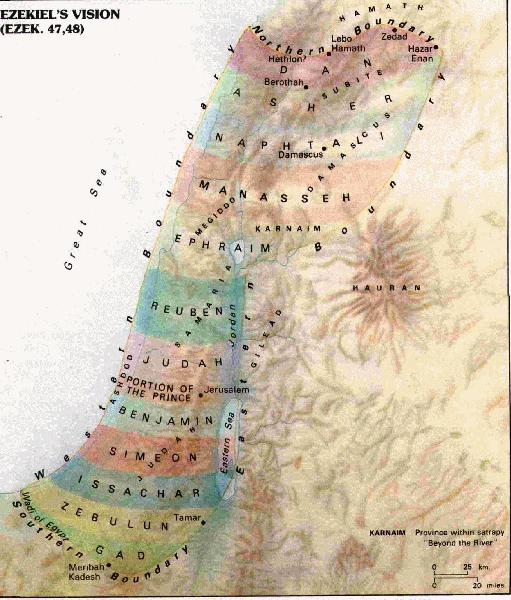
Ezekiel 48: 1-29 The Tribes and the Territory

1These are the names of the tribes: Beginning at the northern border, on the Hethlon road, from Lebo-hamath, as far as Hazar- enon (which is on the border of Damascus, with Hamath to the north), and extending from the east side to the west, Dan, one portion. 2Adjoining the territory of Dan, from the east side to the west, Asher, one portion. 3Adjoining the territory of Asher, from the east side to the west, Naphtali, one portion. 4Adjoining the territory of Naphtali, from the east side to the west, Manasseh, one portion. 5Adjoining the territory of Manasseh, from the east side to the west, Ephraim, one portion. 6Adjoining the territory of Ephraim, from the east side to the west, Reuben, one portion. 7Adjoining the territory of Reuben, from the east side to the west, Judah, one portion.
8Adjoining the territory of Judah, from the east side to the west, shall be the portion that you shall set apart, twenty-five thousand cubits in width, and in length equal to one of the tribal portions, from the east side to the west, with the sanctuary in the middle of it. 9The portion that you shall set apart for the LORD shall be twenty-five thousand cubits in length, and twenty thousand in width. 10These shall be the allotments of the holy portion: the priests shall have an allotment measuring twenty- five thousand cubits on the northern side, ten thousand cubits in width on the western side, ten thousand in width on the eastern side, and twenty-five thousand in length on the southern side, with the sanctuary of the LORD in the middle of it. 11This shall be for the consecrated priests, the descendants of Zadok, who kept my charge, who did not go astray when the people of Israel went astray, as the Levites did. 12It shall belong to them as a special portion from the holy portion of the land, a most holy place, adjoining the territory of the Levites. 13Alongside the territory of the priests, the Levites shall have an allotment twenty-five thousand cubits in length and ten thousand in width. The whole length shall be twenty-five thousand cubits and the width twenty thousand. 14They shall not sell or exchange any of it; they shall not transfer this choice portion of the land, for it is holy to the LORD.
15The remainder, five thousand cubits in width and twenty-five thousand in length, shall be for ordinary use for the city, for dwellings and for open country. In the middle of it shall be the city; 16and these shall be its dimensions: the north side four thousand five hundred cubits, the south side four thousand five hundred, the east side four thousand five hundred, and the west side four thousand five hundred. 17The city shall have open land: on the north two hundred fifty cubits, on the south two hundred fifty, on the east two hundred fifty, on the west two hundred fifty. 18The remainder of the length alongside the holy portion shall be ten thousand cubits to the east, and ten thousand to the west, and it shall be alongside the holy portion. Its produce shall be food for the workers of the city. 19The workers of the city, from all the tribes of Israel, shall cultivate it. 20The whole portion that you shall set apart shall be twenty-five thousand cubits square, that is, the holy portion together with the property of the city.
21What remains on both sides of the holy portion and of the property of the city shall belong to the prince. Extending from the twenty-five thousand cubits of the holy portion to the east border, and westward from the twenty-five thousand cubits to the west border, parallel to the tribal portions, it shall belong to the prince. The holy portion with the sanctuary of the temple in the middle of it, 22and the property of the Levites and of the city, shall be in the middle of that which belongs to the prince. The portion of the prince shall lie between the territory of Judah and the territory of Benjamin.
23As for the rest of the tribes: from the east side to the west, Benjamin, one portion. 24Adjoining the territory of Benjamin, from the east side to the west, Simeon, one portion. 25Adjoining the territory of Simeon, from the east side to the west, Issachar, one portion. 26Adjoining the territory of Issachar, from the east side to the west, Zebulun, one portion. 27Adjoining the territory of Zebulun, from the east side to the west, Gad, one portion. 28And adjoining the territory of Gad to the south, the boundary shall run from Tamar to the waters of Meribath- kadesh, from there along the Wadi of Egypt to the Great Sea. 29This is the land that you shall allot as an inheritance among the tribes of Israel, and these are their portions, says the Lord GOD.

As we come to the end of Ezekiel’s final vision recorded in the book of Ezekiel, we are given a vision of a perfectly ordered arrangement of the tribes surrounding a perfectly ordered temple and city. Ezekiel takes us back to the memory of the tribal order of Israel prior to the monarchy. Solomon had centralized much of the power in Israel[1] and later kings likely continued to centralize power. Yet, for Ezekiel the nasi (prince) does not exercise the same type of authority as previous monarchs. Reestablishing the twelve tribes in the land is a regathering of both the exiles in Babylon and Egypt from Judah, but also a reconstitution of the northern tribes which have been separated from Judah for almost four centuries and have were scattered among the Assyrian empire two and a half centuries ago. Any close look at a topographical map will cause most readers to realize that, in Daniel Block’s words, we are looking at, “a cartographic painting by an artist with a particular theological agenda.” (Block, 1998, p. 723)

The positions of the tribe do not match the original assignments in Joshua[2] or the tribal areas reflected throughout the Deuteronomic history. The territory east of the Jordan, which Reuben, Gad, and one half of Manesseh settled in is not a part of the territory of Israel. Issachar, Zebulun, and Gad are now in the south instead of the north, and even in this equalizing scheme of granting each tribe one portion, there is a reality of assigning Judah and Benjamin, the former royal tribes, a position closest to the temple and city while the tribes descended from Zilpah and Bilhah occupy the farthest distance from the temple. The breadth of the land also is significantly wider in the north than in the south but since there are no dimensions given for the portions that may be accounted for by making the northern portions narrower. The biggest problem with this map is topographical. Each tribal boundary crosses the coastal plains, the northern spine and the Jordan rift valley and travel north and south along those natural boundaries is easier than east and west inside the territory. Ezekiel never mentions the topography of this recreated Israel so in his mind the mountains may be made low and the low places raised up, but this is never alluded to in his visions.

Between the tribes in the north and the tribes in the south is the set aside area for the prince, the priests and Levites, and especially in Ezekiel’s view the temple. This area was previously discussed in Ezekiel 45:1-8, and this is another example of Ezekiel discussing an item at a previous point and then revisiting it in a later portion of the text. For Ezekiel this perfectly ordered land is centered on the temple and has an equitable distribution of land for each of the reconstituted tribes. Pragmatic difficulties are set aside as Ezekiel discloses this vision of a renewed land and people.

Ezekiel 48: 30-35 The City Named the LORD is There


30These shall be the exits of the city: On the north side, which is to be four thousand five hundred cubits by measure, 31three gates, the gate of Reuben, the gate of Judah, and the gate of Levi, the gates of the city being named after the tribes of Israel. 32On the east side, which is to be four thousand five hundred cubits, three gates, the gate of Joseph, the gate of Benjamin, and the gate of Dan. 33On the south side, which is to be four thousand five hundred cubits by measure, three gates, the gate of Simeon, the gate of Issachar, and the gate of Zebulun. 34On the west side, which is to be four thousand five hundred cubits, three gates, the gate of Gad, the gate of Asher, and the gate of Naphtali. 35The circumference of the city shall be eighteen thousand cubits. And the name of the city from that time on shall be, The LORD is There.

Ancient cities are tiny in comparison to modern cities since the effort of creating a wall to protect a city is expensive. This newly created city is roughly one and a half miles on each of its four sides. Ancient walled cities normally had one or a small number of gates that are easier to defend and a twelve gated city is unusual, although the Jerusalem of Ezekiel’s youth had at least six. (Block, 1998, p. 736) This perfectly square city with a gate named for each of the twelve tribes fits within Ezekiel’s scheme and if the city is a place where ‘the LORD is there’ the defensive needs of a walled city are less important.

The new city name ‘YHWH samma’ (the LORD is there) is phonetically similar to Jerusalayim, but there is more than a simple renaming of the city occurring in this image. (NIB VI: 1607) This city placed in the center of the tribes is no longer the city of David, or the capital of Judah, instead the twelve gates indicate it is the city of all the people. The names of the tribes are organized by their mother, with the tribes descended from Leah comprising the north and south gates, Rachel’s two children are on the west, Zilpah’s two children are on the east, and Bilhah’s two children fill in the remaining slots on east and west. It is a perfectly square city near the perfectly ordered temple in the center of a perfectly ordered land. But centrally, the city like the temple is a place where the LORD is there.


[1] 1 Kings 4: 1-19.

[2] Joshua 13-19.

Ezekiel 47 The Waters of Life and the Boundaries of a Renewed Israel

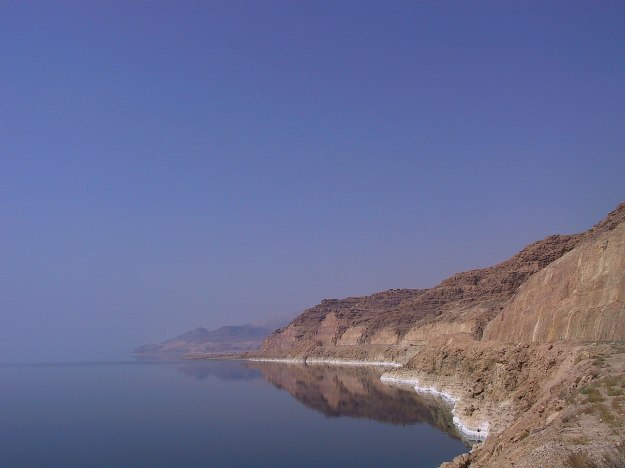
Dead Sea Jordanian Shore Showing Salt Deposits Left Behind By Falling Water Levels By Alexandermcnabb – Own work, CC BY-SA 4.0, https://commons.wikimedia.org/w/index.php?curid=74858999

Ezekiel 47: 1-12 The Renewing Waters from the Temple

1Then he brought me back to the entrance of the temple; there, water was flowing from below the threshold of the temple toward the east (for the temple faced east); and the water was flowing down from below the south end of the threshold of the temple, south of the altar. 2Then he brought me out by way of the north gate, and led me around on the outside to the outer gate that faces toward the east; and the water was coming out on the south side.
3Going on eastward with a cord in his hand, the man measured one thousand cubits, and then led me through the water; and it was ankle- deep. 4Again he measured one thousand, and led me through the water; and it was knee-deep. Again he measured one thousand, and led me through the water; and it was up to the waist. 5Again he measured one thousand, and it was a river that I could not cross, for the water had risen; it was deep enough to swim in, a river that could not be crossed. 6He said to me, “Mortal, have you seen this?”
Then he led me back along the bank of the river. 7As I came back, I saw on the bank of the river a great many trees on the one side and on the other. 8He said to me, “This water flows toward the eastern region and goes down into the Arabah; and when it enters the sea, the sea of stagnant waters, the water will become fresh. 9Wherever the river goes, every living creature that swarms will live, and there will be very many fish, once these waters reach there. It will become fresh; and everything will live where the river goes. 10People will stand fishing beside the sea from En-gedi to En-eglaim; it will be a place for the spreading of nets; its fish will be of a great many kinds, like the fish of the Great Sea. 11But its swamps and marshes will not become fresh; they are to be left for salt. 12On the banks, on both sides of the river, there will grow all kinds of trees for food. Their leaves will not wither nor their fruit fail, but they will bear fresh fruit every month, because the water for them flows from the sanctuary. Their fruit will be for food, and their leaves for healing.

Ezekiel’s vision of a renewed society starts with the temple, but then from the temple it flows out to a renewed land and people. This vision of a life-giving stream that flows from the temple may originate in the imagery of the Garden of Eden in Genesis 2:10-14 where a river flows from through the garden providing life for both the flora and fauna of creation. This imagery is picked up in Psalm 46:4 and centered in Zion when that poet writes: “There is a river whose streams make glad the city of God, the holy habitation of the Most High.” This vision of Ezekiel adopts this stream flowing out of Zion and fixes its source as the holy habitation of the Most High, specifically the threshold of the temple becomes the source of this bubbling spring of renewing waters which bring life to dead waters and desiccated lands. A renewed temple where God’s presence dwells is the source of life for the renewed land.

This image of comfort is one of the portions of Ezekiel that would have the greatest reach in later years, but for a people who had been through the destruction of their home and their hope was a potent vision. As Daniel Block can state:

This marvelous picture of renewal would have stirred the heart of any true Israelite, especially one who had lived through the desolation of Judah and spent many years in exile. (Block, 1998, p. 690)

The people of Judah and Israel have no reason to believe that they can be recreated as a people unless the LORD acts in new and creative ways. Here Ezekiel joins with Jeremiah, Isaiah, and other prophets in viewing a land recreated by the God of Israel. This impossible stream which in the span of a little more than a mile and a quarter moves from a trickling flow bubbling up from the foundation to a stream too deep to wade across defies everything that water should be able to do, and yet this impossible stream can only occur within the world made possible by their God.

Daniel Block is correct from a logical point of view that everything about this stream is unrealistic: streams do not grow from a bubbling source to water too deep to cross without tributaries, nor do they come from temple thresholds or flow uphill. Freshwater when it encounters water that is too salty for life becomes fouled rather than renewing the larger body of water. (Block, 1998, pp. 700-701) Yet, the impossibility of this stream is part of the imaginative power of this image, for this is the image of a God who is doing a new thing and making streams of water to flow in the desert.[1] These miraculous waters which bubble up from the temple threshold and rapidly accumulate depth and volume as they proceed away from their source bringing vegetation to the wastelands and renewing the waters of the Dead Sea can only be an act of the creating God. The path from the temple to the Arabah would require the waters to pass over or through the Mount of Olives and a series of valleys and mountain ranges. Perhaps Ezekiel imagines a scene like Zechariah 14: 4 where the Mount of Olives is split in two which would allow the river to proceed through that space, but that is not explicit in this brief image.

The Dead Sea is the lowest land elevation on earth and its salinity is nine and a half times higher than the ocean. These waters are unable to support life and although salt is a valuable commodity in the ancient world, this place is known for its absence of life. The vision shows the image of the sea and surrounding land revitalized to be a place where fishermen gather food, and the land becomes fruitful. Yet, the marshes[2] still provide valuable salt that can be harvested by the people for preservation, seasoning, and sale.[3] The geographical markers of En-gedi and En-eglaim[4] form a “topographical merismus” (Block, 1998, p. 695) indicating the eastern and western borders of the area and indicating that the entire region is renewed.

This section of Ezekiel resonates with Genesis and the Psalms, but this vision of Ezekiel will have echoes in several other portions of scripture. Among the prophets both Joel 3:18 and Zechariah 14:8 will make a passing reference to water flowing out of the temple or Jerusalem and may be influenced by Ezekiel. In John’s gospel, Jesus will paraphrase scripture saying that, “Out of the believer’s heart shall flow rivers of living water.”[5] It is likely that with John’s imagery that utilizes Jesus as the temple that here Jesus may envision the community of faith as the new temple which these living waters flow out of and may be alluding to Ezekiel 47. The most direct New Testament reference is Revelation 22:1-2 where the water of life flows out of the New Jerusalem and develops Ezekiel’s imagery of trees that continually bear fruit and whose leaves are medicinal. One significant difference between Ezekiel’s and Revelation’s imagery is that in Revelation the living waters, fruit and healing leaves are for the healing of the nations but in Ezekiel there is no indication of any transformation outside of Israel. (NIB VI:1599) Ezekiel’s vision of a renewed temple, a renewed land, and a renewed people emerging out of the devastation of the exile was probably as amazing as this impossible stream that he narrates. Yet, this image of this stream of living water which may have originated in the Garden of Eden will flow through the scriptures to the ultimate chapter of Revelation as God work of healing and renewal reaches its culmination.

Ezekiel 47: 13-23 The Boundaries of the Land

13Thus says the Lord GOD: These are the boundaries by which you shall divide the land for inheritance among the twelve tribes of Israel. Joseph shall have two portions. 14You shall divide it equally; I swore to give it to your ancestors, and this land shall fall to you as your inheritance.
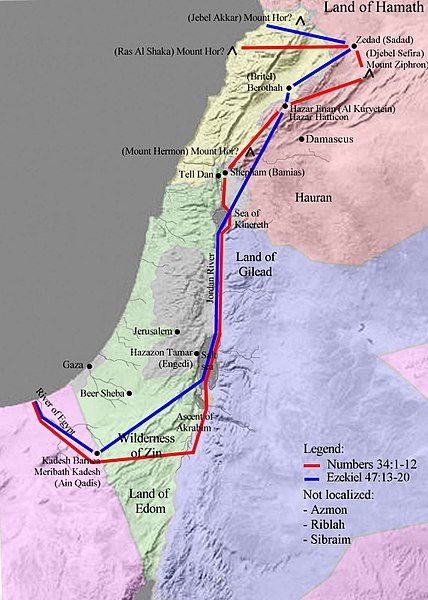
15This shall be the boundary of the land: On the north side, from the Great Sea by way of Hethlon to Lebo-hamath, and on to Zedad, 16Berothah, Sibraim (which lies between the border of Damascus and the border of Hamath), as far as Hazer-hatticon, which is on the border of Hauran. 17So the boundary shall run from the sea to Hazar-enon, which is north of the border of Damascus, with the border of Hamath to the north. This shall be the north side.
18On the east side, between Hauran and Damascus; along the Jordan between Gilead and the land of Israel; to the eastern sea and as far as Tamar. This shall be the east side.
19On the south side, it shall run from Tamar as far as the waters of Meribath-kadesh, from there along the Wadi of Egypt to the Great Sea. This shall be the south side.
20On the west side, the Great Sea shall be the boundary to a point opposite Lebo-hamath. This shall be the west side.
21So you shall divide this land among you according to the tribes of Israel. 22You shall allot it as an inheritance for yourselves and for the aliens who reside among you and have begotten children among you. They shall be to you as citizens of Israel; with you they shall be allotted an inheritance among the tribes of Israel. 23In whatever tribe aliens reside, there you shall assign them their inheritance, says the Lord GOD.

Map of the Land of Israel as defined in Numbers 34 and Ezekiel 47 by Emmanuelm 21 October 2007. Shared under CC 3.0.

For most readers this section describing the territory of the renewed Israel is a place where a picture is worth one thousand words. Yet, there is an important caveat that any pictorial representation of Ezekiel’s map of Israel is an educated guess because many of the place, especially along the northern border cannot be identified with any certainty. Ezekiel does generally follow the Mosaic description of the land in Numbers 34: 3-12, even though the order of describing the boundaries is different (SWNE in Numbers, NESW in Ezekiel). Like Numbers, Ezekiel excludes the Transjordanian originally occupied by Gad, Reuben and one half of the tribe of Manasseh and the holy land stops at the Jordan. (Block, 1998, p. 716) The northern boundary of Lebo-hamath[6] to the southern boundary of the Wadi of Egypt is the northern and southern border of Solomon’s Kingdom (1 Kings 8:65) and this recreated land for the people recreates Israel at its peak.

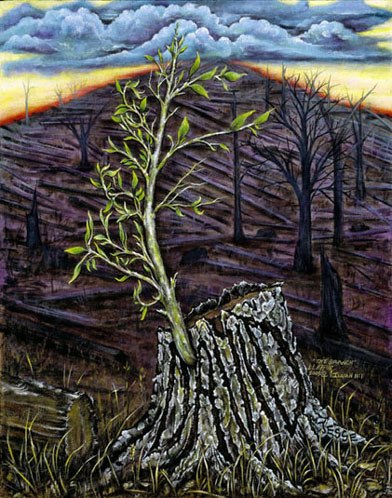
The reconstruction of the land and people of Israel is as incredible as the stream that flows from the temple, crosses mountains, swells in depth, and renews the Arabah. At this point Northern Israel, sometimes called Samaria or Ephraim, has been scattered throughout the former Assyrian empire for two and a half centuries and has been separated from Judah for almost four centuries by the time the first remnants of Judah return to Jerusalem in the time of Cyrus the Great. Even Judah has been brought in exile to Babylon with some portions of the population fleeing to Egypt and others likely scattered across the empire. The recreation of Israel is not a creation ex nihlo[7] but it is a resurrection of a people long imagined as a dead stump, leaderless and lost.

The loss and dispersal of the people may be the reason that there is a space for the gerim, the “resident aliens” to be incorporated into the people and the tribes. Leviticus 19: 33-34 prohibits the resident alien from being oppressed and the people are commanded to treat these aliens like they treat themselves in remembrance of their time as aliens in Egypt. We don’t know how these people were treated throughout the history of Israel, but even Ezekiel seems to have viewed them through the lens of Leviticus 19. In Ezekiel 14:7 these aliens are held to the same standard as the people of Judah in relation to idol worship and in Ezekiel 22 they are listed with the vulnerable members of society: the widows and orphans, the poor and needy who are exploited by the residents and leaders of the bloody city.[8] As Daniel Block remarks, Ezekiel takes the fringe territories of Numbers 35: 13-15 and replaces them with a fringe people. (Block, 1998, p. 717) With the loss of connection between the tribes and the loss of population due to both war and scattering, these aliens now become citizens owning land in the tribes that are now their tribe and whose inheritance they share. They become grafted onto the vine of Israel and are a new growth among the recreated people.


[1] Isaiah 43:19.

[2] Daniel Block indicates this likely refers to the Lashon, a peninsula jutting into the sea from the eastern shore that has shallow waters that are not deep enough for fish to live in. (Block, 1998, p. 695)

[3] Preservation was the primary usage for salt in a world prior to refrigeration. Meats and fishes were packed in salt to prevent their spoilage. Salt was a heavily traded commodity in the ancient world and was so essential that our word ‘salary’ evolved from the Roman soldier’s allowance to buy salt.

[4] The location of En-eglaim is less certain, (NIB VI:1596) but most scholars believe Ezekiel intends to indicate opposite ends of the region of the Dead Sea.

[5] John 7:38.

[6] Jeroboam II also restores this border for Northern Israel in 2 Kings 14:25, yet this is during the divided kingdom but Lebo-hamath seem to be the northern edge of the territory Israel manages to secure during its history.

[7] Creation from nothing.

[8] Ezekiel 22:7, 29.

Ezekiel 42 Concluding the Survey of the New Temple

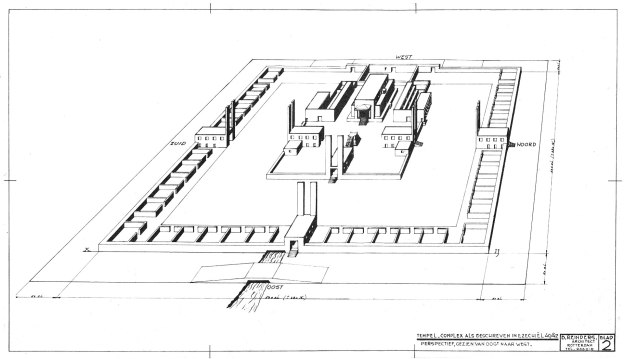
Schematic of Ezekiel’s Temple drawn by Dutch architect Bartelmeüs Reinders, Sr. (1893–1979) released into public domain by artist.

Ezekiel 42:1-14

1 Then he led me out into the outer court, toward the north, and he brought me to the chambers that were opposite the temple yard and opposite the building on the north. 2 The length of the building that was on the north side was one hundred cubits, and the width fifty cubits. 3 Across the twenty cubits that belonged to the inner court, and facing the pavement that belonged to the outer court, the chambers rose gallery by gallery in three stories. 4 In front of the chambers was a passage on the inner side, ten cubits wide and one hundred cubits deep, and its entrances were on the north. 5 Now the upper chambers were narrower, for the galleries took more away from them than from the lower and middle chambers in the building. 6 For they were in three stories, and they had no pillars like the pillars of the outer court; for this reason the upper chambers were set back from the ground more than the lower and the middle ones. 7 There was a wall outside parallel to the chambers, toward the outer court, opposite the chambers, fifty cubits long. 8 For the chambers on the outer court were fifty cubits long, while those opposite the temple were one hundred cubits long. 9 At the foot of these chambers ran a passage that one entered from the east in order to enter them from the outer court. 10 The width of the passage was fixed by the wall of the court.

On the south also, opposite the vacant area and opposite the building, there were chambers 11 with a passage in front of them; they were similar to the chambers on the north, of the same length and width, with the same exits and arrangements and doors. 12 So the entrances of the chambers to the south were entered through the entrance at the head of the corresponding passage, from the east, along the matching wall.

13 Then he said to me, “The north chambers and the south chambers opposite the vacant area are the holy chambers, where the priests who approach the LORD shall eat the most holy offerings; there they shall deposit the most holy offerings — the grain offering, the sin offering, and the guilt offering — for the place is holy. 14 When the priests enter the holy place, they shall not go out of it into the outer court without laying there the vestments in which they minister, for these are holy; they shall put on other garments before they go near to the area open to the people.”

Holy space and holy things are important in the life of a people whose life is centered around a holy God. Holiness is an under appreciated concept in many Christians, particularly in protestant traditions. For many Christians we expect the intimacy of God drawing close to us in Christ and the Spirit without appreciating the terrifying nature of God’s power and holiness. Most of the early followers of Jesus and even the Reformers understood the mystery of God’s was, to use the words of Rudolph Otto, were both fascinating (fascinans) and terrifying (tremendum). There was a deep understanding for reformers like Martin Luther of their own unworthiness to be in the holy presence of God, but in a world where intimacy has eclipsed holiness Ezekiel’s visions of holy space and holy vestments seem strange and alien to many modern readers.

Throughout the bible there is a concern about holiness and its opposite impurity or defilement. Impurity desecrates holy places and things. The idolatrous practices in the previous temple (Ezekiel 810) have led to God abandoning that people and by extension this defiled people. God’s vision was for Israel to be a priestly kingdom and a holy nation (Exodus 19:6) where God’s presence could dwell among them in the temple that bore God’s name. Instead, the people, places and things became corrupted by the abominations that Ezekiel has continually protested.

The recreation of sacred space has been the focus of this and the previous two chapters, a place where God’s presence can again dwell among the people. The text is full of rarely used words and so even the translation is provisional and any visual portrayal lacks both the necessary dimensions and precision, but the complete visualization of the space is probably not the intent. As Daniel Block states:

The burden of the present account is to show that the holiness of the sacred space extends beyond the concentric design of the temple complex to the form of the auxiliary structures, and the conduct of humans within those structures. (Block, 1998, p. 568)

For the priests to work in the presence of the holy God, they must be separated from the rest of the people of Israel. These concentric rings of increasing holiness provide a buffer between the complete holiness of God, the set aside Levites and priests, the people and ultimately the nations. Even the clothing worn in the service of God is not to depart the place and risk contamination beyond the walls. The priests are to dress and eat in this holy place they inhabit before the God of the people.

In the New Testament, particularly with Jesus, holiness will be ‘contagious’ and overwhelm uncleanness and unholiness. A prime example of this is Jesus healing leper who are unclean due to their illness. Yet, throughout the law and the prophets the primary fear is the unclean coming into the presence of the holy. Many scholars use the language of uncleanness contaminating the holiness of God, but I prefer to think of it as offending or perhaps being repellant to God. That is the entire thrust of Ezekiel’s frequent highlighting of the abominations and desecrations of the people that have made all of Israel, even the holy space of the previous temple, abhorrent to the God of Israel.

Ezekiel 42: 15-20

15 When he had finished measuring the interior of the temple area, he led me out by the gate that faces east, and measured the temple area all around. 16 He measured the east side with the measuring reed, five hundred cubits by the measuring reed. 17 Then he turned and measured the north side, five hundred cubits by the measuring reed. 18 Then he turned and measured the south side, five hundred cubits by the measuring reed. 19 Then he turned to the west side and measured, five hundred cubits by the measuring reed. 20 He measured it on the four sides. It had a wall around it, five hundred cubits long and five hundred cubits wide, to make a separation between the holy and the common.

The vision of the new temple moved from the exterior walls, through the gates into the outer courtyard, through a second set of gateways into the inner courtyard and the temple itself along the “central spine of sacrality” (Block, 1998, p. 571) leading to the most holy place. Then remaining in holy space are the places and spaces for the set aside priests to do their work on behalf of the LORD without being contaminated by the people. Now as the description of this holy space is completed we are taken to the exterior of the temple structure to view the total dimensions of the space. This five hundred cubit (eight hundred sixty feet) long walls on each side structure separate the mundane exterior from the holy spaces within these walls.

The walls, which are more like the walls of a fortified city than most temples in the ancient world, could be used as a defensive structure. Yet, for Ezekiel’s purposes they are primarily to separate holy space from mundane space. The walls prevent the unholiness of the people from coming into contact with the holiness of the LORD. Ultimately these walls and gates protect the people from defiling this sacred space and lead to a perfectly ordered temple for a reordered people to assemble around. The return of the divine presence will also need a reestablished priesthood, a renewed practice of the practices of faith, and ultimately a reordered land. Yet, in a Jewish view, this holy space where the presence of God dwells among the people is a central part of this renewed people of God.

Ezekiel 7 A Three Alarm Crisis

Jerusalem is on Fire from the Art Bible (1896)

Ezekiel 7

The word of the LORD came to me: 2 You, O mortal, thus says the Lord GOD to the land of Israel:

An end! The end has come upon the four corners of the land.
3 Now the end is upon you, I will let loose my anger upon you; I will judge you according to your ways, I will punish you for all your abominations.
4 My eye will not spare you, I will have no pity. I will punish you for your ways, while your abominations are among you. Then you shall know that I am the LORD.
5 Thus says the Lord GOD: Disaster after disaster! See, it comes.
6 An end has come, the end has come. It has awakened against you; see, it comes!
7 Your doom has come to you, O inhabitant of the land. The time has come, the day is near — of tumult, not of reveling on the mountains.
8 Soon now I will pour out my wrath upon you; I will spend my anger against you. I will judge you according to your ways, and punish you for all your abominations.
9 My eye will not spare; I will have no pity. I will punish you according to your ways, while your abominations are among you. Then you shall know that it is I the LORD who strike.
10 See, the day! See, it comes! Your doom has gone out. The rod has blossomed, pride has budded.
11 Violence has grown into a rod of wickedness. None of them shall remain, not their abundance, not their wealth; no pre-eminence among them.
12 The time has come, the day draws near; let not the buyer rejoice, nor the seller mourn, for wrath is upon all their multitude.
13 For the sellers shall not return to what has been sold as long as they remain alive. For the vision concerns all their multitude; it shall not be revoked. Because of their iniquity, they cannot maintain their lives.
14 They have blown the horn and made everything ready; but no one goes to battle, for my wrath is upon all their multitude.
15 The sword is outside, pestilence and famine are inside; those in the field die by the sword; those in the city — famine and pestilence devour them.
16 If any survivors escape, they shall be found on the mountains like doves of the valleys, all of them moaning over their iniquity.
17 All hands shall grow feeble, all knees turn to water.
18 They shall put on sackcloth, horror shall cover them. Shame shall be on all faces, baldness on all their heads.
 19 They shall fling their silver into the streets, their gold shall be treated as unclean.
Their silver and gold cannot save them on the day of the wrath of the LORD. They shall not satisfy their hunger or fill their stomachs with it. For it was the stumbling block of their iniquity. 20 From their beautiful ornament, in which they took pride, they made their abominable images, their detestable things; therefore I will make of it an unclean thing to them.
21 I will hand it over to strangers as booty, to the wicked of the earth as plunder; they shall profane it.
22 I will avert my face from them, so that they may profane my treasured place; the violent shall enter it, they shall profane it.
23 Make a chain! For the land is full of bloody crimes; the city is full of violence.
24 I will bring the worst of the nations to take possession of their houses. I will put an end to the arrogance of the strong, and their holy places shall be profaned.
25 When anguish comes, they will seek peace, but there shall be none.
26 Disaster comes upon disaster, rumor follows rumor; they shall keep seeking a vision from the prophet; instruction shall perish from the priest, and counsel from the elders.

27 The king shall mourn, the prince shall be wrapped in despair, and the hands of the people of the land shall tremble. According to their way I will deal with them; according to their own judgments I will judge them. And they shall know that I am the LORD.

My father was a firefighter when I was growing up, and the number of alarms would determine the number of trucks that would be sent to a reported fire. Larger disasters required more trucks and firefighters available to fight the fire or rescue trapped people and they would attempt to dispatch the appropriate response for the situation. The structure of chapter seven sounds three distinct alarms for this disaster which is coming upon the land of Israel and threatens not only Jerusalem, but all the towns of Judea with survivors having to flee to the mountains in powerlessness and humiliation. Yet, for the people hearing these three alarms from the prophet there are no rescuers to deliver them.

Before dealing with the alarms that we encounter in Ezekiel 7, I want to take a moment to recall the character of the LORD as articulated in Exodus 34:

5 The LORD descended in the cloud and stood with him there, and proclaimed the name, “The LORD.” 6 The LORD passed before him, and proclaimed,

“The LORD, the LORD,
a God merciful and gracious,
slow to anger,
and abounding in steadfast love and faithfulness,
7 keeping steadfast love for the thousandth generation,
 forgiving iniquity and transgression and sin,
yet by no means clearing the guilty,
but visiting the iniquity of the parents upon the children
and the children’s children,
to the third and the fourth generation.”

The elements of this list, sometimes called the thirteen attributes of God, are critical to understanding the character of the God of Israel. Within this identity is a God who is merciful and gracious, slow to anger, and abounding in steadfast love and faithfulness who forgives, but there is also the caution that God will not clear the guilty. Ezekiel understands that God has been slow to anger, has continually sought to show Israel steadfast love and faithfulness but Israel has responded with disobedience for generations. Israel has failed, within the prophecies of Ezekiel, to be a light to the nations and now God will no longer clear the guilty who are continuing to corrupt the people of God and to violate God’s covenant.

The first alarm occurs in the first four verses of the chapter when Ezekiel is to declare the end for the land and the people. This is similar to the language of Amos 8:2 where the LORD declares an end for the people of Samaria:

The end has come upon my people Israel; I will never pass them by again.

Amos declared to the northern kingdom that their grace period was running out, and now Ezekiel from exile warns the people of Judah that their grace period has also expired. In the past God may have overlooked their failures to live according to the covenant but now the curses in the law are being enacted. (Block, 1997, p. 249)

A second alarm resounds in verses five through nine. The flow is broken by indicating God speaks a second time at the beginning of verse five. Six words describe the impact of the curse which the people’s continued disobedience have awakened: disaster, end, doom, the time, the day, and the tumult. The language is similar to Zephaniah 1: 14-16, and it is possible that Ezekiel may have been familiar with this prophet from forty to fifty years earlier. Regardless of the similarities, the announcement of this alarm does not give any chance for return, for the time when the wrath of God will unfold upon the nation will be soon. The punishment is for the purpose of removing the abominations from among the people and they will realize that this is the action of their God in response to their long running disobedience.

The final alarm begins in verse ten as many of the words that described the impact of the curse are now repeated along with additional descriptions. The arrival of the day and doom twists the imagery of the budding rod which declared Aaron as God’s chosen high priest (Numbers 17) into a rod of violence and wickedness. In the time where this rod is blooming the normal actions of buying and selling have become meaningless for the land and the marketplace have all been invaded and there is no expectation of returning to one’s home. A sentinel sounds the horn to alert the people to defend their homes, but no one prepares to fight. Conflict destroys those outside the city while famine and sickness ravage those behind the walls. The only refuge is the mountains where the people wail over their fate. Their panic is so complete that their hands have become weak, and they even lose control over their bladders[1]. There is no buying oneself out of this situation and gold and silver are thrown away as unclean[2] things. God has turned away and the worst of the nations comes to put an end to the disobedience of the people. No one can change the unfolding of this curse. The visions of the prophets fail, the priest no longer have instruction (torah) to give, the elders have no counsel, the king mourns, and the princes are without hope. Every corner of the land is stricken by this long-delayed judgment and in the end the people will know the LORD.

These words were hard to hear when they were first spoken or read, and they are difficult today. Many Christians want the God of steadfast love and faithfulness but do not want a God who judges them if they are the ones guilty of disobedience. Many modern people have an agnostic view of God, where God will neither do good or ill. For the prophets this would be the definition of foolishness. There is always a risk when a people focus on the grace of God that the sense of awe and wonder becomes diminished, and both cynicism and self determination replace obedience and respect. The patience of God in the past for Judah has led to complacency among the people in Ezekiel’s time. These words of Ezekiel point to a process of undoing the pillars that the people of Israel’s false security rested upon. In the end the prophecy of Ezekiel envisions a people who once again know the LORD and whose abominations and idols have been removed.

[1] The NRSV’s all knees turn to water is misleading. The imagery here is losing control of the bladder in a state of panic, or crudely pissing oneself in fear. (NIB VI: 1167)

[2] The Hebrew nidda denotes bodily secretions, especially menstrual blood which was considered a source of uncleanness in the Levitical ideas of purity. (NIB VI: 1167)

Introduction to the Prophet Ezekiel

Ezekiel as depicted by Michelangelo on the Sistine Chapel ceiling


Ezekiel will be the fourth of the prophetic books[1] I have approached in my studies on sign of the rose and the second major prophet[2] that I have engaged. Ezekiel is a book that has a significant impact on several later prophets and particularly the books of Zechariah and Daniel as well as the Christian book Revelation. The book of Ezekiel is a strange book full of evocative language which has inspired a plethora of odd interpretations. Jerome notes that Jews under thirty were forbidden from reading the beginning and ending of the book, yet it remained an important book for the rabbinical scholars. (Block, 1997, p. 44)

The Context of Ezekiel

Ezekiel son of Buzi began his prophetic ministry in exile in Babylon in the time between 597 and 586 BCE. This time period is between the first exile when King Nebuchadrezzar of Babylon crushes the rebellion of King Jehoiakim and the larger exile when the forces of Babylon return and destroy Jerusalem and the temple in 586 BCE. Ezekiel is among the group of elites who were taken to Babylon in 597 while the remnant of the people were left under Mattaniah (renamed Zedekiah, see 2 Kings 24:17). Ezekiel’s status is similar to what is narrated at the beginning of the book of Daniel for the titular character as well as well as Hananiah, Mishael, and Azariah (or as more commonly known by their Babylonian names: Shadrach, Meshach, and Abednego)[3]. Ezekiel has nothing positive to say about the Judeans who remained in Jerusalem between 597 and 587, and in Ezekiel’s mind the destruction of Jerusalem, the temple, and the severing of the Davidic line of kings is fully justified based on the unfaithfulness of the people to God’s covenant and their unwillingness to heed God’s words. (NIB VI: 1080) Ezekiel was the first prophet to operate in the Diaspora (the Judean people exiled among the nations). Ezekiel, like Jeremiah from inside Jerusalem, was deconstructing the beliefs that the people in Jerusalem had around the Davidic king, the land of Judea, the city of Jerusalem (Zion) and particularly the temple initially built by Solomon. Temple, land, and king all became symbols of God’s promise, but the prophets continued to call the people back to the covenantal nature of their relationship with God. The promise was dependent upon obedience to the laws, statutes, and ordinances of God and in Ezekiel’s view God’s judgment through Babylon was the just punishment for the lack of faithfulness to God’s laws and vision for the people.

Entering the Strangeness of Ezekiel

Ezekiel with his strange visions, passionate language, and symbolic actions seems like an alien work to most modern readers. The book’s visions attempt to describe things beyond description, the prophet’s actions as instructed by God seem out of step with the reality of his time or ours, and his language may offend our ears and sensibilities. Ezekiel’s language is supposed to be shocking to a complacent people who treated God’s covenant with Jerusalem as a guarantee of their security, and the first half of the book (like most of Jeremiah) is used to “debunk this illusory conviction.” (Block, 1997, p. 48) Yet, despite Ezekiel’s shocking words and performances he, nor his contemporary Jeremiah, is able to convince the people of Jerusalem to repent or change. As Tova Ganzel states:

Perhaps, then, we can see that Ezekiel’s prophetic mission at the time was not to call upon the people to mend their ways and repent, but rather to explain the significance of the events in Jerusalem, and thereby to lay the groundwork for the prophecies of rebuilding which came after the Destruction. (Ganzel, 2020, p. 16)

The Prophet of the Ruach

The prophet Ezekiel utilized the Hebrew word ruach throughout his book more than any other prophet. Ruach can mean “wind, breath, or spirit” and frequently, although translations have to focus on one meaning, there are shades of all three meanings. The living creatures are animated by the ruach, Ezekiel will be picked up and moved by the ruach, the ruach of the LORD will fall upon Ezekiel and cause him to prophesy, and his will prophesy to the ruach to reanimate the boneyard that represents Israel.

Resources Used on This Journey

As with my previous reflections I utilize the works of several authors who have spent their life studying this portion of scripture. I attempt to utilize various perspectives in all of these reflections to inform my own writing and reflections. Below are the works I am reading as I write my own reflections:

Block, Daniel I. The Book of Ezekiel: Chapters 1-24. (New International Commentary on the Old Testament series) Grand Rapids, MI: William B. Eerdmans Publishing Company, 1997.

_______. The Book of Ezekiel: Chapters 25-48. (New International Commentary on the Old Testament series) Grand Rapids, MI: William B. Eerdmans Publishing Company, 1998.

The NICOT series of commentaries have often been helpful textual commentaries, and when looking for a volume to assist with the language as well as the historical background these have often been helpful. Daniel Block is viewed as an evangelical scholar who is well versed in the literature of Israel and its neighbors in the ancient world.

Darr, Katheryn Pfisterer. “The Book of Ezekiel.” In The New Interpreter’s Bible. (New International Commentary on the Old Testament series) Grand Rapids, MI: William B. Eerdmans Publishing Company, 1997.Volume VI. Nashville, Abingdon Press, 1994.

The NIB is a solid all-around commentary on the entire bible and apocrypha. It is designed for pastors and those leading in congregations, so it does not normally engage the textual issues as deeply as the NICOT or Anchor Bible commentaries.

Davis, Ellen F. Swallowing the Scroll: Textuality and the Dynamics of Discourse in Ezekiel’s Prophecy. Sheffield, England: Almond Press, 1989.

Ellen Davis is one of the scholars who I attempt to read anything that they write. This is her doctoral dissertation, so it will probably be a denser read focused on a smaller set of issues than a commentary would be, but I trust it will prove insightful.

Ganzel, Tova. Ezekiel: From Destruction to Restoration. Maggid Studies in Tanakh. Jerusalem: Maggid Books, 2020.

When I can I attempt to utilize a Jewish scholar when reading the scriptures that we share. The Maggid Studies I have utilized in the past have been approachable, but also provide a window into perspectives that most Christian scholars may not explore.

The Book of Ezekiel is a long book of forty-eight chapters, and some of its chapters are quite lengthy. I anticipate this study taking all of 2024 and may stretch into 2025 depending on how my sabbatical later this year impacts my writing. Unlike Isaiah which is used frequently in preaching and Jeremiah which I have written on, Ezekiel has many sections which are relatively unfamiliar to me as I begin this study and as I walk into its strangeness I am curious what this journey will yield.

[1] As Christians organize the Bible, according to the Jewish organization of scriptures both Judges and 1 Kings would also be included in the prophetic writings while most Christians view these as historical narratives.

[2] Jeremiah is the other major prophet I wrote on in 2013-14 as I was beginning this site. The other major prophet is Isaiah. The differentiation of major vs. minor prophets has to do with the length of their ‘books.’ The minor prophets could all be contained on one scroll (the twelve) when texts were compiled that way while Isaiah, Jeremiah, and Ezekiel each required their own scroll.

[3] Daniel 1: 3-7

Prophesy to the Wind

The Knesset Memorial, Jerusalem (Detail) Ezekiel in the Valley of Dry Bones

O mortal can these bones live? This people who continues to dwell in the valley of death
This people who refuses to learn from the past, these ears that did not hear
These hands which did not help and the eyes that remain obstructed so that they do not see
The cataracts of hatred and privilege that blind them to the neighbor they sacrificed
The ears made deaf by the cacophony of shouting voices that no longer hear the victims cry
And yet the Lord says to prophesy to the bones and once again they will rise up again
Bone will join to bone, sinew to sinew, flesh and tendons and heart and muscle will grow anew
 
So dry bones hear the words the prophet proclaims, from one who stands in the valley of death
Daring to enter into that place where dreams have died and history is forgotten
Walking to the remains of a people whose heart and soul shriveled and died as they forgot love
These shambling remains of the people of a dream and a hope, to a nation which lost its way
Stand upon the graves of the present and shout at the top of your lungs about resurrection
Not to some distant heaven but a new creation where eyes and ears and hearts are opened
The death of the moment is not the end of the story for the prophet tells of new beginnings
 
The prophet whose voice strained as he tried to change their direction of yesterday’s winds
Now prophesies again to the four winds that blow upon the earth as they return the breath of God
Which enters into the nostrils and fills the lungs with the air of the new creation which doesn’t die
For the voices of hatred and death, of separation and war, the raised voices of angry men fall silent
As the still, soft, silent creative words are finally heard after the fire, thunder, winds and quakes
And with tears in his eyes the prophet sees the dry bones live, the blind eyes see and the deaf ears hear
As the new hearts learn how to love rather than hate and arms are raised to embrace rather than strike
 
Perhaps the prophet is a madman listening to the voices in his head and prophesying to the wind
To continue to cry out for the possibility of something new as demons dance in the graveyard
To believe that the dry bones might someday choose something other than the death they know
Or perhaps the stubborn prophet is the only sane one, the voice of life in the midst of devastation
The dreamer who refuses to give up in the midst of the nightmare and believes the darkness will end
Perhaps like Isaiah and Jeremiah and Ezekiel the prophet will become a beacon of hope in the night
O mortal can these bones live? Can this people be renewed? O Sovereign Lord, you know
 
Until that day the prophet’s voice goes out to the dry bones and prophesies into the wind.


Jeremiah 23-A Righteous Branch and Unrighteous Prophets

Jeremiah 23: 1-7: The Righteous Branch
rootofjessebranch

1 Woe to the shepherds who destroy and scatter the sheep of my pasture! says the LORD. 2 Therefore thus says the LORD, the God of Israel, concerning the shepherds who shepherd my people: It is you who have scattered my flock, and have driven them away, and you have not attended to them. So I will attend to you for your evil doings, says the LORD. 3 Then I myself will gather the remnant of my flock out of all the lands where I have driven them, and I will bring them back to their fold, and they shall be fruitful and multiply. 4 I will raise up shepherds over them who will shepherd them, and they shall not fear any longer, or be dismayed, nor shall any be missing, says the LORD.
5 The days are surely coming, says the LORD, when I will raise up for David a righteous Branch, and he shall reign as king and deal wisely, and shall execute justice and righteousness in the land. 6 In his days Judah will be saved and Israel will live in safety. And this is the name by which he will be called: “The LORD is our righteousness.”
7 Therefore, the days are surely coming, says the LORD, when it shall no longer be said, “As the LORD lives who brought the people of Israel up out of the land of Egypt,” 8 but “As the LORD lives who brought out and led the offspring of the house of Israel out of the land of the north and out of all the lands where he had driven them.” Then they shall live in their own land.

Anyone who reads Jeremiah has to make educated guesses about the context that Jeremiah is writing to, especially when the time period is not made explicit. I see this as an extension of what comes before at the end of chapter 22 which is addressing the beginning of the exile (the first exile where the leadership is taken into exile but the people are left primarily in the land) in the time of Jechoniah and so this passage comes very late in the story of Jeremiah. The chapter verse delineations in scripture come much later and probably reflect an effort to highlight the messianic hope of this passage rather than see it buried at the end of a long chapter of judgment against the king, yet this passage probably belongs as an extension of chapter 22. Rabbi Lau has a different perspective, that it comes much earlier in the time of Josiah and contrasts between Josiah and the local leaders of his time (Lau, 2013, p. 28ff.) but this is an area where I think both Walter Brueggemann and Patrick Miller, who I have been reading as I have gone through Jeremiah, are correct. (Brueggemann, 1998, p. 205) (Elizabeth Actemeir, et. al., 1994, p. VI:744)

The themes of these verses are full of echoes throughout the prophets and in the gospels as well. The verses about the shepherds and the ways they have not been faithful is echoed in Ezekiel 34:
2 Mortal, prophesy against the shepherds of Israel: prophesy, and say to them– to the shepherds: Thus says the Lord GOD: Ah, you shepherds of Israel who have been feeding yourselves! Should not shepherds feed the sheep? 3 You eat the fat, you clothe yourselves with the wool, you slaughter the fatlings; but you do not feed the sheep. 4 You have not strengthened the weak, you have not healed the sick, you have not bound up the injured, you have not brought back the strayed, you have not sought the lost, but with force and harshness you have ruled them. 5 So they were scattered, because there was no shepherd; and scattered, they became food for all the wild animals. 6 My sheep were scattered, they wandered over all the mountains and on every high hill; my sheep were scattered over all the face of the earth, with no one to search or seek for them.
7 Therefore, you shepherds, hear the word of the LORD: 8 As I live, says the Lord GOD, because my sheep have become a prey, and my sheep have become food for all the wild animals, since there was no shepherd; and because my shepherds have not searched for my sheep, but the shepherds have fed themselves, and have not fed my sheep; 9 therefore, you shepherds, hear the word of the LORD:
10 Thus says the Lord GOD, I am against the shepherds; and I will demand my sheep at their hand, and put a stop to their feeding the sheep; no longer shall the shepherds feed themselves. I will rescue my sheep from their mouths, so that they may not be food for them. 11 For thus says the Lord GOD: I myself will search for my sheep, and will seek them out Ezekiel 34: 2-11
And is echoed in John chapter 10 where Jesus talks about being the good shepherd in contrast to the previous shepherd, or in Mark 6: 34 where the people are discussed as sheep without a shepherd. Here in Jeremiah at the end of verse four the promise is for a new and faithful shepherd who will come. After a long passage of judgment now comes the hope of the coming days.
Again the passage about the righteous branch has echoes in other places as well, for example in Isaiah 11:
A shoot shall come out of the stump of Jesse, and a branch shall grow out of his roots. Isaiah 11:1
And the hope is that out of the defunct lineage of David which seems to be coming to an end that the God of Israel will maintain the commitment to the line of David and from that line will raise up a righteous branch who will live out of the vision of the Lord’s peace. And the renewal that the Lord will bring will make even the paradigmatic event of the Jewish people’s story, the Exodus, take second place to the new renewal that the Lord will do when the people are returned from exile. This is a story of hope for at least two sets of people: for the Jewish people it was a hope of renewal and return with a righteous and faithful king where God would gather from all the lands of the diaspora God’s people once again, and for Christians is also is an image of hope for from the story of Jesus we cannot help but hear that story in the hope of the righteous branch that arises out of the line of David. One passage can bring hope in two different ways, and hearing the hope of one another should also help us to see our dependence upon the Hebrew Scriptures to understand the life and ministry and hope of Jesus and his followers.

Jeremiah 23: 9-40: The Failure of the Prophets

The Breaking of Jeremiah's Yoke by Hananiah, Cathedral of Notre Dame, Amiens, France

The Breaking of Jeremiah’s Yoke by Hananiah, Cathedral of Notre Dame, Amiens, France

9 Concerning the prophets:
My heart is crushed within me, all my bones shake;
I have become like a drunkard, like one overcome by wine,
because of the LORD and because of his holy words.
10 For the land is full of adulterers; because of the curse the land mourns,
and the pastures of the wilderness are dried up.
Their course has been evil, and their might is not right.
11 Both prophet and priest are ungodly;
even in my house I have found their wickedness, says the LORD.
12 Therefore their way shall be to them like slippery paths in the darkness,
into which they shall be driven and fall;
for I will bring disaster upon them in the year of their punishment, says the LORD.
13 In the prophets of Samaria I saw a disgusting thing:
they prophesied by Baal and led my people Israel astray.
14 But in the prophets of Jerusalem I have seen a more shocking thing:
they commit adultery and walk in lies;
they strengthen the hands of evildoers, so that no one turns from wickedness;
all of them have become like Sodom to me, and its inhabitants like Gomorrah.
15 Therefore thus says the LORD of hosts concerning the prophets:
“I am going to make them eat wormwood, and give them poisoned water to drink;
for from the prophets of Jerusalem ungodliness has spread throughout the land.”
16 Thus says the LORD of hosts: Do not listen to the words of the prophets who prophesy to you; they are deluding you. They speak visions of their own minds, not from the mouth of the LORD. 17 They keep saying to those who despise the word of the LORD, “It shall be well with you”; and to all who stubbornly follow their own stubborn hearts, they say, “No calamity shall come upon you.”
18 For who has stood in the council of the LORD so as to see and to hear his word?
Who has given heed to his word so as to proclaim it?
19 Look, the storm of the LORD! Wrath has gone forth, a whirling tempest;
it will burst upon the head of the wicked.
20 The anger of the LORD will not turn back
until he has executed and accomplished the intents of his mind.
In the latter days you will understand it clearly.
21 I did not send the prophets, yet they ran;
I did not speak to them, yet they prophesied.
22 But if they had stood in my council,
then they would have proclaimed my words to my people,
and they would have turned them from their evil way,
and from the evil of their doings.
23 Am I a God near by, says the LORD, and not a God far off? 24 Who can hide in secret places so that I cannot see them? says the LORD. Do I not fill heaven and earth? says the LORD. 25 I have heard what the prophets have said who prophesy lies in my name, saying, “I have dreamed, I have dreamed!” 26 How long? Will the hearts of the prophets ever turn back– those who prophesy lies, and who prophesy the deceit of their own heart? 27 They plan to make my people forget my name by their dreams that they tell one another, just as their ancestors forgot my name for Baal. 28 Let the prophet who has a dream tell the dream, but let the one who has my word speak my word faithfully. What has straw in common with wheat? says the LORD. 29 Is not my word like fire, says the LORD, and like a hammer that breaks a rock in pieces? 30 See, therefore, I am against the prophets, says the LORD, who steal my words from one another. 31 See, I am against the prophets, says the LORD, who use their own tongues and say, “Says the LORD.” 32 See, I am against those who prophesy lying dreams, says the LORD, and who tell them, and who lead my people astray by their lies and their recklessness, when I did not send them or appoint them; so they do not profit this people at all, says the LORD.
33 When this people, or a prophet, or a priest asks you, “What is the burden of the LORD?” you shall say to them, “You are the burden, and I will cast you off, says the LORD.” 34 And as for the prophet, priest, or the people who say, “The burden of the LORD,” I will punish them and their households. 35 Thus shall you say to one another, among yourselves, “What has the LORD answered?” or “What has the LORD spoken?” 36 But “the burden of the LORD” you shall mention no more, for the burden is everyone’s own word, and so you pervert the words of the living God, the LORD of hosts, our God. 37 Thus you shall ask the prophet, “What has the LORD answered you?” or “What has the LORD spoken?” 38 But if you say, “the burden of the LORD,” thus says the LORD: Because you have said these words, “the burden of the LORD,” when I sent to you, saying, You shall not say, “the burden of the LORD,” 39 therefore, I will surely lift you up and cast you away from my presence, you and the city that I gave to you and your ancestors. 40 And I will bring upon you everlasting disgrace and perpetual shame, which shall not be forgotten.

First the critique goes towards the ruling elite, the shepherds, the king but now it turn on the religious authorities and in particular the other prophets. There are several points in the book of Jeremiah where we hear about other prophets who are proclaiming a different message than Jeremiah is called to proclaim and the people hear different religious authorities proclaiming a very different message, or more likely they hear Jeremiah as a voice that is so different from the message others are saying that he goes unheard. In giving the people a false message they have prevented the people from having a realistic hope of turning. The narratives from the political and religious elites are going in the opposite direction of the proclamation given to Jeremiah. They proclaim an unconditional peace which serves the people rather than the covenantal shalom which calls the people to live in justice.
Perhaps these other prophets feel compelled to live into their roles, prophets are supposed to have a message from the Lord, dreams to dreams and visions to tell and so in the absence of these visions they have kept up the appearance, or perhaps the prophets have been coopted into the royal and priestly power systems to be additional mouthpieces for these authorities. Whatever the case they have failed in their calling, according to Jeremiah they are producing only lies and false visions and they are leading the people astray. They have become worse than the prophets of northern Israel which led Israel to worship Baal, for they perhaps are constructing a misleading image of the Lord. God’s judgment is on the prophets who have misled the people. Their condemnation will be harsher, everlasting disgrace and perpetual shame, and unlike the promise of a righteous branch that will arise out of the stump of Jesse, there is no promise for the prophets-they are also to be cast out of the city.

purple rose 01 by picsofflowers.blogspot.com