Tag Archives: Exodus

Exodus 34: Restoring the Covenant


Hebrew Letters for the Name of God

Exodus 34: 1-10 The LORD Reclaims Identity Post Betrayal

The LORD said to Moses, “Cut two tablets of stone like the former ones, and I will write on the tablets the words that were on the former tablets, which you broke. 2 Be ready in the morning, and come up in the morning to Mount Sinai and present yourself there to me, on the top of the mountain. 3 No one shall come up with you, and do not let anyone be seen throughout all the mountain; and do not let flocks or herds graze in front of that mountain.” 4 So Moses cut two tablets of stone like the former ones; and he rose early in the morning and went up on Mount Sinai, as the LORD had commanded him, and took in his hand the two tablets of stone. 5 The LORD descended in the cloud and stood with him there, and proclaimed the name, “The LORD.” 6 The LORD passed before him, and proclaimed,
“The LORD, the LORD,
a God merciful and gracious,
slow to anger,
and abounding in steadfast love and faithfulness,
7 keeping steadfast love for the thousandth generation,
 forgiving iniquity and transgression and sin,
yet by no means clearing the guilty,
but visiting the iniquity of the parents upon the children
and the children’s children,
to the third and the fourth generation.”

 8 And Moses quickly bowed his head toward the earth, and worshiped. 9 He said, “If now I have found favor in your sight, O Lord, I pray, let the Lord go with us. Although this is a stiff-necked people, pardon our iniquity and our sin, and take us for your inheritance.”

 10 He said: I hereby make a covenant. Before all your people I will perform marvels, such as have not been performed in all the earth or in any nation; and all the people among whom you live shall see the work of the LORD; for it is an awesome thing that I will do with you.

This chapter represents a remarkable turn in the story. In chapter 32 the people turn away from the way of the LORD and for the LORD this is an incredible betrayal which plunges the LORD into intense emotional pain and causes the LORD to distance from the people. The LORD’s wrath threatens to consume Israel, but Moses stands between God and the people. In chapter 33 Moses attempts to reconcile the people and God, and here, as we begin this chapter, the healing begins with God reclaiming God’s identity. There will be a new covenant, a new beginning and God will be who God will be despite of the peoples’ disobedience.

Pain can threaten to obscure our identities and can cause people to act in ways that seem discordant to the way they would normally act. In Exodus, the LORD’s merciful and gracious nature is threatened by the other portion of the LORD’s identity that expects faithfulness and obedience. The LORD’s emotions in Exodus are surprisingly human in nature. Yet, here after a time of grieving and making sense of the broken relationship the LORD moves in the direction of forgiveness and reclaims the identity the LORD chooses.

The name of the LORD is proclaimed multiple times and there is an almost joyous quality in this proclamation. This seems to be a moment of rediscovery for God and then we for the first time hear what is known as the Thirteen Attributes of God. These attributes are repeated fourteen times throughout the Hebrew Bible and alluded to many others. (Myers, 2005, p. 264) Within God’s identity lies a paradox: forgiving iniquity, transgressions and sins yet also accountability for iniquity. The LORD chooses to be both gracious and just. The LORD chooses to be slow to anger and yet to remain in Ellen Davis’ words a ‘fool for love’ (Davis, 2001, p. 153) God chooses the path of being vulnerable to the people of Israel.

Many people I have talked to question the final portion of these thirteen attributes where it talks about visiting the iniquity of the parent upon the third and fourth generation. On the one hand, this contrasts the steadfast love that goes until the thousandth generation which attempts to contrast the expansiveness of God’s steadfast love with the limited nature of the judgment of God. It also is something that God will respond to in Jeremiah 31: 29-30 where the children will no longer be held accountable for their parent’s sins but instead everyone will be accountable for their own sins. Finally, it is also something that I have seen play out within family systems where an iniquity, violation, brokenness or sin has impacts not only on the person who commits it but for generations to come. Regardless this is a part of the paradox of God’s identity, a God who refuses to be taken for granted, a God who cares enough to be wounded by the brokenness of God’s followers and yet chooses to be merciful, gracious, slow to anger and abounding in steadfast love.

God has chosen to reclaim God’s own identity and now God chooses to reclaim the people of Israel. God again moves towards them, restates that God will provide for them and go with them as they move toward the promised land. This is one of the steps toward a renewed relationship. God chooses the people again and reenters into the covenant with them. God moves beyond God’s pain and back towards God’s people.

Exodus 34: 11-28 Restating the Commandments

 11 Observe what I command you today. See, I will drive out before you the Amorites, the Canaanites, the Hittites, the Perizzites, the Hivites, and the Jebusites. 12 Take care not to make a covenant with the inhabitants of the land to which you are going, or it will become a snare among you. 13 You shall tear down their altars, break their pillars, and cut down their sacred poles 14 (for you shall worship no other god, because the LORD, whose name is Jealous, is a jealous God). 15 You shall not make a covenant with the inhabitants of the land, for when they prostitute themselves to their gods and sacrifice to their gods, someone among them will invite you, and you will eat of the sacrifice. 16 And you will take wives from among their daughters for your sons, and their daughters who prostitute themselves to their gods will make your sons also prostitute themselves to their gods.

 17 You shall not make cast idols.

 18 You shall keep the festival of unleavened bread. Seven days you shall eat unleavened bread, as I commanded you, at the time appointed in the month of Abib; for in the month of Abib you came out from Egypt.

 19 All that first opens the womb is mine, all your male livestock, the firstborn of cow and sheep. 20 The firstborn of a donkey you shall redeem with a lamb, or if you will not redeem it you shall break its neck. All the firstborn of your sons you shall redeem.

 No one shall appear before me empty-handed.

 21 Six days you shall work, but on the seventh day you shall rest; even in plowing time and in harvest time you shall rest. 22 You shall observe the festival of weeks, the first fruits of wheat harvest, and the festival of ingathering at the turn of the year. 23 Three times in the year all your males shall appear before the LORD God, the God of Israel. 24 For I will cast out nations before you, and enlarge your borders; no one shall covet your land when you go up to appear before the LORD your God three times in the year.

 25 You shall not offer the blood of my sacrifice with leaven, and the sacrifice of the festival of the passover shall not be left until the morning.

 26 The best of the first fruits of your ground you shall bring to the house of the LORD your God. You shall not boil a kid in its mother’s milk.

27 The LORD said to Moses: Write these words; in accordance with these words I have made a covenant with you and with Israel. 28 He was there with the LORD forty days and forty nights; he neither ate bread nor drank water. And he wrote on the tablets the words of the covenant, the ten commandments.

Several portions of the exposition of the law are revisited here as the covenant is reestablished. Verses 11-16 restate and heighten the words of Exodus 23: 20-33 where the commandment not to have other gods is highlighted in the context of their coming occupation of the promised land. Here in addition to making no covenant with the people of the land they are also told not to intermarry with them. The people have already shown a predisposition to copy the practices of the other nations and this serves as another reminder that they are to worship the LORD alone. After the command not to create idols is restated there is a reminder of the festivals of Exodus 23: 14-19, the reminder of the dedication of firstborns which is outlined in Exodus 13: 11-16, the essential nature of Sabbath in Exodus 23: 10-13. While I could restate much of what I have written before exploring these commandments here I think it is important to highlight the necessity of restating them as the covenant is being renewed. With the new tablets which bear the ten commandments (or ten words of God, see Exodus 20) there is also a renewal of the expectation of living in obedience to these commandments. There is a new chance for the people to order their society in a manner that reflects the justice of a covenant people. Restating the expectations for the relationship between the LORD and the people becomes another step in restoring the relationship.
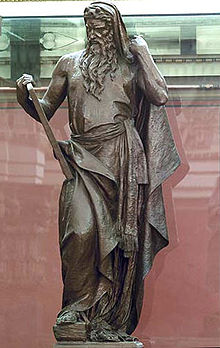
Statue of Moses at the Library of Congress, Washington D.C.

Exodus 34: 29-35: The Radiance of Moses

29 Moses came down from Mount Sinai. As he came down from the mountain with the two tablets of the covenant in his hand, Moses did not know that the skin of his face shone because he had been talking with God. 30 When Aaron and all the Israelites saw Moses, the skin of his face was shining, and they were afraid to come near him. 31 But Moses called to them; and Aaron and all the leaders of the congregation returned to him, and Moses spoke with them. 32 Afterward all the Israelites came near, and he gave them in commandment all that the LORD had spoken with him on Mount Sinai. 33 When Moses had finished speaking with them, he put a veil on his face; 34 but whenever Moses went in before the LORD to speak with him, he would take the veil off, until he came out; and when he came out, and told the Israelites what he had been commanded, 35 the Israelites would see the face of Moses, that the skin of his face was shining; and Moses would put the veil on his face again, until he went in to speak with him.

The time spent by Moses in the presence of God has a transforming effect upon Moses. While the changes are invisible to Moses they are clearly seen by Aaron and the people and it is a cause for fear. This time in God’s presence has made Moses different from the rest of the people, he continues to stand apart. In his role as mediator between God and the people he seems to have brought a little bit of God’s presence back with him.

The presence of God does change people. Moses enjoys a far greater intimacy with God than any other person among the Israelites. Moses has shown great faithfulness to God and to the people as well. Moses is more than an emissary for God or even a prophet of God but one who God trusts and speaks to like one speaks to a friend. Moses has something that even Aaron will never have. Aaron and the priests will need things to announce them before God and will only be allowed to enter God’s presence rarely. Moses dwells both with God and the people. Yet, Moses seems to belong more with God now than the people. Among the people Moses needs to wear a veil to fit in, but in God’s presence Moses doesn’t need to hide the radiance of who he is.

Exodus 33: Repairing the Relationship Between God and Israel

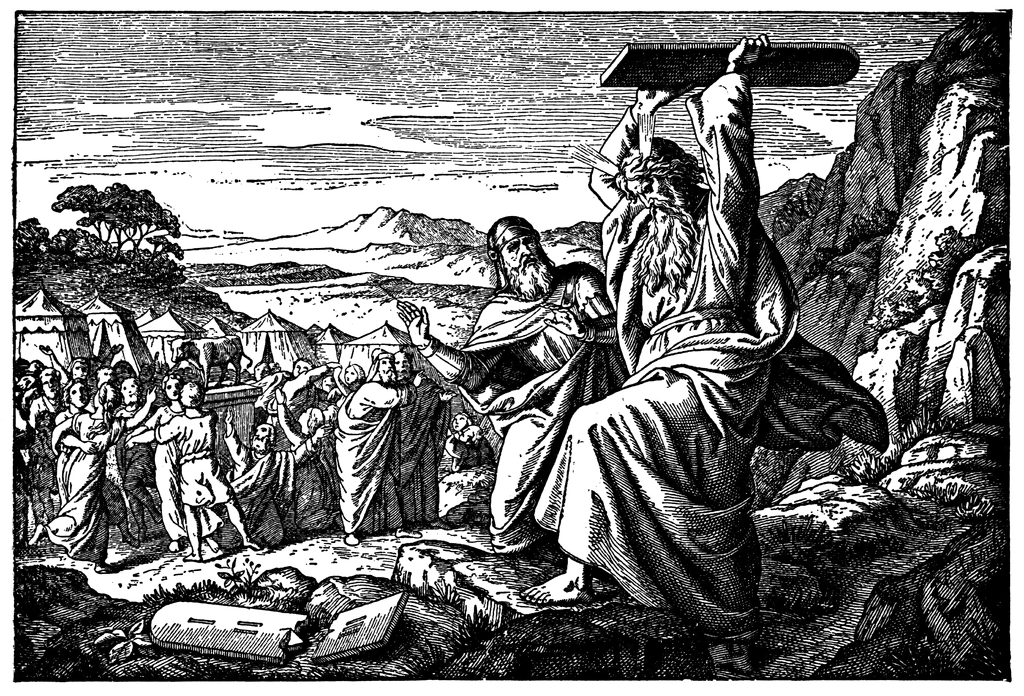
“Ten Commandments by Anton Losenko – Licensed under Public Domain via Wikimedia Commons –

Exodus 33:1-6 The LORD’s Separation from Israel

The LORD said to Moses, “Go, leave this place, you and the people whom you have brought up out of the land of Egypt, and go to the land of which I swore to Abraham, Isaac, and Jacob, saying, ‘To your descendants I will give it.’ 2 I will send an angel before you, and I will drive out the Canaanites, the Amorites, the Hittites, the Perizzites, the Hivites, and the Jebusites. 3 Go up to a land flowing with milk and honey; but I will not go up among you, or I would consume you on the way, for you are a stiff-necked people.”

4 When the people heard these harsh words, they mourned, and no one put on ornaments. 5 For the LORD had said to Moses, “Say to the Israelites, ‘You are a stiff-necked people; if for a single moment I should go up among you, I would consume you. So now take off your ornaments, and I will decide what to do to you.'” 6 Therefore the Israelites stripped themselves of their ornaments, from Mount Horeb onward.

Trust was broken when the Israelites cast and worshipped the golden calf. Perhaps it is my own experience of a broken relationship as well as helping others deal with broken relationships that makes me hear this passage between the LORD and Israel being like the struggling attempts of a couple after trust was broken. The God of the Bible is not the unmoved mover that many Christians imagine, the LORD the God of Israel was passionately invested in this covenant. We see here and many other places in scriptures a wounded God nursing broken dreams and beginning the long journey to the place where trust can be rebuilt. It is not only a journey from Mount Sinai/Horeb to the promised land, it is a journey of rebuilding trust between God and God’s people.

At this point the LORD needs some space from the people. Like a couple who needs to live in separate places after an affair because the presence of the other is a continual reminder of the brokenness that exists between them, the LORD needs space and time to deal with these emotions. The Israelites too in their own way go into mourning. Their ornaments were once removed to cast the golden calf and now they are removed as a mourning of the pain and grief they caused for the LORD and for themselves. They are a people who have lost their God’s trust and who exist in the hope that in the future that trust can be rebuilt, and the relationship restored.

God has not completely walked away from the people or from hope. An angel, and emissary continues to lead and go with the people but the LORD’s desire to dwell among the people has been for a time shattered. The previous focus on the tabernacle is temporarily set aside amid the pain of the broken relationship. Moses still stands between the LORD and the people, clung to by both. For now the people and God journey in parallel paths and Moses’ job will be to bring healing to both God and God’s people.

Exodus 33: 7-11 Separate Camp

7 Now Moses used to take the tent and pitch it outside the camp, far off from the camp; he called it the tent of meeting. And everyone who sought the LORD would go out to the tent of meeting, which was outside the camp. 8 Whenever Moses went out to the tent, all the people would rise and stand, each of them, at the entrance of their tents and watch Moses until he had gone into the tent. 9 When Moses entered the tent, the pillar of cloud would descend and stand at the entrance of the tent, and the LORD would speak with Moses. 10 When all the people saw the pillar of cloud standing at the entrance of the tent, all the people would rise and bow down, all of them, at the entrance of their tent.11 Thus the LORD used to speak to Moses face to face, as one speaks to a friend. Then he would return to the camp; but his young assistant, Joshua son of Nun, would not leave the tent.

Much as adults going through a strained portion of a relationship often separate because the immediate presence of the other causes too much pain, now the LORD meets with Moses outside the camp. Moses’ role as the mediator between the people and God in now intensified as Moses still has the LORD’s trust. The people who are longing for reconciliation, those who seek the LORD, wait and watch Moses’ departure to the tent of meeting and return hopeful for some sign that the relationship will be renewed. This is not the desired state of things for God. The LORD’s desire was to be in the center of the camp but now God’s place of meeting is beyond the borders of the camp.

Dietrich Bonhoeffer in his theological exposition of Genesis 1-3, Creation and Fall, talks about Adam’s original orientation of God placing God in the center of existence. (Bonhoeffer, 1997, p. 88f) In a similar way, the intent for the tabernacle was to echo this place in creation where God is symbolically and theologically in the center of the people of Israel’s life. Both Adam and the people of Israel were to realize their dependence on the LORD’s providence and protection. Yet both would eventually by their disobedience push God to the margins (using Bonhoeffer’s theological metaphor). Yet, God also withdraws to the margins as an act of grace. In the creation narrative it is a grace which overcomes the threat of death to Adam and Eve for eating the fruit of the tree of knowledge of good and evil. In Exodus it is a grace which prevents the people from being consumed by the wrath of God over their betrayal with the golden calf. Moses as the mediator will now continue to work to bring the people and their God back together and to move God away from the margins and back to the center.

Exodus 33: 12-23 The Presence of God

love me forever by syntheses on deviantart.com

12 Moses said to the LORD, “See, you have said to me, ‘Bring up this people’; but you have not let me know whom you will send with me. Yet you have said, ‘I know you by name, and you have also found favor in my sight.’ 13 Now if I have found favor in your sight, show me your ways, so that I may know you and find favor in your sight. Consider too that this nation is your people.” 14 He said, “My presence will go with you, and I will give you rest.” 15 And he said to him, “If your presence will not go, do not carry us up from here. 16 For how shall it be known that I have found favor in your sight, I and your people, unless you go with us? In this way, we shall be distinct, I and your people, from every people on the face of the earth.”

17 The LORD said to Moses, “I will do the very thing that you have asked; for you have found favor in my sight, and I know you by name.” 18 Moses said, “Show me your glory, I pray.” 19 And he said, “I will make all my goodness pass before you, and will proclaim before you the name, ‘The LORD’;1 and I will be gracious to whom I will be gracious, and will show mercy on whom I will show mercy. 20 But,” he said, “you cannot see my face; for no one shall see me and live.” 21 And the LORD continued, “See, there is a place by me where you shall stand on the rock; 22 and while my glory passes by I will put you in a cleft of the rock, and I will cover you with my hand until I have passed by; 23 then I will take away my hand, and you shall see my back; but my face shall not be seen.”

For a beautiful description and meditation on this scene see Ellen Davis’ chapter ‘A Fool for Love: Exodus 33’ in Getting Involved with God: Rediscovering the Old Testament. (Davis, 2001, pp. 153-159) Even though I will be coming at the scene from a different perspective she has some beautiful insights into this scene and suggestions about the character of the LORD. Moses is, “disgusted with the Israelites, betrayed by his own brother, and now even God has bailed out, leaving him alone with a job he never wanted in the first place” (154) and yet he is the one who is caught between a people and their God attempting to make peace. Moses asks for a demonstration of the LORD’s favor and trust in this place where Moses feels abandonment. The LORD attempts to reassure Moses that Moses is seen and known and that the relationship between Moses and God remains strong, but Moses is not willing to allow things to remain as they are. God promises to be present and to walk with Moses (the Hebrew is second person singular-Hebrew has a singular and a plural you unlike English). Moses refuses to allow God to only journey with him, if God will not go with the people Moses asks him to return to the original intent of journeying with the people. For Moses sake God consents to journey with the people and to be vulnerable to the pain that they will cause God along this journey.

God grants Moses request based upon the relationship with Moses, not the people. Moses becomes the one whose prayer is heard when the prayers of the people are not. Moses is one who is righteous for the people, who stands in the gap between the people and God and who holds the relationship together.

Moses makes a bold request of God, to see God’s glory. Moses has been the one who seeks after the LORD throughout the Exodus journey and the LORD grants this request as fully as possible. Moses continues to be the one seeking after God and God consents to be seen in a manner that Moses can endure. God is not insulted by Moses’ request and, as Ellen Davis highlights, God seems to be flattered by it. (157) God has been taken for granted by the people but not by Moses and the LORD has stated that the LORD is a jealous God who will not be taken for granted. Yet, God is willing to show Godself to those who seek and to enter into the relationship with those who are willing to be open to God. Moses’ faithfulness to God’s vision for the relationship between the LORD and the people pulls the LORD back to the LORD’s original dream. Moses’ intercession for the people and desire for God becomes instrumental in the process of reconciliation.

Exodus 32: The Golden Calf Threatens the Covenant

 Exodus 32: 1-6 The People Ask for Gods

When the people saw that Moses delayed to come down from the mountain, the people gathered around Aaron, and said to him, “Come, make gods for us, who shall go before us; as for this Moses, the man who brought us up out of the land of Egypt, we do not know what has become of him.” 2 Aaron said to them, “Take off the gold rings that are on the ears of your wives, your sons, and your daughters, and bring them to me.” 3 So all the people took off the gold rings from their ears, and brought them to Aaron. 4 He took the gold from them, formed it in a mold and cast an image of a calf; and they said, “These are your gods, O Israel, who brought you up out of the land of Egypt!” 5 When Aaron saw this, he built an altar before it; and Aaron made proclamation and said, “Tomorrow shall be a festival to the LORD.” 6 They rose early the next day, and offered burnt offerings and brought sacrifices of well-being; and the people sat down to eat and drink, and rose up to revel.

Being the people of God involves learning patience: patience with the LORD and patience with the leaders who mediate between the people and their God. While Moses has been up with the LORD receiving the instructions for the tabernacle where God can dwell among the people, the people and Aaron go against the covenant they have made and cast the golden calf and prepare to worship it. This is a pivotal scene in the relationship between the people and God. The covenant has been broken by the people and the next couple chapters must reconcile the brokenness of relationship between God and the people.

The people heard the prohibition of creating an idol at the head of the decalogue in Exodus 20 and in Exodus 24 they sealed the covenant ritually as the people when the blood of the sacrificed oxen was dashed on them. The people have heard the LORD’s commandments and agreed to them and yet the absence of Moses creates a crisis of faith for them. Whether the cast image of the calf was meant to represent the LORD the God of Israel whose voice they had heard or whether the calf is not clear, it could be read either way. In either case the people have either, with Aaron the high priest’s assistance, abandoned the LORD their God or attempted to make an image for the God who refuses to be limited to any image on the earth or above the earth or under the earth.

One of the threads in this reading is control. The people and Aaron want an image for god, something they can carry and use as a symbol but there is also a limiting function to having a god in the image of a calf or any other form. Yet, fundamentally the LORD refuses to be limited or controlled by an image. Images of the LORD or any other god were not to be made by the Israelites, even the name of the LORD was only spoken in the greatest of care. From chapters 25-31 we have seen how God has worked with Moses to set aside a space where a little bit of heaven can come down to earth and where the LORD would meet with the people. In contrast the people have attempted to create an earthly god to replace the LORD of heaven and earth.

The golden calf is an incredible resonant image. It can become in any age and time the safe gods we choose instead of the LORD the God of Israel that Exodus presents us with. Even in our time the image continues to hold power. It is perhaps the height of irony that the largest amount paid to a living author for a piece of art was to Damien Hirst for ‘the Golden Calf’ a week before the financial collapse of 2008. (Sacks, 2010, p. 259) During the time while the initial draft of this sat these lines were written by me:

Security may be the golden calf we sacrifice to and worship
We dance in the glow of the images of fertility and strength
Following the masses in the shadow of Sinai as they celebrate
That which they can cast and control, tame gods that don’t speak
Metallic beings of the valley rather than the master of the mountain

There will always be the temptation to worship that which we can see or to model the things we worship upon that which we value. As a religious leader there is the temptation to provide that which the crowd desires rather than to be the prophet in the uncomfortable position of standing between a wounded God and a stiff-necked people. Yet, the golden calves of every age tend to lead to our fragmenting into tribes of like-minded worshippers and sometimes to intertribal warfare like we see at the end of this chapter as Moses and the Levites attempt to bring the people back to the LORD and the LORD’s ways.

Exodus 32: 7-14 Moses Between God and the People

7 The LORD said to Moses, “Go down at once! Your people, whom you brought up out of the land of Egypt, have acted perversely; 8 they have been quick to turn aside from the way that I commanded them; they have cast for themselves an image of a calf, and have worshiped it and sacrificed to it, and said, ‘These are your gods, O Israel, who brought you up out of the land of Egypt!'” 9 The LORD said to Moses, “I have seen this people, how stiff-necked they are. 10 Now let me alone, so that my wrath may burn hot against them and I may consume them; and of you I will make a great nation.”

11 But Moses implored the LORD his God, and said, “O LORD, why does your wrath burn hot against your people, whom you brought out of the land of Egypt with great power and with a mighty hand? 12 Why should the Egyptians say, ‘It was with evil intent that he brought them out to kill them in the mountains, and to consume them from the face of the earth’? Turn from your fierce wrath; change your mind and do not bring disaster on your people. 13 Remember Abraham, Isaac, and Israel, your servants, how you swore to them by your own self, saying to them, ‘I will multiply your descendants like the stars of heaven, and all this land that I have promised I will give to your descendants, and they shall inherit it forever.'” 14 And the LORD changed his mind about the disaster that he planned to bring on his people.

Moses stands between the people and the LORD and he is the one unbroken strand in the covenant. For the LORD this is a betrayal that threatens not only the relationship of the people and their God, but a betrayal that threatens to overcome the people with God’s anger. The LORD takes this relationship seriously! There are many things that can be said about the portrayal of the LORD the God of Israel depending on one’s perspective but this God is never the enlightenment’s unmoved mover. The LORD is engaged in the redemption of the people of Israel from slavery and is invested in this people and the people’s actions can wound God emotionally. Yet, the LORD’s tie to Moses also remains strong and the LORD considers starting over with Moses and even presents this offer to Moses, the same offer that Abraham received.

Moses stands between the people and the LORD, that is where the prophet stands. In the coming verses we will see Moses’ anger but in this time before God Moses is the logical one calling to mind not only God’s honor but also God’s promises to Abraham, Isaac, and Israel. Moses calls upon God, even in God’s anger and grief, to honor the promises that have been made. Moses calls God back to the covenant, even though the covenant has been broken in a spectacular way by the people. Prophets stand between God and the people and God listens even when God wants to be left alone. When the LORD desires silence, for the sake of the people the prophet speak so that they might change God’s mind and avert disaster for the people.

Image from Rt. Rev. Richard Gilmour, Bible History Containing the Most Remarkable Events of the Old and New Testaments, with a Compenduim of Church History (1904)

Exodus 32: 15-24 Broken Covenant, Broken Relationships

15 Then Moses turned and went down from the mountain, carrying the two tablets of the covenant1 in his hands, tablets that were written on both sides, written on the front and on the back. 16 The tablets were the work of God, and the writing was the writing of God, engraved upon the tablets. 17 When Joshua heard the noise of the people as they shouted, he said to Moses, “There is a noise of war in the camp.” 18 But he said, “It is not the sound made by victors, or the sound made by losers; it is the sound of revelers that I hear.” 19 As soon as he came near the camp and saw the calf and the dancing, Moses’ anger burned hot, and he threw the tablets from his hands and broke them at the foot of the mountain. 20 He took the calf that they had made, burned it with fire, ground it to powder, scattered it on the water, and made the Israelites drink it.

21 Moses said to Aaron, “What did this people do to you that you have brought so great a sin upon them?” 22 And Aaron said, “Do not let the anger of my lord burn hot; you know the people, that they are bent on evil. 23 They said to me, ‘Make us gods, who shall go before us; as for this Moses, the man who brought us up out of the land of Egypt, we do not know what has become of him.’ 24 So I said to them, ‘Whoever has gold, take it off ‘; so they gave it to me, and I threw it into the fire, and out came this calf!”

Moses risked entering the furnace of the LORD’s anger for the people but now his own anger burns hot. Moses knows the danger the people have put themselves into, he knows the consequence of the broken covenant with the LORD. He has seen not only the LORD’s hopes but his own hopes dashed in this sudden act of rebellion. The tablets, the work of God, have been made worthless by the work of the people. A broken dream and a shattered covenant. The object which Moses had waited to bring to the people now lies shattered at the base of the mountain.

The tablets are broken, the calf is destroyed and scattered on the waters for the Israelites to drink in the bitter taste of their betrayal. Yet, it is Aaron who in this moment receives Moses’ first attention. Aaron who will be the high priest of the people, whose role will be to atone for the people has been active in their betrayal. In a manner like Adam and Eve in Genesis 3, Aaron immediately attempts to deflect Moses’ anger onto the people. Yet, Moses and Aaron here are in strong contrast: Moses interceded for the people while Aaron blamed them. In one way this is oversimplified since Aaron is down the mountain with the people and feels pressured by them, yet the role of leaders is to restrain the people from a path that would lead to their destruction. Aaron minimizes his role within the creation of the golden calf (I threw the gold into the fire and out popped the calf). Atonement will need to be made for Aaron before he can make atonement for the people. The only one able to make the needed atonement is Moses.

Exodus 32: 25-35 Sin, Brokenness and Consequences

25 When Moses saw that the people were running wild (for Aaron had let them run wild, to the derision of their enemies), 26 then Moses stood in the gate of the camp, and said, “Who is on the LORD’s side? Come to me!” And all the sons of Levi gathered around him. 27 He said to them, “Thus says the LORD, the God of Israel, ‘Put your sword on your side, each of you! Go back and forth from gate to gate throughout the camp, and each of you kill your brother, your friend, and your neighbor.'” 28 The sons of Levi did as Moses commanded, and about three thousand of the people fell on that day. 29 Moses said, “Today you have ordained yourselves1 for the service of the LORD, each one at the cost of a son or a brother, and so have brought a blessing on yourselves this day.”

 30 On the next day Moses said to the people, “You have sinned a great sin. But now I will go up to the LORD; perhaps I can make atonement for your sin.” 31 So Moses returned to the LORD and said, “Alas, this people has sinned a great sin; they have made for themselves gods of gold. 32 But now, if you will only forgive their sin — but if not, blot me out of the book that you have written.” 33 But the LORD said to Moses, “Whoever has sinned against me I will blot out of my book. 34 But now go, lead the people to the place about which I have spoken to you; see, my angel shall go in front of you. Nevertheless, when the day comes for punishment, I will punish them for their sin.”

35 Then the LORD sent a plague on the people, because they made the calf — the one that Aaron made.

Moses and the sons of Levi violently restore order to the camp. I struggle with the violence unleashed in this scene even though I can appreciate the seriousness of the situation. For Moses this is a struggle of life or death. If order cannot be restored he knows the consequences of the LORD’s wrath continuing to burn and break out against the people. The Levites here are set aside for their future ministry in the service of the LORD. The cost of the earlier celebrations has been high indeed. This is nothing short of intertribal warfare and its conclusion determines the direction of the people of Israel.

In what, to me, is one of the most courageous scenes in the book of Exodus and perhaps in all of scriptures, Moses returns to the LORD and still stands with the people. He dares to ask God to forgive the people, but if God cannot forgive the people then Moses stands with them and asks for his own name to be removed. Moses refuses to give the LORD the option of starting over with him. There is consequence to this sin and brokenness but it is not immediate. God has turned aside from the threat of letting God’s anger consume the people, even though there is the plague which comes at the end of the chapter. There is judgment but not annihilation. The relationship and the promise of the land continue but trust has been broken and the relationship is not the same.

Exodus 31: The Artisans, The Sabbath and the Tablets

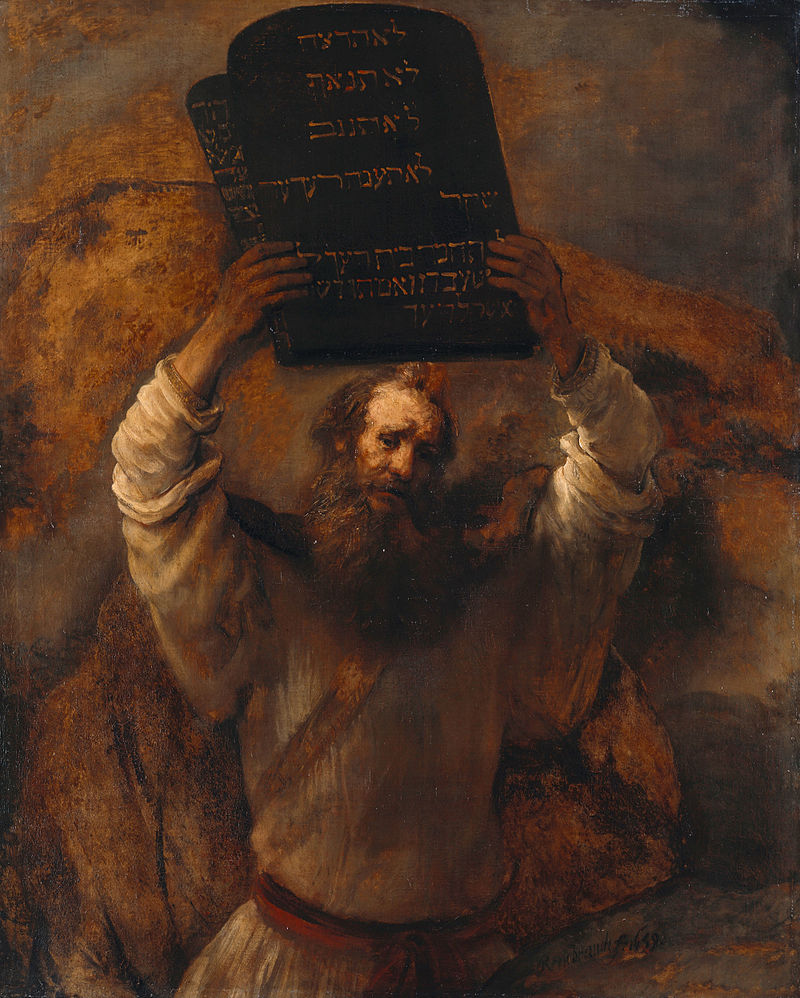
Rembrandt, Moses with the Ten Commandments

Exodus 31:1-11 The Divinely Gifted Artisans

The LORD spoke to Moses: 2 See, I have called by name Bezalel son of Uri son of Hur, of the tribe of Judah: 3 and I have filled him with divine spirit,1 with ability, intelligence, and knowledge in every kind of craft, 4 to devise artistic designs, to work in gold, silver, and bronze,5 in cutting stones for setting, and in carving wood, in every kind of craft. 6 Moreover, I have appointed with him Oholiab son of Ahisamach, of the tribe of Dan; and I have given skill to all the skillful, so that they may make all that I have commanded you: 7 the tent of meeting, and the ark of the covenant,1 and the mercy seat2 that is on it, and all the furnishings of the tent, 8 the table and its utensils, and the pure lampstand with all its utensils, and the altar of incense, 9 and the altar of burnt offering with all its utensils, and the basin with its stand, 10 and the finely worked vestments, the holy vestments for the priest Aaron and the vestments of his sons, for their service as priests, 11 and the anointing oil and the fragrant incense for the holy place. They shall do just as I have commanded you.

The appointment of Bezalel and Oholiab along with the rest of the divinely inspired artisans presents an opportunity to expand the role of the called people of God beyond prophets and priests. Bezalel coming out of the tribe of Judah and Oholiab coming out of the tribe of Dan expands the group of people upon which the divine spirit rests. The work of constructing a tabernacle or a church is the work of the people, not just the work of the priests and pastors. There is within the calling of these artisans a recognition that the accomplishment of the divine vision involves the various gifts of the priest, the prophet, the artisan and the worker. Each person has a part to play in the unfolding of God’s purpose for God’s people.

Martin Luther expanded upon this in his belief that every Christian had a vocation or multiple vocations, areas where their skills were used to serve God. Each person, whether a mother, a farmer, a shoemaker, a pastor, or a prince all had a role to play and gifts to serve God’s kingdom. St. Paul could refer to many gifts coming from the one Spirit of God (both Romans 12 and 1 Corinthians 12) and that all the gifts of the community of faith where for the work of God in the church. God has spread the gifts among God’s people and not solely in the hands of the ordained ministers of the church. One of the peculiarities of the next chapter is that when Aaron the priest becomes the artisan everything comes out wrong.

I’ve mentioned a couple times in this section that my congregation is going through a building expansion as I write this and I’ve gotten to see firsthand the skilled work of the artisans who are working on the building. I have some skill with my hands, but it is not my primary gift. Yet, the crew who is working in concrete, steel, sheetrock and paint (not to mention plumbing, electrical wires and the like) have gifts and skills I do not. I could learn those skills given time, but that is not my vocation or my position. I am able to delight in the work that God is able to do through these artisans and at the same time celebrate the work that God has equipped me to do.

Exodus 31: 12-17 The Seriousness of Sabbath

12 The LORD said to Moses: 13 You yourself are to speak to the Israelites: “You shall keep my sabbaths, for this is a sign between me and you throughout your generations, given in order that you may know that I, the LORD, sanctify you. 14 You shall keep the sabbath, because it is holy for you; everyone who profanes it shall be put to death; whoever does any work on it shall be cut off from among the people. 15 Six days shall work be done, but the seventh day is a sabbath of solemn rest, holy to the LORD; whoever does any work on the sabbath day shall be put to death. 16 Therefore the Israelites shall keep the sabbath, observing the sabbath throughout their generations, as a perpetual covenant. 17 It is a sign forever between me and the people of Israel that in six days the LORD made heaven and earth, and on the seventh day he rested, and was refreshed.”

I had the opportunity over the weekend to travel with my wife to see some of the areas she grew up, and one of the gifts of the weekend was sitting on a deck in some cooler weather than we are currently experiencing in Texas and just to look out over the terrain and be. My wife and I both work jobs that can consume a lot of our life and time and it was good to have some time to just be together and to rest. This is what sabbath is about. It is about resting and it is a deadly serious proposition for the people. The sabbath gets its own commandment in Exodus 20, is mentioned again Exodus 23: 12-13 and then again is brought up here. Even prior to the construction of the tabernacle after the incident of the golden calf the sabbath will again be highlighted at the beginning of Exodus 35. The sabbath for the covenant people is highlighted as a matter of life and death.

In my time and context we have a difficult time with sabbath. I fought for years having a smartphone, and while I enjoy its capability it also ensures that I am continually connected to the demands of work. In the United States we live in a society of acquisition where we place a monetary value on things and while the logo ‘In God we trust’ may be placed on our bills and coins I sometimes wonder if the bills and coins are the god we truly trust. As Rabbi Sacks can wisely state, “When money rules, we remember the price of things and forget the value of things.” (Sacks, 2010, p. 260)

Sabbath is a day where there is no buying or selling, where work is prohibited and people are forced to rest and sit. In our frenetic society this may be the most difficult commandment to live into. In a society where the blue laws that forced businesses to be closed on Sundays it may have been easier since there were few options on Sundays. Yet, that is not our time and there is no easy going back to a past that may or may not have existed like we imagine. For now, the wisdom of sabbath may be learning that it is a matter of life and death in our culture to stop and reflect on the value of things we have rather than the price of the things we can accumulate.

Within the Hebrew Scriptures there is a call to learn patience that moves against our own sense of immediate need. The people in the wilderness would call upon Moses every time there didn’t seem to be enough food or water immediately and threaten to return to Egypt. While Moses is up on the mountain the people will come to Aaron and ask him to craft their gods for them. The LORD expects the people to stop and wait at times and lingers with them in the wilderness while the details are handed on. The sabbath also expect the people to learn the value of waiting, or resting and of valuing the things that have been provided rather than straining towards the things they can acquire.

Exodus 31: 18 The Tablets of the Covenant

18 When God1 finished speaking with Moses on Mount Sinai, he gave him the two tablets of the covenant,2 tablets of stone, written with the finger of God.

The infamous stone tablets are finally given to Moses as the scene transitions from Moses’ time with God on Mount Sinai to Aaron’s struggles with the people in the valley. Moses listens, the people demand. God departs the plan for the tabernacle where God can dwell among the people, Aaron crafts golden calves as poor substitution for an imageless God of Israel. God’s vision is one of order in contrast to the disorder Moses will find when he descends the mountain. The covenant will be broken and remade but it remains the word of God that is to be brought to God’s people.

Exodus 30: Precious Things for the Sacred not the Secular

Erection of the Tabernacle and Sacred Vessels by Gerard Hoet (1728)

 Exodus 30: 1-10 The Incense Altar of Gold

You shall make an altar on which to offer incense; you shall make it of acacia wood. 2 It shall be one cubit long, and one cubit wide; it shall be square, and shall be two cubits high; its horns shall be of one piece with it. 3 You shall overlay it with pure gold, its top, and its sides all around and its horns; and you shall make for it a molding of gold all around. 4 And you shall make two golden rings for it; under its molding on two opposite sides of it you shall make them, and they shall hold the poles with which to carry it. 5 You shall make the poles of acacia wood, and overlay them with gold. 6 You shall place it in front of the curtain that is above the ark of the covenant,1 in front of the mercy seat2 that is over the covenant,3 where I will meet with you. 7 Aaron shall offer fragrant incense on it; every morning when he dresses the lamps he shall offer it, 8 and when Aaron sets up the lamps in the evening, he shall offer it, a regular incense offering before the LORD throughout your generations. 9 You shall not offer unholy incense on it, or a burnt offering, or a grain offering; and you shall not pour a drink offering on it. 10 Once a year Aaron shall perform the rite of atonement on its horns. Throughout your generations he shall perform the atonement for it once a year with the blood of the atoning sin offering. It is most holy to the LORD.

This chapter finishes the description of the holy things that are to be created for the service to the LORD in the tabernacle. On first glance, it seems a random collection of things put at the end, but upon closer inspection there is an order in this chapter. The incense altar is the final golden items described and this small (roughly 1 ½ foot square) altar is near the holiest space and is used to provide a fragrant offering of incense (described at the end of the chapter) before the place where the LORD is to meet Moses or the high priest. The incense is to be set upon the altar every morning and evening and like everything else this altar is portable. An additional part of the priesthood’s job is to maintain this continual offering of incense before the LORD.

Exodus 30: 11-16 The Census of Silver

11 The LORD spoke to Moses: 12 When you take a census of the Israelites to register them, at registration all of them shall give a ransom for their lives to the LORD, so that no plague may come upon them for being registered. 13 This is what each one who is registered shall give: half a shekel according to the shekel of the sanctuary (the shekel is twenty gerahs), half a shekel as an offering to the LORD. 14 Each one who is registered, from twenty years old and upward, shall give the LORD’s offering. 15 The rich shall not give more, and the poor shall not give less, than the half shekel, when you bring this offering to the LORD to make atonement for your lives. 16 You shall take the atonement money from the Israelites and shall designate it for the service of the tent of meeting; before the LORD it will be a reminder to the Israelites of the ransom given for your lives.

The Hebrew Scriptures are of a mixed mind on taking censuses. On the one hand there is the census mentioned here and at the beginning of the book of Numbers where the people are enrolled in obedience to God’s command. On the other hand, in 2 Samuel 24 when David conducts a census it is a sin against God that results in a plague. Perhaps the answer lies in the reason for the census and how it is done. Here and in Numbers the census is an act of worship and devotion where, especially here, the people are measured by the gift they bring. The donation of a shekel allows the census to be taken without counting heads or viable soldiers but instead by measuring the gifts. In contrast, when David orders the military leaders to measure the population in 2 Samuel it is specifically a counting of how many soldiers are available and a measurement of the strength of his kingdom. As Rabbi Sacks can remind us, “The danger in counting Jews is that if they believed, even for a moment, that there is strength in numbers, the Jewish people long ago would have given way to despair.” (Sacks, 2010, p. 267)

Perhaps the wisdom for our time may be the difference between counting gifts and counting resources. We live in a world of accounting, where resources are counted and measured and it is ultimately a worldview based on scarcity. When we attempt to catalog all that we need to ensure nothing is missing and our world becomes based on measuring people, money, or possessions then we can become fixated on securing our own future. The scriptures point to a different type of reality where God is the one who provides for the needs of the people and the offering they provide is a way of giving thanks for the gifts that God has given. It is a way of measuring the gifts that people bring, it is a way that can be more grateful for what has been received rather than fearful of what one doesn’t have.

Exodus 30: 17-21 The Basin of Bronze

17 The LORD spoke to Moses: 18 You shall make a bronze basin with a bronze stand for washing. You shall put it between the tent of meeting and the altar, and you shall put water in it; 19 with the water1 Aaron and his sons shall wash their hands and their feet. 20 When they go into the tent of meeting, or when they come near the altar to minister, to make an offering by fire to the LORD, they shall wash with water, so that they may not die. 21 They shall wash their hands and their feet, so that they may not die: it shall be a perpetual ordinance for them, for him and for his descendants throughout their generations.

We have moved from a golden altar to a silver offering to a bronze basin. Here the basin is described in a very plain manner, it is of the lowest precious metal and is used for the functional, but necessary, washing. This ordinary thing provides a way of preparation for the extraordinary ministry of the priest. Being washed in the water of the basin becomes a necessary preparation for the work of ministry.

Stepping back from the tabernacle itself there is perhaps some reflection that we Christians can do about the way in which our own baptism prepares us for the callings that God has for us. As a pastor my calling is an extension and only possible because of the work that God has done with water and promise. I am continually called back to my baptism which prepares me for the work of ministry that I do daily. Here with the bronze basin and the water the priest is prepared for the work with the holy by things that are both mundane and essential.

Exodus 30: 22-38 Anointing Oil and Incense

22 The LORD spoke to Moses: 23 Take the finest spices: of liquid myrrh five hundred shekels, and of sweet-smelling cinnamon half as much, that is, two hundred fifty, and two hundred fifty of aromatic cane, 24 and five hundred of cassia — measured by the sanctuary shekel — and a hin of olive oil; 25 and you shall make of these a sacred anointing oil blended as by the perfumer; it shall be a holy anointing oil. 26 With it you shall anoint the tent of meeting and the ark of the covenant,1 27 and the table and all its utensils, and the lampstand and its utensils, and the altar of incense, 28 and the altar of burnt offering with all its utensils, and the basin with its stand; 29 you shall consecrate them, so that they may be most holy; whatever touches them will become holy. 30 You shall anoint Aaron and his sons, and consecrate them, in order that they may serve me as priests. 31 You shall say to the Israelites, “This shall be my holy anointing oil throughout your generations. 32 It shall not be used in any ordinary anointing of the body, and you shall make no other like it in composition; it is holy, and it shall be holy to you. 33 Whoever compounds any like it or whoever puts any of it on an unqualified person shall be cut off from the people.”

34 The LORD said to Moses: Take sweet spices, stacte, and onycha, and galbanum, sweet spices with pure frankincense (an equal part of each), 35 and make an incense blended as by the perfumer, seasoned with salt, pure and holy; 36 and you shall beat some of it into powder, and put part of it before the covenant1 in the tent of meeting where I shall meet with you; it shall be for you most holy. 37 When you make incense according to this composition, you shall not make it for yourselves; it shall be regarded by you as holy to the LORD. 38 Whoever makes any like it to use as perfume shall be cut off from the people.

Spices in the ancient world are as valuable as gold and silver, and here these precious spices are used both for an anointing oil and for the incense used in the tabernacle. The anointing oil is used over all the implements of the tabernacle and over Aaron and the priests. This is to be specifically and only used in the tabernacle and its service. The place is to have a unique odor that is not to be copied for mundane things. In a similar way the incense is a unique and precious blend to only be used in the tabernacle. Both are holy things set aside for a specific purpose.

As a Christian the myrrh used in the anointing oil and the frankincense used in the incense remind me of the story of the magi bringing their gifts of gold, frankincense and myrrh to Jesus and his parents as they paid him homage. On the one hand, these are very valuable substances but on the other hand gold, frankincense and myrrh are all used in the tabernacle for the most holy.

Aside: Holy and Sacred in our Secular Conversations

Over the past weekend there was significant controversy when players, coaches and owners in various ways kneeled, locked arms or stayed in the locker room during the national anthem. Within some people’s outrage the language of sacred and holy about the anthem or to the flag was used and I think we need to pay attention to the way in which our language reflects that which we worship. As a Christian I cannot say that the flag or the anthem or any secular ritual are sacred things nor do I worship my nation. But I also think the contrast in the way this language is used in times of controversy and the blasé way we typically use these items is also worth calling attention to.

As a veteran I spent a lot of years where proper respect for a flag was very important. I have always felt uneasy about the way in which the flag was used in clothing, or the modifications that people felt free to place upon the flag. For example, the blue lives matter flag where a blue bar replaces one of the red bars in the flag, or there is a person in my neighborhood who flies an American flag with the “don’t tread on me” snake emblem placed on top of it. These are all things that are improper (not to mention wearing the flag as clothing, as a bag or bandanna or many other ways it is frequently used) within the code that I had to learn as a soldier. I understand that for many people who may either be primarily secularist or for whom their Christianity is a subset of their patriotism (which one should wonder then, is it really Christianity, but I digress) references to the flag as holy or sacred or to patriotic acts as taking on these same meaning may be a part of their ‘faith.’ Yet, I am puzzled by the way in which people will take one type of ‘disrespect of the flag’ as patriotic and the protests on Sunday are somehow unpatriotic. I know these are emotional issues but we also need to acknowledge that sometimes our emotions are being played to let one thing be ok and another not.

Yet, for the Hebrew Scriptures that which is holy or sacred is used only for holy and sacred purposes. The incense or anointing oil is not to be imitated for secular use. The penalty for misusing sacred things for secular purposes is being cut off from the people. We live in a secular society where certain rights, particularly the right of free speech, are highlighted as values to be protected. One can value something secular or feel that a secular ritual to invest things like anthems or flags with religious language and fervor is a short step away from the worship of the gods of a land or nation.

Exodus 29: Ordination and Offerings

Michael Schmitt, the High Priest Aaron (1912)


Exodus 29: 1-37 Consecration and Ordination

Now this is what you shall do to them to consecrate them, so that they may serve me as priests. Take one young bull and two rams without blemish, 2 and unleavened bread, unleavened cakes mixed with oil, and unleavened wafers spread with oil. You shall make them of choice wheat flour. 3 You shall put them in one basket and bring them in the basket, and bring the bull and the two rams. 4 You shall bring Aaron and his sons to the entrance of the tent of meeting, and wash them with water. 5 Then you shall take the vestments, and put on Aaron the tunic and the robe of the ephod, and the ephod, and the breastpiece, and gird him with the decorated band of the ephod; 6 and you shall set the turban on his head, and put the holy diadem on the turban. 7 You shall take the anointing oil, and pour it on his head and anoint him. 8 Then you shall bring his sons, and put tunics on them, 9 and you shall gird them with sashes1 and tie headdresses on them; and the priesthood shall be theirs by a perpetual ordinance. You shall then ordain Aaron and his sons.

 10 You shall bring the bull in front of the tent of meeting. Aaron and his sons shall lay their hands on the head of the bull, 11 and you shall slaughter the bull before the LORD, at the entrance of the tent of meeting, 12 and shall take some of the blood of the bull and put it on the horns of the altar with your finger, and all the rest of the blood you shall pour out at the base of the altar. 13 You shall take all the fat that covers the entrails, and the appendage of the liver, and the two kidneys with the fat that is on them, and turn them into smoke on the altar. 14 But the flesh of the bull, and its skin, and its dung, you shall burn with fire outside the camp; it is a sin offering.

 15 Then you shall take one of the rams, and Aaron and his sons shall lay their hands on the head of the ram, 16 and you shall slaughter the ram, and shall take its blood and dash it against all sides of the altar. 17 Then you shall cut the ram into its parts, and wash its entrails and its legs, and put them with its parts and its head, 18 and turn the whole ram into smoke on the altar; it is a burnt offering to the LORD; it is a pleasing odor, an offering by fire to the LORD.

 19 You shall take the other ram; and Aaron and his sons shall lay their hands on the head of the ram, 20 and you shall slaughter the ram, and take some of its blood and put it on the lobe of Aaron’s right ear and on the lobes of the right ears of his sons, and on the thumbs of their right hands, and on the big toes of their right feet, and dash the rest of the blood against all sides of the altar. 21 Then you shall take some of the blood that is on the altar, and some of the anointing oil, and sprinkle it on Aaron and his vestments and on his sons and his sons’ vestments with him; then he and his vestments shall be holy, as well as his sons and his sons’ vestments.

 22 You shall also take the fat of the ram, the fat tail, the fat that covers the entrails, the appendage of the liver, the two kidneys with the fat that is on them, and the right thigh (for it is a ram of ordination), 23 and one loaf of bread, one cake of bread made with oil, and one wafer, out of the basket of unleavened bread that is before the LORD; 24 and you shall place all these on the palms of Aaron and on the palms of his sons, and raise them as an elevation offering before the LORD. 25 Then you shall take them from their hands, and turn them into smoke on the altar on top of the burnt offering of pleasing odor before the LORD; it is an offering by fire to the LORD.

 26 You shall take the breast of the ram of Aaron’s ordination and raise it as an elevation offering before the LORD; and it shall be your portion. 27 You shall consecrate the breast that was raised as an elevation offering and the thigh that was raised as an elevation offering from the ram of ordination, from that which belonged to Aaron and his sons. 28 These things shall be a perpetual ordinance for Aaron and his sons from the Israelites, for this is an offering; and it shall be an offering by the Israelites from their sacrifice of offerings of well-being, their offering to the LORD.

 29 The sacred vestments of Aaron shall be passed on to his sons after him; they shall be anointed in them and ordained in them. 30 The son who is priest in his place shall wear them seven days, when he comes into the tent of meeting to minister in the holy place.

 31 You shall take the ram of ordination, and boil its flesh in a holy place; 32 and Aaron and his sons shall eat the flesh of the ram and the bread that is in the basket, at the entrance of the tent of meeting. 33 They themselves shall eat the food by which atonement is made, to ordain and consecrate them, but no one else shall eat of them, because they are holy. 34 If any of the flesh for the ordination, or of the bread, remains until the morning, then you shall burn the remainder with fire; it shall not be eaten, because it is holy.

 35 Thus you shall do to Aaron and to his sons, just as I have commanded you; through seven days you shall ordain them. 36 Also every day you shall offer a bull as a sin offering for atonement. Also you shall offer a sin offering for the altar, when you make atonement for it, and shall anoint it, to consecrate it. 37 Seven days you shall make atonement for the altar, and consecrate it, and the altar shall be most holy; whatever touches the altar shall become holy.

The week that I am thinking about these texts I have also been preparing to preside at an installation service for a new pastor in my conference. For a modern ordination, at least in the Christian tradition, is far less elaborate than the ritual that is described here. This is a public rite that lasts for seven days as Aaron and his sons are set aside for the ministry in the tabernacle. Not only are there special garments that are prepared (previous chapter) and the tabernacle itself with all its furnishings (chapters 25, 26 and 27) but now the people, vestments and furnishings must be set aside for the ministry in the tabernacle.

As I mentioned in the previous chapter when discussing the vestments, this process of setting aside Aaron and his sons for the priesthood and the elaborate preparation and consecration become a new beginning after Aaron’s incident with the golden calf. The rite of setting aside Aaron and his sons grants them a new start so that they might be holy before the LORD and continue to offer up the sacrifices that the people might be holy.

The community offers up the produce of their fields and flocks as gifts that are used to be a part of the service. There are three specific offerings lifted up: a sin offering, a burnt offering and an offering of ordination. The bull becomes the sin offering and is the first one offered. Ritually the sins of Aaron and his sons are laid on the head of the bull and then the bull is killed and consumed partially by fire and partially is left outside of the camp. This offering becomes a place where Moses symbolically acts as a priest for Aaron and his sons and acts as an intercessor between them and God, just as they will later act as intercessors between the people and God. The first ram is also consumed by the fire and as a burnt offering is to be pleasing to the LORD while the final ram has a portion set aside for Aaron and his sons to eat.

The ritual use of the blood of an animal may seem abhorrent to us today but was very normal in ancient times. When most of our meat comes shrink wrapped in a grocery store we may find it unimaginable to have blood sprinkled on us or place on our ear lobe or poured out on the altar, but in the ancient world this was life paying for life. The blood was never to be consumed by the Hebrew people, it was always poured out for God for that was where the life was believed to reside. Here the life of animals are used as a way to set aside these people as priests for their service to the LORD.

Exodus 29: 38-46 Offerings and the Presence of God

 38 Now this is what you shall offer on the altar: two lambs a year old regularly each day. 39 One lamb you shall offer in the morning, and the other lamb you shall offer in the evening; 40 and with the first lamb one-tenth of a measure of choice flour mixed with one-fourth of a hin of beaten oil, and one-fourth of a hin of wine for a drink offering. 41 And the other lamb you shall offer in the evening, and shall offer with it a grain offering and its drink offering, as in the morning, for a pleasing odor, an offering by fire to the LORD. 42 It shall be a regular burnt offering throughout your generations at the entrance of the tent of meeting before the LORD, where I will meet with you, to speak to you there. 43 I will meet with the Israelites there, and it shall be sanctified by my glory; 44 I will consecrate the tent of meeting and the altar; Aaron also and his sons I will consecrate, to serve me as priests. 45 I will dwell among the Israelites, and I will be their God. 46 And they shall know that I am the LORD their God, who brought them out of the land of Egypt that I might dwell among them; I am the LORD their God.

Scholars may disagree on what the exact reason sacrifice was so prevalent in ancient cultures and there may have been a multitude of understandings among different cultures about sacrifice and its meaning. Yet, every religion has some manner in which the best one has (and in an agricultural culture this is the produce of the fields and the animals of the herd) and committing it to the LORD. Perhaps some understood this as a way of feeding or appeasing their gods, others may have seen it as a demonstration of their dedication to the deity they worshipped or a way of currying favor with their god. Yet, for the Hebrew people there is also the understanding that these are also ways of demonstrating their continued obedience to the God they believe travels with them each day. The tabernacle becomes a place where God’s presence will dwell among the people and the priestly actions become ways in which they mediate between the holy God and the people who are also set aside to be holy but the continual action of the priests. Just as Aaron and his sons will be consecrated, now their perpetual action becomes a way of consecrating the people as a priestly nation.


Exodus 28: The Vestments for the Priesthood of Aaron and his Descendants

Michael Schmitt, the High Priest Aaron (1912)

Then bring near to you your brother Aaron, and his sons with him, from among the Israelites, to serve me as priests — Aaron and Aaron’s sons, Nadab and Abihu, Eleazar and Ithamar. 2 You shall make sacred vestments for the glorious adornment of your brother Aaron. 3 And you shall speak to all who have ability, whom I have endowed with skill, that they make Aaron’s vestments to consecrate him for my priesthood. 4 These are the vestments that they shall make: a breastpiece, an ephod, a robe, a checkered tunic, a turban, and a sash. When they make these sacred vestments for your brother Aaron and his sons to serve me as priests, 5 they shall use gold, blue, purple, and crimson yarns, and fine linen.

 6 They shall make the ephod of gold, of blue, purple, and crimson yarns, and of fine twisted linen, skillfully worked. 7 It shall have two shoulder-pieces attached to its two edges, so that it may be joined together. 8 The decorated band on it shall be of the same workmanship and materials, of gold, of blue, purple, and crimson yarns, and of fine twisted linen. 9 You shall take two onyx stones, and engrave on them the names of the sons of Israel, 10 six of their names on the one stone, and the names of the remaining six on the other stone, in the order of their birth. 11 As a gem-cutter engraves signets, so you shall engrave the two stones with the names of the sons of Israel; you shall mount them in settings of gold filigree. 12 You shall set the two stones on the shoulder-pieces of the ephod, as stones of remembrance for the sons of Israel; and Aaron shall bear their names before the LORD on his two shoulders for remembrance. 13 You shall make settings of gold filigree, 14 and two chains of pure gold, twisted like cords; and you shall attach the corded chains to the settings.

 15 You shall make a breastpiece of judgment, in skilled work; you shall make it in the style of the ephod; of gold, of blue and purple and crimson yarns, and of fine twisted linen you shall make it. 16 It shall be square and doubled, a span in length and a span in width. 17 You shall set in it four rows of stones. A row of carnelian,1 chrysolite, and emerald shall be the first row; 18 and the second row a turquoise, a sapphire1 and a moonstone; 19 and the third row a jacinth, an agate, and an amethyst; 20 and the fourth row a beryl, an onyx, and a jasper; they shall be set in gold filigree. 21 There shall be twelve stones with names corresponding to the names of the sons of Israel; they shall be like signets, each engraved with its name, for the twelve tribes. 22 You shall make for the breastpiece chains of pure gold, twisted like cords; 23 and you shall make for the breastpiece two rings of gold, and put the two rings on the two edges of the breastpiece. 24 You shall put the two cords of gold in the two rings at the edges of the breastpiece; 25 the two ends of the two cords you shall attach to the two settings, and so attach it in front to the shoulder-pieces of the ephod. 26 You shall make two rings of gold, and put them at the two ends of the breastpiece, on its inside edge next to the ephod. 27 You shall make two rings of gold, and attach them in front to the lower part of the two shoulder-pieces of the ephod, at its joining above the decorated band of the ephod. 28 The breastpiece shall be bound by its rings to the rings of the ephod with a blue cord, so that it may lie on the decorated band of the ephod, and so that the breastpiece shall not come loose from the ephod. 29 So Aaron shall bear the names of the sons of Israel in the breastpiece of judgment on his heart when he goes into the holy place, for a continual remembrance before the LORD. 30 In the breastpiece of judgment you shall put the Urim and the Thummim, and they shall be on Aaron’s heart when he goes in before the LORD; thus Aaron shall bear the judgment of the Israelites on his heart before the LORD continually.

 31 You shall make the robe of the ephod all of blue. 32 It shall have an opening for the head in the middle of it, with a woven binding around the opening, like the opening in a coat of mail, so that it may not be torn.  33 On its lower hem you shall make pomegranates of blue, purple, and crimson yarns, all around the lower hem, with bells of gold between them all around —34 a golden bell and a pomegranate alternating all around the lower hem of the robe. 35 Aaron shall wear it when he ministers, and its sound shall be heard when he goes into the holy place before the LORD, and when he comes out, so that he may not die.

 36 You shall make a rosette of pure gold, and engrave on it, like the engraving of a signet, “Holy to the LORD.” 37 You shall fasten it on the turban with a blue cord; it shall be on the front of the turban. 38 It shall be on Aaron’s forehead, and Aaron shall take on himself any guilt incurred in the holy offering that the Israelites consecrate as their sacred donations; it shall always be on his forehead, in order that they may find favor before the LORD.

 39 You shall make the checkered tunic of fine linen, and you shall make a turban of fine linen, and you shall make a sash embroidered with needlework.

 40 For Aaron’s sons you shall make tunics and sashes and headdresses; you shall make them for their glorious adornment. 41 You shall put them on your brother Aaron, and on his sons with him, and shall anoint them and ordain them and consecrate them, so that they may serve me as priests.42 You shall make for them linen undergarments to cover their naked flesh; they shall reach from the hips to the thighs; 43 Aaron and his sons shall wear them when they go into the tent of meeting, or when they come near the altar to minister in the holy place; or they will bring guilt on themselves and die. This shall be a perpetual ordinance for him and for his descendants after him.

In North Africa during the 4th Century there was a schism that emerged within Christianity known as Donatism. In a time where Christians were no longer a persecuted church there were many individuals both lay and clergy who had, under persecution, denounced their faith while others had been imprisoned or martyred. The Donatists felt that clergy especially needed to be without fault for their ministry to be effective. For the Donatists, clergy who had denied their faith were unable to serve as a pastor. The conflict centered on whether it was the person or the office that made the ministrations of the priest effective and while the early Catholic church decided on the office of priesthood making the ministrations effective and not the character of the priest there are Donatists of every age who want to make priests into prophets, yet here in Exodus we have the setting aside of Aaron and his sons for the ministry of priesthood directly before Aaron fails dramatically in what his role will be.

Moses and the prophets who come after him will not have the vestments, ephods, breastplates, headpieces and all the elaborate garments that Aaron and his sons will have crafted for them as they fulfill their role within the tabernacle on behalf of the people of Israel. The type of relationship that Moses and other prophets have with the LORD will be rare, and yet there is a need for people to lead the community in worship. The clothing they wear sets them apart from everyone else, they are robed more richly than even kings would be, their garments are of incredible detail and workmanship and full of symbolism as they represent the people before their God. Aaron and his sons will not be perfect and yet they are to represent and bear the judgment of the people of Israel before God. The ephod and the breastplate also seem to have some functional role within the worship and the discernment of the will for the people of God.

On both the ephod and the breastplate there is the continual representation of the entire people before the LORD as the priest ministers. The priest acts not on their own behalf but on behalf of the entire people they intercede for. The engraved stones serve as a reminder for the priest, the people and for God of identity of the people in relation to God. The priest intercedes for the priestly kingdom. The precious stones remind us these tribes are God’s treasured possession. even though Aaron and his descendants will be consecrated to be holy to the LORD, the headband reminds both the LORD and the people that they are by extension ‘holy to the LORD.’

There is danger in the priestly role as well, for the priest intercedes for the people and must approach the holiest of spaces. Within the garments there are safeguards to protect the priest, bells sewn onto the robe that would ring as the priest approached the holiest of spaces and the undergarment to prevent the priest from accidentally exposing himself in the presence of God and the holiest items in the tabernacle.

Even though I come out of a liturgical tradition I don’t cling to the symbols of office the way that some pastors and priests do. Perhaps it is an arrogance on my part to not feel the need to be set apart by vestments that are a symbol of my office or simply comfort within my role. Yet, I do see the value in these vestments or symbols that let others know who I am and what my role is. I serve in the capacity I do not because of my own perfection or because I have lived a spotless life but simply because I trust that God and the community has called me. On behalf of the community I do serve in the capacities as priest/pastor and sometimes prophet. Clothes may not make the man (or woman) but sometimes they do grant them some of the power of the office to which they have been called.

Exodus 27: The Court of the Tabernacle and the Altar

Erection of the Tabernacle and Sacred Vessels by Gerard Hoet (1728)

Exodus 27: 1-8 The Altar

You shall make the altar of acacia wood, five cubits long and five cubits wide; the altar shall be square, and it shall be three cubits high. 2 You shall make horns for it on its four corners; its horns shall be of one piece with it, and you shall overlay it with bronze. 3 You shall make pots for it to receive its ashes, and shovels and basins and forks and firepans; you shall make all its utensils of bronze. 4 You shall also make for it a grating, a network of bronze; and on the net you shall make four bronze rings at its four corners. 5 You shall set it under the ledge of the altar so that the net shall extend halfway down the altar. 6 You shall make poles for the altar, poles of acacia wood, and overlay them with bronze; 7 the poles shall be put through the rings, so that the poles shall be on the two sides of the altar when it is carried. 8 You shall make it hollow, with boards. They shall be made just as you were shown on the mountain.

Most people assume that the sacrificial rites were at the center of the religion of the ancient Jewish people, yet this assumption is incorrect. The altar for sacrifice is placed outside of the tabernacle itself in the court of the tabernacle. The altar is made out of lesser materials than the materials used for the ark of the covenant and the lampstand and the table where the bread of the presence is placed. Instead of gold, bronze is used to overlay the acacia table and poles that make up the altar. The sacrifice is done in that space between the holy place of the tabernacle and the common space where the people live, work and worship.

The altar itself is massive, roughly seven and a half feet square and four and a half feet tall. It is also a significant departure from the low stone or earth altars discussed earlier in Exodus. Also at four and a half feet tall the priest would need some type of stair or pedestal to stand upon to be able to use the altar. This new altar is a departure from the open, simple and very modest temporary altars. Yet, it is also very functional for use with larger animals and for regular use. Perhaps the altar was placed closer to the front of the court of the tabernacle so that the priest when he ascended the stairs would be facing away from the tabernacle and not have to worry about exposing himself when climbing the stairs.

As a Christian, I also think this provokes some interesting thoughts about the way in which we arrange things in our worship spaces. Many traditions will call the fixture in the front of their worship space an altar, and particularly for a Catholic perspective where they can talk about the sacrifice of the mass this makes sense. From a Lutheran perspective, we may officially call the fixture a table but many people still consider it an altar even though we have a different perspective on exactly what communion is and what it is for. Many older churches have this table or altar pushed against the back wall there the pastor or priest faces away from the people (and presumably toward God) but most newer church buildings place the altar away from the wall and the pastor/priest faces the people. The architecture and where the pastor/priest faces makes a theological point about the character of worship and who the act is for. From a Lutheran perspective, the act of communion is primarily for the people, and for the ancient Jewish people there is a part of the sacrificial act which is for the people since much of the sacrifice was not burned up but eaten by the family or the priests. From a Catholic perspective, the sacrifice is offered up before God as a reminder of Christ’s sacrifice, and from the ancient Jewish perspective there is also the element of the sacrifice raising up a pleasing odor to God. Ultimately all of these traditions attempt to give glory and offer up their best to the God they attempt to serve faithfully.


Exodus 27: 9-19 The Court of the Tabernacle

9 You shall make the court of the tabernacle. On the south side the court shall have hangings of fine twisted linen one hundred cubits long for that side; 10 its twenty pillars and their twenty bases shall be of bronze, but the hooks of the pillars and their bands shall be of silver. 11 Likewise for its length on the north side there shall be hangings one hundred cubits long, their pillars twenty and their bases twenty, of bronze, but the hooks of the pillars and their bands shall be of silver. 12 For the width of the court on the west side there shall be fifty cubits of hangings, with ten pillars and ten bases. 13 The width of the court on the front to the east shall be fifty cubits. 14 There shall be fifteen cubits of hangings on the one side, with three pillars and three bases. 15 There shall be fifteen cubits of hangings on the other side, with three pillars and three bases. 16 For the gate of the court there shall be a screen twenty cubits long, of blue, purple, and crimson yarns, and of fine twisted linen, embroidered with needlework; it shall have four pillars and with them four bases. 17 All the pillars around the court shall be banded with silver; their hooks shall be of silver, and their bases of bronze. 18 The length of the court shall be one hundred cubits, the width fifty, and the height five cubits, with hangings of fine twisted linen and bases of bronze. 19 All the utensils of the tabernacle for every use, and all its pegs and all the pegs of the court, shall be of bronze.

Over the past couple years, I have learned a lot about church design because I was involved with planning, and now executing an expansion to the congregation I serve. There is a lot of work and planning that goes into utilizing the resources that people commit to the church and to attempting to design space faithfully. One thing I have learned that designing sanctuary space or holy space is much more expensive than designing office space or fellowship space. Holy space attempts to communicate something of a connection to God and it frequently uses various types of precious things: metalwork, art, stained glass, high ceilings or large windows. Typically, when you build a church these are the first things that you design and build since they serve the central functions of worship where the other spaces serve a supporting function. That doesn’t mean these other spaces are unimportant but for religious spaces the highlight of their function is for worship and the most precious resources go into those places. The design of the tabernacle reflects this. The tabernacle itself uses primarily gold and gold overlaid pieces of furniture, clasps, and utensils. For the court, the primary metals used becomes bronze and silver.

The tabernacle’s walls are twice the height of the court’s walls and would be seen from the exterior of the structure, and yet this courtyard does provide a buffer between the holiest place of the tabernacle and the mundane place where the people live. It is an open-air area which is very common in ancient dwellings and temples since much of the activity would be outside. The court of the tabernacle is larger, roughly 150 feet by 75 feet, than the tabernacle but still not a huge space by modern standards of building. Yet, the structure is primarily a place where the priests would be and not the people, like in modern worship spaces, and the structure had to be portable so that also puts a severe limit on the size of the structure.

Exodus 27: 20-21 The Lamp

20 You shall further command the Israelites to bring you pure oil of beaten olives for the light, so that a lamp may be set up to burn regularly. 21 In the tent of meeting, outside the curtain that is before the covenant,1 Aaron and his sons shall tend it from evening to morning before the LORD. It shall be a perpetual ordinance to be observed throughout their generations by the Israelites.

An olive oil lamp that is to be tended by the priests is to provide light outside the tent of the tabernacle perpetually burning during the night, or perhaps perpetually depending on how the translation is rendered. Either way the lampstand outlined previously now is given its function and a part of the role of Aaron and his sons is to maintain this light and keep the lampstand burning. In many churches, they keep perpetual candles going as a symbol of the presence of God or as a reminder of the eternal light of God. Most of these in modern churches are long burning candles that are replaced regularly rather than an oil lamp, but the distinctive lampstand becomes an important symbol for the Jewish people as discussed in Exodus 25: 23-40.

Exodus 26 The Tabernacle

Erection of the Tabernacle and Sacred Vessels by Gerard Hoet (1728)

Exodus 26

Moreover you shall make the tabernacle with ten curtains of fine twisted linen, and blue, purple, and crimson yarns; you shall make them with cherubim skillfully worked into them. 2 The length of each curtain shall be twenty-eight cubits, and the width of each curtain four cubits; all the curtains shall be of the same size. 3 Five curtains shall be joined to one another; and the other five curtains shall be joined to one another. 4 You shall make loops of blue on the edge of the outermost curtain in the first set; and likewise you shall make loops on the edge of the outermost curtain in the second set. 5 You shall make fifty loops on the one curtain, and you shall make fifty loops on the edge of the curtain that is in the second set; the loops shall be opposite one another. 6 You shall make fifty clasps of gold, and join the curtains to one another with the clasps, so that the tabernacle may be one whole.

 7 You shall also make curtains of goats’ hair for a tent over the tabernacle; you shall make eleven curtains. 8 The length of each curtain shall be thirty cubits, and the width of each curtain four cubits; the eleven curtains shall be of the same size. 9 You shall join five curtains by themselves, and six curtains by themselves, and the sixth curtain you shall double over at the front of the tent. 10 You shall make fifty loops on the edge of the curtain that is outermost in one set, and fifty loops on the edge of the curtain that is outermost in the second set.

 11 You shall make fifty clasps of bronze, and put the clasps into the loops, and join the tent together, so that it may be one whole. 12 The part that remains of the curtains of the tent, the half curtain that remains, shall hang over the back of the tabernacle. 13 The cubit on the one side, and the cubit on the other side, of what remains in the length of the curtains of the tent, shall hang over the sides of the tabernacle, on this side and that side, to cover it. 14 You shall make for the tent a covering of tanned rams’ skins and an outer covering of fine leather.1

 15 You shall make upright frames of acacia wood for the tabernacle. 16 Ten cubits shall be the length of a frame, and a cubit and a half the width of each frame. 17 There shall be two pegs in each frame to fit the frames together; you shall make these for all the frames of the tabernacle. 18 You shall make the frames for the tabernacle: twenty frames for the south side; 19 and you shall make forty bases of silver under the twenty frames, two bases under the first frame for its two pegs, and two bases under the next frame for its two pegs; 20 and for the second side of the tabernacle, on the north side twenty frames,21 and their forty bases of silver, two bases under the first frame, and two bases under the next frame; 22 and for the rear of the tabernacle westward you shall make six frames. 23 You shall make two frames for corners of the tabernacle in the rear; 24 they shall be separate beneath, but joined at the top, at the first ring; it shall be the same with both of them; they shall form the two corners. 25 And so there shall be eight frames, with their bases of silver, sixteen bases; two bases under the first frame, and two bases under the next frame.

 26 You shall make bars of acacia wood, five for the frames of the one side of the tabernacle, 27 and five bars for the frames of the other side of the tabernacle, and five bars for the frames of the side of the tabernacle at the rear westward. 28 The middle bar, halfway up the frames, shall pass through from end to end. 29 You shall overlay the frames with gold, and shall make their rings of gold to hold the bars; and you shall overlay the bars with gold. 30 Then you shall erect the tabernacle according to the plan for it that you were shown on the mountain.

 31 You shall make a curtain of blue, purple, and crimson yarns, and of fine twisted linen; it shall be made with cherubim skillfully worked into it. 32 You shall hang it on four pillars of acacia overlaid with gold, which have hooks of gold and rest on four bases of silver. 33 You shall hang the curtain under the clasps, and bring the ark of the covenant 1 in there, within the curtain; and the curtain shall separate for you the holy place from the most holy. 34 You shall put the mercy seat1 on the ark of the covenant 2 in the most holy place. 35 You shall set the table outside the curtain, and the lampstand on the south side of the tabernacle opposite the table; and you shall put the table on the north side.

 36 You shall make a screen for the entrance of the tent, of blue, purple, and crimson yarns, and of fine twisted linen, embroidered with needlework. 37 You shall make for the screen five pillars of acacia, and overlay them with gold; their hooks shall be of gold, and you shall cast five bases of bronze for them.

Constructing holy space is something every religious tradition has to think about and the way in which a tradition creates that space illuminates something about the people who worship there and the god or gods they attempt to worship. The tabernacle serves an unsettled people, a people who are still on their Exodus journey. It is designed to be transported across the wilderness and set up wherever the people dwell. It is a holy space for a God who is not associated with one particular place but rather a God that can move with the people and who desires to dwell among them. Even though there is the desire for a place where the LORD will dwell among the people there is still a need for zones of holiness. Paradoxically the God of Israel is viewed as being both unapproachable and yet approaching to dwell with the people. The tabernacle becomes a place to mediate the presence of the holy God.

The tabernacle is constructed out of the most valuable materials: Gold, silver and copper, acacia wood, died wool and tanned animal skins. Within the curtains, bars, bases and clasps used for the holiest regions the best material is used: gold and precious died wools in purple, blue and crimson. Wool, and in particular the three stated colors, may seem like an ordinary commodity in our time but in the ancient world purple, blue and crimson in particular are self-fixing colors that do not fade with the exposure to sun and water but are expensive to make because of the materials to make them being rare or dangerous to work with. (Myers, 2005, p. 235)  Purple was often a color associated with royalty precisely because of the cost of producing purple cloth. These curtains or sections are probably woven together and the cherubim designs are included as a part of the weaving. Each of these curtains is roughly forty two feet by six feet and a total of ten of these sections are made to enclose the most holy portion of the space. This is a space designed around the ark of the covenant described in the previous chapter that it will contain.

The worship space itself is big for a mobile structure, but it would not be big in terms of worship space that we would design for a modern congregation. Most of the people would never enter the tabernacle and certainly not the holy of holies with the ark, instead they would be outside the tabernacle while the priests would intercede, sacrifice and mediate the presence of the LORD to the waiting people. The curtains and bars and bases all set aside space and the ark, lampstand and table sit within the set aside space. It is the uncluttered worship space of an Exodus people.

Even when King David desires to build a temple (2 Samuel 7) there is resistance to the idea of transitioning from a tent and a tabernacle to a fixed temple. The LORD does not dwell in one specific place and within the construction of the temple there are some often unnoticed contrasts between the temple work and the tabernacle work. The tabernacle work comes from the voluntary offering of the people but the temple built under Solomon will involve conscripted labor and would be a part of the building projects that placed a heavy burden on the people and would eventually lead to the splitting of Israel away from Judah. Eventually the temple itself became such a focal point that it, the Davidic king and the city of Jerusalem became central for the identity of the people. During the Babylonian exile when Jerusalem, the king and the temple were lost the memory of God’s presence moving with the people in a mobile tabernacle may have been a source of comfort as they found themselves separated from their former home in a strange land and wondered how the LORD could be present.

Exodus 25: Holy Things for Holy Space

Exodus 25: 1-9 A Voluntary Offering for the Tabernacle

The LORD said to Moses: 2 Tell the Israelites to take for me an offering; from all whose hearts prompt them to give you shall receive the offering for me. 3 This is the offering that you shall receive from them: gold, silver, and bronze, 4 blue, purple, and crimson yarns and fine linen, goats’ hair, 5 tanned rams’ skins, fine leather,1 acacia wood, 6 oil for the lamps, spices for the anointing oil and for the fragrant incense, 7 onyx stones and gems to be set in the ephod and for the breastpiece. 8 And have them make me a sanctuary, so that I may dwell among them. 9 In accordance with all that I show you concerning the pattern of the tabernacle and of all its furniture, so you shall make it.

For many Christians Exodus 25-31 and 35-40 are portions of scripture they either pass over or perhaps read without much reflection. Yet, particularly in ancient literature where the documents must be hand copied by a scribe, the dedication to such a significant amount of space, ink and time to the preservation of this vision of the tabernacle should make us slow down and take notice. In contrast, the construction of the temple in 1 Kings occupies only two chapters.

Perhaps because I have spent a lot of time over the past two years planning and working with an architectural firm on an expansion for my congregation I have a greater appreciation for the level of detail that goes in taking a vision and attempting to communicate it in text to the people who will construct the expansion. The term tabernacle comes from the Hebrew word which means to dwell and the project they will be constructing will be a place the LORD can dwell with the people. In one sense, it is attempting to create a bit of heaven on earth: the use of the finest resources and specific patterns to emulate in some small way the visions of the throne room of God that Moses and others will see. In another sense, it is a modeling of what creation was supposed to be. There is a creation narrative pattern where the order is brought together and God comes to dwell with humanity in a recreated garden space. Probably both heaven and earth become models for this dwelling place and the greatest resources of the earth are used for this act of creation of a sacred space.

The offering for the space is voluntary not compulsory. Unlike the temple, where Solomon’s building activity places a heavy burden on the people including compulsory labor, the tabernacle will utilize the gifts people freely bring and the divinely gifted artisans that God provides. Unlike the golden calf of Exodus 32 which is hastily molded and cast and whose worship quickly devolves into reveling and disorder, this will be a space where the orderly worship parallels the orderly vision of creation in Genesis.

As we move through the individual components set aside for the tabernacle and the construction of those elements I do believe the construction of this holy space is an act of devotion and worship. There have been times within Christianity where the focus has been upon the building and the collection for those building would also put a high toll on the faithful. My tradition, the Lutheran Church, emerges out of a conflict over the raising of funds through indulgences which would ultimately go to build St. Peter’s Basilica in Rome. But as people of faith we do need sacred spaces, places where God promises to dwell among us. It is faithful for people to give of their own wealth and resources and talents to build these places that are a little taste of heaven here on earth.

James Tissot, Moses and Joshua in the Tabernacle (1896-1902)

Exodus 25: 10-22 The Ark of the Covenant

10 They shall make an ark of acacia wood; it shall be two and a half cubits long, a cubit and a half wide, and a cubit and a half high. 11 You shall overlay it with pure gold, inside and outside you shall overlay it, and you shall make a molding of gold upon it all around. 12 You shall cast four rings of gold for it and put them on its four feet, two rings on the one side of it, and two rings on the other side. 13 You shall make poles of acacia wood, and overlay them with gold. 14 And you shall put the poles into the rings on the sides of the ark, by which to carry the ark. 15 The poles shall remain in the rings of the ark; they shall not be taken from it. 16 You shall put into the ark the covenant1 that I shall give you.

17 Then you shall make a mercy seat of pure gold; two cubits and a half shall be its length, and a cubit and a half its width. 18 You shall make two cherubim of gold; you shall make them of hammered work, at the two ends of the mercy seat. 19 Make one cherub at the one end, and one cherub at the other; of one piece with the mercy seat you shall make the cherubim at its two ends. 20 The cherubim shall spread out their wings above, overshadowing the mercy seat with their wings. They shall face one to another; the faces of the cherubim shall be turned toward the mercy seat. 21 You shall put the mercy seat on the top of the ark; and in the ark you shall put the covenant that I shall give you. 22 There I will meet with you, and from above the mercy seat, from between the two cherubim that are on the ark of the covenant, I will deliver to you all my commands for the Israelites.

Rather than an image of the LORD the people of Israel have a chair or footstool marking where God’s presence will meet them in this holy space. The ark also serves the additional purpose of being a storage space, like a chest, for the covenant or the law. The very best materials are used in this item that will occupy the central and holiest place within the tabernacle. Acacia wood and pure gold form the box and the elaborate lid for the ark of the covenant.

The ark will become a central representation of God’s presence among the Israelites in the time of Joshua, the Judges, King Saul and King David. It is brought out into the battlefield with the armies of Israel. At times when it is captured it bring calamity to the nations who are not the LORD’s priestly kingdom and who place the ark within the pantheon of gods that they worship. It is a place where God’s holiness is reflected to the people and some manner of God’s presence dwells. The ark, which is roughly forty-five inches long and twenty-seven inches wide and deep, (Myers, 2005, p. 227) becomes a mobile seat of God’s presence. Interestingly the mentions of the ark of the covenant disappear during the time a permanent temple is built and it is not mentioned from Solomon’s reign onward. The lost ‘ark of the covenant’ has occupied the imagination of writers of fiction along with items like the holy grail or Noah’s ark as a powerful relic of ancient times.

It is also notable that while the mentions of the ark of the covenant disappear in the time of the monarchy so do the references among the kings to the covenant itself. It is only when the high priest Hilkiah rediscovers the book of the law in the temple that the covenant is for a moment renewed prior to the Babylonian exile. During the exile as the people no longer have the physical structures of the temple to be a place where they can be brought close to God’s presence the written copies of the Torah and other writings become the center of life for the Jewish people. It is during this time without a tabernacle or temple, ark of the covenant or any of the other items used in the worship of God that the Jewish and later Christian followers of God would become people of the written word.

Exodus 25: 23-40 The Table and Lampstand

23 You shall make a table of acacia wood, two cubits long, one cubit wide, and a cubit and a half high. 24 You shall overlay it with pure gold, and make a molding of gold around it. 25 You shall make around it a rim a handbreadth wide, and a molding of gold around the rim. 26 You shall make for it four rings of gold, and fasten the rings to the four corners at its four legs. 27 The rings that hold the poles used for carrying the table shall be close to the rim. 28 You shall make the poles of acacia wood, and overlay them with gold, and the table shall be carried with these. 29 You shall make its plates and dishes for incense, and its flagons and bowls with which to pour drink offerings; you shall make them of pure gold. 30 And you shall set the bread of the Presence on the table before me always.

31 You shall make a lampstand of pure gold. The base and the shaft of the lampstand shall be made of hammered work; its cups, its calyxes, and its petals shall be of one piece with it; 32 and there shall be six branches going out of its sides, three branches of the lampstand out of one side of it and three branches of the lampstand out of the other side of it; 33 three cups shaped like almond blossoms, each with calyx and petals, on one branch, and three cups shaped like almond blossoms, each with calyx and petals, on the other branch — so for the six branches going out of the lampstand. 34 On the lampstand itself there shall be four cups shaped like almond blossoms, each with its calyxes and petals. 35 There shall be a calyx of one piece with it under the first pair of branches, a calyx of one piece with it under the next pair of branches, and a calyx of one piece with it under the last pair of branches — so for the six branches that go out of the lampstand. 36 Their calyxes and their branches shall be of one piece with it, the whole of it one hammered piece of pure gold. 37 You shall make the seven lamps for it; and the lamps shall be set up so as to give light on the space in front of it. 38 Its snuffers and trays shall be of pure gold. 39 It, and all these utensils, shall be made from a talent of pure gold. 40 And see that you make them according to the pattern for them, which is being shown you on the mountain.

Before we have the design of the building we have the details of some of the central items that will occupy the space that will be designed around it. The ark, the table and the lampstand have symbolic and functional purposes. The table is also to be used for holy things and so it is made from acacia wood and pure gold. It may not occupy the same type of visual imagery within the people of Israel’s imagination as the ark of the covenant will, but it does hold a very practical purpose of being a place where the twelve loaves of the bread of the Presence are placed as offering. Bread was the basic element of food for the Jewish people and the twelve loaves probably symbolized the produce of the twelve tribes before God visually. It is these loaves that David is given to eat since there is no other bread in the temple when he is fleeing from King Saul in 1 Samuel 21, which apparently were normally eaten by the priests who worked in the tabernacle.

The lampstand with six branches, three on each side with lamps on each branch and in the center, artistically crafted from gold to look like almond blossoms while serving a practical function of providing light in a time before electricity would also come to serve a symbolic function. Even though the ark disappears from imagery and writing once the temple is built the lampstand would remain and become a central image of Judaism to the present day. For example, when the temple is destroyed in 70 C.E. and items from the temple are brought in procession in Rome one of the easily recognizable images is the lampstand and it becomes reproduced on the arch of Titus in Rome (see below). The Menorah, as this type of lampstand will later be known, is still the Emblem of the State of Israel.

Roman triumphal procession with spoils from the Temple, depicted on the inside wall of the Arch of Titus in Rome