Tag Archives: Exodus 17

Psalm 95 Lifting Up Voices and Listening in Silence

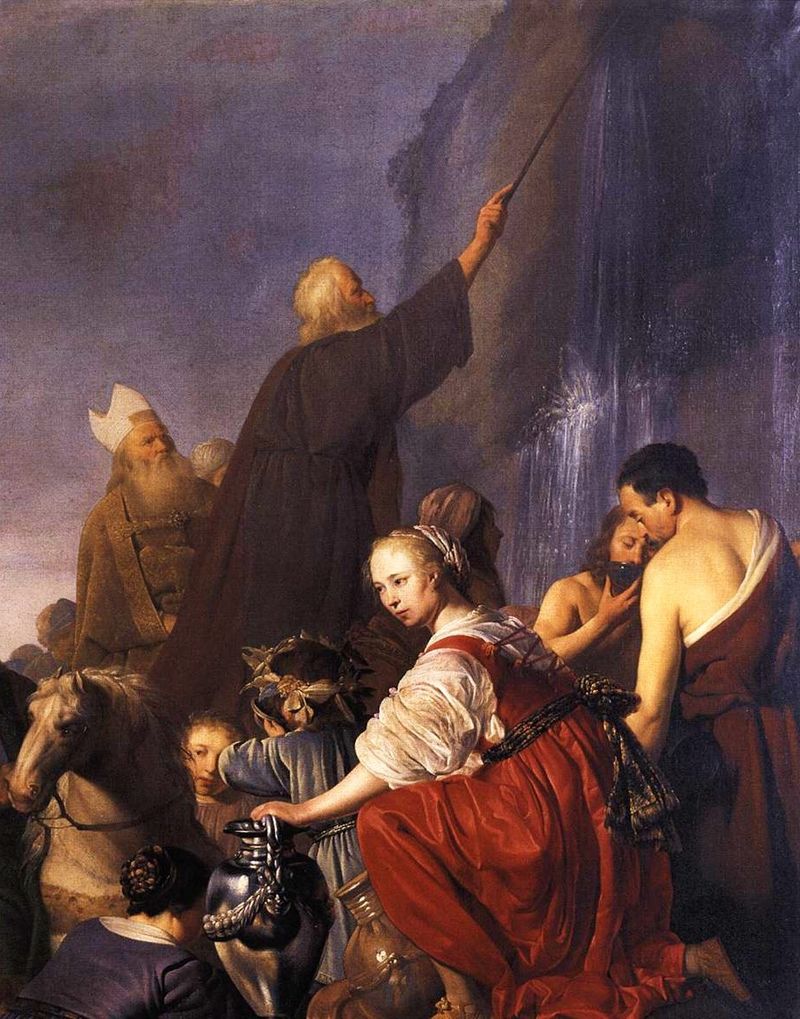
Pieter de Grebber, Moses Striking the Rock (1630)

Psalm 95

1 O come, let us sing to the LORD; let us make a joyful noise to the rock of our salvation!
2 Let us come into his presence with thanksgiving; let us make a joyful noise to him with songs of praise!
3 For the LORD is a great God, and a great King above all gods.
4 In his hand are the depths of the earth; the heights of the mountains are his also.
5 The sea is his, for he made it, and the dry land, which his hands have formed.
6 O come, let us worship and bow down, let us kneel before the LORD, our Maker!
7 For he is our God, and we are the people of his pasture, and the sheep of his hand. O that today you would listen to his voice!
8 Do not harden your hearts, as at Meribah, as on the day at Massah in the wilderness,
9 when your ancestors tested me, and put me to the proof, though they had seen my work.
10 For forty years I loathed that generation and said, “They are a people whose hearts go astray, and they do not regard my ways.”
11 Therefore in my anger I swore, “They shall not enter my rest.”

Psalm 95 is a psalm which invites the hearer to move with the faithful into a noisy and jubilant time of worship which then is silenced so that God (or a prophet or priest speaking for God) can instruct the people in obedience. The life of worship and a life of obedience are linked here as it is frequently in the psalms and prophets. God in this psalm is the great God who reigns over all gods, is the master and creator of the earth and sea, and the one to whom the faithful owe their obedience. History and the memory of the disobedience of their ancestors becomes the invitation for the current generation to respond with obedience.

The first word of this psalm is the imperative form of the Hebrew halak[1] (to walk) and it impels the people to get moving to meet God in celebration and worship. Yet, within the command to move is also an allusion to a way of walking that is in accordance with God’s commandments and within the movement of the psalm is both the uplifted voices of the worshipping faithful but also the lives of obedience which listen to the voice of God. The invitation to ‘sing’ and ‘make a joyful noise’ while familiar in English are not as strong as the Hebrew verbs which they translate.[2] This is not a timid action of worship but instead is a community in full voice shouting and singing to their God and King. The praise of God echoes the sentiment of Psalm 24, where the earth is the LORD’s and all that is in it. The worldview of the psalms assumes the pluralistic world where the surrounding nations worship other gods, but the LORD is the sovereign over both the gods of the nations and the earth itself. The faithful come in jubilant acclamation to worship, bow down, and kneel before the God who is their maker, their king, and their shepherd who provides shelter and pasture for them. The movement and the noise climax in this acclamation and prepares the people for the time of silence that they may hear the words from their God (or God’s messenger).

The second movement of the psalm begins in the second half of verse seven with the command to listen. The congregation is to move from full voice to silence and from motion to stillness. The command to listen is the Hebrew shema which is the critical verb at key points in the declaration of the law:

Now therefore, if you obey (shema) my voice and keep my covenant, you shall be my treasured possession our of all the peoples. Indeed the whole earth is mine, but you shall be for me a priestly kingdom and a holy nation. These are the words that you shall speak to the Israelites.”  Exodus 19:5-6 (immediately before consecrating the people and receiving the commandments)

Hear (shema) O Israel: The LORD is our God , the LORD alone. You shall love the LORD your God with all your heart, and with all your soul, and with all your might. Deuteronomy 6: 4-5[3]

Hearing or listening in Hebrew is not merely listening to the words but also involves living in response to the words. Lifting up praise to God in full voice without hearing and obeying God’s commands is often condemned in the psalms and prophets[4] and here the actions of the people of Israel at Meribah and Massah (Exodus 17: 1-7; Numbers 20: 1-13) are used as an example of the high cost of disobedience. The inability of their ancestors to listen is remembered as the reason for the long journey in the wilderness and the inability of the first generation that left Egypt to enter their rest in the promised land. The relationship between God and the people of Israel is a covenantal relationship which requires obedience. If the people will listen and obey then God will provide for them in the land, but if they do not hear and obey then they may end up without God’s guidance and blessing.

The two parts of the psalm, the movement and raucous noise and the obedient silence and reverential hearing, belong together. The faithful should move to the place where they can praise God in full voice in a jubilant and joyful way, but we must also remember that God desires our obedience. As Beth Tanner can state truthfully, “In worship today, God can be seen as too friendly, too nice, and too forgiving. We can easily forget the great power of the King God.” (Nancy deClaisse-Walford, 2014, p. 718) The previous psalm reminded us, “Happy are those whom you discipline, O LORD, and whom you teach out of your law,” (Psalm 94: 12). Now Psalm 95 uses the story of the people of Israel as an illustration of the dangers when the people refuse to follow God’s way of walking. The life of the faithful is one of coming (walking, halak), hearing (shema), and living in obedience to the ways of God in both jubilant worship, silent listening, and faithful living.

[1] Halak is an important word in Hebrew. Halakha which derives from halak is the collective body of the Hebrew laws (both oral and written) and it means ‘the way of walking.’ This movement at the beginning of the psalm is both the physical motion to the place of worship and the way of walking in accordance with God’s will.

[2] Ranan and rua in the intensified piel form mean to “call loudly” and “lift up a war-cry or cry of alarm.” (Nancy deClaisse-Walford, 2014, p. 716)

[3] Deuteronomy 6: 4-5 has a central place in the practice of the Jewish people and this entire command is often called the shema because of the command to ‘hear.’

[4] See for example Psalm 50, 81, Isaiah 1, and Amos 5: 21-24
Exodus 17: Water and Conflict, Faith and Sight

Pieter de Grebber, Moses Striking the Rock (1630)

Exodus 17: 1-7 Massah and Meribah-Physical Needs, Testing God and Quarreling with Moses

 From the wilderness of Sin the whole congregation of the Israelites journeyed by stages, as the LORD commanded. They camped at Rephidim, but there was no water for the people to drink. 2 The people quarreled with Moses, and said, “Give us water to drink.” Moses said to them, “Why do you quarrel with me? Why do you test the LORD?” 3 But the people thirsted there for water; and the people complained against Moses and said, “Why did you bring us out of Egypt, to kill us and our children and livestock with thirst?” 4 So Moses cried out to the LORD, “What shall I do with this people? They are almost ready to stone me.” 5 The LORD said to Moses, “Go on ahead of the people, and take some of the elders of Israel with you; take in your hand the staff with which you struck the Nile, and go. 6 I will be standing there in front of you on the rock at Horeb. Strike the rock, and water will come out of it, so that the people may drink.” Moses did so, in the sight of the elders of Israel. 7 He called the place Massah1 and Meribah,2 because the Israelites quarreled and tested the LORD, saying, “Is the LORD among us or not?”

The wilderness is a place of perpetual struggle for the people of Israel. The LORD makes life for the people possible for they journey across the wilderness to their promised home, but the wilderness is never a place they are meant to dwell in. Once the threat of Egypt’s use of force has been removed the conflicts in the past two chapters and here revolve around the very basic physical needs for sustaining life: food and water. In Exodus 15: 22-25 the crisis revolved around undrinkable water, Exodus 16 the problem was the lack of food and the LORD’s provision of manna and quail, here in Exodus 17 the first crisis is again water. The lack of a predictable water supply is one of the great challenges of the journey across the wilderness and here the lack of water creates a crisis for Moses.

Moses, in his role as the mediator of God’s words and covenant, bears the impact of the anxiety of the people. Even though the LORD has provided in the past, here in a moment of fear and crisis the faith of the people is challenged. Sitting in air conditioned houses, drinking ice water and having our fill of food it would be easy to critique their fear-but when our basic needs of food and water are threatened we probably would not respond as rationally as we want. Moses deals with a desperate people and is caught between their fear and the lack of an immediate response from God.

A part of the Exodus story is the paradox of faith and sight. For so much of the narrative of the Exodus, God demonstrates God’s strength and trustworthiness in physical and tangible ways. The people see the waters part or the manna, for example, or the pillar of fire as demonstrations of the LORD’s presence in their midst. Yet, most of life is lived in these times where, as St. Paul can state, “We walk by faith and not by sight.” (2 Corinthians 5:7) If one’s belief and trust in God is contingent upon a constant and continual demonstration of God’s miraculous provision then faith is transformed into sight. Yet, need continues to be need and the fears and anxiety of the people about surviving in the wilderness would not be assuaged by being told the need to believe when their needs are not being met. Ultimately, God is not threatened here by the people’s cries and actions—it is Moses who is threatened. God hears Moses, speaks to Moses and provides a solution to the needs that the people voice. The place of testing and quarreling (the meaning behind Massah and Meribah) ultimately becomes one more place where water is provided in the wilderness.

One could argue for many natural explanations for water coming out of the mountain, and this would still be consistent with the Exodus narrative. All throughout the signs and wonders, the parting of the Red Sea, and the provision of food and water God uses the things of the earth to provide. Often God is present in the mundane provision of food and water in natural ways. Yet, this does not take away from the reality that for Moses it is the LORD that demonstrates where he is to lead the elders and strike the rock. Yet, in the beautiful language of Isaiah, the LORD is the one who is doing a new thing: “I am about to do a new thing, do you not perceive it? I will make a way in the wilderness and rivers in the desert.” (Isaiah 43: 19) Whether it is through creation or a new act of creation, the LORD is the one for Israel who gives “water in the wilderness, rivers in the desert, to give drink to my chosen people.” (Isaiah 43: 20)

Exodus 17: 8-16 The First Battle for the New People

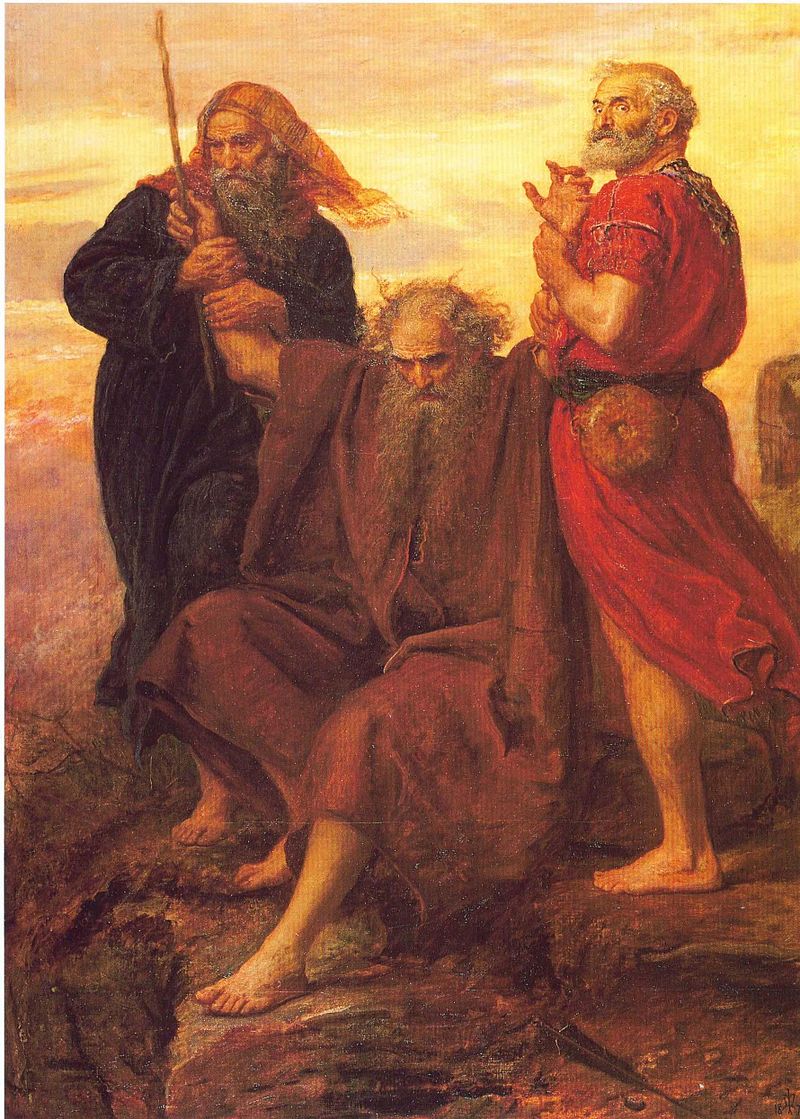
 8 Then Amalek came and fought with Israel at Rephidim. 9 Moses said to Joshua, “Choose some men for us and go out, fight with Amalek. Tomorrow I will stand on the top of the hill with the staff of God in my hand.” 10 So Joshua did as Moses told him, and fought with Amalek, while Moses, Aaron, and Hur went up to the top of the hill. 11 Whenever Moses held up his hand, Israel prevailed; and whenever he lowered his hand, Amalek prevailed. 12 But Moses’ hands grew weary; so they took a stone and put it under him, and he sat on it. Aaron and Hur held up his hands, one on one side, and the other on the other side; so his hands were steady until the sun set. 13 And Joshua defeated Amalek and his people with the sword.

 14 Then the LORD said to Moses, “Write this as a reminder in a book and recite it in the hearing of Joshua: I will utterly blot out the remembrance of Amalek from under heaven.” 15 And Moses built an altar and called it, The LORD is my banner. 16 He said, “A hand upon the banner of the LORD 1 The LORD will have war with Amalek from generation to generation.”

John Everett Millais (1829-1896), Victory O Lord!

Pharaoh’s armies may no longer challenge the people of Israel on their journey but their movement into the promised land will not be conflict free. Here for the first time the people of Israel who left Egypt company by company like an army now for the first time are challenged militarily by Amalek. Joshua enters the narrative for the first time and we see him being the military leader he will be in the book of Joshua. Yet, it is not Israel’s military might which is key factor in the battle’s outcome. Moses again is called upon as a demonstration of the LORD’s presence as the battle rages. The holding up of the staff of Moses to the LORD coincides with the battle’s turning in the people of Israel’s favor, but the people’s strength becomes tied to Moses’ strength. As Moses’ strength fails Aaron and Hur become instrumental in taking some of the burden from Moses’ already overexerted shoulders. They provide a place to sit and support under his arms so that together they can become a demonstration of the combined strength of the people reaching up for the LORD’s aid in battle.

At a simplistic level, the statement that the future of Israel does not rest solely on Moses’ shoulders, or any leader’s shoulders, is an important one. The following chapter will have Jethro giving Moses advice about properly delegating the task of leadership. Yet, Moses will continue to have a unique role among the people and the time where Moses is away from the people will be a time of temptation for Aaron and the people to turn away from God’s stated intent.

The Bible also invites us into many ethical reflections on the use of force and God’s sanctioning of warfare. This is a difficult question that I have dealt with in other places (most completely in Deuteronomy 20). Here Amalek and his descendants become the recipients of an enduring curse that calls for their obliteration. After the Holocaust, Hiroshima, the genocides in Rwanda and Bosnia and several other places throughout the 20th and beginning of the 21st century I will continue to remain uncomfortable with the designation of a people for destruction and I can admit there will be parts of the portrayal of God in the scriptures that will be difficult for me to understand or adopt. This is not the only voice in this conversation of scriptures and so perhaps as Jeremiah 18: 7-8 can state:

“At one moment I may declare concerning a nation or a kingdom, that I will pluck up and break down and destroy it, but if that nation concerning which I have spoken, turns from its evil, I will change my mind about the disaster that I intended to bring on it.”