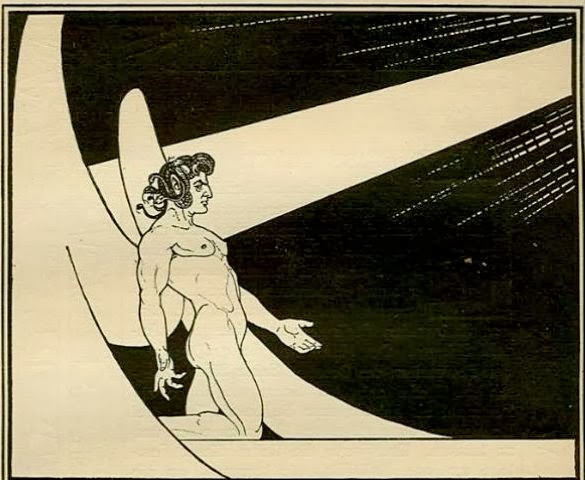
Satan Appears Before the Divine Presence, Ephraim Moses Lillen (1874-1925) Image from https://commons.wikimedia.org/wiki/Category:Book_of_Job#/media/File:Satan_appears_before_the_divine_presence.jpg
One of the difficult to reconcile portions of the prophetic witness to God is the all-encompassing view of God being responsible for all things. In the words of the prophet Isaiah:
I am the LORD, and there is no other; besides me there is no god. I arm you, though you do not know me, so that they may know, from the rising of the sun and from the west, that there is no one besides me; I am the LORD, and there is no other. I form light and create darkness, I make weal and create woe; I the LORD do all these things. Isaiah 45:5-7
Whatever is happening on the earth is directly attributable to the LORD who is not only the God of Israel but works through the movements of nations, natural disasters, the presence or absence of rain, the fruitfulness of both harvest, animals, and children. Everything for good or ill comes from God and can be attributed to either the faithfulness or unfaithfulness of the people. Yet, something shifts theologically in the post-exilic period and prior to the time of Jesus. My theory is that this shift occurs due to the experience of the faithful enduring suffering and the wicked prospering both at the individual and international level.
There seemed to be forces resisting the justice of God, forces larger than what the faithful could account for. Several solutions present themselves within Bible, one being that the ‘gods’ or ‘princes’ of the nations were resisting the forces of the God of Israel. This occurs in Daniel 10 where the ‘prince of the kingdom of Persia’ resists the divine messenger sent to respond to Daniel’s prayers for twenty-one days before the LORD dispatches Michael, ‘one of the chief princes’ to subdue this prince of the kingdom of Persia and allow the messenger to reach Daniel. Michael will later in Revelation 12 be viewed as the commander of the angel. Yet, one answer to this question of resistance to the justice of God was given by some of the faithful as being attributed to these divine protectors or princes of the nation. They were still subservient to the LORD the God of the earth, but their desires are not always aligned with the LORD.
Most people are unaware that throughout the Hebrew Scriptures there are no demons, no devil[1] and the character of Satan who only appears in Job, 1 Chronicles, and Zechariah is not the devilish opponent of God but rather acts as like a prosecuting attorney testing the people of God in God’s presence. The most famous example of this is from Job:
One day the heavenly beings came to present themselves before the LORD, and Satan also came among them. The LORD said to Satan, “Where have you come from?” Satan answered the LORD, “From going to and fro on the earth, and from walking up and down on it.” The LORD said to Satan, “Have you considered my servant Job? There is no one like him on the earth, a blameless and upright man who fears God and turns away from evil.” Then Satan answered the LORD, “Does Job fear God for nothing? Have you not put a fence around him and his house and all that he has, on every side? You have blessed the work of his hands, and his possessions have increased in the land. But stretch out your hand now, and touch all that he has, and he will curse you to your face.” Job 1: 6-11
Similarly in 1 Chronicles 21:1 Satan is responsible for convincing David to conduct his ill-conceived census and in Zechariah 3 Satan is the prosecuting attorney accusing the high priest Joshua before God. Satan is the accuser[2] and although he is responsible for deceiving David, convincing God to test the righteous Job, and accusing the high priest Joshua he is still considered one of the heavenly beings who works for God. He may be an uncomfortable character, but he is not considered evil or opposed to God.
There are others far more familiar with the intertestamental literature than I am, but one thing is clear between the conclusion of the Hebrew Scriptures and the beginning of the New Testament: the cosmology has drastically changed. The devil and demons are present and actively resist the kingdom of God, mislead the nations, and generally have an active role in the current governance of the world. Now instead of God being responsible for making weal and creating woe, now there are cosmic and demonic forces that create woe, while God is primarily resisting their activity to bring about good. There are a variety of imagery that the New Testament applies to these forces: demons, Satan, the devil in Matthew, Mark, and Luke. Sin (as an embodied and possessing forces) and Death in Paul’s letters as well as referring to cosmic rulers (particularly in Ephesians and Colossians) while these forces become embodied in the beasts and the dragon of Revelation.
Somewhere between the New Testament and the Hebrew Scriptures there evolves a view of the cosmos with entities actively opposed to God which help to explain for the prevalence of injustice and suffering in the world. It is different from the all-encompassing view of God being responsible for all things, both good and evil. The question of theodicy, of the persistence of evil in the presence of a powerful and righteous creator, becomes personified in the New Testament. Evil is concentrated in the devil and demons, Sin and Death (as entities) and the cosmic powers which are behind the nations resisting God. Revelation brings these forces into a personified conflict between the beasts of the land and sea, and the dragon which are defeated by the forces of God. The uncompromising prophetic view of God would have to view God in conflict with Godself to explain the injustice of the world, but by the New Testament there seems to be a split in the prophetic identity of God into God working for weal and these anti-God forces working to create woe.
[1] Some will argue that the serpent in the Garden of Eden is the devil, but he is never named thus in the Hebrew Scriptures.
[2] The title ha-satan in Hebrew means the Accuser.

 Sign of the Rose
