Tag Archives: Deuteronomy 28

Joel 1 The Locust as God’s Judgment on the People

Millions of swarming Australian plague locusts on the move By CSIRO, CC BY 3.0, https://commons.wikimedia.org/w/index.php?curid=35486123

Joel 1

1 The word of the LORD that came to Joel son of Pethuel:
2 Hear this, O elders, give ear, all inhabitants of the land! Has such a thing happened in your days, or in the days of your ancestors?
3 Tell your children of it, and let your children tell their children, and their children another generation.
4 What the cutting locust left, the swarming locust has eaten. What the swarming locust left, the hopping locust has eaten, and what the hopping locust left, the destroying locust has eaten.
5 Wake up, you drunkards, and weep; and wail, all you wine-drinkers, over the sweet wine, for it is cut off from your mouth.
6 For a nation has invaded my land, powerful and innumerable; its teeth are lions’ teeth, and it has the fangs of a lioness.
7 It has laid waste my vines, and splintered my fig trees; it has stripped off their bark and thrown it down; their branches have turned white.
8 Lament like a virgin dressed in sackcloth for the husband of her youth.
9 The grain offering and the drink offering are cut off from the house of the LORD. The priests mourn, the ministers of the LORD.
10 The fields are devastated, the ground mourns; for the grain is destroyed, the wine dries up, the oil fails.
11 Be dismayed, you farmers, wail, you vinedressers, over the wheat and the barley; for the crops of the field are ruined.
12 The vine withers, the fig tree droops. Pomegranate, palm, and apple — all the trees of the field are dried up; surely, joy withers away among the people.
13 Put on sackcloth and lament, you priests; wail, you ministers of the altar. Come, pass the night in sackcloth, you ministers of my God! Grain offering and drink offering are withheld from the house of your God.
14 Sanctify a fast, call a solemn assembly. Gather the elders and all the inhabitants of the land to the house of the LORD your God, and cry out to the LORD.
15 Alas for the day! For the day of the LORD is near, and as destruction from the Almighty it comes.
16 Is not the food cut off before our eyes, joy and gladness from the house of our God?
17 The seed shrivels under the clods, the storehouses are desolate; the granaries are ruined because the grain has failed.
18 How the animals groan! The herds of cattle wander about because there is no pasture for them; even the flocks of sheep are dazed.
19 To you, O LORD, I cry. For fire has devoured the pastures of the wilderness, and flames have burned all the trees of the field.
20 Even the wild animals cry to you because the watercourses are dried up, and fire has devoured the pastures of the wilderness.

The prophet Joel looks at the environmental disaster that threatens the people, the animals, and the land itself through the word that he receives from the LORD the God of Israel. The destruction of the locusts and the drought have brought life in Israel to a critical point and Joel calls upon the priests to lead the people in the actions that demonstrate to the LORD the people’s desire to repent and restore the relationship with God. Even though Joel never indicates what actions the people need to repent from he sounds a clarion call to awake from their slumber and realize that the only hope that the people has is to remember their covenant with God, to show that they intend to be obedient, and pray for God to restore their fortunes. Joel’s shrill cry to the people points the way to a future beyond the judgment of God.

The book of Joel begins with the declaration that the word of the LORD came to Joel. This is a formula that is common in the prophets, but unlike many of the major and minor prophets there are no details in this introduction to locate the prophet in the time of a king or a major event. The only information we have on Joel is the name of his father (a name not used elsewhere in scriptures). The name Joel is common in genealogies, and it means ‘YHWH is God.’ It is the same components of Elijah’s name in reverse order. Scholars best guess to the context for Joel is the mid to late Persian empire before 343 BCE, but as mentioned in Transitioning to the Prophet Joel this educated guess is based upon clues throughout the short book.

The first recorded word of the prophet Joel is “hear” (Hebrew shemah) which immediately calls the attentive ear to Deuteronomy where the people of Israel are called to “hear.” The central commandment for the Jewish way of life comes from Deuteronomy 6: 4-5:

Hear, O Israel: The LORD is our God, the LORD alone. You shall love the LORD your God with all your heart, with all your soul, and with all your might.

Deuteronomy articulates a way of life centered around obedience to the commandments of God. It concludes with blessings if the people live wisely in accordance with the commandments of God and curses if they foolishly abandon the way of their God. As James D. Nogalski points out, many of the same elements in these curses articulated in Deuteronomy 28:15-68 are being experienced in this initial chapter of Joel: heat and drought (22-24), attack by locusts (28, 38, 42), devastated vineyards and olive groves (39-40) and the loss of both the harvest of trees and the fields (42). (Nogalski, 2023, p. 86) Joel is a writer who has access to the scriptures, which becomes apparent by his use of imagery found throughout scripture, and it is not surprising that his insight is framed in the language of Deuteronomy. Yet, Joel’s hope is also framed in the language of Deuteronomy:

When all these things have happened to you, the blessings and the curses that I have set before you, if you call them to mind among all the nations where the LORD your God has driven you, and return to the LORD your God, and you and your children obey him with all your heart and with all your soul, just as I am commanding you today, then the LORD your God will restore your fortunes and have compassion on you…and the LORD your God will make you abundantly prosperous in all your undertakings, in the fruit of your body, in the fruit of your livestock, and in the fruit of your soil. For the LORD your God will again take delight in prospering you, just as he delighted in prospering your ancestors. (Deuteronomy 30: 1-3, 9)

In calling the inhabitants of the land to hear, Joel wants them to understand that the environmental catastrophe they are enduring is a work of God to call them back to obedience. Joel is reminding the people how to interpret their lives theologically and calling them to repentance so that this judgment of God may be reversed, and they may experience prosperity again.

Viewing an infestation of locusts, drought, and wildfire through the lens of a punishment of God may seem like an alien concept to most who live in the modern world of weather forecasts, insecticides, and scientific explanations. People who proclaim natural disasters like hurricanes, tornados, droughts, or wildfires as a judgment of God are often viewed in our world as people disconnected from modern society. They are crazy or delusional or they are pushing a judgmental view of God to maintain power over their followers. Joel may have been looked on as a voice out of tune with the rest of society even two millennia in the past. Prophets have rarely been welcomed in their time, and it would be easy to dismiss Joel’s correlation between these disasters and God, but the reality of this short book being included in our scriptures encourages us to slow down and reconsider our world in a different framework than we are used to employing.

Joel asks the elders among his hearers to look to their experience and the experience of their ancestors and see if they can find something comparable in their memory or the stories of their parents and grandparents. The word elders may refer to the leaders of the people, but it may be simply asking the elderly among the people to look back upon the longer span of their lives and look back into the past as far as their memories and stories will allow. Joel wants them to examine and discover that what is happening to their land in the present is not normal, it is like the onslaught of locusts Egypt experienced in the Exodus (Exodus 10: 1-20). This event is to be remembered by them and the future generations so they may return to the ways of God, and their descendants may not encounter these life-threatening conditions.

Most of the people reading this reflection are probably not connected to the land and the annual cycle of preparing, planting, growing, and harvesting that life depends upon. In a drought the prices may increase at the grocery store and municipalities may limit the amount of water to be utilized on landscaping, but life continues without interruption. Some have looked at Joel and thought the situation of the people of Joel’s time was not worth comparing to the military invasions that other prophets dealt with, but that would misunderstand the threat to life. Four different words[1] are used for locusts, and Joel 2:25 indicates that this invasion of locusts may have continued for years. If it was a single lost harvest people may rely on reserves of seed and food from previous years. There is no hardware store or nursery where the people can go to purchase new seeds, they rely on the previous year’s harvest for what will be planted. Not only is one harvest ruined. This crisis places the cycle of production itself at risk. Often the invasion of armies has used the metaphor of locust who eat everything to denote their destructiveness, now in Joel the metaphor is reversed: the invading army is the locusts.

Joel calls the people to wake from their stupor and realize the perilous situation they are in and the hope that their rituals can offer. Not only the wheat and barley have suffered from this invasion of locusts, but the vines and trees are also dying. The wine of the vineyard has been cut off and the vines are laid waste. Even more catastrophic than the devastation of the vineyards is the locusts eating the bark off the trees.  Trees without bark will die, it may be a slow death, but even if the bark of a tree is removed in a ring (a process called girdling) the tree cannot endure. The white branches on the trees are probably mildew or signs of disease.

For Joel the proper response is lament and grief. Public grief for a broken relationship like a virgin mourning the loss of a husband that was promised. Not only the people involved in the activity of planting and harvesting are to mourn but the priests are to mourn as well. No food among the people means no sacrifices to bring to the altar and the priests are suffering along with the people. Without the offerings the priests have no way to feed themselves and their families. Unlike Amos or Isaiah[2] who are critical of the actions of sacrificing and piety, Joel is calling the priests to lead the people in these actions which demonstrate their repentance. Wearing sackcloth both during the day and at night, fasting, lamenting, wailing, calling a solemn assembly, and crying out to God are all appropriate actions in the face of this disaster.

Their broken relationship with God is a problem for the people, but also for the creation. The animals also cry out to God, both the wild animals and the domestic, in the absence of food and water. The pastures of the wilderness, the grazing land for cattle, have been destroyed by wildfire caused by the drought. Even the sheep, which are able to subsist in rockier terrain and are able to eat a more varied diet, are struggling in the decimated land. The animals know who to cry out to, but the people of the land need to prophet to awaken them and help them realize how to respond.

[1] Four is a common pattern in judgments, possible referencing the four corners of the earth or the four winds. See for example Jeremiah 15:3, Ezekiel 14: 21, Daniel 7 and 8, Zechariah 1: 18 and 6:1 and of course the four horsemen of Revelation 6: 1-8.

[2] Amos 5:21, Isaiah 1:13
Deuteronomy 28 Blessings and Curses

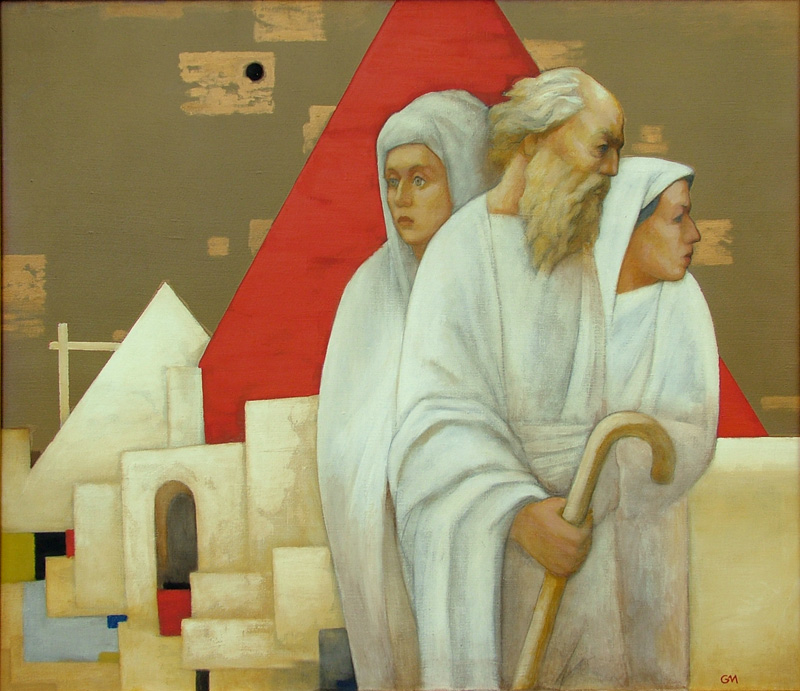
Grigory Mekheev, Exodus (2000) artist shared work under Creative Commons Attribution-Share Alike 3.0

Grigory Mekheev, Exodus (2000) artist shared work under Creative Commons Attribution-Share Alike 3.0

Deuteronomy 28: 1-14 Blessings for Obedience

1 If you will only obey the LORD your God, by diligently observing all his commandments that I am commanding you today, the LORD your God will set you high above all the nations of the earth; 2 all these blessings shall come upon you and overtake you, if you obey the LORD your God:
 3 Blessed shall you be in the city, and blessed shall you be in the field.
 4 Blessed shall be the fruit of your womb, the fruit of your ground, and the fruit of your livestock, both the increase of your cattle and the issue of your flock.
 5 Blessed shall be your basket and your kneading bowl.
 6 Blessed shall you be when you come in, and blessed shall you be when you go out.
 7 The LORD will cause your enemies who rise against you to be defeated before you; they shall come out against you one way, and flee before you seven ways. 8 The LORD will command the blessing upon you in your barns, and in all that you undertake; he will bless you in the land that the LORD your God is giving you. 9 The LORD will establish you as his holy people, as he has sworn to you, if you keep the commandments of the LORD your God and walk in his ways. 10 All the peoples of the earth shall see that you are called by the name of the LORD, and they shall be afraid of you. 11 The LORD will make you abound in prosperity, in the fruit of your womb, in the fruit of your livestock, and in the fruit of your ground in the land that the LORD swore to your ancestors to give you. 12 The LORD will open for you his rich storehouse, the heavens, to give the rain of your land in its season and to bless all your undertakings. You will lend to many nations, but you will not borrow. 13 The LORD will make you the head, and not the tail; you shall be only at the top, and not at the bottom– if you obey the commandments of the LORD your God, which I am commanding you today, by diligently observing them, 14 and if you do not turn aside from any of the words that I am commanding you today, either to the right or to the left, following other gods to serve them.
 
Deuteronomy closes this section with a series of blessings and curses. The previous chapter gives instructions for Simeon, Levi, Judah, Issachar, Joseph and Benjamin to stand on Mount Gerazim to proclaim the blessings. Although the ancient world had a much stronger view of blessings and curses than we do in our culture they are not quite these magic words that linger in the air and take on a power to bless or smite, rather they are a continual reminder of the contingent nature of the blessings that the LORD has promised. Israel does not have a true freedom in the sense of being able to choose its own destiny but it does, according to Deuteronomy, have a choice of which destiny it will live into. The reward for covenant obedience is that they will be materially blessed in this life, their harvests will be good, their flocks and herds will grow, they will have children and good health.

In an American context it would be easy to misread Deuteronomy as some sort of prosperity gospel for individuals, but this would be to miss much of what Deuteronomy is saying. Yes, in the author of Deuteronomy’s view the people (as a community) will be blessed if they are obedient. That obedience involves a harsh set of justice requirements and the continual care for the oppressed in their midst. It involves an acknowledgment that their blessings come from the LORD their God who brought them out of the Egypt and to this land of milk and honey. It is a way of thinking that is simple, and one that other books of the bible do challenge (for example in the book of Job which revolves around the righteous sufferer and in Matthew, Mark and Luke where prosperity is viewed with suspicion) yet it is a perspective that helps many people make sense of their lives, and probably helped the people Deuteronomy is written to initially make sense of their lives.

The people will often fail to diligently observe all the commandments and the much larger portion of this chapter is dedicated to the consequences for disobedience. Perhaps as we approach the following fifty three verses of curses, which seem oppressive and distasteful in our time, we can suspend our judgment and wonder about the experiences of the people who would hear these words.


Deuteronomy 28: 15-68 Curses for Disobedience

      15 But if you will not obey the LORD your God by diligently observing all his commandments and decrees, which I am commanding you today, then all these curses shall come upon you and overtake you:
 16 Cursed shall you be in the city, and cursed shall you be in the field.
 17 Cursed shall be your basket and your kneading bowl.
 18 Cursed shall be the fruit of your womb, the fruit of your ground, the increase of your cattle and the issue of your flock.
 19 Cursed shall you be when you come in, and cursed shall you be when you go out.
       20 The LORD will send upon you disaster, panic, and frustration in everything you attempt to do, until you are destroyed and perish quickly, on account of the evil of your deeds, because you have forsaken me. 21 The LORD will make the pestilence cling to you until it has consumed you off the land that you are entering to possess. 22 The LORD will afflict you with consumption, fever, inflammation, with fiery heat and drought, and with blight and mildew; they shall pursue you until you perish. 23 The sky over your head shall be bronze, and the earth under you iron. 24 The LORD will change the rain of your land into powder, and only dust shall come down upon you from the sky until you are destroyed.
      25 The LORD will cause you to be defeated before your enemies; you shall go out against them one way and flee before them seven ways. You shall become an object of horror to all the kingdoms of the earth. 26 Your corpses shall be food for every bird of the air and animal of the earth, and there shall be no one to frighten them away. 27 The LORD will afflict you with the boils of Egypt, with ulcers, scurvy, and itch, of which you cannot be healed. 28 The LORD will afflict you with madness, blindness, and confusion of mind; 29 you shall grope about at noon as blind people grope in darkness, but you shall be unable to find your way; and you shall be continually abused and robbed, without anyone to help. 30 You shall become engaged to a woman, but another man shall lie with her. You shall build a house, but not live in it. You shall plant a vineyard, but not enjoy its fruit. 31 Your ox shall be butchered before your eyes, but you shall not eat of it. Your donkey shall be stolen in front of you, and shall not be restored to you. Your sheep shall be given to your enemies, without anyone to help you. 32 Your sons and daughters shall be given to another people, while you look on; you will strain your eyes looking for them all day but be powerless to do anything. 33 A people whom you do not know shall eat up the fruit of your ground and of all your labors; you shall be continually abused and crushed, 34 and driven mad by the sight that your eyes shall see. 35 The LORD will strike you on the knees and on the legs with grievous boils of which you cannot be healed, from the sole of your foot to the crown of your head. 36 The LORD will bring you, and the king whom you set over you, to a nation that neither you nor your ancestors have known, where you shall serve other gods, of wood and stone. 37 You shall become an object of horror, a proverb, and a byword among all the peoples where the LORD will lead you.
 38 You shall carry much seed into the field but shall gather little in, for the locust shall consume it. 39 You shall plant vineyards and dress them, but you shall neither drink the wine nor gather the grapes, for the worm shall eat them. 40 You shall have olive trees throughout all your territory, but you shall not anoint yourself with the oil, for your olives shall drop off. 41 You shall have sons and daughters, but they shall not remain yours, for they shall go into captivity. 42 All your trees and the fruit of your ground the cicada shall take over. 43 Aliens residing among you shall ascend above you higher and higher, while you shall descend lower and lower. 44 They shall lend to you but you shall not lend to them; they shall be the head and you shall be the tail.
      45 All these curses shall come upon you, pursuing and overtaking you until you are destroyed, because you did not obey the LORD your God, by observing the commandments and the decrees that he commanded you. 46 They shall be among you and your descendants as a sign and a portent forever. 47 Because you did not serve the LORD your God joyfully and with gladness of heart for the abundance of everything, 48 therefore you shall serve your enemies whom the LORD will send against you, in hunger and thirst, in nakedness and lack of everything. He will put an iron yoke on your neck until he has destroyed you. 49 The LORD will bring a nation from far away, from the end of the earth, to swoop down on you like an eagle, a nation whose language you do not understand, 50 a grim-faced nation showing no respect to the old or favor to the young. 51 It shall consume the fruit of your livestock and the fruit of your ground until you are destroyed, leaving you neither grain, wine, and oil, nor the increase of your cattle and the issue of your flock, until it has made you perish. 52 It shall besiege you in all your towns until your high and fortified walls, in which you trusted, come down throughout your land; it shall besiege you in all your towns throughout the land that the LORD your God has given you. 53 In the desperate straits to which the enemy siege reduces you, you will eat the fruit of your womb, the flesh of your own sons and daughters whom the LORD your God has given you. 54 Even the most refined and gentle of men among you will begrudge food to his own brother, to the wife whom he embraces, and to the last of his remaining children, 55 giving to none of them any of the flesh of his children whom he is eating, because nothing else remains to him, in the desperate straits to which the enemy siege will reduce you in all your towns. 56 She who is the most refined and gentle among you, so gentle and refined that she does not venture to set the sole of her foot on the ground, will begrudge food to the husband whom she embraces, to her own son, and to her own daughter, 57 begrudging even the afterbirth that comes out from between her thighs, and the children that she bears, because she is eating them in secret for lack of anything else, in the desperate straits to which the enemy siege will reduce you in your towns.
      58 If you do not diligently observe all the words of this law that are written in this book, fearing this glorious and awesome name, the LORD your God, 59 then the LORD will overwhelm both you and your offspring with severe and lasting afflictions and grievous and lasting maladies. 60 He will bring back upon you all the diseases of Egypt, of which you were in dread, and they shall cling to you. 61 Every other malady and affliction, even though not recorded in the book of this law, the LORD will inflict on you until you are destroyed. 62 Although once you were as numerous as the stars in heaven, you shall be left few in number, because you did not obey the LORD your God. 63 And just as the LORD took delight in making you prosperous and numerous, so the LORD will take delight in bringing you to ruin and destruction; you shall be plucked off the land that you are entering to possess. 64 The LORD will scatter you among all peoples, from one end of the earth to the other; and there you shall serve other gods, of wood and stone, which neither you nor your ancestors have known. 65 Among those nations you shall find no ease, no resting place for the sole of your foot. There the LORD will give you a trembling heart, failing eyes, and a languishing spirit. 66 Your life shall hang in doubt before you; night and day you shall be in dread, with no assurance of your life. 67 In the morning you shall say, “If only it were evening!” and at evening you shall say, “If only it were morning!”– because of the dread that your heart shall feel and the sights that your eyes shall see. 68 The LORD will bring you back in ships to Egypt, by a route that I promised you would never see again; and there you shall offer yourselves for sale to your enemies as male and female slaves, but there will be no buyer.

One of my practices as I write these reflections is to physically write out the text. I have done this for Haggai, Esther, Jeremiah, Psalms 1-10 and now most of the way through Deuteronomy. This is a challenging text to listen to as you write it, but it is not the first time I have approached a text like this. What the text reminded me of was the end of Jeremiah, particularly Jeremiah 46-51 where the curses are uttered towards all the nations around Judah. Even though it is unusual in our time to think about dedicating this much energy to a ‘hex’ or ‘curse’ it is not unusual in the ancient world: both in Israel and in the cultures around them. Many ancient texts end with a long set of curses for failing to observe the commands or view of the text, but Deuteronomy does not end here. While this is the closing of this central portion of Deuteronomy that deals with the law, in the narrative of Deuteronomy Moses is still going to renew the covenant one more time, promise them that even in the midst of the curses that there is still an option to return to the LORD, a challenge to choose the way of blessing and life, the setting up Joshua as a successor and establishing practices for reminding the people of this law, Moses’ song and Moses’ final blessing. Yet, there is no avoiding the discomfort that a passage like this causes modern people.

I am amazed at the ways I have seen people misuse this text, for example the text in verses 56 and 57 (which is very reminiscent of Jeremiah) which talks about parents eating their own children within the context of a land under siege I have seen it twisted by a person trying to discredit the bible to God commanding parents to eat their children (which never happens). I can understand why people would misread these curses, but let’s take a little time to try to understand what is going on here. The great fear of the author of Deuteronomy is that the people when they enter the promised land will forget the covenant and turn aside to worship other gods. If they do this they lose their identity as being Israel, and with that they lose the land, their prosperity, and everything else. If scholars are correct that Deuteronomy, like many other books, reach their final form during the Babylonian exile then this portion in verses 47-57 makes a lot of sense. It does not parallel any of the blessings but does reflect the experience of the siege of Jerusalem and the departure into exile. As harsh as this language is, it may reflect the process of meaning making that is a part of the recovery from trauma. In her well written book interpreting the book of Jeremiah from the perspective of trauma and recovery Kathleen O’Connor can write about the rhetoric of responsibility and survival by saying:

If the world is ever to be trustworthy, victims need interpretation. For their lives to rest on the most minimal order, they must have meaning, interpretation, explanation, even if the explanation is ephemeral, inadequate, partial or outright wrong. Explanation puts order back in the world…. He (Jeremiah) claims without qualification that God is still in charge of the world; God controls events and governs justly. But perhaps even more important and surprising, when he places responsibility upon the people, he gives people a sense of control. (O’Connor, 2011, p. 43f.)

Amazingly in these curses, perhaps in a period where the world seems out of control, the people of Israel and Judah can find a sense of control and things they can do to return to their former state. The answer may be incomplete or there may be times where it doesn’t adequately address the complexity of the situation. Yet, in a time of a crisis of belief and life where the people are seeking an answer the simple answer is often the one that people cling to. In an option where they could either say their God is powerless or that they themselves were under judgment it was an easier option, at least for those who would become the remnant, to claim that they were the party that failed the covenant. This reflection is not likely to convince the person who does not have God as a central part of their life but to those who consider themselves the faithful they may find great comfort in it.

As I mentioned above, the great fear voiced throughout Deuteronomy is that the people will forget the covenant in their prosperity. They will begin to trust in their own work or in the practice of the nations around them. The narrative that follows beginning in Joshua and running through 2 Kings bears out this fear. If Deuteronomy does have its origins in a speech of Moses, then it is conceivable that this fear of what would happen after his death could be a pressing anxiety for Moses on behalf of this people. Wherever Deuteronomy emerges from in time and history, the form we have it now does spend a lot of energy on these curses in a way that encourages the people to remain faithful. Also remember this is more of an aural document (written for the ear) than a textual one. Even though it is recorded it was to be read to the people and then repeated emphasis on the consequences are probably intended to encourage one more time obedience.

The book of Deuteronomy does have a very binary manner of looking at the world. There is either Mount Ebal, the mountain of curses, or Mount Gerazim, the mountain of blessings. Reality is probably closer to the valley between the two. Even though God is portrayed harshly in Deuteronomy, and other places as well, this wrath of God is never the primary thing. Even though this chapter is dominated by curses for disobedience, the continuing unfolding of this narrative will show how often God attempts to get the people to turn away from the practices that are leading them to destruction. God will be the heartbroken one often in the story going forward, and yet a God who does not judge is an apathetic god, not the passionate God of the Bible. Yet, just as these curses are not the end of Deuteronomy, nor are the experiences of destruction and loss the end of God’s calling for the people. As the final chapters will make clear there is always the possibility for the people’s return and the LORD’s forgiveness.